
Memories Matter
Featured blog Posts


READ THE LATEST POSTS

“Billee’s ‘Famous’ Foods”
Gramma Billee kept a jar for bacon drippings on her stove; she used it liberally and kept it full. She knew everyone’s favorite foods and provided them—often.
Gramma Billee kept a jar for bacon drippings on her stove; she used it liberally and kept it full. But one of the most important ingredients she cooked with was intention: She knew everyone’s favorite foods and provided them. Often. Decades later, her granddaughter shares remembrance and recipes so that Billee’s descendants may nourish their own families with her “famous” foods.
As I have written about before, tastes conjure memories in a most primal way, and can transport us right back to our childhood kitchens. As such, they are excellent jumping-off points for writing or talking about your memories and crafting them into a story for generations to come (not to mention, the kids will be thrilled to have those cherished recipes actually written down).
In this latest contribution in our series, A Taste of the Past, we are treated to one family’s “famous” foods, as skillfully and lovingly prepared by Gramma Billee—and now, her descendants.
A Taste of the Past
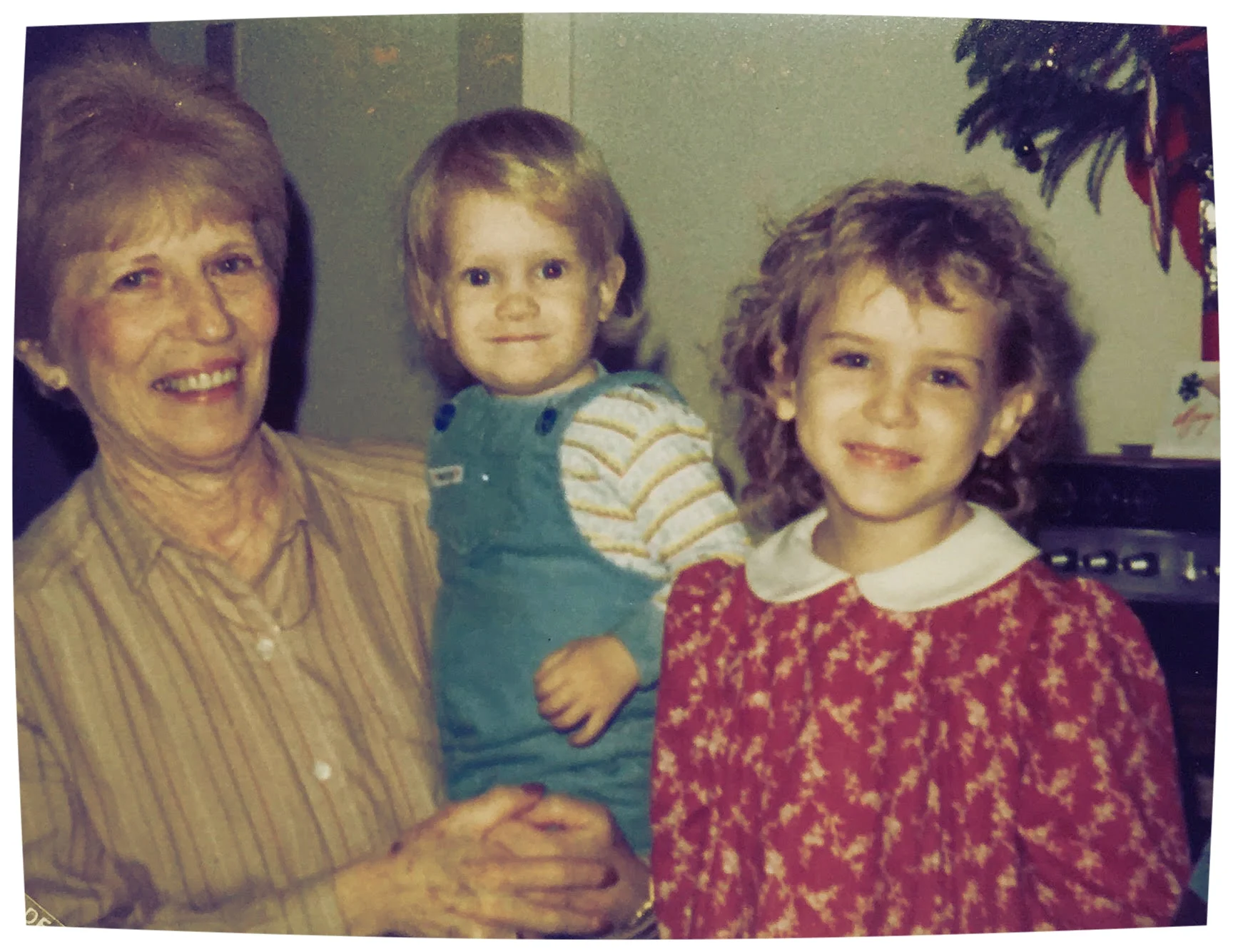
Gramma Billee, the writer's baby brother, and the writer as a little girl, 1982
Billee’s “Famous” Foods
By Melissa Finlay
I visited my grandmother Billee in person for the last time when she was 90 years old. I spent several days interviewing her, recording her memories and anything else she wanted to leave for posterity. She told me plenty of stories about her life and details about our ancestry, but she most wanted me to record her recipes, to pass her food legacy on to her grandchildren and great-grandchildren. Her recipes were close to her heart, full of memories of friends and family, and preciously held knowledge of who loved which food the most.
Stories of struggle, and hope
While I recorded her recipes, I was the fortunate recipient of my grandmother’s stories, as each dish sparked memories anew.
Billee’s dishes were famous among everyone who knew her. Her recipes came to be referred to as “Billee’s Famous Enchiladas,” “Billee’s Famous Cherry Pie,” “Billee’s Famous Hummingbird Cake,” even “Billee’s Famous Hot Cocoa.” Not that her dishes were necessarily original—she liked to collect recipes from newspapers, magazines, and friends—it’s just that she made them so well, and shared them so generously. She cooked for family get-togethers. She brought overflowing platters to church potlucks and work parties (I think they may have held extra work parties to score more of her foods!). Billee knew everyone’s food favorites, and provided them.
Her life wasn’t always full of ample food, though. During the Great Depression, Billee’s father struggled to find work and her mother suffered from serious health problems. Billee’s maternal grandparents stepped in to help the family get through these lean years.
Billee recalled walking with her younger sister to their grandparents’ corner grocery store each morning on the way to school. Her grandmother gave them each a “store lunch” to take with them. After school, Billee returned to the store to work for a few hours to repay her grandparents’ generosity.
Billee’s own young family moved from Oklahoma City, Oklahoma, to Lake Jackson, Texas, on the Gulf of Mexico, in the mid-1950s. Here she learned how to cook with seafood, not as a premium ingredient but as an affordable protein to feed her growing children. When Billee was widowed at 47, she struggled financially while training to enter the workforce. She did her best to nourish herself and her youngest son during this difficult time.
A granddaughter’s perspective
By the time I came on the scene, Gramma Billee had a steady career and an active social life. She was constantly in the kitchen. As I watched her cook, I asked her plenty of questions. She answered every one, but never invited me to pitch in; she did the gourmet cooking and baking herself. She was the master! Cinnamon rolls filled with pecans and raisins. Shrimp quiche. Stuffed mushrooms. Tender brisket. Squash casserole. Molasses cookies. Pie, pie, and more pie.
When I was a child, her dishes always seemed luxurious to me—indulgent even. She used copious amounts of seafood, avocados, cream, pecans, butter, and shortening, ingredients not commonly used at my home. Billee kept a jar for bacon drippings on her stove; she used it liberally and kept it full. Dessert was a standard course on her menus. Yet, for all her decadent cooking, she always watched her own portions and remained slender throughout her life.
Gramma Billee introduced me to many new southern foods. I knew if Gramma made it, it would be delicious, so I tried every strange new thing she offered me. I loved so many! Billee made the only liver and venison I would ever eat, the texture and flavor superb with bacon and onions. Shrimp Victoria became a favorite with tender, succulent shrimp swimming in a rich sour cream gravy. Gramma knew it was my favorite, and made it for me often. I enjoyed the crunchy, salty bites of her fried okra. I can still recall the smells of apricot fried pies bubbling in the cast iron skillet. Nothing, however, could tempt my sweet tooth more than Billee's sweet-tart cherry pie.
I have begun to record the recipes for many of grandmother Billee’s “famous” offerings, transcribing her hand-written (often butter-stained) notes for other members of the extended family. So that her grandchildren and great-grandchildren can choose a favorite dish. So they can make it often and think of her. So her nourishing legacy can live on.
Recipes from Billee’s repertoire
I will start by sharing my favorite dishes that she made “just for me” every time I visited. These dishes still bring me the comfort of being with my gramma every time I eat them.
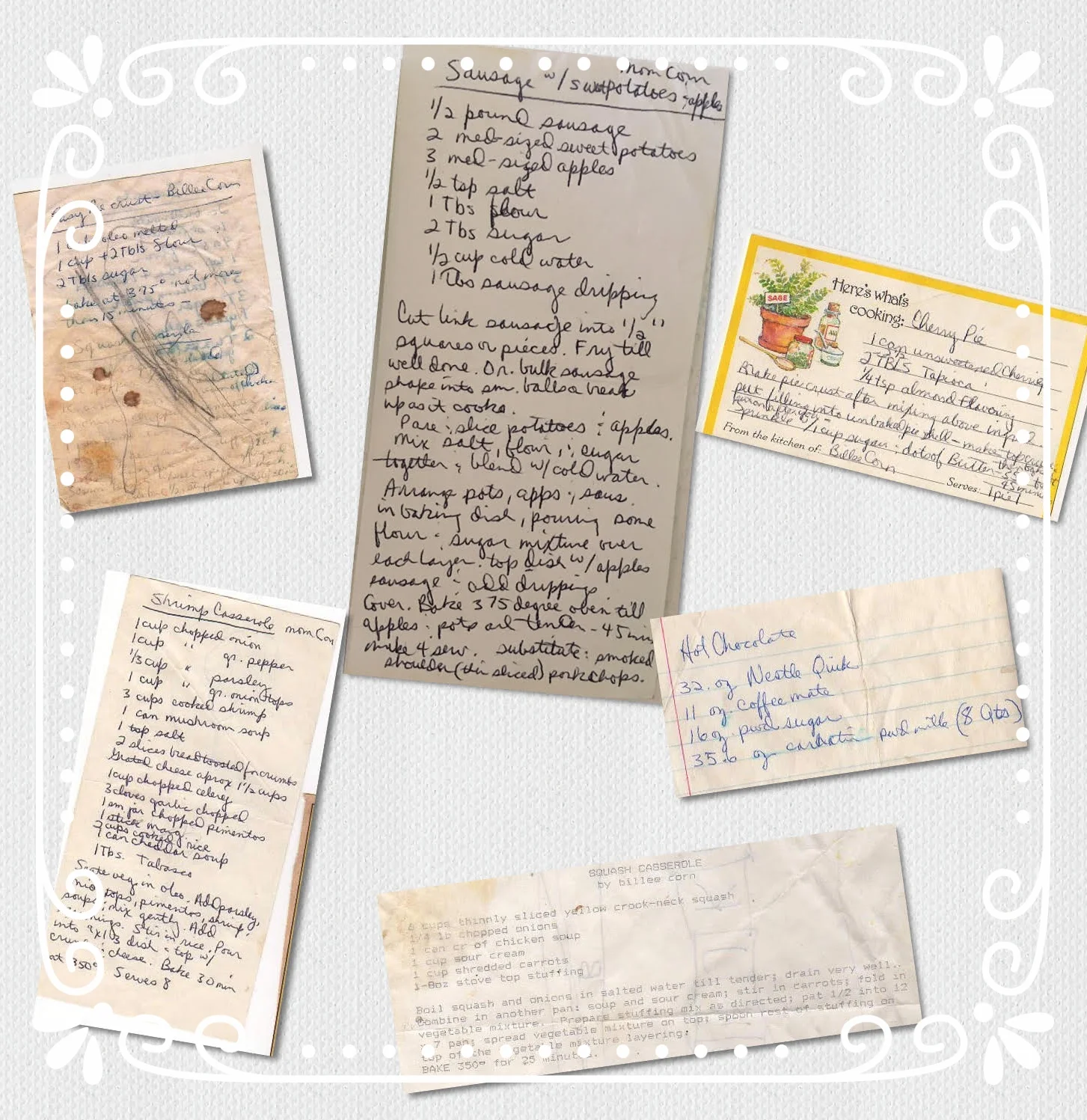
An array of Billee’s handwritten recipes—well-loved and well-used, all!
Shrimp Victoria
1 pound shrimp, peeled and de-veined
½ pound mushrooms, cleaned and sliced
1 onion, diced
2 cloves garlic, minced
½ cube of real butter
1 tub of sour cream
Salt, to taste
Red pepper, to taste
Sauté onion and garlic in butter until softened. Add mushrooms and spices and sauté until soft. Add shrimp and sauté until just pink. Take off the heat and stir in half the sour cream. When dished up over a hot bed of rice or egg noodles, top with a dollop of sour cream. Serve with a salad and a nice loaf of French bread.
Orange-Avocado Salad
1 medium head lettuce, torn, about 6 cups
1 small cucumber, thinly sliced
1 avocado, peeled and sliced
One 11-oz. can mandarin oranges
2 tablespoons sliced green onions
In large salad bowl, combine lettuce, cucumber, avocado, oranges, and onion. Just before serving, pour on dressing and toss.
For dressing:
½ teaspoon grated orange peel
¼ cup orange juice
½ cup salad oil
2 tablespoons sugar
2 tablespoons red wine vinegar
1 tablespoons lemon juice
¼ teaspoon salt
Combine all ingredients in screw-top jar. Cover tightly and shake well.
Cherry Pie
1 can unsweetened cherries
2 tablespoons tapioca
¼ teaspoon almond extract
Mix above ingredients and let rest while making pie crust.
For easy pie crust (makes two crusts, top and bottom):
1 cube oleo, melted (Gramma’s name for shortening)
1 cup + 2 tablespoons flour
2 tablespoons sugar
Mix ingredients until they form a soft ball. Roll, and form half in pie plate.
Pour cherry filling into unbaked pie shell. Sprinkle filling with 1 cup sugar, generous dots of butter. Place top crust over filling. Bake at 350 degrees for 45 minutes.
Melissa Finlay is an avid genealogist, a garden guru, a homeschooler, mama to 7, and wife to the love of her happily-ever-after. She and her husband recently created an app, Little Family Tree, to introduce children to their family history.

“Mom’s Spaghetti and Meatballs”
Red sauce ran in her grandmother's blood, and every family member would one day memorize her beloved recipe. Peek into a family kitchen, and a mother's heart.
Red sauce may have run in her grandmother's blood, but every member of the family would come to know the recipe by heart (even if the size of a "pinch" of this and a "dash" of that differed depending on who was making it)...
Smells—in this case, of garlic and oregano—and tastes conjure memories in a most primal way, and can transport us right back to our childhood kitchens. As such, they are excellent jumping-off points for writing or talking about your memories and crafting them into a story for generations to come (not to mention, the kids will be thrilled to have those cherished recipes actually written down).
In this second contribution in our series, A Taste of the Past, a family passes down the secrets to their own version of spaghetti and meatballs, never writing down a recipe, but always cooking with love and remembrance. Join me in raising a glass (red wine, of course) in honor of Kaitlin Ahern's shared food memory. Cin cin!
A Taste of the Past

The family behind the red sauce: the writer’s mom, Darice, in her mid-twenties, with her parents, Martin and Veronica Smith. Circa 1975
Mom's Spaghetti & Meatballs
By Kaitlin Ahern
I have few memories from childhood more vivid than watching my mother cook dinner. The sight of her standing at the stove in our small kitchen, wooden spoon in one hand and glass of wine in the other, creating a meal for our family of four, is easier to conjure than what I had for breakfast yesterday. And although she passed away when I was barely 17, I’m lucky enough to know many of her recipes by heart.
Mom was the dinner-maker in our household, a task she loved or lamented, usually depending on how stressful the workday had been. She was happiest to cook on weekends, when the hustle of work, sports practice, and homework died down and she could take her time with a meal. That’s when she’d make spaghetti and meatballs—a staple she made so often that she could have made it in her sleep; now I can, too.
I think she loved that meal so much because the two key ingredients tied back to her roots. It all started, of course, with the sauce. Mom’s mom, my grandmother Veronica, was 100 percent Italian; red sauce ran in her blood. When I picture our kitchen from my childhood, I see a pot of sauce simmering on the stove, filling the downstairs with the delicious scents of garlic and Italian spices. The mixture of crushed tomatoes, onion, garlic, basil (fresh from the garden when we could get it), oregano, olive oil, and salt would cook slowly for several hours, covered except when one of us peeked open the lid to scoop up a taste with a piece of crusty bread. The recipe was never written down, to my knowledge, but each member of our family knew it by heart—although the size of the “pinch” or “dash” of this and that was different depending on who was making it.
The other ingredient was ground beef for the meatballs. Our family has always made all-beef meatballs, despite the Italian tradition to mix beef and pork. The preference was really born out of convenience—Mom’s dad was a beef farmer, and he passed that passion down to his oldest son, who still supplies our growing family with grass-fed steak, ground beef, and stew meat. Mom would combine the pound or so of Uncle Marty’s beef with one egg, a splash of milk, parsley, and just enough breadcrumbs to hold it all together, but she always let the flavor of the meat be the star—a small way of showing how proud she was of her big brother’s hard work. After browning the meatballs in olive oil, she’d cover them with the sauce and let them simmer away for an hour or so, or until we were ready to eat. Leftover sauce (if there was any) was tossed in the fridge and saved for Friday night, when Dad would make pizza.
Mom never went as far as making her own spaghetti, so that part of the meal came from a box. But she’d always make a big salad tossed in a homemade Italian dressing with olive oil, vinegar, garlic salt, and dried basil and oregano.
“I didn’t fully realize the gift my mother had given me by teaching me her recipes until I moved out of my childhood home.”
I didn’t fully realize the gift my mother had given me by teaching me her recipes until I moved out of my childhood home. Her spaghetti sauce comforted me when I was far from home studying in London, and I basically lived on salads with her homemade dressing when I was just starting out in New York City after college and could afford little else.
I miss her terribly. But when I’m in the kitchen, tunes cranked up, simmering a pot of red sauce on the stove and making meatballs with Uncle Marty’s grass-fed beef, a glass of wine in one hand and a wooden spoon in the other, I know she’s there with me, as present as the smell of garlic in the air and the recipe in my heart.
-----------------------
Kaitlin Ahern is a writer and editor who grew up riding horses and now rides the New York City subway. She enjoys running, traveling, cooking, and all things animals, because you know what they say about taking the girl out of the country. You can follow her on Instagram.
“Pop’s Pie”
Is a grandfather’s love the missing ingredient to the best key lime pie? A young mother delves into memories of the treats her beloved Pop made just for her.
Maybe it’s a grandfather’s love that is the missing ingredient to the best key lime pie...
Smells & tastes conjure memories in a most primal way, and can transport us right back to our childhood kitchens. As such, they are excellent jumping-off points for writing or talking about your memories and crafting them into a story for generations to come (not to mention, the kids will be thrilled to have those cherished recipes actually written down).
In this first contribution in our new series, A Taste of the Past, a young mom remembers her beloved grandfather, and the sugary treats he often made just for her. Oh, how sweet the memories...
A Taste of the Past

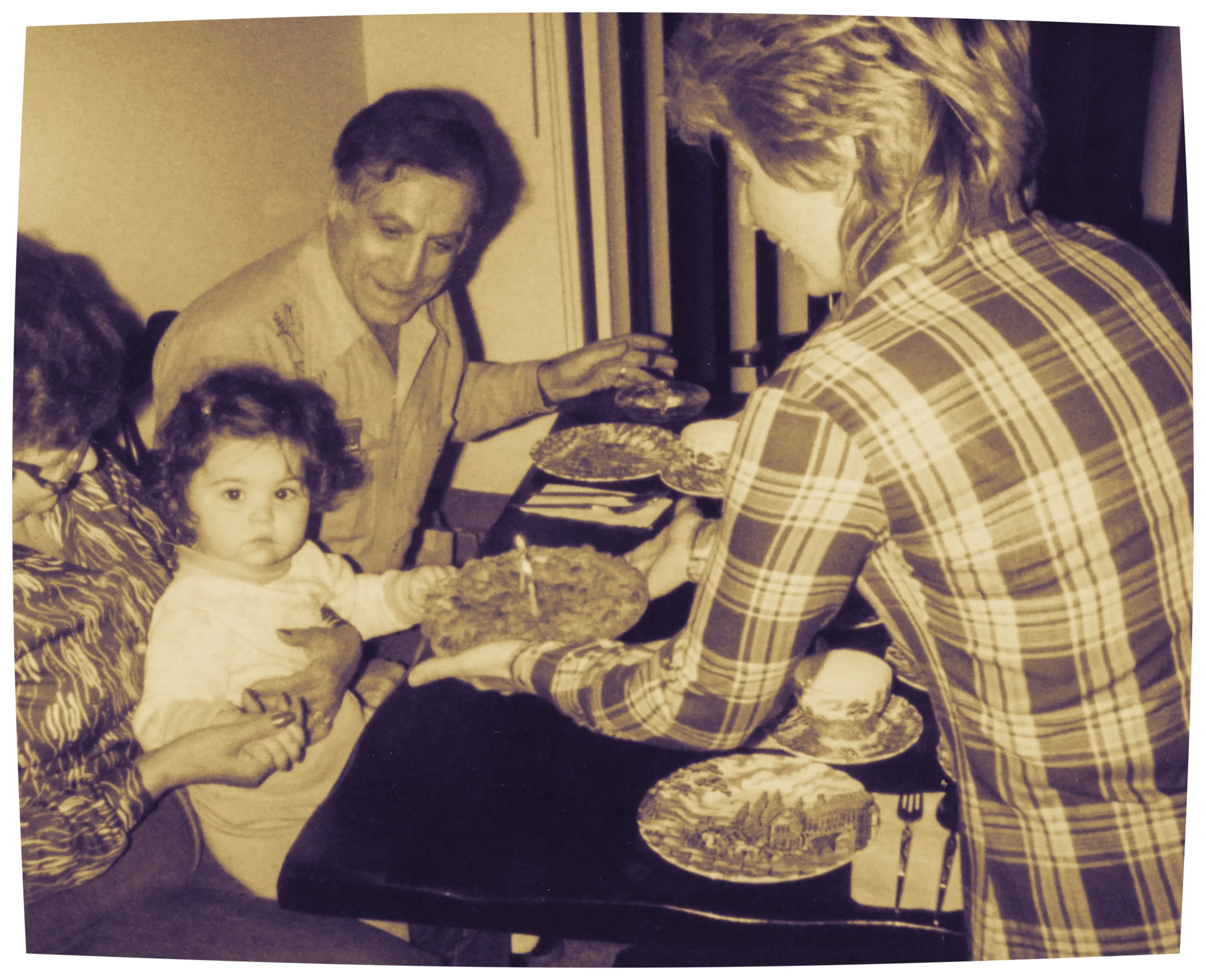
The writer's first birthday, Oct. 29, 1981: Three generations—grandparents Catherine & John, their daughter Joann, and her daughter Christine—celebrate with one of Pop’s pies (rest assured, there was a first birthday cake, too, as Mom is quick to point out!)
Pop’s Pie
By Christine Tarulli Mugnolo
I’ve always been a sweets person. That is to say, I’ll be happy with dessert for breakfast, lunch, and dinner. I believe I have my grandfather partly to thank (blame?) for that…and for my own sporadic hobby of making delectable treats.
My grandfather and grandmother eloped to Colorado in 1942. Soon after, as an officer in the army, he was stationed in Anzio, Italy, for the remainder of World War II. In between the fighting, Pop did what he did best—he cooked. He became the chef for his fellow officers and higher-ranked officials. And when he was finally home, he was head chef for his family.
There was nothing that Papa loved more than watching us devour what he made on any given day. And he never, ever forgot dessert.
I always felt Pop made dessert especially for me, his chubby, sweets-loving granddaughter. I would sometimes catch him beaming at me, all messy-faced and sticky-fingered. How his smile and hearty laugh would light up the entire room!
While I loved his cookies and his pretty lattice cherry pie, Pop’s key lime pie was my absolute favorite. It was always amazing: thick, buttery graham-cracker crust, sweet yet tart filling, and just a few twisty limes on top as garnishment.
As I got older, the pies seemed to get even more delicious, prettier, and, ultimately, simply perfect.
Pop passed away on December 16, 2001, when I was a senior in college. I was—I still am—devastated. I always will be. We lost our family’s heartbeat, our core, and I lost my Papa.
I think that’s when I started to bake. And I baked all the time then—for my family,
for my friends and boyfriends. I adored watching them taste all the goodness that
I (lovingly) shoved in their faces.
I don’t remember when my grandmother gave me my grandfather’s key lime pie
recipe. But when she did, it was as if she were handing me the damn Holy Grail. It’s been about 14 years, and I still cannot get it just right. I make the pie once or twice a year; it’s my special time with him. No TV, no one else in the room...just the two of us. How I curse that Pop didn’t write down what he really did to make his pie so great!
Eventually, I made my own tweaks. While my pie is good, it’s not as good as I remember his to be…and not nearly as beautiful. But that’s okay; it doesn’t have to be.

I have his—our—faded and butter-stained recipe, which, to me, is more beautiful than any pie. And I take it out every time I make it.
If I could have a few more hours with him, I’d introduce him to my daughter (oh, he would just eat her up!); I’d dance with him and not give him a hard time about it; and we’d bake together, so I could finally learn his secrets to the best key lime pie I have ever had.
Love and miss you always, Papa.
-----------------------
Christine Tarulli Mugnolo is a wife to a traveling husband, stay-at-home-mom to a very active toddler and two rescue pups, and in her spare time, a freelance editor. She thinks there’s no better smell than that of an old book from the library.
Pop’s Key Lime Pie Recipe
Crust
1 1/2 packs graham crackers, crushed
2 tablespoons margarine
Filling
8 eggs, separated (yolks only)
2 cans condensed milk
6 ounces lime juice (from about 6-7 limes) or Nellie & Joe’s Famous Key West Lime Juice
green food coloring (optional)
To make crust:
Combine graham crackers and melted margarine in bowl, then press into pie pan. Chill 30 minutes before pouring in pie filling.
To make filling:
Preheat oven to 350°
Combine egg yolks with condensed milk in medium bowl.
Mix well. Add lime juice a little at a time until smooth and creamy. Add a touch of food coloring until filling is desired color. Pour into pie shell. Slice a lime very thinly and add slices to top of pie before baking. Bake at 350° for 20 minutes.

The writer’s grandfather, John Carl Esposito (April 25, 1922 - December 16, 2001), in uniform in Pueblo, Colorado, where he was stationed before going overseas; 1942


A taste of the past
Smells and tastes conjure memories in a most primal way, and can transport us right back to our childhood kitchens. Our recipe for preserving your food stories.

Smells and tastes conjure memories in a most primal way, and can transport us right back to our childhood kitchens. As such, they are excellent jumping-off points for writing or talking about your memories and crafting them into a story for generations to come (not to mention, the kids will be thrilled to have those cherished recipes actually written down).
Delve into your food-related memories if...
you have a living relative who can be equated with the family hearth: recording those recipes, techniques, & special foods while you can is an invaluable gift for future generations
family holidays center around the table
milestone celebrations come back to you in waves every time you smell a certain dish
you want to preserve your culture
Foods Stir the Memory
On Tuesday we will be launching a new series of posts, A Taste of the Past, in which food plays a starring role, leading us down a path of reminiscence and reflection.
In the first contribution, Christine Mugnolo recalls her grandfather's singular key lime pie: Why can't she recreate it just so?
“It’s been about 14 years, and I still cannot get it just right. I make the pie once or twice a year; it’s my special time with him. No TV, no one else in the room...just the two of us.”
In another post, Kaitlin Ahern pays tribute to her mom’s spaghetti and meatballs, and you'll raise a glass with her to toast the memory of a mother gone too soon (and I guarantee you'll be uncorking a bottle of red, picking some basil from the garden, and putting on a pot of red sauce yourself—and, if all goes well, you'll be conversing around the dinner table about your own favorite handed-down recipes).
In “Billie’s Famous Foods,” Melissa Finlay recalls how her Gramma kept a jar for bacon drippings on her stove, used it liberally, and kept it full. “She knew everyone’s favorite foods and provided them—often.”
I hope these and other upcoming stories will inspire you to want to record your own memories. When you've gathered enough, or decide you'd like our professional help in recording them for posterity, an heirloom book is the perfect place to preserve them.

Related Reading:
If the idea of bottling memories of your ancestors' foods appeals, you might also want to check out:
Grandma's Project ("Sharing the World's Most Delicious Heritage"), in which filmmakers from around the globe cook with their grandmothers—and elicit evocative stories of the past along the way
Dinner: A Love Story, a so-much-more-than-a-blog compendium of recipes, kids' lunch ideas, and more from book author Jenny Rosenstrach; she occasionally hones in on the power of food as love, too, such as in these three lovely posts: Sense Memories (her husband's recollections of the birth of their first child and chicken salad, not necessarily in that order); The Napkin Note (about her mom and lunchbox missives); and Absolute Value (about her dad, Oyster Bar, and chocolate marzipan bars)
The Dinner Party, a glorious, long-time-coming community of mostly 20- and 30-somethings who've each experienced significant loss, who get together over potluck dinners to talk about the ways in which it continues to affect their lives and how to thrive in #LifeAfterLoss—an inspiring, real-life example of the power of a shared meal to heal and create community, even (maybe especially) after the death of a loved one.

Choose your own adventure—then tell it.
When you read memoirs—or even binge-watch reality TV—the stories you are witness to often seem larger than life. How can my little life compare?, you might think. I have nothing remarkable to say. Oh, but you do. Every choice you make, each person you encounter, adds to the texture and direction of your life. You are creating your own narrative. You’ve got reasons why you AREN’T telling your story. I’ve got reasons why you SHOULD.

(7 Reasons You CAN’T Tell Your Story, & 7 Better Reasons You CAN)
When I was a kid I read the choose-your-own-adventure series of books, liking, as most preteens did, the ability to hold some sway over how the storyline unfolded. I would read one book multiple times, attempting to make every choice combination possible. It was easy to become part of the story.
As I grew up and immersed myself in literary worlds well beyond Sweet Valley High, I would lose myself in stories of characters both like and unlike me.
Only as an adult did it fully dawn on me that I was, in fact, living my own story.
When you read memoirs—or even binge-watch reality TV—the stories you are witness to often seem larger than life. How can my little life compare?, you might think. I have nothing remarkable to say.
Oh, but you do.
Every choice you make, each person you encounter, adds to the texture and direction of your life. You are creating your own narrative.
You’ve got reasons why you AREN’T telling your story. I’ve got reasons why you SHOULD.
What’s your reason for not telling your story?
1 - I don’t keep a diary, so I won’t be able to remember details.
Time passes. Our memory is faulty. Even with a journal or diary, you would never be able to reliably relate all details of a time or scene from your past. While having a journal to reference could be a tremendous help, it is by no means a prerequisite for remembering, and telling, your own stories.
All memoir writers—and anyone who just reminisces over a cup of tea—challenges the limits of memory. Your sister might remember details differently from a shared memory—That dress was blue! It was winter!—and who can say which of you is right? While you might get a detail wrong, you are striving, in good faith, to recreate the essence of your memories, to transport those who are receiving your stories to your emotional state of mind, to feel your experiences.
“The present is all that’s genuinely available to anyone, and the present is fleeting, always turning instantly to the past. Even facts distort: What’s remembered, recorded, is never the event itself, no matter how precise the measurement—a baseball score is not the game…. At best, what we can do is listen to memory and watch memory…and translate [it] for those we want to reach.” —Bill Roorbach, Writing Life Stories
I’m not advocating getting details wrong—but by no means does one need a day-by-day accounting of their youth to begin to tell their early stories!

2 - My story is nothing special.
Oh, contraire. Stop comparing yourself to those aforementioned reality-TV show subjects. Have you loved? Made difficult choices? Gone on adventures that made you smile, laugh, feel invincible? Accomplished things that would make your parents (or your children) proud? Are there stories you used to retell around the dinner table, or the campfire? Are there questions your grandchildren have asked that you’ve only skimmed the surface of answering?
Even if the answer to every one of these questions is, “No!”—even then, I am confident there are questions to which you will answer with a resounding, “Yes!” You are living your story, and YOUR story matters.
Want a little (fun to read) proof? Check out what happened when a fellow personal historian spoke to a group of 10-year-olds about some pretty ordinary people. Then check out this video, and bear witness to some amazingly average people telling small stories that feel remarkable. Get ready to be moved.
3 - I don’t have very many photographs.
You’ve got a few, don’t you? And I would venture to guess that if you’ve saved those few, there’s a reason. Tell the stories of those pictures. Sit down with a friend, hit RECORD on your smartphone’s audio feature, and have a conversation about what you recall. Describe the sensory details—the coarse fabric of the formal jacket you wore, the fishy smell blowing in from the shore, the metallic taste of spearmint from the gum tucked behind your tongue. You may not know the exact date the photograph was taken, but I’m willing to bet you know more substantive stuff about the “when”: after you had graduated; before your father died.

So you've got just one treasured photo—start there! What memories does it spark?
Maybe you have absolutely no photographs. There are other options worth exploring: illustrating your book in a style that complements your narrative; using archival photographs to illustrate what the time was like; staging professional photo shoots to include family heirlooms, yourself and your current family members, or even the places that have mattered in your life.
4 - I’m too old to start now—how could I possibly cover 70 years?
It’s only too late if you never begin.
“You don’t have to cover all 70 years at once,” says Linda Coffin, founder of History Crafters. “Start small. Don't box yourself into ‘I was born... And then... And then…’ Tell just your favorite stories, or tell the stories that no one is left to tell but you. ANY stories that you tell will be important to those you leave behind, even if they aren't ALL your stories.”
Your stories are a testament to who you are, and “something is better than nothing,” says Lyn Jackson, founder of Every Story Media. “Your loved ones will cherish what you choose to relate.”
5 - I’m too young to start now—my story is just beginning!
Ah, how fortunate you are. Consider how fresh and visceral your favorite coming-of-age tales are: Stephen King’s Stand By Me (short story and movie), Judy Blume’s Are You There God, It’s Me, Margaret? (adolescent fiction), Lena Dunham’s Not That Kind of Girl (modern essays written by a feminist actress who has tapped into the zeitgeist like no other recently).
You are in the midst of your story, and dare I say it may be one of the most exciting parts! Life milestones are opportune times to craft a book, as they are often emblematic of turning the page on a new chapter in your life. Consider telling your first chapter.
Are you embarking on your college education? Engaged to be married? In the midst of changing careers? Bat/bar mitzvahs are also popular times to memorialize in words and pictures. Remember, your story can be primarily photo-driven, too—quotes and short first-person reflections add color and context in a lovely way and help bind a picture story together, helping you capture a formative time in your life, both for yourself and your ancestors.
6 - I don’t have any children of my own, so who cares?
If you are fortunate, you have friends and other loved ones to whom your story matters. You may not be leaving a genealogical legacy to your children, but there are many other types of stories that hold meaning, and that are begging to be told.
Your story may be part of a broader narrative that history has a responsibility to capture: veteran accounts, the early LGBT experience, the Civil Rights movement (or ongoing race relations in our nation), even seemingly “small” historic moments in your local community. What has mattered to you, and how have you participated in the world at large?
“Every life—every, single life—matters equally, and infinitely.” —Dave Isay
Even if you have no interest in publishing a book to hold your memories, there is value in the writing itself—and equally in the sharing of stories for strangers to hear (StoryCorps comes immediately to mind!).
All of this to say: We care. People care.
7 - I am not a writer.
That’s what we are here for.
Often the most intimate and revealing stories result from one-on-one conversation. You talk, and we listen. What we do from that point is, well, just a little bit of magic.
Let's talk, and see what we can do together.
Related reading:
20 Reasons Why You Should Write Your Family History
Association of Personal Historians Experts Weigh In: More Reasons to Tell Your Family History

When a bad photograph is the perfect picture
Throwing away photos that hold no meaning (or are duplicates, or are just plain bad) is a requisite for organizing your visual memories. Think before you toss, though. Sometimes that blurry shot—or an old, ripped black-and-white, or the one where you are so small you're like an ant!—are worth keeping. Here's why.
Throwing away photos that hold no meaning (or are duplicates, or are just plain bad) is a requisite for organizing your visual memories; you’ll never find anything if it’s unlabeled and sitting at the bottom of an overwhelming pile, after all. (Photo hoarders, you are not alone: Get help here!)
Think before you toss, though. There are, in fact, some instances when you should keep that seemingly bad photo.

Oldies are goodies.
If it’s wearing its old age like a badge (frayed edges, torn corners, faded color, and other rips and blemishes) but is otherwise a keeper, keep it. Consider having the image restored by a professional retoucher. With high-resolution photo scanners and digital retouching, professionals can recreate missing parts of an image, remove stains and discoloration, and generally work magic on your old treasures. After all, those vintage shots of your grandparents are the only ones you’ve got. Even if you opt not to restore your old photos now, scan them at a high resolution (600 dpi is sufficient for most people’s use) to preserve them digitally, and take pleasure in the characteristics of age (we often include those charming scalloped photo edges or a small corner tear when we reproduce images in our legacy books).
Blurred but essential?
My baby shower was a whirlwind of hors d’oeuvres, cellophane-wrapped gifts, hugs, and laughter. I was in a constant state of motion, a little pink in the cheeks from the attention (um, the pregnancy, too), and oblivious to the idea of capturing the occasion in pictures. My camera was passed around, though, and I posed for a shot here and there.

When I downloaded the images later, all but a few of the pictures were blurred beyond recognition. Honestly, though, I don’t mind not having an album’s worth of pictures commemorating this occasion; it lives in my memory. And, this one shot of me and my mother—streaked with blur—captures the energy and the emotion of the day: certainly not “perfectly” from a technical standpoint, but undoubtedly beautifully from an emotional one. She, near giddy with excitement at the prospect of her “baby having a baby,” and I, whisked around like a socialite, appear as we should in this shot, a surprising keeper: happy, in motion, dazzled.
If you’ve got blurry shots from a special occasion or milestone, it’s likely at least one of them is worth holding on to. The inadvertent blur might help convey sadness or the passing of time, perhaps. Or maybe the blur does nothing artistically except distract—yet the photograph is the only one that reveals the setting of a day for which you want to remember every detail; photos, especially physical ones we can hold in our hands and touch, help us remember to remember.
Photos help us remember to remember.
Distance makes the heart grow fonder.
We’ve gotten used to tightly cropped images. Favorite game-day shots are those that zoom in on an athlete’s great play. Our Instagram feeds are flooded with close-ups of herb-garnished lunch plates and quirky, oh-so-close selfies. But what of those old snapshots where the background dominates? Where your childhood self is a speck on the landscape?
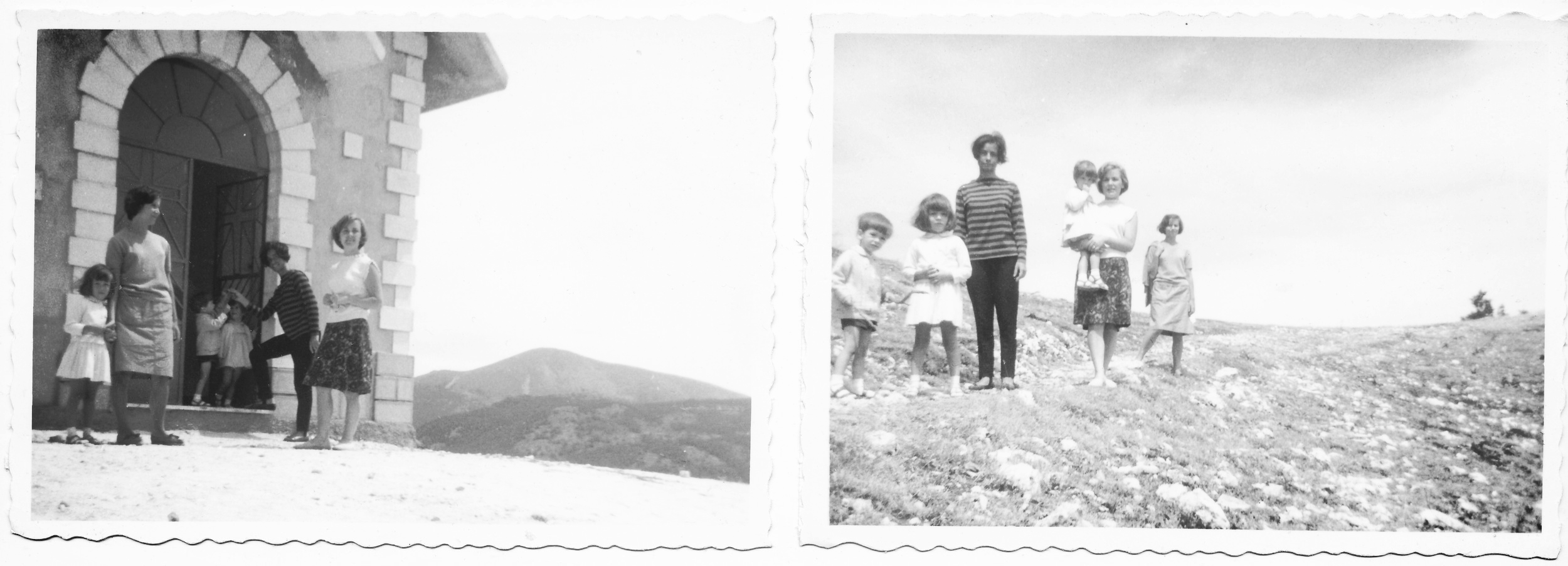
These family photos from a stay in Italy aren't great technically, but the places they evoke and the memories they call forth are priceless. Isn't it wonderful to see siblings' relative sizes to one another, to sense the kids' moods from their posture, to feel transported to the Italian countryside?
Newer drone photography, as adopted by some trendy wedding photographers, shows the appeal of pulling back to a wide-angle shot in the extreme, taking advantage of a grand perspective to show off beautiful scenery. You might not recognize the couple in that stunning scenic setting, but you know it’s you or your loved ones—and oh how that makes all the difference!

I admit, this one is a spectacular photograph—it would never be in contention for getting tossed! It's a wonderful example, though, of how a dramatic perspective can be a true gift, even when the subjects in the picture are not recognizable from that distance. Photo by Lilly Red Photography
So don’t fret that the characters in a photo are too small to clearly identify, especially when you know who they are. Relish the fact that you get a glimpse into the environment (especially when it’s representative of a time gone by or a place no longer visited). Label these photos, whether on the back with a photo-safe pen, in the metadata of a digital file, or alongside the image in a book—you want to ensure that your children and theirs will be able to appreciate not just the gift of the photo, but the knowledge of who is in it.
What pictures have you saved that don’t necessarily qualify as “the best photograph”?
Share with us on Instagram, Facebook, Twitter, or in the comments below!

Why genealogy is not the answer to finding yourself
Genealogy is history on a personal scale. It helps satisfy a deep need to understand how we fit into the broader world around us. But knowledge of our ancestors does not define us. Read on for musings on why we should collect stories, not ancestors.

Genealogy is history on a personal scale. It helps satisfy a deep need to understand how we fit into the broader world around us. Nonetheless, knowledge of our ancestors does not define us.
It has been written about plenty: Genealogy is the second-most popular hobby in the United States, just behind gardening. Genealogy sites are second only to porn on the Internet.
Genealogy and the search for family history can be a big part of what we do here at Modern Heirloom Books, especially when a family wants to tell the stories that have passed through generations of descendants and preserve them for the children.
And I am not immune to the quest: Having almost no knowledge of my family beyond my grandparents (“We’re American,” my grandmother would tell me when I asked about where we came from), I can sit for hours scanning census records and clicking on those enticing “hint” leaves on Ancestry. I watch Finding Your Roots and Genealogy Roadshow, too.
Genealogy is fun, and it has great value. However, having a knowledge of your ancestry does not define you as a person.
You are making your own path.
Over Father’s Day weekend I saw an article, “Searching for Our Roots,” and was troubled when I read this quote from a man who has no ties to his blood relatives:
“When asked if he felt ‘incomplete,’ Giddins replied, ‘Definitely. I knew nothing about me. Can you imagine growing up knowing nothing about your health, your family? You’re nothing.’ “
I have read similar sentiments before from individuals who are not connected to their roots, including from adoptees as well as from folks whose parents simply did not talk about the past. “How can I know who I am when I don’t know where I came from?” the thinking goes.
While knowing your family’s past can be empowering, even liberating, it should not be a prerequisite for knowing oneself. Especially in our digitally dominated lives, self-reflection is becoming more and more rare. Perhaps we should look inward more often. Journaling, writing letters, having tech-free conversations with friends, are all powerful ways to connect both with loved ones and with our inner self. You, whether you are aware of your ancestry or not, have important stories to tell.
If there is a lesson in genealogical research, it is how interconnected we are to one another. (A personal aside: If only this message were so widely accepted that intolerance were a thing of the past, but headlines deem otherwise.) This is a profound lesson, but isn’t it one we can get as well from stories of individuals whose names do not appear on our own family tree? (Listen to The Moth podcast for proof.)
Don’t collect ancestors. Collect stories.
It’s the people you want to know, not just their names. Their struggles, their triumphs, their foibles and follies. You can’t get those stories from a branch on a family tree (though you will almost certainly get clues that lead you to those stories if you are persistent!).
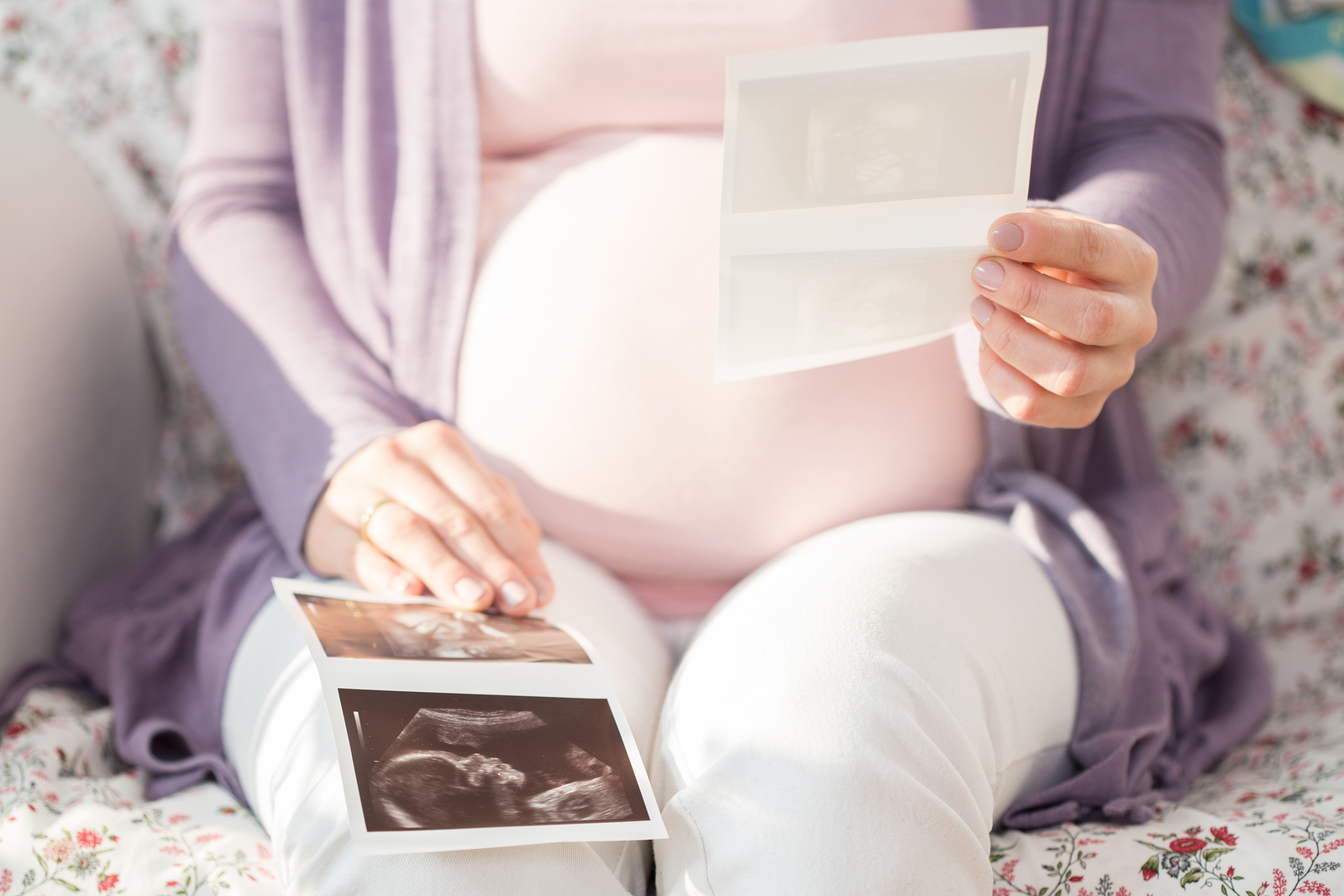
Look to loved ones in your present, not just your past, to define who you are and what is important to you. After all, you are living your life, making memories, and creating stories to share with your own children one day!
So sure, click on the green “hint” leaves, gather names and census records, even take a DNA test if you’re so inclined (I did). Just don’t pin your own identity on what you find—and don’t lose sight of the people behind the names. The journeys of those people have led to you. And your journey is continuing, right now.
Oh yeah: And tell your stories as you go. Talk of them around the dinner table, record them, preserve them. As the research indicates, it’s the sharing of family stories that helps kids be resilient and contributes to a healthy sense of identity. You may be depriving your future generations of a grand genealogy adventure by giving them their lineage instead of a mystery to be solved...but that’s a good thing, right?

#Legacy Links: June 10 - Photographs, Memory, and Life Lessons
This week's top 4 legacy links all focus in some way on the enduring power of photography—the power to connect us with the past, to inspire, and my favorite, to reveal stories and truths.
Our top 4 #legacy links for the week ending Friday, June 10, 2016
1 - Families photographed with images of their descendants make a powerful connection to past.
A photography exhibit, on view until tomorrow at El Tejar del Mellizo community center in Seville, Spain, presents photographs of the living descendants of those who lost their lives during the Spanish Civil War. Organized by the Our Memory Association, “DNA of Memory—Graves from the Franco Regime” features photographs by more than 30 Spanish artists. The images capture descendants carrying photographs of relatives killed at the beginning of the Civil War, and they are more provocative and moving than I could have imagined. If you don't happen to be in Seville tomorrow (!!), I urge you to click on the photo below to view the various photographs on HuffPo.
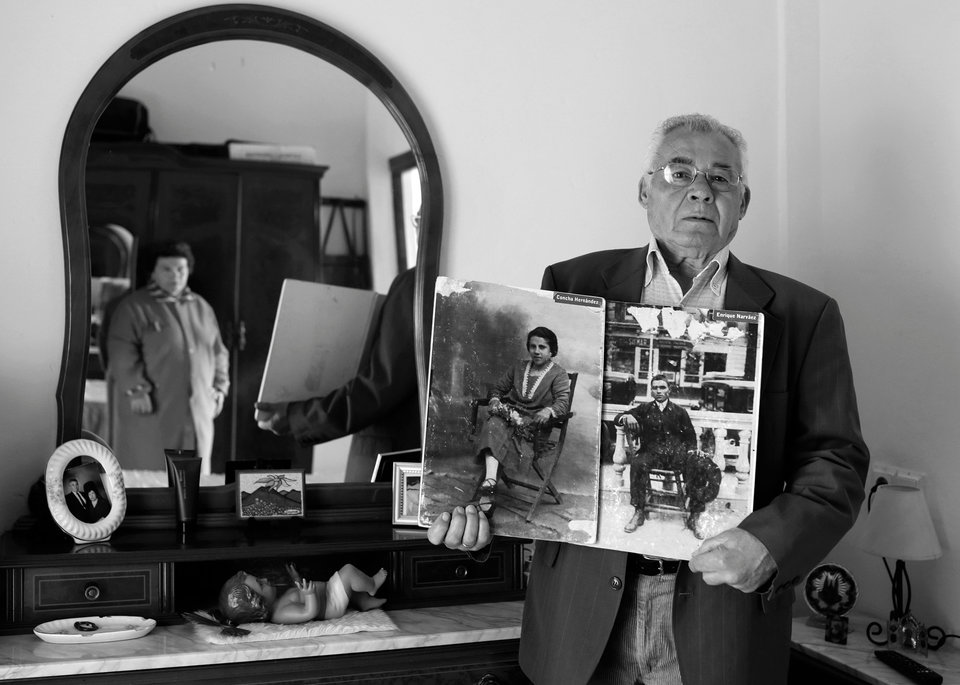
In a photo from the "DNA of Memory" exhibit, Narvaez Hernandez holds up photos of his parents, Enrique Narvaez Borrego and Concepcion Hernandez Garcia, who both died in Marchena, Seville, when Hernandez was 3 years old. Photo by Javier Diaz, courtesy Our Memory Association
2 - How a personal quest to find family resemblances turned into something more.
This one's not new, but somehow I missed it when it made the viral rounds last year. See what fellow personal historian Rachael Rifkin discovers when she undertakes a unique experiment to recreate eight photos of her relatives. Her musings on the nature of descendancy are as enticing as her photo recreations.
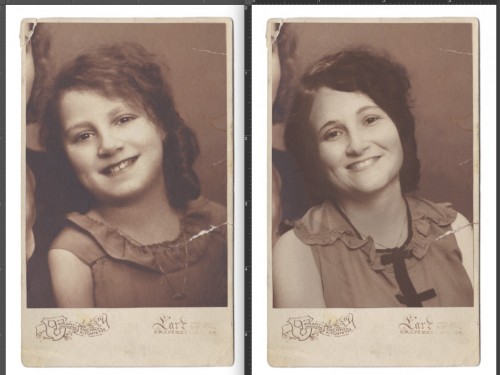
According to a family tree, Rifkin's cousin Ibolia, left, died at Auschwitz in 1944. Rifkin estimates this picture is from sometime in the 1930s. Image courtesy Life Stories Today
3 - One decade, one family, one photographer: This is a photo book I am looking forward to.
Thanks, Family Search, for bringing this one to our attention. Photographer Thomas Holton's book The Lams of Ludlow Street \, which chronicles one family through 13 years' worth of photographs, will be published next month.
"As Mr. Holton got to know the family, the project became more personal. He would pick up the children from school. He visited the Lams’ relatives in Hong Kong and China. When he married, Cindy was his flower girl,"
writes Annie Correal in the New York Times article. Make sure to click through the accompanying slideshow!
4 - What happens when a suitcase of photos sends her on the storytelling adventure of a lifetime.
In the vein of "Finding Vivian Maier," a North Carolina woman hit the found photos jackpot when she discovered a suitcase full of one man's life effects, including photos, letters, and other ephemera—and then began a journey of discovery as she sought to uncover the stories his things revealed. Her site is wonder to behold.

Read an introduction to her photographic treasure hunt on the ever-interesting Save Family Photos:
"Handling these seemingly random artifacts serves as a constant reminder that the sometimes cryptic, occasionally awkward, and often amusing snippets of the past were once as alive and vital to their creators as my own emails, journals and vacation photos are to me."