Memories Matter
Featured blog Posts


READ THE LATEST POSTS
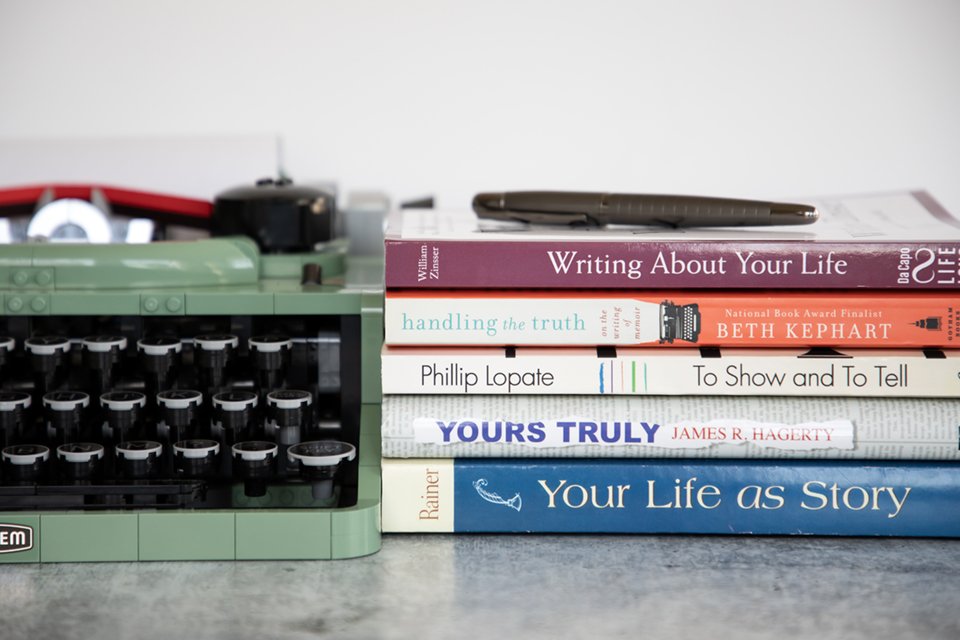
“Which life writing book is best for me?”
While all five of these books add value to any memoirist or life writer’s library, I’ve identified which is best for you based on your goals and experience.
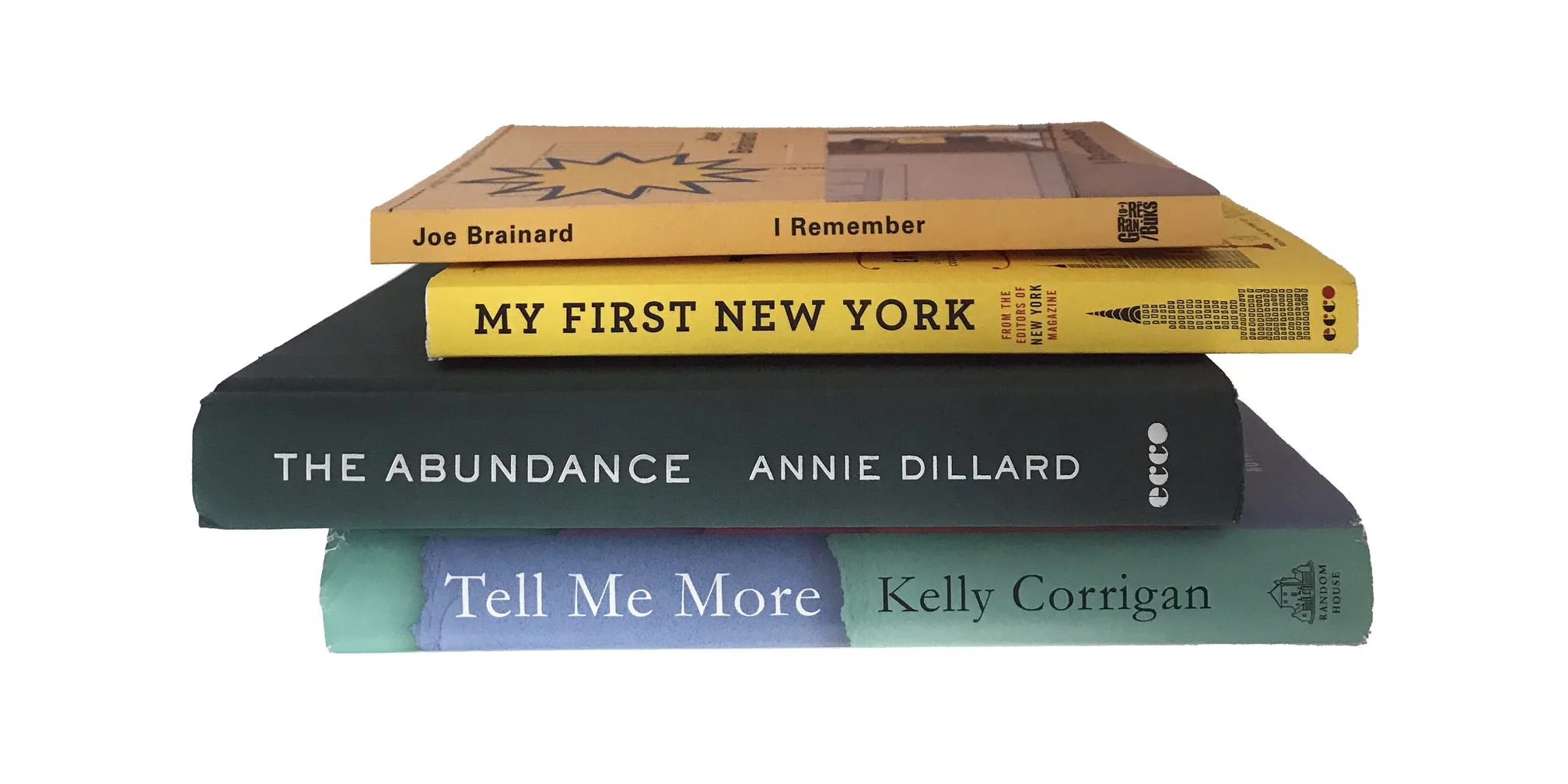
From the many, many craft books on my bookshelves, these are the five I consider essential for anyone endeavoring to write about their life.
If there’s a book out there about how to write memoir, autobiography, personal essays, or narrative nonfiction, I’ve probably read it. There are plenty that may be worth a read, but there are only a handful that I would consider essential for every life writer’s bookshelf.
Here I aim to classify my top five life-writing titles by who each one is best for. Click if you are…
a journalist or student aiming to up your personal essay game
anyone hungry for personal narrative guidance, including writers of every level
anyone who wants to make sure their story is told the way they want
And before we get to the heart of things below, I’ve written elsewhere about some books that are great choices for other scenarios, too; find those recommendations by clicking if…
“To Show and To Tell: The Craft of Literary Nonfiction” by Phillip Lopate

Best for:
Journalists and students aiming to up their personal essay game
in brief:
While the book jacket touts this title as a “nuts-and-bolts guide to writing literary nonfiction,” I would argue that it is more a collection of insightful lessons from this expert’s vast experience rather than a how-to guide. Widely regarded as one of the best personal essayists around, Phillip Lopate has here collected his ruminations and conclusions about the genre of personal narrative as a whole. If you’re in the mood for a well-informed, sometimes cheeky, always smart exploration of writing literary nonfiction, then this book’s for you. It’s an apt choice for anyone wanting to finesse their writing skills, to hone their craft, and to luxuriate in the history of the genre; if you’re in search of a book with more direct guidance, I recommend one of the last two entries on this list instead. [To Show and To Tell: The Craft of Literary Nonfiction, Free Press, 2013]
Author’s credentials:
Phillip Lopate directs the graduate nonfiction program at Columbia University. Among the 12 books he has written, three of them are personal essay collections.
“Handling the Truth: On the Writing of Memoir” by Beth Kephart

Best for:
Aspiring memoir writers
in brief:
“Teaching memoir is teaching vulnerability is teaching voice is teaching self,” Beth Kephart writes, a fair summation of her approach to teaching, in the classroom and in print. As I have written in a previous review, here the author “spends a good portion of the book on what she calls ‘not-yet-writing-memoir work’—preparatory ideas, tapping memories, conjuring beauty, exploring diversions, finding your story,” but she also delves into the nitty-gritty of getting words down on paper, of editing and honing and creating art from experience. Handling the Truth is a must-read for anyone at any stage in the memoir writing process. [Handling the Truth: On the Writing of Memoir, Gotham Books, 2013]
Author’s credentials:
Beth Kephart is the award-winning author of more than 30 books, including multiple memoirs. She is a longtime writing teacher—of creative nonfiction as a professor at the University of Pennsylvania, and as co-founder of Juncture Workshops.
Bonus:
If you relate more to the word “aspiring” than “memoirist,” you may want to check out Kephart’s companion workbook, Tell the Truth. Make It Matter (CreateSpace, 2017), in which prompts and exercises put you on the path to remembering and meaning-making.
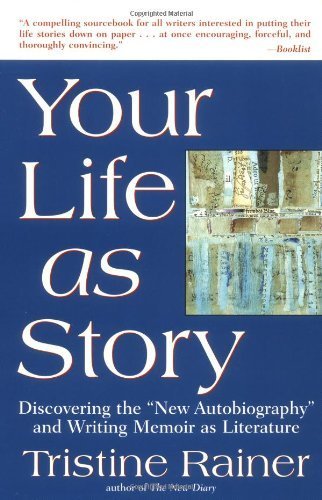
“Your Life as Story” by Tristine Rainer
Best for:
Anyone hungry for personal narrative guidance, including writers of every level
in brief:
When I first encountered this book years ago, it was a loaner from my local library. By its due date it had amassed a ridiculous number of yellow sticky notes hanging off the pages, each marking a passage I felt was revelatory or essential. Needless to say, I bought my own copy soon thereafter.
First published in 1997, this book’s subtitle and grounding premise—“discovering the ‘new autobiography’”—might seem off-putting. By now, I hope that we no longer need to define and justify memoir’s raison d’être, nor the assumption that it is “available to everyone.” That said, get past any reservations you may have about the book being dated, because it is chock-full of concrete writing advice, real inspiration, and helpful exercises. Rainer herself encourages readers to jump around, to use the table of contents and index to navigate the book to find what they are needing at that moment in their writing journey. As she says, “The purpose of this book is to give you the tools to see story in your life, and then, if you choose, to give it shape in writing so it can be shared.” So grab your highlighter and a blank journal and dig in! [Your Life as Story: Discovering the ‘New Autobiography’ and Writing Memoir as Literature, Tarcher/Putnam, 1998]
Author’s credentials:
Tristine Rainer’s first book, The New Diary, was written in 1977 and is still the bestselling book on journal writing, according to Amazon. She has taught writing at the university level for decades, and was a founder of the Center for Autobiographic Studies.
“Writing About Your Life: A Journey Into the Past” by William Zinsser

Best for:
Newbie life writers and family historians
in brief:
“My purpose in this book is to give you the permission and the tools” to write about your life, Zinsser puts forth in the introduction. His conversational, warm writing style is accessible and supportive. Readers learn about his writing choices—decisions he made about tone, language, structure, and all those fundamental elements of craft—as he takes them along on a wonderfully enjoyable ride of personal storytelling and instruction. He calls this a “double journey into memoir—yours and mine.” In addition to concrete tips for how to write your life story, Zinsser delivers hefty doses of confidence bolstering and inspiration by example. [Writing About Your Life: A Journey Into the Past, Marlowe, 2004]
Author’s credentials:
William Zinsser was a writer, editor, and teacher. His enduring classic, On Writing Well, grew out of a course he taught at Yale. Some of his other books include Inventing the Truth: The Art and Craft of Memoir and Extraordinary Lives: The Art and Craft of American Biography.
“Yours Truly: An Obituary Writer’s Guide to Telling Your Story” by James R. Hagerty

Best for:
Anyone who wants to make sure their story is told the way they want
in brief:
“When is the best time to get started? Before it’s too late. How about right now?” James Hagerty proffers in the introduction to this book. It’s advice I give often, as well, and the best part about his book Yours Truly is that he equips you with lots of straightforward writing advice and carefully selected first-person pieces as examples so you can hit the ground running. You may be surprised that a book with “obituary” in the subtitle is infused with humor, but make no mistake, this is a book about honoring life in all its weird and wonderful glory—not only a great read, but a model to write your own. [Yours Truly: An Obituary Writer’s Guide to Telling Your Story, Citadel Press, 2022]
Author’s credentials:
James R. Hagerty worked for more than four decades as a reporter and bureau chief at the Wall Street Journal and was for some time the paper’s only full-time obituary writer.
bonus
Check out this earlier post for a deeper dive, with five life writing (and life) lessons derived from Hagerty’s book.



























Life Story Links: February 6, 2024
This week’s curated roundup is overflowing with informative podcasts, videos, and stories about memoir, life writing, legacy film, and how memory works.
“Sometimes it feels like each poem I write is a draft of The Poem I’m trying to write—that singular, golden, impossibly definitive poem. The one poem I’m trying to live. Or the one life I’m trying to write.”
—Maggie Smith
Vintage poster with original artwork by Richard Halls produced by the Work Projects Administration circa 1938; image courtesy of the Library of Congress Prints and Photographs Division, Digital Collection. The posters were designed to publicize exhibits, community activities, theatrical productions, and health and educational programs in seventeen states and the District of Columbia between 1936 to 1943.
On writing our lives
LIFE STORY INNOVATIONS & PRACTICE
The current issue of The International Journal of Reminiscence and Life Review contains a number of interesting papers, including a special section, “The Healing Power of Storytelling.” Two worth checking out:
KICKSTARTING YOUR WRITING LIFE
“It was such a loss for me, to know that I had the opportunity to ask questions and I didn’t,” Patricia Charpentier says in this video introduction to writing about your life.
IT’S ALL MATERIAL
“In a certain sense it goes to the heart of who we are as writers: why she is a novelist and I a memoirist. Now that I find interesting.” Vivian Gornick on Lore Segal.
CRAFTING A LOVING TRIBUTE
After a prospective client asked if I had a series of memory prompts specifically geared to help him write about his wife, I crafted these questions to help anyone honor their partner and tell the story of their relationship.
TOP GHOSTS DISH
Joel Stein sat down with six of the top ghostwriters in the celebrity memoir business to learn “about the curious craft of ghostwriting and the types of personalities drawn to help famous people tell their life stories.”
In search of the past
MISSING PERSONS
“The most representative thing about my family was not the small farm, the nightly saying of the Rosary, or the close community of neighbours … but the fact that most of its members lived elsewhere.” On a grandmother’s secrets and a search for broader truths.
ADOPTION, ACCESS, AND IDENTITY
“Late at night, in my childhood room, questions haunted me: Where did I come from? Why was I adopted? Who was my original family?” This writer says she could have gone to prison for what she did to find her birth parents.
TASTES OF THE PAST
Many “cultures live in the diaspora, in cracks and crevices of oral histories, of old folded scraps of paper, of recipes. I’ve found that food has the best clues.” Historians on bringing “dead recipes” back to life.
LOST STORIES
“I mean, you go to any antique shop and you are going to find family photographs… It’s amazing the stuff that families don’t want.” How once meaningful keepsakes end up in estate sales.
“AN INTRICATE MOSAIC”
“Holding a handwritten letter from a grandparent, reading their words, and feeling the texture of the paper can be a profoundly emotional experience. Personal archives bring the past into the present.” Margot Note on preserving history and memory in archives.
IDENTITIES BUILT ON SHIFTING SAND
“Our memories form the bedrock of who we are. Those recollections, in turn, are built on one very simple assumption: This happened. But things are not quite so simple.” A leading memory researcher explains how to make precious moments last.
For your listening pleasure
INSIGHTS FROM A TOP MEMOIRIST
In this wide-ranging discussion, award-winning author Dani Shapiro discusses striving towards the universal in memoir, writing a book without an outline, and how she had to slow down the rush of storytelling in her bestselling memoir Inheritance because she was living the tale as she was writing it:
A COUNTRY BOY AT HEART
Fans of Finding Your Roots will recognize Henry Louis Gates Jr.’s smarts and sense of humor, but I am willing to bet you haven’t heard his storytelling skills shine like they do in this interview with Dax Shepard:
LEGACY IN THE FACE OF DEATH
On this episode of Inside Photo Organizing podcast, professional photo manager Sharon Wunder talks about how her cancer diagnosis shifted her thinking about the idea of legacy, and about how she approaches preserving memories that are not accompanied by photos; I recommend starting at the 7:13 mark:
PROMPTING POWERFUL STORYTELLING
“This is not about ego, about being big and great, but rather, about being of service, and of understanding your place in the larger story. Trained interviewers draw people out of their shells and get people talking in story,” Jamie Yuenger, founder of StoryKeep, says in this video, which is part of a larger series called Legacy Lens:
...and a few more links
What does it take for a writer to achieve sentiment without sentimentality?
New demographic report sheds light on exactly how many Jewish Holocaust survivors are still living.
King Charles’s biographer on the moment Charles learned he was King.
Landscapes of Resistance trailer and review: “an enigmatic meditation on a life marked by Auschwitz”
Personal histories: a “trend of publishing them for a wider audience is catching on in India”
Short takes






How to write a loving tribute to your spouse or partner
A love letter (or book!) overflowing with memories makes a thoughtful anniversary gift. Here, 14 writing prompts to help you honor—and surprise—your partner.
Whether you want to write a personal love letter for Valentine’s Day or an extended tribute to your spouse for a milestone anniversary, the writing prompts below will give you ideas for sharing your love on the page.
Read through the list of prompts and mark the ones that resonate the most—then start there with your writing. Some of the prompts may yield long stories while others might only spark a phrase or sentence; that’s okay. Our relationships are as unique as our signatures—honor what makes yours special!
One tip before you begin: Don’t put pressure on yourself to sound like anything other than you. Think of your writing as an extended letter to the one you love and let your voice come through.
14 thematic memory prompts to help write about your love
THE SETUP
How, when, and where did you meet? Tell the story of your first meeting, your courtship, and your favorite memories from the early days of your relationship.
CUTE QUIRKS
Share some of your partner’s quirks that make them them. Does she twist her hair around her finger when deep in thought? Does he put post-it notes all over the house to remind him of mundane things? Hone in on their character traits that are unique and lovable and…specific.
ADVENTURES OF A LIFETIME
Take this prompt in any direction you wish: Perhaps your biggest (ongoing?!) adventure has been parenthood—write about that. What other adventures have you been on together? Think travel destinations, new skills you endeavored to learn together, and passions you’ve developed over the years.
SAYINGS & PET NAMES
Do you have a special way of saying “I love you”? What about terms of endearment for one another? If there’s a fun story here, then of course tell it; otherwise simply weave your sayings and pet names throughout your writing.
HEARTH & HOME
How do you define home? Is it a more ephemeral notion of being together, or have you built spaces to live that embody your family philosophy? Describe the first place you lived together, the most challenging place you called home, and the home where you find yourselves now.
LOVING LIST
This one’s fun and invites creativity and playfulness: Write a list of “50 Things I Love About You” that includes everything you can think of, from seemingly obvious-yet-true things such as the color of their hair or the feel of them in bed beside you to more personal-and-unexpected things like “the way you set out a mug and a Splenda packet for me when you make coffee in the morning,” “the way you croon country music in the car,” or “the fact that you’re still trying to convert me to someone who will be on time.” The more specific here, the better!
MISHAPS & MISDEMEANORS
Write about “that time” you made a wrong turn and ended up weekending in a different town than you expected, or accidentally missing a birthday—little things that may have gone wrong that you weathered together (and maybe even ended up enjoying).
INSIDE JOKES
Do you and your partner glance across a crowded room and know exactly what the other is thinking? Are there inside jokes that you’ve shared for years? Write about your secret language of laughter and, well, just knowing what the other may need.
ROLE REVERSAL
How are you two different? Write about how you at times complement one another and at other times clash. Try to find the humor or the life lessons in your differences. Find the stories and also some underlying wisdom.
OFFER GRATITUDE
What are you most thankful for in your relationship? Think about your partner’s qualities that you appreciate, but also ways you mesh and make your way through the world together. Like with each of these memory prompts, try to hone in on some specific details or moments that come to mind when you think about gratitude.
GOING DEEP
Aim to write the most epic love letter, including thoughtful reflections such as:
times you missed your partner or wished they were near
ways your spouse has changed you or impacted your outlook on life
why you consider your partnership a successful one
your favorite romantic gestures from your years together
how you have manifested being there for one another “through good times and bad, through sickness and health.”
FROM THE ARCHIVE
Did you save early handwritten letters your partner sent you? How about everyday notes or even emails? Unearth these and consider including one or quotes from a few in your tribute.
BONUS REVEAL
You’ve been writing about your beloved all this time, but remember that sometimes the real gift is sharing a bit of YOURSELF. Consider telling them something they may not know about you yet. It could be a silly anecdote from your childhood or a deep-seated fear you’ve held for decades. No matter what you decide to share, allow yourself to be vulnerable.
BUCKET LIST
Perhaps you’ve been married for 25 years and you’re celebrating a host of favorite memories in this book. For this prompt, turn your attention to the memories you’d yet like to make. What’s still on your to-do list? What dreams do you hold for your future together?
Remember that your efforts to create something meaningful for the person you love is gift enough—this really is one occasion where “it’s the thought that counts.” So have fun with this, be thoughtful as you write, and you’re sure to craft a gift that your partner will cherish!
And if you need help packaging your extended love letter into an heirloom book, please reach out to see how we can work together.






Life Story Links: January 23, 2024
In this week’s curated roundup: how to have a legacy mindset, how documenting our lives does (or does not) help us remember, and ways to honor lost loved ones.
“I started to believe that writing is humanity distilled into ink.”
—Diana Chao
Vintage poster with original artwork by Anthony Velonis produced by the Work Projects Administration circa 1939; image courtesy of the Library of Congress Prints and Photographs Division, Digital Collection. The posters were designed to publicize exhibits, community activities, theatrical productions, and health and educational programs in seventeen states and the District of Columbia between 1936 to 1943.
On preservation, life stories, and legacy
OVERSHARERS ANONYMOUS
“Writing is how I understand life,” bestselling memoirist Dolly Alderton, author of Everything I know About Love, says. And yet, she swears she’ll never write another book about herself.
CAN OUR ARCHIVES HELP US REMEMBER BETTER?
“But how exactly does documenting our lives impact how we live and remember them?” Listen in to a robust conversation about the gaps in how we record things and how we remember them, from The Atlantic:
HOW WILL YOU BE REMEMBERED?
“When we think in terms of legacy, we’re really trying to use our imagination to think far beyond our own individual existence.” Katherine Kam on how to adopt a legacy mindset.
FAMILY SECRETS, REVEALED
Recent advice from the NYT Ethicist columnist—about the burden of newly discovered genealogy information from a DNA test—is being hotly debated in the comments (more than 500 to date). Dig in for some fascinating back-and-forth.
Remembering those who have gone
KEEPING MEMORIES ALIVE
This young Irish entrepreneur uses gravestone plaques with QR codes to help families celebrate the memory of their lost loved ones (even pets).
GENEROSITY IN GRIEF
A single short conversation with one of my clients revealed a few truths that I have witnessed over and over again during my years creating books to memorialize our lost loved ones.
“MEMORY’S COMPOUND OF EMBELLISHMENT AND REALITY”
Robert Glück’s About Ed—which draws on the subject’s notes, audio clips, diaries, and dream journals—“is a literary monument that harnesses memoir’s emotional honesty while indulging fiction’s stylistic latitude,” writes a reviewer.
Short takes

“Little gifts keep coming”
Once you invite people to share memories about your lost loved one, you’ll hear familiar stories—but there will be some new gems, too, and those are gifts.
“Little gifts keep coming,” she said to me in awe. “Stories I never heard before about him.”
My client lost her beloved twenty-something son the previous year and is undertaking to create a tribute book in his honor. During our first consultation I helped her write a letter to her family members and her son’s friends inviting them to contribute stories about him—what they loved, moments that reveal his character, favorite memories.
Often I work with clients to create a tribute book over the course of two to three months with a deadline to have books in time for a celebration of life, memorial service, or other rite honoring their lost loved one. This time, though, my client wants to take her time: The journey of receiving and lingering over the tributes about her son is as important to her as the book she hopes to pass on to her grandchildren.
So, a few months had passed between our initial consultation and this follow-up call. She was surprised by people’s willingness to share their memories (I was not). She was grateful for the fact that friends shared not just platitudes and descriptive adjectives, but stories—real stories!—about her son (I was too). And she was not prepared for some of the things she was discovering; they weren’t shocking, but rather intimate…evoking a visceral response. “For now, I am putting all that in a box.” Did she mean metaphorically, I wondered? “Well, I have a physical box, but yes, metaphorically, too—my grief is so strong that there are some things I just can’t handle right now.”
This one short interaction with my client revealed a few truths that I have witnessed over and over again during my years creating books to memorialize our lost loved ones.
Stories are gifts.
All family stories are gifts, but they are priceless gifts when the story is about someone who has passed away. So if you know someone who is grieving—even if it is years past their loved one’s death—share that story; you know, the one that keeps coming up when you think about the deceased, the one that makes you smile or laugh. Write them a quick note (it needn’t be long to be meaningful!) or pick up the phone for a quick chat (even if you haven’t spoken to them in ages). You’ll be giving a gift that’s easy to give, and that will be received with gratitude and awe.
People WANT to share their memories, so don’t be shy about asking.
If you are putting together any kind of tribute to honor a lost loved one, whether it is a memorial slide show, a book of memories, or a compilation video with words of condolences, don’t hesitate to ask people to participate. If you loved the person who has passed, so too did others. Have you ever had the experience of attending a wake or shiva and finding yourself amazed at the animated conversation and the memories swirling around the room? It’s ingrained in us to celebrate our loved ones when they are gone, and most people will be more than willing to share their stories in writing.
Don’t endeavor to create a tribute book immediately after a loved one has passed.
There is a heaviness to grief. And while grief has its own timeline and rarely goes away entirely, those early days of loss are not, in my experience, the best time to begin a project. Don’t get me wrong, I have worked with (and will certainly again work with) folks who urgently want to memorialize their loved one in the wake of a death. But the process can be much more healing and rewarding when a few months have passed. When a loss is fresh enough that the deceased is constantly on your mind, but not so fresh that you can’t laugh and sit with your joyful memories of them; when that loss is recent enough that even distant relatives and work friends won’t be surprised by your request for stories, but not so recent that you can’t focus on managing a project of this nature…that’s when I recommend beginning a tribute effort.








Life Story Links: January 9, 2024
Our first curated roundup of 2024 is overflowing with recent stories of interest to life story and memoir writers, family history lovers, and memory-keepers.
“We are all virtuoso novelists…[who] try to make all of our material cohere into a single good story. And that story is our autobiography. The chief fictional character at the centre of that autobiography is one’s self.”
―Daniel Dennett
Vintage postcard celebrating the new year (“Bonne Année”) courtesy The Miriam and Ira D. Wallach Division of Art, Prints, and Photographs: Picture Collection, The New York Public Library Digital Collections.
Spaces, stuff, and story
IMAGINED IMAGES
“For Maria Mavropoulou, growing up without a family archive interrupted her sense of belonging, leaving her with the haunting sensation that something was always missing. Rather than accept this lack, she turned to AI to fill in the gaps.”
“DECORATING IS AUTOBIOGRAPHY”
“How do you memorialize the people you loved and lost? Object by object, the CNN anchor is finding out,” reads the intro to this peek inside Anderson Cooper’s home—and how he decides what to keep and, by extension, what to remember.
PACK YOUR MEMORIES
“Reminding people that sentimental belongings—whether a photograph, a figurine, or an item of clothing—matter too could be a small stride toward helping them recover emotionally after a disaster.” Why we should think about adding a meaningful supplement to our disaster kit.
THE DETRITUS OF DAILY DOINGS
“As the blank dates of a new year accrue the granular minutia of our day-to-day stuff, week after week, month after month, the datebook morphs into a retrospective collage that’s as messy as life itself.” A writer on the stories held within her decades’ worth of personal datebooks.
Memoir behind-the-scenes
WHEN SOMEONE ELSE’S STORY RESONATES
“When I write, I’m carrying so much care inside of me. I’m not writing to feel more alone, I’m writing to connect further to all the people who have loved me.”
REVISIONS AND REFLECTIONS
The September 11 tragedy was a major inspiration for Catherine Underhill Fitzpatrick’s memoir. When beta readers and her editor asked her to go deeper into how that time impacted her life, she listened.
A WOMEN’S HISTORY
Emma Southon says her book A Rome of One’s Own “is a history of individuals, because, to quote Svetlana Alexievich, ‘this miniature expanse: one person, the individual. It’s where everything really happens.’”
JOURNEY OF SELF-DISCOVERY
“The most compelling stories involve a teller amid discovery. Discovery of self. Discovery of new ideas. Discovery of community.” This lesson from The Moth Storytelling School focuses on how discovery plays a role in crafting a story.
Finding yourself in a family history
WHOSE SCRIPT ARE YOU IN?
From movies to novels to our own family history, “as we access the character in that story, we access ourselves in our own stories.” From Psychology Today, thoughts on the healing power of storytelling.
A QUESTION OF LEGACY
“Some of my ancestors had money, and some held awful beliefs. I set out to investigate what I once stood to inherit,” David Owen writes in this piece exploring varied stories from his extensive family history.
FROM WRITER TO CURATOR
“My interest in my grandmother's story has always been about being curious how our own stories change as life unfolds. This moment in history could not be a better example of that,” Rachael Cerrotti said about adapting her book, We Share the Same Sky, for an exhibit currently on view at the Florida Holocaust Museum.
...and a few more links
A look at Liz Cheney’s memoir, which skyrocketed to the top of the bestseller list upon release.
Former Boston Herald reporter to write the life of Marvelous Marvin Hagler
Invite your loved ones into your family history research at your next get-together.
“Mandela: The Official Exhibition” chronicles the leader’s personal journey with unseen items.
Short takes

Life Story Links: December 12, 2023
Personal historian Dawn Roode’s biweekly curated roundup includes stories of interest to memoir writers and readers, family history fans, and life story lovers.
“It’s significant that whenever we think about people saving letters, we think of them tied up with a ribbon.”
—Brittany Snow & Jasper Guest, September Letters: Finding Strength and Connection in Sharing Our Stories
Vintage poster promoting winter tourism in New York, with original illustration by Jack Rivolta, produced by the Work Projects Administration; image courtesy of the Library of Congress Prints and Photographs Division, Digital Collection. The posters were designed to publicize exhibits, community activities, theatrical productions, and health and educational programs in seventeen states and the District of Columbia between 1936 to 1943.
Memories, memoir and unique histories
“HOW DOES IT WORK?”
After launching an annual subscription of Write Your Life memory prompts, I got some questions about how the program works—so I compiled a list of answers.
WHAT IT MEANS TO BE A PERSON
“The beauty of memoir is its resistance to confinement: We contain multitudes, so our methods of introspection must, too. This year’s best memoirs perfectly showcase such variety.”
ETHICS, CONSENT, AND TELLING FAMILY STORIES
When weaving first person narrative into a reported piece, award-winning journalist Jennifer Senior says to “take nothing for granted and fact-check your own memory. We are really unreliable narrators.... You want to tape record conversations with your mother, for instance, and rely heavily on archival material when there is material.”
USING SKELETAL REMAINS TO TELL STORIES
“Archaeologists from the University of Cambridge have compiled a series of ‘bone biographies’ that shed new light on residents of medieval Cambridge. The project’s website, called After the Plague, chronicles the lives of 16 ordinary individuals who lived between the 11th and 15th centuries.”
OUR STORIES CHANGE IN THE RETELLING
“The way I talk about an event to my mother is not the same as how I talk about it to a friend, for example. Writing this book was a little frightening, in that it felt like now this would be the definitive version,” memoirist Jami Nakamura Lin says in an interview.
Short takes
All your Write Your Life questions answered
Wondering if 52 weeks of memory prompts will help YOU write about your life at last? Here, answers to the most commonly asked questions about Write Your Life.
Are you wondering if our 52 weeks of memory prompts are the right choice to help you or a family member write about your life at last? Read on for answers to all your questions.
Recently I announced the launch of an annual email subscription of memory and writing prompts called Write Your Life. I have been humbled by your interest, and have learned a lot from the questions people have been asking me via email and Instagram DM. As a result, I have created a FAQ page all about Write Your Life, and have expanded that here to include two more questions I received just yesterday.
If you’ve still got questions, please leave them in the comments and I will respond asap!
Frequently asked questions about the Write Your Life annual subscription
Are the writing prompts in Write Your Life difficult?
No! The prompts in this subscription are carefully curated so they spark memories in a fun way. They are open-ended, which means that every person can interpret them in their own unique fashion; it also means that one prompt might spark so many memories that it inspires multiple stories over many days of writing. We have included tips from writing experts to make the process as smooth as possible for you, but we encourage you to write the way you talk. It’s all about capturing your memories, not writing a bestseller.
How much does Write Your Life cost?
A one year subscription (52 weeks of curated prompts) costs $132, with an introductory rate of just $99 through the end of 2023. Subscribe to our newsletter to be alerted to occasional discount codes or sales.
Do I do my writing online/via email?
No, to keep things as simple and straightforward as possible, YOU choose how you record your stories. There is no app or other software needed for Write Your Life.
Many people handwrite their stories. We recommend a journal dedicated just for this purpose or a loose-leaf binder where you can arrange things to your liking and easily edit.
Other people type their stories on a computer (our fingers can usually work a keyboard faster than we can write). In this case, I recommend creating one document that you update each time you write (don’t forget to back it up to the cloud or to an external hard drive so you don’t lose your precious memories!).
And for some, who don’t prefer to write at all, speaking their stories into a voice recorder (such as the one on most smart phones) is the most convenient option; those digital recordings can be easily shared with loved ones via email, and transcribed with AI software so you ultimately have a written version of your memories, too.
How long will the writing take each week?
As little or as long as you like. Participants may choose to write brief answers that aim to succinctly share your memories, in which case you may spend as little as 45 minutes on a single prompt and create something of value. Or you may wish to luxuriate in the process, spending an intentional hour on the “remembering” portion of the prompts, for example, then writing a little each day, revising and editing to create a polished family history story by the end of the week. Some questions may resonate more than others, too, so one week’s prompt may take longer to write about than another.
What if I can’t stay on schedule?
While we send you a prompt every week, we understand that life can get in the way of even the best intentions—vacations, work, family engagements, even laziness can interrupt your flow. Don’t stress. Simply print out the prompts you have missed—there’s a beautifully designed page to download in every email for this very purpose—and return to it later, when you have more time. The goal is to regularly capture your memories, not to militantly keep to an arbitrary schedule. The best time to start is now, and the best time to finish is…when you can!
Can I pause my subscription at any time?
Unfortunately, we do not currently have that capability. See above on what to do if you fall behind.
Do I have to read the free e-book that accompanies my subscription?
Of course not. You can skip the book and hit the ground running as soon as your first prompt arrives. The e-book, which is delivered two days after your subscription begins, has some helpful tips on how to prepare for your life writing journey, how to sound authentic on the page, and more. It’s 26 pages of goodness, but it’s not required reading!
What types of themes will be covered in my Write Your Life subscription?
Most themes last a few weeks, with prompts within each theme to inspire your writing. Over the course of the year, themes will include: Childhood; Food; Identity; Life Transitions; Fun & Favorites; Lessons, Values & Legacy; plus a handful of creative themes to wrap things up.
I’m buying Write Your Life now as a gift for someone else. How do I make sure the emails don’t start coming to them right away?
If you know when you would like the emails to start (the week after someone’s birthday, for example), then you can specify that date in the form when you make your purchase; their subscription will begin on the date you specify. If you are not sure, then I would recommend buying a gift certificate and letting your recipient sign up when they are ready to begin.
Will I get a printed book at the end of the year?
Unlike some other services out there, Write Your Life does not create a book from your writing. There are two key reasons for this:
The quality of those books is not really great, and the business model those huge companies have is not sustainable for a small business such as Modern Heirloom Books.
I want you to focus on really getting your memories down—being thoughtful about your answers, and enjoying the journey of remembering. Your family members won’t care about the format, they’ll be thrilled that your stories were recorded at all!
I will give you ideas for creating a book or other keepsake at the end of your writing, I promise. And if you’re not the DIY type but want your stories and photos designed in an heirloom book, you might consider hiring us to design your book…but that’s not for everyone, and it’s NOT necessary!
How else does Write Your Life differ from StoryWorth and those other services?
Those services provide family history questions that are valuable and interesting, certainly (I provide FREE guides with many such questions, too). The prompts in Write Your Life are different—they are open-ended memory prompts designed to get you thinking, and to find meaning in your experiences. Each email will include specific sparks to help jog your memory, and writing tips to make the process seamless. All the guidance is based on my decades of experience as a personal historian, interviewer, writer, and editor—distilled so you can make the most of your time.
How do I subscribe?
WHAT if I have more questions?
Pop your question in the comments field below and I will reply when I can!