
Memories Matter
Featured blog Posts


READ THE LATEST POSTS

Exhibit reveals history through personal portraits: “Survivors: Faces of Life after the Holocaust” review
“Survivors: Faces of the Holocaust” will be on display in New York City until the summer of 2023—here’s why you should see the exhibit's powerful photographs.
The monograph of photographs by Martin Schoeller, Survivors: Faces of Life after the Holocaust
On Sunday, September 18, 2022, I attended the opening of an exhibit at The Museum of Jewish Heritage in downtown Manhattan, “Survivors: Faces of Life After the Holocaust.” On view through June 28, 2023, you have ample time to visit—and I suggest that you do.
The exhibition, which showcases 75 large-scale portraits taken by renowned photographer Martin Schoeller, originated at Israel’s Yad Vashem to mark the 75th anniversary of the Liberation of Auschwitz in 2020.
Schoeller photographed these Holocaust survivors and created a short film documenting the process. The New York exhibition includes the entire body of work including the film, brief biographies, and quotes from the sitters.
In an Instagram post that coincided with the original release of the portrait series, Schoeller wrote, “The Survivors in this series, having endured the most appalling campaign of hatred in modern times, stand in for all of the wronged and aggrieved people of the world. And, in their spirit of generosity and warmth, they offer an inspiring testament to the best of what we can be.”
Click through to that post and those that immediately follow it to see many of the portraits included in both the exhibit and the monograph available for purchase.

The poetry of photographic storytelling
Henry Greenspan, whose book On Listening to Holocaust Survivors: Recounting and Life History, approaches the idea of inviting and listening to a survivor’s testimony as an ongoing conversation. He “shows us the ways survivors do ‘make stories’ for the ‘not-story’ they remember. Just as important, he shows us the ways they are not able to do so,” reads the book jacket.
Why quote this book here? Because no testimony is a complete story. No recounting of an individual’s Holocaust experience can be considered representative of history. And what survivors cannot say—what they deem will be ‘unhearable’ by listeners, what they cannot find words to describe—tells as much of their story as the words they have chosen to convey.
A former client of mine—a man who survived Camp Les Mille in France, and whose oral history now resides in the museum housed there—told me of his experiences at length. After an extended silence, he said, “A poem would be best. Things left unsaid that are unsayable. Allusions. Maybe that is what’s needed. But I am not a poet, so there are some things I cannot tell you.”
All this, I suppose, is prelude to my observation that Martin Schoeller’s photographs in this exhibition are poetry: individual portraits as stanzas, lines, that say a great deal—but taken together, all together, they form a visual poem that can only allude to the magnitude of the tragedy, the miracle of resilience, and the humanity and power of bearing witness.
And that is why I implore you to visit—for the juxtaposition of these 75 images in the rotunda, so tightly displayed and so imposing in stature, so gloriously alive and so undeniably affecting…and for the individuals whose faces, and whose stories, are represented therein.
Learn more about “Survivors: Faces of Life After the Holocaust”
Find details about visiting the exhibition, “Survivors: Faces of Life After the Holocaust” at The Museum of Jewish Heritage in New York City.
Scroll down to posts dated August 24, 2020, on Martin Schoeller’s Instagram feed to encounter some of the personal portraits taken for this project.
Purchase Martin Schoeller’s monograph (a stunning book I bought at the museum): “Presented close-up and larger-than-life, every feature of Martin Schoeller’s subjects provides us with a piece of personal and collective history: their faces observe us, their gazes hold us. The lines they bear evidence horrors endured, as well as the triumph of their survival and building their lives anew.”
Browse some of the photographer’s other work, including his signature close-ups of celebrities and other cultural icons and provocative series of homeless individuals and death row exonerees.
Watch a recording of the opening-day Q&A between photographer Martin Schoeller and Sara Softness, the curator of special projects at The Museum of Jewish Heritage; this recording also includes a clip from the moving behind-the-scenes video that accompanies the in-person exhibition.



























Life Story Links: October 18, 2022
This week’s curated roundup has thoughtful pieces about experimenting with form in your life writing, as well as memoir and film recs and family history tips.
“Even before we consciously know what a story is, we are gathering material for the self-defining story we will someday compose.”
—Dan P. McAdams, Ph.D.
Vintage photo of children in costume on Halloween in New York City, taken between 1940-1979 by Morris Huberland, courtesy of the Miriam and Ira D. Wallach Division of Art, Prints and Photographs: Photography Collection, The New York Public Library Digital Collections.
Autobiographical media to check out
HOLD THE ONIONS
“Food is home. And if you talk about it the smell comes to you and home comes back,” said Tova Friedman, an 84-year-old survivor of Auschwitz whose recipes are included in Honey Cake and Latkes: Recipes from the Old World by the Auschwitz-Birkenau Survivors.
“THE STORIES WE TELL”
“At some point, I realized I was writing a story—my story. The bits and pieces that shape who I am. It was messy and winding and beautiful, and graciously revealed about a million wonders. Some of it broke my heart—and some of it pieced it back together.” Joanna Gaines is releasing her first solo memoir in November.
“I WANTED TO BOTTLE HIM UP”
Filmmaker Oni Timoner thought she was creating a home movie…until it became the most important story of her life. This film, Last Flight Home, despite this mixed review, is at the top of my must-see list (it’s now playing in theaters):
Writing outside the box
GENRE BENDING
“If you want to write a memoir without writing a memoir, go ahead and call it something else. Let other people argue about it. Arguing with yourself or the dead will get you nowhere,” Elizabeth McCracken writes in her new fictionalized memoir.
CONTAINERS FOR OUR STORIES
“Experimenting with storytelling forms can introduce you to compelling, layered ways of telling your stories,” Vanessa Mártir writes in this introduction to three new, affordable virtual “Writing Our Lives” classes.
Family history storytelling
HOW TO PRESERVE YOUR FAMILY ARCHIVE
“Everyone started realizing how precious these memories are and, if they don’t pass them down, we will lose them.... I started asking questions during our monthly family Zoom calls and it opened Pandora’s box.”
NEARLY ‘ERASED BY HISTORY’
“Connecting descendants to their ancestors involves detective work: collecting oral histories from family members and local elders; tracking death certificates; studying property maps and deeds; and combing spotty and unforgiving records.” African Americans search for lost graves.
CUSTODIANS OF MEMORY
Last week I shared three ways to leave a personal legacy that has a positive impact on our loved ones; I view this as both a responsibility we bear and a gift we can give.
First person reads worth your time
FRIDAYS AT THE BEAUTY PARLOR
This personal essay about her mother’s salon routine—“a “weekly commitment to beauty,...a sacred form of worship”—is an example that the best autobiographical writing often comes at things from a surprising angle.
ON HIS CHILDHOOD MIGRATION
“From up the river, we see two boats approaching. They’re identical to ours: no canopy, filled with people, and big red gasoline barrels near the back.” Read an excerpt from the recently released Solito by Javier Zamora.
...and a few more links
Registration for RootsTech 2023—both the in-person and virtual events—is open now.
A decade after Hurricane Sandy, volunteer historians restore a Queens, New York, neighborhood's lost memories.
This month from the Biographers Guild of Greater New York: Writing your memoir: DIY vs. hiring an expert
Short takes


Leave a legacy that is a blessing to your descendants
Your legacy is more than the assets you leave behind—much more. Here, three ways to leave a personal legacy that has a positive impact on your loved ones.
Happy memories. An example of a life well lived. A model of resilience. A set of values to guide one’s choices. An inheritance of service to others. Of gratitude. Faith. Love.
These are the things of a meaningful legacy.
For your legacy is more than merely the finances and property you leave behind. So much more, in fact. Your legacy is not something you leave for your family and friends; your legacy is something you leave in them.
3 ways to leave a meaningful legacy
This isn’t a blueprint for your life, just a few suggestions for leaving a legacy that has a positive impact on the loved ones you leave behind.
“Thoughtful focus on legacy not only brings meaning and context to our daily lives, but it also allows us to create and pass down a rich, multi-dimensional view of our lives to future generations,” my personal history colleague Clémence Scouten has written. I couldn’t have said it better!
So, here are three ways you can begin to preserve your legacy for those you love:
1 - Curate the stuff of your life now, so they don’t have to do it later.
Going through my mother’s belongings after she died was one of the hardest things I have ever done. Virtually everything I touched in her home held memories, and the weighty decision of what to keep and what to get rid of overwhelmed me in my grief. I was thoughtful (some might say overly thoughtful) about these decisions, but what if your descendants don’t have the time or inclination to be so discerning when the time comes to go through your stuff?
Make it easy for them:
Purge things from your closets and storage rooms that you don’t use (a gift to yourself now, too—you’ll feel lighter, I promise!).
Organize and digitize old photographs and mementos. There are professionals who can help with this, if it seems like too much; reach out and I can refer someone to you in you area.
Photograph heirlooms and write up their stories on an index card attached to the back of each print: How old is it? Who did it belong to before you? Why is it special? (And remember, an heirloom is such because you say it is, not because it would sell well in an antique store—that well-loved stuffy your son clung to as a baby or your mom’s grease-stained, handwritten recipes are as heirloom-worthy as a string of pearls!).
Consider getting rid of “heirlooms” that either don’t bring you joy or that make you feel heavy or resentful. That rifle used by your Confederate ancestor in the Civil War? If it makes you feel bad, you don’t have to hold onto it; photograph it, write its story, then pass it on to a museum or other institution that can honor its history in context. Or that bulky piece of furniture that has been in your family for generations but that has no place in your home? Maybe refinish it, or ask your kids now if they like it—if so, sure, save it for them; but if they say ‘no,’ don’t hold onto it out of obligation, and don’t pass that sense of obligation (and guilt) onto them!
2 - Preserve your stories to inspire and guide them.
Have you ever wished you knew more about your grandparents’ lives? Heck, how about your parents’ lives? Be a good steward of your own family history and get those stories down! You have many choices for how to preserve your personal history:
Write your life stories. If you enjoy writing and have the time, by all means consider writing your memoir. Find resources for how to get started writing your life here.
Speak—and record—your stories. For many people, it’s easier to tell their stories out loud than to write them. Consider using some family history questions to guide you in your storytelling, or ask a family member to sit and interview you (having a compassionate and curious listener is incredibly helpful in eliciting meaningful stories). Remember: Hit “record” on your smart phone app to ensure you have captured everything. Find a helpful step-by-step guide to how to record your life stories here.
Hire a personal historian to help capture your legacy. There are those of us, like me, who specialize in turning the materials from our interviews into heirloom books; and there are colleagues of mine who produce video biographies or even audio snippets of your life. Why hire a professional? Perhaps you want to ensure the highest standards of your project, or maybe you are simply overwhelmed by the idea of where to even start, no less finish, such an endeavor. Or maybe you recognize that having someone to receive your stories—to bear witness, to engage with—can be invaluable. As Mark Yaconelli writes, “Each of us wants to catch the birdsong of our own life, but often we need a listener to score the melody, to sing it back to us, to help us whistle forth our own merry tune.” Amen.
3 - Live a life well-lived.
There are entire books, podcasts, and films made about how exactly to live a life well-lived, so I am certainly not going to sum up this idea here in a few words. I will say this, though:
Live with intention. Follow the path that feels authentic and right to you. And please, be gentle with yourself. You don’t want to live to create a legacy, of course, but remember that the WAY you live your life will be your legacy.
In closing, I would like to leave you with a few words from Rabbi Steve Leder, whose book For You When I Am Gone: Twenty Essential Questions to Tell a Life Story I highly recommend. He writes, “Let us leave words for those we love in order that we may journey with them long after we are gone, and let it not take imminent death for us to find those words and craft a more meaningful legacy.”
And: “We cannot learn from a story no one has ever told us.”
So, tell yours, won’t you?















Life Story Links: October 4, 2022
Curated just for you: Recent stories on the craft of life writing, memories held in objects, legacy building, new memoir, and honoring loved ones after death.
“Clearly, the most joyous outcome of the life review process is that you really do treat your past as history, you appreciate your triumphs, and the misery becomes part of the context of your life, not the focus.”
—Linda Feldman
Vintage postcard depicting the “Temple de Thésée, Athènes,” courtesy of the Miriam and Ira D. Wallach Division of Art, Prints and Photographs: Picture Collection, The New York Public Library Digital Collections.
Aftermath
RELEASE
“Nowhere in the five boroughs was distant enough: If the subway could get me there, I might wake one night from an Ambien-induced sleep to find myself stabbing Mom repeatedly.” Rachel Cline’s naked essay in Dorothy Parker’s Ashes.
ABUELA’S STORIES
“When I’m writing, I close my eyes and my grandmother’s voice comes to me: ‘Each one of us is responsible for keeping history alive.’ ” Armando Lucas Correa’s grandmother’s stories about Cuba inspired him to write.
LOSS, GRIEF, LEGACY
While packing up the apartment of his late mother, Gloria Vanderbilt, journalist Anderson Cooper begins recording his experiences. In the resulting podcast, he explores how we find meaning in the things our loved ones leave behind, how we navigate grief, and how to live on after loss—with laughter, and with love. Here’s a preview:“
Words last: A kind of legacy
“AS LONG AS YOU READ US, WE’RE NOT DEAD”
As author Terry Pratchett’s dementia became prohibitive, his assistant’s role grew to amanuensis, to “keeper of the anecdotes,” and he finished the biographical book that Pratchett had begun, A Life With Footnotes.
“WOMAN WITHOUT SHAME”
“I wanted to understand my father, a man who served in the Second World War without understanding or speaking English. If you don’t write a story like that down, it’ll be like it never happened. He doesn’t have Ken Burns trying to tell his story.” Sandra Cisneros, who calls Studs Terkel her ‘literary ancestor,’ in conversation.
LETTING THE STORY MARINATE
“For [my new memoir], Beautiful Country, I spent three years (and one might say, most of my life) thinking about the book, researching through my diary and retracing my steps, and processing how I wanted to write it.”
The stuff of memories
SARTORIAL STORIES
“Most of the clothes I’ve saved in my closet cannot be recycled physically; they hang there as aide-mémoire to a life.” Julia Reed on the memories woven into well-worn clothes.
THE TRAPPER KEEPER GENERATION
“When I was interviewing people about their school supplies, I was really asking how they felt about themselves during their vulnerable adolescence.” An iconic binder elicits strong memories and visceral responses for these writers.
UNIVERSITY ARCHIVE
“Lucky for us, Hemingway was a pack rat. He saved everything from bullfight tickets and bar bills to a list of rejected story titles written on a piece of cardboard.” A new collection at Penn State provides insight into the author’s writing process and his personal life from childhood onward.
Crafting our stories
WRITE YOUR LIFE
Last week I shared an iterative life writing prompt that gets your pen moving and delivers a trove of future ideas for your memoir. Bonus: It’s a fun one!
“EVERYONE’S GOT A STORY IN THEM”
“Many of us regret not asking our parents and grandparents more about their lives while we had the chance, but I’ve yet to come across anyone who has regretted writing their story.” The Guardian reports on a boom in the personal history industry.
AN INTENTIONAL JOURNEY
“Writing about myself and reading what I wrote to strangers changed me. Or, did it reveal me?” Barbara McCarthy on how taking a guided autobiography course was a significant turning point in her life.
UNEXPECTED TEACHERS
“Those early lessons I got on craft—from likely and unlikely sources—have stayed with me through every essay, every editing job, every student manuscript, and through to writing my memoir.”
...and a few more links
Pieces of history: Urgent effort to preserve thousands of pairs of children’s shoes at Auschwitz
Solito is a personal story of immigration that sheds light on the universal.
A glimpse at early Cormac McCarthy interviews that were recently discovered.
Two new grief-tinged memoirs of male platonic love and loss.
Search for a Hebrew cookbook was “part of a lifetime of connecting with his roots through food.”
Short takes

A fun—and easy!—exercise for generating new autobiographical writing
Want a life writing prompt that gets your pen moving AND delivers a trove of future ideas for your memoir? Here it is—and bonus, it's a fun one!
This simple writing prompt will get you typing—and it will provide lots of ideas for future writing, too. All it takes is eight minutes!
A blank page is sometimes—heck, often—all it takes for us to back away from our desk and ignore our writing. But rather than turn to dusting or laundry or making multi-level to-do lists (all active forms of procrastination I have indulged in, I admit), instead, try a writing prompt to get your pen moving.
Writing prompts are so powerful because they are low-pressure (no expectation of publication, no working towards a finish line!); and they are elastic (let your ideas go in any direction you wish, and write anywhere—even during the 15-minute train transfer on your commute).
And while writing in response to a prompt can serve to simply get your creative juices flowing, doing so can also supply you with a bank of ideas for future writing.
When it comes to autobiographical writing, this multi-part writing prompt guarantees to result in a list of topics for you to mine when you sit down to write your memoir in earnest.
An iterative writing prompt for aspiring memoir writers

Get inspired!
For inspiration, check out the Six-Word Memoirs site—it’s chock-full of small-dose mini-memoirs (or order one of their books to keep by your desk).
Set a timer for 8 minutes.
Jot down as many one-sentence memoirs as you can.
If you were to stop here, you’d have brainstormed some ideas you can write about down the road. But if you keep going…
Choose one of those one-sentence memoirs and write as many first lines as you can for that memoir.
Or
Choose one of those one-sentence memoirs and write as many chapter titles as you can think of.
Or
Choose one of those one-sentence memoirs and write as many memories associated with it that you can think of.
…by doing any of these options that build upon the first writing prompt, you’ll likely discover which ideas are most fertile—and which simply don’t have legs.
This approach relies on your gut for idea generation—try to keep your pen moving (or your fingers sweeping across your keyboard) with no thought for editing or deliberation. Don’t worry if the one-sentence memoir you are writing has any merit or potential—just write it. Then write another, and another, until your timer goes off.
If you’ve never done brainstorming in this way, chances are you will love the sense of freedom and inspiration that comes with it (I know I do!). But the best part, in my opinion, is that you’ve now got a rough list of topics to consider: Should I write about this? How about that?
Next step: How to tap your ideas for real memoir writing
Wait at least a few days (that emotional and narrative distance is helpful). Then sit down and review your list of one-sentence memoirs—and all the writing associated with them—and take note of which ones resonate. Which ones make you itch to pick up your pen and start writing immediately? Which one makes you feel uncomfortable in that good way—you know, when you fear diving in but know deep down that there’s something substantive there?
Transfer these ideas to a notebook or new document. Consider this your own personal library of memoir writing prompts. Then: Start writing.





Life Story Links: September 20, 2022
This week's roundup includes plenty of memoir writing—both first-person pieces and guidance—plus photo archive help and family history media recommendations.
“I believe that the urge to examine life lies at the heart of writing. Engaging in this kind of close examination is enormously difficult—but can be enormously rewarding.”
—Alan Gelb

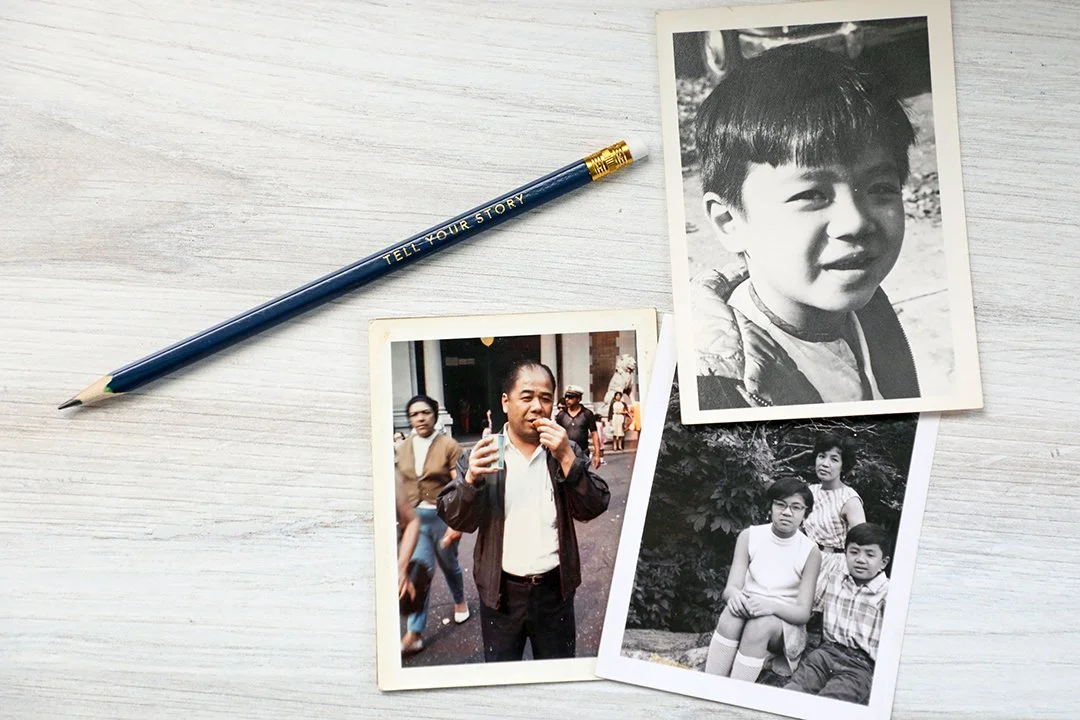
Vintage photo of three children in New York City taken some time between 1940-1979 by Morris Huberland, courtesy of the Miriam and Ira D. Wallach Division of Art, Prints and Photographs: Photography Collection, The New York Public Library.
Recording angels
LISTENING TO OUR PAST
In each episode of The Memory Generation, host Rachael Cerrotti converses thoughtfully with someone “about what it means to inherit memories and the power of passing stories from one generation to the next.”
A LIVING EULOGY
“‘Mom, we’re gonna do this differently,’ began my second son, Jason. ‘You know how there is always a eulogy at a funeral? A lot of great things are said. We don’t want to wait until you are dead for obvious reasons.’”
HER STORIES, HER HEIRLOOM
“I came to think of Stella as a modern-day Scheherazade who left me hanging, week to week, as she talked me through the story of her youth.” Michael Frank, author of a book that sits atop my to-be-read pile, One Hundred Saturdays, on the importance—and challenges—of oral history.
Writing our lives
SHIFTS, PAUSES, AND JUXTAPOSITIONS
“Narrative pacing addresses the overall speed of storytelling; emotional pacing addresses the impact of events and their associated emotions throughout the narrative.” Aggie Stewart shares lessons on writing a trauma memoir.
READING LIST
Last week I reviewed To Write the Past, a supportive companion for thoughtful memoirists that promises “to hearten and embolden those who pick it up to set their memories and musings on the page.”
“THROUGH THE LENS OF STORYTELLING”
“As you comb through your memories for storytelling fodder, lean into the uncomfortable and the outright embarrassing.” Artistic director of The Moth, Catherine Burns, is interviewed about what makes a good story.
AWAKENING THE EMERGING WRITER
Of the terrain she covers in her forthcoming book, You, The Story: A Writer’s Guide to Craft Through Memory, YA author Ruta Sepetys says: “It is more about the interior landscape. And through that we all have a story. A day is a story. A year is a story. A life is a story.”
ILLUMINATING HISTORY
“In life as it’s lived, there is no obvious plot; the arc of the past is visible only in hindsight. But in historical fiction, the aim is to capture a story, so fidelity to literal facts and timelines is not always the goal.” In the wake of Queen Elizabeth II’s death, an interesting look at the genre of historical fiction.
“BOY”
It doesn’t go without saying that a songwriter will be a talented memoir writer, but this essay, excerpted from his book Surrender: 40 Songs, One Story, shows Bono has earned his life story bona fides.
Managing your family archive
DROWNING IN A SEA OF PAPERS?
This three-step guide from Family Tree magazine promises to yield a “lean, well-curated family history collection” and includes a handy, printable checklist. to help determine which of your family papers to keep and which to toss.
PICTURE THIS
Albuquerque–based genealogist and photo organizer Hazel Thornton shares her take on the popular photo digitization app Photomyne, clearly demonstrating how knowing what scanning method to choose is all about knowing your end goals.
The big short
WORLDS AWAY
Sometimes all you need for a meaningful remembrance is two minutes, as evidenced by this slice-of-life narrative from sisters recalling growing up in their parents’ Hollywood laundry business:
SMALL BUT MIGHTY
The New York Times offers up a guide for their Tiny Memoir Contest (which runs until October 12, 2022), “How to Write a 100-Word Narrative”: “Step-by-step directions for telling a meaningful, interesting and short true story from your life.” Comment—and experiment—here.
A GAME OF STORIES
Storytelling nonprofit The Moth has added a card deck inspired by themes from their live storytelling shows and workshops—orchestrate your own story slam, or use “the story prompts to encourage lively conversation at your next dinner party or family gathering.”
Beyond family history
RECKONING WITH FAMILY HISTORY IN MEMOIR
“These books uniquely tackle the subject of ancestral legacy, leading readers into social and historical questions as one way of understanding the personal past.” Juliet Patterson suggests eight books that investigate family history with imagination.
STORIES OF HER ANCESTORS
What began as a chapter in Mali Bain’s master’s thesis ended up being a five-year journey to extensively research her own family history and connections to colonization in Canada. Now the British Columbia–based personal historian’s book is available in print or as an e-book.
CONNECTING PAST AND PRESENT
“Once again, [Ken] Burns and company have made history come to life — and reminded us that our life, right now, is indeed history in the making.” The U.S. and the Holocaust premiers September 18.
...and a few more links
The art of questioning: simple tips for conducting interviews from the Audio Transcription Center
Commentary by MTSU Professor Larry Burriss: Will your digital family photos be viewable 20 years from now?
“Change the way we listen”: a TEDTalk from Lifestorian Emma Fulenwider
Australia’s archivist on preserving the nation’s official memories
Short takes
“To Write the Past”: A supportive companion for thoughtful memoirists
This small yet dense self-published book comprises nine essays in which writer Sara Mansfield Taber aims to answer “the questions that plague the memoirist.”
To Write the Past: A Memoir Writer’s Companion by Sara Mansfield Taber
In my constant effort to keep up-to-date with the latest on memoir writing—particularly craft essays and books—I ordered the custom-published volume To Write the Past: A Memoir Writer’s Companion by Sara Mansfield Taber.
The book promises “to hearten and embolden those who pick it up to set their memories and musings on the page.”
To be sure, the eight essays within To Write the Past are thoughtful and at times thought-provoking, and the word “musings” is an apt description of the meandering style with which Taber approaches her topic. (The title’s sub-subheading reads, “Musings on the Philosophical, Personal, and Artistic Questions Faced by the Autobiographical Writer.”)
Book review:
“To Write the Past: A Memoir Writer’s Companion” by Sara Mansfield Taber
Taber is most qualified to write about memoir, having penned two memoirs herself and taught autobiographical writing for more than two decades at universities and in group workshops. As a writing coach she says she “has midwifed hundreds of memoirs into being.”
But her expertise on display in this book is broad, philosophical, pensive. You won’t get tips for creating a compelling narrative or weaving dialogue into your stories. You will, however, feel supported. A sense of “we’re in this together, fellow memoirist” pervades the book.
Some essays spoke more directly to me than others, and I have no doubt certain themes will resonate more with you than others based on your own experience as a writer. Taber approaches her topics, as perhaps one would expect a memoirist to do, firmly rooted in her own experiences writing, publishing, and reading memoirs.
The first few essays gripped me the most—I related to them, as a human, a fellow writer, and a personal historian.
On the topic of why we write memoir (something I often consider and write about myself), my yellow highlighter swept across passages. A few favorite lines, so you can get a taste of Taber’s tone and insights:
“Upon my father’s death, up-wellings of love for him, and for my whole past, swirled into the surges of grief, forming a roaring tide of need—to write.”
“As I wrote, it was as if I was writing about some other girl I once knew well. I sensed that she might be of some use to me even now, many years later.”
And:
“By writing, I dig a pool to catch all the joy and pain that constantly leaks from the years past.”
That last quote in particular captures my own urge to write, and oh, how beautifully expressed!
Taber’s musings on the question of legitimacy (“who am I to write my story?”) were familiar and affirming. On who one should be writing for, her thoughts were arresting and fodder for future contemplation. The essay exploring “the question of truth”—one of my favorite topics to discuss with fellow writers—was less exciting for me; “truth is multiple,” she writes, but I wanted more—more than “this is one story of my life.” (For anyone especially intrigued by the notion of writing your truth, I recommend Beth Kephart’s singular Handling the Truth: On the Writing of Memoir as well as her follow-up workbook, Tell the Truth. Make It Matter.)
The essay that resonated least with me concerned the notion, “Should I write something so personal?” I admit: I haven’t questioned this in my own writing. I haven’t encountered such criticism that Taber seems to have (quite strongly, it would seem) that her self-revelations are “too personal.” Her intense—and lengthy—defenses of getting personal felt overdone, though they may speak to you if this is an idea you, too, struggle with.
Overall, To Write the Past is a comforting and considerate meditation on undertaking to write a memoir. Check it out if you want to commune with a likeminded spirit, and to find compelling reasons to move forward in the face of criticism, doubt, or struggle. “There are so many things that get in the way as we endeavor—valiantly or timidly—to set down our autobiographical paragraphs,” Taber writes. Her essays strive to help you navigate those invasive thoughts, circumvent the roadblocks, and find your way on the path to a memoir—your memoir, finally written.
Why? Because: “A memoir is a prayer, an offer of company, an invitation to dinner. An offering of honesty…to whomever will receive it.” A worthy endeavor, indeed.
Note: This is an unsolicited review of a book I purchased at full price. I did not receive any compensation or free products in exchange, and any endorsements within this post are my own.

Life Story Links: September 6, 2022
Your curated reading list: Kick off September with an array of stories about family history tools, memoir writing tips, and more storytelling inspiration.
“In writing the memoir I had a chance to try to encompass the whirling aspects of my flickering self, to unite my past and present selves, to express a fuller self than I could with my friends and family. Since, with each person we know, we are partial.”
—Sara Mansfield Taber
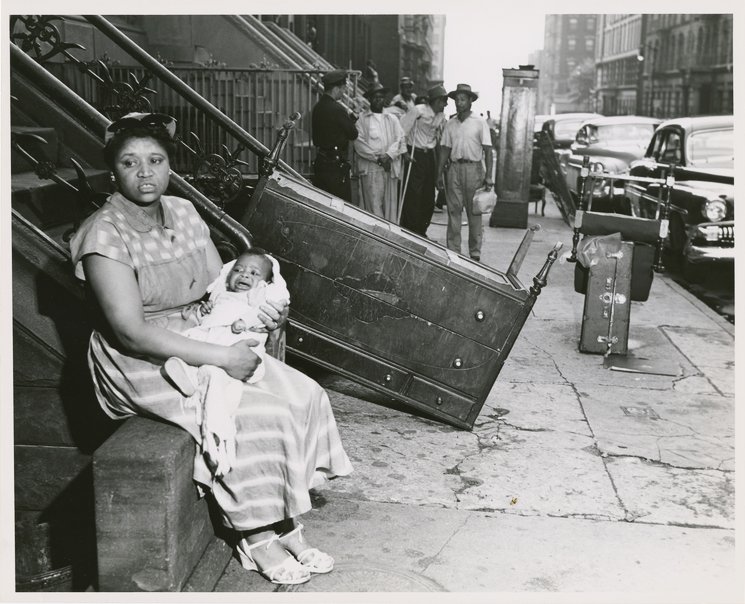
Vintage photo of a woman holding a baby outside of a building from which they had been evicted, Harlem, New York, 1954. Photograph courtesy of the Schomburg Center for Research in Black Culture, Photographs and Prints Division, The New York Public Library Digital Collections.
Family history tools
MAPPING A LIFE
“I started using her iPad to take her to the address of her childhood home in Huntington, Indiana…. Her memories spilled out about people, places, events,” Wisconsin–based personal historian Sarah White recalls in this piece about a newly available app called LifeMapping.
ESSENTIAL FAMILY HISTORY RESOURCE
In her review of Nearby History: Exploring the Past Around You, New Jersey–based genealogist Lorraine Arnold says the book’s progressive, actionable steps are conducive to eliminating that feeling of overwhelm when faced with a large family history project.
Our stories, our selves
ON BIOGRAPHY
“Even when a writer and her subject never meet, excavating a life can uncover hidden truths.” Emma Sarappo on what biography reveals—and how picking a subject can be “like picking a roommate.”
“THE BLESSING OF FEELING LIKE I KNOW WHO I AM”
Upon TV producer David Milch’s diagnosis of Alzheimers in 2019, his family members began “recording his personal remembrances and reaching out to others for stories that could stimulate [his] memories, all in the service of creating Life’s Work,” Milch’s memoir, out this month.
DON’T WAIT, MEMOIRIST!
Last week I wrote about why now is the right time to begin writing about your life—and why you should ignore the naysayers.
MOURNING A GUARDIAN OF MEMORY
“This is my responsibility and my privilege—to be custodian of their memories, to be able to pass their stories on to the next generation.” Phillip Maisel, pioneer of video testimonies at the Melbourne Holocaust Museum, has died.
‘YOU’RE BREAKING MY HEART’
“I am queer, a lesbian, or something, born in 1977 to a young, midwestern mom on welfare and no father. In 2002, I wore orange, my grandma’s favorite color, and brushed her hair as morphine quieted the cancer. The years leading up to this, I tried to come out. But I didn’t.” Read this short, powerful autobiographical essay by Chrys Tobey.
‘I NEVER LOOKED UP’
Holocaust survivor Tova Friedman’s new memoir reflects on life as The Daughter of Auschwitz. Listen in as she speaks with NPR’s Scott Simon (9-minute audio):
...and a few more links
“You’ve Probably Seen Yourself in Your Memories”: Remembering your life in the third person
Asking the right questions to develop primary source literacy
How to list divorced and remarried family members on a family tree chart
A posthumous memoir of actor Michael K. Williams is published.
“This is not a tennis story. This is a human story”—check out McEnroe documentary
Book review: To Fall in Love, Drink This: A Wine Writer’s Memoir
Short takes