
Memories Matter
Featured blog Posts

READ THE LATEST POSTS

3 unexpected places to discover great life story questions
While there are lots of lists of family history questions on the web, here are 3 places to find unexpected questions that lead to meaningful life story writing.

There are abundant resources online and in libraries for family history questions. You know the kind I mean: checklists of all the possible questions you can ask the grandparents, military veterans, immigrants, distant cousins. One of my recent favorites is the #52Stories project from Family Search, which provides 52 prompts for capturing one brief story about your life every week, hopefully motivating you to begin shaping your family’s intergenerational narrative.
But if you’re in the market for more thought-provoking conversation starters—deeper questions that you can ask relatives or yourself on your journey of documenting your life stories—then we’ve got three unexpected resources for you. The questions included in these recommendations are often provocative, occasionally off the wall, and always open-ended to encourage a full, meaningful answer using the subject’s own experience and feelings.
The Best Questions Yield the Best Answers
If you select questions thoughtfully, you’re sure to get revealing answers. Whether you choose to use those answers to inform writing your own memoir, as episodic stories in a personal history book, or merely as a means of self-development or family bonding, you’re guaranteed to learn something new about yourself in the process!
1 - Gravitas: The Little Box of Big Questions
Gravitas is a powerhouse of thought-provoking questions. This parlor game of sorts engages “players” in conversation with questions that call for reflection yet can be dealt with in a thoughtful or a more lighthearted manner. While the goal of the game is ostensibly to declare a philosopher king of the occasion, the real value in this “Little Box of Big Questions” is to get everyone offering thoughts on life’s big questions as a way of discovering who we really are and how we have lived.

Here is a sampling of the prompts (there are 429 questions in the box), designed to spark meaningful conversation and profound insights.
What takes your breath away?
What is your gold standard for a good friend?
How do you ‘carpe diem’?
Describe the gap between life as you imagined it and life as it is.
How do you practice kindness?
When they say you have to work hard at love, what do they mean?
And a few less profound options to keep the banter flowing—questions that could as easily invite surprising insights and wisdom as they could a punchline:
If we are what we eat, who are you?
When does the fun stop?
What is the best thing you have ever found?
They say that Seinfeld is a TV series about nothing. Any ideas for an episode?
Who would you like to eavesdrop on?
2 - Know Yourself: Cards for Self-Exploration
This small box of 60 prompt cards is less about conversation with others, like the Gravitas questions above, but rather about conversation with oneself. They delve straight into big-picture, deep ideas and often read like prototypical “head shrink” questions—but when approached with an open mind and a truly self-aware lens, these prompts can undoubtedly help us understand ourselves better.
Some of the questions in the Know Yourself box are clearly intended for private introspection, such as “What things would deeply alarm your loved ones if they knew them about you?” and “What are you currently lying to certain people around you about?”

Many of them, though, are wonderful prescriptions for prolonged thought or writing assignments that will yield worthwhile insights:
When do you cry or want to cry (as an adult)?
What did you learn about relationships from your parents?
List everything you are worried about, from the very large to the very small.
And some, well, simply invite interesting answers:
What are you trying to say through your clothes?
If a really kind person wanted to praise me, they’d say… If a really tough person assessed me, they’d say…
Name three works of art (music, literature, and visual art/architecture) that mean a lot to you.
I recommend consulting these questions if you are an aspiring memoirist or avid journaler who wants to be challenged to explore who you are, or just a curious soul craving a gentle nudge towards deeper self-reflection.
The cards are produced by The School of Life, who bills itself as “a global organization dedicated to developing emotional intelligence [applying] psychology, philosophy, and culture to everyday life.” Visit their site for a treasure trove of resources to enlighten and entertain. And if you decide to check out their Confessions Game—“a series of questions around career, sex, money, relationships, family, gently inviting everyone to share important bits of themselves in an intimate and playful atmosphere”—please let me know what you think, particularly if the questions might be helpful for memory-keepers and life story writers, too!
3 - If… (Questions for the Game of Life)
Writing one’s life stories requires not just looking towards the past, but also looking towards the future. It is our hopes and dreams and the life we imagine for ourselves that define us as much as the paths we have already taken—and preserving those thoughts for future generations is a worthwhile endeavor.
“Fantasies are what inspire us all; to work, marry, raise families, create, improve our world…. We imagine in order to learn, to understand, to strive, to attempt, to predict, to avoid, to correct, to describe, to solve,” write the authors of If: (Questions for the Game of Life) (Villard 1995). As you may have guessed, every question in this book begins with the word “if.”

Perhaps some of these questions lean towards the cliché (there are plenty of the if-you-could-dine-with-anyone-from-history variety), but that in no way diminishes from their purpose: to spark your imagination, and to provide glimpses into your personality and life. It is their accessibility, and their ability to make you step outside your everyday worries, that make them worthwhile.
These are a few of the questions that, in my opinion, go beyond the expected and provide impetus for life-story writing or conversation geared toward meaningful reminiscence:
If your plane were about to crash and you had time to write one quick note, to whom would you write, and what would you say?
If you could, in retrospect, change one thing about your childhood, what would it be?
If you could discover that something you thought was true was actually false, what would you wish it to be?
If you could gain total memory of one year of your life so far, which year would you pick?
If is a book that can be tucked away in your car’s glove compartment to make long road trips bearable, or it is a book that can be stashed in your bedside stand for instant journaling inspiration.
And now, some questions for YOU.
What is the one question that you find always elicits interesting stories?
If you could have asked one question of a deceased family member, what would you have asked, and to whom?
What other sources of interesting questions are in your repertoire? Books, websites, podcasts?
Please share your thoughts in the comments below—I’d love to hear from you!
Related Reading:
Who Will Tell Your Life Story? It can be daunting to think of writing (or even telling!) your life story. So don’t. Start saving your stories, one at a time.
35 Questions to Ask to Prompt Memories of a Lost Loved One
How to Use Photographs as Prompts for Writing Life Stories
This Week in Personal History... August 8
How the stories we tell about ourselves shape our lives, how to handle family photographs after a loved one dies, & more #lifestories links you’ll love.
“If you want a happy ending, that depends, of course, on where you stop your story.”
—Orson Welles
From “sharenting” to editing, from how the stories we tell about ourselves shape our lives to how to handle family photographs after a loved one dies, this week’s links run the storytelling gamut. Which is your favorite—and why? Share your thoughts with our generous contributors, if you will.
And, of course, let us know if you swing by Times Square to pick up the telephone!
Roundup of Personal History Links - August 8, 2017
In the News
OVERSHARING?
Many of us have the urge to document our lives, but for one segment of the American population this has become an almost obsessive compulsion: parents. I count myself among this group and understand both the draw and drawbacks of digital sharing. Check out two varying perspectives in “I’m Giving Up the ‘Sharenting’–for the Sake of My Children” and “X Marks the Mylestone.”
NARRATIVE IDENTITY
“When we want people to understand us, we share our story or parts of it with them; when we want to know who another person is, we ask them to share part of their story.” How subtly reframing your narrative can help you to live more purposefully.
On the Blogs
GIVE GRANDMA A CALL
This one’s an oldie but a goodie, rediscovered when a colleague shared it on social media: Genealogies tend to focus on names and dates, but oral traditions add flesh to the skeleton. Are you listening to your grandmothers?
AFTER A DEATH
When cleaning out your parent’s home after a death, don’t let all those boxes of family photos, and the stories they hold, be a burden; instead, allow them to help you heal.
THE WRITE CONVERSATION
Have you written your life story? If you’re ready to take the next step, Shreveport, LA–based Sarah Hamer discusses the value—and different types—of editing.
AN ARCHIVE OF INFORMATIVE LINKS
Longtime editor and writer Pat McNees, who is based in Maryland, provides a wealth of information on her site about memoir and life story writing. Warning: Don’t click unless you’re willing to get lost in a web of links—one good story leads to another here!
Worth Checking Out
At the intersection of pop culture and oral history, this brilliant interactive art installation in NYC's Times Square creates a platform for immigrant voices. Visitors are invited to open the door of one of three repurposed telephone booths, pick up the receiver, and listen to oral histories of immigration from the newest New Yorkers.
Visitors can also open the phone book inside each booth to read more about the storytellers' communities both here in New York and the countries they have traveled from, and to leave behind a part of their own story if they wish. The installation includes 70 different stories that will last anywhere between 2 and 15 minutes. Through September 5.
#MemoriesMatter #Legacy #LifeStories #Memoir #OralHistory
This Week in Personal History... August 1
This week’s collection of personal history links includes meaningful first-person storytelling, tips for family historians, & a fun Finding Your Roots TV teaser.
“Be the silence that listens.”
—Tara Broch
This week’s collection of links includes some meaningful first-person storytelling, tips for family historians, and a fun TV teaser—enjoy, memory-keepers!
Roundup of Personal History Links - August 1, 2017
In the News
A LIFE IN THEATER
“I was compelled by the idea of a grieving daughter going through her father’s boxed up treasures in the theater that made his name,” writes Michael Paulson in the NYT. What James Houghton left behind: keepsakes from a life in theater.
HIGHLIGHT REEL
Interested in family history? Then, like me, you're probably a fan of Henry Louis Gates, Jr.’s Finding Your Roots. The series returns on October 3, and here’s a sneak peek at some of the guests.
On the Blogs
VIETNAM-ERA ACCOUNT
“I would soon realize arriving in the middle of the night in a strange place was the Air Force’s first step in ripping us away from the civilian life we had left,” writes Doug Elwell in “Falling Through the Rabbit Hole.”
Personal historian Sarah White, who conducts life-writing workshops through her Madison, Wisconsin–based First Person Productions, is always looking for creative nonfiction contributions like this one.
THE PHOTO LEGACY YOU LEAVE YOUR KIDS
Prepare your family photos so they provide comfort—not a burden—to your children when you're gone. It’s one of the most meaningful legacies you can leave your kids.
CHEERS!
The story of how wine glasses made Katelyn Burns, a trans woman, feel more connected to three generations of women in her family than ever before. A powerful true story of identity, belonging, and names.
Worth Checking Out
For newbies to the world of personal history, this thorough and easy-to-follow toolkit is a step-by-step guide to doing a successful oral history project. It's a great resource for anyone wanting to preserve an individual’s unique memories & life stories. Thanks to @FionaCosson for sharing!
#MemoriesMatter #Legacy #LifeStories #Memoir

The photo legacy you leave your kids
Prepare your family photos so they provide comfort—not a burden—to your children when you're gone. It’s one of the most meaningful legacies you can leave your kids.
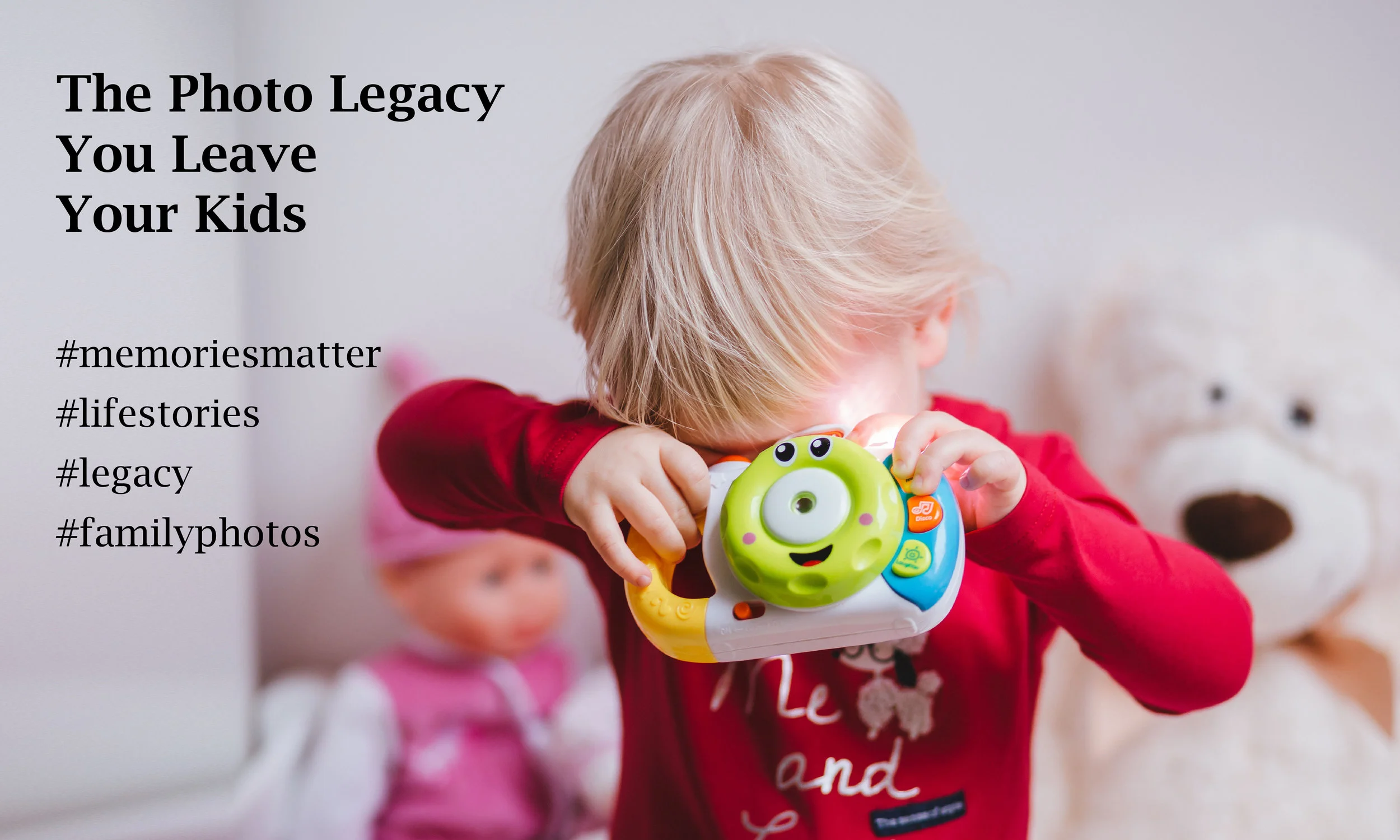
Don’t leave behind three obsolete devices filled with thousands of digital photos for your children to find when you’re gone. Prepare your pictures so they provide comfort—not a burden—to your children: It’s one of the most meaningful things you can do for your kids.
Prepare for the inevitable.
We are all going to die one day. Hopefully you’re not thinking about this inevitability too often, but it’s wise to prepare: Have a will drafted by an estate attorney, prepare your finances and insurance, and organize your records. Even this common wisdom is too often ignored by many.
So is it only the organizationally obsessed who will think about something as mundane as preparing your photos? I hope not.
The legacy of family photos, stories, and the artifacts of memory—scrapbooks, letters, heirlooms—may be of greater value to your heirs than your monetary legacy. Don’t underestimate how much a connection to the past will mean to your loved ones someday!
All that stuff can be a burden to your kids.
It’s convenient as heck to have a basement in which to toss those extra boxes of stuff. But Americans have taken consumerism to new levels in recent years, with shows about hoarding captivating television viewers and paid storage facilities dotting suburban landscapes. We love our stuff, for sure. And while I doubt you are a hoarder, chances are your closets and garage are housing plenty of stuff.
Julie Hall, author of The Boomer Burden: Dealing with Your Parents' Lifetime Accumulation of Stuff, speaks from decades of experience when she says that the next generation will undoubtedly be burdened by all that you will leave behind. “I can virtually guarantee they will not care for these items the way you do, and often are upset and resentful when having to sell or discard them,” she says. “When this happens, hasty decisions are made to ‘just get rid of it.’”
Her advice? “Choose only your favorite things and let the rest go. Future generations will be most appreciative.”
Organize your family photos so they provide comfort, not nuisance.
Don’t assume that your library of family photos is exempt from that “just get rid of it” mentality. If what you leave behind is messy or overwhelming, well, then it’s more of a burden than a gift.
Here’s how to approach your photo organization project, in seven simple steps:

1 - Organize.
Tossing family photos can be one of the hardest things we do. There is a guilt associated with it—those pictures meant something to someone, after all. But do they mean anything to you? Will they matter to your children? Before you can determine which pictures to keep and which to trash, you must first organize them.
Choose a method that suits you, and dive in: Chronological, thematic, or by individual.
If you think creating a straight visual timeline of your life is best, keep in mind that it’s unlikely you will know exact dates for everything; sorting photographs into decades might be most efficient.
Sorting pictures by theme—birthdays, vacations, Christmas, childhood milestones, etc.—is a popular option for those who may want to create books or slideshows down the road. It can be fun to see the similarities in your traditions or amongst your children, too.
It’s possible that you are undertaking this organization project with the idea of divvying up the treasures for your kids. The most challenging part here, particularly with physical photographs, is that multiple children are likely to appear in one photo. I suggest creating one pile for those shots, and prioritizing having those images digitized first.
2 - Toss.
Delete pictures from your phone. Throw away old photos. Easier said than done? Yes, but once complete, this process can feel liberating. And it will be tremendously less burdensome for your heirs. Find advice for how to start trashing digital photos in this helpful article. And don’t forget to place the digital images you choose to keep into albums or folders sorted by date or theme—a hard drive filled with thousands of pictures in no particular order will be more overwhelming than inviting!
Do the same thing with the piles of physical photos you sorted in step one—begin to throw away any that do not hold meaning. Get rid of duplicates and indecipherable pictures.
On the most basic level, ask yourself: Does the picture tell a story that you want to remember? Is it a spectacular photo? If the answer to either of those is YES, it’s a keeper. If not, consider if someone else may value it, or put it in the garbage.
3 - Caption.
Now that you’ve sorted and narrowed down your collection, it’s time to preserve the most basic details of your important pictures. Use a photo-safe pen to write names, dates, and places on the back of your physical photos. Write legibly, and include full names whenever possible. Don’t assume your children will remember their toddler friends’ names or even their grandparents’, for that matter.
If you are technologically savvy, consider inputting all the caption information into the metadata of your digital photos. If that’s too ambitious, print out the most important ones, even on regular office paper, so you can write the information on them.
Seem like a crazy amount of work? Perhaps it is a lot, but consider this: What value will these photos hold if your family members do not even know what they represent? (None.) Alternatively, what value will they hold if you share not only the vital details, but the stories behind them? (Priceless.)
4 - Designate.
Don’t leave it for your kids and your grandkids and your siblings to hash out who gets what. Determine who might want your photos, and divvy them up accordingly.
Many people find that gifting old photos, especially, to their loved ones, is a worthwhile endeavor to do now. Sit with those you love, use your photographs as prompts to share the stories of your life, and see how much they are cherished! Your time and story sharing are the best gifts you can give. If you can’t part with your pictures just yet, share your intentions for bequesting them when you are gone.
5 - Create.
There are strong reasons why we hold our family photos dear. They connect us to the past, testify to our triumphs and experiences, and make us remember. And smile.
Share the smiles with those you love by creating something special from your favorite photo moments:
enlarge and frame a single print
send a digital image via email with more than a #tt hashtag: write its story, share the memories it conjures up
By creating something—and sharing it—you are giving life to the stories behind your photos.
6 - Permit.
Give permission to your children to toss your things. You may have an attachment to your stuff, but your children will find their own connection to what you leave behind—and it may be to something completely unexpected.
Let them know that you do not expect them to keep everything, and if you have a preferred charity, tell them you’d be happy to have your things be donated. Likewise, tell them which photographs and heirlooms you would most like to pass on, and why. When your loved ones are armed with this knowledge, their decision-making becomes much less emotionally charged, and they are more likely to hold onto and cherish those things that hold true meaning.
7 - Hire.
If all of the above seems too daunting, or if your time is simply taken up by other priorities right now, consider hiring a professional photo organizer. They can jump in at any stage of the process or help out with just one step.
This Week in Personal History... July 25
Our collection of links for the week of July 25, 2017, runs the gamut from frivolous (Meryl Streep’s hair) to significant (the value of storytelling to bridge divides).
“Your legacy is every life you’ve touched.”
—Oprah WInfrey
This week’s collection of links runs the gamut from frivolous (think Meryl Streep’s hair) to the significant (the value of personal storytelling to bridge divides). Which story lingers with you after reading? Please comment and share with other memory-keepers and storytellers!
Roundup of Personal History Blogs - July 25, 2017
In the News
“The dead help the living face what lies ahead. In exchange, the living must translate the lives of the dead into history. They can find myriad ways to do so, from visiting gravesites to writing someone’s biography.” An interesting look back at the phenomenon of postmortem photographs in The Atlantic.
AUTOBIOGRAPHICAL STORYTELLING IS BRIDGING DIVIDES:
Storytelling evenings aim to engage Muslim & Jewish communities in conversation at a time when the climate is strained. “The ability to have conversations across difference has never been more difficult and never been more important.”
In Beirut, where the tradition of public storytelling has faded in recent decades, a new phenomenon is drawing crowds: autobiographical storytelling events where participants share their experiences on a theme such as love, transition, or roots.
On the Blogs
ANNUAL TIME CAPSULE
Birthday letters are an easy way to keep a consistent & meaningful record of your life, writes Olive Lowe of Phoenix-based Life Stories by Liv.
WHAT’S IN A NAME?
Family names can reveal more than just family history—they can be indicative of social & cultural influences, and sometimes plain old taste. Australia-based personal historian Rose Osborne takes a light look at the women in her family.
MEMORIES IN CONTEXT
For Richmond, Virginia–based Carol McLaren, July 20, 1969, is a date with both personal & historical significance. Read about her memorable childhood experience that just happened to coincide with “a giant leap for mankind.”
Worth Checking Out
Spotted: Meryl Streep donning a teased-up mouse-brown wig to better resemble Katharine “Kay” Graham, who she’s portraying in a Spielberg-led biopic. It’s based on The Washington Post publisher’s Pulitzer Prize winning 1998 memoir, Personal History, which I highly recommend you read (whether you plan to see the film or not)! Get a taste of the book in Nora Ephron’s original New York Times review from 1997.
“Your legacy is every life you’ve touched,” said Oprah Winfrey in her 2017 commencement speech at Agnes Scott College. View highlights in this brief video.

Quick Takes
#MemoriesMatter #Legacy #LifeStories #Memoir
This Week in Personal History... July 18
Unexpected stories, digital photo storage, & pop culture offerings that tap into the value of oral history make the cut in this blog roundup for July 18, 2017.
“One lives in the hope of becoming a memory.”
―Antonio Porchia (Italian poet)
This week's posts examine how everyday conversations with folks we already know can yield unexpected and rich stories; outline the best options for saving your precious family photos in the cloud; and highlight a few pop culture offerings that tap into the genuine value of oral history and memory-keeping.
Roundup of Personal History Blogs - July 18, 2017
In the News
“I wanted to show the quiet, normal moments of this family of African-American women: our everyday life, our happy moments, our down moments. ‘Mitochondria’ is a family album, a visual diary of our intimate lives.” Check out this rich gallery of family photographs, telling stories from the life of artist Nona Faustine.
On the Blogs
WHAT PROMPTS STORY SHARING?
There are many techniques to get people started sharing their stories. Yet sometimes, life presents an opportunity to listen that is “out of the box.” Read Just a Whistle by Marjorie Turner Hollman for a glimpse of just such an opportunity.
“SO, I ASKED A QUESTION...”
Even if you have known someone for years, you never really know their whole story. Timing is everything for learning more about the people you love and admire, as Lori Gillespie discovered.
VIRTUAL PHOTO STORAGE
Photographs play an important role in preserving family stories. Where are you keeping yours? So many cloud-based photo storage options are available today that picking one can be a daunting task—here's guidance from the experts at Nevada-based Legacy Tale.
Worth Checking Out
“This is the first time that the two of us have ever spoken about her as a mother,” Prince Harry said of Princess Diana as he flipped through a family photo album. “She was our mum. She still is our mum.” While they are royals whose stories captivate people all over the world, these two sons privately cherish their personal history & memories, as revealed in a documentary premiering July 24 on HBO.
Please leave comments about any of the topics featured here (they’re nothing if not conversation starters, I hope!) and share with other like-minded memory-keepers. And if you're a blogger with content you'd like to see featured here, of course click the link and share what you’ve got!
What Are You Reading?
Let me know what you've read that the rest of us might enjoy—memoirs, how-to or business books, even articles.
#MemoriesMatter #Legacy #LifeStories #Memoir
This Week in Personal History... July 11
The weekly roundup of blogs for July 11, 2017 includes posts on family reunions, legacy letters, & stories of mom, curated by Dawn Roode for all memory-keepers.
“Every man's memory is his private literature.”
― Aldous Huxley
Welcome back, memory-keepers! I hope you had a festive and safe Fourth of July week, and that (if you must) you're easing back into the work week with a smile on your face ; )
This week we take a dive into family reunions, legacy letters, and stories of mom.
Please leave comments about any of the topics featured here (they’re nothing if not conversation starters, I hope!) and share with other like-minded memory-keepers. And if you're a blogger with content you'd like to see featured here, of course click the link and share what you’ve got!
Roundup of Personal History Blogs - July 11, 2017
In the News
“Aunts, uncles, friends, neighbors, children and grandchildren—everyone who grieves my Opa has different memories, different recollections of him. Standing by that photo album, I realized we were putting our memories & knowledge & stories together like a puzzle to see a larger picture of the man we’d lost.” Read more in Love by the Puzzle Pieces.
“People almost always tend to gravitate to very personal, impactful stories in their lives. So if you say, ‘Tell us something that's really important to you,’ most people tell something that makes them tear up at a certain point.” Read about an interesting community oral history endeavor in Southern Colorado.
On the Blogs
LEGACY LETTERS
Legacy writing can be both healing and historical, and can make a lasting difference to your family & friends. Here are 5 tips on how to write a ‘love’ letter to your family from Sarah Hamer.
FAMILY REUNION FUN
“On the eve of the reunion a few of the cousins gathered at my parents’ house to celebrate my father’s 85th birthday and started sharing stories,” writes Bruce Summers of Summoose Tales, whose post focuses on how he integrated “adult Show & Tell” at his latest family reunion.
Check out the inspiration behind Bruce's story-sharing device and find a Show & Tales event near you (from personal experience, I can attest you won't be disappointed!).
IN SEARCH OF...
Meghan Vigeant of Stories to Tell is seeking women to interview about their experiences gathering their own mother’s stories. Have you interviewed or recorded your mother telling her stories, delved through her journals, or interviewed other family members about your mom? If so, reach out to Meghan—who knows where the conversation will lead?!
Worth Checking Out
One of the best ways to get to the heart of someone's story is to ask them great questions.
Even oral historians who have conducted countless interviews still hone their craft. A new (rather meta) podcast, The Turnaround with Jesse Thorn, turns the tables on interviewers, making them the interviewees. The first episode with Ira Glass was a delight.
Radio Rookies, produced by WNYC, has compiled resources to help students conduct better interviews—but I would say these links (which include advice on how to record interviews, how to choose a topic, and a handy question generator) are great tools for anyone wanting to interview their own family members to capture stories for posterity.
What Are You Reading?
Let me know what you've read that the rest of us might enjoy—memoirs, how-to or business books, even articles.
#MemoriesMatter #Legacy #LifeStories #Memoir
This Week in Personal History... June 27, 2017
Weekly roundup of blogs & news stories of interest to personal historians, memory keepers, and life storytellers curated by Dawn Roode. Comment, share, contribute!
“Live, love, laugh, leave a legacy.” –Stephen R. Covey
If you’re visiting this site, it means you’re a memory-keeper, a storyteller, the family archivist. However you identify yourself, I am fairly certain you’d agree that preserving our most meaningful stories for the next generation is paramount.
Welcome to the first in what promises to be a weekly roundup of stories geared just for you!
Personal history is a vital industry that includes oral historian bookmakers like myself, videographers, ghostwriters, genealogists, biographers…and many more; we are united by a shared mission of preservation & story gathering. This site has plenty of advice and book ideas & inspiration, and we’d love to work with you to create a coffee table book bringing your stories to life. But we can also refer you to personal historians with services more closely geared to what you’re looking for, or who are closer to your home—many of them whose blogs are featured in this roundup.
Please leave comments about any of the topics featured here (they’re nothing if not conversation starters, I hope!) and share with other like-minded memory-keepers. And if you're a blogger with content you'd like to see featured here, of course click the link and share what you’ve got!
Roundup of Personal History Blogs - June 27, 2017
In the News
Explore 22k immigration photos & read the accompanying personal stories from the @naagovau's collection on the revamped “Destination: Australia” site
Did you know your home movies may be unwatchable soon?
“Why You Need to Stop Procrastinating and Transfer Your VHS Tapes to Digital ASAP”
“Videotapes Are Becoming Unwatchable As Archivists Work To Save Them”
Some insightful writing & glorious photos documenting lesbians from all walks of life, from perhaps a surprising source: “American Women: Pride”
On the Blogs
“Turn, Turn, Turn” by Verissima Productions' Pam Pacelli Cooper on the nature of change, and her company's next big documentary endeavor (can't wait to learn more!).
“Stories Are Everything” by Dawn Roode of Modern Heirloom Books: Why Soledad O'Brien and Henry Louis Gates, Jr. value stories so much.
“In the Beginning, or How We Created Something from Nothing,” a conversation between personal historians and partners Samantha Shubert and Susan Hood on the occasion of the first anniversary of their business, Remarkable Life Memoirs: “There’s such a market for preserving people's stories that I feel really positive about how it’s going to go for us.” So do we, so do we! Happy first anniversary, ladies ; )
What Are You Reading?
Let me know what you've read that the rest of us might enjoy—memoirs, how-to or business books, even articles.
#MemoriesMatter #Legacy #LifeStories
Dawn Roode’s curated roundup for the week of Sept. 23, 2026, is overflowing with recent reads on memoir, life story writing, and family history preservation.