
The emotional work of finishing a family history book
Finishing a family history book can feel like saying goodbye. Why is it so hard to end? And how can completing the story become its own act of love?
For many people, the act of documenting a loved one’s life becomes more than a project. It becomes a relationship—a dialogue with the past that can stretch on for years.
One of my clients, Hanna, has spent the last decade immersed in her father’s archive. He saved everything—letters, certificates, paperwork of every sort, from his wartime documents to every continuing education class he took and taught. Her NYC apartment is filled with this stuff of the past: It’s in file cabinets, in boxes, on CDs and flash drives…and swimming in her head. Hanna has meticulously catalogued and researched every piece, determined to understand the life her father lived.
When she came to me, she had already assembled the materials of a lifetime. Over the course of fourteen hours of interviews, we shaped his story into a cohesive narrative and designed a book that was as thorough as it was beautiful—a complete, tangible record of a remarkable life.
And yet, when the book was nearly complete, I sensed her hesitation. Emails trickled in slowly, often with more documents attached—not new revelations, but additions that felt like a way of keeping the conversation going. I realized: She wasn’t stalling the book. She was stalling the goodbye.
The emotional attachment behind the work
Creating a family history or memoir is rarely just a logistical project. It’s an act of devotion—of returning, again and again, to a person or time that mattered deeply. For many, the research, writing, and decision-making become a way of staying in relationship with the person they’ve lost.
When the work nears completion, it can feel like a second loss—the moment when the living connection, the active engagement, comes to an end.
Why it’s so hard to finish
Identity Shift:
The project becomes part of who you are—“the one who’s telling Dad’s story,” for example. Letting go means reimagining yourself outside of that role.
Fear of Finality:
Finishing the book can feel like closing the door on someone’s memory, even though the act of preservation is itself a form of continuation.
Perfectionism as Protection:
Adding “one more document” or “one more edit” can feel like diligence, but it’s rarely about accuracy alone. It’s often a gentle way to postpone the ache of completion.
How to know when it’s time to step back
Legacy work will always be unfinished in some way. There will always be another photo tucked in a drawer, another relative with a different recollection. The art lies in knowing when the story feels whole enough to share.
Ask yourself:
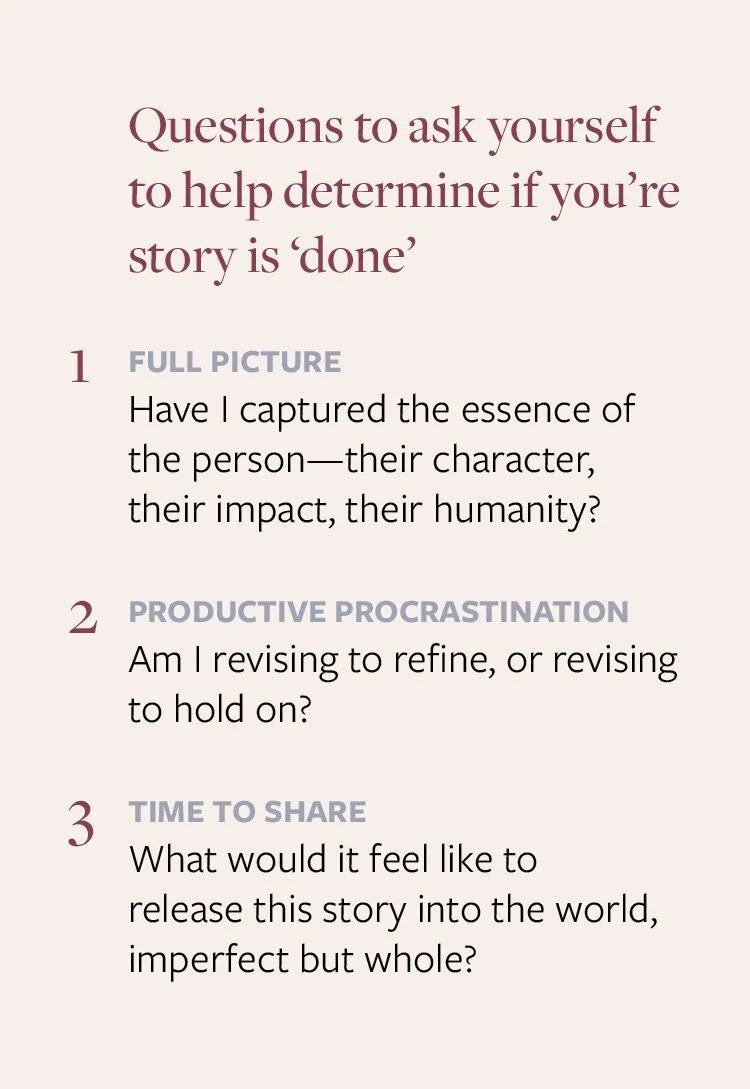
Have I captured the essence of the person—their character, their impact, their humanity?
Am I revising to refine, or revising to hold on?
What would it feel like to release this story into the world, imperfect but whole?
Finishing doesn’t mean forgetting. It means you’ve tended the story well. You’ve given it form, context, and love—and created something that will live beyond you.
A different kind of closure
There’s a special moment when a client first holds their finished book. The story that once existed only in notes, folders, and memory becomes something tangible—a keepsake that can be passed, shared, and cherished. The project shifts from being a private labor of love to a living heirloom.
That, to me, is the real completion: when the work becomes a bridge, not between researcher and archive, but between generations.
A note for those still in the process
If you find yourself struggling to let go, be gentle with yourself. Allow yourself the grace of feeling the peace that comes from knowing you’ve done what you set out to do.
The impulse to keep adding, refining, and revisiting is a sign of deep care. But remember that the story’s power isn’t in its perfection—it’s in its presence.
It’s also in the connection the comes from sharing the story; the legacy you’ve built continues through the people who will now read it.
At Modern Heirloom Books, I see this again and again: The beauty of storytelling lies not only in what we preserve, but in the courage it takes to finish—to give the story form and release it into the world, so it can keep speaking long after we do.


























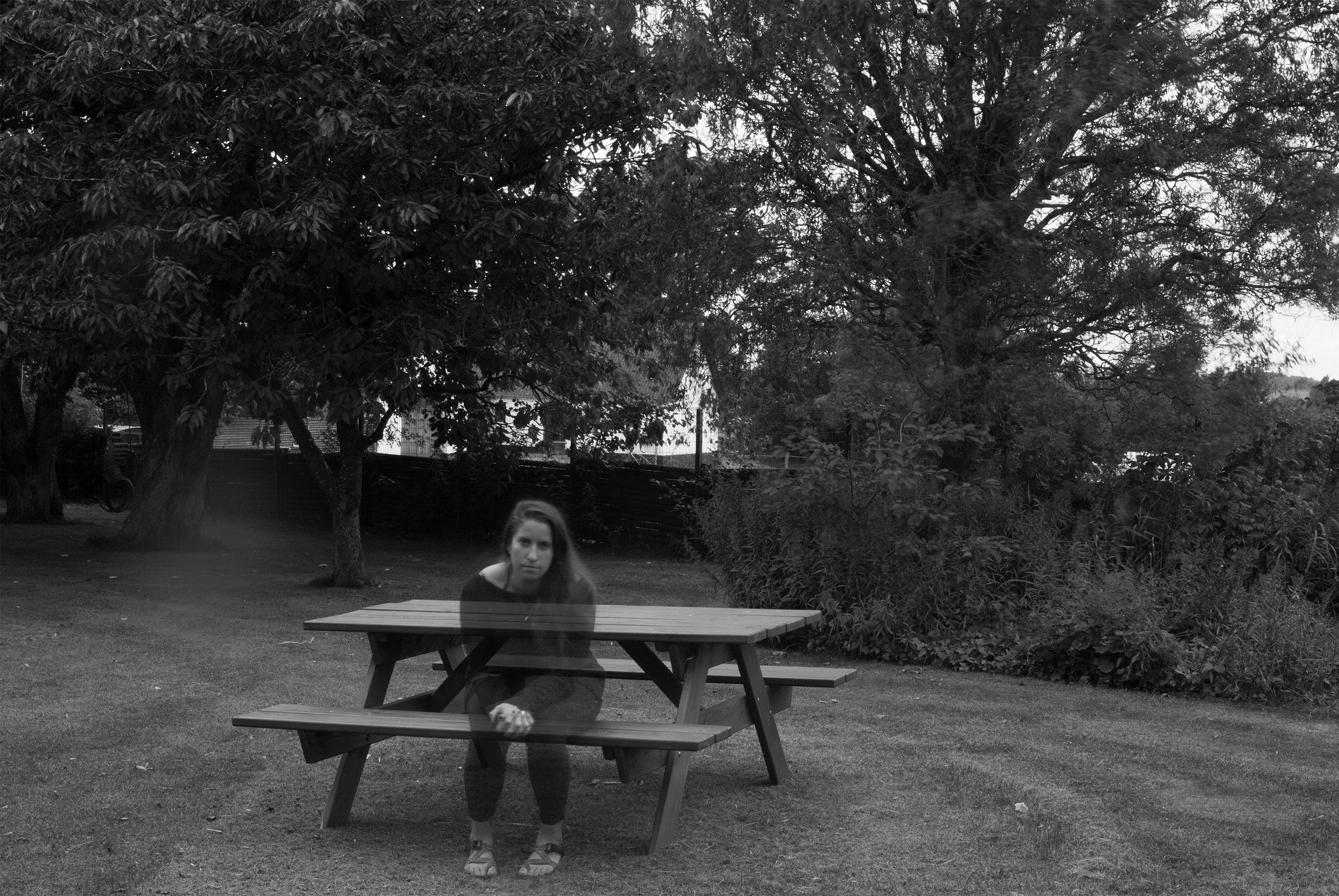




Sharing family stories keeps memories alive. Discover how to extend your loved one’s legacy—and meaningful ways to share your finished book.