
Memories Matter
Featured blog Posts
READ THE LATEST POSTS

Why we forget—and what it means for memoir writing
Memory is imperfect—but that shouldn’t stop you from tapping into yours to write your memoir. Learn how forgetting and bias can deepen truth in your life story.
When we look back on our lives, we like to believe we’re scrolling through an archive: a set of neatly labeled folders, each containing exact details of what happened and how we felt. But that’s not how memory works at all.
In truth, our recollections are constantly shifting, reinterpreted with every act of remembering. They’re less like recordings and more like retellings—edited, rearranged, and subtly reshaped each time we bring them to mind.
So: Memory is fallible, yes. Does that mean you shouldn’t tap into your memories to write your own memoir?
Nope. Honestly, that malleability of memory is one of the things that I think makes memoir so compelling.
Why we forget (and why that’s normal)
Scientists tell us that the brain’s job isn’t to preserve everything—it’s to help us survive. So our minds naturally prioritize the information most relevant to our safety, well-being, and identity.
We forget because the brain is selective. It keeps what matters and lets go of what doesn’t. And even what it keeps, it continually revises. Each time we recall a memory, it’s like opening a document, making a few edits, and saving over the original file. Over time, details shift—a color, a date, a conversation.
Layer onto that our human tendency toward confirmation bias (remembering things that affirm what we already believe) and rosy retrospection (looking back on the past more fondly than we felt in the moment), and it’s no wonder that siblings can recall the same event in entirely different ways.
But these imperfections aren’t flaws—they’re texture.
What that means for memoir writers
If you’ve ever worried that you don’t “remember enough” to write your story—or that your memories conflict with someone else’s—you’re not alone.
The truth is, memory doesn’t need to be perfect to be meaningful. Memoir isn’t about getting every detail right; it’s about revealing the truth of experience.
When differences arise (“My sister swears it was raining that day—I remember sunlight”), consider leaving them in. That contrast adds depth and honesty. It reminds readers—and ourselves—that our lives are filtered through perception, emotion, and time.
In the same way, partial memories or emotional impressions can be just as valuable as precise ones. A single sensory fragment—the smell of wet grass, the hum of a neighbor’s radio, the taste of hospital coffee—can transport both writer and reader far more powerfully than perfect chronology.
When you’re unsure what’s “true”: 3 ways to write anyway
Acknowledge uncertainty on the page. If you’re not sure whether a detail is exact, say so: “I think it was autumn—or at least it felt that way.” Readers appreciate honesty, and this kind of transparency builds trust.
Follow the feeling. Instead of forcing accuracy, focus on what the moment felt like: “I don’t remember what we said, but I remember how safe I felt sitting beside her.” Emotion is memory’s most reliable anchor.
Explore the differences. If someone else remembers it differently, include that contrast: “My brother insists we moved out of the house before my grandparents died; I am confident it was after. Either way, we were both impacted by the loss for years to come.”
Small divergences such as these show how perspective shapes story—and how memory itself is a conversation.
The beauty of imperfect memory
Forgetting is part of being human. It’s what makes our stories living things rather than static archives.
When you write a memoir, you’re not testifying in court—you’re offering your version of truth, shaped by love, loss, laughter, and the unsteady work of remembering.
So don’t let uncertainty stop you from writing. Let it deepen your storytelling. Use memory’s flaws as texture, its gaps as space for curiosity, and its contradictions as proof of life lived fully.
Because in the end, what we forget isn’t nearly as important as what we choose to remember—and what those memories reveal about who we are.
Further reading: memoirs that play with memory
If you’d like to see how other writers have embraced the imperfections of memory, these memoirs offer wonderful examples:
Joan Didion, The Year of Magical Thinking
Grief distorts time and recollection; Didion shows how writing through uncertainty can illuminate emotional truth.
Dani Shapiro, Hourglass
A fragmented, time-bending look at marriage and memory, proving that what’s forgotten can be just as revealing as what’s remembered.
Mary Karr, The Liars’ Club
Karr doesn’t hide her hazy recollections; instead, she acknowledges contradictions head-on, using them as evidence of her story’s complexity.
Jeannette Walls, The Glass Castle
Walls reconstructs an imperfect past with honesty and heart, reminding us that emotional accuracy matters more than factual precision.
Alice Walker, The Same River Twice
Juxtaposing journals written decades apart, Walker shows how perspective transforms memory over time.
Philip Roth, Patrimony
The interplay between Roth’s and his declining father’s memories becomes a meditation on what remains when both narrative and life begin to fade.
Each of these writers proves that memory’s flaws aren’t barriers; they’re invitations to look deeper, write braver, and embrace the shifting landscape of truth.


















Why privacy is a top commandment at Modern Heirloom Books
At Modern Heirloom Books, privacy is sacred. Learn why we never share clients’ stories publicly—and how discretion builds trust and honors every legacy.
Dawn Roode is the founder of and principal personal historian at Modern Heirloom Books. Every member of her team is carefully vetted and adheres to the same strict privacy promise for the clients we serve.
In a world that prizes visibility—where nearly everything is photographed, posted, and shared—it can feel almost countercultural to keep things private.
At Modern Heirloom Books, privacy isn’t just a courtesy. It’s a cornerstone of our philosophy.
Many of the books we create are never seen by anyone outside the family who commissioned them. They aren’t photographed for social media, featured on our website, or referenced by name in our portfolio. And that’s entirely by design.
Stories deserve discretion.
Every project begins with trust. Our clients open their hearts, their homes, their family archives—and often, their vulnerabilities. Behind every heirloom book are stories of love and resilience, yes, but also stories of loss, struggle, and deeply personal transformation.
Those stories are not ours to share.
While we’re proud of every book we create—the craftsmanship, the design, the narrative care—what we value even more is the confidence our clients place in us. The knowledge that what they entrust to Modern Heirloom Books will be handled with reverence and never exploited for publicity.
We navigate sensitive waters with care.
Over the years, we’ve worked with families in every imaginable circumstance:
Busy executives who don’t have time to manage a sprawling archive but want to preserve their story for their children.
Thought leaders whose public voices differ from the personal reflections they want to preserve privately.
Families navigating tension or rifts between siblings, where the story must be told with sensitivity, neutrality, and grace.
Loved ones working through grief or reconciliation, uncertain what they’re ready to share.
Each project requires not just editorial skill, but emotional intelligence. We listen without judgment. We guide with care. We adapt to the boundaries that feel right for each family.
That discretion is not incidental; it’s essential.
Privacy is a form of respect.
The act of recording a life story is, at its heart, intimate. It asks people to speak aloud things they may never have said before.
We treat those stories as sacred. They belong to the families who tell them—not to us, not to the world, not to the internet.
So while it might mean fewer glossy “after” photos on our Instagram feed, it also means something far more important: that our clients feel protected, honored, and free to share their truths fully.
When you entrust us with your story, you’re not just commissioning a book—you’re choosing confidentiality, compassion, and care.
In an age that celebrates exposure, we choose discretion.


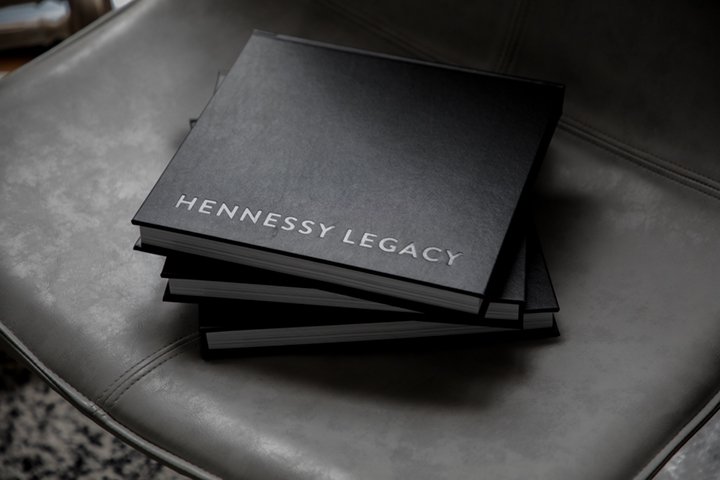





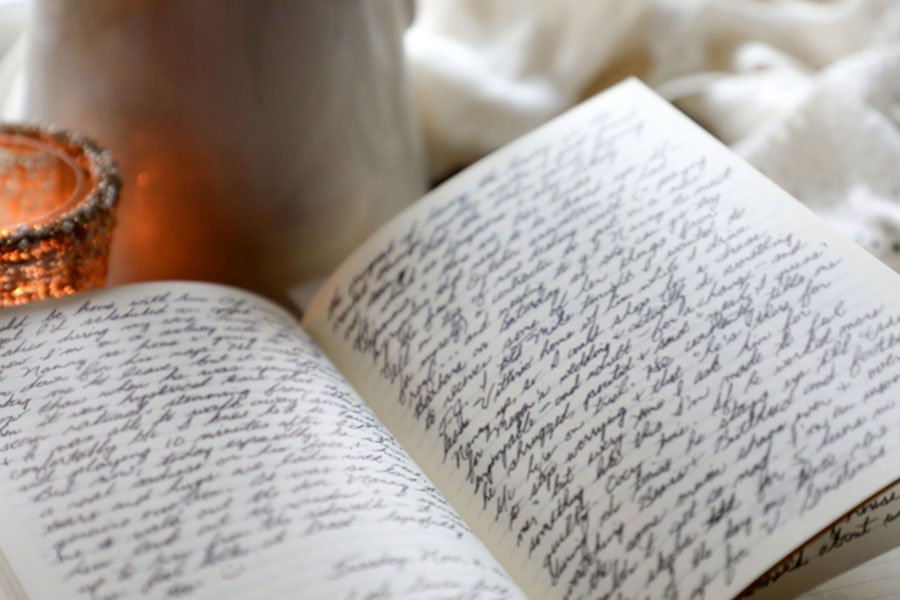



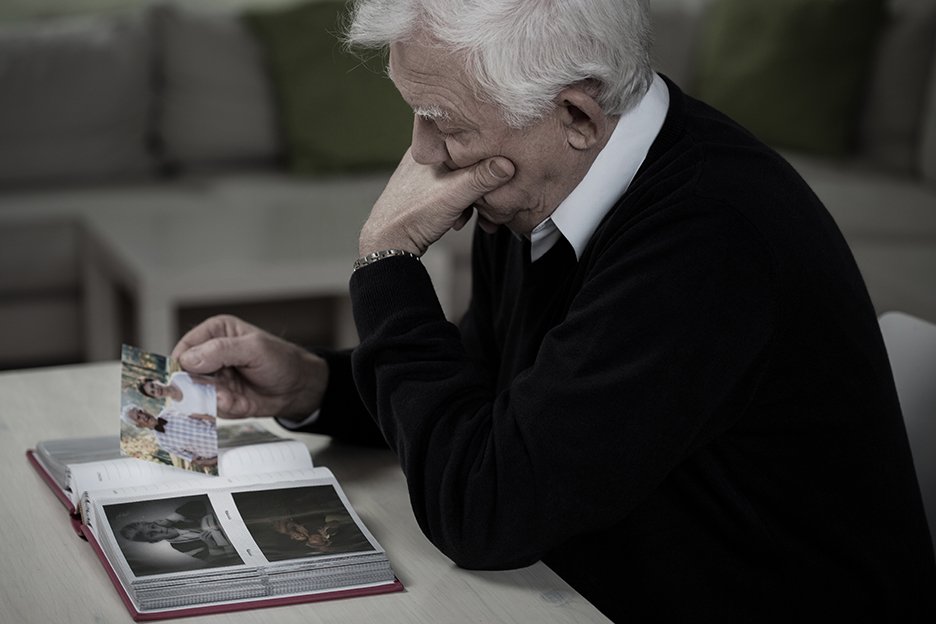




The emotional work of finishing a family history book
Finishing a family history book can feel like saying goodbye. Learn why it’s so hard to end—and how completing the story can become its own act of love.
Finishing a family history book can feel like saying goodbye. Why is it so hard to end? And how can completing the story become its own act of love?
For many people, the act of documenting a loved one’s life becomes more than a project. It becomes a relationship—a dialogue with the past that can stretch on for years.
One of my clients, Hanna, has spent the last decade immersed in her father’s archive. He saved everything—letters, certificates, paperwork of every sort, from his wartime documents to every continuing education class he took and taught. Her NYC apartment is filled with this stuff of the past: It’s in file cabinets, in boxes, on CDs and flash drives…and swimming in her head. Hanna has meticulously catalogued and researched every piece, determined to understand the life her father lived.
When she came to me, she had already assembled the materials of a lifetime. Over the course of fourteen hours of interviews, we shaped his story into a cohesive narrative and designed a book that was as thorough as it was beautiful—a complete, tangible record of a remarkable life.
And yet, when the book was nearly complete, I sensed her hesitation. Emails trickled in slowly, often with more documents attached—not new revelations, but additions that felt like a way of keeping the conversation going. I realized: She wasn’t stalling the book. She was stalling the goodbye.
The emotional attachment behind the work
Creating a family history or memoir is rarely just a logistical project. It’s an act of devotion—of returning, again and again, to a person or time that mattered deeply. For many, the research, writing, and decision-making become a way of staying in relationship with the person they’ve lost.
When the work nears completion, it can feel like a second loss—the moment when the living connection, the active engagement, comes to an end.
Why it’s so hard to finish
Identity Shift:
The project becomes part of who you are—“the one who’s telling Dad’s story,” for example. Letting go means reimagining yourself outside of that role.
Fear of Finality:
Finishing the book can feel like closing the door on someone’s memory, even though the act of preservation is itself a form of continuation.
Perfectionism as Protection:
Adding “one more document” or “one more edit” can feel like diligence, but it’s rarely about accuracy alone. It’s often a gentle way to postpone the ache of completion.
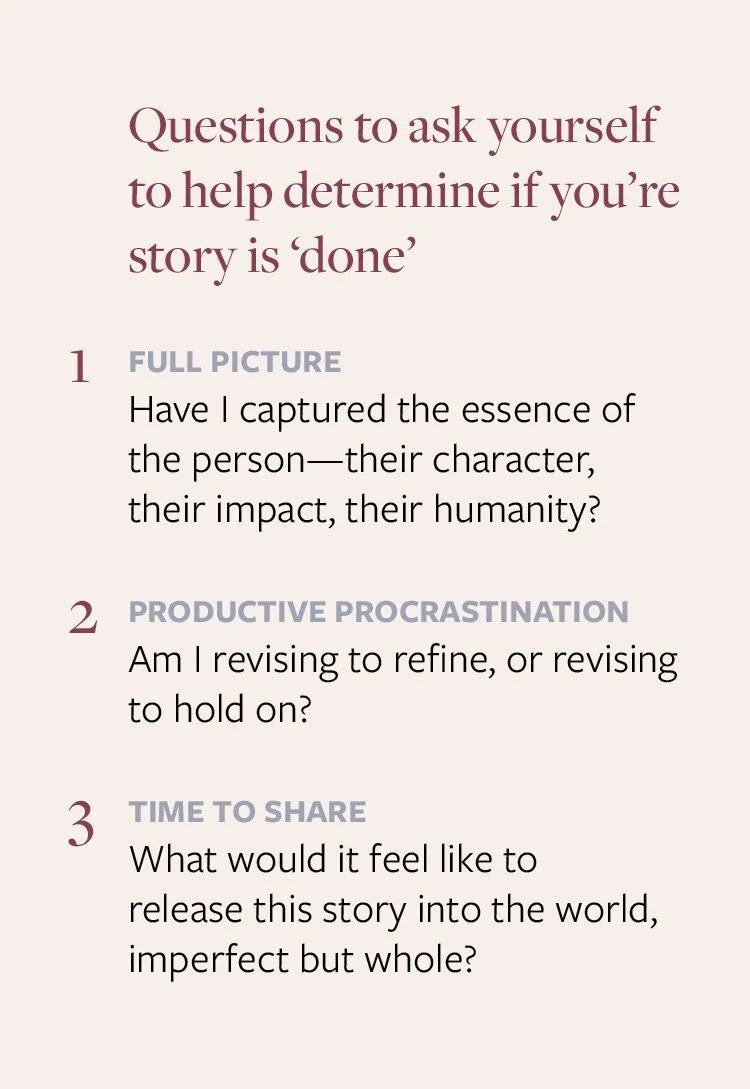
How to know when it’s time to step back
Legacy work will always be unfinished in some way. There will always be another photo tucked in a drawer, another relative with a different recollection. The art lies in knowing when the story feels whole enough to share.
Ask yourself:
Have I captured the essence of the person—their character, their impact, their humanity?
Am I revising to refine, or revising to hold on?
What would it feel like to release this story into the world, imperfect but whole?
Finishing doesn’t mean forgetting. It means you’ve tended the story well. You’ve given it form, context, and love—and created something that will live beyond you.
A different kind of closure
There’s a special moment when a client first holds their finished book. The story that once existed only in notes, folders, and memory becomes something tangible—a keepsake that can be passed, shared, and cherished. The project shifts from being a private labor of love to a living heirloom.
That, to me, is the real completion: when the work becomes a bridge, not between researcher and archive, but between generations.
A note for those still in the process
If you find yourself struggling to let go, be gentle with yourself. Allow yourself the grace of feeling the peace that comes from knowing you’ve done what you set out to do.
The impulse to keep adding, refining, and revisiting is a sign of deep care. But remember that the story’s power isn’t in its perfection—it’s in its presence.
It’s also in the connection the comes from sharing the story; the legacy you’ve built continues through the people who will now read it.
At Modern Heirloom Books, I see this again and again: The beauty of storytelling lies not only in what we preserve, but in the courage it takes to finish—to give the story form and release it into the world, so it can keep speaking long after we do.









Missing a loved one this holiday season?
Dawn Roode offers up four suggestions for further reading (and listening) for anyone who, like her, is missing a friend or family member during the holidays.

As families celebrate Hanukkah and Christmas in the coming days, we can get caught up in the hustle and bustle, in expectations of mirth and traditions honored… For many of us, though, grief has a way of underpinning everything during this season, even amidst the joy and carols.
Those who have followed my journey for a while or who know me personally understand that loss is a theme I revisit often. I do so because the loss of three loved ones—my mother, in particular—has changed me as a person. The absence of my mom permeates my life. And while there is sadness, and there is a sense of longing—especially during the holidays—I have also gained much; I have become a new me in the wake of her loss. And I feel compelled to help others remember their own lost loved ones, to use story and memory as ways to honor those they have lost, to help them heal—even if it’s a (very) little bit at a time…
But sometimes there is nothing that will make those stabbing moments of grief go away. And maybe we’re meant to feel them. I find some consolation in connecting with others who may feel similarly; of reading others’ experiences with loss and holiday grief. And so I thought this week I would share with you a few things that have resonated with me, and a few I have written myself; I hope one or more of these will help you feel seen anew, will connect you with positive memories of the loved one you are grieving (whether they died yesterday or three decades ago), and will help you find moments of solace and light when grief seems like a shadow darkening all else.
4 ideas for finding solace on your holiday grief journey
personal reflections
I wrote this piece in 2017. I was missing my mom fiercely as Mother’s Day approached. Something compelled me to share some especially personal words on Facebook (and I am not one who is typically vulnerable—or even active, really—on Facebook). That act connected me in a most beautiful and unexpected way with a community of others who felt similar grief—and the bonus these days is that it comes up in my feed periodically as a memory. Rereading my words from that day makes me feel closer to my mom, and gives me hope when I need it. May it do the same for you:

“Wish You Were Here, Mom”
“Because a number of people expressed gratitude for my words—for recognizing my prolonged grief as their own, for glimpsing something universal in my very individual experience—I decided to share the post in this broader setting…”
being there for others who are grieving
What if someone else in your circle is experiencing grief? In a world where rituals around dying are disappearing, where talking to someone about loss feels almost taboo, I find it can be helpful to have some concrete ideas on how to be there for another who is grieving. Take a look at this story for those ideas—and know that some of them may help you, too:

A Balm for Holiday Grief
A few ideas for sharing memories of someone who has died…
LISTENING IN, living on
As an avid podcast listener, I was thrilled to stumble upon the first episode of Anderson Cooper’s podcast “All There Is” back in September 2022. He started recording while going through his late mother’s journals and keepsakes, as well as things left behind by his father and brother, narrating his experiences—and emotions—as he went. The result is a vulnerable, human, necessary meditation on grief (including a series of compelling interviews) that had me feeling seen—and wanting to hug Cooper and others walking through grief. I highly recommend giving it a listen (as for me, I will be revisiting episode two, where Stephen Colbert joins Cooper for a profound conversation).
As of December 2025, Cooper continues to explore the theme of grief in this podcast, and his generosity of spirit with his community of listeners—he says he has listened to thousands of audio messages and read tens of thousands of DMs, and that he is moved by every single one—is powerfully moving. “Listening to your messages, hearing your voices, learning the names of your lost loved ones,” he says, “has been incredibly profound. It’s made me feel less alone in my grief, and I hope these messages you’re about to hear help you feel less alone, as well.” I recommend this episode where he reads from some of those messages.

“All There Is”
I have recommended this podcast to many people this year. Anderson Cooper shares “a series of emotional and moving conversations about the people we lose, the things they leave behind, and how to live on—with loss, with laughter, and with love.”
FINDING COMMUNITY
In the wake of my mother’s death in 2009, I desperately sought community and a safe space for sharing my grief. It wasn’t easy. I eventually found a grief support group in my neighborhood in Park Slope, Brooklyn; it met at the nearby hospital and was a balm to my soul and frazzled nerves—that is, for the two sessions we met. Because it was run by a volunteer and there was no funding or outside support, it disbanded as quickly as I had discovered it. But many of us (a wildly diverse group—all ages, religions, and colors with unique experiences of recent death) had exchanged numbers. So I proposed we meet without a moderator at a local public place…and every single person showed up. That community was necessary for us then. If I hadn’t moved to another state, I would probably still be organizing our make-shift grief support get-togethers.
This year I discovered grief specialist Barri Leiner Grant via Instagram and extend an invitation to you to follow her, too, especially if you, like I was in 2009, are craving community around your loss. She offers memory circles, grief resources, a write-to-heal support group, and beautiful doses of inspiration through her work.

The Memory Circle
Barri Leiner Grant says that grief tending—“time dedicated to your release and relief”—is the foundational grounding of her philosophy. See if the tools she provides can help you maintain a meaningful connection with your lost loved one.
This blog post, originally written in December 2022, has been updated with new content on December 8, 2025.
The case for classic design
A book that captures your legacy should be designed with longevity in mind, so it remains engaging and accessible for generations. It should be beautiful, too.
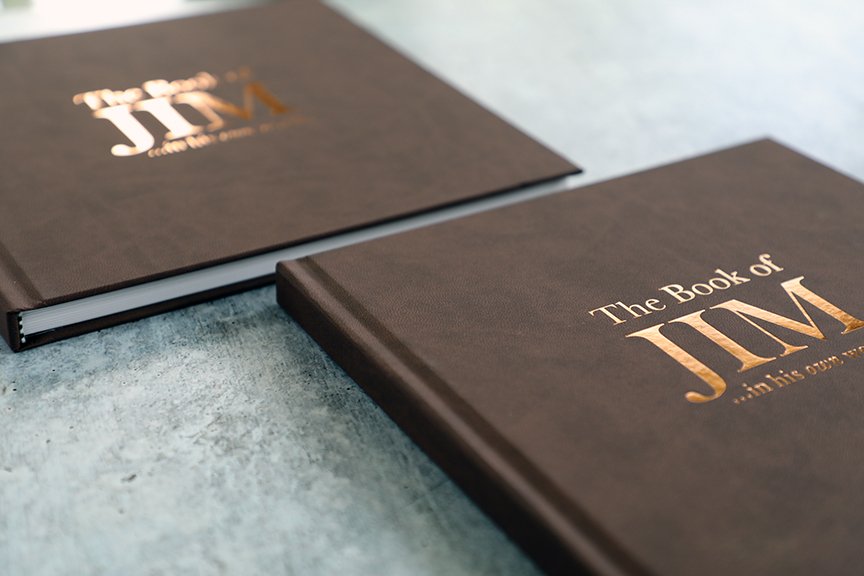
Black leather and a debossed title elevate this book cover from boring to elegant, signaling the timeless page design inside.
I have a pair of Adidas Spezial sneakers that I purchased in the 1980s and still wear today. Adidas debuted the style in 1979, and it’s sold in an array of colorways as part of the Originals line on their website in 2025.
I have an Armani tailored black blazer that I bought in the late 1990s that I still wear today. Its materials and craftsmanship were worth the hundreds of dollars I invested in the piece when I worked at Vogue, and no one would guess it wasn’t brand new now.
My fashion sense has always tended towards fine classics (often embellished with bolder accessories that I can swap out as the times change). “Classic,” in the way I view it, is a synonym for “timeless.”
And “classic, timeless style” is an aesthetic I also apply to the heirloom books I create for my clients.
You won’t find trendy design approaches or typeface choices that broadcast a specific decade (unless that’s befitting the stories within, of course!) at Modern Heirloom Books. Instead, we’ll work together to find a design that feels right to the client and their stories, while also respecting tradition and legibility—so your book feels fresh and of its time, no matter when your descendants are reading it.
Why I opt for classic book design
Have you ever picked up a book and known it was old despite its pristine condition? Your grandparents’ wedding album, perhaps (pillowy white leather with gold italic imprinting, say)? Or a softcover book that’s been sitting on your shelf for decades (Are You There God? It’s Me, Margaret comes to mind for me, with its instantly recognizable cover treatments across different editions)?
Design, like fashion, can date itself. This isn’t necessarily a bad thing—retro aesthetics have their place; but for life story books, I aim for something more enduring. A book that captures your legacy should not feel like a product of a fleeting trend. It should be designed with longevity in mind, so it remains engaging and accessible for future generations.
“Designers choose typefaces by considering the history of type, the combinations of form, the balance between readability and surprise, the content and themes at hand, and the designer’s own desires and interests,” Ellen Lupton explains in Thinking with Type.
The two variables sandwiched in the middle of that sentence are of the utmost importance to me when designing an heirloom book:
Finding “the balance between readability and surprise.”
Serving “the content and themes at hand.”
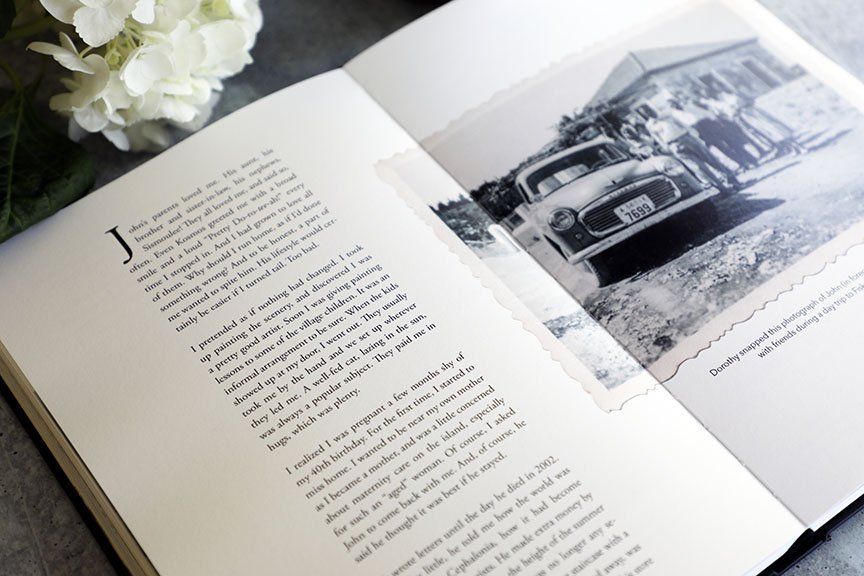
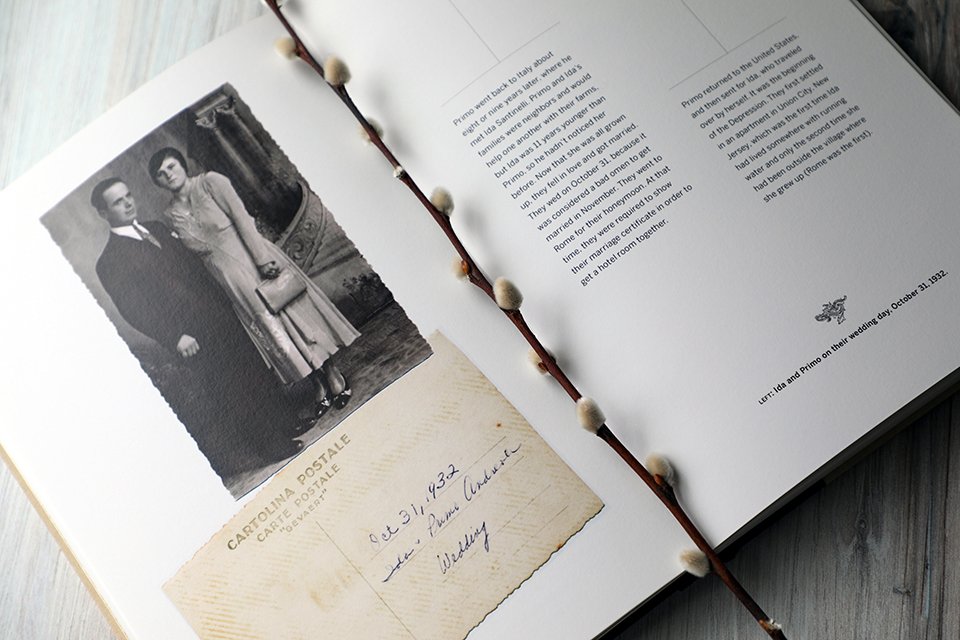
Ample white space gives a life story book breathing room.
The Balance Between Readability and Surprise
Readability should always take precedence in book design, particularly for long-form personal narratives. A typeface that prioritizes elegance over clarity—one with too much flair, too little contrast, or an overly condensed structure—becomes a distraction rather than an enhancement.
This is why many classic books use time-honored typefaces such as Garamond, Baskerville, or Times New Roman. These fonts have endured for centuries because they provide that perfect harmony: sophisticated yet unintrusive, distinctive yet universally readable.
Surprise, however, is where personality comes in. This might be through subtle flourishes—a well-placed drop cap, a unique yet restrained display font for chapter titles, a slightly unexpected but still harmonious color palette. These are touches that make a book feel special without overpowering the narrative itself.
Serving the Content and Themes at Hand
A book about a family’s multigenerational journey deserves a design that reflects continuity. A memoir detailing a life of adventure may benefit from visual storytelling elements like maps or archival-style captions. The key is ensuring that every design choice serves the story rather than pulling attention away from it.
Elements such as generous margins, high-quality paper, and a well-proportioned layout all contribute to a book’s readability and aesthetic longevity. White space, for example, isn’t just about making a page look elegant—it allows the reader’s eyes to rest, giving weight to the words and photographs that matter most.
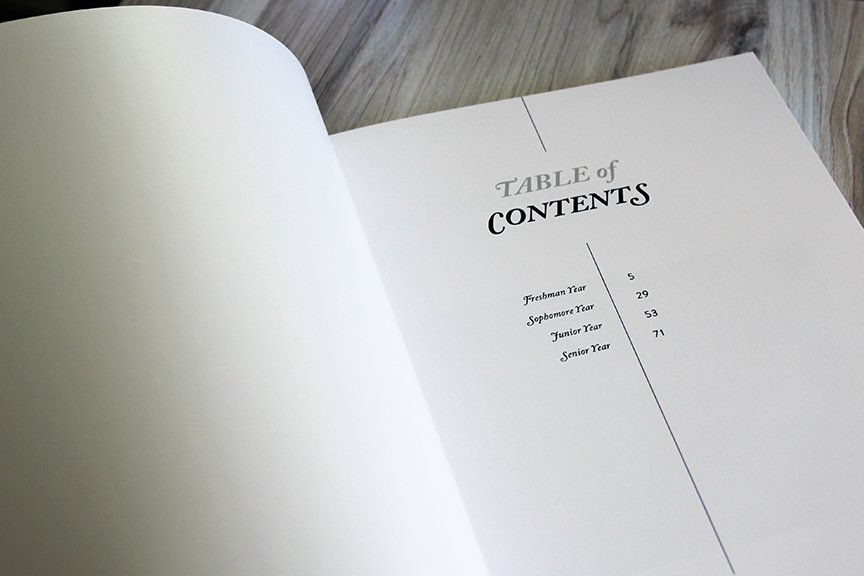
This book of correspondence between a father and his daughter during her time at Georgetown University used Adobe Caslon, the same font in the Georgetown logo, for display type; Caslon was originally designed in 1722, and its modern iterations are still revered for its readability and elegance.
What makes a timeless book design?
There are a few fundamental principles that contribute to classic, enduring book design:
Typography with integrity: Typefaces that have stood the test of time, with an emphasis on readability and subtle beauty.
Thoughtful layouts: Balanced margins, considered line spacing, and harmonious text hierarchy to create an effortless reading experience.
Understated elegance: A design that enhances the story without distracting from it, avoiding overly trendy or gimmicky elements.
Quality materials: A book’s physical form is part of its longevity—fine archival paper, durable binding, and careful printing methods ensure that it lasts as an heirloom.
When you commission a personal history book, you are investing in something that will outlive you—a physical manifestation of your legacy. The stories within are timeless, and the design should reflect that. A well-designed book will not only be read; it will become a treasured heirloom, passed down and revisited for generations.












“Who listens to you?”
We are a world of talkers, but what we need is to listen, and to be listened to. Find inspiration from author Kate Murphy and personal historian Dawn Roode.
“When I interview people—whether it’s a person on the street, CEO, or celebrity—I often get the sense that they are unaccustomed to having someone listen to them. When I respond with genuine interest to what they are saying and encourage them to tell me more, they seem surprised; as if it’s a novel experience. They noticeably relax and become more thoughtful and thorough in their responses, assured I’m not going to rush them, interrupt, or glance at my phone. I suspect that is why so many end up sharing such tender things—unsolicited by me and wholly unrelated to the story I am writing. They find in me someone who will finally, at last, listen to them.”
This paragraph is from the introduction to You’re Not Listening: What You’re Missing and Why It Matters by Kate Murphy—I had jotted it down as a reminder to write about this phenomenon someday. The notation about the author and the book title was on the reverse side of the piece of paper I wrote the quote on. So when I unearthed the scrap among my things recently, I thought for a moment I had written these words; the sentiment and the experiences reflected within are as if my own (though, admittedly, it’s been a while since I interviewed a celebrity!).
It’s common—too common, really—for people to feel almost shocked when I maintain eye contact and do not interrupt their story sharing. More than one interview subject has teared up and needed to pause once they get going during our interview sessions—once it dawns on them that I am not going to interrupt them, and that I am listening intently.
Kate Murphy interviewed many people for her book, and among the questions she asked them, she writes, was, “Who listens to you?” The answers, as you can imagine, were not overwhelmingly positive: Many, many of us feel like we are not being listened to, and even, says Murphy, that we are not good listeners ourselves.
If you’re interested in exploring this—how we got here, how we can change course—I recommend picking up a copy of You’re Not Listening.
For a sampling of the author’s thinking and her voice, I recommend listening in to this Fully Booked podcast interview with Kate Murphy:
And for a few of my (very quick!) thoughts on the topic, read on.
Listening is an active endeavor.
Listening is not the same as hearing. Listening is a conscious act—being open to receiving the words and messages of another. “Listening is an act of community,” author Ursula K. LeGuin wrote. So next time you ask someone a question, pay attention to their answer; when it seems like they are done speaking, take a beat—awaiting more from them, perhaps, and listening to your shared silence. There is much there to hear.
Listening makes you a more empathetic person.
Empathy is the ability to understand and share the feelings of others. It can be developed through practice, and it's not a fixed trait. “When you talk, you are only repeating what you already know. But if you listen, you may learn something new.” This is an oft-quoted sentiment from the 14th Dalai Lama, and it resonates for a reason. By listening to (or reading) another’s stories, we are given the opportunity to see ourselves in their experiences—and in so doing, help us understand their perspective.
Everyone is interesting if you listen to them.
It’s partly a matter of asking the right questions, partly of giving someone space to share, but it’s mostly a matter, in my opinion, of listening—if you listen with an open heart and an abundance of curiosity, every person will show themselves to be interesting.
I hope you have someone in your life who listens to you—really listens to you. “Love is listening,” artist Titus Kaphar has said (and, oh, how I agree!)…and we are all worthy of love.
I leave you with this quote, written in my commonplace book years ago, from one of my most beloved writers:
“In the silence of listening, you can know yourself in everyone, the unseen singing softly to itself and to you.”
—Rachel Naomi Remen





“People still buy handmade shoes.”
As AI gets better and more accessible, will there still be a need for in-person story sharing services offered by personal biographers and historians? Yes!
Will there ever come a day when we are so reliant on artificial intelligence that our appreciation for and need for handmade goods and in-person services are gone?
In my professional circles, there is much talk about AI and the impact it will have on our work lives. Some of the talk is excited—how AI can help us streamline processes, for example. Some of the talk is panicked—how we’re being led down a path of no return, when artificial intelligence becomes smarter than people and AI takes over (conspiracy theory?).
Of course, the reality is somewhere in the middle. And with the technology evolving so quickly, how should I, as a professional personal historian, incorporate it into my work for YOU?
This is a question I think about often—and undoubtedly, my answer to this will shift as the technology does.
Despite typically being a tech early adopter, I have currently dipped my toes into the AI waters with caution: I have readily integrated some things such as AI transcription into my workflow (a godsend!!) but have remained more of an educated lurker. I have concerns—privacy chief among them—yet at the same time know that there is a revolution at hand. So, I test the evolving AI interfaces, listen to friends and colleagues who have embraced AI more readily, and learn from them and from experts I trust.
Listening to a recent Tim Ferriss podcast in which he speaks briefly about how we may adopt AI in the long run, I took note of one seemingly offhand remark he made: “I mean, people still buy handmade shoes, right?”
I was driving while listening to this podcast, and I kept turning this phrase over in my mind even after I had reached my destination; it struck a chord. “People still buy handmade shoes.” Sure, the majority of shoes sold around the world are likely made in factories—but there is a market for bespoke shoes, even now.
This led me to think about all the things that make my service as a personal historian unique, and in particular, different from any app- or AI-driven storytelling services out there (they abound, and are proliferating more and more). Because I DO believe that there will always be a place for one-on-one personal history services…even if the day comes when every single individual records aspects of their life story using AI.
What makes in-person storytelling special?
It’s not just about the end-product—it’s about the journey.
All of my experience to date with AI models has shown me one thing: They can be used effectively as tools with me guiding—very carefully—our trajectory. But compelling conversation (a back-and-forth with another being)…well, not so much.
I do believe that story sharing apps and online memory-keeping services are strong tools that make story sharing accessible to the masses—but they are by no means my favorite option. I would much prefer a family member interview their loved ones and hit “record” on their phone than for an email prompt to be sent weekly from a random cache of questions, to be answered in isolation. Because having someone to receive your story, having a person to connect with and reflect pieces of your narrative back to you, is so valuable.
As a personal historian, I am a generous listener who gives my undivided attention to my interview subjects. How rare is it these days to have someone’s full attention? To be listened to and heard? How rare an opportunity is it to give ourselves time to reflect so intentionally?! It’s all of these things combined that have inspired many of my clients to tell me, each in their own words, how the story sharing itself was even more valuable to them than the book that resulted. Would they have felt this way if I weren’t there to receive their stories? I know they would not have.
It’s about community.
I always, always tell my clients that my greatest hope is that the book they hold in their hands at the end of our time together—the book that holds their stories—will become a vehicle for even MORE story sharing with their friends and loved ones. I hope their readers will ask questions, will learn and feel and grow even more curious about the book’s author. I hope that the authors will pull their book out with their grandchildren, and allow the photos within to spark more memories that they share in person. I hope the next generation will pull the book out with THEIR children and recount stories they heard, and add in their own experiences, too. A book that originates as part of an in-person story sharing experience has this sense of community written in its DNA.
It’s about finding meaning through follow-ups.
Follow-up questions are at the heart of any good personal history interview. We may start with a small script of questions, but I generally prefer to identify a theme for the interview and proceed from there. One story leads to another. Details that are not initially shared by the interview subject may be drawn out by the interviewer. How did you feel? How did it smell? WHY do you think you did that? One day AI will inevitably get better at the art of the follow-up question, but for now I believe in my heart that the connection between an interviewer and their subject yields one-of-a-kind stories and meaning-making—and that connection leads to intuitive, sensitive follow-ups; the rapport that develops leads to a sense of trust that allows a subject to go deep; and the back-and-forth nature of in-person conversation leads to revelations and humor and surprises that can only happen with a fellow human.
It’s about making art.
“That sense of interplay, or the ability to react in the moment, is something that artificial intelligence can’t reproduce,” musician Yosvany Terry says in this piece from The Harvard Gazette that asks the question, “If it wasn’t created by a human artist, is it still art?”
I have a feeling this philosophical conundrum will persist forever, even as AI advances to create art that reliably evokes emotions and is deemed ‘original.’ But I tend to agree with this line of thought: “AI currently requires a level of supervision and feedback that means a human touch and eye still very much have their place in the art world.”
As a human writer and editor, I am creating an original piece of art from my clients’ stories. My decisions—about tone, about structure, about design aesthetic, about what to highlight and what to leave out—are informed by years of experience, and by my human interactions with those clients. There is a dialogue infused with values spoken and inferred; there is a sensitivity to family relationships and other intangibles that may impact how a story is received; and there is a real collaboration towards turning stories into art.
Like those who still buy handmade shoes, there will always be people who prefer in-person story sharing to AI-led preservation—and as a personal historian, I am proud and honored to be the cobbler of your memories.
Conversation starters
I wonder if I read this post in just a few years time whether my thoughts will have changed much?
I wonder what you think about the value of human interplay in story preservation?
I wonder what concrete ways you have found to incorporate AI use into your own work or family history preservation?
I wonder what ways you so far resist using AI, and why?
I wonder if you are interested in collaborating on a personal history project? Let’s talk.
Hello, it’s me—the person behind the brand
Modern Heirloom Books is a business, of course, but it’s a business defined by one person’s mission, expertise, and passion—and I’m pleased to meet you!
While I much prefer candid shots (and, truth be told, being the one TAKING the pictures!), I will occasionally pose for a behind-the-scenes shot like this…so you remember that there is indeed a human being behind my brand.
When I first launched Modern Heirloom Books more than a decade ago, I was reluctant to put my photo anywhere in my branding. I wanted to seem like a “real” company. Despite decades working at a high level in magazine journalism, in this then-new entrepreneurial venture I faced my share of imposter syndrome—and truth be told, maybe I was trying to seem “bigger” than I was.
Who would want to hire a single individual to create their family history book?, my thinking went. They’ll expect a whole team. What if they think I look too young? What if I look too old? What if, by seeing my white face, they jump to the conclusion that I might not be the right person to capture their (fill-in-the-blank) stories?
I was a one-person operation then (still am, though now I rely on a bevy of freelancers when appropriate to allow me to serve more people), but you wouldn’t have known this from looking at my website.
Then, somewhere along the line (maybe as my confidence increased and I had more business under my belt), my thinking shifted.
The aha moment: If someone is going to share their stories via interviews, they darn well want to know who they’ll be sitting across from, right?
This industry that I’m in of capturing people’s stories, preserving their memories and their family history, creating printed legacies…well, it’s come to be known as “personal history.” And “personal” it is.
It makes sense that my business should have a personal feel, as well.

So a few years in I added my name to the company—now it’s Modern Heirloom Books by Dawn Roode. Then I began adding my pictures here and there; despite my discomfort with being photographed, I can now be seen in my element (usually at a computer or wielding an audio recorder) on my website and across my social media.
And the best part? People who reach out to me are reaching out to ME. So many clients call because they read a post about my own journey with grief that resonated with them, or they understand from following me that I will be a compassionate listener. Maybe they’ve delved deep into my experience and like the fact that my approach to writing and editing life stories is contemporary, informed by that lifestyle magazine experience I mentioned earlier. Or maybe they don’t notice these personal details at all.
Whatever the case, they know there’s a person behind the business. And that matters to me. And from what my clients have told me, it matters a great deal to them, too.
Would you like to see if we might be a good fit to work together? Whatever type of life story preservation project you have in mind, remember that all my projects are fully custom—so let’s chat, and see how we can best capture your stories for the next generation. I look forward to meeting YOU 💕
Dawn Roode’s curated roundup for the week of Sept. 23, 2026, is overflowing with recent reads on memoir, life story writing, and family history preservation.