
Memories Matter
Featured blog Posts

READ THE LATEST POSTS

Why genealogy is not the answer to finding yourself
Genealogy is history on a personal scale. It helps satisfy a deep need to understand how we fit into the broader world around us. But knowledge of our ancestors does not define us. Read on for musings on why we should collect stories, not ancestors.

Genealogy is history on a personal scale. It helps satisfy a deep need to understand how we fit into the broader world around us. Nonetheless, knowledge of our ancestors does not define us.
It has been written about plenty: Genealogy is the second-most popular hobby in the United States, just behind gardening. Genealogy sites are second only to porn on the Internet.
Genealogy and the search for family history can be a big part of what we do here at Modern Heirloom Books, especially when a family wants to tell the stories that have passed through generations of descendants and preserve them for the children.
And I am not immune to the quest: Having almost no knowledge of my family beyond my grandparents (“We’re American,” my grandmother would tell me when I asked about where we came from), I can sit for hours scanning census records and clicking on those enticing “hint” leaves on Ancestry. I watch Finding Your Roots and Genealogy Roadshow, too.
Genealogy is fun, and it has great value. However, having a knowledge of your ancestry does not define you as a person.
You are making your own path.
Over Father’s Day weekend I saw an article, “Searching for Our Roots,” and was troubled when I read this quote from a man who has no ties to his blood relatives:
“When asked if he felt ‘incomplete,’ Giddins replied, ‘Definitely. I knew nothing about me. Can you imagine growing up knowing nothing about your health, your family? You’re nothing.’ “
I have read similar sentiments before from individuals who are not connected to their roots, including from adoptees as well as from folks whose parents simply did not talk about the past. “How can I know who I am when I don’t know where I came from?” the thinking goes.
While knowing your family’s past can be empowering, even liberating, it should not be a prerequisite for knowing oneself. Especially in our digitally dominated lives, self-reflection is becoming more and more rare. Perhaps we should look inward more often. Journaling, writing letters, having tech-free conversations with friends, are all powerful ways to connect both with loved ones and with our inner self. You, whether you are aware of your ancestry or not, have important stories to tell.
If there is a lesson in genealogical research, it is how interconnected we are to one another. (A personal aside: If only this message were so widely accepted that intolerance were a thing of the past, but headlines deem otherwise.) This is a profound lesson, but isn’t it one we can get as well from stories of individuals whose names do not appear on our own family tree? (Listen to The Moth podcast for proof.)
Don’t collect ancestors. Collect stories.
It’s the people you want to know, not just their names. Their struggles, their triumphs, their foibles and follies. You can’t get those stories from a branch on a family tree (though you will almost certainly get clues that lead you to those stories if you are persistent!).

Look to loved ones in your present, not just your past, to define who you are and what is important to you. After all, you are living your life, making memories, and creating stories to share with your own children one day!
So sure, click on the green “hint” leaves, gather names and census records, even take a DNA test if you’re so inclined (I did). Just don’t pin your own identity on what you find—and don’t lose sight of the people behind the names. The journeys of those people have led to you. And your journey is continuing, right now.
Oh yeah: And tell your stories as you go. Talk of them around the dinner table, record them, preserve them. As the research indicates, it’s the sharing of family stories that helps kids be resilient and contributes to a healthy sense of identity. You may be depriving your future generations of a grand genealogy adventure by giving them their lineage instead of a mystery to be solved...but that’s a good thing, right?

#Legacy Links: June 10 - Photographs, Memory, and Life Lessons
This week's top 4 legacy links all focus in some way on the enduring power of photography—the power to connect us with the past, to inspire, and my favorite, to reveal stories and truths.
Our top 4 #legacy links for the week ending Friday, June 10, 2016
1 - Families photographed with images of their descendants make a powerful connection to past.
A photography exhibit, on view until tomorrow at El Tejar del Mellizo community center in Seville, Spain, presents photographs of the living descendants of those who lost their lives during the Spanish Civil War. Organized by the Our Memory Association, “DNA of Memory—Graves from the Franco Regime” features photographs by more than 30 Spanish artists. The images capture descendants carrying photographs of relatives killed at the beginning of the Civil War, and they are more provocative and moving than I could have imagined. If you don't happen to be in Seville tomorrow (!!), I urge you to click on the photo below to view the various photographs on HuffPo.
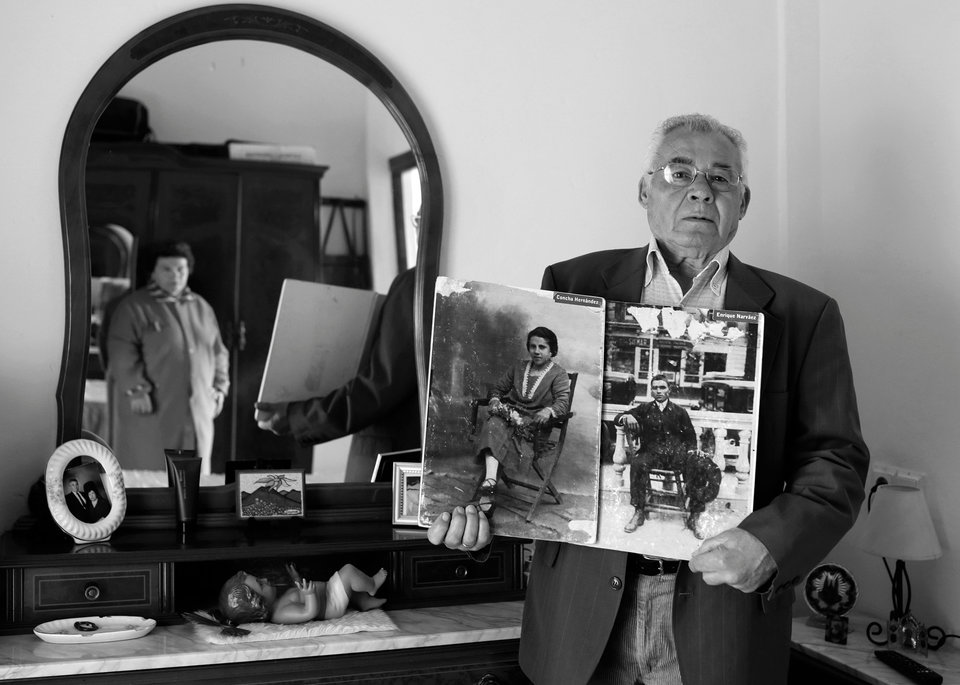
In a photo from the "DNA of Memory" exhibit, Narvaez Hernandez holds up photos of his parents, Enrique Narvaez Borrego and Concepcion Hernandez Garcia, who both died in Marchena, Seville, when Hernandez was 3 years old. Photo by Javier Diaz, courtesy Our Memory Association
2 - How a personal quest to find family resemblances turned into something more.
This one's not new, but somehow I missed it when it made the viral rounds last year. See what fellow personal historian Rachael Rifkin discovers when she undertakes a unique experiment to recreate eight photos of her relatives. Her musings on the nature of descendancy are as enticing as her photo recreations.
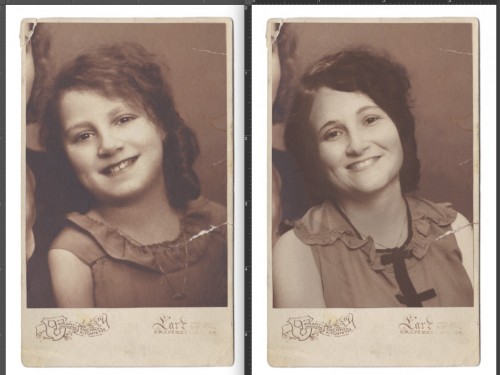
According to a family tree, Rifkin's cousin Ibolia, left, died at Auschwitz in 1944. Rifkin estimates this picture is from sometime in the 1930s. Image courtesy Life Stories Today
3 - One decade, one family, one photographer: This is a photo book I am looking forward to.
Thanks, Family Search, for bringing this one to our attention. Photographer Thomas Holton's book The Lams of Ludlow Street \, which chronicles one family through 13 years' worth of photographs, will be published next month.
"As Mr. Holton got to know the family, the project became more personal. He would pick up the children from school. He visited the Lams’ relatives in Hong Kong and China. When he married, Cindy was his flower girl,"
writes Annie Correal in the New York Times article. Make sure to click through the accompanying slideshow!
4 - What happens when a suitcase of photos sends her on the storytelling adventure of a lifetime.
In the vein of "Finding Vivian Maier," a North Carolina woman hit the found photos jackpot when she discovered a suitcase full of one man's life effects, including photos, letters, and other ephemera—and then began a journey of discovery as she sought to uncover the stories his things revealed. Her site is wonder to behold.

Read an introduction to her photographic treasure hunt on the ever-interesting Save Family Photos:
"Handling these seemingly random artifacts serves as a constant reminder that the sometimes cryptic, occasionally awkward, and often amusing snippets of the past were once as alive and vital to their creators as my own emails, journals and vacation photos are to me."

Join me at a new, vibrant storytelling festival this weekend in Madison, NJ
Join Modern Heirloom Books this Saturday, June 11 from 10am-4pm at the Madison Storytellers Festival in Madison, New Jersey. You'll enjoy performances, crafts, and community with likeminded culture and story lovers, and what we're most excited about: meeting! We look forward to meeting you, showing off some of our books, and discovering YOUR stories. Learn more about the event here.
I am so thrilled to be participating in this new event spearheaded by local business folks and artists who deeply understand the value of storytelling!
About the Madison Storytellers Festival
Madison Storytellers Festival will be held on Saturday, June 11th, in downtown Madison, NJ. Modern Heirloom Books will have a space showcasing some of our books, framed life vignettes, and special offers.
The event will be staged at Madison’s ‘Culture Corner,’ with a main stage under the railroad trestle on Green Village Road (closed off between Main Street and Kings Road from 10am – 4pm) and additional stages at the Museum of Early Trades and Crafts, Short Stories Bookshop and Arts Hub, and Drip Coffee. Free and open to the public, the event will be held Saturday, June 11, 10 – 4pm, followed by evening music at Short Stories Bookshop and Arts Hub at 23 Main Street, from 4-6 PM.
Fully planned and staffed by volunteers, stages will feature:
opening remarks by Madison Mayor Honorable Robert H. Conley, who will share highlights of his own oral history of growing up in Madison
contributors to Elizabeth Gilbert’s Eat Pray Love Made Me Do It
New York Times bestselling novelist Miranda Beverly-Whittemore, on the heels of the May 31st release of her new novel JUNE
special interviews led by Bonnie Monte of the Shakespeare Theatre of New Jersey and John Pietrowski of Writer’s Theatre of New Jersey
...and so much more.
The Museum of Early Trades and Crafts lawn and Green Village Road itself will feature special crafts and interactive arts events as well as vendor tables available for literary and arts organizations and businesses, including Modern Heirloom Books. Arts activity stations and three ‘stages’ of interviews, music, poetry, literary readings, dance, oral history, visual arts—from celebrity to professional to amateur to interactive/education workshops—will showcase diversity of offerings and experiences.
The Appeal of Madison, an Arts-Loving Community
If you’ve spent any amount of time in Madison, NJ, on the train line to New York City’s Penn Station, you know its unique distinction as an arts and culture destination. Named a top school district for music education and proud home of the critically acclaimed Shakespeare Theatre of New Jersey, the town has somehow preserved not only its stunning historic architecture, but also the vibrant offerings of an arts and crafts history museum, a top 50 jazz club, a rare and used bookshop, and three universities, while also yielding a new indie bookshop and arts hub, literary presses, a hat shop, a knitting shop, a comic book shop, and numerous arts and dance studios.
Yet the real treasure is in Madison’s community of talent—the students, families, educators, and people across interests and industries who share a passion for—or, in many cases, hold notable careers in—writing, publishing, film, television, photography, music—and are drawn to the town’s unique environment of creativity and expression. The festival plans to showcase that talent as well.
“Storytelling is the expression of who we are, who we were, and who we hope to be. It is both experience and identity, and is what brings us together as a culture,”
said Dan Blank, owner of WeGrowMedia and a founding member of the festival Steering Committee. Editor and publisher of Atticus Press Dan Cafaro added,
“It’s critical that each of us is empowered to tell our stories—to express our vision of who we are as individuals, and how we fit together as a whole.”
Special Discount on New Product Offering, "Little Life Story"
In the spirit of sharing our stories, we are launching a new product offering at the festival.
While we specialize in creating legacy and other heirloom books that showcase your stories, many people are not yet ready to dive into such a big project. Others may not think their stories are worth telling—or that they can present them in a way that’s appealing, memorable, evocative.
First: Your story is worth telling.
I repeat: You have a story that’s your alone, and your story is worth sharing.
Second: It's our job to help you best relate your story! We thought, why not create a product that allows individuals to get a taste for the process—and to see how easy (and fulfilling) it can be to create a lasting heirloom that records one of your stories beautifully? So, presenting a Madison Storytellers Festival Special:
“Little Life Story”
Got one hour? That’s all it takes (well, that and a little fond reminiscing!) to create a short life vignette tied to a favorite old photograph, family recipe, or other memento. Here’s how it works:
Choose a photo, recipe, memento, or other physical item that sparks a special memory for you.*
We work together to give voice and form to your story.
We scan and optimize your image.
You get a frame-worthy page to display!

Madison Storytellers Special: You pay $150 for the approximately one-hour session (where we discuss and refine your memories, identify and distill the story) and the resulting life vignette.
This would normally be part of a full book-making process, but we want to introduce you to the joys of finding—and sharing—your own stories! So, our gift to you includes a one-page design that incorporates your photograph and story, typeset and designed in a way that begs to be framed and displayed (we will have samples on hand the day of the festival). It will be printed on archival art paper or, if you prefer, on high-quality glossy photo paper.
You’ll also receive a bonus digital version for you to share with friends and family on social media or via email.
If you decide to try our “Little Life Story” package, you’ll get a taste of what our process is like—and who knows, it just may be the first step on your journey towards your very own book!
Come on out this Saturday to say hi, see some sample books, and see what Modern Heirloom Books is all about. We look forward to meeting you—and to hearing YOUR stories!

*Your privacy and your precious photos and memorabilia are respected and safeguarded at every step of the process.

#Legacy Links: June 3
This week's roundup includes #legacy links from fellow members of the Association of Personal Historians and other pro storytellers: Click for a short “flash memoir,” a moving commencement speech video, a powerful 3-word sentence, and reactions to the remake of the classic “Roots” miniseries.
This week’s roundup includes links from fellow members of the Association of Personal Historians and other professional storytellers.
Our top 4 #legacy links for the week ending Friday, June 3, 2016
1 - Read this “flash memoir” for a quick dose of inspiration.
I have written about life vignettes: scenes from a life and other short biographical stories that distill memories and provide a glimpse into an individual's life. Sarah White of Stories Well Told goes a step further and delves into what she calls “flash memoir”:
brief essays that capture a small moment of time, but invite contemplation. They work in a “flash,” like a lightning bolt that suddenly illuminates a landscape.
Read contributor Kay Frazier's flash memoir, “Balloons Are for Kids” for a quick dose of inspiration.
2 - There's always one commencement speech from graduation season that resonates far and wide.
Pam Pacelli Cooper, president of Verissima Productions, shares a 2016 Colgate University commencement address from Dr. Omid Safi of Duke University, in which he eloquently—and with great humor and warmth—speaks about the many definitions of success, love, and justice. “Welcome into the circle of compassion,” he tells the graduates. And he leaves them, and us, with much to ponder—including, as Pacelli Cooper does, about the vital role memories of hardship and pain play in our own legacies.
If you are short on time, fast-forward to the 36-minute mark, when Dr. Safi is introduced.
3 - There’s power in a 3-word sentence.
Sometimes people just need a little reminder, and storyteller Nikki Groom delivers:
4 - Did the epic “Roots” remake retain its original potency?
I have DVR'd the series, and the blockbuster remake is still available for streaming. Journalist David Zurawik offers his take in the Baltimore Sun, and opines that
perhaps the greatest storytelling triumph of “Roots” is that Haley wrapped all of it, from the inverted captivity narrative to the Kunta Kinte hero quest, in the structure of a family saga. “Roots” is essentially a cosmic version of the kinds of stories told at family gatherings about those who came before us...
I'd love to hear your take on the remake: Was the more graphic violence redeemed by the storytelling? Did the miniseries have a strong impact on you?
#legacy #FamilyLegacy #FamilyHistory #LifeStories #storytelling #writing #custombooks #OralHistory #design #genealogy #MemoriesMatter #LegacyLinks

“His are the sepia eyes that passed through me.”
“His is the broad nose, the high cheekbones, the determined mouth, the face not like an oval or a heart, but like a square. He died long before I'd ever meet him, but I carried him in my blood.” In Beth Kephart's contribution to our “Pictures Into Words” series, you’ll find inspiration for writing about a photograph that holds more mystery than memory. Sometimes it's the wondering, the imagining, that brings life to an old photo—that carries your ancestors from the past into the present and finds the narrative thread in our connected lives.
When it comes to writing your own life stories, sometimes what's called for is inspiration, plain and simple. Sure, you can get plenty of tips on how to approach the process; there are some notable books that can guide you on the journey, and our blog regularly offers advice on the topic. But beautiful words, strung together like pearls and simply telling a story, may be a far richer bounty.
With that in mind, here is another installment in our “Pictures Into Words” series, contributions from other memory-keepers who know the joy and process of using a photograph as a prompt for writing. Each provides not only a wonderful short read, but a fine and unique example of how you too may approach telling the stories behind your family photographs.
This short piece by author Beth Kephart has been previously published; it was the opening to her 2002 memoir Still Love in Strange Places. In her poetic contribution, you'll find inspiration for writing about a photograph that holds more mystery than memory; sometimes it's the wondering, the imagining, that brings life to an old photo—that carries your ancestors from the past into the present and finds the narrative thread in our connected lives.
Pictures Into Words:

Photo courtesy Beth Kephart; pictured on right is Carlos Alberto Bondanza, the grandfather of Kephart's husband, and the man whose stories captivated her imagination
“Torn Photograph, Sepia Stained”
By Beth Kephart
The tear runs like a river through a map, hurtling down toward his right shoulder, veering threateningly at his neck, then diverting south only to again pivot east at the fifth brass button of his captain's uniform. Below the tear, two more brass buttons and the clasp of his hands, and below all that, the military saber; the loosening creases on his pants; the shoes with their reflections of the snap of camera light. He is one of three in a sepia-colored portrait, and someone had to think to save his face. Someone had to put the photo back together—re-adhere the northeast quadrant of this map with three trapezoids of tape so that his left hand would fall again from his left elbow and he would still belong to us. We suppose he is the best man at a wedding. We suppose that it was eighty years ago, before the matanza, before he was jailed and then set free, before he saved the money to buy the land that became St. Anthony's Farm.
“Did I ever tell you what my grandfather did the year the farm first turned a profit?”
“No.”
“He threw the money into the air, the bills, and they got caught up with a wind.”
“And so?”
“And so he ran after those colones through the park. Chased his own money through the leafy streets of Santa Tecla. Imagine that.”
I do. I am often imagining that. Imagining that I know him—this man whose likeness is my husband's face, whose features are now borne out by my son. His are the sepia eyes that passed through me. His is the broad nose, the high cheekbones, the determined mouth, the face not like an oval or a heart, but like a square. He died long before I'd ever meet him, but I carried him in my blood. Just as the land carries him still, remembers. Just as St. Anthony's Farm will someday, in part, belong to my son, requiring him to remember what he never really knew, to put a story with the past. Words are the weights that hold our histories in place. They are the stones that a family passes on, hand to hand, if the hands are open, if the hearts are.
“You look like your great-grandfather.”
“I do?”
“Yes. Come here. See? That’s him, in the photograph.”
“Him? My great-grandfather?”
“Yes.”
“But he looks so young.”
“Well, he was young once. But that was a long time ago, in El Salvador.”
We remember. We imagine. We pass it down. We step across and through a marriage, retrieve the legacies for a son.
-----------------------
Beth Kephart is an award-winning author of 21 books of fiction and nonfiction, including Handling the Truth: On the Writing of Memoir, which we recommend in a previous post. Her current book is This Is the Story of You (Chronicle). The above was excerpted with permission of the author from Still Love in Strange Places: A Memoir (W. W. Norton, 2002).
Kephart has recently launched Juncture, writing workshops where the locale plays an integral role in inspiring and enabling the writing process. Sites have included
an experience-enriching Pennsylvania farm and, in the fall, a sunny gathering place along the coast in historic Cape May. “Participants will learn what memoir genuinely is—and what it is not. They’ll study the words of the greatest memoirs ever written, respond to daily prompts, and work toward a fully developed memoir prologue that summons both the themes and tone of work yet to come,” details her site.
And they will enjoy the unique surroundings of their chosen environs, gathering formally and informally for readings, conversation, and inspiration.

5-Bullet Friday Legacy Edition: May 27
We’re launching 5-Bullet Friday Legacy Edition here on the blog, in which we compile five of our favorite articles, tweets, Instagram posts, or other shares from around the web on topics near and dear to our mission:
#legacy #FamilyLegacy #FamilyHistory #LifeStories #storytelling #writing #custombooks #OralHistory #design #genealogy #MemoriesMatter
I’m a huge Tim Ferriss fan, and his 5-Bullet Friday emails are one of the only newsletters to which I subscribe that I actually open every single time they land in my inbox. They’re brief, substantive, and interesting.
In homage to Tim’s format (and fun alliterative name), we’re launching 5-Bullet Friday Legacy Edition here on the blog, in which we compile five of our favorite articles, tweets, Instagram posts, or other shares from around the web on topics near and dear to our mission:
#legacy #FamilyLegacy #FamilyHistory #LifeStories #storytelling #writing #custombooks #OralHistory #design #genealogy #MemoriesMatter
Our top 5 #legacy links for the week ending Friday, May 27, 2016
1 - Ahh, the good old days!
Our elementary school years are rife with memories. Jennifer at Red Barn Memories shared this retro graphic on Instagram, and her blog offers quick questions to ask your loved ones about their early school years to help get their stories on record:
2 - From diaries to collages on poster board, from Snapchat to Instagram, teenagers are adept at proclaiming their interests in graphic storytelling fashion. Two recent examples that resonate for me:
- Actress Chloe Sevigny’s contribution to a magazine called “FanPages” was a collage she made in fifth grade—and, oh how familiar it looks to what hung on my own walls (if ONLY I had saved them!).

Chloe Sevigny's pinboard, courtesy “FanPages”
- And actress, feminist, and writer Lena Dunham published a limited-run book with all benefits going to Girls Write Now, an organization I support. The concept? Excerpts from her journals written during 2005-2006—when she was a vulnerable and open 19-year-old.
3 - Before you throw away your child's artwork...
Scanning or photographing kids’ artwork is a wonderful way to preserve some of the color and whimsy of their childhood. Here’s a little sketch my 6-year-old son did in between activities at school this week:

"Ladybug Dreaming," pencil and crayon on paper, by Vittorio, age 6
4 - Oral histories connect us to our cultures and identities.
Jane Jun, a student at the University of Chicago, shares some of her own personal history, and the realizations it brought her to.
"Perhaps this type of knowledge, transmitted from one mouth to another, preserves a certain kind of magic that ought not be lost, offering a real and intimate form of learning intricately tied to culture and identity. I wonder what sorts of discoveries we, as students, can also gain from examining our own family histories, and the kinds of thought-provoking and extraordinary stories we can unearth about how we came to be where we are today."

Illustration by Meera Joshi, courtesy The Chicago Maroon
5 - Is this the app you need to quickly scan all those dusty photo albums?
Tech I’m testing now: Unfade. This app looks to be a great way for the average family memory-keeper to turn shoeboxes of photos into lasting digital files, especially handy for when convenience and ease of use trump having full control over the digitization process.
Have you tried this photo scanning app yet? Thoughts?
My first “scan” took all of two seconds, and I gotta say I do like the simplicity, color quality, and auto-cropping! Full review to come.


“Honoring Mamita”
Yuliana Gomez Delgado reflects on a favorite photograph with her grandmother, a shot that has taken on new meaning now that Yuliana herself knows what it is to be called Mother. As she poignantly writes, “Burying her was saying goodbye to my childhood—it was the first time I realized time went forever forward, and so many happy memories were destined to stay behind.” And yet, she finds a lasting way to honor her Mamita, and create a loving legacy for her family.
You don’t have to call yourself a writer to write meaningful vignettes about your life. There are some notable books that can guide you on the journey of writing your life stories, and our blog regularly offers advice on the topic. Sometimes, though, all you need is a little inspiration.
With that in mind, here is the second contribution in our “Pictures Into Words” series, vignettes from other memory-keepers who know the joy and process of using a photograph as a prompt for writing. Each provides not only a wonderful short read, but a fine and unique example of how you too may approach telling the stories behind your family photographs.
Since it's still May, we’re proud to feature recollections of another strong matriarch in honor of Mother’s Day. In her piece, Yuliana Gomez Delgado reflects on a favorite photograph with her grandmother, a shot that has taken on new meaning now that Yuliana herself knows what it is to be called Mother.
Pictures Into Words:
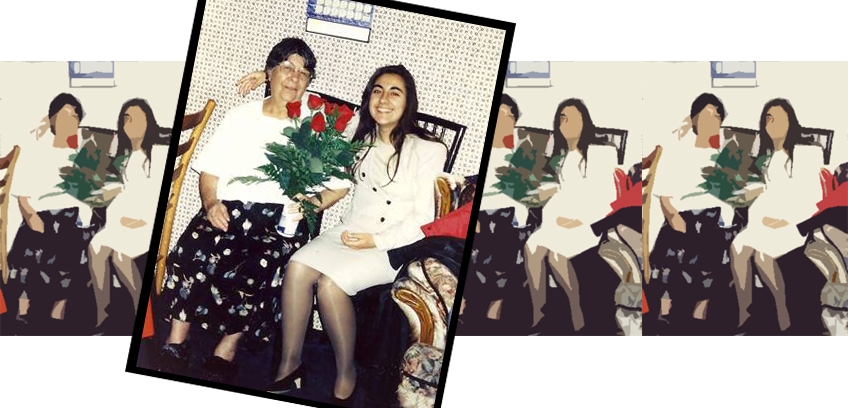
The writer, Yuliana Delgado, with her maternal grandmother, Mother's Day, 1996
Honoring Mamita
By Yuliana Delgado
I keep this picture in a safe place because of all that it represents to me. It was Mother's Day 1996 and we were visiting my Mamita (what I called my mom’s mom, my abuela or grandma) after church that Sunday. I was hamming it up for the camera, but I can still feel the scratchy icky-ness of those seldom-worn pantyhose on my legs and how silly I felt in my beige suit. What can I say, I tried to dress up a little since I lived in sweats and tees pretty much all the time (I was in college after all!). Beyond how I felt about my church garb on that day, what I remember clear as day is the incredible love and gratitude I felt for Mamita, whose health had been declining rapidly over the previous months.
Holy crap, that was 20 years ago! I was in my teens and a sophomore in college. And yet, despite my relative youth, I think I knew how little time I had left with my incredible, wonderful, always happy, always positive Mamita, María Noemí. In the days that followed that weekend, we visited her Queens apartment as much as we possibly could, to spend time or just to help around the house after her grueling radiation sessions or after those exam days, when the poking and prodding she had to endure at the hospital left her exhausted.
Almost two years to the day that this picture was taken, Mamita left us, finally succumbing to the cancer that had ravaged her body. Despite the fact that I knew it was coming—and as I think is always the case—her death was beyond painful, surprising, crushing. It didn’t matter that I knew the day would come, it had to come; knowing she was gone forever still destroyed me. Burying her was saying goodbye to my childhood—it was the first time I realized time went forever forward, and so many happy memories were destined to stay behind.
I found this photograph about two years ago, when I was pregnant with my daughter. While we had decided upon Sofía as our girl’s first name, we were struggling with a middle name. The picture brought inspiration. I would honor Mamita in a most special way, one that would keep her ever-present in my life: We would give our baby Mamita's middle name. It was the best way I could honor her, so many years after she left us. And Sofía Noemí is in, so many ways, a little bit like Mamita.
I hope Mamita’s great-granddaughter can carry on her spirit and legacy. Her name is a way to have her again in our lives. And whenever I look at my Sofi, I know we chose the name well.
-----------------------
Yuliana Gomez Delgado is the managing editor at MamasLatinas.com. She lives in New Jersey with her hubby, 4-year-old son, 20-month-old daughter, and two cranky Chihuahuas, Pablo and Arnie.

“My Mother, the Most Beautiful Woman in the Room”
You don't have to call yourself a writer to write meaningful vignettes about your life—and photographs make wonderful prompts. In this series, “Pictures Into Words,” Rachel Brodsky offers up her own vignette as inspiration. "Even as I—and the photo of us together—grew older, my mom still never seemed to age. Perhaps part of that has to do with the fact that she’s blessed with enviable genes—even today she’s well past 50 and still only has a smattering of barely visible gray hair..."
You don't have to call yourself a writer to write meaningful vignettes about your life. There are some notable books that can guide you on the journey of writing your life stories, and our blog regularly offers advice on the topic. Sometimes, though, all you need is a little inspiration.
With that in mind, this is the first in a series of contributions from memory-keepers: some who write for a living, and some who don't but are brave enough to pick up pen to paper (or fingers to keyboard). Each of them uses a photograph as a prompt for writing a little life story. And each of them provides not only a wonderful short read, but a fine and unique example of how you too may approach telling the stories behind your family pictures.
I hope to make this series, "Pictures Into Words," a regular feature on the site; if you would like to contribute, please reach out via email or social media (Twitter or Instagram)—I would love to share your stories as inspiration, too.
Without further ado, part one in our series...
Pictures Into Words:
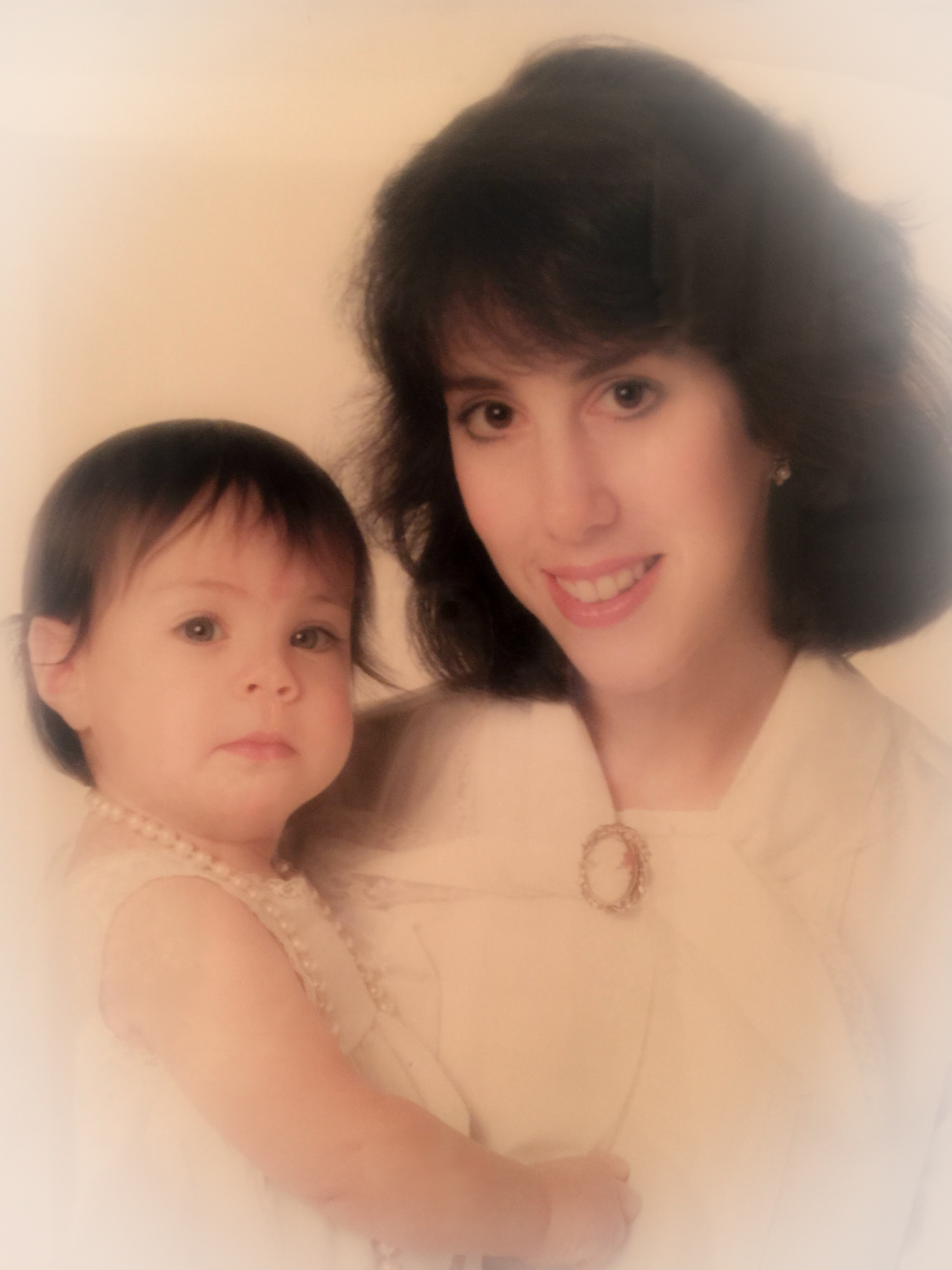
Author Rachel Brodsky and her mother
“My Mother, the Most Beautiful Woman in the Room”
By Rachel Brodsky
I don’t think it’s unusual for a daughter to view her mother as the most beautiful woman in the room. I certainly did. I was sure there was something that separated my mom from all other mothers. Maybe it was how tall she was, with her height clocking in at 5’9"—unusually lanky for a Jewish woman. Equally uncommon for a member of the tribe were her chest and backside, which were flat as pancakes—physical features she used to bemoan. But I thought those things, combined with her long, thin legs, made her look elegant and model-esque. I wanted to be naturally tall and thin when I grew up, too. I wanted to literally stand out from the crowd.
I used to stare, mesmerized, at a professional photo of the two us taken when I was barely a year old. My parents got me all dressed up for Baby’s First Photo Shoot, selecting a lacy white dress, a matching headband, and a string of long, Flapper-like pearls. They sat me down in a rocking chair holding a teddy bear, standing up on a white shag carpet, and each parent held me as they grinned into the camera. I remember thinking that this photo of my mom holding me in her arms was her at her most stunning. The way she, too, is dressed in white, looking up with a calm, quiet grace, seemed to radiate an uncommon mixture of innocence and wisdom.
Even as I—and the photo of us together—grew older, my mom still never seemed to age. Perhaps part of that has to do with the fact that she’s blessed with enviable genes—even today she’s well past 50 and still only has a smattering of barely visible gray hair. Maybe it’s also because she has maintained the same mid-length, feathery haircut decade after decade. Maybe it’s because she works out every week, stresses the importance of healthy foods (something that used to drive me insane as a kid, for obvious reasons), and never goes too heavy on the makeup—all habits I picked up once I got old enough to care about appearances.
Of course her beauty went beyond looks. She had, and still has, an openness, an honest streak, that let her smartly confront a lot of my teenage conundrums. When I was 10, I asked if I could begin shaving my legs. Not only did she agree, but she showed me how to do it without nicking myself. When I was 13 and started showing interest in makeup, she took me to the Clinique counter and bought me a starter kit. Fortunately, this never extended to anything truly embarrassing (it’s not like she bought me condoms in high school or college or quizzed me about my sex life), but the fact that Mom was inherently so open to discussing femininity and womanhood—no matter what the topic—just made her seem more progressive than most. Never mind the fact that she could easily pass for my cool, younger aunt instead of my mother.
Almost 30 years have gone by since this photo of us was taken. Her face has grown a few lines, her hair’s a little shorter, and usually I see her in glasses. But it's her inner elegance that has not changed a bit. I see it every time I look at her—the woman who is still the most beautiful one in the room.
-----------------------
Rachel Brodsky is a writer and editor living in New York. She currently works for SPIN.com. She also has two cats, one of whom is named “Jones” for Sigourney Weaver's tabby in Alien.
Dawn Roode’s curated roundup for the week of Sept. 23, 2026, is overflowing with recent reads on memoir, life story writing, and family history preservation.