
Memories Matter
Featured blog Posts

READ THE LATEST POSTS
The power of sharing family stories
Sharing family stories keeps memories alive. Discover how to extend your loved one’s legacy—and meaningful ways to share your finished book.
After years of work gathering photos, transcribing interviews, or shaping a loved one’s life into a book, the moment of completion can feel both satisfying and strangely empty. You’ve poured your heart into preserving their story—now what?
For many of my clients, the answer lies in sharing.
When you share a loved one’s story, you’re not closing a chapter. You’re extending it. You’re allowing their life to ripple outward—to inform, inspire, and comfort those who come after. In a sense, storytelling becomes its own continuation of relationship: a way to keep the tether alive between generations.
Oh, and it’s one of the most joyful things you can do!
The continuing connection
Telling someone’s story publicly or within your family can feel like reintroducing them to the world. Each time their name is spoken, their image held, or their story retold, they live again—not just in memory, but in action and influence.
Stories have a way of finding their place. A grandchild reads a passage and suddenly understands the origin of a family value. A friend finds courage in a story of resilience. A community member recognizes a shared history. What once lived privately on your desk becomes a bridge to others.
Why sharing matters
It Transforms Grief into Generosity.
Sharing the story moves it from a private expression of loss to a gift of love and learning, and it keeps their spirit alive—for you, for their loved ones, and for their descendants.
It Strengthens Family Identity.
When descendants know where they come from—not just the facts, but the wisdom and lived experiences that came before them—they carry that knowledge with confidence and empathy.
It Invites Reflection and Dialogue.
Family members often begin sharing their own memories, adding richness to the story you thought was finished. (If I had to choose, I’d say THIS is my favorite aspect of story sharing…it’s contagious!)
It Expands theIR Legacy.
What was once a tribute becomes a touchstone. Future generations can return to it again and again, finding new meaning as their own lives evolve.
Ways to share once your book is complete
Host a Family Gathering or Reading.
Gather relatives to celebrate your finished family history book. Read a few favorite excerpts, tell behind-the-scenes stories from the project, and invite others to share memories.
Create a Digital Version.
Scan or photograph key pages to share with distant family members or post excerpts privately online. (Here at Modern Heirloom Books, every bound print volume comes with a digital version of the book, both for backup and for sharing.)
Gift Copies to loved ones.
Thoughtfully Include a handwritten note inside each copy, explaining what part of the story most moved you—or what you hope it will mean to the recipient.
Two suggestions from my years of working with clients:
➡️ Either write on the endsheets or title page if it’s a short dedication; or use archival glue to adhere the envelope to the inside back cover and tuck your handwritten note inside—both approaches will ensure your sentiments are never separated from the book.
➡️ Order more books than you think you need! Privately published books are often printed in short runs, and it’s challenging—and more expensive—to go back and print more. If cost is a major concern, consider printing extras as softcovers.Record Oral Readings.
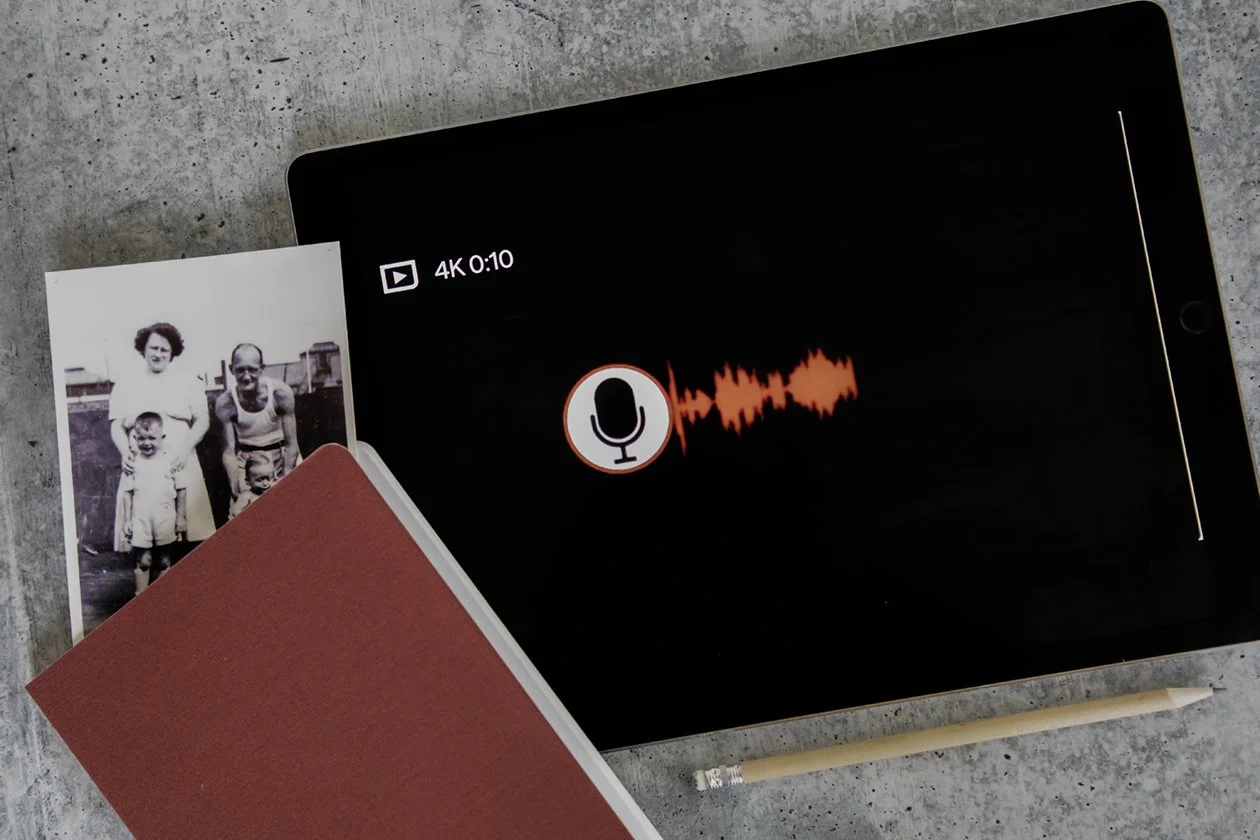
Use the book as a script for audio or video recordings—either record individual stories or chapters as discrete podcast episodes, or turn the whole narrative into an audiobook. A familiar voice reading aloud adds a new layer of intimacy. (And technology makes it easier than ever to record quality audio!)
Partner with a Local Institution.
Donate a copy to a library, historical society, or cultural archive. Your family’s story may illuminate a piece of community history. (If your book includes stories and photos of family members who are still living, get their permission first—and respect their wishes if they prefer for the book to be kept private.)
Create a Companion Keepsake.
Pair the finished book with a framed photo, a family recipe, or a meaningful object. These small tokens extend the emotional life of the story, and make for an even more special gift-giving experience!
A legacy shared is a legacy alive
Finishing a family history project is not the end of a relationship—it’s the beginning of a new kind of connection. When you share the story you’ve so carefully preserved, you’re giving others the chance to know, remember, and continue the conversation.
The story no longer belongs just to you—and that’s the beauty of it. It lives in the hands, hearts, and words of everyone who receives it.
P.S. I wrote this post about sharing the stories you’ve preserved about your family members, but OF COURSE it applies to sharing your OWN stories, too. Celebrate the life you’ve lived…and the ways you’ve chosen to bind it in the pages of a book ❤️❤️❤️ Your family will thank you.




























How to find their stories when they’re no longer here
Learn how to preserve family stories when firsthand voices are gone. Use archives, photos, and context to honor loved ones and keep memories alive.
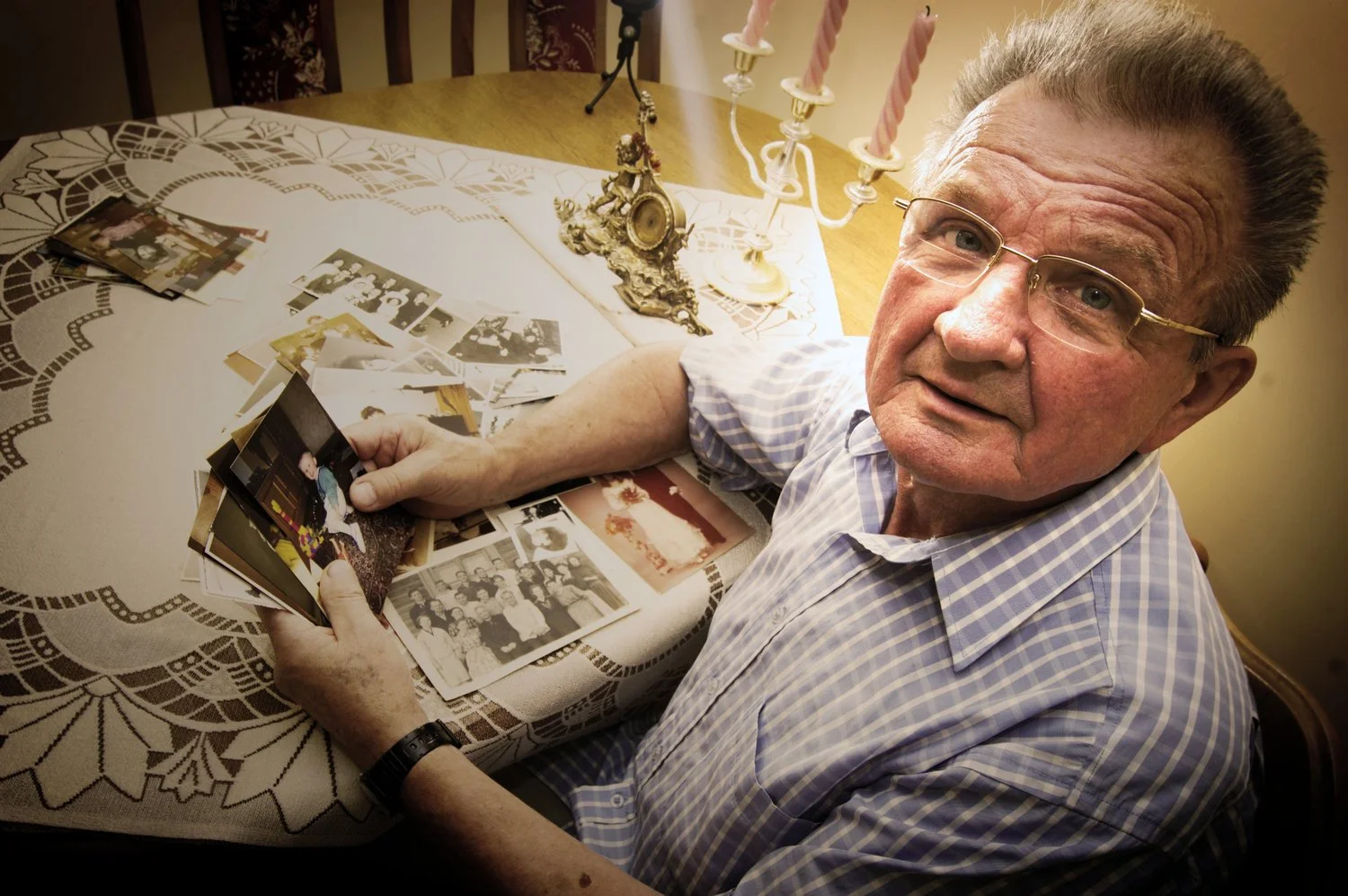
When a family member is no longer with us, it might seem like their stories have disappeared—but there are ways to ensure that their legacy lives on.
One of the hardest moments in family history work is what I call the silence gap. It’s that point when the people who lived the stories are no longer here to tell them. The firsthand voices have quieted, and we’re left wondering how much we’ve lost.
But the truth is, even when storytellers are gone, their lives don’t have to vanish with them. With care and creativity, you can still piece together a vivid, meaningful picture of who they were and what their world looked like.
Where to look for clues when stories are missing
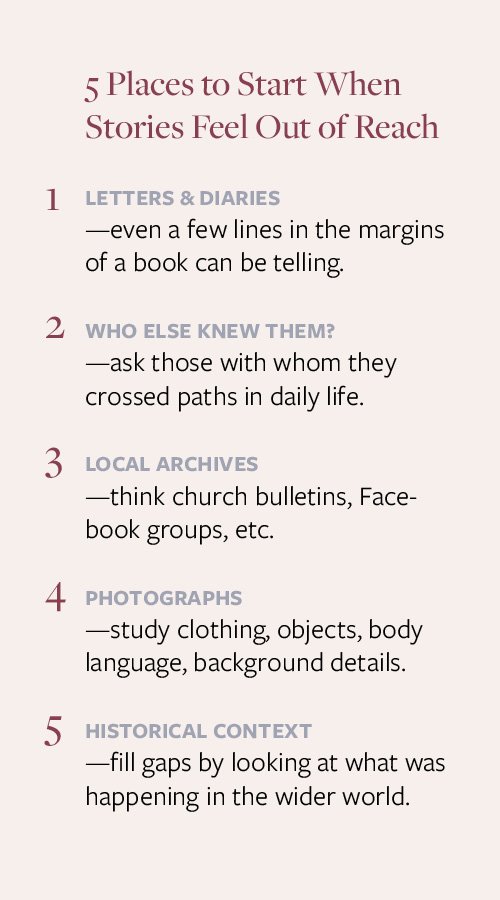
Letters and Diaries
Private writing—whether it’s a carefully kept journal, a series of letters, or a few lines scrawled in the margins of a book—is often the most direct glimpse into a person’s inner life. Look for tone, handwriting style, even what’s left unsaid. (And even if you glean minimal details towards a story, I promise you’ll feel closer to them upon discovering such personal writing!)
Oral Histories from Others
Sometimes the people who knew your loved one best weren’t family at all. Neighbors, classmates, coworkers, or fellow congregants may hold memories worth recording. Even a single anecdote can unlock perspective. (And if you feel shy about reaching out to someone you might not know so well for their memories, imagine this: Wouldn’t YOU feel touched to know you could offer that person something so special just by sharing memories of THEIR loved one?)
Community Archives
Don’t underestimate the power of local sources: synagogue or church bulletins, school records, town newspapers, civic directories, or Facebook feeds. These often capture the rhythms of daily life—and the names of people and families alongside them. (Social media, in this case, may have even greater potential than more traditional sources, as the interconnected web of people your loved one was connected to may surprise and delight!)
Photographs as Texts
A photograph can be “read” almost like a document. Clothing, hairstyles, household objects, even the way people posed can reveal details about status, personality, and era. (Further reading for this one may prove super-useful: Check out this post for how to choose which photos may hold the best stories. and head here for specific guidance on how to write stories from your family photos.)
Historical Context
If the personal stories are sparse, zoom out. What was happening in their community, country, or the wider world at that time? Context can help you understand what shaped their decisions and daily routines. (If you love books, take a trip to your local library and ASK a librarian in person for their recommendations—it’s a great way to be surprised, and to tap into the wisdom of someone who is trained in the art of research!)
The challenge of the ‘silence gap’ in family history
A note on honesty: As you reconstruct a life, it’s important to be clear about what’s fact, what’s interpretation, and what’s imaginative filling-in. Transparency honors both the truth and the integrity of the storyteller’s absence.
The good news? Even when memories fade and voices fall silent, the story isn’t lost. By piecing together fragments—from a letter here, a photo there, a scrap of community history—you can create a portrait that honors your loved one and keeps their life present for future generations.
Why it’s important to record family stories while you can.
While it’s true that fragments can help us reconstruct the lives of those who are gone, the fullest, richest portraits come from listening directly to people while they are here. Every conversation we have now—every story told in a parent’s or grandparent’s own words—is a gift to the generations that follow.
At Modern Heirloom Books, my work centers on capturing these living voices before they become silent, preserving not just the facts of a life, but the humor, warmth, and humanity that no archive can ever fully replicate. So, please: Do what you can now to preserve your own stories. You’re loved ones will be blessed by that gift (and grateful to you for sharing it 😉).






How will you be remembered?
Have you ever thought that your most valuable assets are intangible? Your legacy is more than the financial security you leave behind—it’s your life’s story.
What we leave behind can shape generations. Yet, too often, legacy is reduced to numbers on a balance sheet—monetary inheritances, real estate, investment accounts. While financial security matters, the most enduring legacies are often not the ones measured in currency but in character, wisdom, and love.
Has it ever occurred to you that your most valuable assets are intangible? Your family stories, the lessons you’ve learned, and the values you cherish—these will stand the test of time. Money can be spent, properties sold, but the stories and principles you pass down can continue shaping hearts and minds long after you’re gone.
The power of a story-driven legacy
Stories give meaning to life’s struggles.
Every family has its challenges, but within those challenges are lessons of resilience, perseverance, and hope. By sharing your experiences—your failures, triumphs, and the moments that changed you—you offer future generations a guidebook for navigating life’s uncertainties.
Values are best taught through stories.
It’s one thing to say “be honest” or “always work hard.” It’s another to share the story of a grandparent who upheld their integrity despite hardships or a personal moment when choosing the right path wasn’t the easy one. Stories turn abstract values into living, breathing lessons.
Family stories serve as a bridge between generations.
When children and grandchildren hear about their ancestors—their struggles, dreams, and sacrifices—they feel a deeper connection to their roots. They are reminded that they come from a lineage of strength and love. According to research from Emory University, adolescents who know more family stories “have higher self-esteem, higher sense of mastery in the world, lower anxiety, and a higher sense of meaning and purpose,” writes Robyn Fivush, Ph.D., director of the Family Narratives Lab at Emory University.
Stories endure.
Unlike material possessions, stories don’t depreciate. They can be retold, recorded, and passed down indefinitely, growing richer with each telling. Whether through written letters, recorded conversations, or shared traditions, your family history ensures your presence is felt long after you’re gone.
Your legacy is more than a will—it’s a testament to a life well lived. The stories you share, the love you give, and the wisdom you impart are the true markers of a meaningful life.
So ask yourself: How will you be remembered? What will you do to ensure you leave a legacy that is a blessing to your descendants?
How to begin shaping your legacy, now
Commit to writing about your memories every week for a year.
Find a lawyer who can help you create a holistic estate plan that accounts for both your financial assets and your values.
Work with a personal historian to preserve your most meaningful stories in book form.
How can I write about my life when I am still living it?
The three most common excuses I hear for not writing about your life “yet,” and how—and why—to overcome them. It’s not too soon for your memoir, I promise.
Even if you don’t love to journal, keeping a simple ideas notebook—with snippets of memories, headlines that resonated, quotes from loved ones, ticket stubs, whatever may prompt life writing ideas later—is a powerful tool. Use a simple composition notebook, or grab this lay-flat one from our store.
There’s a common misconception that a memoir—or any personal writing—needs to be a finished product, a neatly wrapped narrative with a clear beginning, middle, and end. But life doesn’t work that way, and neither does great storytelling.
The truth is, the best time to start writing about your life is right now—not years from now, when everything has “settled.” Writing as you live allows you to capture moments in real-time, with fresh emotions and raw details that might fade with time. It’s not about having all the answers; it’s about documenting the journey.
So, how do you begin? Let’s break down some of the biggest hesitations and how to move past them.
The 3 most common excuses that it’s ‘too soon’ to write about your life
“I don’t know how my story ends.”
Good news: You don’t need an ending to start writing. Memoir and personal essays don’t require a final chapter before you begin—many of the most compelling life stories are explorations, not conclusions.
💡 Try this: Instead of worrying about how everything ties together, focus on individual moments that feel meaningful right now. Write about a recent experience, a challenge you’re navigating, or a lesson you’re learning in real time.
📖 Example: Eat, Pray, Love by Elizabeth Gilbert
Gilbert didn’t write her memoir after she had “figured everything out.” She wrote it in the middle of transformation, capturing a period of self-discovery. Her story unfolds as she travels through Italy, India, and Indonesia, and it doesn’t wrap up with a perfect ending—just a deeper understanding of herself.
👉 Further Reading: How to use short vignettes to create a mosaic of your life.
“I haven’t achieved anything ‘big’ yet.”
You don’t need a dramatic, bestselling-worthy life event to write about your experiences. Some of the most powerful personal writing comes from small, everyday moments—the way you felt on a quiet morning, a childhood memory that keeps resurfacing, the way certain music transports you to another time.
💡 Try this: Instead of chasing “big” moments, focus on specific details that make a memory or realization come alive. If you keep a journal, flip through an old one to discover how compelling small experiences from your everyday life can be.
📖 Example: An American Childhood by Annie Dillard
One of the first memoirs I ever read, Dillard’s book isn’t about a single, dramatic event—it’s about how she experiences the world as a child growing up in Pittsburgh. She writes about curiosity, wonder, and the process of paying attention to life as it unfolds, proving that even the smallest moments can make for profound storytelling. I highly recommend it as a model to emulate.
👉 Further Reading: How to choose which life story theme to explore first.
“What If My Perspective Changes?”
Your perspective will change—and that’s a good thing. The beauty of writing while living is that your story evolves—and your writing can, too. You can revisit memories with new understanding, update reflections with fresh insight, and track how your views shift over time.
💡 Try this: Start a “living memoir” journal where you capture thoughts and stories as they happen. Revisit entries later to see how your perspective has changed.
📖 Example: Hourglass: Time, Memory, Marriage by Dani Shapiro
One of my favorite books from one of my favorite authors, Shapiro’s Hourglass explores how we evolve and change over time, and how those changes impact her relationship and sense of self. Instead of writing from a place of finality, she embraces the shifting nature of perspective—reflecting on the past while still actively living her present.
👉 Further Reading: 5 steps to drafting your own library of life writing prompts.
Your life doesn’t need to be finished to be worth writing about. Your words matter right now—in the middle of the mess, in the midst of discovery, even before you have all the answers.
So, pick up the pen. Start where you are. Your story is unfolding, and that’s exactly why you should write it.
Should I hire a professional biographer?
My biased opinion: Working with a professional biographer can be one of the most meaningful investments you’ll ever make. Here are a few reasons why.
Professional biographer, personal historian, memoir coach—Dawn Roode, pictured with a client, is all those things.
Depending on the day, and my mood, and whom I am speaking with, I may call myself a personal historian, a professional biographer, or a memoir coach; because the legacy preservation work that I do is 100-percent customized to each specific client—and, maybe even more so, because most people have never heard of ‘my job’—I opt for clarity over consistency. Other people who do similar work may call themselves ghostwriters, or family historians, or life story facilitators, even practitioners of guided autobiography.
At the end of the day, though, we are professionals who help everyday people capture their life stories—in my case, in books.
Should you consider hiring…well, for simplicity’s sake, let’s just say a ‘professional biographer’?
I’m biased, of course—I believe that working with a professional biographer can be one of the most meaningful investments you’ll ever make. So, my answer is “yes.” Here are a few reasons why:
1. We know how to bring out the best in your story.
Many people assume they need a dramatic, bestselling-worthy life to justify documenting their story. The truth is, every life is extraordinary in its own way—it just takes the right approach to uncover the details that make it shine.
A professional biographer is skilled in:
✔ Asking the right questions to help you recall meaningful moments.
✔ Finding themes and connections you might not see in your own experiences.
✔ Bringing your voice to life in a way that feels authentic and natural.
Example: Have you ever tried to tell a story but felt like you were rambling? A biographer helps organize your thoughts, ensuring your memories are preserved with clarity and depth.
2. The process is easier (and more enjoyable) than you think.
Many people put off documenting their life because they think it will be too time-consuming or difficult. But hiring a biographer makes the process simple and even enjoyable—it’s just like having a relaxed conversation, with someone else doing the heavy lifting of recording, organizing, and shaping the story.
✔ No writing required—just share your memories in a comfortable, guided interview.
✔ You set the pace—whether you want to do a few short sessions or take your time reviewing your life experiences over the course of a year.
✔ It’s a conversation, not an interrogation—biographers create a safe space for you to open up and share.
Think of it this way: If you’ve ever enjoyed telling stories to friends or family, you’re already doing it! A biographer simply captures those stories and turns them into something lasting.
3. Your story deserves more than just a few scattered notes.
If you’ve ever tried to jot down memories on your own in a journal, scrapbook, or other memory-keeping tool, you might have found yourself starting and stopping, unsure where to go next. A professional biographer helps weave everything together into a clear, beautiful narrative.
✔ We create structure—so your story has a natural flow and impact.
✔ We capture your unique voice—so it truly sounds like you.
✔ We ensure accuracy—so the details of your legacy are preserved with care.
Consider: Leaving behind a device overflowing with digital clutter and haphazard notes, letters, and journals for your offspring forces them to sift through the clues of your life; a professional biographer helps you curate the stuff of your life so your loved ones don’t have to do it later.
4. Your legacy matters—now and for future generations.
One of the greatest gifts you can give your family is a well-preserved, well-told story of your life. Whether it’s a bound book, an audio recording, or a digital archive, working with a biographer ensures that your memories don’t fade over time.
✔ Your children, grandchildren, and beyond will know your voice, your experiences, your wisdom.
✔ Your history won’t be lost—your struggles, triumphs, and lessons will live on.
✔ It’s not just about the past—it’s about shaping how you want to be remembered, and offering up your hard-won lessons to your descendants.
Imagine this: Decades from now, a great-grandchild you’ve never met picks up your story and feels connected to you in a way they never could have otherwise. (Wouldn’t you have cherished such a gift from your own parents or grandparents?) Even better—what if they are able to learn from one of your stories? This is such a biggie, but I’ll leave you with one word: IMPACT ❤️
Hiring a skilled personal historian or biographer isn’t about handing over your story to someone else; it’s about having an experienced guide who knows how to ask the right questions, shape a compelling narrative, and preserve your legacy in a way that resonates for generations to come.

“I’m scared.”
Are you nervous about undertaking a life story project? Working with a personal historian or memoir coach can help alleviate many of the most common fears.
Before I had even met with a particular prospective client, he told me has was scared.
He had filled out a form expressing interest in writing his life story. I replied to him within 24 hours, but did not hear back from him until about three months later. At that time, I urged him to set up a free phone consultation, so I could learn more about the project he envisioned. He scheduled that for a week later, then did not answer the phone when I called.
Then he emailed me: “I’m scared.”
That’s it—two words, but two words that hold so much weight.
Have you ever felt nervous about undertaking a life review project? Whether it’s a reflective memoir, an extensive family history, or just a few short stories encapsulating your favorite memories, starting any personal legacy journey can feel daunting.
Working with a personal historian or memoir coach can help alleviate many of the most common fears.
A few fears that my personal history clients have told me about over the years:
Fear that their family members won’t be interested in their life story.
This is one I hear ALL the time. And you know what? It’s often the case…for now. Your family members are living their lives, and likely taking for granted that you—their parent or grandparent—will always be there. But your stories are the gift they don’t yet know they want. Writing them now—even if it’s for them to appreciate later—is giving them an unequivocal gift.
Fear that they won’t remember enough to write a memoir.
Memories can be elusive. Especially for folks who don’t often share their stories around the dinner table or in a journal, accessing those memories might seem like an impossible task. But we professional personal historians and memoir coaches have plenty of tools and prompts at our disposal to help! Consider using this straightforward and EASY prompt that is guaranteed to yield surprising memories; use your senses to help you travel back in time; or consider picking up a journal designed especially to stir memories, like this one from Beth Kephart.
Fear that they will have a hard time managing their emotions when writing about traumatic life experiences.
It’s a common refrain that writing about hard times can be cathartic. It can, but as Lisa Cooper Ellison writes in this post, catharsis is just the beginning. Writing about trauma is generally only worthwhile—and valuable, even healing—when we can make some meaning out of it. “Writing well requires an open heart,” Ellison says. “That means you must relive a small portion of the incident as you write about it.” In other words, you will relive some trauma if you write about it—but while there’s no way around that, there are ways to cope with it. Limiting writing sessions that cover traumatic experiences to a half hour or so may help; allowing yourself to write from a distanced perspective will, too. Some people swear by writing groups or trustworthy readers to offer them support when writing about difficult experiences; and others find walking this path with a therapist is necessary. Make sure to include self-care as part of your writing ritual, and be gentle on yourself—if it feels too hard today, wait until tomorrow. Though it likely is a scary endeavor, writing into our trauma can be life-transforming for many. (And remember: You can do all of this just for YOU…write in a private journal, either as a first step, or as the thing itself; no one else need ever read your words.)
Fear about being vulnerable.
Exposing our emotions is scary. Remember that you are in control of what makes it into the final draft of your memoir, so if something feels too exposed, you can always cut it. But also remember that it’s our vulnerability, often, that proves most powerful for our readers. “Revealing oneself is an act of radical generosity: letting oneself be seen allows others to do the same,” Robin MacArthur writes. “And this vulnerability creates connection.”
Are you scared of taking the first step in preserving your life story for the next generation? Set up a free 20- to 30-minute consultation to see if working together can help settle those fears—and get you on the path to preservation.

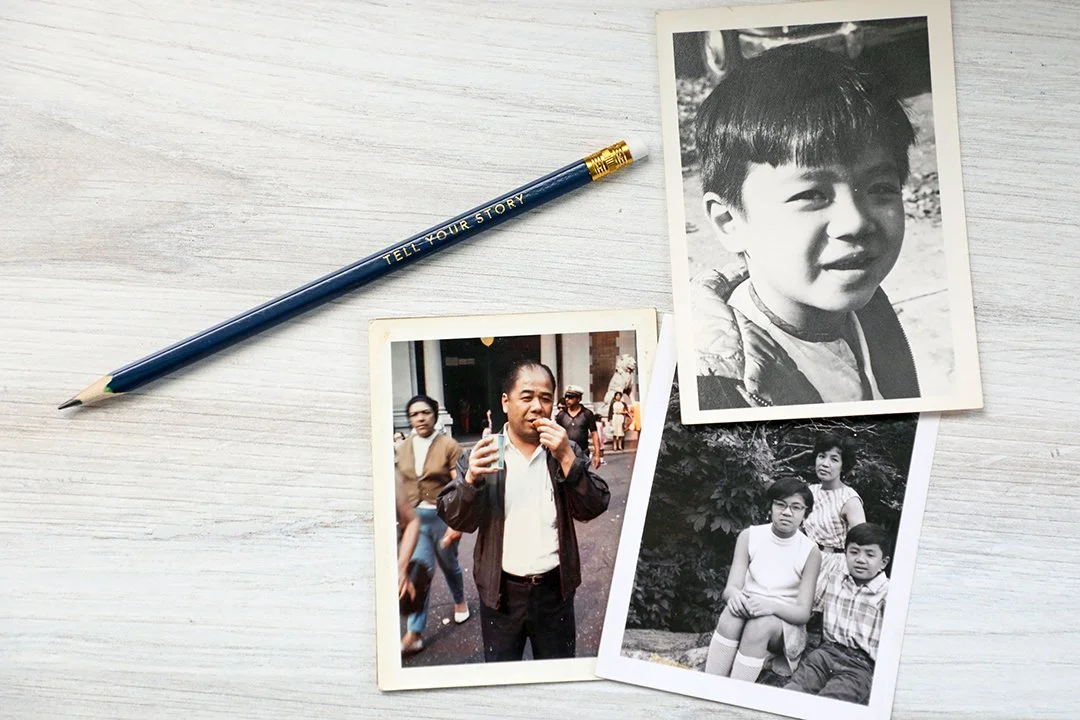



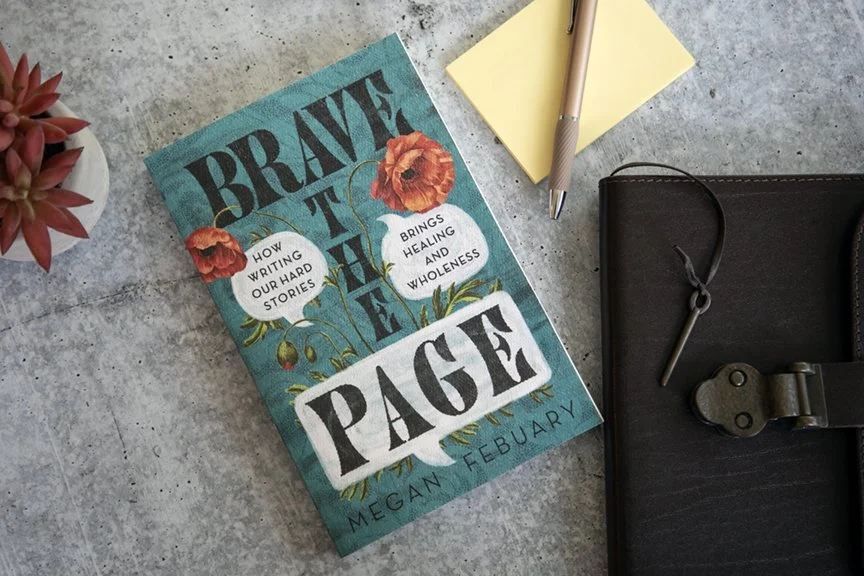








What do you wish you had asked them?
“I wish I knew why Mom moved to New York when she was just 16.” “I wish Papa told me how he makes his Sunday sauce.” Don’t wish for stories; ask for them.
Do you wish you had asked your parent certain questions before they passed away? Are your parents still living, but you know you haven’t asked them for all the stories you hope to one day hear (and pass on to your kids)?
“I wish I had asked my father about his time in the Army during the war.”
“I wish I had asked Gran about what Mom was like as a teenager.”
“I wish I had asked Mommy why she never remarried after my father left.”
“I wish I asked what the heck the ‘secret ingredient’ is in Nonno’s Sunday sauce.”
Whether it’s a seemingly small thing like how to get a favorite family recipe just right or a big thing such as why a loved one left home at the age of 16, we all have questions we wish we had asked.
I hear these laments regularly from prospective clients and from friends, from those I am coaching on their own memoirs to those who are honoring a deceased family member in a tribute book. It’s an unfortunate universal truth: We think we have unlimited time with those we love—time to do the things we want together, to share our appreciation for them, to ask them questions (about any and everything, but especially about themselves).
If there are two things I could impart to you right now—lessons learned from these repeated regrets—they would be:
1 - Ask your parents questions now.
If your parents or grandparents are still living, start asking them more meaningful questions than “How are you?” or “Do you want to meet for dinner?” Instead…
Encourage them to write about their life by telling them how much you really DO want to hear their stories!
Or just start having some intentional, thoughtful conversations and hit “record” on your smartphone. (Need inspiration? I am currently listening to Laura Dern and her mother, Diane Ladd, have these exact type of conversations in the audio book of Honey, Baby, Mine: A Mother and Daughter Talk Life, Death, Love (and Banana Pudding) [Grand Central Publishing, April 2024]).
2 - Answer questions your own kids haven’t asked yet.
Be proactive. I guarantee your children will one day wonder about you. Not you, their parent, but you, the individual. Think about the questions you wished you had asked your now-gone family elder, and find a way to answer some of them. It could be by…
writing in a journal devoted just to this purpose that you will one day pass on to them;
creating a weekly writing practice to preserve your life stories;
working with a personal historian like me to interview you to capture those “answers” (let’s chat!);
simply having CONVERSATIONS over the phone or over dinner where you intentionally share memories and allow them “in” to your world in a deeper way (this is ideally done with adult children, but you can begin sharing your memories and life lessons in age-appropriate ways throughout their young lives!);
preparing an ethical will (also known as a legacy letter), an opportunity to share your values in a way that takes much less time than writing a whole life story book, to be sure, but that may hold as much value to your descendants.
It’s natural to take our loved ones for granted. But I urge you to step off that easy path and take a turn towards intentionality: Ask questions. Answer questions. Sidestep regrets 💕
No readers, no matter—your life story benefits YOU
Walking down memory lane can be fun, but writing about your life has big benefits beyond that, including making meaning out of your lived experience.
“A story is a map and we the mapmakers plotting the landscapes of our lives,” Mark Yaconelli writes in Between the Listening and the Telling.
Most people who approach me wanting to explore their personal history are motivated by a desire to create a legacy and pass something of value on to the next generation. Whether it’s a full family history or short vignettes from their own life they hope to capture, they’re usually thinking about an audience of their kids and grandkids, or a broader circle of friends and family—the point is, they’re aware of an audience, even if it’s small.
Without exception, though, every person I have guided on a life writing journey has discovered profound benefits for themselves. Even without a single other individual having read their words, those words have changed them.
There are myriad ways writing about one’s life is good, of course. But for now I want to share just two biggies.
2 profound benefits of writing about your life
RECOGNIZING AGENCY
I don’t mean to get all jargony on you when I say you will recognize the agency you have—I guess what I really want to say is that you are the writer of your own life: You make the decisions, pull the strings, choose the paths…but often we forget that simple fact. We (and I readily include myself in this collective ‘we’) can get caught up in the things that happen to us. “I lost my job.” “I can’t get pregnant.” “My father died.”
Yes, things happen—and despite the conventional wisdom, not always for a reason. But one thing that becomes abundantly clear when writing about your experiences is that how we choose to respond is what defines us.
You will see that you are an active participant in your life—you are not just a storyteller, but a story creator.
In fact, this insight is the foundation of narrative therapy. “With this perspective, individuals feel more empowered to make changes in their thought patterns and behavior and ‘rewrite’ their life story for a future that reflects who they really are, what they are capable of, and what their purpose is, separate from their problems” (Psychology Today).
I bet you never imagined that writing about your life will empower you to rewrite your next chapters…but it will.
INFORMING IDENTITY
From beginning to end, life writing is an exploration that leads to meaning-making. The memoirist asks themselves questions such as: Which experiences are worth telling? Why did I behave a certain way? How is that part of my life a story?
Those questions may at first seem like mere steps toward completing your personal writing, but in truth they are foundational to understanding one’s own identity, as Phillip Lopate explains in this quote from To Show and To Tell:
“In attempting any autobiographical prose, the writer knows what has happened—that is the great relief, one is given the story to begin with—but not necessarily what to make of it…. Writing is one way of self-making.”
Through your writing, you will begin to understand the value in your experiences, to see them as pieces of a bigger puzzle rather than as isolated events. As the best memoirs mine individual experiences to get at a universal truth, so too will your writing bring your own world view into sharper focus.
The memories that come to the surface, and the stories you write about them, will be gifts to your family; the insights you discover along the way will be gifts to yourself.
Dawn Roode’s curated roundup for the week of Sept. 23, 2026, is overflowing with recent reads on memoir, life story writing, and family history preservation.