
Memories Matter
Featured blog Posts

READ THE LATEST POSTS

Tenement Museum tidbits
Under One Roof at NYC’s Tenement Museum is a must-see exhibit: First person testimony (and authentic furnishings) bring 3 families’ immigrant experiences to life.
Last week I had to be in Manhattan for a few business meetings, so I scheduled in a midday “appointment” to see an exhibit I had written about that piqued my interest: Under One Roof at New York City’s Tenement Museum.
While the museum’s original exhibits in the building at 97 Orchard Street highlight immigrant families who lived there between 1863 and 1935, the new installation down the block at 103 Orchard Street turns its attention to life in this Lower East Side neighborhood during the 1950s, 1960s, and 1970s.
Under One Roof
Over its 127 years as a residence, 103 Orchard Street housed more than 10,000 people. Under One Roof introduces us to three of them: Bella Epstein, Ramonita Saez, and Mrs. Wong.
The stories of these women and their families are told through the room interiors themselves, which are recreated in glorious authentic detail, from the crocheted doilies in Ramonita’s living room to the mezuzah affixed to the doorframes in the Esptein household. But it’s the first-person accounts of family members themselves that bring these immigrant experiences to life.
During the 90-minute tour we meet the families through their own testimony (short recorded audio clips and passed handouts with immigration records, photos, and other details), but these are mere glimpses. My amazing tour guide recounted the families’ experiences, always placing them in the broader historical context and framing a dialogue about the immigrant experience that continues to be of vital importance in our country.
As we were invited to take a seat on Ramonita’s plastic covered sofa and listen to some of the history of the neighborhood, it was inevitable that many of us would find moments of connection, and even consider how our own family stories contribute to our country’s ever-evolving identity.

The families of “Under One Roof” who lived at 103 Orchard Street, from left: Bella Epstein, pictured with her sister, Bluma, moved to the building in 1955; Ramonita Saez, who worked in a garment industry sweatshop and was a single mom of two sons, came in 1962; and Mrs. Wong, who moved to the Lower EastSide in 1968, still lives on the same block today.
Delving Deeper Into the Stories
Upon my return home, I discovered the rich website that does these families’ stories even greater justice. If you can make it to the Tenement Museum, I highly recommend Under One Roof or any of the amazing tours; if you can’t make it, though, do visit the site—and get lost in the textures and sounds and experiences of this not-so-distant time in our country’s history. You’ll discover oral history video clips, lots of photographs of the families and the downtown in which they resided, and plenty of food for thought.
Our individual stories are the stories of our country. We are history. Learning about the past through first-person experiences is the kind of “history” I wish I was taught in school alongside the dates and the textbooks. Bring your older kids to the museum to spark conversation and show them that history doesn’t have to be boring. Or consider sharing your own stories, and doing so with your kids—you just may be surprised how interested they are once the dialogue has begun!
Gift Shop Treasures
I’m one of those parents who tells my kid “no” to every gift shop tchotchke request, but I almost never say no to buying a book. This time around, I nabbed some books for my own memoir-obsessed self, along with a nice pen for him (he’s eight, and recently obsessed with writing in his journal—that’d be his Diary of a Wimpy Kid Journal, thank you very much ; )
Among my book recommendations:
A Tenement Story: The History of 97 Orchard and the Lower East Side Tenement Museum
Bintel Brief: Sixty Years of Letters from the Lower East Side to the “Jewish Daily Forward”
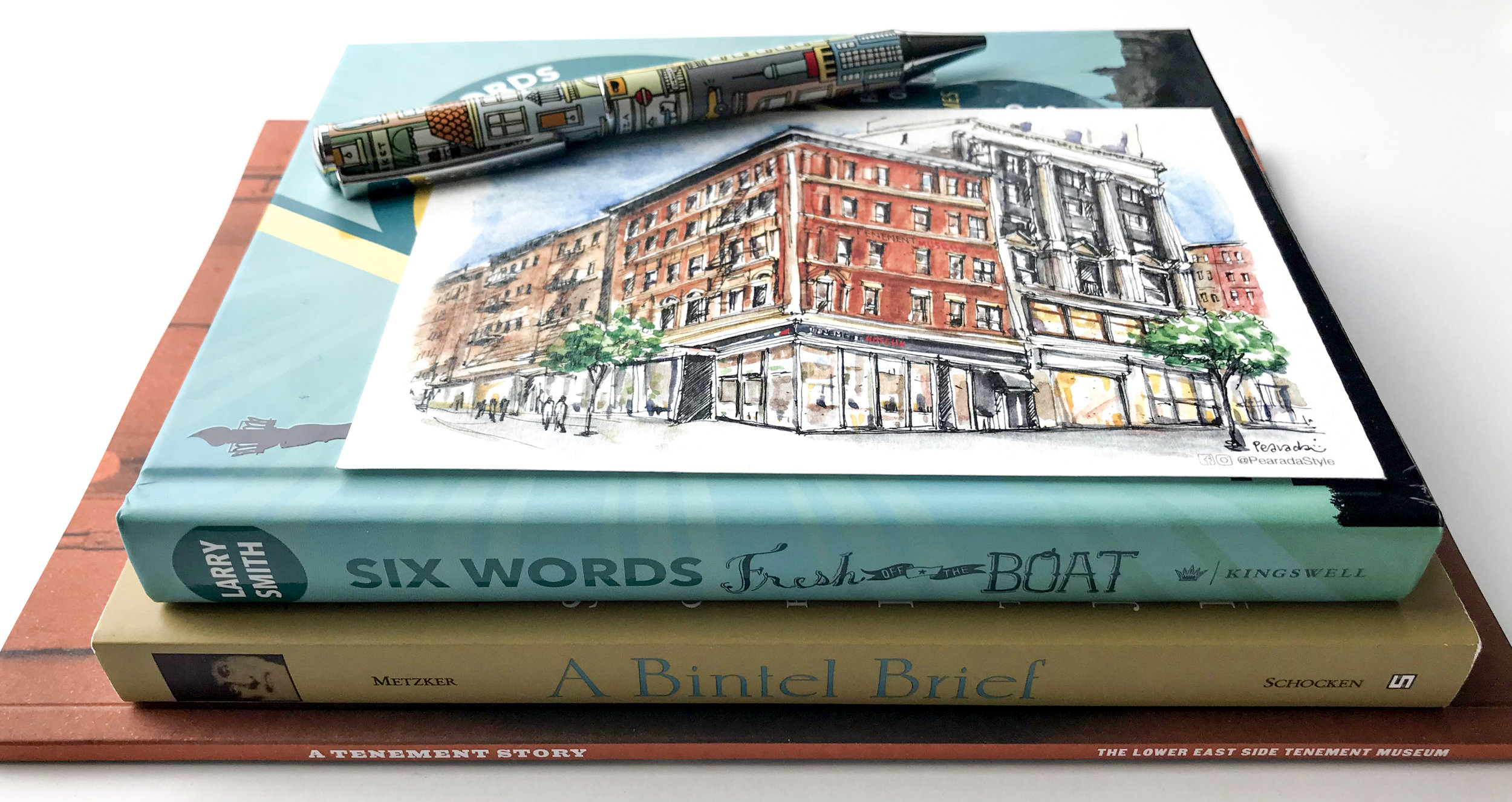
I will be finished with the Six Words book soon, simply because I can’t seem to put it down. It is uplifting and surprising, and when all of these (extremely) mini memoirs are stitched together, they create a diverse patchwork representative of “the American experience.”
For anyone who doubts that a six-word memoir can be powerful, check these out:
Daughter’s sweat equity paid son’s tuition. —Lisa Carlson
I no longer needed to whisper. —Hanni Gorenz Finaro
My mother: maid to mechanical engineer. —Jennifer Na
What would your six-word memoir be?
*Please note: I am in no way affiliated with the Tenement Museum, and this is an unsolicited review; I purchased tickets to the exhibit myself.

Life Story Links: Blog Roundup, Feb. 20, 2018
Multiple personal historians weigh in on telling stories creatively using more than straight narrative, plus writing tips, family archive preservation & more.
“In the particular is contained the universal.”
—James Joyce
What a rich array of resources and articles we’ve got this month! Let’s dive right in, shall we?
Stories Come in Many Forms
FACES, PLACES
In an exhibition at the Art Institute of Chicago, Al Solh’s ongoing series of drawings—or as she prefers to call them, “time documents”—emerged from deeply personal encounters and conversations between the artist and Syrian refugees, as well as other forcibly displaced people. “After five years of continuing this work, I am more aware of how faces tell a story that is as powerful as each person’s story, their ideas about life, aspirations, and how we can go on, wherever we have ended up." I wish I were closer and could see the work in person, but this gallery of images is quite inspiring.

Mounira Al Solh. I strongly believe in our right to be frivolous, 2012–ongoing. Photo: Courtesy of the artist and Sfeir-Semler Gallery; Beirut / Hamburg
BIOGRAPHICAL COMICS
Ellie Kahn of Living Legacies Family Histories in Van Nuys, CA, is working with an illustrator to transform one client’s personal stories into comics! See some sample strips, by cartoonist Ben Evans, here.
A LIST OF LISTS?
Sometimes it’s not a long narrative that most interestingly tells your story, it’s a simple list. I explore how to use lists to add texture to a life story book, including a list of list-writing prompts geared at family historians, plus some sample spreads from my personal library.
MORE THAN WORDS
Memoirs consist primarily of narrative. But they can also serve as a medium for artwork, poems, songs, toasts, and other bits of memorabilia that represent your life. Massachusetts-based Nancy West shares ideas from the pages of books she has produced.
Tips, Tenements & Time Travel
WRITING LIFE STORY
Sarah White of First Person Productions in Madison,WI, shares a powerful writing exercise from the most thumbed-though, sticky-noted book in her memoir writing library, Your Life as Story by Tristine Rainer. Definitely check it out—I can say from experience Rainer’s tips are beyond useful, and often surprising in what they elicit in your writing, and White features a gem here.
TIME TRAVEL
The initial rationale for funding a personal history project may be to share the subject’s life with grandchildren or great-grandchildren—but, writes Jim Michael of the Personal History Center in Lilburn, GA, “We can never predict who may eventually see it and how it may influence those who view or read it.” Send your life story on a time voyage.
TWO-FER TUESDAY
Brianna Audrey Wright, who calls herself a “storyteller of bygone days” and specializes in Nebraska, Iowa & South Dakota family history, offers up two recent blogs of interest: “Names and records are wonderful and necessary, yes, but it’s that dash between birth and death that’s so fascinating,” she writes in “Genealogist or Family Historian?” In another post, she contemplates the question: What is a legacy in the digital age?
NEW YORK NARRATIVES
It took 10 years and hundreds of hours of interviews to create NYC’s Tenement Museum’s latest exhibit, which chronicles the lives of three post-World War II families who once lived in the building at 103 Orchard Street. “Under One Roof” isn’t a straight work of architectural preservation—rather, it is both a reversion and a reinvention, preserving a space in order to preserve the stories of the people who once occupied it, as a way of telling the story of America.
“WHAT CAN I SAY THAT HASN’T BEEN SAID?”
A conversation with her father prompted Olive Lowe to reflect on why we should tell our stories, even when we think they’re simply not original. “It’s true that most of the items we could list on our ‘life resume’ are on someone else’s too,” writes the Mesa, AZ–based personal historian. But it’s not the what that matters as much as everyone’s personal why.
...and a Few More Links!
- The New York Times addresses How to Preserve Your Family Memories, Letters and Trinkets in the Smarter Living Section.
- The obituary that Jean Lahm wrote about her father told his story and made people laugh a little, too—and made strangers miss a man they never knew.
Short Takes

Revealing your life stories, one list at a time
Sometimes it’s not a long narrative that most interestingly tells your story, it’s a simple list. How to use lists to add texture to your life story heirloom book.
My Ideal Bookshelf (Thessaly La Force, Little, Brown and Company, 2013) is a gem that I discovered displayed at the front of my local library—an impulse check-out, if you will. The authors approached a wide array of luminaries (writers, artists, chefs, and more) and asked them to list their ideal bookshelf: “Select a small shelf of books that represent you—made you who you are today, your favorite favorites,” they write.
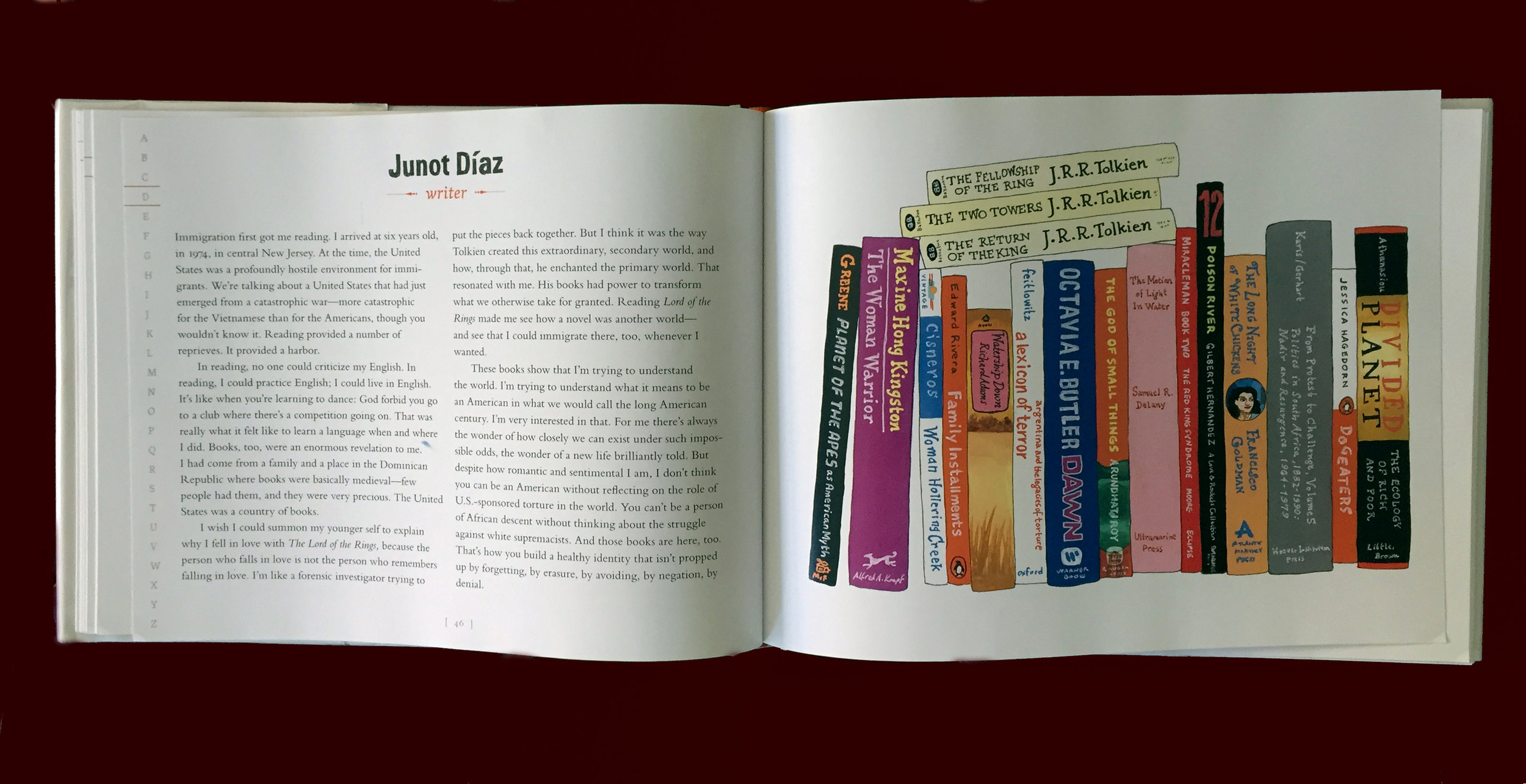
They are quick to note that this is not your one-and-only, ideal bookshelf—“there is no ur-bookshelf.” Rather, it is a snapshot of you in a moment in time. “You could build an ideal bookshelf every year of your life, and it would be completely different. And just as satisfying.” And, of course, just as revealing.
The Lure of Lists
We often use lists as a narrative device in our heirloom books. When mixed in with longer stories of an individual’s life, they can be especially alluring for readers, and a fun way to offer a glimpse into a person’s opinions and life. Breaking up long blocks of text with shorter pieces helps with a book’s pacing—and, most importantly, usually ensures that a book will be picked up often, not abandoned on a bookshelf to collect dust.
And when someone visits with an heirloom book, they are visiting with its subjects, too—communing with the family, staying connected, continuing to weave the family narrative for the next generation. Why not give them some insights into you they’ll really want to read?
Your Own Bookshelf
Are you an avid reader? Then designing your own “shelf of books” that represent you might be a rewarding—and telling—endeavor. Check out My Ideal Bookshelf from your own library for some inspiration.
“We’re all still hunting, still hoping to discover one more book that we’ll love and treasure for the rest of our lives,” La Force writes.
Imagine that your future grandchildren are all grown up, now hungry readers themselves. Imagine they pick up your list: Maybe they find a book they simply must try. Maybe they find one they are curious about—and they begin a conversation with you about why these books mattered to you. Maybe your conversation becomes an ongoing one, each of you sharing your ideas about what you’ve read lately… Maybe a list such as this has a life of its own.
“Some people like to snoop through medicine cabinets, but that only gives you insight into a person's physical well-being. The books tell a tale about the person's mind.” —David G. Allan, CNN, “Why Shelfies, Not Selfies, Are a Better Snapshot of Who You Are”
Lists that Matter
What else might you explore in list form that is revealing of much more than the list might seem to indicate at first glance? (It’s worth noting that I am generally not referring to lists that include mere titles, but that include some elucidation and broader storytelling about the list—why choices were made, how the process felt.)
Here are a few ideas for meaningful lists from previous heirloom books we have done, and some we’d love to do for you down the road:
On Reading
My Ideal Bookshelf, 2018
The Children’s Books Worth Saving & Passing Down
Where I Get My News, 2017
What I Read to Feel Hope
Books I Wish I Had Written (and Why)
“You may not have a biography written about your life, but you have a personal bibliography.” —David G. Allan, CNN
On Travel
Best Childhood Vacations
The Places Our Family Returns to Again and Again
My Bucket List: Where I Want to Travel
Memories of Our Family Staycations (When Travel Cost Too Much but We Made Our Own Fun!)
Top 5 Places I’ve Ever Visited
On Music
My Ideal Playlist
Soundtrack, 1988-1992: The Songs that Shaped My College Years
Summer Sounds, 1972
My Happy Playlist: Songs Guaranteed to Put Me in a Good Mood
On Food
Top 10 Comfort Foods
Foods that Remind Me of Home
Foods that Transport Me to My Childhood
What Was in My Lunchbox, 1977
Recipes Passed Down through Generations (and How I Made them My Own)
Random:
All the Jobs I’ve Ever Held (Yes, Including that One-Day Paper Boy Stint)
The Scrapes and Bruises of My Childhood (On My Path of Adventure)
Fears I Have Overcome, and How
Habits I Just Can’t Break (Do You Have Them, Too?)
Other Themes to Explore:
On Cars
On Movies
On Sports
On Fashion
On Friends
On Hobbies
On Love
On Embarrassing Moments
On Life’s Challenges
A Little List Inspiration
Want to see how lists might take shape?
The co-founders of Modern Loss, a website providing candid conversations about loss, each honored their fathers through lists last year. I think both of their lists are wonderful examples of how a form so seemingly simple can truly offer special—and engaging—insights:
20 Things You Probably Don’t Know About My Dead Dad by Gabrielle Birkner
“No, you can’t meet him. But yes, you can know him, through photos, scrapbooks and stories of those who knew and loved him best. Through me. And that goes not just for my children, but also for my husband and my many close friends who never had a chance to meet my dad. He isn’t just dead; he was so much more.” —Birkner
21 Things You Probably Don’t Know About My Dead Dad by Rebecca Soffer
How might we treat such substantive lists in an heirloom book? Well, here’s one example of a spread from a book of my own, also about my father.
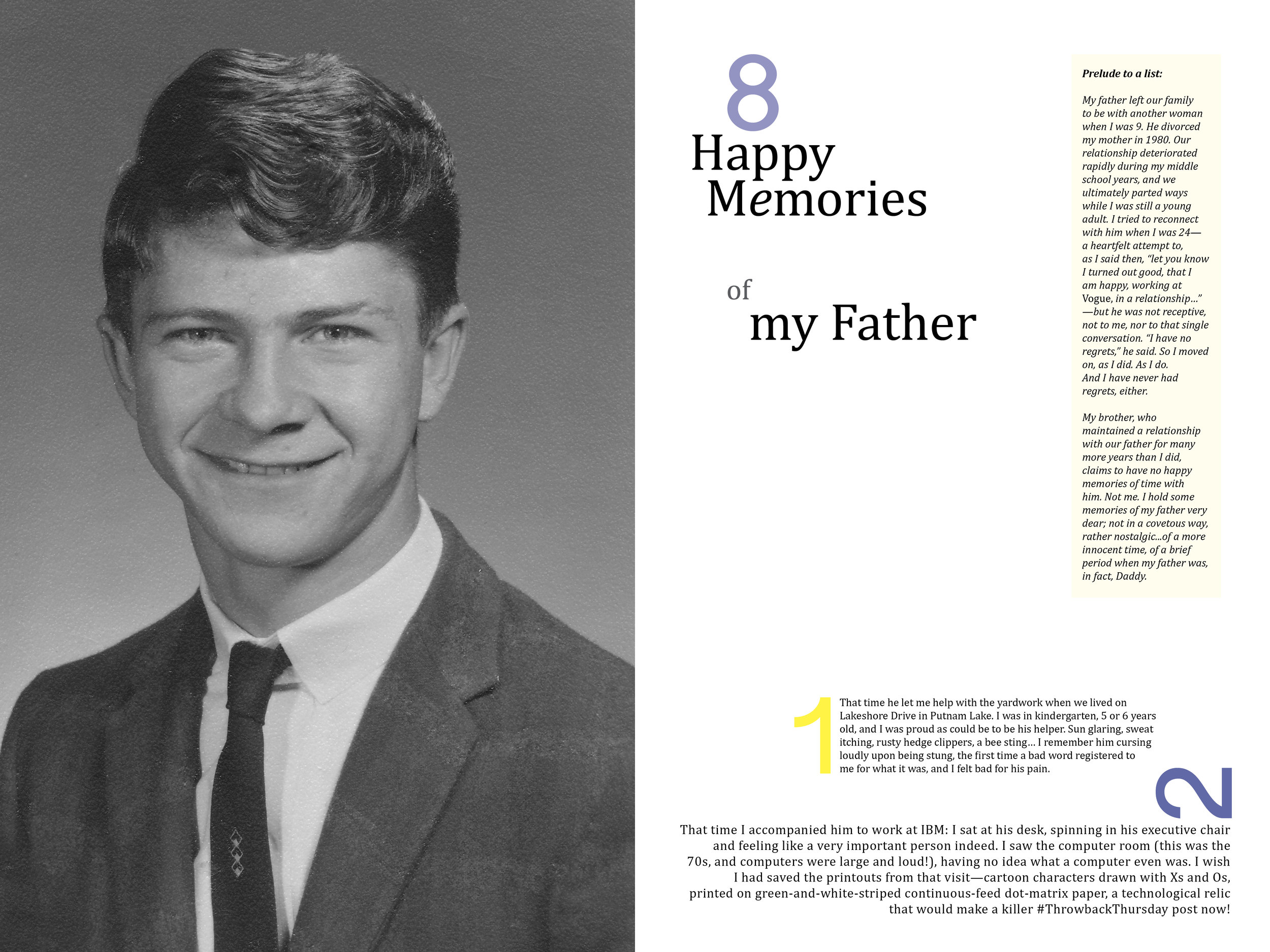
The opening spread of a section of an heirloom book that uses a list format to tell family stories; view all eight pages below.
Unlike the Modern Loss writers, my father is still alive, though I have not had contact with him in many, many years; this list, then, provides an example of how one might approach incorporating difficult or painful memories into your life story (not every story has a happy ending, after all).
Mostly, though, I wanted to share this to illustrate that lists can be designed in modern, captivating ways that truly draw readers into a life story:
Better Than a To-Do List
I admit to being an obsessive list maker of things I need to get done—and what satisfaction I feel when I cross things OFF those lists! But the next time you pick up a pad to jot down a list of tasks, consider using the paper to create a more meaningful list that preserves memories! What will your first list be?
I'd love to hear your ideas for fun lists, and even better—what’s on your ideal bookshelf? (I'm working on mine as we speak ; )

Life Story Links: Blog Roundup, February 5
Click for memoir writing advice, personal history workshops, how you can help make Holocaust victims’ records searchable online, and more life story links.

“We tell ourselves stories in order to live.”
—Joan Didion
Whose story will you tell?
SHOW-DON’T-TELL MOMENTS
We all know the old maxim: “Show, don’t tell.” But sometimes subjects don't believe that it applies to memoir: “Clients want to tell me their feelings,” says Massachusetts–based memoir ghost writer Nancy West. “And yet it's usually easy to find actions that demonstrate those feelings much better than adjectives or adverbs ever can.”
NEW YEAR
“The stories from the past help prepare us for the future. We must be ready to embrace what is coming,” writes Carol McLaren as she embarks on a year filled with changes, including a move from Virginia to Arizona, and a new website for her business, Unique Life Stories, on the horizon. Good luck, Carol!
EVERYONE GETS AN ‘A’
Life story writing workshops are safe places to share one’s story and bond with others as they do the same. Karen Bender of Leaves of Your Life in Herndon, VA, is offering in-person and online workshops for anyone interested in exploring weekly themes.
“IT HAPPENED.”
Millions of documents containing details about victims of the Holocaust and Nazi persecution during WWII still exist today. Through the World Memory Project, you can help make these victims' records searchable online & restore the identities of people the Nazis tried to erase from history, one person at a time.
First-person reads
“DO YOU WANT TO DANCE?”
Sarah White of Madison–based First Person Productions often publishes the writing of others on her blog. Deb Wilbrink answered a New Orleans-themed call for submissions with an engaging coming-of-age story about teenage firsts in the Big Easy.
PHOTOS TELL STORIES, TOO
“The Cubans encouraged exchange of words and hospitality, not discouraged by my minimal Spanish language skills,” says MA–based personal historian Leah Abrahams in her introduction to her photo essay, “Cuba on the Cusp,” on the Social Documentary Network website (“visual stories exploring global themes”).
Bonus links
- This Beginner’s Guide to Backing Up Photos is a must-read for every camera-toting memory keeper.
- Forty first-person essays that talk candidly about love and loss: “Brutally honest and inspiring, Modern Loss invites us to talk intimately and humorously about grief, helping us confront the humanity (and mortality) we all share.” I highly recommend this new book.
- My own blog contribution this week would likely fall on the “low-brow” quadrant of New York mag’s Approval Matrix, but I still submit it’s worth a read: Recapture the spirit of childhood Valentine’s Days with three unique ideas for marking the holiday with meaning—and heart.
Short Takes
#MemoriesMatter #Legacy #LifeStories #Memoir #OralHistory #FamilyHistory

Finding the love in Valentine’s Day
Recapture the spirit of childhood Valentine’s Days with these three unique ideas for marking the holiday with meaning—and heart.

3 Simple Ways to Make Valentine’s Day as Special as It Was When You Were a Kid
I’ve never been one who appreciates holidays that, to me, feel forced. You know: New Year’s Eve, Valentine’s Day… I am too conscious of the commercialism surrounding these days. The irony is that I am not an especially cynical person—but I want to know that a card with an “I love you” sentiment is coming from the heart, not a heart-shaped, guilt-inducing ad.
I don’t want to seem like a February scrooge, though, so I’ve come up with 3 ways that likeminded folks can mark the day with meaning.
Write a love letter.
Have you ever written a love letter? With handwritten notes completely falling by the wayside in our text-driven world, getting one is more special than ever.
You might want to go all out, writing a heartfelt missive on luscious stationery and decorating it with a romantic wax seal.
If that seems old-fashioned or intimidating, here’s an idea that I came up with early in my own relationship with my husband: Write a list of 20 things you love about the person. Include things big and small, emotional and funny. Details get extra credit (don’t say “I love the way you hug me,” but say, “I love the way you hold me for a few extra seconds when I try to pull away from a hug,” or “I love the way you lift me up just a little bit every time we hug”). If you make this an annual tradition (I admit I did it on birthdays, not Valentine’s Day), it can be surprising which things get repeated and what new things you come up with.
If you merely write this on a yellow legal pad with no adornment, I guarantee it will still be saved and cherished by the recipient. I chose to typeset it and shrink it down to credit card size, then have it laminated; what better thing could your loved one serendipitously pull out of his or her wallet one day in the future?
Spread the love.
I am willing to bet that for many of us, our happiest Valentine’s Days happened when we were kids. I have lots of fond memories of exchanging paper valentines with my classmates, of folding red construction paper in half to craft hearts for the refrigerator, and even wearing pink to school to honor the day. Those were the days when everyone could “be mine,” when as third graders we weren’t hoping and praying for that special someone to take notice…when we loved everyone.
Why not spread some of that all-encompassing love around in unexpected ways? Buy a pack of punny Valentines from the drugstore and hand them out to people you interact with regularly: the school crossing guard, the gas station attendant, the conductor who checks your ticket on your morning commute? There’s something cheeky about it (I’m pretty sure none of the recipients will mistake your “Choo choo…I choose you!” sentiments as being literal ; ), but there’s something genuine, too—an unexpected “I see you,” and “I am grateful.”
Attach a $5 gift card for your local coffee house and you’ll really make someone’s day.
Rediscover favorite Valentines.
Do you have a stash of letters and old paperwork in a box somewhere? You felt compelled to save the things within, but chances are you haven’t revisited them in a while. Once you remember where the box actually is (good luck!), dust it off, and dive in.
What did you find?

I hope you, like I did, discover artifacts that
bring back heartfelt memories
stir emotions
make you laugh
inspire you to record your memories, share stories with a loved one, or even just pick up the phone to reconnect with an old Valentine.
It’s my job to recommend that you find a way to preserve these mementos (scan them for a digital archive, include them in an heirloom book, or follow archivist Margot Note’s advice for creating your family archive). That said, I think it’s equally important to just cherish these items: pull them out of their box every once in a while, let their touch bring back memories, and let those memories encourage you to call someone who might also relish your stories.
Story sharing leads to connection.
Does this seem like an odd blog post to appear on the site of an heirloom bookmaker? Maybe, but just maybe not—I hope you are here, after all, because memories matter to you, and because stories and mementos that spark reminiscence lead to genuine connection.
The books I create are meant to be revisited often, to become a living heirloom that encourages interaction. That compels readers to say, “Remember when…” and “That’s just like the time….” That inspires them to relate, and to share their own stories.
So, happy Valentine’s Day to you and yours—may you give and receive genuine affections that are one day looked back on fondly!
Life Story Links: Blog Roundup, January 23
Our roundup explores the path to legacy, including (mis)adventures with DNA, community memoirs, family history through storytelling & a new Ann Curry TV series.
“Is that the secret meaning of the word ‘story,’ do you think: a storing place of memories?”
—J.M. Coetzee, Foe
Stories are at the heart of what we do. As personal historians, we work across an array of media, from coffee table books and audio recordings to full-fledged video biographies and printed memoirs. No matter the medium, though (and no matter what we call our work), the preservation of stories is key. Oh yes, and story sharing—did I mention the sharing...?!
The Path to Legacy
SENIOR CENTER STORIES
“In 2012, I completed my first community memoir, a compilation with 47 senior citizens from Carleton-Willard Village in Bedford, MA,” says Nancy West of Nancy Shohet West Editorial & Memoir Services. Five years later she was invited back to do a second volume, which launched this week.
200 YEARS OF MEMORIES
How deep is your memory bank? “We often despair when an elderly person passes away, their memories unrecorded,” writes Pam Pacelli Cooper of Massachusetts–based Verissima Productions. “What we often forget to do is seek out the younger person who listened to the stories of their elders. We can record them.”
A TENDENCY TOWARD NOSTALGIA
Rediscovering an old family photo album in my closet prompted me to reflect on the lasting appeal and transformative power of nostalgia.
(MIS)ADVENTURES WITH DNA
“Sometimes your heritage doesn’t have anything at all to do with your genetics—and I didn’t even have to spit in a test tube to figure it out,” writes Kristen V. Brown is this compelling piece that unravels the science behind ancestry DNA tests—and that, certainly, makes us wonder if those colorful pie-chart genetic results reveal something profound about what makes you, you...or if they are simply a fun conversation starter.
Must-See TV
“THROUGH THE EYES OF ORDINARY PEOPLE”
In her new PBS series We’ll Meet Again, veteran journalist Ann Curry focuses on reunions between people whose lives intersected and were torn apart at pivotal moments. The seasoned interviewer honors the power of connection, and the stories she draws forth from her subjects are emotional and, perhaps more important, seem to inspire viewers to reflect on their own lives and moments of connection. View the official trailer and get a peek at upcoming episodes here. The first episode airs tonight.
Short Takes
#MemoriesMatter #Legacy #LifeStories #Memoir #OralHistory #FamilyHistory

A tendency toward nostalgia
Rediscovering an old family photo album in her closet prompts Modern Heirloom Books’ founder to reflect on the lasting appeal & transformative power of nostalgia.
When I was in sixth grade, my new English teacher gave us an assignment to create an acrostic from our first name; each letter was meant to be an adjective describing ourselves for the class. I don’t recall what I chose for three of the letters, but I remember being especially challenged by the “N.” When I mentioned to my teacher that I was thinking of using “nostalgic,” she chided me that someone my age most certainly could not be nostalgic. I felt belittled and foolish, and despite my reservations, I wrote, simply—boringly—“neat.”
It’s funny what stays with us over time. I never forgot this episode from middle school, and I occasionally wonder, why? Mostly I think it was a lesson to go with my gut. Even then I knew that I was right, and that I should have written “nostalgic” on that paper; I have long prided myself in the years since as someone who trusts my instincts almost to a fault.
When I consider this memory alongside another one that stuck with me—a minor event that made a big impression—I am sure, too, that it reflects a real dread of having missed opportunities. A time when I didn’t act, or didn’t follow my gut, is a bad thing in my mind. I never want to miss out on something because I was scared or lazy or simply didn’t act quickly enough.
Today, though, I remembered this incident for a different reason. In cleaning out a cabinet to make room for some of my son’s Christmas loot, I came across an old-fashioned photo album that I had put together when I was about 14. It is a small, linen-covered album. Each page is separated by a thin sheet of textured tissue paper, making turning the pages feel like you are unveiling something precious. And indeed, even as a teenager, I knew how precious the photos within were.

I had bought the book with my babysitting money, and collected the photos from my mom’s and grandmother’s messy boxes. It seemed important to me to curate the images carefully, to select those that were visually appealing and that captured moments in our lives that we would one day want to recollect.
All these years later, it is a serendipitous pleasure to rediscover the images I chose. They are not displayed chronologically or thematically, but all together they do convey a loose story of sorts, a story of the everyday joys of our close-knit family.

These days I spend my time helping people not only to curate their family photos, but to discover and capture the stories behind them. To preserve the memories in a way that is both visually compelling and that strikes an emotional chord.

It is heartening to know that the nostalgia I have long felt serves a purpose—and that, in my unexpected role as entrepreneur, I am following a path that is not only central to who I am, but is wonderfully, enchantingly restorative.

It is a privilege that I get to hear your stories, and to capture them for posterity. If you are interested in beginning such a journey with me, please reach out to see how we can work together to create a family heirloom that will encourage story sharing for years to come!

Related Reading:
Life Story Links: Blog Roundup, January 9
The (unexpected?) audience for your memoir, the wisdom of old people & remembrance of those lost in 2017 round out this week’s life story links blog roundup.
“What I know for sure is that speaking your truth is the most powerful tool we all have.”
—Oprah Winfrey, Golden Globes, 2018
It has been a slow start to the new year for me, hit with a flu that has left me grumpy and tired and well, not at all productive. I’ve had plenty of time to read, though, and since my guilty-pleasure Christmas gift, Tina Brown’s Vanity Fair Diaries (so much dish I recognize from my years in the same mag world!) is too heavy to hold up in my weakened state, I’ve been indulging in memoirs on the Kindle and plenty of link diving on my phone.
I’m almost done with Alan Cumming’s 2014 memoir Not My Father’s Son (well worth the read). I’ve got the current issue of Brevity open on my phone, for creative nonfiction pieces that fulfill and enlighten in short periods of time. And I’ve been perusing Cathi Nelson’s new book, Photo Organizing Made Easy: Going from Overwhelmed to Overjoyed, gleaning tips to share in a future blog post (as I’ve written about before, photographs can make for incredible memory prompts, and being able to find the photos in our overflowing photo libraries is often no easy task).
Here are a few posts and articles that have been on my sick-bed reading list, as well. Happy (and healthy!) New Year to you all, fellow storytellers.
Living, Writing, Remembering
WHY WE READ ABOUT ONE ANOTHER
“My memoir clients assume their readership will be limited to their children and grandchildren,” says Massachusetts-based personal historian Nancy Shohet West. “They are consistently surprised when their nieces, nephews, friends, neighbors, former colleagues, and long-time acquaintances all start clamoring for copies of their own.” If you can picture just one reader, it might be time to start writing.
CLASS NOTES
Craig Siulinski of Sharing Legacies in San Carlos, CA, recently completed leading his first Life Story Writing class based on the principles of guided autobiography. Read about his joyful experience, learn more about guided autobiography, or pick up a book to help you on your path to crafting your own life story. And if you’re in the market for a flash nonfiction writing class, check out Sarah White’s recent post.
REMEMBERING THOSE LOST IN 2017
As part of the New York Times Magazine’s annual The Lives They Lived issue, editors invited readers to contribute a photograph and a story of someone close to them who died this year: The Lives They Loved.
“TALKING TO ALL THOSE OLD PEOPLE”
“No work I have ever done has brought me as much joy and hope, or changed my outlook on life as profoundly,” writes John Leland of his year interviewing elderly New Yorkers. His book Happiness Is a Choice You Make: Lessons From a Year Among the Oldest Old will be published on Jan. 23. A. E. Hotchner reviewed: “Remarkable revelations gleaned from those who, in their superannuated years, have discovered rewarding benefits from the life that actually surrounds them.”
CELEBRATING LIFE, AND ART
A film called “funny and life-affirming,” Faces Places explores themes of art, vision, regular people, and aging, all with tenderness and wit, energy and delight. Find showtimes in select cities.
Dawn Roode’s curated roundup for the week of Sept. 23, 2026, is overflowing with recent reads on memoir, life story writing, and family history preservation.