
Memories Matter
Featured blog Posts


READ THE LATEST POSTS

Books to help you write your family’s stories, even if you are not a writer
These books will help you write engagingly and concisely about your loved ones, yourself, or your family members, even if you don't call yourself a "writer."
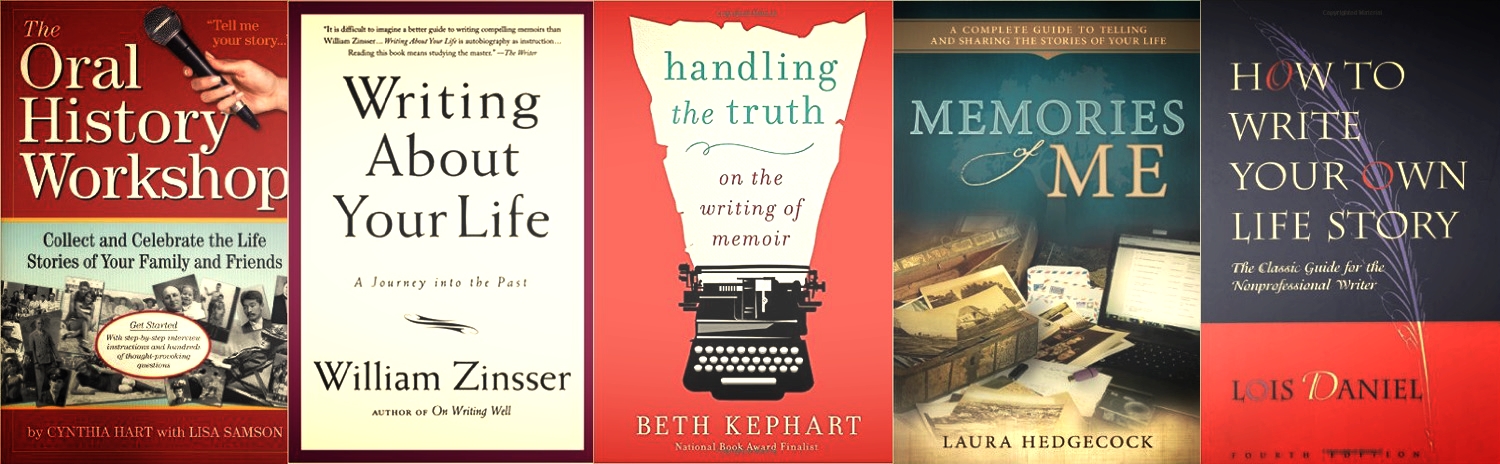
We all have stories within us. Eliciting those stories from family elders, or getting our own down on paper, though, is not always easy.
Here at Modern Heirloom Books, we do not strive to publish full biographies or memoirs; rather, we want to help you curate your family’s stories—through words and pictures—in a way that your children (and hopefully their children’s children) will want to interact with them. A book of family memories, after all, is worth nothing if no one connects with it. We most often use what is referred to as a quilt-work approach to storytelling: weaving vignettes and small narratives around photographs or other mementos that spark memory and serve as a touchstone to the past, carefully connecting them to a broader theme to create a textured picture of an individual.
We’re at your disposal: Some folks like to hand over a few boxes of photos and memorabilia, and guide the book-making process from afar.
Others prefer to do much of the heavy-lifting in terms of story gathering themselves. With that in mind, I have read piles of books that promise to help you write your family’s stories, and narrowed a long list down to a manageable 5 titles that we recommend. These are especially helpful for non-writers, but even for professional editors and wordsmiths, there is much wisdom to be gleaned specifically about writing about your own life and your family.
(Note: These are in no particular order!)
5 Top Book Titles for Autobiographical Writing, Reviewed
1 The Oral History Workshop
The Oral History Workshop: Collect and Celebrate the Life Stories of Your Family and Friends by Cynthia Hart with Lisa Samson (Workman 2009)
Once upon a time, a book such as this would not have been necessary, as the authors are quick to point out: “...when people lived in small, tight-knit communities, with or within a stone’s throw of their families. When stories, lore, and family history were essential parts of everyday life.” These days, not so much.
This book is concerned with an oral history, and as such doesn’t provide much in the way of writing help—so why include it? Well, it is the most complete source I have found for helping people prepare for interviews. And since your memory alone cannot convey an entire family’s stories (not to mention the fallibility of memory in general), interviewing loved ones may be the quickest and most accurate route to capturing what you want.
The Oral History Workshop lays out plenty of preliminary guidance, from technical aspects such as recording and archiving your interviews to ethical considerations including listening with compassion and sharing sensitive information. It even includes a chapter with basic ideas for, as the authors write, “turning your interviews into something more,” like scrapbooks and an inheritance for future generations.
It is the longest central chapter, though, entitled “Ask a Question, Gather a Story” that propels me to recommend this book to you. While interviews are highly personal endeavors, and each interviewee will have a unique past from which to draw stories, sometimes getting the ball rolling can be challenging. Hart and Samson provide an array of sample questions to inspire the reader. More than 800 questions are bulleted in 64 categories. And if that seems overwhelming, well, it can be—but the editors have been careful to make the chapter skimmable, and have included a sidebar, “The Terrific Twenty,” which lists 20 “all-around great questions” as a shortcut to getting started. I suggest tackling this chapter in the evening—you can even do so while watching some brainless TV show—and highlighting categories and questions that resonate (or do so on photocopies of the pages, with a set for each person you plan to interview).
You’ll of course want to focus on specific content for every individual—it’s virtually impossible to chronicle a person’s life from birth to retirement, yet of even greater importance is that doing so would bore your audience to death! Decide on a likely story arc before your interview, and choose questions accordingly. Just remember that, through attentive listening and thoughtful follow-up questions (think of your interview as a conversation, with one person doing most of the talking) you’re likely to get off course from your planned questions—as you should. As the authors write: “It’s possible that the interviewee has his own map for the interview, his own priorities and interests, his own list of things he wants to express…. Encourage him to talk about the things that matter so much to him. Don’t feel that you’ve gone astray by setting aside your questions and exploring uncharted territory.” See where the conversations lead, and be open to new directions.
Paperback, $10.55 at Amazon.
2 Writing about Your Life
Writing about Your Life: A Journey into the Past by William Zinsser (Marlowe 2004)
William Zinsser, who was a lifelong journalist, is most well-known for his landmark book On Writing Well, a mainstay resource for writers for generations. In this title, he focuses on memoir writing specifically, and does so with his typical eloquence and wisdom.
This book has two main premises:
One, don’t plan out your entire personal history; rather, let the stories take you on a journey. “Be ready to be surprised by the crazy, wonderful events that will come dancing out of your past when you stir the pot of memory. Embrace those long-lost visitors. If they shove aside some events you originally thought you wanted to write about, it’s because they have more vitality.”
“To write well about your life you only have to be true to yourself.”
And two: Think small. Zinsser wisely advises not to think about the “important” events in your life. Instead, write about “small, self-contained incidents that are still vivid in your memory.” These are likely the ones that contain a morsel of universal truth, that will resonate with readers. And they should not be 5,000 words. Brief stories told with meaningful details and palpable emotion are more evocative than lengthy treatises any day. One of my favorite tips: “Be content to tell your small portion of a larger story. Too short is always better than too long.”
Zinsser focuses on writing a memoir, and I imagine most of you who follow Modern Heirloom Books are not especially interested in completing a full biography. That doesn’t mean, though, that this book doesn’t contain sage words for you, as well, as it assuredly does. When writing scenes from your life—short stories that capture the essence of a person, a time, or a place—all the same memoir-driven lessons apply.
Indeed, Zinsser weaves what he refers to as “mini-memoirs” into this teaching book: Readers are taken along on a captivating journey through Zinsser’s own past while being given instructional notes along the way. The book is a pleasure-read with advice woven in, not a typical self-help book by any stretch.
Zinsser’s main message is clear and so on par with our own opinion here: “To write well about your life you only have to be true to yourself.” His demonstration of craftsmanship in this book will enhance your writing, and give you the tools to take pen to paper without fear. You’ll be inspired by Zinsser’s example (his words and stories are wonderful) as well as by his teaching.
Paperback, $12.43 at Amazon.
3 Handling the Truth
Handling the Truth: On the Writing of Memoir by Beth Kephart (Gotham Books, 2013)
I’ll state this upfront: This book is written for writers. Aspiring memoir writers, to be precise.
Why share this in this forum, then, you might ask? Because it is the book I wallowed in: I luxuriated in Kephart’s language, savored her insights, letting the lyricism and rhythms of the writing wash over me. Feel her words:
“Time is the memoirist’s salvation and sin. Time is the tease and the puzzle. Time is the trickster, the tormentor, the vexer. Time solved or resolved is memoir mostly mastered.”
While Kephart writes for writers, there is such value in immersing oneself in her attitudes about writing the self, about opening oneself to vulnerability, about the startle of details and discovering truth at the edge of the frame and the nature of love...all of this is wisdom even the non-writers among us will grasp at, cling to, think upon. And regarding love, take note: “Love,” she writes, “is where life stories start, no matter what one is writing about.”
Allow yourself to embark on this journey with Kephart. Just as reading biographical writing will inspire and inform your own life story practice, so too will reading Handling the Truth. For amidst the technical advice and deep dives into honing the meat of your memoir, this book weaves so many golden nuggets for you, too.
“Journal keeping, diary making, blogging—it’s all a curious thing, and it isn’t...memoir. But it’s a start, an inroad, a gesture.” Kephart spends a good portion of the book on what she calls “not-yet-writing-memoir work”—preparatory ideas, tapping memories, conjuring beauty, exploring diversions, finding your story. I am betting you will relish those parts. And in the relishing, there will be epiphanies that will make you see your life in new ways, write your life with your authentic voice.
One of my favorite gems from the book, I offer up as a call to action: “Let your words uncover you. Let your words prove you.”
Paperback, $13.29 at Amazon
4 How to Write Your Own Life Story
How to Write Your Own Life Story: The Classic Guide for the Nonprofessional Writer by Lois Daniel (Chicago Review Press, Fourth Edition 1997)
While the aforementioned two books were written largely with “writers” in mind, this next title was explicitly created to address non-writers, and it holds some key truths—and highly specific exercises—that may help you on your journey as a non-writer endeavoring to write your life story.
Written with a warm-hearted tone by a college professor, this book is built around 52 assignments, which parallel assignments Daniel used for years teaching inexperienced writers the craft of autobiographical writing. So if you were to write one assignment per week, theoretically you would have the raw material for your life story book in one year!
In a chapter entitled “Your Stories Don’t Actually Have To Be ‘Stories,’” Daniel provides a few examples of compelling pieces that might be considered essays rather than stories (which have a beginning, middle, and end). These composites of memories and ideas may be easier for many people to write, as they don’t have the pressure of conforming to traditional story structure, yet they are often equally revealing. She also encourages inclusion of “brief encounters,” snippets describing interesting encounters that occurred throughout a person’s life, giving your readers wonderful glimpses into your everyday life. Sometimes, short is sweet, and oh-so-evocative!
Daniel does not focus on polishing the writing (the final chapter does a shallow dive into how to approach revisions), focusing instead on how to efficiently and effectively record memories and start the process. Her assignments are akin to writing prompts, and what I find most helpful are the variety of examples of other students’ writing included throughout the book.
“I do believe that as a society we are emotionally undernourished in terms of understanding and feeling kinship with our heritage. Ours has been a society on a headlong dash into the future,” Daniel writes. “Consequently, unlike many older cultures which have been built on generations of traditions we have, to some extent, misplaced our past.”
"We have, to some extent, misplaced our past.”
We can help future generations have a meaningful link to their heritage by writing about our own lives and experiences—writing about the past, and writing “about today, which will be history tomorrow.”
Paperback, $13.59 at Amazon.
5 Memories of Me
Memories of Me: A Complete Guide to Telling and Sharing the Stories of Your Life by Laura Hedgecock (Plain Sight Publishing)
There’s a reason our first diaries come with a lock and key, notes Hedgecock: “For most of us, sharing our more vulnerable side—let alone our most personal thoughts and stories—does not come easily or naturally.” Of course, it’s precisely those personal stories that resonate and connect our loved ones to our journeys.
Hedgecock was inspired to write her book by a gift left to her by her grandmother: a spiral notebook filled with what she coined a “Treasure Chest of Memories,” writings that included stories about her childhood, recipes, nuggets of wisdom, and other heartfelt remembrances from her life.
In her book, formerly titled Treasure Chest of Memories: How to Capture and Share the Stories of Your Life, Hedgecock offers practical advice for novice memory keepers. Grounded in the world of scrapbooking, blogging, and social media, her tips do not merely cover writing and memory-jogging, but also span creative means of sharing your stories, whether in an old-fashioned journal or via more technologically savvy outlets, down to such nitty-gritty details as choosing an appealing and easy-to-read font and using photo-organizing software for digital images.
While Hedgecock does not offer as much guidance on the subtleties of strong writing (Kephart and Zinsser offer the most in terms of crafting lyrical prose and fine-tuning language), she goes much further in terms of rounding out family stories beyond the text. Her insights on using visual aids, including photographs, historical documents, and drawings; her out-of-the-box ideas for building a “treasure chest of memories,” including prayers, letters to loved ones, and even lists; and her heartfelt understanding of what an important journey the reader is undertaking, make this a perfect book for a non-writer who wants to leave a meaningful legacy behind.
Indeed, Hedgecock writes, “My goal is to assist you as you establish a rich endowment of memories, not to teach the art of writing.” And she does that with flair and enthusiasm, generously providing some psychological bolstering for those reluctant to write, as well as concrete tips for finding your voice and writing colloquially.
This book is available to buy in paperback, but I advise purchasing the e-book, which is not only cheaper but easier to navigate via search functionality and text highlighting capabilities.
E-book, $6.99 at Amazon.
Honorable Mention: To Our Children’s Children
To Our Children’s Children: Preserving Family Histories for Generations to Come by Bob Greene and D. G. Fulford (Doubleday 1993)
This compact book reminds me of the myriad memory journals found in bookstores today—the kind that prompt parents and grandparents to answer one question a day—only this book does not provide space to write those memories down. It is rather a companion to the writer, offering questions designed to open the doors to memory. “The particulars,” the authors say, are what your family will treasure most. Hear, hear!
Organized into thematic chapters, questions are easy to browse strategically (for example: High School; Holidays and Celebrations; Favorites; The House You Raised Your Family In), and the book is inviting enough to skim and quickly find a gem or two that appeals to your storytelling self (I loved, for instance, “Are you usually late or early?”, which prompted a number of telling and funny stories I would otherwise have forgotten all about!).
Hardcover, $17.19 at Amazon
You're on the road to reminiscing— and sharing your stories.
There are shelves of how-to books at your library about how to write—how to write better, how to write more clearly, how to write to persuade and sell, how to write to get published, how to write for marketing and SEO… None of those titles, however, will help you to write engagingly and concisely about your loved ones, yourself, or your family members. The books detailed above will hopefully put you on the road to reminiscence and retelling.
Be sure to follow us, as well, for an upcoming in-depth storytelling series on this blog with advice on: identifying the best family stories to tell; dealing with painful memories and stories about estranged family members; sparking your memory; interviewing techniques and tips; using photographs as prompts for life stories; and more.
No matter where you are in your storytelling process—if it’s just a flickering flame of an idea in your head or a fleshed-out drama written in journals for the past decade—we at Modern Heirloom Books are here to guide you along the process. Want to see what we can do together? Let’s create a legacy book that will become a family heirloom destined to be treasured for generations to come. Set up a consultation now!
Disclaimer: None of these books were provided to me. Before narrowing down this list, I frequented my local library a LOT, and ultimately purchased the five books I recommend via the reviews above. I hope you find a gem among them!

Using technology to help you share your family’s stories
There is plenty you can do to ensure that you are—easily!—capturing bits and pieces of your family history on a regular basis. Even if a photo book is way off in your future, take steps now to make life easier later with our recommended memory-sharing websites. With weekly emails prompting a family elder to share personal stories, and options for video, audio, and other customization, creating your personal digital archive is simpler than ever.

A recurring theme here at Modern Heirloom Books is that while we are drowning in our digital images, most people are not doing anything really worthwhile with their pictures. That’s a main reason we exist as a company—to help you curate your pictures and craft them into stories you can share through exquisitely designed books.
What of those stories, though? There is plenty you can do to ensure that you are—easily!—capturing bits and pieces of your family history along the way. Even if a photo book is way off in your future, take steps now to make life easier later.
“There is plenty you can do to ensure that you are—easily!—capturing bits and pieces of your family history along the way.”
In the last few years a host of memory sharing sites have arisen to help tech-savvy families record and share their family memories. Some have evolved over time, while new ones continue to hit the app store in an attempt to simplify the process with more elegant and engaging interfaces. Many of them are too labor-intensive or convoluted to warrant your time, however (and I doubt they’ll be around in a few more years).
One Memory-Sharing App That’s Worth Your Time—and One to Watch (IOHO)
You know those fill-in-the-blank memory books that tempt on Barnes & Noble bookshelves, or the beautiful journals that promise to leave your story for your children? (You know, the one that sits on your nightstand with just two pages filled in?) They’re a wonderful idea, if only we’d truly sit down and answer the questions. StoryWorth is like a digital version of these books, but with so many more benefits.

Options for good old-fashioned fill-in-the-blank memory journals abound—but they're useless if no one fills them in!
StoryWorth recipients receive a weekly email prompting them to answer a question based on their life experiences. The array of questions is vast and evocative, though users may always choose to answer a question they themselves craft. When a reply is input, answers are emailed to a preset list of people (so, as many family members and friends as you want to designate may receive your stories).
The value? It’s easy and fun to answer these prompts, whether a subject types a response on the website or via email, or chooses to record an audio clip over the phone. Photos and audio files can also be uploaded to the site, and stories—all saved on StoryWorth and available for printing or download at any time—are editable and secure. Remember: These aren’t biographies you’re crafting. They are nuggets from your (or your mother’s or grandfather’s) life—the time you hitchhiked across the state, the first time he flew on an airplane, that time none of the kids could find the hidden Easter eggs—colorful tales that the rest of there family will be thrilled to discover.
The site has a few packages ranging from $39 to $119 per year, and they offer a one-month free trial (you don’t even have to enter your credit card to start your trial). Check it out.
If your memories are all over the multimedia map and you want something more dynamic and mobile-friendly, I venture to guess that the imminent app I Rememba might be a good choice. I can’t say much more, though, as the app is still in development; I have signed up for access to their beta launch, so I’ll update you when I’ve eventually had time to test it. Why does it warrant my interest? Well, I am right there with the founder’s inspiration:
““Today, I’m 34 yrs old and have a 3.5 yr old daughter, of whom I have more than 25GB of pictures and videos…and due to the sheer speed with which we’re creating new memories, we don’t really care about them as much as we used to. Can you imagine, when my daughter grows up, what it would be like for her to Search and/or Share just the BEST memories of her life?? ….feels like trying to find a needle in a haystack…””
The launch site promises ways to preserve, capture, and share memories, in whatever format (video, audio, photo, text, and even family tree charts), and to “leave your legacy through time capsules.” I Rememba, like Modern Heirloom Books, is about preservation of memories and connecting generations. I’ll be watching them!
Family History vs. Family Stories
There is a place for memoirs and full-fledged biographies: the library.
Your own stories should not be told in minute detail, covering every life decision and milestone. I am not insinuating that your accomplishments and experiences are not worthwhile—truly, I am not. But for most of us, that…long…story would be rather…boring.
Perhaps it is important for you to chronicle your heritage, and I value a detailed family tree as much as any genealogist. For me, though, the personal tales that inspire a smile or reveal a person’s character are of even greater value. As the cliché goes, no one wants to sit through two hours’ worth of family vacation video, but a highlight reel is always welcome! Likewise, your descendants don’t want to feel like they are reading a 100-page history lesson, but rather as if they are being introduced to the interesting, unique people who came before them.
“No one wants to sit through two hours’ worth of family vacation video, but a highlight reel is always welcome!”
The memory-sharing apps mentioned above are great options for capturing the memories that matter. You’ll know which stories resonate when you get responses from your family members. “OMG I had no idea you were such a rebel soul!!” “I always knew you had a generous spirit, but this is above and beyond.” “LOL you are the same now as when you were 6yo!” “Now that I’m a mom I do the same thing!!”
“You’re not faced with thinking about your whole life or even what story you want to tell,” Nancy Mills told the NY Times about her experience with StoryWorth. “It’s like you’re having a conversation.”
And editing out stories that are less impactful—meaning that when you read them months later they don’t make you feel something—is easy.
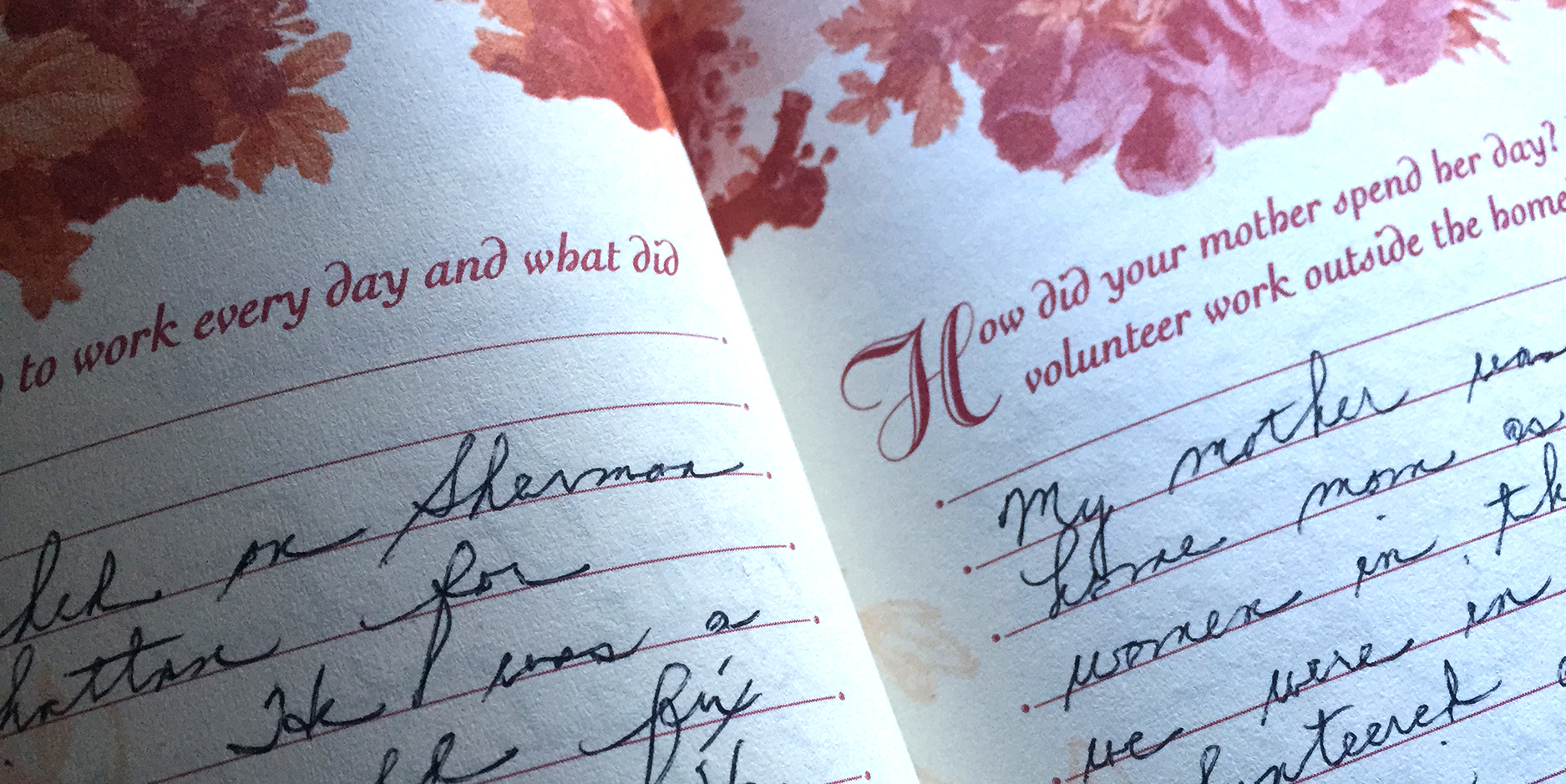
I was lucky enough to inherit a book in which my mom recorded some memories the old-fashioned way—a true treasure.
Whether you actually sit down and use a good old-fashioned pen to record your memories (my mother did, and the book she left me will be forever cherished) or you subscribe to StoryWorth or another tech-aid, just do it. Get your stories down, and saved in one place.
Then, when you’re ready, let’s turn them into something even more special.
Learn about our Write Your Life course, providing memory prompts, writing guidance and a dose of inspiration to anyone who wants to preserve their stories now.