
Memories Matter
Featured blog Posts

READ THE LATEST POSTS

The index card solution to family history preservation
Want to organize your family history archive? This cheap, convenient solution is a great way to record your stories until you’re ready to move them into a book.
Don’t worry, you won’t need a library’s worth of card catalog drawers for your family history records—a simple recipe box (or two) should do!
I’m all about books—I’ve got stacks of them all over my office, my bedroom, my kitchen; I turn to them for escape and for knowledge, for catharsis and for fun; and I write, edit, and design books for a living. But I know that sometimes creating a book may not be the best choice for a specific memory-keeping challenge. That’s where recipe card boxes come in.
Over the many years I have been advising clients on how to turn their family stories into lasting legacy books, I have found a few common occasions when the time is simply not right (yet!) to commit to book publication. In the three scenarios that follow, I suggest buying a simple recipe card box and some blank index cards that will fit within—then using those (easily changeable, inexpensive, convenient) cards to record your stories until you’re ready to move them into a book. (Oh, and even if you find you never get to that ‘ready’ stage, you’ll still have preserved a great deal of your family history in an accessible format…and who knows, someone in the next generation just may take up the challenge of continuing your research and one day creating an heirloom book!)
Three memory-keeping occasions when recipe cards (a.k.a., index cards) are a great tool:
MEMORIES
You want to capture memories for your children in real time.
Are you regularly sharing tidbits about your new baby on Facebook or Instagram? Do you tell stories about your grade-schooler to your mom during weekly phone calls? Do you wish you had created annual family albums for your kids’ earlier years, but never found the time? It’s never too late to start recording family memories—and it’s easiest when you write those micro memories down as they happen!
How to record family memories in a recipe box:
Keep a pen and a stash of blank recipe cards in convenient locations—your bag, your bedroom nightstand, a kitchen drawer—so that they’re always on hand when you need them.
When your child says something laugh-out-loud funny or wise beyond their years, when they achieve something they’re proud of or try something new, jot it down on a card. Be especially conscious of capturing catch-phrases that characterize a certain age, or things that make you smile every.single.time!
If you have a tendency to share these things in real time on your Instagram stories or other social media platform, take a screenshot of the shared memory, print it out, and tape onto a blank index card.
Whenever you can, make physical prints of favorite photos: Ideally, print them at the same size as your index cards so they can be stored behind the memory card it goes with, or print smaller and adhere to a card with a handwritten memory on the reverse.
Use dividers to label months and year, or perhaps have a divider for each of your children—whatever organizational system makes the most sense for you.
Consider asking your kid(s) to contribute something once in a while—maybe they write how they’re feeling on the first day of every school year, or what they hope for on each birthday. Preserving their handwriting in this way is priceless!
Future uses: These memory cards will become not only a cherished family heirloom, but they’ll be resources for you to easily create meaningful gifts in years to come—think a photo montage at their high school graduation, or a memory book on the occasion of their wedding. You may want to use them as memory prompts for YOU to write a book one day, or maybe you’ll digitize them for yourself then tie a ribbon around the box to gift to your child when they buy their first home!
HEIRLOOMS
You want to record the stories of your heirlooms, but can’t undertake a big new project.
Instead, jot down a list of all the heirlooms you hold dear, then tackle writing down their provenance one by one when you have time. That first index card will be like a checklist (that you can add to any time you want!). Each subsequent card will include
a photo of the heirloom
a physical description
who it belonged to (including originally and over the years)
approximate year it came into your family
any associated stories or details that make it meaningful.
You may end up writing about one heirloom per month, or completing a flurry of them at once and then not again for a while—go at your own pace!
Future uses: You may want to one day design a book of all your heirlooms (or have a professional book designer create one for you), in which case you’ll have everything you need in one place. Alternately, as you downsize or simply gift items to loved ones and friends, you may hand them the card that goes with their heirloom—voilà, origin story complete.
RECIPES
You are working towards a heritage cookbook—‘towards’ being the operative word.
Sure, this one may seem obvious (recipe cards in a recipe box!!)…but I encourage you to be more intentional than one might normally be when jotting down recipes. You may recognize your mom’s scribbles, or your grandmother’s shorthand, but the next generation may not. As you cook each recipe, look over what’s written and ask yourself:
Is each ingredient amount clear?
Is cook time accurate?
Have I changed something since I originally began cooking this?
Do we always use a certain brand of an ingredient?
Are there other things worth noting—that you often double the recipe and freeze half, say, or that It can be modified if using fresh rather than canned vegetables?
Examples: Grandma may have used shortening, Mom preferred margarine, and you now use butter; “cook until browned” is only helpful if you have a general idea of cook time, so be more explicit for future recipe readers—“cook approximately 20 minutes, until browned”; “syrup” may obviously denote dark maple syrup to you, but being specific is the key to a foolproof recipe.
A few tips for recipe testing:
I recommend having a single divider in your box—the ones in front have not yet been tested (and marked up), while the ones in back have been.
It can be helpful to cook the recipes with another family member or friend who isn’t familiar with the process to make sure you answer questions that can crop up. (Bonus? Way more fun!)
Definitely write down more than just the recipe—include that “this was Jennifer’s favorite lunch in kindergarten” or that “we’ve been baking this bread every Easter since 1896.” Capturing the stories behind your family’s favorite foods will make this box/eventual cookbook all the more special!
Future uses: You can easily copy recipe cards to gift to your kids when they move out, or compile them in a heritage cookbook that’s professionally printed and bound and distribute among family members.

One instance where I thought index cards might be useful but have since changed my mind: for organizing genealogy materials. Whether you are in the early stages of your genealogy research or just addicted to learning more and more about your ancestors’ lives, every family historian knows their work is never done. It’s the most common reason I hear for why people aren’t ready to create a family history book. I get it! But while using an index card filing system may seem like an elegant solution to organizing lots of changing data, the cards’ small size is too restrictive. Click here for some expert guidance on organizing your genealogical information, click here for some best practices, and click here for ways you CAN use index cards as a handy reference for your ancestry research.














3 books to inspire your own family cookbook
These three titles—two hybrid cookbooks and one genealogical look at preserving food memories—dish up lots of inspiration for making your own family cookbook.
These books by Gena Philibert-Ortega, Gwyneth Paltrow, and Rachael Ray are not only brimming with recipes you’ll want to try, but they can serve as incredible inspiration for ways to approach making your OWN hybrid family history/cookbook.
Whenever I share photos of family cookbooks or food heritage projects, I get a tremendous response—“I wish I had thought to do that before my mom passed,” “Oh, I HAVE to do this!!!” or, on occasion, more reluctant feedback such as “I would have no idea where to begin.”
Well, I’ve shared plenty in recent months about how to approach making your own heritage cookbook, including, most notably, an easy-to-follow 10-step plan for making a DIY (heirloom-worthy) cookbook, plus 3 surprising ways to elevate your family cookbook.
Now I thought I’d share some fun inspiration—books you can either buy or check out from your local library that guarantee to provide some, ahem, food for thought! These aren’t new books, just ones I’ve collected over time that, to me, epitomize great storytelling in beautiful formats in the food genre.
What follows are three book recommendations—two hybrid cookbooks and one genealogical look at preserving food memories—that I think you’ll love, too. Let me know which ones inspire you, and how!

“Rachael Ray 50: Memories and Meals from a Sweet and Savory Life” by Rachael Ray

Why you’ll be inspired:
With 25 essays depicting Rachael Ray’s personal life plus 125 recipes handpicked to correspond to her favorite memories, this book is a prime example of what a heritage cookbook can be. From vignettes about childhood movie night and special occasion dinners at NYC’s Mamma Leone’s all the way to moments with her famous friends and how she got to Carnegie Hall, the chef used her milestone fiftieth birthday as a spark to take stock.
“This is not a memoir,” she writes. “It’s a series of recollections, a scrapbook of my life so far.” Lots of those recollections are accompanied by recipes, sure, though “other episodes in the book have nothing to do with food, but they remain important ingredients that have helped give my life its particular flavor.” (Can you hear me cheering?!)
This book is stunningly bound and printed on matte paper with elegantly simple graphic section openers and an abundance of images, including nostalgic childhood photos as well as the expected styled food photos.
Fun quotes:
“I was marked to be in a kitchen when I burnt my finger on an industrial stove at age two.”
“I think I’m a nurturing person but I have resigned myself to the role of cooking vegetables rather than growing them. Upstate my husband is the farmer. I can pick the stuff, and prepare it, but I’m not allowed near it when it’s growing.”
My favorite recipe:
Carbonara (a classic done the authentic way!)
Buy or Learn More:
Rachael Ray 50: Memories and Meals from a Sweet and Savory Life by Rachael Ray (2019, Ballantine)
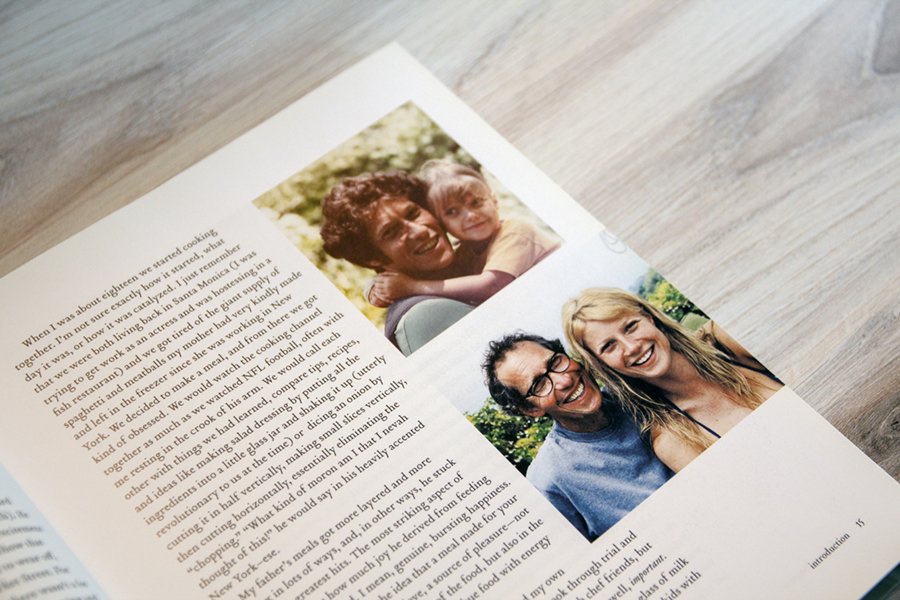
“My Father’s Daughter: Delicious, Easy Recipes Celebrating Family & Togetherness” by Gwyneth Paltrow

Why you’ll be inspired:
Long before she was crowned a lifestyle guru, actress Gwyneth Paltrow shared her journey of what friend and foreword author Mario Batali calls “blossoming as a mom cook” in this cookbook–cum–celebration. A self-proclaimed foodie (if you can find it, her PBS series Spain…On the Road Again is worth watching!), Gwyneth’s approach in this very personal title is familiar and laidback.
While there are lots of (mostly) healthy recipes in its pages, this book is truly a love letter to Gwyneth’s father. “I always feel closest to my father, who was the love of my life until his death in 2002, when I am in the kitchen,” she writes. “I can still hear him over my shoulder, heckling me, telling me to be careful with my knife, moaning with pleasure over a bite of something in the way only a Jew from Long Island can, his shoulders doing most of the talking. I will never forget how concentrated he looked in the kitchen, it almost looked like a grimace or a frown if you didn’t know him. He practiced incredible care and precision when he was preparing food. It was as if the deliciousness of the food would convey the love he felt in direct proportion.”
When I think of—and prepare—the foods my own mother cooked for me, her love comes through, even all these years after her passing. And I can almost guarantee there’s someone in your life whose food you equate with love. Flip through the pages of this cookbook to see how a minimal amount of text can introduce each recipe in a meaningful way—all it take is a paragraph to explain why a food matters to you, who it reminds you of, or what memories it calls forth!—and how even the simplest of dishes is worthy of inclusion (like Gwyneth’s four-ingredient, no-cook bruschetta).
Fun quotes:
“Unlike my daddy, who back in the day thought Oreos and a glass of milk were snack worthy, I became a bit obsessed with providing my kids with healthy, unprocessed foods.”
“This book is meant to channel the ethos of my father by sharing the greatest gifts that he imparted to me. Invest in what’s real. Clean as you go. Drink while you cook. Make it fun. It doesn’t have to be complicated. It will be what it will be.”
Favorite recipe:
Chicken & Dumplings
Buy or Learn More:
My Father’s Daughter: Delicious, Easy Recipes Celebrating Family & Togetherness by Gwyneth Paltrow (2011, Grand Central Publishing)

“From the Family Kitchen: Discover Your Food Heritage and Preserve Favorite Recipes” by Gena Philibert-Ortega
Why you’ll be inspired:
This book is like a primer for family historians who want to preserve their food heritage. Unlike the above titles, the author is not cataloguing her own family foods, but rather she is tapping her expertise as a longtime genealogy teacher. Philibert-Ortega offers up a menu heavy on history and how-to, with just a few (historical) recipes thrown in, and a keepsake recipe journal section meant to be filled in with your own handwritten recipes.
You won’t find luscious food photography or colorful coffee-table book design in this tome, but you will find lots of nitty-gritty insights on why documenting your family’s food heritage matters—and tips for doing it thoughtfully. Chapters include social history (including looks at food throughout time as well as how food traditions vary by region) and deep dives into historical recipes (from deciphering old food terms to discovering vintage advice among old “recipes”).
One of the author’s central themes is that exploring our own family food heritage is an effective way to learn more about our female ancestors: “The stories of women’s lives must be told by more than the government or institutional records they left behind. Their history is best expressed through the traditions, stories, and artifacts that were part of their lives.” Including, of course, their recipes.
Fun quotes:
“One day in the not-too-distant future, your children or grandchildren will be wishing they had the recipe for their favorite special dish you made every holiday because it reminds them of you…”
“Help your family get a glimpse into their ancestors’ lives by researching what food was available to your ancestors and the price of that food.”
Recipe least likely to try:
It’s a tie: Jell-O Cheese Loaf and Imitation Pattie de Foie Gras
buy or learn more:
From the Family Kitchen: Discover Your Food Heritage and Preserve Favorite Recipes by Gena Philibert-Ortega (2012, Family Tree Books)
Note: This is an unsolicited review of books I purchased at full price. I did not receive any compensation or free products in exchange, and any endorsements within this post are my own.





Your 10-step plan for making an heirloom-worthy family cookbook
From gathering recipes to editing, from design to printing, these steps will walk you through how to create a family cookbook to preserve your food heritage.
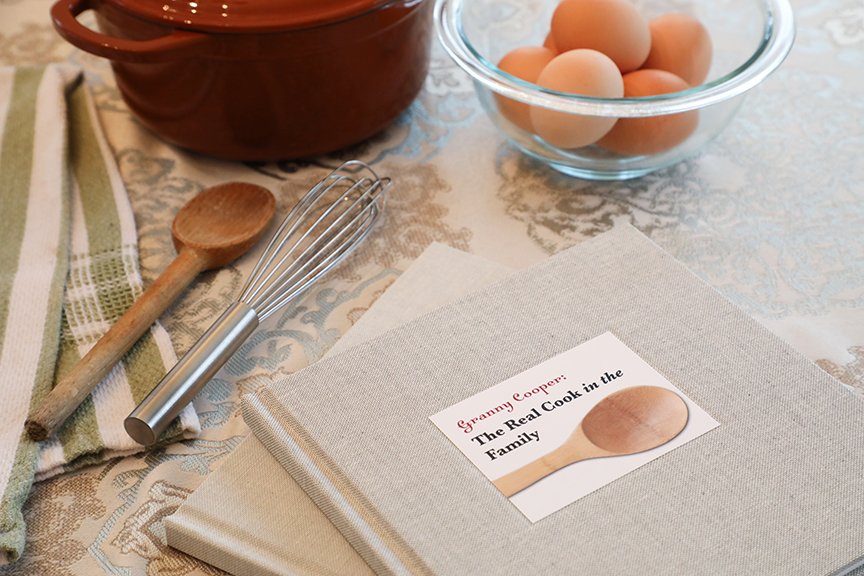
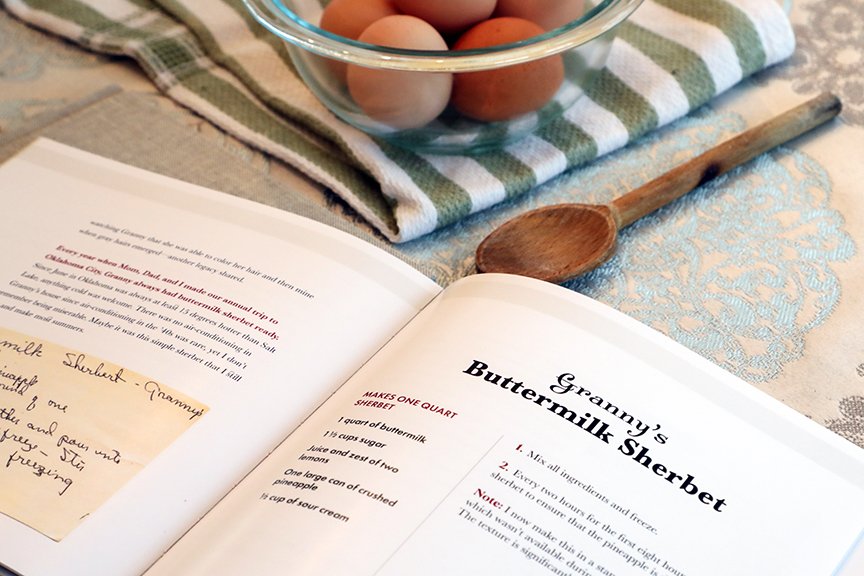
This family cookbook hones in on the recipes of one family member known for her prowess in the kitchen, Granny Cooper.
Want to put all your family recipes into a printed cookbook? Doing so will not only ensure that generations’ worth of foods get passed on, it will also give you the opportunity to indulge in some nostalgia and revisit childhood memories (ah, the smell of my mom’s roast chicken! the texture of Nanny’s potato pancakes!!).
Creating a thoughtful, heirloom-worthy family heritage cookbook takes planning and a fairly serious time commitment, but don’t let that stop you. This 10-step plan—with details on how to execute each step with flair and accuracy—will take the stress out of making your family history cookbook (heck, you might even find the process fun).
1. Decide on a theme.
Sure, your theme can be as broad as “our family recipes,” but I encourage you to go a little deeper; a tighter focus invites more meaningful storytelling and will ultimately help you curate which recipes to include. Some ideas for family cookbook themes:
Cooking with Nana
Holiday Dishes of the Ruggierio Family
The Tastes of Our Childhood
Mama Nash’s Birthday Celebration Secrets
Three Generations’ of Schwartz Recipes
Grandpa Lou’s Barbecue Bible
Categorize your recipes any way you wish—and remember, you can always make a companion volume down the road.
2. Gather recipes.
Here are some key places to look to ensure you get all the recipes you’d like to include (you don’t want to be hunting them down midway through the design process, so focus on finishing this before moving to the next step):
recipe boxes
file folders
magazines and cookbooks (even handwritten faves can be stuffed inside)
your computer
other family members’ homes
in someone’s head (if Bubbe is the only one who knows how to make the matzoh ball soup you love, best get the details out of her head and onto the page!)
I suggest brainstorming a list of recipes you’d like to include with a family member. Having a partner can help not only with accountability but also with discovery.
And don’t discount simple favorites such as the easy vinaigrette your mom made on every school night—you might be surprised by how the simplest of “recipes” can escape us years later.
3. Get cooking.
You didn’t think you’d get away with writing a cookbook without a little recipe testing, did you? If you want the recipes you include to be truly useful, cooking them with someone who has never done so before is a great opportunity to learn what steps may not be clear enough. Include specific tips whenever questions arise—for instance, “a cast iron pan works best” or “letting the meat get to room temperature before roasting will ensure even cooking.” Make sure that all ingredients have measurements; all recipes have cooking times and temps; and, when possible, indicate how many servings a recipe yields. Take notes as you cook and edit your written recipe accordingly later.
A useful approach: Test recipes over the course of a few months so you don’t feel rushed (and can truly enjoy the results over multiple meal seatings). When you’ve worked out all the kinks, then schedule a few consecutive days to cook many of them again, this time with photography in mind. I recommend taking some photographs during prep (you could do a still-life of some key ingredients, or take shots of a sauce simmering on the stove, or of a family member stirring the pot) as well as taking well-lit pictures of the finished dishes, either styled on your counter or at the table with family members included. A cookbook with gorgeous photos is sure to inspire!
4. Determine how you will record everything.
If you are working towards a printed cookbook, at some point all your recipes and stories will need to be typewritten and placed in one document—but that doesn’t mean you have to start that way. In fact, taking handwritten notes in a dedicated notebook while preparing your foods (see previous step) is an efficient way to get everything down accurately. Having a partner will also expedite your process: One person cooks and preps while the other takes notes (and later, takes photos).
If you are including stories alongside your recipes (please do!!), you may want to dictate your memories and record them with an app on your phone—there are plenty of AI-powered transcription services now that make converting your audio files to type easier than ever (check out rev.com or otter.ai). Remember that handwritten recipes will need to be typed up, as well, so they can be imported into layout software and designed after editing.
5. Edit the contents of your book.
Now that you’ve got all of your heritage cookbook content in one file, it’s time to edit. First, focus on structure: Sort your recipes into categories according to the theme you selected at the outset, and place them in an order that makes sense. Add subheadings for each section, as well as any stories that will accompany your recipes.
Next, edit for readability: Cut extraneous things, add explanation where it seems necessary, inject personality into your writing (this is your family cookbook, not a college thesis), and generally make sure everything makes sense and reads well. (A great tip for any kid of writing: Read along out loud and see where you get tripped up—chances are you need to fix your phrasing or shorten a sentence.)
Finally, it’s time for copyediting. If your grammar and spelling skills aren’t stellar, I suggest asking someone else to take on this step. This is where you fine-tune language and ensure consistency of everything from punctuation to fraction styles to ingredient amounts.
P.S. I can hear your groaning about this step—yes, it’s tedious, but impeccable editing will elevate your cookbook from a homespun craft to a real family heirloom.
6. Find a printer.
Yes, I advise you to decide upon a printer before you begin designing your book. Why? Because knowing their specs—available trim sizes, importantly!—and pricing options will help you decide upon a format that best suits your needs. If you know you are printing 10 or more books, you’ll be able to find a printer that discounts bulk orders; and if you just need one or two copies of your cookbook, then print-on-demand is the way to go. Some publishers may have their own proprietary software that makes designing a book with them easier; while others will expect you to prepare press-ready digital files in professional software such as InDesign (not something you want to be learning from scratch for this project, I assure you). This step and the next (design and production) are by far the ones most people need help with, but if you’re fairly tech-savvy and willing to devote some time to this project, you can create something special.
7. Design your cookbook.
If you are not a designer, this can be one of the most challenging steps, especially if you’d like your book to look professional. I recommend finding a few favorite cookbooks to emulate—you may find those on your bookshelf, or a trip to the local library may be in order. Here are a few basic tips to get your cookbook design going:
Create a design template according to the specs from the printer you selected.
Limit your typeface usage to two basic font families: one serif and one sans-serif. Set all stories and accompanying text in a classic serif font such as Times New Roman or Baskerville, then set the actual recipes in a sans serif typeface that has multiple weights such as Futura or Helvetica.
Be consistent with image placement—perhaps a horizontal image of the finished dish at the top of each recipe or a full-page image on the page across from your recipe. The stronger your photography at the outset, the stronger your finished family cookbook will be!
Choose a fairly neutral color palette so your design complements the photographs rather than competing with them. That doesn’t mean no color at all, but rather colors that will work alongside your images. Did you use bright pottery in the images for your Mexican-food cookbook? Then bold colors such as orange and blue may work. If your book includes mostly muted tones (images of bread baking and lots of flour and dough, for instance) then perhaps a combination of a subdued blue and a shade of taupe will work. Whatever combination of colors you choose, use those few tones consistently throughout the design for a cohesive look.
Include page numbers and foot lines throughout the book.
Create a table of contents listing all the recipes and their corresponding page numbers—and if you’re ambitious, also include an index so readers can locate recipes by ingredient.
8. Proofread your book, please!!
You’ve worked so hard to produce this special legacy cookbook—it’s worth your time to read it two, three, even four times to ensure there are no mistakes after it is designed. Ideally you will also ask another individual to give it a read, as your own closeness to the project can make it hard to spot some errors. Copyeditor pro tip: Don’t forget to read the largest type on the page; too often our eyes will skim right over headlines and titles, and that’s the last place you want to see a typo!
9. Print your book.
Hopefully you already settled on a printing service in step number six above. At this point you will need to export your pages in whatever format your printer designates—generally either high-resolution jpegs or PDF files. Check to see if you need to account for bleed (photographs or colors that run off the edges of the page), and pay attention to any warnings for low-resolution images—you’ll want to replace those so your book prints beautifully. After uploading your book files, do a final check to make sure everything looks good before hitting “send.”
10. Share your heirloom cookbook with your family.
Why not host a party with some of the dishes featured in the cookbook? Take some pictures and keep the memory-making—and legacy—going. If you’re gifting the cookbooks to family members, handwrite a dedication on the title page to personalize the books for each recipient.

Free Guide: Preserving Your Food Memories
Download this free printable guide with family history questions designed to elicit food memories.
3 awesome food memoirs not written by chefs
Favorite food memoirs that deliciously incorporate recipes and sense memories—fine examples of how you, too, can weave a personal narrative inspired by food.
What is a “food memoir”?
Browsing various online lists of the best food memoirs, one might think they must tell the tale of a chef’s life. Among almost every top-ten list: Anthony Bourdain’s Kitchen Confidential; Jacque Pepin’s The Apprentice: My Life in the Kitchen; and, of course, Julia Child’s My Life in France.
And then there are the divine stories of the food critics and journalists—those who have immersed themselves in the sensuous world of gastronomy professionally—who write memoirs that center around their tables. Among my favorites: Ruth Reichl’s Tender at the Bone and, more recently, Save Me the Plums; Jeffrey Steingarten’s The Man Who Ate Everything; and Born Round by Frank Bruni.
All of the aforementioned memoirs are well worth getting lost in.
But what about the stories of those for whom food simply taps into deep-held memories? For whom the smell of a certain dish transports us back to our childhood kitchens? We needn’t be professional chefs or food writers to deliciously incorporate recipes and sense memories into our life story writing.
If you are looking for some inspiration for weaving food memories into your own memoir writing—or if you just want to read some incredible books that happen to include tasty morsels throughout—add these food-inspired memoirs to your reading list.
title no. 1
“Trail of Crumbs: Hunger, Love, and the Search for Home” by Kim Sunée

(Grand Central Publishing, 2008)
Hailed as “brave, emotional, and gorgeously written” by Frances Mayes, Kim Sunée’s memoir, Trail of Crumbs, struck me as simultaneously tender and bold as she detailed a decade-long period spent living and traveling through Europe. While the locations and foods are exotic (from Harry’s Bar in Venice to her lover’s various homes in Provence, France, and beyond), an undercurrent of sadness prevails as the young writer struggles to find her place in the world. After being abandoned in a marketplace by her Korean mother at the age of three, Sunée was adopted by an American couple and raised in New Orleans—and subsequently spends most of her twenties on a tremulous search for identity.
From Kirkus reviews: “From the crumbs in the fist of an abandoned three-year-old to bowls of richly sauced pasta, her text chronicles the entwining of food with security and love.”
Does the book include recipes?
Yes. Most chapters end with a handful of recipes that Sunée has cooked—and found some comfort in—including crab crawfish she learned to make from her grandfather; kimchi, the traditional fermented cabbage dish of her Korean heritage; and a variety of Provençal dishes including wild peaches poached in Lillet Blanc and lemon verbena, orange couscous, and gratin de salsify.
Author insight:
“…cooking, for me, became like language: another form of survival. It was probably the only thing that I thought I could do well. And, like with my grandfather, it was a gift. It was a way to give love to other people.” —Kim Sunée
Memorable quote:
“Somehow, I thought he’ll never realize that the everything he wants to give me will never take away the nothing that I’ve always had.” —Kim Sunée
title no. 2
“Finding Freedom: A Cook’s Story Remaking Life from Scratch” by Erin French

(Celadon Books, 2021)
Okay, so maybe you’re questioning why I would include a memoir by a successful restaurant owner on this list of food memoirs not by chefs. Maybe it’s a technicality, but while Erin French is now the owner and chef of The Lost Kitchen in Freedom, Maine (and a television personality, to boot), she says, “It makes me uncomfortable when people call me a chef. I’m like, nope! I’m just a girl who cooks.”
More than her lack of formal training, though, it’s that this book, Finding Freedom, recounts French’s life leading up to her role as celebrated restauranteur. She writes with exceeding vulnerability and openness about her strained relationship with her father; dropping out of college to give birth to her son; surviving an abusive marriage; and battling a pill addiction that eventually led to her losing custody of her son for a time. “Despite these hardships, French refreshingly avoids unnecessary self-pity or sentimentality, and the life-affirming details are just as strong,” reads a review from Kirkus.
Indeed, it is her return again and again to the comforts of food—and the joys of the community it can instill—that weave a thread of positivity through French’s story. “It was the power of good, simple food,” she writes. “It was the food I wanted to cook and the way I wanted to make people feel: nostalgic and loved…. It was food that, with one bite, swaddled you, reminding you of your childhood, of someone you loved, and of the one, the few, or the many sweet moments they gave you.”
I was rooting for her. I was wishing I could taste the foods that sustained her. And, to be honest, I was awed by her willingness to bare herself on the page in a way I would like to but have not yet felt brave enough to do.
Does the book include recipes?
While French mentions numerous favorite foods throughout the memoir (her father’s meatloaf, her grandfather’s garlic powder–rubbed steaks, Nanny’s molasses cookies, and her own beloved butter cake, for instance), there are no recipes included within its pages. But don’t fret: You can find an abundance of them in the cookbook she authored in 2017, The Lost Kitchen: Recipes and a Good Life Found in Freedom, Maine: A Cookbook (Penguin Random House). Find a few recipes here, as well.
Author insight:
“Scrubbing my arms in that sink reminds me of my dreams, once, to be a doctor, to chase a different life. But by the time I’ve dried my hands with a kitchen towel, I’ve already glanced around the open dining room, realized who I am, and the dream I did chase—the one I caught in my own backyard…. The road to this place was winding, but it led me home. I found a good life, my own slice of heaven, right here in Freedom, where they told me nothing was possible.” —Erin French
Memorable quote:
“By the meal’s end, the warmth of a home-cooked dinner had turned the cold silence into mild content. For dessert my mother made tapioca, and the soft and creamy vanilla pearls were a salve we all happily gobbled up, curing whatever was momentarily ailing us all.” —Erin French
title no. 3
“Kitchen Yarns: Notes on Life, Love, and Food” by Ann Hood

(W. W. Norton, 2019)
Renowned chef Jacques Pepin had this to say about Kitchen Yarns: “Ann Hood’s tender, witty, and funny voyage through a life of food reminds us that the visceral taste memories of our past are essential benchmarks of our life, and that the stories of a family are always best felt and expressed through those dishes.”
Hood tells us one captivating story after another, rendering slices of her life meaningful through stand-alone essays that overlap and jump back and forth in time and hone in on themes of resilience and love and comfort. Though not told chronologically, the stories grow from moments of transition in Hood’s life—moving to New York City as a single woman, getting divorced, becoming a parent, nurturing her father through cancer, and losing her five-year-old daughter. Through it all, food sustains her; cooking becomes her tether.
She sets aside a room in her new home for her grown son Sam, for when he visits. “He stands beside me in this new kitchen,” she writes, “all six feet, five inches of him, stirring polenta with a long wooden spoon. ‘It smells like home here,’” he tells her. And indeed it feels like home within the pages of this fierce book, one I initially borrowed from the library but decided halfway through to buy for myself—partly because there were so many specific food references that could serve as memory prompts for my own writing, and partly because its memoir-in-essays form and Hood’s writing are inspirational examples I know I’ll be sharing with my own memoir students.
Does the book include recipes?
Yes. Each of the 27 essays that compose this book is anchored by at least one recipe from the author’s experience. And they’re not fussy recipes, either—they’re hearty (“My Perfect Spaghetti Carbonara) and nostalgic (“Fancy-Lady Sandwiches”) and use ingredients such as store-bought pie crust and her dad’s secret flavoring, celery salt. (Of course, there’s also Matt Genus’s Cassoulet.) While Hood’s stories are her main course, the recipes are delicious and inviting accompaniments.
Author insight:
“…perhaps [my parents] would be satisfied that in their ordinary way, they taught me something extraordinary. That even in grief, we must take tentative steps back into the world. That even in grief, we must eat. And that when we share food with others, we are reclaiming those broken bits of our lives, holding them out as if to say, I am still here. Comfort me. As if with each bite, we remember how it is to live.” —Ann Hood
Memorable quote:
“My father’s pals and their wives loved my mother’s Italian cooking, the meatballs and eggplant Parmesan and veal scaloppine. But it was pie that my mother insisted on making. Looking back, I see now that those pies—so American, so contemporary—represented her own independence, her growing up and away from that big Italian family.” —Ann Hood
Family potluck: reminiscing and recipes
If you're not sure who is the keeper of your family's favorite recipes, take advantage of your next holiday gathering to start preserving your food heritage.
Thanksgiving—or Passover, Christmas, or other holidays where extended family gathers in one place—is an optimal time to collect stories and memories via oral history interviews. There needn’t be a lot of pressure: Simply turn on your smart phone’s voice recorder or set up a video camera on a tripod, then forget it’s there...and let the reminiscing begin.

Ask family members about their favorite food memories and record these tasty bits of family history in a heritage cookbook—or simply stash them in a recipe box.
Collecting family recipes is one of those things that’s on many of our “I want to do someday” lists but that can easily slip through the cracks. It always seems like there will be time. But instead of saying “next time,” make it a priority—as well as an enjoyable endeavor!
Invite family members over for brunch one Sunday with the dual intention of visiting and connecting AND sharing recipes. Consider making it a pot-luck get-together and asking each person to bring at least one of their favorite recipes—maybe from childhood, or maybe one that’s part of their current immediate family’s repertoire (we’re always making new traditions, right?!).
This doesn’t have to be an anxiety-inducing project. Follow the few tips below and remember: You’re collecting your family’s food heritage, so you can do so whatever way makes sense for YOU! (Just, well, do it.)
A few tips for getting your family involved in preserving your food heritage:
Make one person (you?) the point person, organizing the day and ensuring that recordings get transcribed and backed up digitally.
Distribute recipe cards to everyone and ask that they handwrite one of their favorite recipes on the front with accompanying memories on the back.
Use the recipe cards as a jumping-off point for telling longer stories that, when joined together, bring your family history to life.
Designate one or two people as photographers. You may want to collect photographs of the dishes once they’re cooked to accompany the recipes (those can be brought the day of your get-together or collected later), but don’t forget to take pictures of the family interacting around the table or in your home. Food brings people together, after all.
Consider collecting all the recipes and food memories along with a special collection of photos old and new into a heritage cookbook that you can gift to loved ones next year. (Go the DIY route or reach out to us for professional assistance.)
I wonder: What dish will you bring to this family reminiscence potluck?
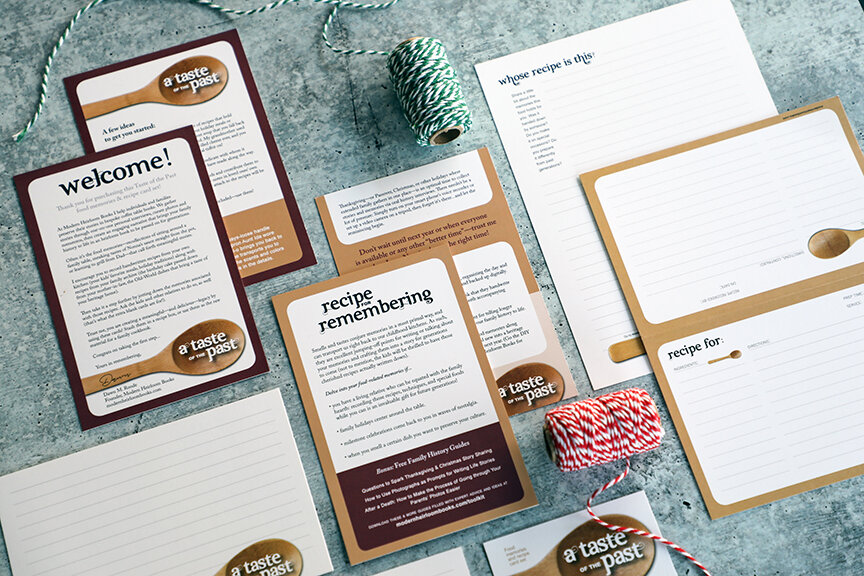
Limited-time SALE on food heritage gift set!
Through the end of November 2021, input code GRATITUDE at checkout for 25% off our Taste of the Past recipe & memory card set (they make a great holiday host gift, too!).
Read more Food Memories blog posts:
Explore more blog posts in these categories:
3 awesome (and easy!) Thanksgiving memory-keeping ideas
Get the whole family involved in saving stories and favorite holiday recipes with these three easy and fun Thanksgiving memory-keeping ideas.

My fingers are crossed that you are able to gather with your loved ones this year in person to celebrate Thanksgiving—to honor your family traditions and find fellowship around the table.
If you would like to use the opportunity to share stories and begin preserving some of your delicious family history, here are three simple Thanksgiving memory-keeping ideas, complete with ways to make them manageable and fun.
Thanksgiving activities that help you preserve bits of your family history
1 - Start a recipe preservation project.

In addition to writing down your family recipes, snap a few photos of a family member cooking the food, of the ingredients (especially unique or hard-to-find ones), and of the finished dish; whether or not you eventually put them into a family cookbook, your family photo archive will be more complete.
Notice I said “start.” Too often we let things we really want to do fall by the wayside because they seem overwhelming. Don't think about creating a heritage cookbook or worry about getting every single recipe your family has ever cooked! Instead, try one of these approaches to put your family on the path to preserving your best recipes:
Why not write down recipes for every dish at this year's Thanksgiving meal? Take a few pictures of prepping the dishes, what they look like when they are finished, and a few of the family around the table enjoying them? When the time eventually comes for you to make a recipe book, you'll have wonderful photos at the ready. And because you are beginning with a finite number of recipes—those for this year's menu only—your task is manageable enough to take on without worry
Make your recipe gathering a group endeavor. Send a blank recipe card (or a digital template for them to print) to every member of your family and ask them to record the recipe for their favorite Thanksgiving dish or meal. Important: Tell them where to return it, and provide a deadline (trust me, you'll never get them back otherwise).
Consider upping the ante and asking not just for a recipe, but for your loved ones to also write up a favorite story associated with that food. It's not just the provenance (that this was Aunt Betty's stuffing, for example) that make a passed-down recipe special, after all—it's the memories and traditions associated with it.
2 - Make a gratitude jar.

A handmade gratitude jar is easy to make and even easier to incorporate into your Thanksgiving festivities—I bet it will become a new tradition.
This one is so easy and it's sure to become your newest Thanksgiving tradition. It can be as basic as handing out pens and small pieces of paper to your guests, asking them to write one specific thing they are grateful for (as well as their name and the date), then storing them all in a mason jar until next year. There are so many ways to soup this one up.
Consider having each participant read theirs aloud, sharing a bit of a story with all those gathered before dropping their paper into the jar.
If your family does this annually, pull out random slips from previous years and share what was recorded—while this is sure to be touching, hopefully it will also prompt even more story sharing and reminiscing together as a family.
Maybe you want to set out construction paper, markers, ribbon, and glue and ask the kids to decorate the jar.
Why not find some autumn-themed paper to record your thanks?
Consider preserving everyone's notes of gratitude as a section in your annual family photo book.
3 - Revisit Thanksgivings past.
Thanksgiving is a great time to interview family members about food heritage, holiday traditions, and favorite childhood memories.
Thanksgiving is a perfect opportunity to interview your mom, dad, or another family elder about their holiday memories, as it's usually a time when generations gather together in one place—and nothing sparks visceral recollections like the smells and flavors of childhood foods!
Like with the recipe preservation project above, it's super-important that you don't get caught up in the idea that this is too big a task to take on. I promise this is something you can do even if your shopping list is long and you plan on getting up at the crack of dawn to get that 15-pound turkey in the oven! A few ways to make a family history project like this practical:
Is there a younger family member or non-chef in the family who might want to take the reins? Ask them to be the ringleader, bringing a list of interview questions designed to elicit Thanksgiving memories; setting up the voice recorder on their phone; and generally ensuring that everyone gets to participate.
If you've got a large clan and the football game's on, too, consider setting up a quiet area especially for brief interviews to happen and be recorded without interruption.
A fun—and efficient!—idea: Designate pairs of people who can interview one another, so you are not burdening one person to handle all the logistics. Two siblings, for instance, may be able to jog one another's memories of shared experiences; and a grandmother might have fun sitting with a grandchild to talk about how times were different “back then.”
Remember, any memory-keeping project you begin this Thanksgiving does not need to be finished by the next morning’s turkey trot. But if you don't start somewhere, your cherished recipes and stories won’t get recorded at all…so hop to it!
Resources to make your Thanksgiving memory-keeping easier
A Taste of the Past: Recipe card set that capture recipes and memories
Free guide: 55 Questions to Spark Thanksgiving Story Sharing
Gift idea: 8 weeks of writing prompts specifically designed to capture food memories
If you'd like to talk about working together to preserve your recipes, stories, and family history in an heirloom book, reach out any time to set up a free half-hour consultation.

Free Printable Thanksgiving Guide
Download this handy e-book with 55 family history questions perfect for Thanksgiving day!

Great gift idea!
Invite a beloved family member to share their stories via inspirational prompts specifically designed to capture food memories—just $15 for 8 weeks of writing prompts!
Thanksgiving 2020: A most unusual time to celebrate
The way we gather and celebrate Thanksgiving this year will be impacted by the pandemic. May you find gratitude and connection while staying healthy.

How will your Thanksgiving celebration be impacted by the pandemic—will you have a smaller get-together, forgo travel, or connect virtually? I hope that however you observe the holiday this year, that you are able to feel real gratitude and find connection with loved ones.
What will Thanksgiving look like this year?
With smaller families who have remained in a Covid bubble, maybe your Thanksgiving will not be much different from previous years.
What about for larger families spread far and wide who usually use the holiday as a time to get together in one big group? Or families who are caring for a sick family member? In most parts of the country gathering inside in large groups without masks is still not recommended—and well, it’s kind of tough to eat turkey with a mask on.
I don’t know about you, but I am all “Zoomed” out. Don’t get me wrong—I am grateful for technology that allows us to connect, to hear one another’s laughs and continue our jobs. After a while, though, the allure of the screen dims and we crave hugs and touches and the buzz of energy in a shared space. And I think if I have to watch Great Aunt Constance pull her pumpkin pie from the oven over my computer screen without getting to savor the scent, I just might skip the holiday altogether.
This isn’t a post where I share “5 ways to make Thanksgiving special during a pandemic” or prescribe “ways to express your gratitude during a Covid-19 Thanksgiving.”
No, it’s a post where I ask, with genuine curiosity: What will your Thanksgiving look like? Have you thought about finding ways to connect virtually that don’t feel so…virtual?
How do I envision my own Thanksgiving?
For me, perhaps I will focus on the gratitude part of Thanksgiving, which often gets lost in the stuffing-and-cranberries food mayhem. Maybe I’ll write about all that I am grateful for; maybe I’ll talk about it with my son and husband. Maybe I’ll meditate on the unforeseen blessings this pandemic has manifested for many of us.
Maybe I’ll also focus on the celebration of the fall harvest—it’s always been my favorite time of year, after all, so maybe no matter the weather I will get outside for a walk at the very least, a sunset hike if I can swing it. Maybe I will create a new dish inspired by the autumn bounty at my local farmer’s market—and maybe it will make it onto the menu of future Thanksgivings when everyone can be present around one table again.
Maybe I’ll feel sad at the nature of our celebration. Or maybe I’ll revel in the closeness of my immediate (very small) family.
What I know for sure is that no matter what, Thanksgiving will be different this year.
I may not get as many hugs, but there will most likely be more leftovers in my fridge. And there is much—so very much—that I am grateful for.
Making Thanksgiving memories last
I will definitely be writing about this Thanksgiving after all the desserts are cleared, as part of my family history archive. I’ll ask my son to, as well, and though I may get an eye roll before he does so, I have no doubt his reflections will be thoughtful (and matter to him in years to come).
Will you join me in writing about your Thanksgiving experiences this year, whether it’s simply for your eyes only in your bedside journal or for inclusion in a life story book down the road?
If you prefer to revel in Thanksgivings past, you may want to use these Thanksgiving-inspired oral history questions as writing prompts rather than as interview questions this year. Or if you’re up for a Zoom call that’s slightly more purposeful than watching the Cowboys game together from your separate couches, consider interviewing a loved one—and no, I don’t mean asking them every question on the list, but rather picking two or three of your favorites and spending some time reminiscing together. Now that’s some socially-distanced Thanksgiving togetherness I can get behind!
Remembering
Thanksgivings Past
Use this list of 55 questions as writing prompts or to interview a loved one about their holiday memories.
What will your Thanksgiving look like this year?
38 questions to prompt food memories
Use these food-themed family history questions as conversation starters or writing prompts to capture your cherished food memories for the next generation.

In a previous post we outlined the four basic steps to begin preserving your food memories. After you have gathered recipes and photographs, the real fun begins: the remembering. The story sharing. And the cooking.
If you’re ready to begin capturing the stories that make up your food heritage, hurray! I recommend you start by hosting a family get-together (in person or virtually during these socially distanced times). Set a simple menu—one that includes some of your family’s favorite comfort foods and, most definitely, dessert—and an agenda: to talk about the foods and the holiday feasts and the kitchen antics that make you laugh, smile, and drool.
Memories flow when you’re all reminiscing together (“Remember that time…?”), and the communal feeling around a family dinner table adds to the story sharing appeal.
Print out the questions below (you can download a printable guide here) and pass it around the table. Or select your 10 favorite questions and write them on index cards before the get-together; then people can pick from your deck of cards to get the conversation going.
If your family is not as into the project as you are, or if you prefer to work alone, consider the questions writing prompts instead of conversation starters—it doesn’t matter how you gather your food stories, simply that you do.
Food-themed family history questions
THE KITCHEN OF YOUR CHILDHOOD
How was cooking in your home (either growing up or when you were raising your family) similar to or different from other families in your neighborhood?
What do you remember about holidays and special events?
Describe the kitchen of your childhood: what color were the walls? was it small or big? was there a window, and what was the view? what were the smells? the sounds? were the pots and pans hung on hooks or hidden in a cabinet? was there a pantry filled with…? did you do anything other than cook there—gather with friends, do your homework, talk on the telephone?
What are some of your earliest food memories?
What are some of your favorite food memories?
What are some of your funniest food memories?
Were there any foods you hated but were forced to eat as a kid? (Did you eat them or sneak scraps to the dog?)
What did you talk about around the dinner table when you were growing up? What about now?
What did your mother (or the primary cook in your family) wear when cooking? An apron? A house coat over her work clothes? A sauce-stained sweatshirt?
Were there any comfort foods from your childhood that hold a special place in your heart—in other words, what was your family’s “chicken soup” for the soul?
Did you have a regular day of the week for take-out food (such as pizza Fridays or, a more recent example, taco Tuesdays)? If so, what was your to-go restaurant of choice?
What did you snack on when you were little?
Were you ever a picky eater? Describe when, and if/how you got over it.
Free Guide: Preserving Your Food Memories
Download this free printable guide that include all the family history questions in this post as well as bonus tips for preserving your family food heritage.
ALL GROWN UP
How did you learn to cook?
Who taught you some of your most important kitchen lessons? Tell me about them.
What were your experiences making some of your first dishes?
What cooking triumphs (or disasters) stand out in your memory?
How has cooking changed for you over the years?
What foods always cheer you up?
What meal do you most often cook for those you love?
What junk food is your guilty pleasure?
The way we cook at different stages of our life can be revealing. Do you remember the dishes you relied on when you first went out on your own? Did you cook at all during college? If not, do any celebratory meals or meals cooked by a visiting parent stand out in your memory? How did cooking change after you had children? When they got to be teenagers? When you went back to work?
If you moved away from your home, are there any foods that you would miss that are indigenous to the area or especially well-made in the region?
Do you eat for comfort, for health, for enjoyment? Talk a little bit about your relationship with food over the years.
Do you remember the first time you tasted the cuisine of a seemingly exotic culture? What was it, and did you like it? What were the circumstances?
Do you have one or more cookbooks you return to again and again? Have the chefs you admire changed over the years?
HERITAGE RECIPES
What are your oldest recipes and where did they come from?
What are some of your family’s unique food traditions?
Are there recipes that particularly represent your family’s culture, religion, or regional background? Do you know how to cook them?
Are there any recipes in your family that seem unusual or unique?
Is there a recipe you wish you had gotten from an ancestor but that was never written down? What memories does it hold for you? Have you tried (successfully or not) to recreate it?
Do you have handwritten recipes from your parents and grandparents, and if so, where do you keep them?
FAMILY & FOOD
Who are/were the best cooks in the family? Tell me about them.
What family dishes would you miss the most if you never tasted them again?
Who sat/sits at the head of your table, and is it a position of honor?
Do you say grace before eating, and if so, is there a particular prayer or approach to what is said (e.g., something you’re each grateful for, something nice you did that day, etc.)?
How were birthdays celebrated in your family? Did you have the same cake every year, or something new? Was it homemade or store bought? Did you put an extra candle on the cake for good luck?
What other food traditions do you uphold (or have you abandoned from your childhood)?
Do you enjoy entertaining large groups of people around food? What types of celebrations? What kind of host are you?

Dawn Roode’s curated roundup for the week of Sept. 23, 2026, is overflowing with recent reads on memoir, life story writing, and family history preservation.