
Memories Matter
Featured blog Posts


READ THE LATEST POSTS

“Mom’s Spaghetti and Meatballs”
Red sauce ran in her grandmother's blood, and every family member would one day memorize her beloved recipe. Peek into a family kitchen, and a mother's heart.
Red sauce may have run in her grandmother's blood, but every member of the family would come to know the recipe by heart (even if the size of a "pinch" of this and a "dash" of that differed depending on who was making it)...
Smells—in this case, of garlic and oregano—and tastes conjure memories in a most primal way, and can transport us right back to our childhood kitchens. As such, they are excellent jumping-off points for writing or talking about your memories and crafting them into a story for generations to come (not to mention, the kids will be thrilled to have those cherished recipes actually written down).
In this second contribution in our series, A Taste of the Past, a family passes down the secrets to their own version of spaghetti and meatballs, never writing down a recipe, but always cooking with love and remembrance. Join me in raising a glass (red wine, of course) in honor of Kaitlin Ahern's shared food memory. Cin cin!
A Taste of the Past

The family behind the red sauce: the writer’s mom, Darice, in her mid-twenties, with her parents, Martin and Veronica Smith. Circa 1975
Mom's Spaghetti & Meatballs
By Kaitlin Ahern
I have few memories from childhood more vivid than watching my mother cook dinner. The sight of her standing at the stove in our small kitchen, wooden spoon in one hand and glass of wine in the other, creating a meal for our family of four, is easier to conjure than what I had for breakfast yesterday. And although she passed away when I was barely 17, I’m lucky enough to know many of her recipes by heart.
Mom was the dinner-maker in our household, a task she loved or lamented, usually depending on how stressful the workday had been. She was happiest to cook on weekends, when the hustle of work, sports practice, and homework died down and she could take her time with a meal. That’s when she’d make spaghetti and meatballs—a staple she made so often that she could have made it in her sleep; now I can, too.
I think she loved that meal so much because the two key ingredients tied back to her roots. It all started, of course, with the sauce. Mom’s mom, my grandmother Veronica, was 100 percent Italian; red sauce ran in her blood. When I picture our kitchen from my childhood, I see a pot of sauce simmering on the stove, filling the downstairs with the delicious scents of garlic and Italian spices. The mixture of crushed tomatoes, onion, garlic, basil (fresh from the garden when we could get it), oregano, olive oil, and salt would cook slowly for several hours, covered except when one of us peeked open the lid to scoop up a taste with a piece of crusty bread. The recipe was never written down, to my knowledge, but each member of our family knew it by heart—although the size of the “pinch” or “dash” of this and that was different depending on who was making it.
The other ingredient was ground beef for the meatballs. Our family has always made all-beef meatballs, despite the Italian tradition to mix beef and pork. The preference was really born out of convenience—Mom’s dad was a beef farmer, and he passed that passion down to his oldest son, who still supplies our growing family with grass-fed steak, ground beef, and stew meat. Mom would combine the pound or so of Uncle Marty’s beef with one egg, a splash of milk, parsley, and just enough breadcrumbs to hold it all together, but she always let the flavor of the meat be the star—a small way of showing how proud she was of her big brother’s hard work. After browning the meatballs in olive oil, she’d cover them with the sauce and let them simmer away for an hour or so, or until we were ready to eat. Leftover sauce (if there was any) was tossed in the fridge and saved for Friday night, when Dad would make pizza.
Mom never went as far as making her own spaghetti, so that part of the meal came from a box. But she’d always make a big salad tossed in a homemade Italian dressing with olive oil, vinegar, garlic salt, and dried basil and oregano.
“I didn’t fully realize the gift my mother had given me by teaching me her recipes until I moved out of my childhood home.”
I didn’t fully realize the gift my mother had given me by teaching me her recipes until I moved out of my childhood home. Her spaghetti sauce comforted me when I was far from home studying in London, and I basically lived on salads with her homemade dressing when I was just starting out in New York City after college and could afford little else.
I miss her terribly. But when I’m in the kitchen, tunes cranked up, simmering a pot of red sauce on the stove and making meatballs with Uncle Marty’s grass-fed beef, a glass of wine in one hand and a wooden spoon in the other, I know she’s there with me, as present as the smell of garlic in the air and the recipe in my heart.
-----------------------
Kaitlin Ahern is a writer and editor who grew up riding horses and now rides the New York City subway. She enjoys running, traveling, cooking, and all things animals, because you know what they say about taking the girl out of the country. You can follow her on Instagram.
“Pop’s Pie”
Is a grandfather’s love the missing ingredient to the best key lime pie? A young mother delves into memories of the treats her beloved Pop made just for her.
Maybe it’s a grandfather’s love that is the missing ingredient to the best key lime pie...
Smells & tastes conjure memories in a most primal way, and can transport us right back to our childhood kitchens. As such, they are excellent jumping-off points for writing or talking about your memories and crafting them into a story for generations to come (not to mention, the kids will be thrilled to have those cherished recipes actually written down).
In this first contribution in our new series, A Taste of the Past, a young mom remembers her beloved grandfather, and the sugary treats he often made just for her. Oh, how sweet the memories...
A Taste of the Past

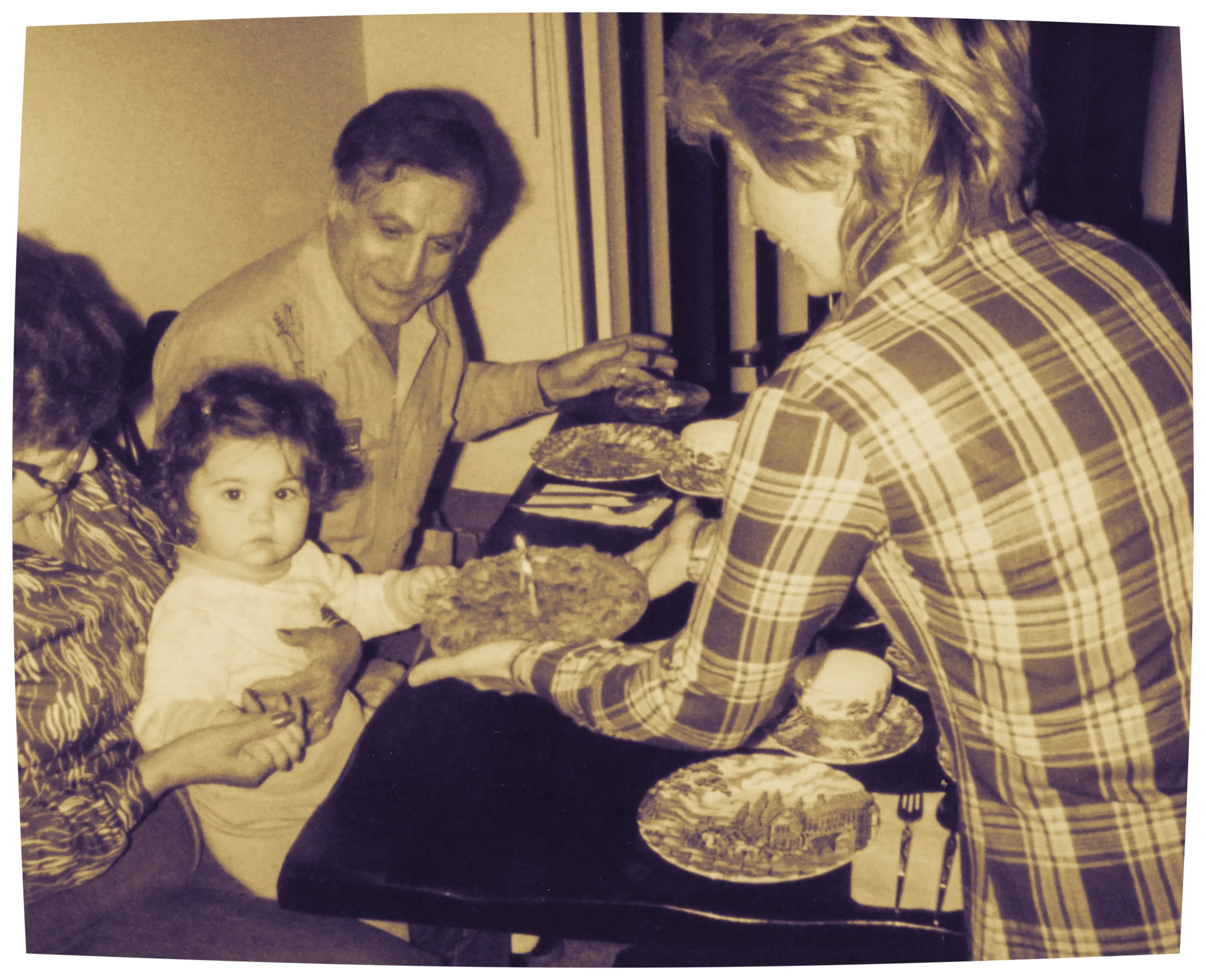
The writer's first birthday, Oct. 29, 1981: Three generations—grandparents Catherine & John, their daughter Joann, and her daughter Christine—celebrate with one of Pop’s pies (rest assured, there was a first birthday cake, too, as Mom is quick to point out!)
Pop’s Pie
By Christine Tarulli Mugnolo
I’ve always been a sweets person. That is to say, I’ll be happy with dessert for breakfast, lunch, and dinner. I believe I have my grandfather partly to thank (blame?) for that…and for my own sporadic hobby of making delectable treats.
My grandfather and grandmother eloped to Colorado in 1942. Soon after, as an officer in the army, he was stationed in Anzio, Italy, for the remainder of World War II. In between the fighting, Pop did what he did best—he cooked. He became the chef for his fellow officers and higher-ranked officials. And when he was finally home, he was head chef for his family.
There was nothing that Papa loved more than watching us devour what he made on any given day. And he never, ever forgot dessert.
I always felt Pop made dessert especially for me, his chubby, sweets-loving granddaughter. I would sometimes catch him beaming at me, all messy-faced and sticky-fingered. How his smile and hearty laugh would light up the entire room!
While I loved his cookies and his pretty lattice cherry pie, Pop’s key lime pie was my absolute favorite. It was always amazing: thick, buttery graham-cracker crust, sweet yet tart filling, and just a few twisty limes on top as garnishment.
As I got older, the pies seemed to get even more delicious, prettier, and, ultimately, simply perfect.
Pop passed away on December 16, 2001, when I was a senior in college. I was—I still am—devastated. I always will be. We lost our family’s heartbeat, our core, and I lost my Papa.
I think that’s when I started to bake. And I baked all the time then—for my family,
for my friends and boyfriends. I adored watching them taste all the goodness that
I (lovingly) shoved in their faces.
I don’t remember when my grandmother gave me my grandfather’s key lime pie
recipe. But when she did, it was as if she were handing me the damn Holy Grail. It’s been about 14 years, and I still cannot get it just right. I make the pie once or twice a year; it’s my special time with him. No TV, no one else in the room...just the two of us. How I curse that Pop didn’t write down what he really did to make his pie so great!
Eventually, I made my own tweaks. While my pie is good, it’s not as good as I remember his to be…and not nearly as beautiful. But that’s okay; it doesn’t have to be.

I have his—our—faded and butter-stained recipe, which, to me, is more beautiful than any pie. And I take it out every time I make it.
If I could have a few more hours with him, I’d introduce him to my daughter (oh, he would just eat her up!); I’d dance with him and not give him a hard time about it; and we’d bake together, so I could finally learn his secrets to the best key lime pie I have ever had.
Love and miss you always, Papa.
-----------------------
Christine Tarulli Mugnolo is a wife to a traveling husband, stay-at-home-mom to a very active toddler and two rescue pups, and in her spare time, a freelance editor. She thinks there’s no better smell than that of an old book from the library.
Pop’s Key Lime Pie Recipe
Crust
1 1/2 packs graham crackers, crushed
2 tablespoons margarine
Filling
8 eggs, separated (yolks only)
2 cans condensed milk
6 ounces lime juice (from about 6-7 limes) or Nellie & Joe’s Famous Key West Lime Juice
green food coloring (optional)
To make crust:
Combine graham crackers and melted margarine in bowl, then press into pie pan. Chill 30 minutes before pouring in pie filling.
To make filling:
Preheat oven to 350°
Combine egg yolks with condensed milk in medium bowl.
Mix well. Add lime juice a little at a time until smooth and creamy. Add a touch of food coloring until filling is desired color. Pour into pie shell. Slice a lime very thinly and add slices to top of pie before baking. Bake at 350° for 20 minutes.

The writer’s grandfather, John Carl Esposito (April 25, 1922 - December 16, 2001), in uniform in Pueblo, Colorado, where he was stationed before going overseas; 1942


A taste of the past
Smells and tastes conjure memories in a most primal way, and can transport us right back to our childhood kitchens. Our recipe for preserving your food stories.

Smells and tastes conjure memories in a most primal way, and can transport us right back to our childhood kitchens. As such, they are excellent jumping-off points for writing or talking about your memories and crafting them into a story for generations to come (not to mention, the kids will be thrilled to have those cherished recipes actually written down).
Delve into your food-related memories if...
you have a living relative who can be equated with the family hearth: recording those recipes, techniques, & special foods while you can is an invaluable gift for future generations
family holidays center around the table
milestone celebrations come back to you in waves every time you smell a certain dish
you want to preserve your culture
Foods Stir the Memory
On Tuesday we will be launching a new series of posts, A Taste of the Past, in which food plays a starring role, leading us down a path of reminiscence and reflection.
In the first contribution, Christine Mugnolo recalls her grandfather's singular key lime pie: Why can't she recreate it just so?
“It’s been about 14 years, and I still cannot get it just right. I make the pie once or twice a year; it’s my special time with him. No TV, no one else in the room...just the two of us.”
In another post, Kaitlin Ahern pays tribute to her mom’s spaghetti and meatballs, and you'll raise a glass with her to toast the memory of a mother gone too soon (and I guarantee you'll be uncorking a bottle of red, picking some basil from the garden, and putting on a pot of red sauce yourself—and, if all goes well, you'll be conversing around the dinner table about your own favorite handed-down recipes).
In “Billie’s Famous Foods,” Melissa Finlay recalls how her Gramma kept a jar for bacon drippings on her stove, used it liberally, and kept it full. “She knew everyone’s favorite foods and provided them—often.”
I hope these and other upcoming stories will inspire you to want to record your own memories. When you've gathered enough, or decide you'd like our professional help in recording them for posterity, an heirloom book is the perfect place to preserve them.

Related Reading:
If the idea of bottling memories of your ancestors' foods appeals, you might also want to check out:
Grandma's Project ("Sharing the World's Most Delicious Heritage"), in which filmmakers from around the globe cook with their grandmothers—and elicit evocative stories of the past along the way
Dinner: A Love Story, a so-much-more-than-a-blog compendium of recipes, kids' lunch ideas, and more from book author Jenny Rosenstrach; she occasionally hones in on the power of food as love, too, such as in these three lovely posts: Sense Memories (her husband's recollections of the birth of their first child and chicken salad, not necessarily in that order); The Napkin Note (about her mom and lunchbox missives); and Absolute Value (about her dad, Oyster Bar, and chocolate marzipan bars)
The Dinner Party, a glorious, long-time-coming community of mostly 20- and 30-somethings who've each experienced significant loss, who get together over potluck dinners to talk about the ways in which it continues to affect their lives and how to thrive in #LifeAfterLoss—an inspiring, real-life example of the power of a shared meal to heal and create community, even (maybe especially) after the death of a loved one.

Choose your own adventure—then tell it.
When you read memoirs—or even binge-watch reality TV—the stories you are witness to often seem larger than life. How can my little life compare?, you might think. I have nothing remarkable to say. Oh, but you do. Every choice you make, each person you encounter, adds to the texture and direction of your life. You are creating your own narrative. You’ve got reasons why you AREN’T telling your story. I’ve got reasons why you SHOULD.

(7 Reasons You CAN’T Tell Your Story, & 7 Better Reasons You CAN)
When I was a kid I read the choose-your-own-adventure series of books, liking, as most preteens did, the ability to hold some sway over how the storyline unfolded. I would read one book multiple times, attempting to make every choice combination possible. It was easy to become part of the story.
As I grew up and immersed myself in literary worlds well beyond Sweet Valley High, I would lose myself in stories of characters both like and unlike me.
Only as an adult did it fully dawn on me that I was, in fact, living my own story.
When you read memoirs—or even binge-watch reality TV—the stories you are witness to often seem larger than life. How can my little life compare?, you might think. I have nothing remarkable to say.
Oh, but you do.
Every choice you make, each person you encounter, adds to the texture and direction of your life. You are creating your own narrative.
You’ve got reasons why you AREN’T telling your story. I’ve got reasons why you SHOULD.
What’s your reason for not telling your story?
1 - I don’t keep a diary, so I won’t be able to remember details.
Time passes. Our memory is faulty. Even with a journal or diary, you would never be able to reliably relate all details of a time or scene from your past. While having a journal to reference could be a tremendous help, it is by no means a prerequisite for remembering, and telling, your own stories.
All memoir writers—and anyone who just reminisces over a cup of tea—challenges the limits of memory. Your sister might remember details differently from a shared memory—That dress was blue! It was winter!—and who can say which of you is right? While you might get a detail wrong, you are striving, in good faith, to recreate the essence of your memories, to transport those who are receiving your stories to your emotional state of mind, to feel your experiences.
“The present is all that’s genuinely available to anyone, and the present is fleeting, always turning instantly to the past. Even facts distort: What’s remembered, recorded, is never the event itself, no matter how precise the measurement—a baseball score is not the game…. At best, what we can do is listen to memory and watch memory…and translate [it] for those we want to reach.” —Bill Roorbach, Writing Life Stories
I’m not advocating getting details wrong—but by no means does one need a day-by-day accounting of their youth to begin to tell their early stories!

2 - My story is nothing special.
Oh, contraire. Stop comparing yourself to those aforementioned reality-TV show subjects. Have you loved? Made difficult choices? Gone on adventures that made you smile, laugh, feel invincible? Accomplished things that would make your parents (or your children) proud? Are there stories you used to retell around the dinner table, or the campfire? Are there questions your grandchildren have asked that you’ve only skimmed the surface of answering?
Even if the answer to every one of these questions is, “No!”—even then, I am confident there are questions to which you will answer with a resounding, “Yes!” You are living your story, and YOUR story matters.
Want a little (fun to read) proof? Check out what happened when a fellow personal historian spoke to a group of 10-year-olds about some pretty ordinary people. Then check out this video, and bear witness to some amazingly average people telling small stories that feel remarkable. Get ready to be moved.
3 - I don’t have very many photographs.
You’ve got a few, don’t you? And I would venture to guess that if you’ve saved those few, there’s a reason. Tell the stories of those pictures. Sit down with a friend, hit RECORD on your smartphone’s audio feature, and have a conversation about what you recall. Describe the sensory details—the coarse fabric of the formal jacket you wore, the fishy smell blowing in from the shore, the metallic taste of spearmint from the gum tucked behind your tongue. You may not know the exact date the photograph was taken, but I’m willing to bet you know more substantive stuff about the “when”: after you had graduated; before your father died.

So you've got just one treasured photo—start there! What memories does it spark?
Maybe you have absolutely no photographs. There are other options worth exploring: illustrating your book in a style that complements your narrative; using archival photographs to illustrate what the time was like; staging professional photo shoots to include family heirlooms, yourself and your current family members, or even the places that have mattered in your life.
4 - I’m too old to start now—how could I possibly cover 70 years?
It’s only too late if you never begin.
“You don’t have to cover all 70 years at once,” says Linda Coffin, founder of History Crafters. “Start small. Don't box yourself into ‘I was born... And then... And then…’ Tell just your favorite stories, or tell the stories that no one is left to tell but you. ANY stories that you tell will be important to those you leave behind, even if they aren't ALL your stories.”
Your stories are a testament to who you are, and “something is better than nothing,” says Lyn Jackson, founder of Every Story Media. “Your loved ones will cherish what you choose to relate.”
5 - I’m too young to start now—my story is just beginning!
Ah, how fortunate you are. Consider how fresh and visceral your favorite coming-of-age tales are: Stephen King’s Stand By Me (short story and movie), Judy Blume’s Are You There God, It’s Me, Margaret? (adolescent fiction), Lena Dunham’s Not That Kind of Girl (modern essays written by a feminist actress who has tapped into the zeitgeist like no other recently).
You are in the midst of your story, and dare I say it may be one of the most exciting parts! Life milestones are opportune times to craft a book, as they are often emblematic of turning the page on a new chapter in your life. Consider telling your first chapter.
Are you embarking on your college education? Engaged to be married? In the midst of changing careers? Bat/bar mitzvahs are also popular times to memorialize in words and pictures. Remember, your story can be primarily photo-driven, too—quotes and short first-person reflections add color and context in a lovely way and help bind a picture story together, helping you capture a formative time in your life, both for yourself and your ancestors.
6 - I don’t have any children of my own, so who cares?
If you are fortunate, you have friends and other loved ones to whom your story matters. You may not be leaving a genealogical legacy to your children, but there are many other types of stories that hold meaning, and that are begging to be told.
Your story may be part of a broader narrative that history has a responsibility to capture: veteran accounts, the early LGBT experience, the Civil Rights movement (or ongoing race relations in our nation), even seemingly “small” historic moments in your local community. What has mattered to you, and how have you participated in the world at large?
“Every life—every, single life—matters equally, and infinitely.” —Dave Isay
Even if you have no interest in publishing a book to hold your memories, there is value in the writing itself—and equally in the sharing of stories for strangers to hear (StoryCorps comes immediately to mind!).
All of this to say: We care. People care.
7 - I am not a writer.
That’s what we are here for.
Often the most intimate and revealing stories result from one-on-one conversation. You talk, and we listen. What we do from that point is, well, just a little bit of magic.
Let's talk, and see what we can do together.
Related reading:
20 Reasons Why You Should Write Your Family History
Association of Personal Historians Experts Weigh In: More Reasons to Tell Your Family History

“His are the sepia eyes that passed through me.”
“His is the broad nose, the high cheekbones, the determined mouth, the face not like an oval or a heart, but like a square. He died long before I'd ever meet him, but I carried him in my blood.” In Beth Kephart's contribution to our “Pictures Into Words” series, you’ll find inspiration for writing about a photograph that holds more mystery than memory. Sometimes it's the wondering, the imagining, that brings life to an old photo—that carries your ancestors from the past into the present and finds the narrative thread in our connected lives.
When it comes to writing your own life stories, sometimes what's called for is inspiration, plain and simple. Sure, you can get plenty of tips on how to approach the process; there are some notable books that can guide you on the journey, and our blog regularly offers advice on the topic. But beautiful words, strung together like pearls and simply telling a story, may be a far richer bounty.
With that in mind, here is another installment in our “Pictures Into Words” series, contributions from other memory-keepers who know the joy and process of using a photograph as a prompt for writing. Each provides not only a wonderful short read, but a fine and unique example of how you too may approach telling the stories behind your family photographs.
This short piece by author Beth Kephart has been previously published; it was the opening to her 2002 memoir Still Love in Strange Places. In her poetic contribution, you'll find inspiration for writing about a photograph that holds more mystery than memory; sometimes it's the wondering, the imagining, that brings life to an old photo—that carries your ancestors from the past into the present and finds the narrative thread in our connected lives.
Pictures Into Words:

Photo courtesy Beth Kephart; pictured on right is Carlos Alberto Bondanza, the grandfather of Kephart's husband, and the man whose stories captivated her imagination
“Torn Photograph, Sepia Stained”
By Beth Kephart
The tear runs like a river through a map, hurtling down toward his right shoulder, veering threateningly at his neck, then diverting south only to again pivot east at the fifth brass button of his captain's uniform. Below the tear, two more brass buttons and the clasp of his hands, and below all that, the military saber; the loosening creases on his pants; the shoes with their reflections of the snap of camera light. He is one of three in a sepia-colored portrait, and someone had to think to save his face. Someone had to put the photo back together—re-adhere the northeast quadrant of this map with three trapezoids of tape so that his left hand would fall again from his left elbow and he would still belong to us. We suppose he is the best man at a wedding. We suppose that it was eighty years ago, before the matanza, before he was jailed and then set free, before he saved the money to buy the land that became St. Anthony's Farm.
“Did I ever tell you what my grandfather did the year the farm first turned a profit?”
“No.”
“He threw the money into the air, the bills, and they got caught up with a wind.”
“And so?”
“And so he ran after those colones through the park. Chased his own money through the leafy streets of Santa Tecla. Imagine that.”
I do. I am often imagining that. Imagining that I know him—this man whose likeness is my husband's face, whose features are now borne out by my son. His are the sepia eyes that passed through me. His is the broad nose, the high cheekbones, the determined mouth, the face not like an oval or a heart, but like a square. He died long before I'd ever meet him, but I carried him in my blood. Just as the land carries him still, remembers. Just as St. Anthony's Farm will someday, in part, belong to my son, requiring him to remember what he never really knew, to put a story with the past. Words are the weights that hold our histories in place. They are the stones that a family passes on, hand to hand, if the hands are open, if the hearts are.
“You look like your great-grandfather.”
“I do?”
“Yes. Come here. See? That’s him, in the photograph.”
“Him? My great-grandfather?”
“Yes.”
“But he looks so young.”
“Well, he was young once. But that was a long time ago, in El Salvador.”
We remember. We imagine. We pass it down. We step across and through a marriage, retrieve the legacies for a son.
-----------------------
Beth Kephart is an award-winning author of 21 books of fiction and nonfiction, including Handling the Truth: On the Writing of Memoir, which we recommend in a previous post. Her current book is This Is the Story of You (Chronicle). The above was excerpted with permission of the author from Still Love in Strange Places: A Memoir (W. W. Norton, 2002).
Kephart has recently launched Juncture, writing workshops where the locale plays an integral role in inspiring and enabling the writing process. Sites have included
an experience-enriching Pennsylvania farm and, in the fall, a sunny gathering place along the coast in historic Cape May. “Participants will learn what memoir genuinely is—and what it is not. They’ll study the words of the greatest memoirs ever written, respond to daily prompts, and work toward a fully developed memoir prologue that summons both the themes and tone of work yet to come,” details her site.
And they will enjoy the unique surroundings of their chosen environs, gathering formally and informally for readings, conversation, and inspiration.

“Honoring Mamita”
Yuliana Gomez Delgado reflects on a favorite photograph with her grandmother, a shot that has taken on new meaning now that Yuliana herself knows what it is to be called Mother. As she poignantly writes, “Burying her was saying goodbye to my childhood—it was the first time I realized time went forever forward, and so many happy memories were destined to stay behind.” And yet, she finds a lasting way to honor her Mamita, and create a loving legacy for her family.
You don’t have to call yourself a writer to write meaningful vignettes about your life. There are some notable books that can guide you on the journey of writing your life stories, and our blog regularly offers advice on the topic. Sometimes, though, all you need is a little inspiration.
With that in mind, here is the second contribution in our “Pictures Into Words” series, vignettes from other memory-keepers who know the joy and process of using a photograph as a prompt for writing. Each provides not only a wonderful short read, but a fine and unique example of how you too may approach telling the stories behind your family photographs.
Since it's still May, we’re proud to feature recollections of another strong matriarch in honor of Mother’s Day. In her piece, Yuliana Gomez Delgado reflects on a favorite photograph with her grandmother, a shot that has taken on new meaning now that Yuliana herself knows what it is to be called Mother.
Pictures Into Words:
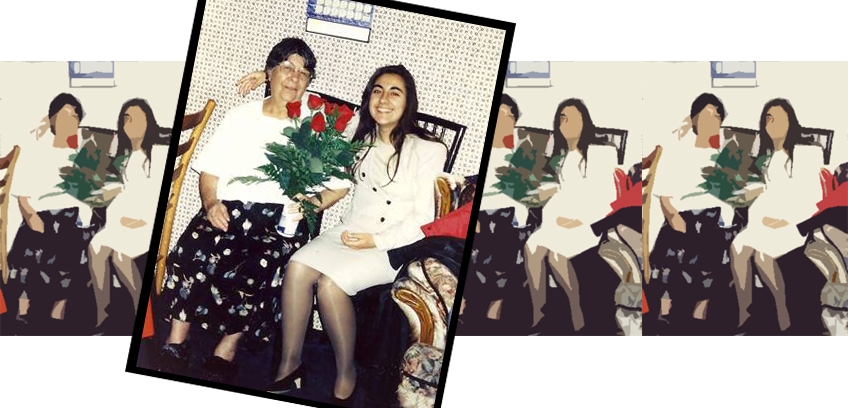
The writer, Yuliana Delgado, with her maternal grandmother, Mother's Day, 1996
Honoring Mamita
By Yuliana Delgado
I keep this picture in a safe place because of all that it represents to me. It was Mother's Day 1996 and we were visiting my Mamita (what I called my mom’s mom, my abuela or grandma) after church that Sunday. I was hamming it up for the camera, but I can still feel the scratchy icky-ness of those seldom-worn pantyhose on my legs and how silly I felt in my beige suit. What can I say, I tried to dress up a little since I lived in sweats and tees pretty much all the time (I was in college after all!). Beyond how I felt about my church garb on that day, what I remember clear as day is the incredible love and gratitude I felt for Mamita, whose health had been declining rapidly over the previous months.
Holy crap, that was 20 years ago! I was in my teens and a sophomore in college. And yet, despite my relative youth, I think I knew how little time I had left with my incredible, wonderful, always happy, always positive Mamita, María Noemí. In the days that followed that weekend, we visited her Queens apartment as much as we possibly could, to spend time or just to help around the house after her grueling radiation sessions or after those exam days, when the poking and prodding she had to endure at the hospital left her exhausted.
Almost two years to the day that this picture was taken, Mamita left us, finally succumbing to the cancer that had ravaged her body. Despite the fact that I knew it was coming—and as I think is always the case—her death was beyond painful, surprising, crushing. It didn’t matter that I knew the day would come, it had to come; knowing she was gone forever still destroyed me. Burying her was saying goodbye to my childhood—it was the first time I realized time went forever forward, and so many happy memories were destined to stay behind.
I found this photograph about two years ago, when I was pregnant with my daughter. While we had decided upon Sofía as our girl’s first name, we were struggling with a middle name. The picture brought inspiration. I would honor Mamita in a most special way, one that would keep her ever-present in my life: We would give our baby Mamita's middle name. It was the best way I could honor her, so many years after she left us. And Sofía Noemí is in, so many ways, a little bit like Mamita.
I hope Mamita’s great-granddaughter can carry on her spirit and legacy. Her name is a way to have her again in our lives. And whenever I look at my Sofi, I know we chose the name well.
-----------------------
Yuliana Gomez Delgado is the managing editor at MamasLatinas.com. She lives in New Jersey with her hubby, 4-year-old son, 20-month-old daughter, and two cranky Chihuahuas, Pablo and Arnie.

“My Mother, the Most Beautiful Woman in the Room”
You don't have to call yourself a writer to write meaningful vignettes about your life—and photographs make wonderful prompts. In this series, “Pictures Into Words,” Rachel Brodsky offers up her own vignette as inspiration. "Even as I—and the photo of us together—grew older, my mom still never seemed to age. Perhaps part of that has to do with the fact that she’s blessed with enviable genes—even today she’s well past 50 and still only has a smattering of barely visible gray hair..."
You don't have to call yourself a writer to write meaningful vignettes about your life. There are some notable books that can guide you on the journey of writing your life stories, and our blog regularly offers advice on the topic. Sometimes, though, all you need is a little inspiration.
With that in mind, this is the first in a series of contributions from memory-keepers: some who write for a living, and some who don't but are brave enough to pick up pen to paper (or fingers to keyboard). Each of them uses a photograph as a prompt for writing a little life story. And each of them provides not only a wonderful short read, but a fine and unique example of how you too may approach telling the stories behind your family pictures.
I hope to make this series, "Pictures Into Words," a regular feature on the site; if you would like to contribute, please reach out via email or social media (Twitter or Instagram)—I would love to share your stories as inspiration, too.
Without further ado, part one in our series...
Pictures Into Words:
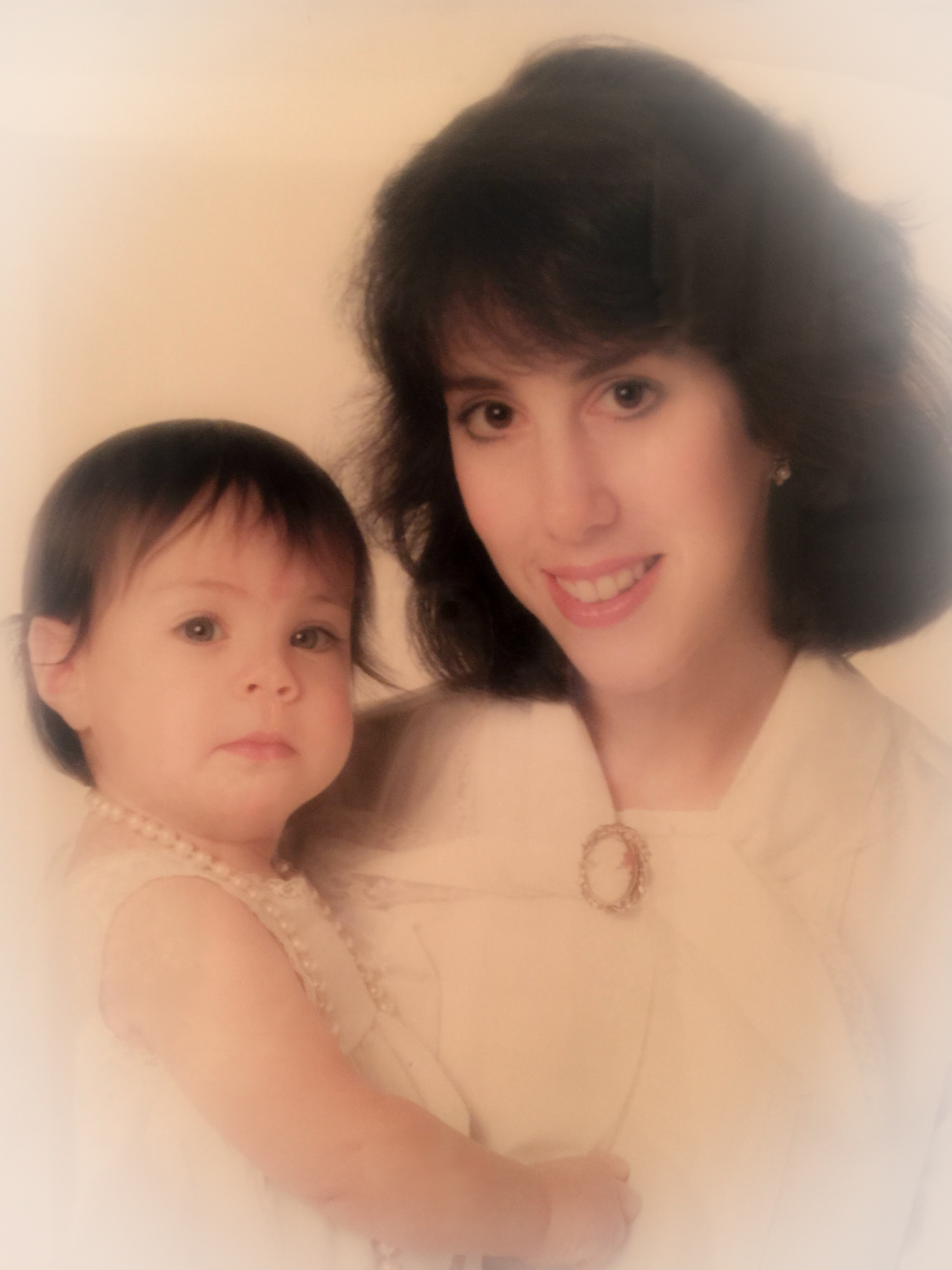
Author Rachel Brodsky and her mother
“My Mother, the Most Beautiful Woman in the Room”
By Rachel Brodsky
I don’t think it’s unusual for a daughter to view her mother as the most beautiful woman in the room. I certainly did. I was sure there was something that separated my mom from all other mothers. Maybe it was how tall she was, with her height clocking in at 5’9"—unusually lanky for a Jewish woman. Equally uncommon for a member of the tribe were her chest and backside, which were flat as pancakes—physical features she used to bemoan. But I thought those things, combined with her long, thin legs, made her look elegant and model-esque. I wanted to be naturally tall and thin when I grew up, too. I wanted to literally stand out from the crowd.
I used to stare, mesmerized, at a professional photo of the two us taken when I was barely a year old. My parents got me all dressed up for Baby’s First Photo Shoot, selecting a lacy white dress, a matching headband, and a string of long, Flapper-like pearls. They sat me down in a rocking chair holding a teddy bear, standing up on a white shag carpet, and each parent held me as they grinned into the camera. I remember thinking that this photo of my mom holding me in her arms was her at her most stunning. The way she, too, is dressed in white, looking up with a calm, quiet grace, seemed to radiate an uncommon mixture of innocence and wisdom.
Even as I—and the photo of us together—grew older, my mom still never seemed to age. Perhaps part of that has to do with the fact that she’s blessed with enviable genes—even today she’s well past 50 and still only has a smattering of barely visible gray hair. Maybe it’s also because she has maintained the same mid-length, feathery haircut decade after decade. Maybe it’s because she works out every week, stresses the importance of healthy foods (something that used to drive me insane as a kid, for obvious reasons), and never goes too heavy on the makeup—all habits I picked up once I got old enough to care about appearances.
Of course her beauty went beyond looks. She had, and still has, an openness, an honest streak, that let her smartly confront a lot of my teenage conundrums. When I was 10, I asked if I could begin shaving my legs. Not only did she agree, but she showed me how to do it without nicking myself. When I was 13 and started showing interest in makeup, she took me to the Clinique counter and bought me a starter kit. Fortunately, this never extended to anything truly embarrassing (it’s not like she bought me condoms in high school or college or quizzed me about my sex life), but the fact that Mom was inherently so open to discussing femininity and womanhood—no matter what the topic—just made her seem more progressive than most. Never mind the fact that she could easily pass for my cool, younger aunt instead of my mother.
Almost 30 years have gone by since this photo of us was taken. Her face has grown a few lines, her hair’s a little shorter, and usually I see her in glasses. But it's her inner elegance that has not changed a bit. I see it every time I look at her—the woman who is still the most beautiful one in the room.
-----------------------
Rachel Brodsky is a writer and editor living in New York. She currently works for SPIN.com. She also has two cats, one of whom is named “Jones” for Sigourney Weaver's tabby in Alien.

How to use photographs as prompts for writing life stories
Use these tips to tell the stories behind your family photos and leave a visual AND narrative history to your children—a gift from the past to the future.
“Your photography is a record of your living, for anyone who really wants to see.” —Paul Strand
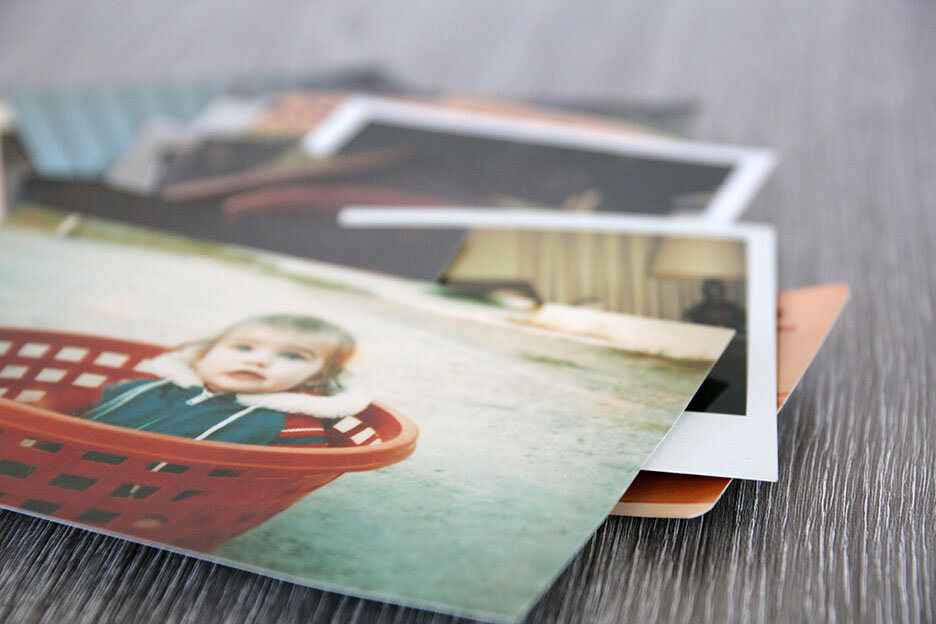
If writing a life story book seems overwhelming, write shorter stories from your life using some favorite family photos to jog your memory.
My generation knows the pleasure, both tactile and emotional, of exploring a box of dusty old photographs: the sense of discovery, of time travel, the good fortune of glimpsing our parents as carefree teenagers, of seeing ourselves as Garanimals-clad kids.
But this is becoming a thing of the past. Do you even have a box of photos in your home?
It saddens me to think of our children inheriting a box of old devices (your iphone will be extinct one day, you know!) and wondering how they can access the digital trove of photos they know must be stored within. And they likely won’t be able to retrieve those images, as the technology will have changed by then.
Just as I wish my mother and grandmother had jotted names and dates on the back of their old photos, our kids will one day be wishing we left some clues about our own pictures (metadata, anyone?).
I urge you to go a few steps further, to not only record the details of important photographs, but to elucidate the stories associated with them. To leave a visual AND narrative history to your children, a gift from the past for the future.
How to Shape Your (Small) Life Stories
I’ve written about this before, but it’s worth reiterating: Shorter is often better, especially when it comes to autobiographical writing. That’s why using photos as jumping-off points for your stories can be such an effective method.
Don’t worry about length when you sit down to write. Just choose a photo, and begin sharing. A few initial ideas:
1 - Talk, don’t write.
Pick up a digital recorder (or use the function on your smart phone) and talk into it. Often spoken language is more direct. You won’t get hung up on sentence structure or finding the perfect words. Rather, your language will flow and have a natural rhythm. Your words will be honest and forthright. You can transcribe your recording later.
2 - Find a partner.
Having someone to listen to your story can be a powerful aid. Even if that person doesn’t engage you or ask questions, the very act of listening—an occasional nod, an understanding expression—let’s the speaker know that what they are saying matters. The more you converse with someone about your life stories, the easier it becomes to share them, shape them, and delve even deeper.
3 - Be specific.
Small details. Moments. A focus on life as it is truly lived. Did your mother enjoy a cup of room-temperature tea every night before bed? What did the hand-me-down pajamas you’re wearing in the Christmas-morning picture feel like? It wasn’t just a red car, it was a 1955 crimson Cadillac convertible that your dad referred to as “My Dorado.” This is not to say get lost in the details: Do not go overboard describing every object and movement in your story with multiple modifiers. This is to say that the specificity of the right details brings an era or a person to life in a most vibrant and revealing way. Choose wisely.
4 - Interview you.
If you hadn’t taken the picture, what would you want to know? Make believe you’re interviewing yourself. This is a helpful exercise in making sure the most essential (often obvious to you but not others) elements do not get left out of your story. And then, like HONY’s Stanton, edit, edit, edit: whittle your interview down to the bone, keeping in those details that surprise, delight, enlighten. I suggest waiting at least a day, longer if you have the luxury of time, to do the editing; it’s amazing how such distance enables us to better self-edit.
Let’s get started: Choose a picture, and use it as a prompt to write a life story vignette
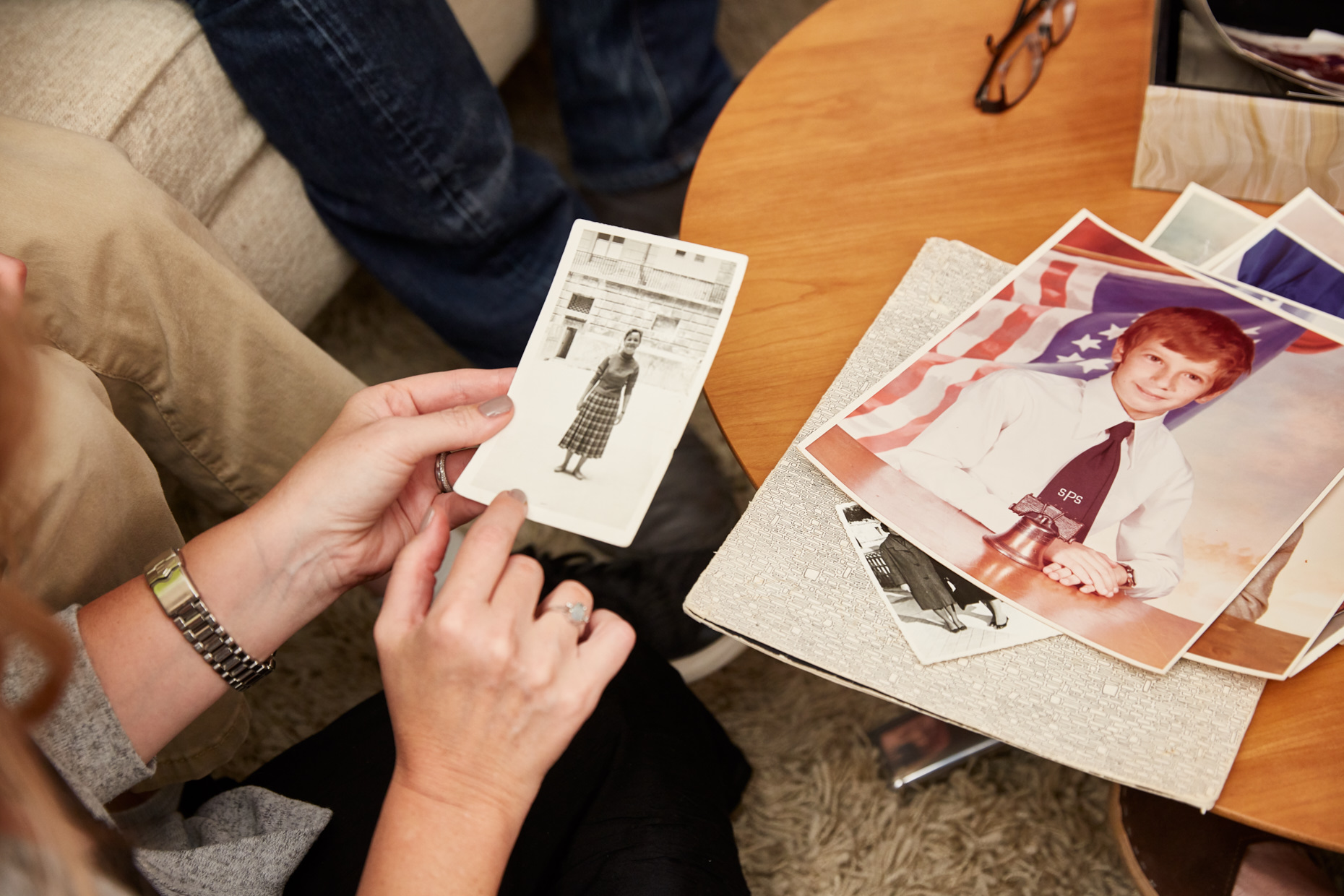
Step 1: Look at your chosen photo.
Study it; ignore it. Eat some lunch and let the memories the picture elicits percolate. Now sit down at your computer to free write: Don’t worry about story structure or creating something for an audience, just write from your heart. If you are more comfortable with pen and paper, you might forego sentences altogether and jot down phrases, recollections, adjectives. The key to both approaches, whether stream-of-consciousness writing or brainstorming, is to go fast and to not worry about anything. Just do it.
thumbs up?
You may find that this one photo has stirred a wealth of memories for you to mine. Perhaps it recalls one vibrant scene from your childhood. Consider yourself lucky if either of these is the case! You’ve got the makings of a life story vignette at your fingertips.
thumbs down?
If the photo you’ve chosen reveals nothing more than a string of boring observations, don’t fret. First, go through this list to see if you get anywhere:
What is your personal connection to the photo?
What would you caption the photo (include as much basic factual information as possible, answering Who, What, Why, When?)
Write a question the photo brings to mind.
Write a detailed observation about the photo.
Still boring…? Don’t worry, just move on to the helpful exercise below to get the story behind your photo!
Step 2: Go beyond the frame.
Next, try this exercise from author Beth Kephart, an early assignment she would give to her creative nonfiction students at the University of Pennsylvania, as detailed in her book Handling the Truth:
Study the background of any chosen photograph. Not the foreground, the background. What’s in the picture that you didn’t see when you were snapping? What lies beyond the chosen subject—just to the right or the left? … What does the startle of the once-unnoticed detail suggest to you? What would happen if this small thing—and not the obvious thing, the central thing, the thing easily seized and snatched—was the start of your story?
Still nothing of interest?
Step 3: Enlist Help.
If you are convinced there is a worthy story attached to the photo, show it to a sibling or other relative to see what memories they may have. If you have other pictures from the same period, gaze at those for clues. Maybe it means something to you not for the story it tells, but for the one it does not tell: Who is the subject gazing at? What happened right before the camera was snapped? Who was left out of the moment—was it you? Or was the picture in a frame at your grandparents’ home, and your memory of that is what’s important?
If nothing more reveals itself and yet you are still compelled to include the photograph in your life story, ask yourself, why? Draft a caption that at least puts the image in context, reveals a mystery, or taps an emotion. Then leave it at that, and turn to your next photo. It is likely that after taking this approach with more of your family snapshots, this one will eventually find its way into your narrative or, rightfully, be edited out in favor of others that weave a more textured and colorful tapestry.
FREE Printable Guide
Download our FREE GUIDE, “How to Use Photographs as Prompts for Writing Life Stories” and get started asap on your journey of preserving your memories!
Next steps, and advice for non-writers
If all of this appeals to you but you’re not a DIYer, that’s what we are here for.
You may want to begin the journey of remembering and selecting photos on your own, using much of the advice provided on the blog—and then hand it over for refining and shaping; our expert editors and designers will transform your memories into a beautiful heirloom that reveals even more than you had imagined.
If you only get as far as piling up those boxes, no worries: We’ll walk you through the whole process! Set up a free consultation to learn how we can work together.
Learn about our Write Your Life course, providing memory prompts, writing guidance and a dose of inspiration to anyone who wants to preserve their stories now.