
Memories Matter
Featured blog Posts

READ THE LATEST POSTS

“His are the sepia eyes that passed through me.”
“His is the broad nose, the high cheekbones, the determined mouth, the face not like an oval or a heart, but like a square. He died long before I'd ever meet him, but I carried him in my blood.” In Beth Kephart's contribution to our “Pictures Into Words” series, you’ll find inspiration for writing about a photograph that holds more mystery than memory. Sometimes it's the wondering, the imagining, that brings life to an old photo—that carries your ancestors from the past into the present and finds the narrative thread in our connected lives.
When it comes to writing your own life stories, sometimes what's called for is inspiration, plain and simple. Sure, you can get plenty of tips on how to approach the process; there are some notable books that can guide you on the journey, and our blog regularly offers advice on the topic. But beautiful words, strung together like pearls and simply telling a story, may be a far richer bounty.
With that in mind, here is another installment in our “Pictures Into Words” series, contributions from other memory-keepers who know the joy and process of using a photograph as a prompt for writing. Each provides not only a wonderful short read, but a fine and unique example of how you too may approach telling the stories behind your family photographs.
This short piece by author Beth Kephart has been previously published; it was the opening to her 2002 memoir Still Love in Strange Places. In her poetic contribution, you'll find inspiration for writing about a photograph that holds more mystery than memory; sometimes it's the wondering, the imagining, that brings life to an old photo—that carries your ancestors from the past into the present and finds the narrative thread in our connected lives.
Pictures Into Words:

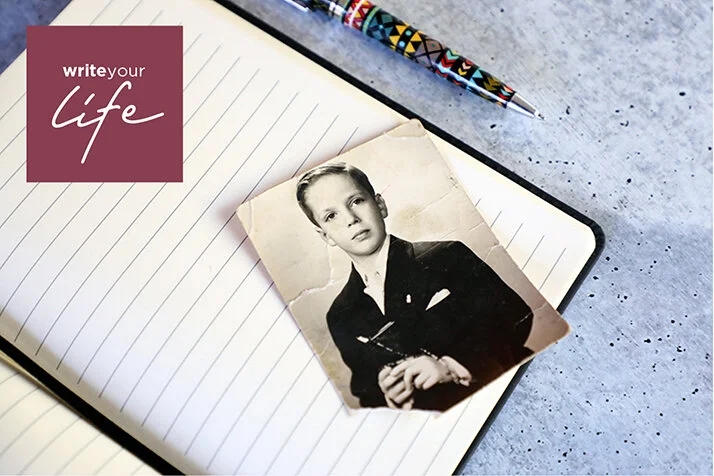
Photo courtesy Beth Kephart; pictured on right is Carlos Alberto Bondanza, the grandfather of Kephart's husband, and the man whose stories captivated her imagination
“Torn Photograph, Sepia Stained”
By Beth Kephart
The tear runs like a river through a map, hurtling down toward his right shoulder, veering threateningly at his neck, then diverting south only to again pivot east at the fifth brass button of his captain's uniform. Below the tear, two more brass buttons and the clasp of his hands, and below all that, the military saber; the loosening creases on his pants; the shoes with their reflections of the snap of camera light. He is one of three in a sepia-colored portrait, and someone had to think to save his face. Someone had to put the photo back together—re-adhere the northeast quadrant of this map with three trapezoids of tape so that his left hand would fall again from his left elbow and he would still belong to us. We suppose he is the best man at a wedding. We suppose that it was eighty years ago, before the matanza, before he was jailed and then set free, before he saved the money to buy the land that became St. Anthony's Farm.
“Did I ever tell you what my grandfather did the year the farm first turned a profit?”
“No.”
“He threw the money into the air, the bills, and they got caught up with a wind.”
“And so?”
“And so he ran after those colones through the park. Chased his own money through the leafy streets of Santa Tecla. Imagine that.”
I do. I am often imagining that. Imagining that I know him—this man whose likeness is my husband's face, whose features are now borne out by my son. His are the sepia eyes that passed through me. His is the broad nose, the high cheekbones, the determined mouth, the face not like an oval or a heart, but like a square. He died long before I'd ever meet him, but I carried him in my blood. Just as the land carries him still, remembers. Just as St. Anthony's Farm will someday, in part, belong to my son, requiring him to remember what he never really knew, to put a story with the past. Words are the weights that hold our histories in place. They are the stones that a family passes on, hand to hand, if the hands are open, if the hearts are.
“You look like your great-grandfather.”
“I do?”
“Yes. Come here. See? That’s him, in the photograph.”
“Him? My great-grandfather?”
“Yes.”
“But he looks so young.”
“Well, he was young once. But that was a long time ago, in El Salvador.”
We remember. We imagine. We pass it down. We step across and through a marriage, retrieve the legacies for a son.
-----------------------
Beth Kephart is an award-winning author of 21 books of fiction and nonfiction, including Handling the Truth: On the Writing of Memoir, which we recommend in a previous post. Her current book is This Is the Story of You (Chronicle). The above was excerpted with permission of the author from Still Love in Strange Places: A Memoir (W. W. Norton, 2002).
Kephart has recently launched Juncture, writing workshops where the locale plays an integral role in inspiring and enabling the writing process. Sites have included
an experience-enriching Pennsylvania farm and, in the fall, a sunny gathering place along the coast in historic Cape May. “Participants will learn what memoir genuinely is—and what it is not. They’ll study the words of the greatest memoirs ever written, respond to daily prompts, and work toward a fully developed memoir prologue that summons both the themes and tone of work yet to come,” details her site.
And they will enjoy the unique surroundings of their chosen environs, gathering formally and informally for readings, conversation, and inspiration.

“Honoring Mamita”
Yuliana Gomez Delgado reflects on a favorite photograph with her grandmother, a shot that has taken on new meaning now that Yuliana herself knows what it is to be called Mother. As she poignantly writes, “Burying her was saying goodbye to my childhood—it was the first time I realized time went forever forward, and so many happy memories were destined to stay behind.” And yet, she finds a lasting way to honor her Mamita, and create a loving legacy for her family.
You don’t have to call yourself a writer to write meaningful vignettes about your life. There are some notable books that can guide you on the journey of writing your life stories, and our blog regularly offers advice on the topic. Sometimes, though, all you need is a little inspiration.
With that in mind, here is the second contribution in our “Pictures Into Words” series, vignettes from other memory-keepers who know the joy and process of using a photograph as a prompt for writing. Each provides not only a wonderful short read, but a fine and unique example of how you too may approach telling the stories behind your family photographs.
Since it's still May, we’re proud to feature recollections of another strong matriarch in honor of Mother’s Day. In her piece, Yuliana Gomez Delgado reflects on a favorite photograph with her grandmother, a shot that has taken on new meaning now that Yuliana herself knows what it is to be called Mother.
Pictures Into Words:
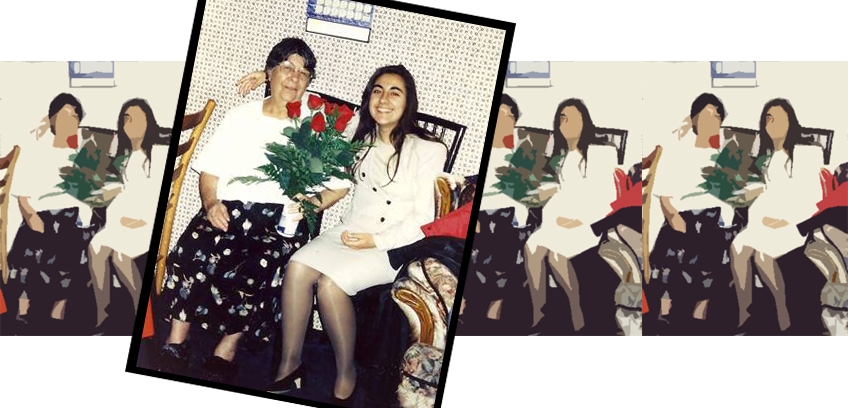
The writer, Yuliana Delgado, with her maternal grandmother, Mother's Day, 1996
Honoring Mamita
By Yuliana Delgado
I keep this picture in a safe place because of all that it represents to me. It was Mother's Day 1996 and we were visiting my Mamita (what I called my mom’s mom, my abuela or grandma) after church that Sunday. I was hamming it up for the camera, but I can still feel the scratchy icky-ness of those seldom-worn pantyhose on my legs and how silly I felt in my beige suit. What can I say, I tried to dress up a little since I lived in sweats and tees pretty much all the time (I was in college after all!). Beyond how I felt about my church garb on that day, what I remember clear as day is the incredible love and gratitude I felt for Mamita, whose health had been declining rapidly over the previous months.
Holy crap, that was 20 years ago! I was in my teens and a sophomore in college. And yet, despite my relative youth, I think I knew how little time I had left with my incredible, wonderful, always happy, always positive Mamita, María Noemí. In the days that followed that weekend, we visited her Queens apartment as much as we possibly could, to spend time or just to help around the house after her grueling radiation sessions or after those exam days, when the poking and prodding she had to endure at the hospital left her exhausted.
Almost two years to the day that this picture was taken, Mamita left us, finally succumbing to the cancer that had ravaged her body. Despite the fact that I knew it was coming—and as I think is always the case—her death was beyond painful, surprising, crushing. It didn’t matter that I knew the day would come, it had to come; knowing she was gone forever still destroyed me. Burying her was saying goodbye to my childhood—it was the first time I realized time went forever forward, and so many happy memories were destined to stay behind.
I found this photograph about two years ago, when I was pregnant with my daughter. While we had decided upon Sofía as our girl’s first name, we were struggling with a middle name. The picture brought inspiration. I would honor Mamita in a most special way, one that would keep her ever-present in my life: We would give our baby Mamita's middle name. It was the best way I could honor her, so many years after she left us. And Sofía Noemí is in, so many ways, a little bit like Mamita.
I hope Mamita’s great-granddaughter can carry on her spirit and legacy. Her name is a way to have her again in our lives. And whenever I look at my Sofi, I know we chose the name well.
-----------------------
Yuliana Gomez Delgado is the managing editor at MamasLatinas.com. She lives in New Jersey with her hubby, 4-year-old son, 20-month-old daughter, and two cranky Chihuahuas, Pablo and Arnie.

“My Mother, the Most Beautiful Woman in the Room”
You don't have to call yourself a writer to write meaningful vignettes about your life—and photographs make wonderful prompts. In this series, “Pictures Into Words,” Rachel Brodsky offers up her own vignette as inspiration. "Even as I—and the photo of us together—grew older, my mom still never seemed to age. Perhaps part of that has to do with the fact that she’s blessed with enviable genes—even today she’s well past 50 and still only has a smattering of barely visible gray hair..."
You don't have to call yourself a writer to write meaningful vignettes about your life. There are some notable books that can guide you on the journey of writing your life stories, and our blog regularly offers advice on the topic. Sometimes, though, all you need is a little inspiration.
With that in mind, this is the first in a series of contributions from memory-keepers: some who write for a living, and some who don't but are brave enough to pick up pen to paper (or fingers to keyboard). Each of them uses a photograph as a prompt for writing a little life story. And each of them provides not only a wonderful short read, but a fine and unique example of how you too may approach telling the stories behind your family pictures.
I hope to make this series, "Pictures Into Words," a regular feature on the site; if you would like to contribute, please reach out via email or social media (Twitter or Instagram)—I would love to share your stories as inspiration, too.
Without further ado, part one in our series...
Pictures Into Words:
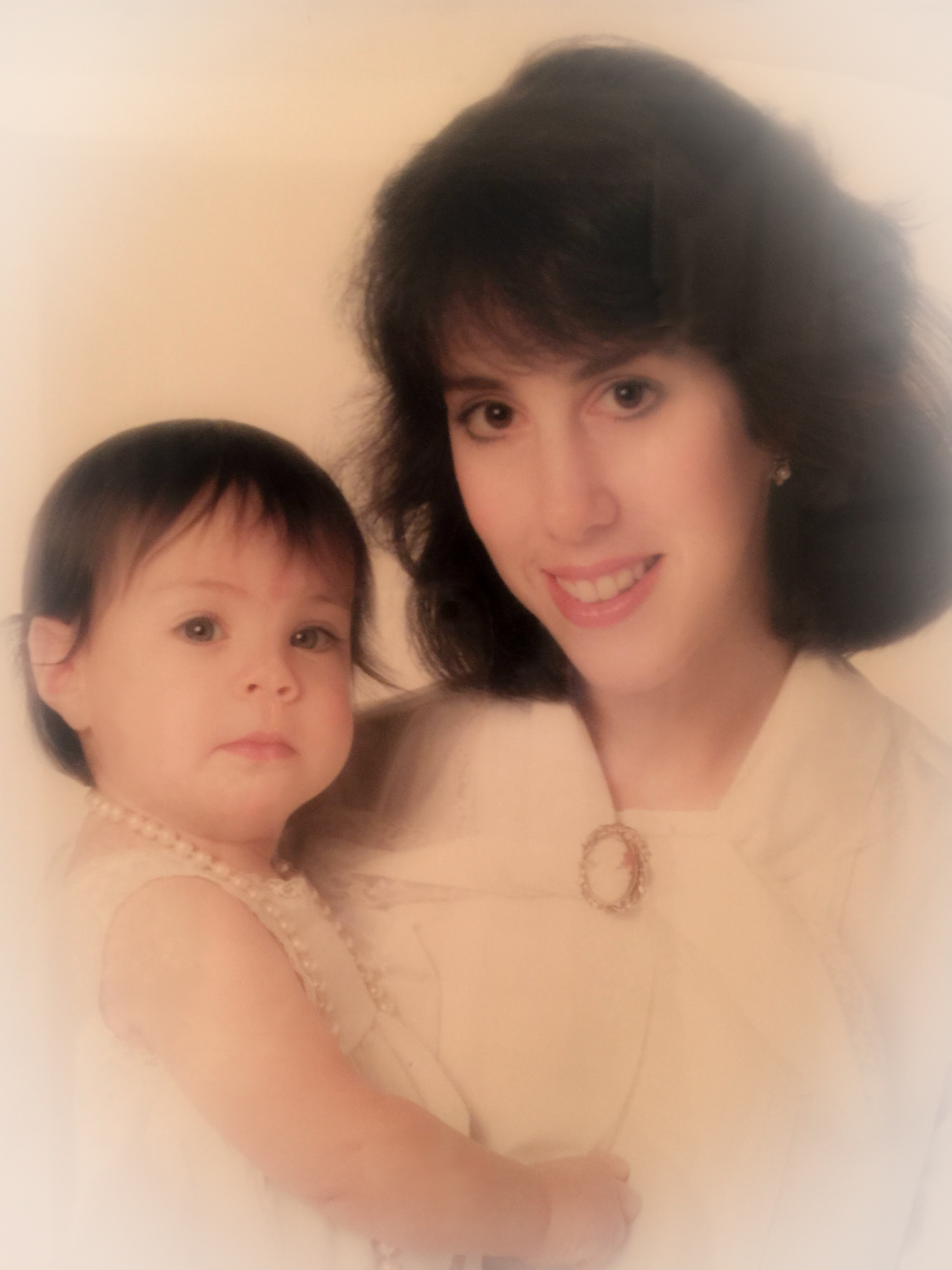
Author Rachel Brodsky and her mother
“My Mother, the Most Beautiful Woman in the Room”
By Rachel Brodsky
I don’t think it’s unusual for a daughter to view her mother as the most beautiful woman in the room. I certainly did. I was sure there was something that separated my mom from all other mothers. Maybe it was how tall she was, with her height clocking in at 5’9"—unusually lanky for a Jewish woman. Equally uncommon for a member of the tribe were her chest and backside, which were flat as pancakes—physical features she used to bemoan. But I thought those things, combined with her long, thin legs, made her look elegant and model-esque. I wanted to be naturally tall and thin when I grew up, too. I wanted to literally stand out from the crowd.
I used to stare, mesmerized, at a professional photo of the two us taken when I was barely a year old. My parents got me all dressed up for Baby’s First Photo Shoot, selecting a lacy white dress, a matching headband, and a string of long, Flapper-like pearls. They sat me down in a rocking chair holding a teddy bear, standing up on a white shag carpet, and each parent held me as they grinned into the camera. I remember thinking that this photo of my mom holding me in her arms was her at her most stunning. The way she, too, is dressed in white, looking up with a calm, quiet grace, seemed to radiate an uncommon mixture of innocence and wisdom.
Even as I—and the photo of us together—grew older, my mom still never seemed to age. Perhaps part of that has to do with the fact that she’s blessed with enviable genes—even today she’s well past 50 and still only has a smattering of barely visible gray hair. Maybe it’s also because she has maintained the same mid-length, feathery haircut decade after decade. Maybe it’s because she works out every week, stresses the importance of healthy foods (something that used to drive me insane as a kid, for obvious reasons), and never goes too heavy on the makeup—all habits I picked up once I got old enough to care about appearances.
Of course her beauty went beyond looks. She had, and still has, an openness, an honest streak, that let her smartly confront a lot of my teenage conundrums. When I was 10, I asked if I could begin shaving my legs. Not only did she agree, but she showed me how to do it without nicking myself. When I was 13 and started showing interest in makeup, she took me to the Clinique counter and bought me a starter kit. Fortunately, this never extended to anything truly embarrassing (it’s not like she bought me condoms in high school or college or quizzed me about my sex life), but the fact that Mom was inherently so open to discussing femininity and womanhood—no matter what the topic—just made her seem more progressive than most. Never mind the fact that she could easily pass for my cool, younger aunt instead of my mother.
Almost 30 years have gone by since this photo of us was taken. Her face has grown a few lines, her hair’s a little shorter, and usually I see her in glasses. But it's her inner elegance that has not changed a bit. I see it every time I look at her—the woman who is still the most beautiful one in the room.
-----------------------
Rachel Brodsky is a writer and editor living in New York. She currently works for SPIN.com. She also has two cats, one of whom is named “Jones” for Sigourney Weaver's tabby in Alien.

How to use photographs as prompts for writing life stories
Use these tips to tell the stories behind your family photos and leave a visual AND narrative history to your children—a gift from the past to the future.
“Your photography is a record of your living, for anyone who really wants to see.” —Paul Strand
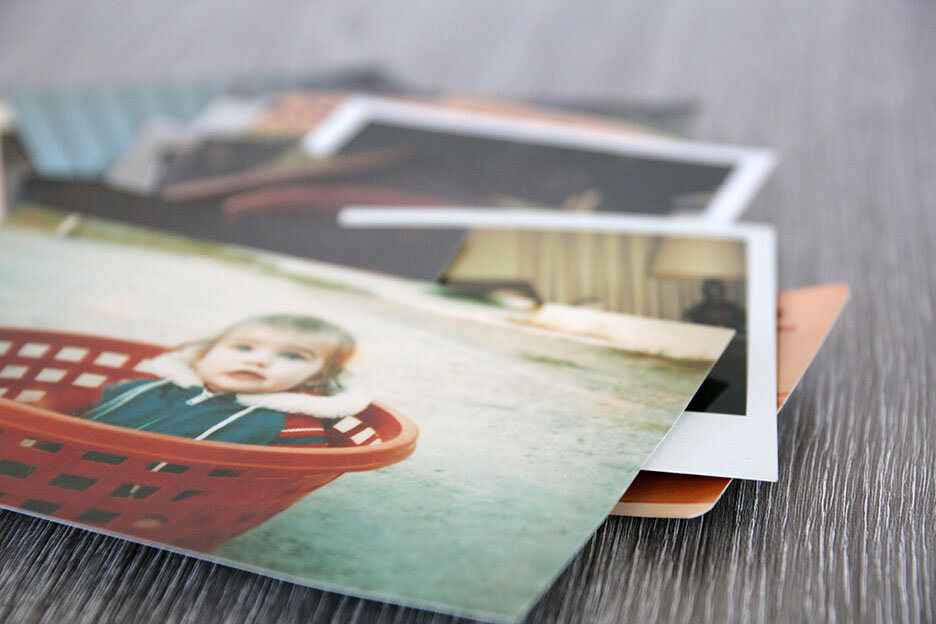
If writing a life story book seems overwhelming, write shorter stories from your life using some favorite family photos to jog your memory.
My generation knows the pleasure, both tactile and emotional, of exploring a box of dusty old photographs: the sense of discovery, of time travel, the good fortune of glimpsing our parents as carefree teenagers, of seeing ourselves as Garanimals-clad kids.
But this is becoming a thing of the past. Do you even have a box of photos in your home?
It saddens me to think of our children inheriting a box of old devices (your iphone will be extinct one day, you know!) and wondering how they can access the digital trove of photos they know must be stored within. And they likely won’t be able to retrieve those images, as the technology will have changed by then.
Just as I wish my mother and grandmother had jotted names and dates on the back of their old photos, our kids will one day be wishing we left some clues about our own pictures (metadata, anyone?).
I urge you to go a few steps further, to not only record the details of important photographs, but to elucidate the stories associated with them. To leave a visual AND narrative history to your children, a gift from the past for the future.
How to Shape Your (Small) Life Stories
I’ve written about this before, but it’s worth reiterating: Shorter is often better, especially when it comes to autobiographical writing. That’s why using photos as jumping-off points for your stories can be such an effective method.
Don’t worry about length when you sit down to write. Just choose a photo, and begin sharing. A few initial ideas:
1 - Talk, don’t write.
Pick up a digital recorder (or use the function on your smart phone) and talk into it. Often spoken language is more direct. You won’t get hung up on sentence structure or finding the perfect words. Rather, your language will flow and have a natural rhythm. Your words will be honest and forthright. You can transcribe your recording later.
2 - Find a partner.
Having someone to listen to your story can be a powerful aid. Even if that person doesn’t engage you or ask questions, the very act of listening—an occasional nod, an understanding expression—let’s the speaker know that what they are saying matters. The more you converse with someone about your life stories, the easier it becomes to share them, shape them, and delve even deeper.
3 - Be specific.
Small details. Moments. A focus on life as it is truly lived. Did your mother enjoy a cup of room-temperature tea every night before bed? What did the hand-me-down pajamas you’re wearing in the Christmas-morning picture feel like? It wasn’t just a red car, it was a 1955 crimson Cadillac convertible that your dad referred to as “My Dorado.” This is not to say get lost in the details: Do not go overboard describing every object and movement in your story with multiple modifiers. This is to say that the specificity of the right details brings an era or a person to life in a most vibrant and revealing way. Choose wisely.
4 - Interview you.
If you hadn’t taken the picture, what would you want to know? Make believe you’re interviewing yourself. This is a helpful exercise in making sure the most essential (often obvious to you but not others) elements do not get left out of your story. And then, like HONY’s Stanton, edit, edit, edit: whittle your interview down to the bone, keeping in those details that surprise, delight, enlighten. I suggest waiting at least a day, longer if you have the luxury of time, to do the editing; it’s amazing how such distance enables us to better self-edit.
Let’s get started: Choose a picture, and use it as a prompt to write a life story vignette
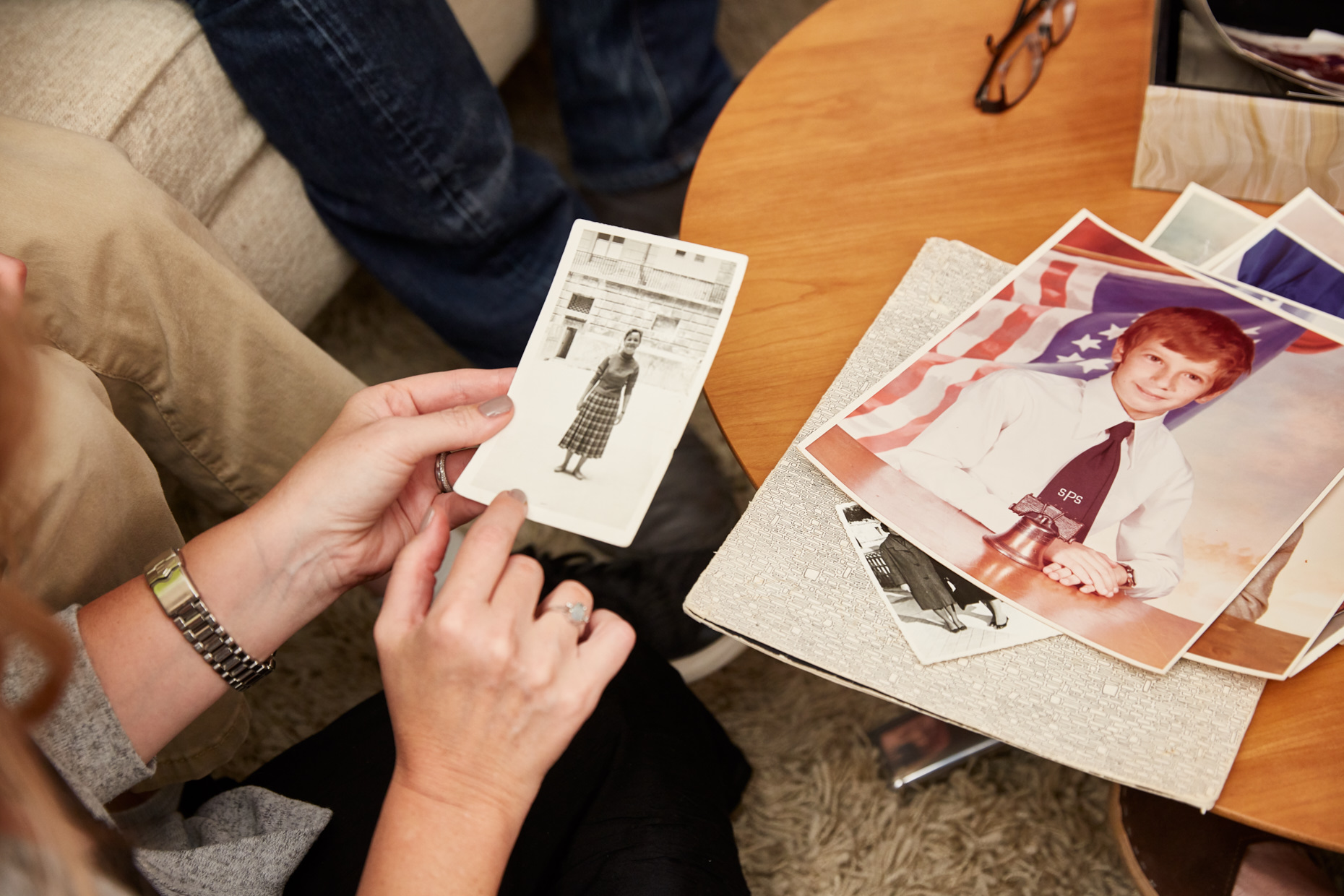
Step 1: Look at your chosen photo.
Study it; ignore it. Eat some lunch and let the memories the picture elicits percolate. Now sit down at your computer to free write: Don’t worry about story structure or creating something for an audience, just write from your heart. If you are more comfortable with pen and paper, you might forego sentences altogether and jot down phrases, recollections, adjectives. The key to both approaches, whether stream-of-consciousness writing or brainstorming, is to go fast and to not worry about anything. Just do it.
thumbs up?
You may find that this one photo has stirred a wealth of memories for you to mine. Perhaps it recalls one vibrant scene from your childhood. Consider yourself lucky if either of these is the case! You’ve got the makings of a life story vignette at your fingertips.
thumbs down?
If the photo you’ve chosen reveals nothing more than a string of boring observations, don’t fret. First, go through this list to see if you get anywhere:
What is your personal connection to the photo?
What would you caption the photo (include as much basic factual information as possible, answering Who, What, Why, When?)
Write a question the photo brings to mind.
Write a detailed observation about the photo.
Still boring…? Don’t worry, just move on to the helpful exercise below to get the story behind your photo!
Step 2: Go beyond the frame.
Next, try this exercise from author Beth Kephart, an early assignment she would give to her creative nonfiction students at the University of Pennsylvania, as detailed in her book Handling the Truth:
Study the background of any chosen photograph. Not the foreground, the background. What’s in the picture that you didn’t see when you were snapping? What lies beyond the chosen subject—just to the right or the left? … What does the startle of the once-unnoticed detail suggest to you? What would happen if this small thing—and not the obvious thing, the central thing, the thing easily seized and snatched—was the start of your story?
Still nothing of interest?
Step 3: Enlist Help.
If you are convinced there is a worthy story attached to the photo, show it to a sibling or other relative to see what memories they may have. If you have other pictures from the same period, gaze at those for clues. Maybe it means something to you not for the story it tells, but for the one it does not tell: Who is the subject gazing at? What happened right before the camera was snapped? Who was left out of the moment—was it you? Or was the picture in a frame at your grandparents’ home, and your memory of that is what’s important?
If nothing more reveals itself and yet you are still compelled to include the photograph in your life story, ask yourself, why? Draft a caption that at least puts the image in context, reveals a mystery, or taps an emotion. Then leave it at that, and turn to your next photo. It is likely that after taking this approach with more of your family snapshots, this one will eventually find its way into your narrative or, rightfully, be edited out in favor of others that weave a more textured and colorful tapestry.
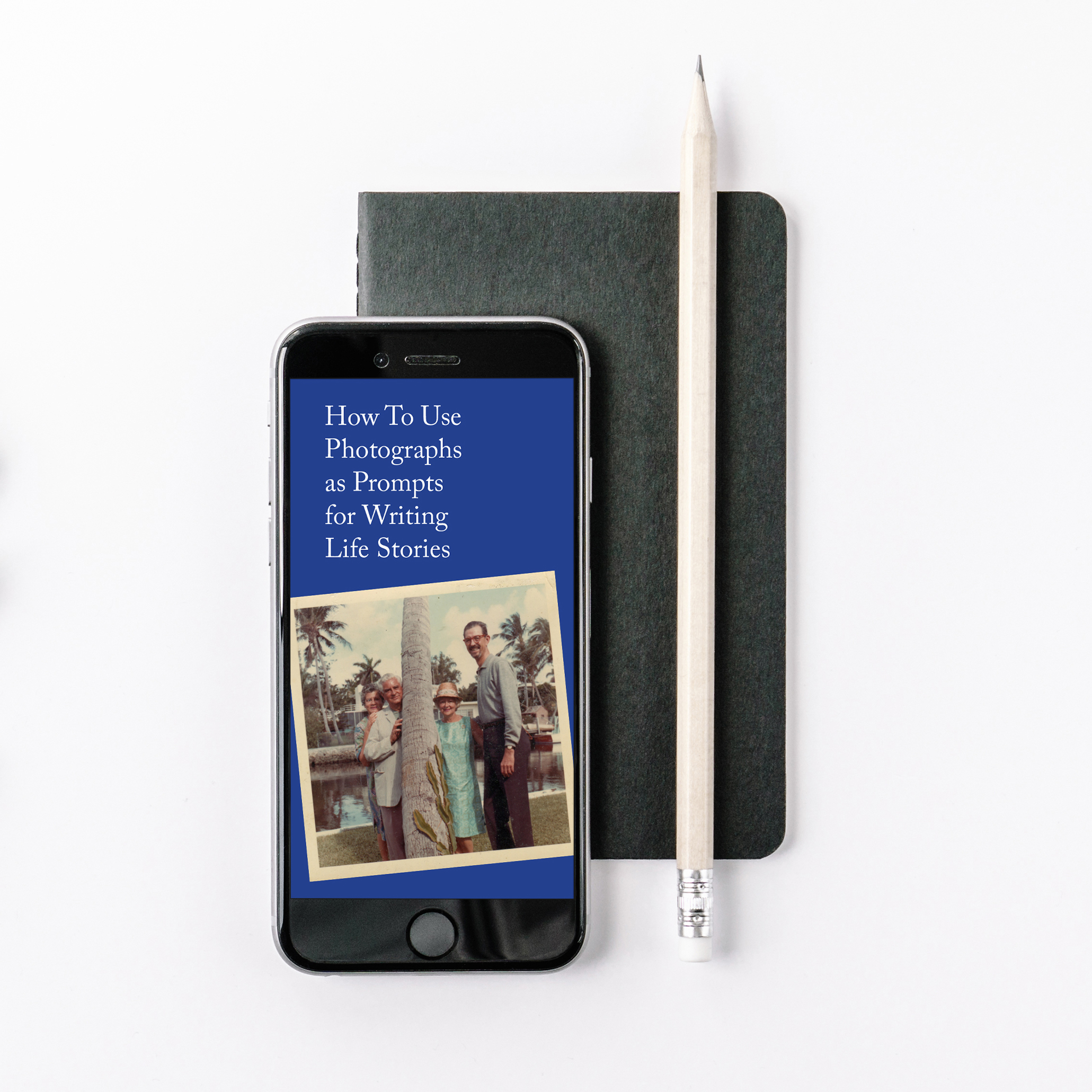
FREE Printable Guide
Download our FREE GUIDE, “How to Use Photographs as Prompts for Writing Life Stories” and get started asap on your journey of preserving your memories!
Next steps, and advice for non-writers
If all of this appeals to you but you’re not a DIYer, that’s what we are here for.
You may want to begin the journey of remembering and selecting photos on your own, using much of the advice provided on the blog—and then hand it over for refining and shaping; our expert editors and designers will transform your memories into a beautiful heirloom that reveals even more than you had imagined.
If you only get as far as piling up those boxes, no worries: We’ll walk you through the whole process! Set up a free consultation to learn how we can work together.

Your kids’ natural smiles make most authentic photos
It’s pretty cool when, as parents, we get some slick shots of our kids posing in trendy duds, looking like they belong on a J. Crew billboard. Plenty of amazing family photographers can capture those shots for you, and they’re a hoot, as my grandmother would say. Indulge in those photo shoots, to be sure—the kids will (most often) have fun, and you’ll be rewarded with some magazine-worthy pictures. But don’t showcase those in frames and books at the expense of showing your kids for who they really are, too.

When I worked at Child magazine, we orchestrated the first-ever children’s runway show at New York Fashion Week. It was a big deal, with some impressive casting (including Lindsay Lohan’s then little-known siblings Ali and Dakota as well as Russell and Kimora Lee Simmons' daughter, Ming Lee) and a 6am call time to the Bryant Park tents. The coiffed kids wore clothes by Tommy Hilfiger, Nicole Miller, Kenneth Cole, Escada, Lucy Sykes, and Gap Kids, and they strutted their stuff down the runway under the bright lights.
It was 2005, pre-Instagram and Twitter. So while there were plenty of camera flashes going off, the pictures were mainly seen in mainstream media. There was a glossy and aspirational quality to the shots, kids all dolled up like their adult counterparts, lighting just so…you got it, like they stepped out of the pages of a magazine. Because they did.
It’s pretty cool when, as parents, we get some slick shots of our kids posing in trendy duds, looking like they belong on a J. Crew billboard. Plenty of amazing family photographers can capture those shots for you, and they’re a hoot, as my grandmother would say: your son with a felt fedora jauntily tipped over his brow, your daughter donning a faux-fur vest and Ray Bans, giving the camera some attitude.
Indulge in those photo shoots, to be sure—the kids will (most often) have fun, and you’ll be rewarded with some magazine-worthy pictures. But don’t showcase those in frames and books at the expense of showing your kids for who they really are, too (unless, of course, your kindergartener really does wear a fedora around the neighborhood). Ask the photographer to take a handful of more natural shots, such as your son and daughter laughing in the clothes they themselves picked out. A real laugh elicits the best images, in my opinion; eyes light up and joy shines through.
“A real laugh elicits the best images, in my opinion; eyes light up and joy shines through.”
When you look back on your kids’ photos years from now, you want to recall their personalities. You want to be able to get clues about the time period from their clothes and accessories—their hairstyles (or lack thereof!). You want context.
Remember the Glamour Shots you insisted your mom let you get at the mall back in the day? You were made over to look more like Olivia Newton-John in Grease than yourself, but that was the point. The backlit hair. The excessive retouching that smoothed skin to porcelain… Would you want those pictures hanging on your wall now? Do they feel like you? Didn’t think so. #embarrassing
Let your photos tell your family’s stories. Your true stories. You’ll be glad one day.

Here's an example of a shot from a professional shoot where the natural light and everyday clothing choices make it feel natural, not contrived. (Before heading out to Central Park, the photographer shot my son in the studio leaning on a skateboard, looking like he was in a clothing ad—cute as a button, but not at all indicative of my child's interests or personality!). Photo by PhotoOpNYC
Are you telling your stories at all?
Here I am lecturing you about letting your kids’ personalities shine through in the pictures you choose, but chances are that aside from social media, you’re not doing much to document their stories. Who has time, really?
Let Modern Heirloom Books accommodate you. We’re here to help you identify and hone your stories, with pictures and words. Find out how we can work together to get your pictures out of cyberspace and into books.
P.S. We’ll even include yours and your kids’ glamour shots if you prefer!
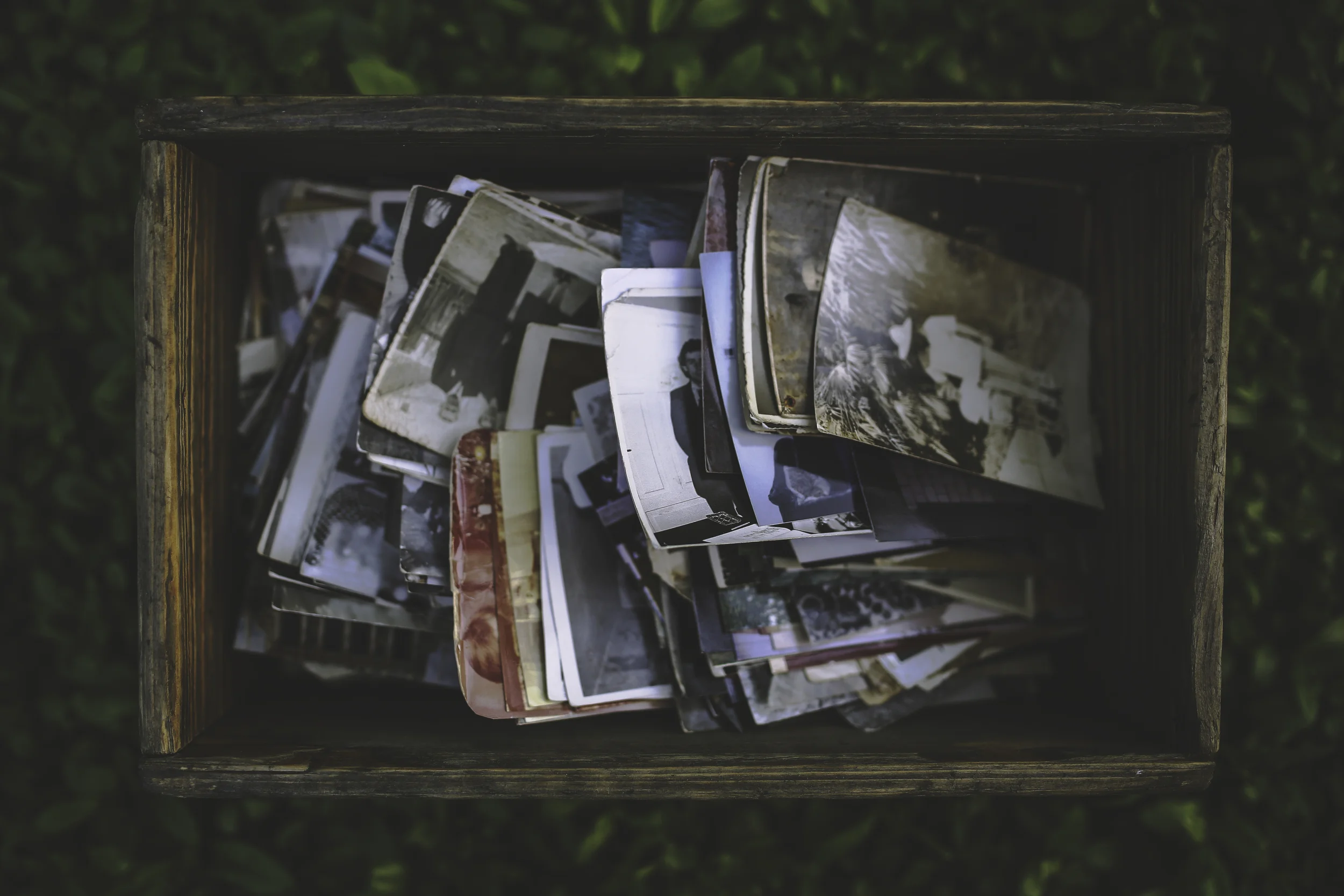
It’s time to start spring cleaning your photographs!
Leave the Windex and broom in the closet for now—all you need to undertake this spring cleaning project are a few boxes, post-it notes, and a pencil. Oh, and all those scattered photographs you've got lying around the house! While spring cleaning might not be ‘your thing,’ the deeper meaning in this organization project will hopefully spur you into action...and score some winning #ThrowbackThursday pics in the process!
Forget about spring cleaning in your closet and basement—those are musty chores, no fun at all. (Writers have been known to say they don’t relish the process of writing, but “having written”; I don’t like cleaning, but love the effects of “having cleaned”!).
Delving into myriad boxes of curling photos might not sound like an enjoyable task, either, but it can be. And the rewards, for you and particularly for future generations, are plenty.

Why even begin such a daunting task as sorting boxes of old pictures?
Well for starters, you saved those boxes for a reason. The pictures they contain are treasures, glimpses of the past with stories to tell. But they do no one any good fading away in the back of your closet.
Beyond that: You just might enjoy the process. As you discover forgotten gems among the piles of photos, your memory will spark and you’ll want to share them. Sort pictures into piles that make sense for how to store them, but more importantly, how to share them:
a stack of perfect Throwback Thursday #TT pics;
some unexpected candids to enlarge and frame;
some that don’t hold great meaning for you but certainly do for a friend or family member—your perfect excuse to write a genuine letter and send them off.
While spring cleaning might not be ‘your thing,’ the deeper meaning in this organization project will hopefully spur you into action.
Is there a right way to sort my photos?
There’s no one right way, of course—but there is a wrong way: You can’t keep everything. Well you can, but why? Photo hoarders can never find what they’re looking for amidst the mass, and you don’t want to leave such a mess to your heirs, do you? You must learn to throw some pictures away. In previous posts I explored the ABCs of photo organizing, in which I explain in simple terms how to sort and store your photos; plus ways to minimize your digital footprint and manage your digital images across your devices.
Today, we’re addressing how to begin the process of cleaning through your physical photographs. We’ll take a deeper dive into digital another day.
Set priorities, and make a realistic plan.
1. Determine the best place to make your mess.
Because you will make a mess. A few piles will certainly turn into many, many piles, and your sorting process will get interrupted by dinner duties and TV time. Find a corner or a room that you’re comfortable storing this stuff for a period of time, and where a family pet or your cleaning person won’t disturb your work.
2. Decide on a realistic time frame.
If you are just tackling the six boxes you’ve accumulated, a couple of days will suffice—and kudos to you for not letting things get too out of control!
On the other hand, if your array of boxes has been collected from family members and you don’t want to even venture a guess as to how many actual pictures are filling up those plastic tubs, then setting a goal is key to your success. The worst thing is starting the project, getting overwhelmed by the scope, then abandoning it.
So set mini-goals to start: Choose a few boxes you believe contain some special photos, and make that part-one of your project; hide the others from your sight. Alternatively, choose a few you think contain mostly junk: It may be easiest to throw away the obvious rejects and feel invigorated by the dent you’ve made.
Write down your objective and your due date, and post it within view so you are always aware of the mission.
GOAL: Sort Grandma’s 3 boxes and my 4 childhood photo albums into manageable piles, storing them in archival photo storage boxes, and throwing away pictures along the way.
COMPLETE BY: May 12
3. Keep an informal inventory as you go.
This will prove most helpful if you’ve got years’ worth of stuff. It doesn’t have to be formal--just some notes on a pad, such as:

Box #1 - all Dad’s military pics with a few random childhood shots; finished sorting
Box #2 - completely random, in terrible shape from being stored without a top in garage; have set aside favorites that need scanning and restoring, and piles for family to look at before throwing away
Box #3 - includes family milestone photos; aim to go through before Denise’s bridal shower, so we can make photo book in time!
When you get further into sorting thematically for storing in photo boxes, then your accounting of what is in each pile can get more detailed. In that case, you are labeling for posterity.
4. Follow up on projects.
Don’t let your “A” photos languish—do something with them.
Scan your favorites so they are backed up digitally.
Enlarge some pictures for framing, and hang them in your home and at work.
Frame a small photo for a loved one or friend for no reason other than you know they’d appreciate it!
Find a story arc or theme and let us help you put together a most special photo book.
Scan a pile of black-and-whites and put them in a #TT folder on your computer, where they’ll be accessible when Thursdays roll around.
5. Be inspired to move on to part-two of your spring cleaning project.
Seeing your beloved photos displayed on the walls of your home, or reading the warm comments from Facebook friends on your latest nostalgic share, should provide the inspiration you need to keep going.
Remember: Spring cleaning starts in the spring, but it’s easiest when maintained all year long. Then “spring cleaning” isn’t even a THING anymore. You’ll feel liberated and empowered once you get your old photographs under control.

Out-of-the-box ideas for making your photo book truly unique
Heirlooms shouldn’t be stuffy or overly conservative: They should reflect the values and real lives of their subjects. And—we hope—for most of you that means lives filled with joy, music, and good company. If you're tackling your own DIY photo book, here are a few out-of-the-box ideas for adding color to your homemade books, from thought bubble captions (with a free download) to flip-book fun!

What's your family listening to? Add a playlist to your photo book to add yet one more fun layer to your memories!
We’re all about high-end books here at Modern Heirloom, but that doesn’t mean we ignore the fun factor! Heirlooms shouldn’t be stuffy or overly conservative: They should reflect the values and real lives of their subjects. And—we hope—for most of you that means lives filled with joy, music, and good company.
When you come to us, we will do way more than design a book for you—we’ll help you sift through ALL those photos, make suggestions for storylines and book angles, and ultimately curate and visually edit your story to create a wonderful end product. And we’re always open to creative twists and add-ons.
Sometimes, though, you might just want to create your own books. We know that not every photo book needs to be handcrafted and archival (though, we’re always here for you to create those!). For example, you might want to create a cheaper book for your toddler with pictures for every letter of the alphabet, or with pictures of faraway relatives—something that your child can actually play with, and get pureed carrots on without consequence. Or you might want your teens to put together their own version of a family annual, so you memorialize their point of view and favorite photos.
No matter the reason, there are times you’ll want to do your own thing. With that in mind, here are a few out-of-the-box ideas for adding color to your homemade books.

Blow some cartoony thought bubbles.
You might not be a designer, but that doesn’t mean you can’t add a few graphic elements to your book that’ll look professionally done. One of my favorite lighthearted design additions is the classic thought bubble. We’re all used to annotating our images these days on Instagram and Facebook, so why not let that sense of humor shine through in your photo books, too? Just search online for “free clip art thought bubbles,” or find fun templates in software such as Canva.
Add a book soundtrack.
Did you know that sensory cues can help trigger memories? Like the smell of bread baking eliciting memories of Grandma’s house, for instance. And while smell may most strongly evoke emotions, I have yet to find a way to produce a scratch-and-sniff photo book. You can, however, create a good old-fashioned print book and add in a musical component.
Brainstorm a music playlist to listen to while viewing your book. If it’s a family album, ask everyone to check back on their devices for their most played songs; think of the songs that marked occasions such as summer road trips or your kid’s camp performance. If your book is celebrating an occasion, record the obvious: songs played at the bar/bat mitzvah or wedding reception. A fiftieth wedding anniversary? Maybe you select a couple of songs per decade that have meaning to the golden couple.
Definitely typeset the list of songs and artists and include as a Playlist Epigraph in your book. If you’ve got the means, burn a CD of the music as well and keep in a plastic sleeve at the back of your book. For Modern Heirloom Books customers who decide to purchase a digital version of their book in addition to the hard copy, we can include the digital music files on the same flash drive.
Have some fill-in-the-blank fun.
Go a little Mad Libs with fun fill-in-the-blank statements scattered throughout your book. This is not appropriate for certain topics, of course, but there are a few that would benefit from the levity. One we love: A mini book in celebration of a half-birthday. Some ideas:
In these past six months, I have gotten so much more ________ and __________. I’m __________ now.
All I want for my half-birthday is ________________________.
Typeset the sentences and fill in the blanks with your handwriting, which makes the photo book that much personal, adding the human touch.
Animate your story with flip book corners.
Do you remember those little books when we were kids that you flipped the pages and the stick figures moved? I haven’t seen one of those in ages, but Pinterest and YouTube are filled with creative ideas for making them.
If you can draw, why not create a series of illustrations that grace the bottom right corner of your photo book, so there is an animated story running parallel to your photographic one? If you’re working with us and want to incorporate this idea into a book, we can hire an illustrator to customize your book corners with your own flip book. We especially love this idea for a Proposal book—share the story of your relationship through photographs and simultaneously show a cartoon-you going down on bended knee to pop the big question, flip-book-style!
We'd love to hear other creative ideas you have—or see the results of your own designs! Please share in the comments below or on social media.
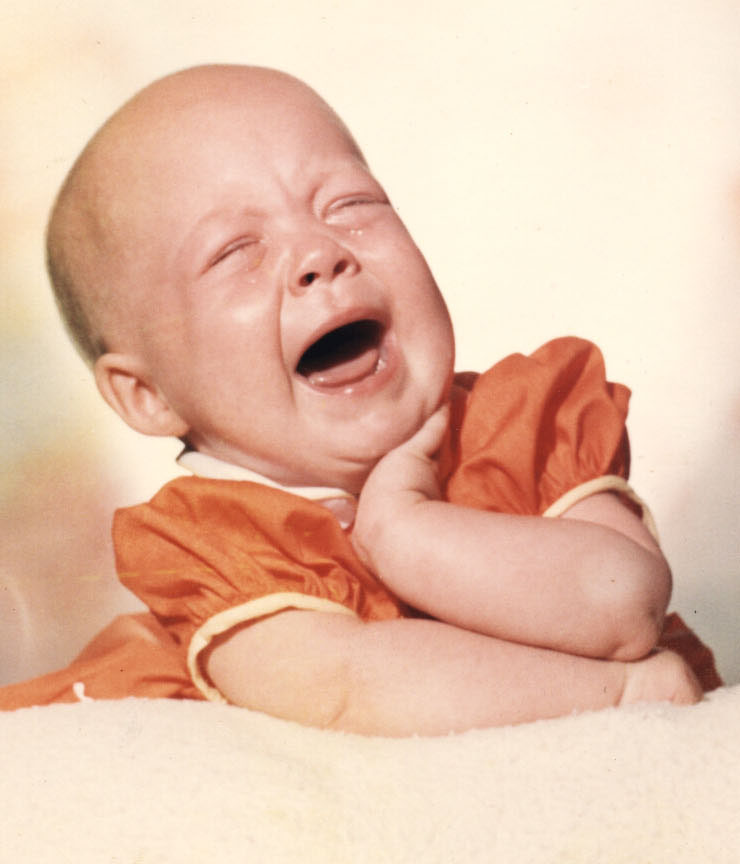
Sometimes it’s the outtakes that matter. #unfiltered
From the crying baby to the teenage 'tude captured on Instagram, the less-than-perfect moments in our photo feeds should not be throwaways—heck, those are some of the most fun (and honest) pictures we have! Our top 5 reasons why the outtakes might matter more than your professionally posed pictures in the end.
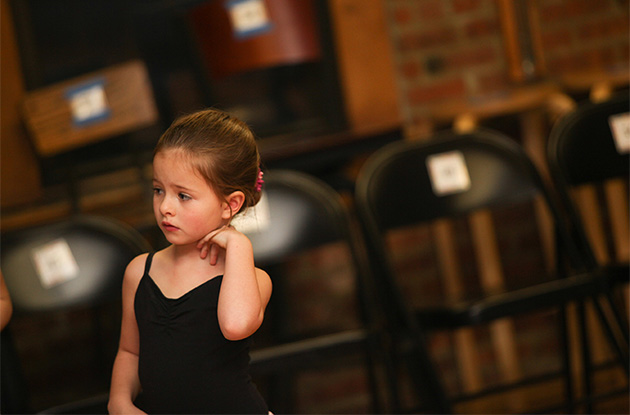
That moment of pre-show jitters makes for as memorable a shot as her big recital debut! Photograph by Marc Goldberg
Why the photos you threw away might really be keepers.
That posed shot of your family sitting in front of the Christmas tree? Lovely, perhaps even frame-worthy. The one of your 3-year-old son looking wide-eyed and contrite after dropping a delicate ornament? Priceless.
Many a Facebook and Instagram feed boasts one near perfect shot after another—online, anyway, we’re living the life of our dreams. But putting aside “friend” envy and FOMO concerns, take note of what pictures you really respond to when browsing your social media feeds: You might LIKE the formal wedding portrait, but you smiled and laughed at the groom’s own boisterous snapshots from the reception. You probably LIKED your sister’s latest (professionally taken) profile picture, but you loved her imperfectly perfect #TT picture shot in your parents’ dark basement 10 years ago.
“Online, anyway, we’re living the life of our dreams.
When we sit down to consider what images to include in a photo book, it’s common to gravitate first to all those perfect shots. We want our family albums to be beautiful—hell, we want to look beautiful in all our pictures, right? And those shots just might make up the backbone of your book. Just don’t discount the outtakes. Here’s why.
1. It’s often the moments right before and after the “big moments” that matter.
Here’s an obvious example: After the wedding vows comes the kiss—a moment no wedding photographer worth her salt would miss. But how about after a graduation? The pensive times your graduate is reflecting on the imminent changes in his life—did you snap him looking a little lost? He might not think so now, but that picture is one he’ll want in later years, reminding him of the magnitude of the moment (and it’ll mean a little more to him upon reflection…and well past the time of worry!). So don’t post that one on Facebook now, but do hold onto it for a book he’ll cherish down the road.
2. Tears are part of life.
When your kid fell off his bike after taking off the training wheels, he cried; you captured the moment because you were snapping away. Include it in your book. Learning to ride a bicycle is a process, and the sense of accomplishment is best felt in light of that fall. You may consider a triumphant picture after he’s mastered his two-wheeler—make it big. Then complement that with a few smaller shots—like stills from a movie—adding color and detail: his tears, his dad removing the training wheels, your child adjusting his helmet.
And speaking of tears: Have you ever been to a wedding where the bride’s parents cried? Tears of joy, well worth recounting. A newborn? Come on—if your child’s baby book doesn’t include some wailing shots, something’s not right!

A smiling baby is always cute, but c'mon...is there anything cuter than a crying baby (sans volume)?
3. Creative cropping can bring a scene into focus.
And “bad” photos can be transformed into artistic images. With digital imaging so accessible these days—from Instagram filters and collage makers to PhotoShop Elements—everyone’s able to alter their pictures for the better. But so much of this post-processing is about making an already good picture stronger with light or subtle retouching effects. Never underestimate the power of good old cropping.
By cropping a picture, we redraw its borders and change the scale of its elements in relation to the overall picture. You can close in on a detail, crop out extraneous people or distracting signs, or just crop a touch from the edges to redirect the eyes. So even if Aunt Sally is smirking in the corner of the picture or a little imp photo-bombed your family shot, crop out what offends and hone in on an otherwise meaningful moment!
4. Everyone has a sense of humor.
Bloopers are a perennial TV hit for a reason. And you are familiar with Awkward Family Photos, are you not?! If a picture makes you laugh uncontrollably, smile knowingly, or blush with memory, chances are it’s a winner.
Like the baby who peed during his newborn session. The muddy dog who jumped on your pristine dress (animals can make for some of the most fun bloopers!). A trip-and-fall at a big moment, a dropped birthday cake, a twisted face as if she just tasted sour grapes…you get the idea!
These inopportune pictures might not make it onto your Christmas cards (though I’m willing to bet your friends and family would hang them front and center!) but they should have a place in your books and albums, for sure.

Photo by Kristen Livingston
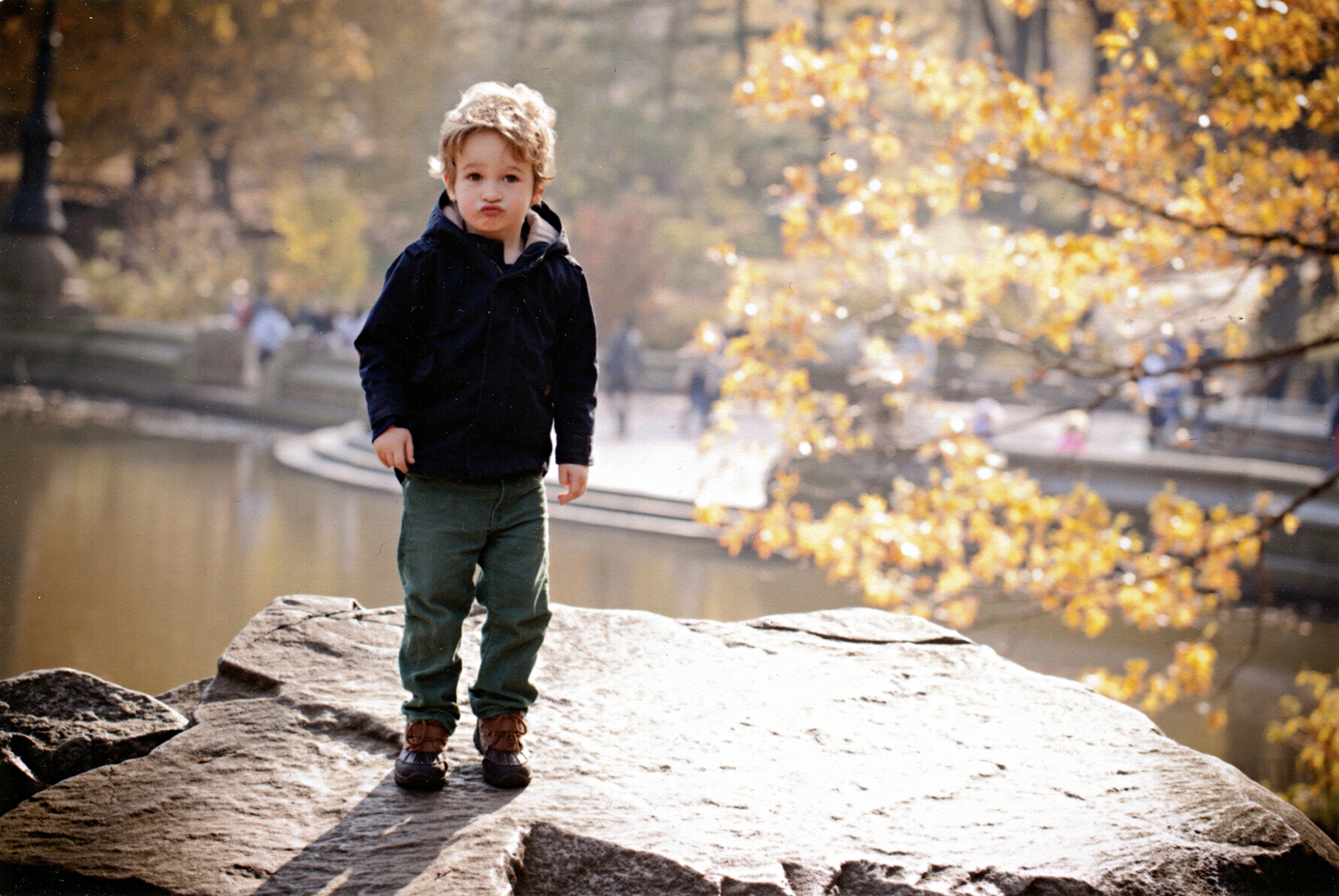
You might not want to showcase that pout in a frame, but in a photo book? Heck, yeah!
5. Stars: They’re just like us. Well, so are we.
Us magazine tapped into just how much we all love to see celebrities doing everyday things—they get coffee, ride the subway, pump their own gas! I admit, I could flip through those photo pages for days.
No, I’m not advocating having someone photograph you at the gas pump. But remember that pictures that offer a glimpse into our everyday lives might be cherished in years to come. They’re revealing. They provide the truest sense of time.
Some of my favorite shots from my family’s archives are of the everyday variety—my grandmother cooking a roast in her housecoat (a “housecoat”!), seeing my father put together a bike in the driveway. These shots offer a glimpse into what their lives were like. It’s not as if our parents came of age in “the olden days,” as we used to say—but let’s face it, the ’60s and ’70s were a very different time! Just imagine what our ’80s hair will seem like to our kids in 20 years! (Oh, and phones had those long, twisty cords!)
When we had to pay to get film developed, every shot counted, so those everyday snapshots made their way into our albums and drawers. These days we can snap away forever, and deleting a shot that seems unremarkable is easier. Just remember to keep a few of them. Like the one of your kid doing the dishes—that’s a keeper, and will seem like a relic when he gets married.

Photograph by Colie James, a professional photographer who sees the beauty and importance of chronicling our everyday lives.
6. Remember that there are some shots that should be off-limits.
Respect your subjects’ dignity and privacy. It’s one thing for J. Lo’s wardrobe malfunction to go viral, it’s another entirely for your girlfriend’s see-through blouse or your sister's Marilyn-dress moment to be shared. Don’t save or share pictures that would embarrass or humiliate anyone. It’s that essential “do unto others” rule: Would you want a picture of you like THAT shared? Didn’t think so.
What are your favorite outtakes and photo bloopers? Do share!!
Tweet at us and use hashtag #photoblooper.
Share on our Facebook page and on Instagram.
We’ll compile the best into an updated blog post!
Dawn Roode’s curated roundup for the week of Sept. 23, 2026, is overflowing with recent reads on memoir, life story writing, and family history preservation.