
Memories Matter
Featured blog Posts

READ THE LATEST POSTS

8 tips for creating your own tribute book in honor of a lost loved one
Writing a tribute book is a meaningful way to create a lasting legacy for a lost loved one. These expert tips from a personal historian will help.

Writing and designing a tribute book is a meaningful way to create a lasting legacy for a lost loved one.
After helping many individuals gather memories and express their love for a family member who has passed away, I have gathered my top eight tips for creating a tribute book on your own.
Remember: This is a labor of love. It may take some time, and you may get frustrated when you embark upon a part of the project with which you have no experience. That’s okay. Always think back to your why. Why you have decided to create this tribute book will motivate you to keep going, as I hope, too, will the advice that follows.
Top tips for gathering memories of a lost loved one:
Top tips for editing and designing a tribute book:
Click on any of the numbered items to go straight to that tip, or continue scrolling to read the whole story.
Gathering memories & tributes for your book

1 - It’s okay to be funny.
If your loved one was a vibrant and funny person in life, it stands to reason that tributes about them after their death should be infused with humor. It’s okay to step outside your grief and remember them with a smile, even a laugh. Happy memories provide comfort and help us heal, and will be a balm to the soul when you pull out this tribute book to visit with your lost loved one someday in the future.
2 - Be specific.
Be as specific as possible in your remembrances. This is the key to creating a moving tribute that holds meaning and calls the spirit of your loved one forth. Be heartfelt and open-hearted, and talk about distinct experiences you shared with the deceased. “That time Marc walked three miles to get Mom a cookie…” says so much more than “Marc was thoughtful”; “Deborah donned her Giants fan gear and ordered pizza from Sinapi’s every single Sunday” demonstrates her love of sports more than saying “Deborah was a Giants fan.” If everyone writes "Maria was a lovely person," it's not nearly as personal as saying WHY or sharing a story that illustrates the point!
3 - Be smart about gathering tributes from other people.
Chances are you won’t be the only person writing a tribute to your loved one who has passed away. Go ahead and ask family members, friends, work colleagues, and others to contribute to your tribute book. Ask for something concrete: “200-500 words about why you loved the person,” for example, or “please tell a story about a time they made you feel special.” Give contributors a deadline (even if you don’t need the book completed by a celebration of life or other event, choose a due date or you won’t get responses at all). Remember, too, that for some people, talking is easier than writing: If you think that may be the case for key family members, consider asking them to record their reminiscences, or record a conversation with them to capture their tributes, which you can type up later for the book.
4 - Include something in the deceased’s own words.
You don’t need to replicate full pages from their journal, but if you come across one or two things they have written that resonate, include them. Perhaps it’s a poem or a quote from a diary, a special letter to a family member, or even a handwritten recipe for that one comfort dish they always made. Hearing their voice come through in the pages of your tribute book will help keep their spirit alive.
Editing & designing your tribute book

1 - List relationships explicitly.
While it seems obvious to you as you’re creating a tribute book that the person you are honoring was your mother, someone else’s sister, friend, colleague…well, it won’t be so obvious in a few years’ time, and certainly not in a few decades. Make your tribute a lasting contribution to your family history archive. By providing full names and relationships to the person being honored, you ensure that the next generation may understand the bigger picture and get to know your deceased loved one more intimately.
2 - Include pictures—but not too many.
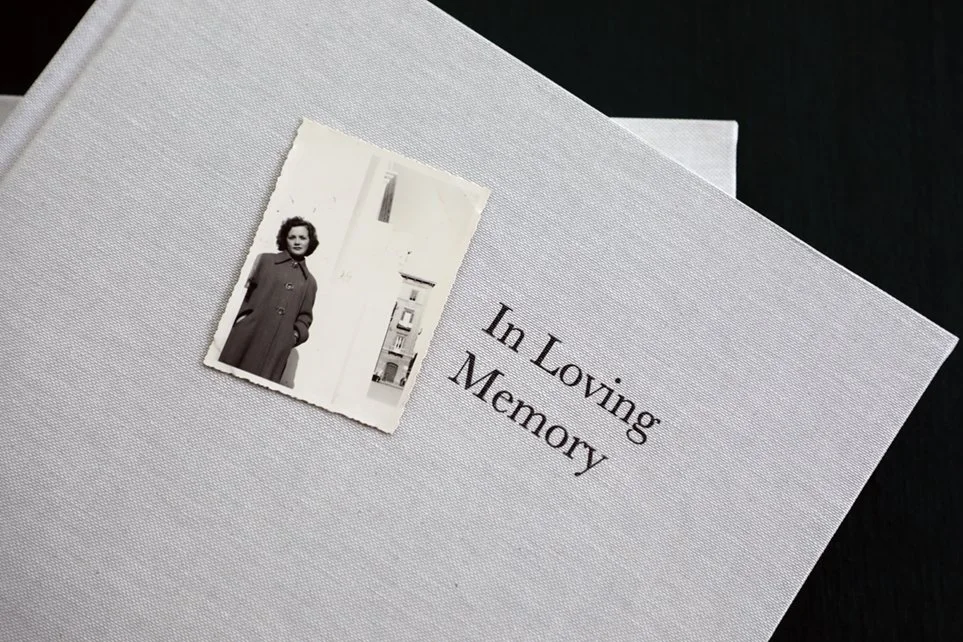
Will you include photos of the person being honored only? I recommend also including pictures of the people offering tributes. Alongside an individual’s quotes, include a photo of them with the deceased whenever possible. Include a curated selection of photos of the person you are honoring from different stages of their life—from childhood through old age—so you show their personality and experiences but do not overwhelm a reader. You want the photos to add to the stories within your tribute book, not distract from them.
3 - Consider transcribing handwritten notes.
While I love the idea of including handwritten tributes in your book, you run the risk of people not reading them if they don’t appear immediately legible. A design can get messy, too, if a book has page after page of scanned handwritten missives. Consider including portions of a note—such as a handwritten quote here and there—as design elements alongside typeset transcripts of everyone’s tributes. You can always save handwritten stories tied with a lovely ribbon or inside a special box; they’re destined to become a unique family heirloom all their own.
4 - Choose book materials wisely.
Whether you decide to use a digital on-demand printer to produce your book or go a more DIY scrapbooking route, plan for your tribute book to last. Use archival paper and acid-free adhesives in a scrapbook or hand-bound album; and save digital copies of your computer-designed book in multiple locations (an external hard drive or cloud backup, for instance). You and your family have worked hard to memorialize this special person who has passed away, so do what you can to ensure their legacy lives on.
Related resources
If you’d like to create a book but would rather have professional guidance along the way, consider our personal historian services: Explore our tribute book packages.
Contact Dawn to learn how we could work together on a tribute book or other heirloom book project.

FREE:
Questions to Help You Honor Them
This printable list of 35 questions to ask to prompt memories of your lost loved one is a helpful tool, especially to have on hand when gathering with family.








Using technology to help you share your family’s stories
There is plenty you can do to ensure that you are—easily!—capturing bits and pieces of your family history on a regular basis. Even if a photo book is way off in your future, take steps now to make life easier later with our recommended memory-sharing websites. With weekly emails prompting a family elder to share personal stories, and options for video, audio, and other customization, creating your personal digital archive is simpler than ever.

A recurring theme here at Modern Heirloom Books is that while we are drowning in our digital images, most people are not doing anything really worthwhile with their pictures. That’s a main reason we exist as a company—to help you curate your pictures and craft them into stories you can share through exquisitely designed books.
What of those stories, though? There is plenty you can do to ensure that you are—easily!—capturing bits and pieces of your family history along the way. Even if a photo book is way off in your future, take steps now to make life easier later.
“There is plenty you can do to ensure that you are—easily!—capturing bits and pieces of your family history along the way.”
In the last few years a host of memory sharing sites have arisen to help tech-savvy families record and share their family memories. Some have evolved over time, while new ones continue to hit the app store in an attempt to simplify the process with more elegant and engaging interfaces. Many of them are too labor-intensive or convoluted to warrant your time, however (and I doubt they’ll be around in a few more years).
One Memory-Sharing App That’s Worth Your Time—and One to Watch (IOHO)
You know those fill-in-the-blank memory books that tempt on Barnes & Noble bookshelves, or the beautiful journals that promise to leave your story for your children? (You know, the one that sits on your nightstand with just two pages filled in?) They’re a wonderful idea, if only we’d truly sit down and answer the questions. StoryWorth is like a digital version of these books, but with so many more benefits.

Options for good old-fashioned fill-in-the-blank memory journals abound—but they're useless if no one fills them in!
StoryWorth recipients receive a weekly email prompting them to answer a question based on their life experiences. The array of questions is vast and evocative, though users may always choose to answer a question they themselves craft. When a reply is input, answers are emailed to a preset list of people (so, as many family members and friends as you want to designate may receive your stories).
The value? It’s easy and fun to answer these prompts, whether a subject types a response on the website or via email, or chooses to record an audio clip over the phone. Photos and audio files can also be uploaded to the site, and stories—all saved on StoryWorth and available for printing or download at any time—are editable and secure. Remember: These aren’t biographies you’re crafting. They are nuggets from your (or your mother’s or grandfather’s) life—the time you hitchhiked across the state, the first time he flew on an airplane, that time none of the kids could find the hidden Easter eggs—colorful tales that the rest of there family will be thrilled to discover.
The site has a few packages ranging from $39 to $119 per year, and they offer a one-month free trial (you don’t even have to enter your credit card to start your trial). Check it out.
If your memories are all over the multimedia map and you want something more dynamic and mobile-friendly, I venture to guess that the imminent app I Rememba might be a good choice. I can’t say much more, though, as the app is still in development; I have signed up for access to their beta launch, so I’ll update you when I’ve eventually had time to test it. Why does it warrant my interest? Well, I am right there with the founder’s inspiration:
““Today, I’m 34 yrs old and have a 3.5 yr old daughter, of whom I have more than 25GB of pictures and videos…and due to the sheer speed with which we’re creating new memories, we don’t really care about them as much as we used to. Can you imagine, when my daughter grows up, what it would be like for her to Search and/or Share just the BEST memories of her life?? ….feels like trying to find a needle in a haystack…””
The launch site promises ways to preserve, capture, and share memories, in whatever format (video, audio, photo, text, and even family tree charts), and to “leave your legacy through time capsules.” I Rememba, like Modern Heirloom Books, is about preservation of memories and connecting generations. I’ll be watching them!
Family History vs. Family Stories
There is a place for memoirs and full-fledged biographies: the library.
Your own stories should not be told in minute detail, covering every life decision and milestone. I am not insinuating that your accomplishments and experiences are not worthwhile—truly, I am not. But for most of us, that…long…story would be rather…boring.
Perhaps it is important for you to chronicle your heritage, and I value a detailed family tree as much as any genealogist. For me, though, the personal tales that inspire a smile or reveal a person’s character are of even greater value. As the cliché goes, no one wants to sit through two hours’ worth of family vacation video, but a highlight reel is always welcome! Likewise, your descendants don’t want to feel like they are reading a 100-page history lesson, but rather as if they are being introduced to the interesting, unique people who came before them.
“No one wants to sit through two hours’ worth of family vacation video, but a highlight reel is always welcome!”
The memory-sharing apps mentioned above are great options for capturing the memories that matter. You’ll know which stories resonate when you get responses from your family members. “OMG I had no idea you were such a rebel soul!!” “I always knew you had a generous spirit, but this is above and beyond.” “LOL you are the same now as when you were 6yo!” “Now that I’m a mom I do the same thing!!”
“You’re not faced with thinking about your whole life or even what story you want to tell,” Nancy Mills told the NY Times about her experience with StoryWorth. “It’s like you’re having a conversation.”
And editing out stories that are less impactful—meaning that when you read them months later they don’t make you feel something—is easy.
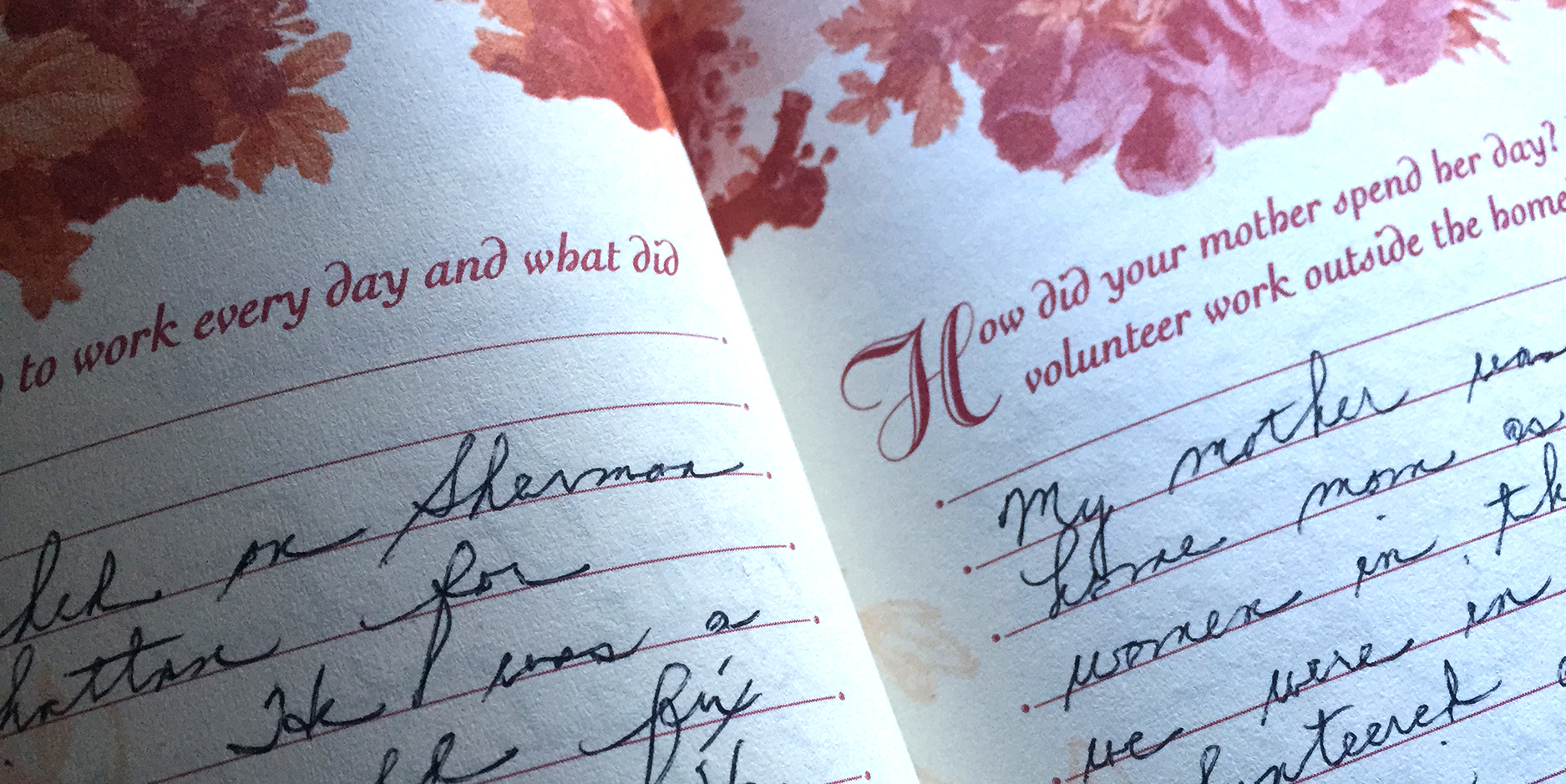
I was lucky enough to inherit a book in which my mom recorded some memories the old-fashioned way—a true treasure.
Whether you actually sit down and use a good old-fashioned pen to record your memories (my mother did, and the book she left me will be forever cherished) or you subscribe to StoryWorth or another tech-aid, just do it. Get your stories down, and saved in one place.
Then, when you’re ready, let’s turn them into something even more special.
Dawn Roode’s curated roundup for the week of Sept. 23, 2026, is overflowing with recent reads on memoir, life story writing, and family history preservation.