Memories Matter

Featured blog Posts


READ THE LATEST POSTS

Filter by categories
curated roundups Dawn M. Roode curated roundups Dawn M. Roode

Life Story Links: Blog Roundup, Feb. 20, 2018

Multiple personal historians weigh in on telling stories creatively using more than straight narrative, plus writing tips, family archive preservation & more.

stories of interest to people who preserve family history and tell or write life stories
“In the particular is contained the universal.”
—James Joyce

What a rich array of resources and articles we’ve got this month! Let’s dive right in, shall we?

Stories Come in Many Forms

FACES, PLACES
In an exhibition at the Art Institute of Chicago, Al Solh’s ongoing series of drawings—or as she prefers to call them, “time documents”—emerged from deeply personal encounters and conversations between the artist and Syrian refugees, as well as other forcibly displaced people. “After five years of continuing this work, I am more aware of how faces tell a story that is as powerful as each person’s story, their ideas about life, aspirations, and how we can go on, wherever we have ended up." I wish I were closer and could see the work in person, but this gallery of images is quite inspiring.

Mounira Al Solh. I strongly believe in our right to be frivolous, 2012–ongoing. Photo: Courtesy of the artist and Sfeir-Semler Gallery; Beirut / Hamburg

Mounira Al Solh. I strongly believe in our right to be frivolous, 2012–ongoing. Photo: Courtesy of the artist and Sfeir-Semler Gallery; Beirut / Hamburg

BIOGRAPHICAL COMICS
Ellie Kahn of Living Legacies Family Histories in Van Nuys, CA, is working with an illustrator to transform one client’s personal stories into comics! See some sample strips, by cartoonist Ben Evans, here.

A LIST OF LISTS?
Sometimes it’s not a long narrative that most interestingly tells your story, it’s a simple list. I explore how to use lists to add texture to a life story book, including a list of list-writing prompts geared at family historians, plus some sample spreads from my personal library.

MORE THAN WORDS
Memoirs consist primarily of narrative. But they can also serve as a medium for artwork, poems, songs, toasts, and other bits of memorabilia that represent your life. Massachusetts-based Nancy West shares ideas from the pages of books she has produced

Tips, Tenements & Time Travel

WRITING LIFE STORY
Sarah White of First Person Productions in Madison,WI, shares a powerful writing exercise from the most thumbed-though, sticky-noted book in her memoir writing library, Your Life as Story by Tristine Rainer. Definitely check it out—I can say from experience Rainer’s tips are beyond useful, and often surprising in what they elicit in your writing, and White features a gem here.

TIME TRAVEL
The initial rationale for funding a personal history project may be to share the subject’s life with grandchildren or great-grandchildren—but, writes Jim Michael of the Personal History Center in Lilburn, GA, “We can never predict who may eventually see it and how it may influence those who view or read it.” Send your life story on a time voyage.

TWO-FER TUESDAY
Brianna Audrey Wright, who calls herself a “storyteller of bygone days” and specializes in Nebraska, Iowa & South Dakota family history, offers up two recent blogs of interest: “Names and records are wonderful and necessary, yes, but it’s that dash between birth and death that’s so fascinating,” she writes in “Genealogist or Family Historian?” In another post, she contemplates the question: What is a legacy in the digital age?

NEW YORK NARRATIVES
It took 10 years and hundreds of hours of interviews to create NYC’s Tenement Museum’s latest exhibit, which chronicles the lives of three post-World War II families who once lived in the building at 103 Orchard Street. “Under One Roof” isn’t a straight work of architectural preservation—rather, it is both a reversion and a reinvention, preserving a space in order to preserve the stories of the people who once occupied it, as a way of telling the story of America.

“WHAT CAN I SAY THAT HASN’T BEEN SAID?”
A conversation with her father prompted Olive Lowe to reflect on why we should tell our stories, even when we think they’re simply not original. “It’s true that most of the items we could list on our ‘life resume’ are on someone else’s too,” writes the Mesa, AZ–based personal historian. But it’s not the what that matters as much as everyone’s personal why.

...and a Few More Links!

Short Takes

Read More
memoir & writing, why tell your stories? Dawn M. Roode memoir & writing, why tell your stories? Dawn M. Roode

Choose your own adventure—then tell it.

When you read memoirs—or even binge-watch reality TV—the stories you are witness to often seem larger than life. How can my little life compare?, you might think. I have nothing remarkable to say. Oh, but you do. Every choice you make, each person you encounter, adds to the texture and direction of your life. You are creating your own narrative. You’ve got reasons why you AREN’T telling your story. I’ve got reasons why you SHOULD.

(7 Reasons You CAN’T Tell Your Story, & 7 Better Reasons You CAN)

When I was a kid I read the choose-your-own-adventure series of books, liking, as most preteens did, the ability to hold some sway over how the storyline unfolded. I would read one book multiple times, attempting to make every choice combination possible. It was easy to become part of the story.

As I grew up and immersed myself in literary worlds well beyond Sweet Valley High, I would lose myself in stories of characters both like and unlike me.

Only as an adult did it fully dawn on me that I was, in fact, living my own story.

When you read memoirs—or even binge-watch reality TV—the stories you are witness to often seem larger than life. How can my little life compare?, you might think. I have nothing remarkable to say.

Oh, but you do.

Every choice you make, each person you encounter, adds to the texture and direction of your life. You are creating your own narrative.

You’ve got reasons why you AREN’T telling your story. I’ve got reasons why you SHOULD.

What’s your reason for not telling your story?

1 - I don’t keep a diary, so I won’t be able to remember details.

Time passes. Our memory is faulty. Even with a journal or diary, you would never be able to reliably relate all details of a time or scene from your past. While having a journal to reference could be a tremendous help, it is by no means a prerequisite for remembering, and telling, your own stories.

All memoir writers—and anyone who just reminisces over a cup of tea—challenges the limits of memory. Your sister might remember details differently from a shared memory—That dress was blue! It was winter!—and who can say which of you is right? While you might get a detail wrong, you are striving, in good faith, to recreate the essence of your memories, to transport those who are receiving your stories to your emotional state of mind, to feel your experiences.

“The present is all that’s genuinely available to anyone, and the present is fleeting, always turning instantly to the past. Even facts distort: What’s remembered, recorded, is never the event itself, no matter how precise the measurement—a baseball score is not the game…. At best, what we can do is listen to memory and watch memory…and translate [it] for those we want to reach.” —Bill Roorbach, Writing Life Stories

I’m not advocating getting details wrong—but by no means does one need a day-by-day accounting of their youth to begin to tell their early stories!

2 - My story is nothing special.

Oh, contraire. Stop comparing yourself to those aforementioned reality-TV show subjects. Have you loved? Made difficult choices? Gone on adventures that made you smile, laugh, feel invincible? Accomplished things that would make your parents (or your children) proud? Are there stories you used to retell around the dinner table, or the campfire? Are there questions your grandchildren have asked that you’ve only skimmed the surface of answering?

Even if the answer to every one of these questions is, “No!”—even then, I am confident there are questions to which you will answer with a resounding, “Yes!” You are living your story, and YOUR story matters.

Want a little (fun to read) proof? Check out what happened when a fellow personal historian spoke to a group of 10-year-olds about some pretty ordinary people. Then check out this video, and bear witness to some amazingly average people telling small stories that feel remarkable. Get ready to be moved.

3 - I don’t have very many photographs.

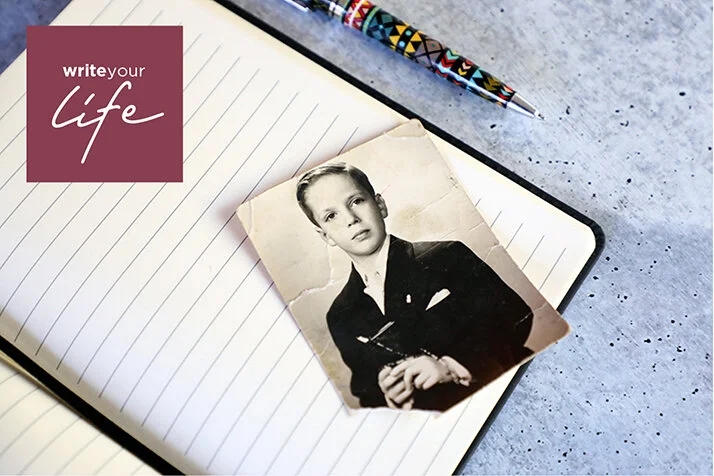
You’ve got a few, don’t you? And I would venture to guess that if you’ve saved those few, there’s a reason. Tell the stories of those pictures. Sit down with a friend, hit RECORD on your smartphone’s audio feature, and have a conversation about what you recall. Describe the sensory details—the coarse fabric of the formal jacket you wore, the fishy smell blowing in from the shore, the metallic taste of spearmint from the gum tucked behind your tongue. You may not know the exact date the photograph was taken, but I’m willing to bet you know more substantive stuff about the “when”: after you had graduated; before your father died.

So you've got just one treasured photo—start there! What memories does it spark?

So you've got just one treasured photo—start there! What memories does it spark?

Maybe you have absolutely no photographs. There are other options worth exploring: illustrating your book in a style that complements your narrative; using archival photographs to illustrate what the time was like; staging professional photo shoots to include family heirlooms, yourself and your current family members, or even the places that have mattered in your life.

4 - I’m too old to start now—how could I possibly cover 70 years?

It’s only too late if you never begin. 

“You don’t have to cover all 70 years at once,” says Linda Coffin, founder of History Crafters. “Start small. Don't box yourself into ‘I was born... And then... And then…’ Tell just your favorite stories, or tell the stories that no one is left to tell but you. ANY stories that you tell will be important to those you leave behind, even if they aren't ALL your stories.”

Your stories are a testament to who you are, and “something is better than nothing,” says Lyn Jackson, founder of Every Story Media. “Your loved ones will cherish what you choose to relate.”

5 - I’m too young to start now—my story is just beginning!

Ah, how fortunate you are. Consider how fresh and visceral your favorite coming-of-age tales are: Stephen King’s Stand By Me (short story and movie), Judy Blume’s Are You There God, It’s Me, Margaret? (adolescent fiction), Lena Dunham’s Not That Kind of Girl (modern essays written by a feminist actress who has tapped into the zeitgeist like no other recently).

You are in the midst of your story, and dare I say it may be one of the most exciting parts! Life milestones are opportune times to craft a book, as they are often emblematic of turning the page on a new chapter in your life. Consider telling your first chapter. 

Are you embarking on your college education? Engaged to be married? In the midst of changing careers? Bat/bar mitzvahs are also popular times to memorialize in words and pictures. Remember, your story can be primarily photo-driven, too—quotes and short first-person reflections add color and context in a lovely way and help bind a picture story together, helping you capture a formative time in your life, both for yourself and your ancestors.

6 - I don’t have any children of my own, so who cares?

If you are fortunate, you have friends and other loved ones to whom your story matters. You may not be leaving a genealogical legacy to your children, but there are many other types of stories that hold meaning, and that are begging to be told. 

Your story may be part of a broader narrative that history has a responsibility to capture: veteran accounts, the early LGBT experience, the Civil Rights movement (or ongoing race relations in our nation), even seemingly “small” historic moments in your local community. What has mattered to you, and how have you participated in the world at large?

“Every life—every, single life—matters equally, and infinitely.” —Dave Isay

Even if you have no interest in publishing a book to hold your memories, there is value in the writing itself—and equally in the sharing of stories for strangers to hear (StoryCorps comes immediately to mind!). 

All of this to say: We care. People care.

7 - I am not a writer.

That’s what we are here for.

Often the most intimate and revealing stories result from one-on-one conversation. You talk, and we listen. What we do from that point is, well, just a little bit of magic.

Let's talk, and see what we can do together.


Related reading:

20 Reasons Why You Should Write Your Family History

Association of Personal Historians Experts Weigh In: More Reasons to Tell Your Family History


Read More
