
Memories Matter
Featured blog Posts

READ THE LATEST POSTS

Life Story Links: December 14, 2021
A wealth of reading on the topics of memoir writing, honoring lost loved ones through storytelling, and the best creative nonfiction pieces to read now,
“But here’s the other thing I believe about writing memoir. Even if you never publish your story, it deserves to be told. There is much to be learned from the simple act of figuring out what your story is ABOUT. Which is not the same as WHAT HAPPENED.”
—Joyce Maynard
Vintage photo of postman with his sack of deliveries; the magazine in front is The Literary Digest, dated May 22, 1920. Original photograph from Bain News Service, 1920, courtesy of Library of Congress Prints and Photographs Division Washington, digital collection.
Telling Our Stories
WHO IS YOUR FAMILY?
While documenting our family history is essential, so too is stepping back to ask ourselves a few questions about our family. These two writing prompts may be just the ticket to more thoughtful storytelling and meaning-making.
STORIES HOLD POWER
On this episode of Stories in Our Roots podcast, host Heather Murphy interviews Laura Roselle of the Family Narrative Project about how we can change the meaning of a story by shifting the way we tell it:
IN CONVERSATION
Memoirists Michelle Bowdler and Kenny Fries discuss “how to write honestly and fearlessly about one’s life and the larger meaning of one’s personal experiences.”
BEING OPEN ON THE PAGE
“I’ve taught writing for more than thirty years, and I always explain to my students that writing it down is the opposite of covering it up,” Gina Barreca, Ph.D., writes in this piece suggesting that stories need a heart.
Discovering the Stories of Others
READING LIST
For your future reading pleasure: Bookmark this list of the best 60 essays in the creative nonfiction genre from the past year, as selected by the staff and readers of Entropy.
RICH NONFICTION NARRATIVE WRITING
How creative nonfiction —“this nonfiction form that let you tell stories and incorporate your experiences along with other information and ideas and personal opinions”—became a legitimate genre.
A MEMOIR FOR COVID TIMES
“Happy and sad, upbeat and poignant, optimistic and anxious, all of these stories [in the community memoir Sorrows & Silver Linings: Global Pandemic in a Small Town] paint a picture of what life was like in Carlisle when COVID struck in spring of 2020,” journalist Nancy West writes.
Memories, Legacy, Life
MEANINGFUL GIFT IDEAS
“All of these gifts connect to conversation, memory-keeping, and story-sharing in some way,” says Whitney Myers, the video biographer behind Sacred Stories in Texas. Her list of holiday giving ideas includes stocking stuffers, too.
TALKING ABOUT DECEASED FAMILY
“We got up and started walking along the edge of the lake when Andy stopped and said, ‘Boys, I have something to tell you.’” How one family honors the memory of three who died years before, with love and intention.
“THE LIFE STORY FACTORY”
“As the pandemic brought mortality into sharp relief, ghost-writing collective StoryTerrace experienced an uptick in business, publishing biographies about and for regular people. Here…we discover the extraordinary things you learn when you spend your days detailing ordinary lives.”
QUITE A JOURNEY
A U.S. soldier overseas during World War II lost a bracelet inscribed with his sweetheart's name. With the help of a hobbyist treasure hunter, the U.S. Embassy, the Marines, and, finally, a Czech-speaking woman in Colorado, it was returned to him. Hear the story:
...and a Few More Links
Review of the new book Artful Truths: The Philosophy of Memoir
Landmark photo archive of black life in New York comes to the Met.
A Florida city keeps the memory of Zora Neale Hurston alive with a heritage trail.
LitHub gathers the best reviewed memoirs and biographies of 2021.
Old photo album shows high school life in Michigan before WWII.
Rediscovered film footage offers rare glimpse of everyday life in 1920s Ireland.
Short Takes

Life Story Links: November 24, 2020
Conversations on memoir, memories of Thanksgiving, new courses of note, plus a diverse array of stories about memory-keeping and life story preservation.
“We all want to get to the masterpieces of our writing lives by the shortest route possible. Trouble is, the shortest route possible is always the road ahead.”
—Bill Roorbach

On this vintage postcard, a parrot says to the turkey: “I would rather spend my life behind the bars than lose my head upon the block.” Courtesy New-York Historical Society, 1907.
Courses of Note
WRITE YOUR LIFE
Last week I began rolling out short memory and writing prompt courses geared at anyone who wants to preserve their family stories, even if they don’t consider themselves a writer.
OBITUARY HELP
In a free lunch-and-learn from Keeper on Tuesday, December 1, grief expert Allison Gilbert interviews professional biographers Kate Buford and Abby Santamaria about “how to expertly craft the kinds of obituaries that truly honor and celebrate your loved ones.”
The Memoir Files
TIM & MARY TALK
In this wide-ranging conversation Tim Ferriss speaks to Mary Karr about why she staged fights in her university memoir classes, how she found poetry in the idioms of her Texas upbringing, and why every writer should keep a commonplace book. Listen in here, or read the full transcript on Tim’s site:
PLAYING WITH FORM
“I think memoir is so much more than a single person’s memories, or the story of one life. That’s a power of the form for me—that it is so poetic, and it is so flexible, you can play with it.” Kao Kalia Yang, a self-described “prose writer with a poet’s sensibility,” on pushing the boundaries of the memoir genre.
IN HIS WORDS, IN HIS VOICE
In these five audio excerpts from Barack Obama’s new memoir, A Promised Land, the former president tells stories about spending time with some of the women in his life as well as his decision to approve the raid that led to the killing of terrorist mastermind Osama bin Laden.
DIVERSE, PERSONAL WAR STORIES
“After poring over people's correspondence and journal entries, it can be emotional seeing a young soldier's attitude…change from excited about going abroad to huddling in the trenches fearing for their lives,” historian Jacqueline Larson Carmichael said. Her new book, Heard Amid the Guns: True Stories from the Western Front, 1914-1918, is out this month.
Times, They Are A-Changin’
A VASTLY DIFFERENT FRESHMAN BREAK
Massachusetts–based personal historian Nancy West shares a first person piece about welcoming her daughter home from college for Thanksgiving, a ritual made quite different due to Covid-19.
TURKEY TALES
“These 29 Thanksgiving vignettes…exuberantly celebrate many cultures, stories, and people that loved us through their cooking,” Becky Hadeed writes. She curated a variety of holiday stories—sometimes funny, sometimes poignant, altogether relatable—for this episode of The Storied Recipe, which you can (and should!) listen to in full here:
MORE PANDEMIC JOURNALING
For the first 25 years after the pandemic, materials from University of Connecticut’s Pandemic Journaling Project will be available only to academic researchers; after that, the entire collection will become a publicly accessible archive. Each week a few entries are featured anonymously, with permission.
Potpourri
A “GREAT AND GEEKY” LEGACY
”I know people get upset when celebrities die,” former Jeopardy! contestant Burt Thakur said. “To me, he wasn’t a celebrity. To me, Alex Trebek was just another uncle.” Read tributes from fans of the American icon, as well as obituaries at Legacy.com and USA Today.
BEYOND A FINANCIAL LEGACY
“The question of how to pass personal values to future generations—and to continue to have some influence long after death—is expanding the traditional parameters of estate planning.” A look at family legacy trusts from Barron’s.
PILOT PROGRAM FOR MEMORY-CARE PATIENTS
Telememory, a telehealth startup that uses AI to power its digital technology, is helping families collect, curate, and reminisce together even as it tracks memory-care patients’ emotional responses to help improve their health and happiness.
MUSEUM OF SMELLS
I inhaled the tiny pot of Play-Doh my son got in his Halloween bag this year then stashed it in my room for when I need another sniff of nostalgia—for me, it truly is a singular childhood scent. Which of “your own personal smell memories” have become part of you? The New York Times asked readers, and their answers are unsurprisingly evocative.
NOW CASTING
How I Got Here, a new television series, is looking for second-generation individuals aged 14–30 to be cast on the program; subjects will travel (with their parent or grandparent) to their country of origin. Deadline for applications is December 1, 2020.
Our Stories, Our Selves
REASONS FOR DOCUMENTING PERSONAL HISTORY
“Sharing one’s personal history can benefit the individual recounting it as well as family members. One study found that reminiscing and storytelling reduce older people’s loneliness and increase feelings of social connectedness and overall well-being,” reports the Catholic Sentinel.
PERSONAL HISTORY RESOURCE
StoryCorps has released this seven-minute masterclass with Daniel Horowitz Garcia on how to conduct a great interview:

A GIFT FOR THE FUTURE
Pam Pacelli Cooper of Verissima Productions in Massachusetts coins a new verb, ‘ancestoring,’ and offers a few ideas for how to get good at it.
...and a Few More Links
“Memory Walking” exhibit in Poughkeepsie, NY, celebrates ordinary objects, family history.
Fair use: a statement on best practices for biographers drafted jointly by legal scholars, book publishers, and writers
Hippocampus magazine announces winners of “Remember in November” creative nonfiction writing contest.
Conversation with an ancestor surrounding the verity of Alexander Hamilton as a slave owner
Browse videos (mostly of biographers speaking about their subjects) from the archives of the Leon Levy Center for Biography.
The prospect of a memoir by President Trump is proving divisive in the publishing industry.
Short Takes

Thanksgiving 2020: A most unusual time to celebrate
The way we gather and celebrate Thanksgiving this year will be impacted by the pandemic. May you find gratitude and connection while staying healthy.

How will your Thanksgiving celebration be impacted by the pandemic—will you have a smaller get-together, forgo travel, or connect virtually? I hope that however you observe the holiday this year, that you are able to feel real gratitude and find connection with loved ones.
What will Thanksgiving look like this year?
With smaller families who have remained in a Covid bubble, maybe your Thanksgiving will not be much different from previous years.
What about for larger families spread far and wide who usually use the holiday as a time to get together in one big group? Or families who are caring for a sick family member? In most parts of the country gathering inside in large groups without masks is still not recommended—and well, it’s kind of tough to eat turkey with a mask on.
I don’t know about you, but I am all “Zoomed” out. Don’t get me wrong—I am grateful for technology that allows us to connect, to hear one another’s laughs and continue our jobs. After a while, though, the allure of the screen dims and we crave hugs and touches and the buzz of energy in a shared space. And I think if I have to watch Great Aunt Constance pull her pumpkin pie from the oven over my computer screen without getting to savor the scent, I just might skip the holiday altogether.
This isn’t a post where I share “5 ways to make Thanksgiving special during a pandemic” or prescribe “ways to express your gratitude during a Covid-19 Thanksgiving.”
No, it’s a post where I ask, with genuine curiosity: What will your Thanksgiving look like? Have you thought about finding ways to connect virtually that don’t feel so…virtual?
How do I envision my own Thanksgiving?
For me, perhaps I will focus on the gratitude part of Thanksgiving, which often gets lost in the stuffing-and-cranberries food mayhem. Maybe I’ll write about all that I am grateful for; maybe I’ll talk about it with my son and husband. Maybe I’ll meditate on the unforeseen blessings this pandemic has manifested for many of us.
Maybe I’ll also focus on the celebration of the fall harvest—it’s always been my favorite time of year, after all, so maybe no matter the weather I will get outside for a walk at the very least, a sunset hike if I can swing it. Maybe I will create a new dish inspired by the autumn bounty at my local farmer’s market—and maybe it will make it onto the menu of future Thanksgivings when everyone can be present around one table again.
Maybe I’ll feel sad at the nature of our celebration. Or maybe I’ll revel in the closeness of my immediate (very small) family.
What I know for sure is that no matter what, Thanksgiving will be different this year.
I may not get as many hugs, but there will most likely be more leftovers in my fridge. And there is much—so very much—that I am grateful for.
Making Thanksgiving memories last
I will definitely be writing about this Thanksgiving after all the desserts are cleared, as part of my family history archive. I’ll ask my son to, as well, and though I may get an eye roll before he does so, I have no doubt his reflections will be thoughtful (and matter to him in years to come).
Will you join me in writing about your Thanksgiving experiences this year, whether it’s simply for your eyes only in your bedside journal or for inclusion in a life story book down the road?
If you prefer to revel in Thanksgivings past, you may want to use these Thanksgiving-inspired oral history questions as writing prompts rather than as interview questions this year. Or if you’re up for a Zoom call that’s slightly more purposeful than watching the Cowboys game together from your separate couches, consider interviewing a loved one—and no, I don’t mean asking them every question on the list, but rather picking two or three of your favorites and spending some time reminiscing together. Now that’s some socially-distanced Thanksgiving togetherness I can get behind!

Remembering
Thanksgivings Past
Use this list of 55 questions as writing prompts or to interview a loved one about their holiday memories.
What will your Thanksgiving look like this year?

Life Story Links: June 30, 2020
Lots about letters (the old-fashioned kind—handwritten & stamped), plus the future of family history, communicating with our elders, and mini first-person reads.
“To acknowledge our ancestors means we are aware that we did not make ourselves…We remember them because it is an easy thing to forget: that we are not the first to suffer, rebel, fight, love, and die.”
—Alice Walker

Vintage postcard of a beach scene of the past (social distancing was clearly not SOP of the day!). “Beach Scene Along Woodland Beach, Staten Island, N.Y.” Courtesy Irma and Paul Milstein Division of United States History, Local History and Genealogy, The New York Public Library.
Our Lives, Our Stories
WHAT TESTIMONY CARRIES
“There were these families around the world where my grandmother’s survival had essentially become folklore in their families, the way that her survival had become folklore in my life,” says Rachael Cerrotti, co-producer of the arresting podcast We Share the Same Sky, in this exploration of “The Power of Testimony in a Digital Age” from USC Shoah Foundation.
OUT OF THE CLOSET
Hey memories—come out, come out, wherever you are! Last week I wrote about how to use family photos, heirlooms, and the "stuff" of your past to elicit memories and chronicle the stories of your life.
GENEALOGICAL TREASURE TROVE
“A funeral is, among many highly emotional things, an opportunity to consecrate someone’s life as historical fact, and to commit that truth to the public record.” A new archive digitizes more than a century of Black American funeral programs, including lives lived from before the Civil War to today.
“INDEPENDENT LIVING”
“On March 15, the assisted living facility where my mother lives went into lockdown to attempt to prevent the spread of Covid-19,” writes personal historian Sarah White, who describes herself as a member of a cohort of daughters who are lifelines to the world for these elders. “For nearly everyone, that lifeline was severed that day in March. I am still allowed in: What I see is breaking my heart.”
THE FUTURE OF FAMILY HISTORY
From an article in the latest issue of the New York Researcher: “A fundamental shift from collecting names and dates to gathering stories over the past decade appears to be here to stay…” Indeed.
In Letters
THE AGE OF PROPER CORRESPONDENCE
“Each day when the mail carrier arrives, I find myself longing for a surprise letter—a big, juicy one,” Dwight Garner writes. “I do trade big, juicy emails with some people in my life, but receiving them isn’t quite the same as slitting open a letter, taking it to a big chair and settling in for the 20 minutes it takes to devour it.”
“I THOUGHT I KNEW THEM”
How much does anyone ever know about the experiences that shaped our parents? As Nancy Barnes rummages through letters her parents wrote to one another in the earliest years of their courtship, she ponders this. “My mother’s handwriting is bold and loopy, almost wild—quite unlike the neat orderly hand I knew all my life.”
AN ENCHANTING ENCOUNTER
“Sometimes I take out your letters & verses, dear friend, and...rejoice in the rare sparkles of light,” Thomas Wentworth Higginson wrote to Emily Dickinson. This book excerpt captures their first face-to-face meeting after eight years of letter writing.
...and a Few More Links
Australian storytelling project helps participants re-imagine their past and invent new ways to see their stories.
Personal Historians NW group has recorded an estimated 500 “slices of life” among them.
Short Takes

Life Story Links: June 2, 2020
Unique memory preservation methods including illustrated maps, birthday tributes & travel scrapbooks; plus memoir writing now, and a vintage Mary Karr interview.
“The people we most love do become a physical part of us, ingrained in our synapses, in the pathways where memories are created.”
—Meghan O’Rourke
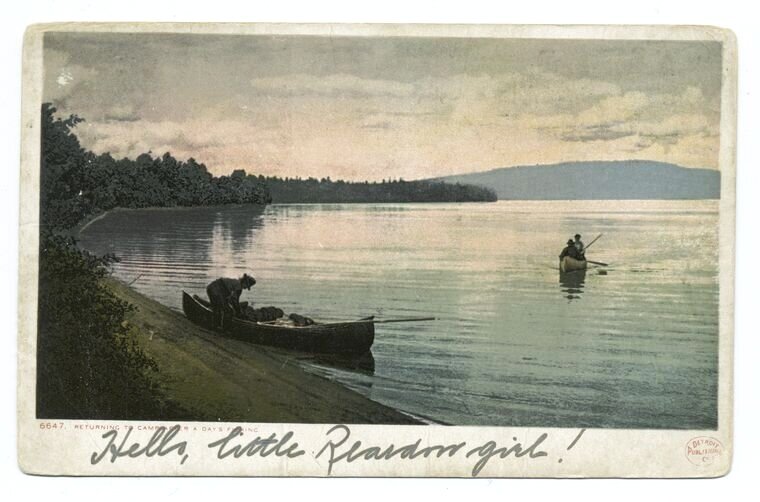
Returning to Camp after a day’s fishing, Maine. Photograph courtesy The Miriam and Ira D. Wallach Division of Art, Prints and Photographs: Photography Collection, The New York Public Library. (1898 - 1931).
All Ways of Remembering
TAKING CARE OF TRAVEL MEMORIES
“There’s no wrong way to scrapbook, and there needn’t be any rhyme or reason, aside from what resonates with you. Whether the order is chronological or geographical, the captions hyper-specific or non-existent, the finished product is unavoidably sentimental, a reflection of the way you lived while walking (or biking, or dog-sledding) out into the world.”
BIRTHDAY LOVE
When you want to cap off a milestone birthday party with a most meaningful gift, consider an heirloom birthday tribute book oozing with love and memories. Why tribute books are so popular right now.
A COLORFUL APPROACH
An illustrated map “can be a beautiful and highly personal reflection of a place you, friends and family know quite well. It can tell a story, a personal history, or be a unique lens through which one can experience a special place.”
DISPATCHES FROM THE BASEMENT
“Dad, I just want to say, thank you for helping get rid of this virus.” In this remote video, a son thanks his father, a doctor who has been isolating from his wife and four children to shield them from exposure to Covid-19:
Write It Out
WRITING YOUR HISTORY IN REAL TIME
“Sure, today’s youth may know that Jackie Robinson was the first African American to play in the MLB. But did they know that their grandfather got a black eye from a schoolyard fight when a classmate argued that ‘[African Americans] shouldn’t play baseball?’ That makes it real.” Virginia–based personal historian Karen Bender makes a case for keeping a Covid diary.
AN OLDIE BUT A GOODIE
“This is a simply stunning interview of Mary Karr from 2009,” Tim Ferriss writes. “I’ve read it multiple times, highlighted nearly every page, and saved my scans to Evernote. That’s how much goodness I think it contains. It’s also laugh-out-loud funny.”
PATCHWORK
“I wrote most of the essays as individual pieces so then it was the work of figuring out how they spoke to one another. I wanted to be aware of overlaps and gaps in the memoir arc, the narrative and consciously choose how I addressed them.” Sejal Shah on giving shape to her essay collection.
...and a Few More Links
How will we remember the pandemic? Museums are already deciding.
Anthony Bailey, memoirist and biographer of artists, died at 87.
Escape to the past with stories of NYC of old—including, perhaps, your own.
Michigan–based video biographers think now, “in the time of coronavirus,” is the perfect time to preserve your stories.
Short Takes
Dawn Roode’s curated roundup for the week of Sept. 23, 2026, is overflowing with recent reads on memoir, life story writing, and family history preservation.