
Memories Matter
Featured blog Posts

READ THE LATEST POSTS

Life Story Links: May 31, 2022
This week's roundup by personal historian Dawn Roode includes inspiring first person reads, memoir news, and pieces on the intersection of life and story.
“We listen with different ears when we can feel and believe that a story is true.”
—Editors at The Moth
Vintage postcard depicting sea bathers in Avalon, Santa Catalina, California, circa 1903. Courtesy of the Miriam and Ira D. Wallach Division of Art, Prints and Photographs: Photography Collection, The New York Public Library Digital Collection.
Our Lives, Our Stories
THIS IS YOUR LIFE
“Suddenly, ordinary lives are of note,” The Guardian reports in this look at the growing personal history industry; moreover, “the way we tell stories of our lives can shape our memories.”
A STORY, DISTILLED
“Memoir writers tell what happened, what we feel about it, and what we learned. We hope our lessons are universal. We must always look beyond events to the layers below.” Lessons from revising a 100-word mini-memoir for The New York Times.
WHERE’S MOM?
Too often these days moms aren’t represented in family photos, leaving a regrettable gap. Mali Bain, a personal historian in Canada, shares a recent life story book that put one grandmother “center stage, as many mothers and grandmothers are in our own childhood memories.”
TWO STORYTELLERS, IN CONVERSATION
“Our memories are anything but fixed—and when stories are passed down to a new generation, their malleability, their meaning, and their impact change, too”: One of my favorite interviews I’ve conducted to date, with memoirist and podcast host Rachael Cerrotti.
Asking the Questions
AN AUDITORY SNIPPET OF LIFE
“As a journalist, I have spent many hours in front of other people’s grandparents recording their stories for work. Usually the offspring are there with me and express a fascination at all the previously untold and hidden stories that come tumbling out of their elders when the right questions are asked. This was the first time I had recorded my own.”
INTERVIEWER EXTRAORDINAIRE
Terry Gross, host of NPR’s Fresh Air, “has perfected a singular kind of interview; she is part conversationalist, part therapist, and part oral historian…. Above all, she is a great listener—attentive, probing, without ever feeling intrusive”:
Memoir Morsels
TASTY READS
Cookbooks are becoming more memoir-like. These hybrid books bring readers “on an emotional journey. Then they get to leave with a recipe and actually eat the food; that’s a really intense, intimate connection between reader and writer.”
NEW MICHAEL CIMINO BIOGRAPHY
“Every biography could be two books rather than one—the work itself and the nonfiction making-of detailing the journalistic adventures that yield the biographical record.” A look at a new biography of the director of The Deer Hunter and Heaven’s Gate.
First Person Reads to Inspire
A FLASH ESSAY FOR MEMORIAL DAY
“The world was sleeping, we were deploying, ocean-crossing.” With staccato pacing and gut-punching language, Laura Joyce-Hubbard writes about serving her country: “We were always leaving.”
FINDING LOVE (BY ACCIDENT)
“My very first date with Produce Man landed on the second anniversary of my father’s death. I took this as a sign that my father had sent him from the heavens and it was bashert, the Jewish term for ‘destiny.’”
Stuff, Stories, History
“ACCUMULATION OF LIFE”
“If it was just junk, it would not be so hard. But possessions have meaning; they tell stories and reinforce our memories.” A look at the “emotional challenge to dealing with the treasure and trash that your parents leave behind.”
A HOUSE’S HISTORY, REDISCOVERED
Leslie Stahl turns the 60 Minutes lens on the story of how an Air Force veteran discovered his new house was the seat of a plantation where his ancestors were enslaved. Plus, the original article that inspired her piece: “An old Virginia plantation, a new owner and a family legacy unveiled.”
SAYING SORRY WITH DUMPLINGS
Salt Lake City–based personal historian Rhonda Lauritzen was close to her brother growing up. “Then we weren’t,“ she writes. “I made mistakes, caused some deep hurts, and I never really said the words I’m sorry. So I said the words.” And cooked Grandma’s dumplings.
...and a few more links
He co-founded Covid Stories Archive to combat what he saw as biases and limitations of Congress’s proposed COVID-19 American History Project Act.
Preserve your memories with these easy scrapbooking ideas.
In his latest email newsletter Tucson–based video biographer Steve Pender looks at using Zoom for legacy audio recordings.
Legacy: In Memory of Roger Angell, 1920-2022
Short Takes

Life Story Links: June 30, 2020
Lots about letters (the old-fashioned kind—handwritten & stamped), plus the future of family history, communicating with our elders, and mini first-person reads.
“To acknowledge our ancestors means we are aware that we did not make ourselves…We remember them because it is an easy thing to forget: that we are not the first to suffer, rebel, fight, love, and die.”
—Alice Walker

Vintage postcard of a beach scene of the past (social distancing was clearly not SOP of the day!). “Beach Scene Along Woodland Beach, Staten Island, N.Y.” Courtesy Irma and Paul Milstein Division of United States History, Local History and Genealogy, The New York Public Library.
Our Lives, Our Stories
WHAT TESTIMONY CARRIES
“There were these families around the world where my grandmother’s survival had essentially become folklore in their families, the way that her survival had become folklore in my life,” says Rachael Cerrotti, co-producer of the arresting podcast We Share the Same Sky, in this exploration of “The Power of Testimony in a Digital Age” from USC Shoah Foundation.
OUT OF THE CLOSET
Hey memories—come out, come out, wherever you are! Last week I wrote about how to use family photos, heirlooms, and the "stuff" of your past to elicit memories and chronicle the stories of your life.
GENEALOGICAL TREASURE TROVE
“A funeral is, among many highly emotional things, an opportunity to consecrate someone’s life as historical fact, and to commit that truth to the public record.” A new archive digitizes more than a century of Black American funeral programs, including lives lived from before the Civil War to today.
“INDEPENDENT LIVING”
“On March 15, the assisted living facility where my mother lives went into lockdown to attempt to prevent the spread of Covid-19,” writes personal historian Sarah White, who describes herself as a member of a cohort of daughters who are lifelines to the world for these elders. “For nearly everyone, that lifeline was severed that day in March. I am still allowed in: What I see is breaking my heart.”
THE FUTURE OF FAMILY HISTORY
From an article in the latest issue of the New York Researcher: “A fundamental shift from collecting names and dates to gathering stories over the past decade appears to be here to stay…” Indeed.
In Letters
THE AGE OF PROPER CORRESPONDENCE
“Each day when the mail carrier arrives, I find myself longing for a surprise letter—a big, juicy one,” Dwight Garner writes. “I do trade big, juicy emails with some people in my life, but receiving them isn’t quite the same as slitting open a letter, taking it to a big chair and settling in for the 20 minutes it takes to devour it.”
“I THOUGHT I KNEW THEM”
How much does anyone ever know about the experiences that shaped our parents? As Nancy Barnes rummages through letters her parents wrote to one another in the earliest years of their courtship, she ponders this. “My mother’s handwriting is bold and loopy, almost wild—quite unlike the neat orderly hand I knew all my life.”
AN ENCHANTING ENCOUNTER
“Sometimes I take out your letters & verses, dear friend, and...rejoice in the rare sparkles of light,” Thomas Wentworth Higginson wrote to Emily Dickinson. This book excerpt captures their first face-to-face meeting after eight years of letter writing.
...and a Few More Links
Australian storytelling project helps participants re-imagine their past and invent new ways to see their stories.
Personal Historians NW group has recorded an estimated 500 “slices of life” among them.
Short Takes

Life Story Links: June 2, 2020
Unique memory preservation methods including illustrated maps, birthday tributes & travel scrapbooks; plus memoir writing now, and a vintage Mary Karr interview.
“The people we most love do become a physical part of us, ingrained in our synapses, in the pathways where memories are created.”
—Meghan O’Rourke
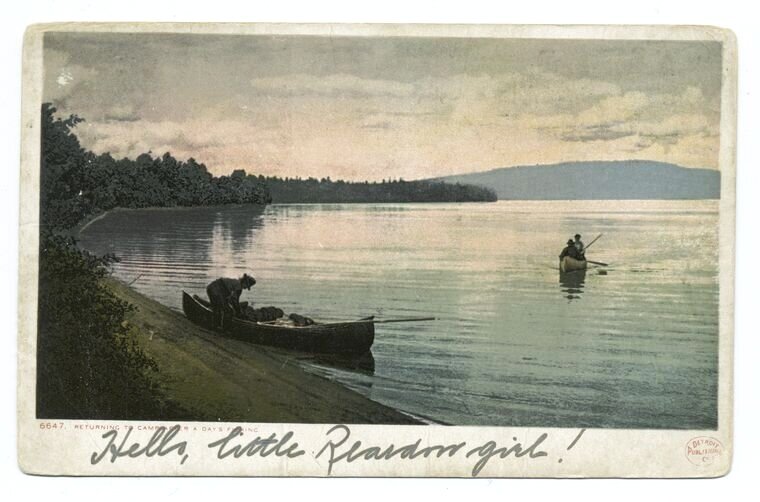
Returning to Camp after a day’s fishing, Maine. Photograph courtesy The Miriam and Ira D. Wallach Division of Art, Prints and Photographs: Photography Collection, The New York Public Library. (1898 - 1931).
All Ways of Remembering
TAKING CARE OF TRAVEL MEMORIES
“There’s no wrong way to scrapbook, and there needn’t be any rhyme or reason, aside from what resonates with you. Whether the order is chronological or geographical, the captions hyper-specific or non-existent, the finished product is unavoidably sentimental, a reflection of the way you lived while walking (or biking, or dog-sledding) out into the world.”
BIRTHDAY LOVE
When you want to cap off a milestone birthday party with a most meaningful gift, consider an heirloom birthday tribute book oozing with love and memories. Why tribute books are so popular right now.
A COLORFUL APPROACH
An illustrated map “can be a beautiful and highly personal reflection of a place you, friends and family know quite well. It can tell a story, a personal history, or be a unique lens through which one can experience a special place.”
DISPATCHES FROM THE BASEMENT
“Dad, I just want to say, thank you for helping get rid of this virus.” In this remote video, a son thanks his father, a doctor who has been isolating from his wife and four children to shield them from exposure to Covid-19:
Write It Out
WRITING YOUR HISTORY IN REAL TIME
“Sure, today’s youth may know that Jackie Robinson was the first African American to play in the MLB. But did they know that their grandfather got a black eye from a schoolyard fight when a classmate argued that ‘[African Americans] shouldn’t play baseball?’ That makes it real.” Virginia–based personal historian Karen Bender makes a case for keeping a Covid diary.
AN OLDIE BUT A GOODIE
“This is a simply stunning interview of Mary Karr from 2009,” Tim Ferriss writes. “I’ve read it multiple times, highlighted nearly every page, and saved my scans to Evernote. That’s how much goodness I think it contains. It’s also laugh-out-loud funny.”
PATCHWORK
“I wrote most of the essays as individual pieces so then it was the work of figuring out how they spoke to one another. I wanted to be aware of overlaps and gaps in the memoir arc, the narrative and consciously choose how I addressed them.” Sejal Shah on giving shape to her essay collection.
...and a Few More Links
How will we remember the pandemic? Museums are already deciding.
Anthony Bailey, memoirist and biographer of artists, died at 87.
Escape to the past with stories of NYC of old—including, perhaps, your own.
Michigan–based video biographers think now, “in the time of coronavirus,” is the perfect time to preserve your stories.
Short Takes

Life Story Links: February 4, 2020
A wealth of good reading on topics including Holocaust remembrance, telling our own stories, and bearing witness to the stories of others.
“Tell your story. Take the data of your life and turn it into real people doing real things and you will move mountains. You will change the world.”
—Dave Lieber

Camp buddies, Christmas Seals Camp, Haverstraw, New York, January 1, 1943. Photograph by Gordon Parks, courtesy Library of Congress.
Bearing Witness to Stories of Others
THE FINE ART OF LISTENING
“Good listeners ask good questions. One of the most valuable lessons I’ve learned as a journalist is that anyone can be interesting if you ask the right questions.” Kate Murphy, author of You’re Not Listening: What You’re Missing and Why It Matters, on how to talk less and listen more.
CREATING A NARRATIVE IDENTITY
“When the future is running out, can we make more of the past? I often struggle with my role as a caregiver for patients at the end of life. I know the most healing things I can offer aren’t the things I usually do,” writes Dhruv Khullar, M.D., M.P.P. in this thoughtful piece. What are those healing things? “To sit. To listen. To explore what it’s all meant.”
FULL CIRCLE
A son’s photographic journey through Alzheimer’s with his dad results in a grant with which he plans to create a book. What’s up next inspires me just as much: “He has begun making appointments with his mother, who is living in his childhood home, to photograph her…. She plays Mahjong, goes to the grocery store, keeps busy. She is full of life. And he wants to be there with her, documenting it.”
FIGHTING FOR THE ANONYMOUS
“It hurt like hell to hold her story. It hurts like hell to tell it. It would hurt a thousand times worse than hell if I hadn’t stopped to hear it. We are to blame when we do not memorialize the living,” writes Beth Kephart in this “memoirist’s chant.”
Telling Our Own Stories
SEALED WITH LOVE
“A different human wrote to the 24-year-old me than the one who wrote to the 44-year-old, but there are aspects of her in these later ages,” writes Ann Napolitano, a novelist who writes to her future self every ten years. “One of the lessons in these letters is that our lives have chapters—I just happen to have an envelope to mark each of mine.”
NO EXCUSES
For anyone intimidated by the idea of writing their life story, here are four specific tactics to write their way in, one memory at a time, and finally get that memoir started.
PICTURES HOLD STORIES
“Photos will spark your memory much better...if a small number of them are curated into an album. This more manageable collection of photos will increase the chances you’ll engage with them on a meaningful basis later on.”
Voices of the Holocaust
January 27, 2020, was International Holocaust Remembrance Day, and many media outlets helped to remember and honor the six million Jewish victims and millions of other victims of the Holocaust. A handful follow.
NEVER FORGET
Edith Fox sometimes told friends she wanted the words “Holocaust Survivor” on her tombstone. But she didn’t want to talk about what she had endured. It was simply too painful. Until her health recently began to fail and she decided, at age 90, that she didn’t want her story to die with her.
“LETTER FROM AN UNKNOWN WOMAN”
In an excerpt from A Bookshop in Berlin: The Rediscovered Memoir of One Woman’s Harrowing Escape from the Nazis, Patrick Modiano introduces us to the sweeping journey of Françoise Frenkel's No Place to Lay One’s Head, which Modiano opines belongs in the company of literary giants.
FACES, LIVES
Survivors: Faces of Life After the Holocaust is a photo portfolio by Martin Schoeller, who “felt that it was his professional and personal responsibility to not only reflect on and learn from the Holocaust, but to help memorialize it” with these unflinching portraits of survivors.
IN THEIR OWN WORDS
Echoes of Memory is an ongoing collection of survivor reflections and testimonies from the United States Holocaust Memorial Museum. The remembrances are varied and poignant, well worth reading—and sharing.
...and a Few More Links
Renovated museum celebrates New Orleans' Italian history; Sicilian visitors can also learn about their own personal history.
Using cutting edge technology to recover an audio treasure
Maia Fischler of Life Writer Personal Histories in Oregon celebrates a recent autobiography completion.
Residents of a senior living community in Minnesota have released their third book of personal histories, Distinctly I Remember: More Stories We Love to Tell.
Tips on archival preservation of your papers and mementos
How Phillip Lim learned to cook by following his nose back to the fragrant dishes of his childhood.
Helping young kids create a grandparent journal
Short Takes

Life Story Links: May 14, 2019
A wealth of reading on the enduring power of family stories and the elusiveness of memories, plus recommended first-person reads and memoir writing prompts.
“Our mothers are our first homes, and that’s why we’re always trying to return to them.”
—Michele Filgate

In Honor of Mother’s Day
REMEMBRANCE OF SOUPS PAST
“Maybe, decades from now, my own kids will uncover a cookbook from long ago, turn to a yellowed page and a recipe for soup that they’ll remember from childhood,” John McMurtrie writes upon finding his mother in the pages of her favorite cookbook.
THIS BOY’S LIFE
“Even allowing for the vagaries of memory, for the various ways different people may interpret the same event, it doesn’t follow that the stories we tell from our experience are not to be trusted simply because they are personal.” Tobias Wolff on the iconic memoir he never intended to write.
MOTHERS AND DAUGHTERS
In this excerpt from What My Mother and I Don’t Talk About, writer Lynn Steger Strong revisits, with a fair amount of distance and a little bit of compassion, scenes (and recurring themes) from her relationship with her mom. In the eagerly anticipated new book, 14 other writers also “take the sacred mother-child ideal down from its pedestal and inspect it, dissect it, run tests on it, muck it up a bit.”
WISH YOU WERE HERE, MOM
Mother’s Day can be challenging for those of us who have lost our moms. I find that lingering in our memories can help (and, yes, also hurt). Here, a very personal tribute I wrote in grief, and love.
Then and Now
“AND NOW, I’LL NEVER KNOW”
“[My grandfather] always had the perfect anecdote for any situation at his fingertips,” Samantha Shubert, a NYC–based personal historian writes. And yet, she never asked him about certain aspects of his past, even as he entertained the family with stories well into his eighties.
SENSE MEMORIES
In Part One of an ongoing series on Life Story Vignettes Writing Prompts, I offer five specific exercises for writing about your memories by engaging all your senses.
WHAT WE KEEP
“Knowing that their mother and grandmother had held this very same object, had felt those same edges and that same weight, was part of the experience, enhancing the memory and also adding another layer to the emotional connection,” subjects told author Bill Shapiro of their most meaningful objects.
MEMORY LANE
Accenture is using Artificial Intelligence to combat elder loneliness and preserve generations of memories in Stockholm. Listen to a few conversations captured through the project, dubbed Memory Lane, and explore why the company took on such an important challenge.
Picture This
SECOND TIME’S THE CHARM
About 10 years ago video biographer Stefani Elkort Twyford, owner of Legacy Multimedia in Houston, scanned her parents’ large photo collection. Now she is taking on a re-do of the project, using her accumulated knowledge about genealogy and digital preservation to get it right—and is discovering some nice surprises along the way.
A PAST NOT OUR OWN
In “How Eudora Welty’s Photography Captured My Grandmother’s History,” Natasha Trethewey finds context and inspiration. “Welty’s photographs were, for me, a resource, a way to see a time and place I’d only encountered in history books and my grandmother’s stories.”
ONE PHOTOGRAPH
History of Memory, a brand collaboration with HP and a winner at the 2019 Tribeca Film Festival’s X Awards, is a series of short episodes that hone in on the power of photographs to move people—and even change lives. See a preview here:
Holocaust Remembrance
SURVIVOR STORIES EVER-RELEVANT
“As survivors become endangered, and their flames extinguish, they rely on the next generation to not only light new candles, but to bear witness—both for the dead and the living.”
“GATHERING THE FRAGMENTS”
"It's a small testimony to what happened, another drop in this sea of testimony. It doesn't uncover anything new. The facts are known. What happened happened, and this is another small proof of it." As the number of Holocaust survivors dwindles, Israel preserves their memories.
Recommended First-Person Reads
SELECTIVE MEMORY
“How can I blame them for choosing to forget in order to survive? And how can I not think about what may happen as a result—future generations, grasping in the dark for their own histories?” Victoria Huynh seeks the stories of her refugee family.
A MOST PERSONAL PERSONAL HISTORY
“Helping my aunt write her memoir, I realized that her story was my story, also,” Massachusetts–based personal historian Nancy West writes. “We are related by blood and DNA and history, and as she told me about her forebears, I saw my own backstory filling in with details I’d never known.”
BRIEF YET MIGHTY
Two distinctly divine pieces from the latest issue of Brevity that illustrate the power of concise, vivid writing from life: “A Legacy of Falling,” by Jenny Apostol, and “My One, My Only,” by Michaella A. Thornton.
...and a Few More Links
All the Way: Joe Namath memoir “as exciting as it is personal”
The StoryCorps podcast is back next week with a new season of stories.
Adam Gopnik on the new biography of Theodor Geisel, Becoming Dr. Seuss
In China, a podcast inspired by ‘This American Life’ showcases stories of everyday life.
Short Takes

Life Story Links: April 30, 2019
Ways in which the past is ever-present, artifacts made accessible, writing from our lives, the power of personal narrative in medicine, and new memoirs of note.
“No legacy is so rich as honesty.”
—William Shakespeare

Ruth Reichl as a young girl with her mother in the photograph that graced the cover of her 2009 memoir, Not Becoming My Mother: And Other Things She Taught Me Along the Way; Reichl has a new memoir, Save Me the Plums, out this month.
The Ever-Present Past
FACEBOOK’S DIGITAL MEMORIALS
Facebook is no longer just a social network; it’s also a scrapbook. “When users die, they may leave behind accounts containing over a decade of memories, and they might not have specified how they want that archive to be maintained,” Wired reports on the platform’s latest rollout of features for legacy contacts.
A WITCHY LEGACY
“I would never truly know my father or my Polish family, but I could know our homeland, its history.” How Michelle Tea found a spiritual home in her Polish heritage.
ON GRIEF, MEMORY, AND TIME
“When your beloved dies, your memory is at risk. Your past no longer fits your story of who you are,” Matthew Salesses writes. “To remember is not to time-travel; it is to alter how time feels.”
A STORYKEEPING MILESTONE
“Clinton Haby, founder of San Antonio–based StoryKeeping, celebrated a decade in business with a party filled with appreciative clients and likeminded family storytellers. “When you say ‘it’s been ten years’ I don’t believe it, but when I look at the [video] equipment I’m using and the productions I’m working on today I recognize it took a decade to get here,” Haby says. Congratulations, and cheers to the next 10 years!
Memoirs of Note
SAVE ME THE PLUMS
I was as eager to read the new memoir of everyone’s favorite foodie, Ruth Reichl, as much for the inside dish on Condé Nast (where I worked in the late nineties at the same time as Reichl) as for again encountering the author’s poignant and deliciously charming voice. (I brought Save Me the Plums along on vacation and devoured it on one trans-Atlantic flight.)
HER VERSION OF EVENTS
How do you write a memoir when you can’t remember? This conversation between ghostwriter Anna Wharton and Wendy Mitchell, subject of their jointly written memoir Somebody I Used to Know, ranges from using WhatsApp to communicate about the book to waiting for the fog of dementia to clear so their process could proceed.
AUTOBIOGRAPHY OF AN ENSLAVED MUSLIM
Omar Ibn Said was 37 years old when he was taken from his West African home and transported to Charleston, South Carolina, as a slave in the 1800s. His one-of-a-kind autobiographical manuscript has been translated from its original Arabic and housed at the Library of Congress, where it is challenging the American narrative:
Writing from Our Lives
PHOTOS AS WRITING PROMPTS
Family photos can be useful tools to jog memories and call forth stories. In a recent post I share six tips for determining which images will elicit the best family stories.
LOVED IN THE TRANSLATION
In just 15 lines Marie A. Mennuto-Rovello shows us how love and memories and setting can come alive through poetry (not all life story writing need be narrative!).
A LIFE MOSAIC
How the best life story vignettes are powerful ways to capture your past, and why writing short narrative pieces from your memories is an effective way to begin your memoir.
PROJECT PACE
When Massachusetts–based Nancy West isn't writing memoirs she is a journalist for a daily paper: “Tight deadlines and fast turnarounds are in my professional DNA,” she says. But sometimes her personal history clients need more time—so she is “learning to be patient with the process.”
BEHIND-THE-SCENES PEEK
Lisa O’Reilly says that finishing a book about her dad was her greatest accomplishment. “My whole life, he’s been the king of my world and now I can let everyone know why,” the California–based personal historian writes.“That makes it a precious gift to myself, as well as to him.”
Artifacts Made Accessible
FROM A VINTAGE VARSITY JACKET TO AN 1876 DIARY
Unless you live in Plano, Texas, knowing that the Genealogy Center at Haggard Library houses, behind lock and key, thousands of newspaper clippings, pieces of ephemera, and amazing historical and personal artifacts likely wouldn’t interest you. But I, an East Coast girl, was fascinated by the breadth of their collection, and find inspiration in the fact that this local team has, over the last 18 years, digitally preserved more than 30 thousand archives for the public to access!
DIGITAL AGE DIARY
“Being present in the moment doesn't mean I can't ever capture the moment,” Daryl Austin writes in this defense of using Instagram for “photo-journaling” his family’s daily lives. “Captions turn pictures into stories” and, he says, help you remember why a memory was worth safeguarding in the first place.
From Left Field, Perhaps?
A DOCTOR’S EDUCATION
I have written before about narrative medicine, and in this brief piece I was newly reminded of the power of personal story—of listening, of being attuned to someone—in a caregiving setting.
MAKING CONNECTIONS
When Maria Popova discovers books that her great-grandfather had annotated, “it was this sort of intellectual dance with another mind that you could see in the margins of his books,” she tells Krista Tippett on the On Being podcast. Popova’s Brain Pickings website is a treasure trove of interconnected themes and literary gems; she calls it “a record of my becoming who I am.”
...and a Few More Links
Rachel Howard names five great writer biographies.
Connecticut author publishes personal story of the Holocaust and its aftermath.
Is your smartphone already organizing your unwieldy digital photo collection?
An “intensely charming, a tinge eerie, and deliciously nostalgic” repurposing of old family photos
Prince’s memoir, due in August, will include handwritten song lyrics and portions of his own scrapbook.
Spotlight on Naperville, IL, digital preservation business Memory Keepers
Four hassle-free ways to get your Google Photos memories in order
“Surfing My DNA,” a live one-woman show in New Jersey, explores a unique family history.
Short Takes
Dawn Roode’s curated roundup for the week of Sept. 23, 2026, is overflowing with recent reads on memoir, life story writing, and family history preservation.