
Memories Matter
Featured blog Posts

READ THE LATEST POSTS
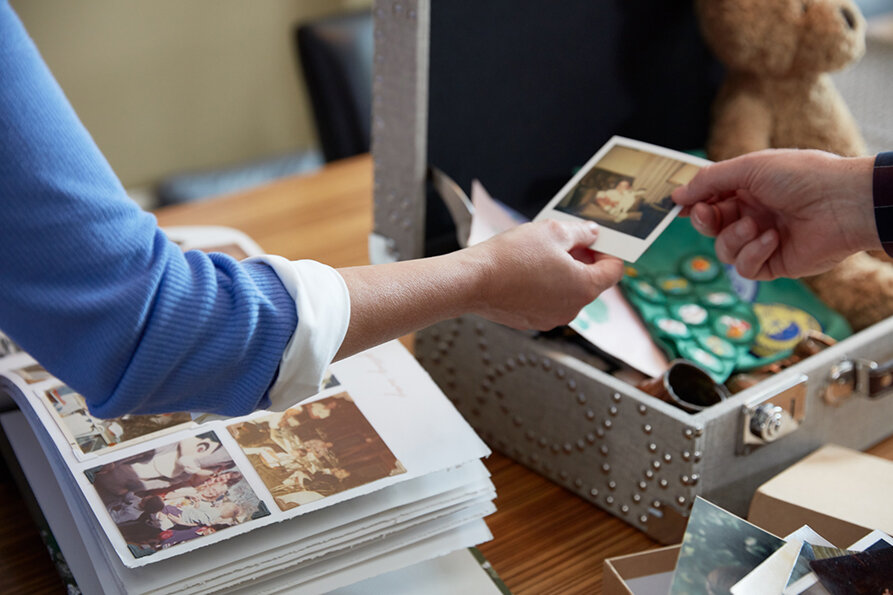
Hey, memories! Come out of the closet, will you?
Your memories live in your head and heart, but family photos, heirlooms & mementos sure do call those memories forth—how to use them towards a life story book.

Sorting through your family archive for items for your life story book should be more strategic than organizing everything for posterity.
One of the first steps in any life story project is to begin to gather all the stuff in your family archive.
By that I mean photos, journals, letters, and mementos—the stuff of your life.
Finding and inventorying these items will help you in two ways:
as a tool for helping you prioritize and determine what is worth saving and what can be tossed—and how to plan for tackling the archive as a (separate) organization and preservation project.
as a resource for finding those items that will help tell your stories visually for your life story book project.
That second one is what we are focused on here!
How to organize your family archive as a resource for your life story book
Ready to get started? Using this free chart or a digital spreadsheet, make a list of everywhere your items live.
Remember: This is a guide to preparing your archive specifically as a resource for your life story book! That means yes, you should be focused on items that you want to include visually in your book, but also items that simply spark memories.
What is included in your family archive?
A Family Archive Checklist
physical family photos in boxes, albums, and frames
digital family photos on phones, computers, old disks, social media accounts, and external hard drives
family papers, including genealogy documentation, birth and death certificates, etc.
letters, journals, and diaries
mementos such as ticket stubs, postcards, report cards, scrapbook ephemera
physical family heirlooms such as inherited china, heritage furniture, passed-down jewelry
Finding inspiration and raw material
Back to using your archive as a reference for your life story book: Consider all of the items in your family archive to be raw materials that you can both find inspiration in and use to help tell your stories. A few ways to mine your family archive for this project:
Resources for remembering
Use specific family photos to jog your memories about your childhood.
Use letters and journals to help you recall details and emotions of recorded experiences.
Pull out tickets stubs and other mementos that hold the most meaning and make you feel something strong—they’ll likely be fodder for compelling stories if they hold that much sway.
Consider your genealogical files to be fact-checking resources for names, dates, and relationships that may be fuzzy in your memory.
Materials to reproduce in your book
Photograph family heirlooms so they can be accompanied by their stories in your book, so years from now they won’t be some dusty relics but heirlooms with a storied pedigree.
Select key old photos to digitize for inclusion in your book: Pictures help bring your words to life, but they must be chosen wisely.
Perhaps your handwritten journals evoke your teen years or capture a particularly emotional period in your life: Consider reproducing a key page or paragraphs throughout your book if you think they will add texture and a visual touchstone.
At this point, you should be most concerned with identifying and locating those items that you feel will be most useful to you in your life story project. Make a separate list, and pull out those materials to have on hand. Consider this a separate collection specifically gathered to help you tell your life story.
“When you have finished your appraisal, you’ll be left with a collection of the best and most significant artifacts,” archivist Margot Note writes. “Because you’ll be focusing on the collections that have the most value, you’ll be able to concentrate your efforts on what is most meaningful to you.” Indeed.
Keeping your curated archive on hand
Now that you have a tighter collection of photos, journals, and mementos set aside specifically for your life story project, keep them on hand—as well as the bulk of your family archive that you designated in the beginning.
Just because you set aside a photo initially doesn’t mean it will be the best for spurring memories later on; you may end up going back to those boxes to find another shot, or flipping through a different journal to discover a later recollection.
Be gentle with yourself. There’s no “getting it right”—this is a journey of discovery! Try to be strategic and deliberate while sorting your family archive, and understand that it’s all too easy to get lost in memories and nostalgia while trying to organize. When you realize that’s happening, steer yourself back to the task at hand, and remember: All of this is to provide you with the opportunity to reflect purposefully later on.

Printable Inventory Form
Download our free printable to help you keep track of all your life story project’s visual assets, from family photos to ticket stubs and journals—it’s easy-peasy.
Related reading
I will link to parts two and three in this series when they are posted:
You might also be interested in:
Tackling your whole archive?
If you would like to tackle getting your archive under control, I highly recommend purchasing archivist Margot Note’s book Creating Family Archives: A Step-by-Step Guide to Saving Your Memories for Future Generations. She’ll walk you through how to handle your materials, the best supplies, to buy, and ways to display and share your personal archives. Keep in mind: This is usually a big (and sprawling) project that takes some time to complete, but it is well worth your effort (especially if you have children; as I have written about before, leaving them a mess of family mementos is usually more of a burden than a welcome gift).

Life Story Links: June 11, 2019
Storytelling in unexpected places, piecing together personal WWII histories, plus writing prompts, Scrivener notes, and curating our own legacies.
“I thought everything you wrote had to be about England; nobody ever told me you could write about growing up in Ireland.”
—Frank McCourt
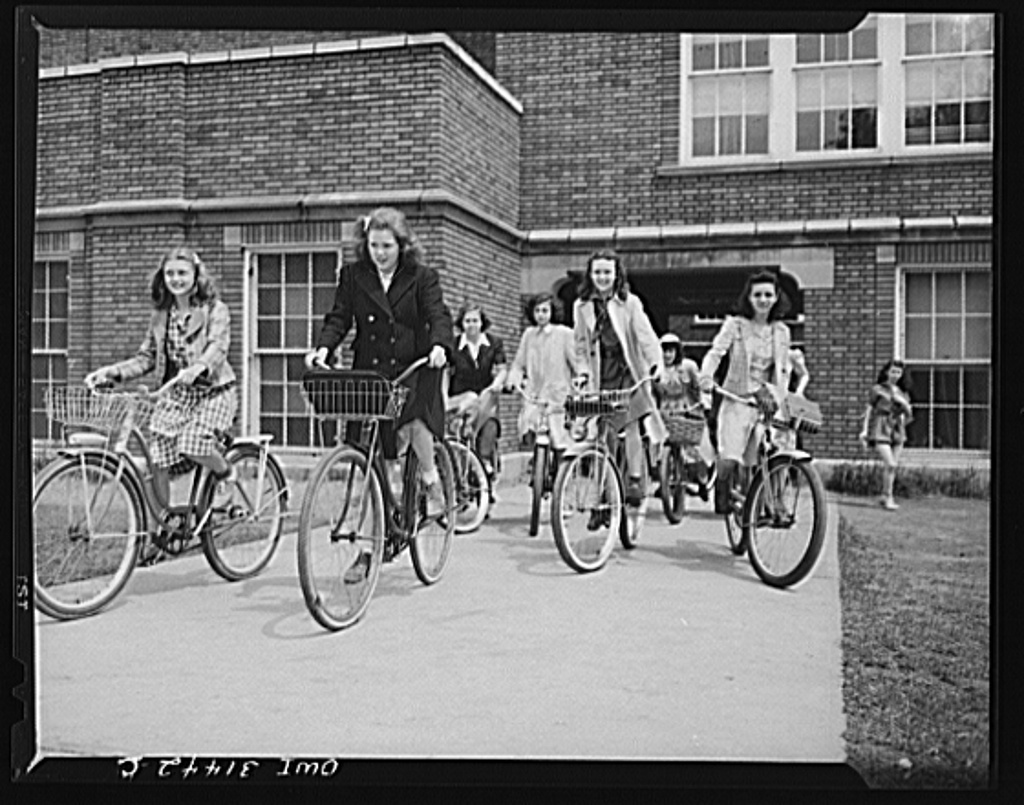
Schenectady, New York, June 1943. Photograph by Philip Bonn, courtesy Library of Congress Prints & Photographs Division.
What We Leave Behind
A MEANINGFUL LEGACY
“It’s easy to leave the house, the car, the money, the boxes of pictures,” Sarasota–based personal historian Curt Werner says. “But it’s much harder to leave pieces of yourself.”
MATTERS OF THE HEART
“I was looking for pictures that had the power to turn bitter memories into sweet. Images that said, ‘I love you more than anything.’ Images that whispered, ‘I can’t express how sorry I am to leave you.’” Mary Bergstrom curates her legacy while decorating a new home.
THE (DIGITAL) PIECES OF A LIFE
“If the only way to preserve her memories was to put together the pieces of her digital life, then we had to hack into her online accounts.” Historian Leslie Berlin recounts her desperation to break into her mother’s phone after she died.
Process of Discovery
A SCRIVENER WORKFLOW
Sarah White, whose First Person Productions is based in Madison, Wisconsin, describes her conversion from an occasional Scrivener user to a devotee who finds it “highly useful in finding the best structure for long-form writing projects.”
THE SELF-INTERVIEW
How interviewing yourself (follow-up questions and all!) can be a useful writing exercise for generating life story vignettes.
FILLING IN THE GAPS OF WWII VETERANS
“Those lauded as the Greatest Generation might just as easily be called the Quietest”—leaving family members to wish they had asked more, and to attempt to recreate their loved ones’ stories through a vast archive of war papers.
ONE FAMILY’S NUCLEAR HISTORY
“Never one to talk directly about his role as a pilot in the Second World War, my grandfather instead told my siblings and I scraps of his story that I would eventually stitch together into an incomplete whole,” Tyler Mills writes.
Storytelling in Unexpected Places
OFF THE CHARTS
“There is research that suggests when caregivers know their patients better, those patients have improved health outcomes.” See how personal storytelling is filling the gaps between patients and staff at VA hospitals.
DEPT. OF STORYTELLING
The city of Detroit has hired a Chief Storyteller. You heard that right—and with a team of storytellers on board, The Neighborhoods has become a platform that shares locals' stories and aims to change the traditional narrative surrounding the place they call home.
...and a Few More Links
Do you have (or need?) a writer’s will?
Some research suggests that events in our lives can affect the development of our children and perhaps even grandchildren.
Unique documentary series follows group of schoolchildren over six decades.
Have you listened to episodes from the new season of the StoryCorps podcast?
D-Day vet bonds with 9-year-old through the magic of music.
If you are interested in learning more about a family member who served in WWII, explore this Research a Veteran Guide.
New York State substitutes for the lost 1890 census
Short Takes


3 unexpected places to discover great life story questions
While there are lots of lists of family history questions on the web, here are 3 places to find unexpected questions that lead to meaningful life story writing.

There are abundant resources online and in libraries for family history questions. You know the kind I mean: checklists of all the possible questions you can ask the grandparents, military veterans, immigrants, distant cousins. One of my recent favorites is the #52Stories project from Family Search, which provides 52 prompts for capturing one brief story about your life every week, hopefully motivating you to begin shaping your family’s intergenerational narrative.
But if you’re in the market for more thought-provoking conversation starters—deeper questions that you can ask relatives or yourself on your journey of documenting your life stories—then we’ve got three unexpected resources for you. The questions included in these recommendations are often provocative, occasionally off the wall, and always open-ended to encourage a full, meaningful answer using the subject’s own experience and feelings.
The Best Questions Yield the Best Answers
If you select questions thoughtfully, you’re sure to get revealing answers. Whether you choose to use those answers to inform writing your own memoir, as episodic stories in a personal history book, or merely as a means of self-development or family bonding, you’re guaranteed to learn something new about yourself in the process!
1 - Gravitas: The Little Box of Big Questions
Gravitas is a powerhouse of thought-provoking questions. This parlor game of sorts engages “players” in conversation with questions that call for reflection yet can be dealt with in a thoughtful or a more lighthearted manner. While the goal of the game is ostensibly to declare a philosopher king of the occasion, the real value in this “Little Box of Big Questions” is to get everyone offering thoughts on life’s big questions as a way of discovering who we really are and how we have lived.

Here is a sampling of the prompts (there are 429 questions in the box), designed to spark meaningful conversation and profound insights.
What takes your breath away?
What is your gold standard for a good friend?
How do you ‘carpe diem’?
Describe the gap between life as you imagined it and life as it is.
How do you practice kindness?
When they say you have to work hard at love, what do they mean?
And a few less profound options to keep the banter flowing—questions that could as easily invite surprising insights and wisdom as they could a punchline:
If we are what we eat, who are you?
When does the fun stop?
What is the best thing you have ever found?
They say that Seinfeld is a TV series about nothing. Any ideas for an episode?
Who would you like to eavesdrop on?
2 - Know Yourself: Cards for Self-Exploration
This small box of 60 prompt cards is less about conversation with others, like the Gravitas questions above, but rather about conversation with oneself. They delve straight into big-picture, deep ideas and often read like prototypical “head shrink” questions—but when approached with an open mind and a truly self-aware lens, these prompts can undoubtedly help us understand ourselves better.
Some of the questions in the Know Yourself box are clearly intended for private introspection, such as “What things would deeply alarm your loved ones if they knew them about you?” and “What are you currently lying to certain people around you about?”

Many of them, though, are wonderful prescriptions for prolonged thought or writing assignments that will yield worthwhile insights:
When do you cry or want to cry (as an adult)?
What did you learn about relationships from your parents?
List everything you are worried about, from the very large to the very small.
And some, well, simply invite interesting answers:
What are you trying to say through your clothes?
If a really kind person wanted to praise me, they’d say… If a really tough person assessed me, they’d say…
Name three works of art (music, literature, and visual art/architecture) that mean a lot to you.
I recommend consulting these questions if you are an aspiring memoirist or avid journaler who wants to be challenged to explore who you are, or just a curious soul craving a gentle nudge towards deeper self-reflection.
The cards are produced by The School of Life, who bills itself as “a global organization dedicated to developing emotional intelligence [applying] psychology, philosophy, and culture to everyday life.” Visit their site for a treasure trove of resources to enlighten and entertain. And if you decide to check out their Confessions Game—“a series of questions around career, sex, money, relationships, family, gently inviting everyone to share important bits of themselves in an intimate and playful atmosphere”—please let me know what you think, particularly if the questions might be helpful for memory-keepers and life story writers, too!
3 - If… (Questions for the Game of Life)
Writing one’s life stories requires not just looking towards the past, but also looking towards the future. It is our hopes and dreams and the life we imagine for ourselves that define us as much as the paths we have already taken—and preserving those thoughts for future generations is a worthwhile endeavor.
“Fantasies are what inspire us all; to work, marry, raise families, create, improve our world…. We imagine in order to learn, to understand, to strive, to attempt, to predict, to avoid, to correct, to describe, to solve,” write the authors of If: (Questions for the Game of Life) (Villard 1995). As you may have guessed, every question in this book begins with the word “if.”

Perhaps some of these questions lean towards the cliché (there are plenty of the if-you-could-dine-with-anyone-from-history variety), but that in no way diminishes from their purpose: to spark your imagination, and to provide glimpses into your personality and life. It is their accessibility, and their ability to make you step outside your everyday worries, that make them worthwhile.
These are a few of the questions that, in my opinion, go beyond the expected and provide impetus for life-story writing or conversation geared toward meaningful reminiscence:
If your plane were about to crash and you had time to write one quick note, to whom would you write, and what would you say?
If you could, in retrospect, change one thing about your childhood, what would it be?
If you could discover that something you thought was true was actually false, what would you wish it to be?
If you could gain total memory of one year of your life so far, which year would you pick?
If is a book that can be tucked away in your car’s glove compartment to make long road trips bearable, or it is a book that can be stashed in your bedside stand for instant journaling inspiration.
And now, some questions for YOU.
What is the one question that you find always elicits interesting stories?
If you could have asked one question of a deceased family member, what would you have asked, and to whom?
What other sources of interesting questions are in your repertoire? Books, websites, podcasts?
Please share your thoughts in the comments below—I’d love to hear from you!
Related Reading:
Who Will Tell Your Life Story? It can be daunting to think of writing (or even telling!) your life story. So don’t. Start saving your stories, one at a time.
35 Questions to Ask to Prompt Memories of a Lost Loved One
How to Use Photographs as Prompts for Writing Life Stories
Dawn Roode’s curated roundup for the week of Sept. 23, 2026, is overflowing with recent reads on memoir, life story writing, and family history preservation.