
Memories Matter
Featured blog Posts


READ THE LATEST POSTS
Life Story Links: June 14, 2022
This week's curated reading list for memory-keepers and family historians includes lots on saving and sharing a family legacy—and why it matters—plus, new memoir.
“He who digs into the past would know that barely a millionth of a second divides the past from the future..”
—Eugenio Montale
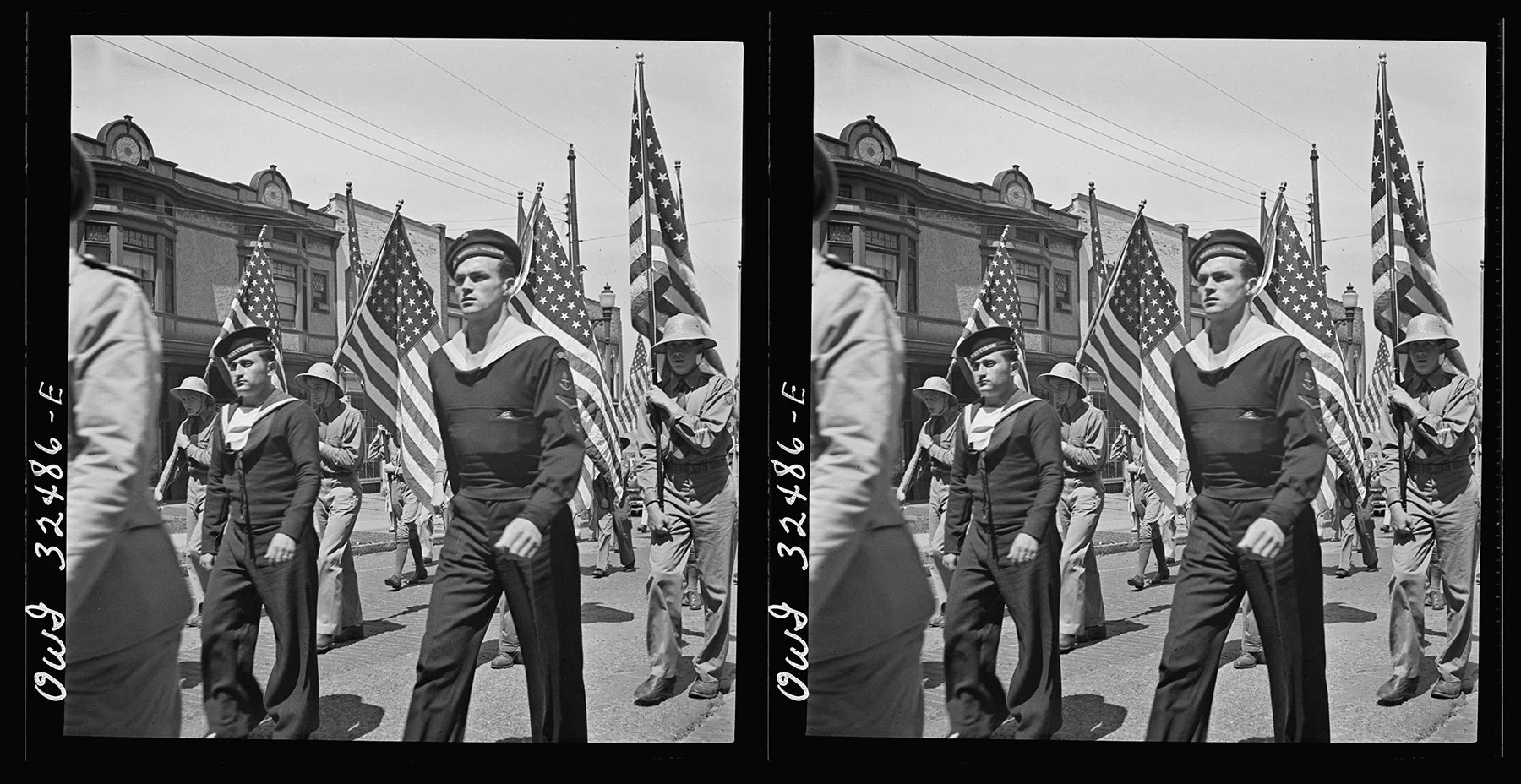
United Nations Heroes marching in the Flag Day parade during United Nations week in Oswego, New York, in June 1943. Photographed by Marjory Collins for the Office of War Information; courtesy of the Library of Congress Prints and Photographs Division Digital Collection.
What we capture
AVOIDABLE REGRETS
Nearly half of Americans in a recent poll regret not recording or documenting conversations with loved ones who have died; and many people (44 percent) wish others would record or document conversations they have to preserve memories.
SO, LET’S START RECORDING!
In light of the above-mentioned poll, I put together some resources to make it easier for anyone to record conversations and gather stories from loved ones—so we can begin to see an upward trend in legacy preservation…and avoid regrets.
Our families, our stories
YOUR STORY, OR THEIRS?
“How do I write about social workers who harmed a child I love? How do I write about her mother? What do I owe them on the page?” Sarah Sentilles wrestles with the notion of writing about others in memoir.
MEMORIES OF THE POGROMS
“Grandma eventually came to learn that the only way I would fall asleep was by listening to the soft sound of her voice as she described in detail her early childhood in Russia.” A childhood interest in stories becomes a lifelong search for legacy—then, a book.
LEARNING TO LIVE WITH GHOSTS
The Korean tradition of jesa, or memorializing ancestors, helped Joseph Han understand that “our loved ones’ memories and histories suffuse our world and continue to shape our lives long after they have departed.”
BEDTIME STORY
“I am speaking to an audience of one, who happens to be the book’s foremost subject, my 74-year-old father, Joe, or Daddy as Northern Irish naming conventions insist he must be addressed.” Séamas O'Reilly on reading his memoir to his father.
WHAT CONTRADICTION?
On the latest episode of Schmaltzy, a podcast that explores the intersection of Jewish identity and food, Hillary Reinsberg shares stories about the distinctly German-Jewish way of doing things at her grandparents’ New York home:
The power of narrative exploration
CONFESSIONAL WRITING, REFINED
“Melissa Febos’s recent essay collection shows us not only how to capture the difficult, intimate details of our lives in writing, but why we should.” Adam Dalva on the necessity of creative confession.
THE STORY WE WRITE FOR OURSELF
“Will you take some chapters from your family’s history and courageously edit and fit them into the vision for your life’s purpose? Will you dare to write completely new chapters based on your true passions and desires?”
NARRATIVE MEDICINE IN PRACTICE
Read an excerpt from The Healing Power of Storytelling: Using Personal Narrative to Navigate Illness, Trauma, and Loss by Annie Brewster with Rachel Zimmerman, and listen to an interview with the author and Here & Now host Robin Young:
SLAVERY’S LEGACY: ORAL HISTORY PROJECT
“This kind of oral history project has never been done before. Many will, for the first time, hear the voices and memories of people whose personal experiences are still inextricably tied to racial slavery, the transatlantic slave trade, and colonialism.”
...and a few more links
New memoir of Chris Blackwell, founder of Island Records, reflects on helping bring the music of Bob Marley, U2 and Grace Jones to the world.
A one-page “Empathy Interview Guide” from Stanford d.School
On the True Stories Well Told blog: “10 Minutes to Death” by Marg Sumner
Short takes


Life Story Links: May 31, 2022
This week's roundup by personal historian Dawn Roode includes inspiring first person reads, memoir news, and pieces on the intersection of life and story.
“We listen with different ears when we can feel and believe that a story is true.”
—Editors at The Moth
Vintage postcard depicting sea bathers in Avalon, Santa Catalina, California, circa 1903. Courtesy of the Miriam and Ira D. Wallach Division of Art, Prints and Photographs: Photography Collection, The New York Public Library Digital Collection.
Our Lives, Our Stories
THIS IS YOUR LIFE
“Suddenly, ordinary lives are of note,” The Guardian reports in this look at the growing personal history industry; moreover, “the way we tell stories of our lives can shape our memories.”
A STORY, DISTILLED
“Memoir writers tell what happened, what we feel about it, and what we learned. We hope our lessons are universal. We must always look beyond events to the layers below.” Lessons from revising a 100-word mini-memoir for The New York Times.
WHERE’S MOM?
Too often these days moms aren’t represented in family photos, leaving a regrettable gap. Mali Bain, a personal historian in Canada, shares a recent life story book that put one grandmother “center stage, as many mothers and grandmothers are in our own childhood memories.”
TWO STORYTELLERS, IN CONVERSATION
“Our memories are anything but fixed—and when stories are passed down to a new generation, their malleability, their meaning, and their impact change, too”: One of my favorite interviews I’ve conducted to date, with memoirist and podcast host Rachael Cerrotti.
Asking the Questions
AN AUDITORY SNIPPET OF LIFE
“As a journalist, I have spent many hours in front of other people’s grandparents recording their stories for work. Usually the offspring are there with me and express a fascination at all the previously untold and hidden stories that come tumbling out of their elders when the right questions are asked. This was the first time I had recorded my own.”
INTERVIEWER EXTRAORDINAIRE
Terry Gross, host of NPR’s Fresh Air, “has perfected a singular kind of interview; she is part conversationalist, part therapist, and part oral historian…. Above all, she is a great listener—attentive, probing, without ever feeling intrusive”:
Memoir Morsels
TASTY READS
Cookbooks are becoming more memoir-like. These hybrid books bring readers “on an emotional journey. Then they get to leave with a recipe and actually eat the food; that’s a really intense, intimate connection between reader and writer.”
NEW MICHAEL CIMINO BIOGRAPHY
“Every biography could be two books rather than one—the work itself and the nonfiction making-of detailing the journalistic adventures that yield the biographical record.” A look at a new biography of the director of The Deer Hunter and Heaven’s Gate.
First Person Reads to Inspire
A FLASH ESSAY FOR MEMORIAL DAY
“The world was sleeping, we were deploying, ocean-crossing.” With staccato pacing and gut-punching language, Laura Joyce-Hubbard writes about serving her country: “We were always leaving.”
FINDING LOVE (BY ACCIDENT)
“My very first date with Produce Man landed on the second anniversary of my father’s death. I took this as a sign that my father had sent him from the heavens and it was bashert, the Jewish term for ‘destiny.’”
Stuff, Stories, History
“ACCUMULATION OF LIFE”
“If it was just junk, it would not be so hard. But possessions have meaning; they tell stories and reinforce our memories.” A look at the “emotional challenge to dealing with the treasure and trash that your parents leave behind.”
A HOUSE’S HISTORY, REDISCOVERED
Leslie Stahl turns the 60 Minutes lens on the story of how an Air Force veteran discovered his new house was the seat of a plantation where his ancestors were enslaved. Plus, the original article that inspired her piece: “An old Virginia plantation, a new owner and a family legacy unveiled.”
SAYING SORRY WITH DUMPLINGS
Salt Lake City–based personal historian Rhonda Lauritzen was close to her brother growing up. “Then we weren’t,“ she writes. “I made mistakes, caused some deep hurts, and I never really said the words I’m sorry. So I said the words.” And cooked Grandma’s dumplings.
...and a few more links
He co-founded Covid Stories Archive to combat what he saw as biases and limitations of Congress’s proposed COVID-19 American History Project Act.
Preserve your memories with these easy scrapbooking ideas.
In his latest email newsletter Tucson–based video biographer Steve Pender looks at using Zoom for legacy audio recordings.
Legacy: In Memory of Roger Angell, 1920-2022
Short Takes

Life Story Links: May 17, 2022
For memoirists: Writing tips and inspiring first-person reads. For family historians: heirloom books themes and photo stories. This week's curated reading list.
“…writing has become for me a primary means of digesting and integrating my experiences and thereby reducing the pains of living, or if not, at least making them useful to myself and to others. There is no pain in my life that has not been given value by the alchemy of creative attention.”
—Melissa Febos
This vintage photo of boys on a tricycle in New York City was taken by Morris Huberland circa 1950. Photograph courtesy of The Miriam and Ira D. Wallach Division of Art, Prints, and Photographs, New York Public Library Digital Collection.
Preserving our stories
OUT IN NOVEMBER
Bono reads an excerpt from his memoir Surrender: 40 Songs, One Story, due to be published in November. An animation from Bono’s own drawings accompanies his words from the chapter titled “Out of Control,” which tells the story of how Bono began writing U2's first single on his 18th birthday, May 10, 1978:
THE DANCE OF MOTHERHOOD
Stories don’t always have to be told with words. In this gallery, photographers capture their own experiences as mothers through pictures—self-reflective, narratively engaging, and vibrant.
WHICH STORIES TO TELL?
From life story books to a family history collection, from travel journals to heritage cookbooks, last week I offered up 10 favorite heirloom book themes to inspire those who want to preserve their stories but have no idea which stories to focus on.
PHOTOGRAPHIC MEMORIES
Head to “storytelling school” with The Moth: This lesson offers tips and exercises for telling a good story from a photograph, as well as a storytelling video to inspire.
HISTORIAN TURNS FOCUS ON HIMSELF
“An American Childhood…succeeds as memoir by carefully narrating the protagonists’ experiences as they perceived them as children and as teenagers, not filtered through subsequent informed and reasoned understanding. It succeeds as history by gently noting the faultiness of those perceptions.”
TASTY MEMORIES
“I feel like our kids know Nana still, because…they know when we make the chocolate chip cookies from her cookbook, those are Nana’s cookies.” Minneapolis–based company preserves food memories with personalized cookbooks.
Shadow play
GENEALOGY PROBLEMS
“We know that ‘race’ is a social construct. We need to acknowledge the ways in which ‘ancestry’ is, too.” The New Yorker looks at the “twisted roots” of our obsession with ancestry.
HOLDING THE PAIN
“I like to think it is the solemn duty of a writer to record stories that need to be heard, but it has occurred to me over the course of this work that listening and bearing witness to trauma is the duty of all citizens in a community. It’s what connects us.”
First-person stories that captured me
“DEAR MOM…”
“I’ve missed my mom every day, but suddenly the pain of not having her felt acute, a pain that I turned against myself for being a lousy daughter.” Twenty-four years after her mother's death, Liza Deyrmenjian writes a letter to her mom.
“THIEVES”
“I sit, I lie, and memory rises, memory merges. My marooned mother. My marooned self.” Beth Kephart sets up two parallel situations—seeking answers, sleuthing patterns, writing her way to truth
LESSONS FROM HER FATHER
“Growing up, my father took me to libraries the way other fathers took their kids to the park or the movies. It wasn’t just that he loved or appreciated them—he believed in them like some believe in churches, religions, God.”
Pieces of the past
A RECKONING WITH CLUTTER, GRIEF, AND MEMORIES
The New York Times has curated a selection of letters from readers recounting stories of dealing with a lifetime of possessions—their own or a loved one’s—and the memories and emotions attached to them.
THE URGE TO COLLECT
Enjoy this conversation about the urge to collect, the stories embedded in certain objects, and how some items can unearth stories from the person who covets them:
LOOKING BACK
On this episode of Canadian podcast Now or Never, the hosts explore how reading love letters from the 1920s is helping one woman deal with heartache; talk to three siblings digging through the contents of their childhood home; and talk about how pieces of the past can help shape your future. Listen in.
Miscellaneous
INTERESTING THEATER REVIEW
The main character of this Chicago stage production “considers memory to be a kind of photography.” The action of At the Vanishing Point hinges on an old photo discovered at a garage sale, linking characters across time and place.
...and a few more links
How a debut graphic memoir became the most banned book in the country.
Read an excerpt from the new book Anna: The Biography, about Vogue editor (and my former boss) Anna Wintour.
Nostalgic remembrance: old photo brings back memories of Grandma’s pies.
How a Holocaust survivor finally learned her own birth name.
Pandemic sparks autobiography for Delaware State professor.
Ethics considerations for conducting research for your narrative nonfiction among friends
Consider a family history book series to preserve your family heritage.
A best seller in France, Camille Kouchner’s memoir The Familia Grande is an indictment of incest that started a national reckoning.
Personal stories of hardships endured in WWII Japanese internment camps told through augmented reality exhibit in Los Angeles.
Read the newly released Spring 2022 issue of Creative Nonfiction.
Get a free guide from Rachel LaCour Niesen, founder of Save Family Photos: “3 Simple Steps to Backing Up Your Family Photos.”
Short takes

Life Story Links: May 3, 2022
This week's curated reading list is heavy on quality articles to help you tell your stories well plus inspiring first-person reads and interesting legacy takes.
“I am fooling only myself when I say that my mother exists now only in the photographs on my bulletin board or in the outline of my hand or in the armful of memories I still hold tight. She lives on beneath everything I do. Her presence influenced who I was and her absence influences who I am. Our lives are shaped as much by those who leave us as they are by those who stay. Loss is our legacy. Insight is our gift. Memory is our guide.”
—Hope Edelman

On this vintage postcard, horse-drawn carriages idle along Richmond Avenue at Bergen Point Ferry in Staten Island, New York. Image courtesy of the Irma and Paul Milstein Division of United States History, Local History and Genealogy, The New York Public Library Digital Collections.
Your stories, well told
TELL A CAPTIVATING STORY
“Leveling up our storytelling game can lead to more meaningful connections.” Here’s a step-by-step guide on how to tell a story, from an idea to delivery, from the editors of The Moth’s new book, How to Tell a Story:
DOUBLE THE STORIES
While I interview people for their stories regularly as part of my business, a big part of my mission is to inspire and empower families to conduct such interviews themselves. Last week I offered tips for interviewing a couple (your parents, say, or one set of grandparents) together.
TWO TALENTS TRADE INSIGHTS
“I’m not going to share [traumas from my life] for the sake of sharing.... I’m sharing what needs to be shared as part of this story. To do right by the story I’m creating, I’ve got to put in the right ingredients.” Marion Roach Smith interviews Mary Laura Philpott about how to write a memoir in essays. Listen in:
In their own words
“SWEET SPOT”
“I bummed rides home after practice. I bummed clothes, snacks, socks, money for the vending machine, and anything else I needed to survive.” This personal essay from Jennifer Shields transported me with time-specific details and a powerful remembrance of adolescence.
HER SERBIAN GRANDFATHER
“During the Nazi occupation, the Gestapo chose our hotel for their headquarters. I haven’t decided if it’s a sign of disrespect to that past, or a mark of triumph that we’re staying here now.” Julie Brill remembers a childhood interrupted by genocide.
THE DRIVE TO SUCCEED
“It has dawned on me lately that insecurity is one of the biggest killers of art,” Alice Walker wrote in October, 1977. Take a deep dive into her journals with this reflective and engaging piece in The New Yorker.
STILL LIFE
Award-winning writer Jhumpa Lahiri talks about a few of her favorite things, including a book she bought when she was 12 years old and “a road map to how to write” from a university professor.
Beginning, ending
NEW ITALIAN SURNAME CONVENTIONS
“Italy had until now carried “a story of male biographies,’ [one Italian official] said. “The surname is part of one’s identity and personal history, a story that we can now pass on written in the feminine.’”
WHAT IS LEGACY?
“Surveys conducted show that when faced with end-of-life planning, Boomers (and older generations) are more concerned about the loss of their values and personal history than the loss of their wealth,” personal historian Clémence Scouten writes in this pub from the Philadelphia Estate Planning Council (scroll to page 11 for the article).
MEMORY FLASHBACKS OF DYING
A patient whose brain waves were being studied by doctors died suddenly during the recordings; the resulting scientific data may be consistent with our idea that our “life flashes before us” just before death.
Miscellaneous
TESTIMONIES ON THE BLOCKCHAIN
The first Holocaust museum in the metaverse aims to use NFTs to transform survivors’ tragic memories into artistic visual presentations.
COOKING UP THE PAST
A new film premiering June 1 as part of the Tenement Museum’s annual fundraising gala will focus on food traditions, family stories, and local history; virtual attendance is donation-optional. The film, which looks at the American immigrant experience through the lens of food, was inspired by Padma Lakshmi’s visit to the Lower East Side museum, as featured on this episode of Taste the Nation:
...and a few more links
Holocaust survivors ask Israel museum to return one-of-a-kind Haggadah.
The LIFE Picture Collection is launching a non-fungible token (NFT) collection of its legendary photography.
Apple Photos adds “sensitive locations” filter to Memories functionality.
Check out this free hour-long webinar from Creative Nonfiction managing editor, Hattie Fletcher, on writing long-form.
Short Takes
Life Story Links: April 19, 2022
If you're into family history, memoir, and memory-keeping, you'll want to check out this week's list of stories hand-picked by personal historian Dawn Roode.
“As for how to actually organize your memoir, my final advice is, again, think small. Tackle your life in easily manageable chunks. Don’t visualize the finished product, the grand edifice you have vowed to construct. That will only make you anxious.”
—William Zinsser
Vintage black and white photograph of a young girl in Illinois, spring 1962, by Francis Miller for Life magazine, © Time Inc.
History in our homes…
SUGGESTED INTERVIEW QUESTIONS
Mali Bain, a custom publisher in British Columbia, shares ten open-ended questions to ask in a family interview session so you may “naturally follow up on ideas without struggling to find a suitable next question or getting lost in brain fog.”
BEST PRACTICES
Before any family history interviews can begin, there’s a little prep involved. Read how professional oral historians set the stage for effective storytelling and secure saving.
THE FAMILY KNOWLEDGE GAP
A new survey from Ancestry.com found that while more than half (53%) of Americans can’t name all four grandparents, 66 percent of respondents said they want to learn more about their family history and over half (51%) want stories about when their ancestors were young.
“THE ITEM IS THE VEHICLE TO THE STORY”
“I can say this firmly: Along with your stories, your family members are going to want some of your possessions. They just might not be the ones you'd expect.” Matt Paxton on the sometimes surprising stuff of legacy.
HER GRANDFATHER’S STORIES
“He had taken to telling his grandchildren many, many stories. Unfortunately, at that time, we brushed it off, even choosing not to sit with him at restaurants, so that he would not ‘bore us’ with yet another story. But here we were—confronted, for the first time, by death. This protector, this legend and all his stories had a deadline.”
MAKING TIME
Think you’re too busy to write about your life? Think again. Here are three easy ways to make memoir writing more approachable—and more efficient, so you can finally fit it into your busy schedule.
HER UKRAINIAN HISTORY
In light of recent world events, StoryCorps looked into their online archive to explore Ukrainian voices recorded with their interview app. Here’s one:
…and history in a broader sense
LEGACY OF SILENCE
“A society can forget on a mass scale, not when the government imposes amnesia as a political project, but when people refuse to look within—to dig into the messy and complex family biographies that turn memory into a landmine, and forgetting into a psychological salve.” A compelling piece about historical reconciliation and one man’s discovery of a lynching in his family.
JEWISH BEACON HISTORY WALK
In researching the origins of the first and only synagogue in Beacon, New York, historian Anna Brady Marcus and her team uncovered a rich history of Jewish enterprise in the town. To coincide with its centennial, they have released a digital walking tour derived from a rich catalog of oral history interviews.
What we keep
OTHER WRITER’S WORDS
“If keeping a journal would be a way to look in the mirror and make an honest appraisal of myself, keeping a commonplace book is more like looking at myself out of the corner of my eye.”
PHONE PHOTOS
“You’re you, and your pictures are yours, and what you bring to a photograph is not separate from it.” So when attempting to curate your digital gallery, “scroll your roll, and find the pictures that please your eye and touch your heart and stir your feelings because you’re you”—and keep those.
DO YOU NAME YOUR POSSESSIONS?
“Some researchers believe that people write a biography of themselves with things, that our life stories aren’t complete without the items that matter to us”—but do we really need to name those things?
THE WELTY COLLECTION
A trove of letters from Eudora Welty’s family that has been made newly available to the public provides insight about the author’s parents; her siblings and their families; her grandmother and great grandmother and their children.
IS THAT GRANDMA?
How fun to follow the lost-and-found journey of a family photo album via this Twitter thread (click through to read the full thread):
Personal essays of note
WHOSE STORY IS IT?
“Day had written his family history after conducting archival research and reading the relevant sociocultural experts; I wrote mine after growing up in my family.” Tad Friend on a relationship reconsidered by reading between the lines.
KNOWING NIRVANA’S FRONTMAN
“‘Who put these fingerprints on my imagination?’ Elvis Costello once sang. I didn’t want someone else’s fingerprints on my memories [of Kurt Cobain],” Michael Azerrad writes in this New Yorker personal history column.
AN IMPULSE TO CONNECT
In this personal essay on Oldster, Robert Burke Warren recalls an impromptu visit he made to his estranged grandparents at 19. He writes of connection and gratitude and “compassion delayed.”
In the books
BACKDOOR MEMOIRS
“When writers get away from what’s going on inside their head, they just might see their own life in a new light and find something universal in the personal”: nine nonfiction authors who set out to investigate the outside world and ended up finding themselves.
BOOK REVIEW OF NOTE
“Ancestor Trouble represents decades of research into genealogic records, genetic science, and the cultural history of ‘ancestor hunger’ and reverence—as well as [Maud] Newton’s own coming to terms with how to face and honor her family history,” reads a review on NPR. This one in the NYT describes “the preoccupation of the entire book” as “the periphrastic construction of identity itself.”
...and a few more links
Read an excerpt from Osman Yousefzada’s memoir, The Go-Between: A Portrait of Growing Up Between Different Worlds
Austin–based video biographer Whitney Myers is profiled in this regional magazine Q&A.
A life documented: Winkfield, an enslaved man in colonial Virginia
Tech startup uses artificial intelligence to enliven family photographs.
The unique challenge of designing a book by incarcerated writers
Ohio mother and son pen personal history book about mom’s memories of living through Nazi-occupied France.
What the New York Public Library is doing to save the sounds of the early 20th century.
How to save time with these eight translation tools for genealogy.
Short Takes

Life Story Links: March 29, 2022
From sacred storytelling to writing about one's own personal history, from family legacy to family heirlooms, this curated roundup is filled with great stuff.
“Face-to-face conversation is the most human—and humanizing—thing we do. Fully present to one another, we learn to listen. It’s where we develop the capacity for empathy. It’s where we experience the joy of being heard, of being understood. And conversation advances self-reflection…”
—Sherry Turkle
Vintage photo of Washington Senators coach Nick Altrock with Dot Meloy, who, according to the original caption, was in training as a side line entertainer; 1920. Photograph from the National Photo Company Collection, courtesy of the Library of Congress Prints and Photographs Division.
Writing our truths
A WRITER’S WHY
In conversation about her memoir in essays Bomb Shelter, Mary Laura Philpott says, “My hope was to do what many other books have done for me, which is to tell one person’s story in a way that makes other people look at their own lives differently or perhaps understand something about themselves better.”
WIDENING HIS LENS
“My life is too boring for a memoir,” Fintan O’Toole writes in the afterword to his new book We Don’t Know Ourselves—so he instead turned his attention to the personal history of Ireland.
EXPLORING YOUR OWN TRAUMA
Melissa Febos, associate professor in the nonfiction writing program at University of Iowa and author of the new memoir, Body Work: The Radical Power of Personal Narrative, offers up guidance to other aspiring writers on how to begin their journey—including, of course, the hard stuff:
FROM A WRITING TEACHER
“I engage with personal narrative as a contribution to a bigger political or cultural conversation that puts human beings front and center,” memoirist Meghan Stielstra tells the hosts of Everything Is Fine podcast. Fast-forward to the 7:45-minute mark to get right to their conversation, which includes discussion of narrative distance, giving and accepting criticism, and the creative writing practice:
Not just preservation, but curation
WHAT’S NOT REPRESENTED
“Of the 270,000 photographs commissioned by the U.S. Farm Security Administration to document the Great Depression, more than a third were ‘killed.’ Erica X. Eisen examines the history behind this hole-punched archive and the unknowable void at its center.”
PROTECT YOUR PHOTO LEGACY
“It'll happen to all of us someday: We'll be gone, but our data will persist.” Wired magazine takes a look at how to leave your photos to someone when you die.
“WE ARE HISTORY”
“Am I only the sum of all the things that I have collected? And if so, shouldn’t I declare it proudly?” Questlove ponders in this opinion piece on his lifelong collection of music and cultural artifacts.
Physical manifestations of memory
LEGACY LIST TIME
Making a legacy list is a powerful way to identify which family items are worth passing on—and as long as the stories of those heirlooms are preserved, the list becomes a de facto cheat sheet to your family history.
PREHISTORIC MEMENTOS
“Just like us, our early ancestors attached great importance to old artifacts, preserving them as significant memory objects—a bond with older worlds and important places in the landscape."
WRITTEN BY HAND
“I apologize to those who will have to deal with my boxes of letters and cards some day in the future. You have my permission to dispose of them, light a bonfire, or make a book out of the ones that are important to you.”
Sacred storytelling
“OUR JOB IS TO LOVE THE WORLD”
“So that’s the question, I guess, for you and for me and for all of us trying to do this sacred task of telling stories for the young: How do we tell the truth and make that truth bearable?” Krista Tippett shares a thoughtful letter from author Kate DiCamillo.
HONORING THEIR FOREMOTHERS
“To this day, I do not know which story is more amazing—the yearlong conversations I had with my aunt, who spent her last days sharing the stories of our ancestors, or the actual stories she had told.”
GILDED HISTORY
A young writer delves into his family’s past life in Vienna after his 95-year-old grandmother passed on her unpublished memoir—he finds tragedy, but hope, as well.
“READ ME. TAKE MY HAND.”
“Have we learned our lesson yet? About embodiment? About stories? Our need for connection in order to tell them? Our need for a usable past?” Diane Seuss’s advice for life as a writer.
OPPORTUNITY FOR STORY SHARING
My favorite part of this piece about how to make family reunions more meaningful: the recommendation that all family storytelling that takes place be “just the beginning.”
Miscellaneous
RECOMMENDED FIRST-PERSON READ
“The stars were infinite. The men were always liquid. The moms—choking on anger at idiot men—were our saviors, our solidity and happiness.” Samantha Hunt on being marked by addiction.
NYC HISTORY, UNLOCKED
A new online platform gives free access to 9.3 million historical NYC records. Time Out New York shares the details of how to access the Municipal Archives and links to tips for how to best search them.
RE-HUMANIZING PEOPLE
“I think genealogy is a tool for being able to achieve healing, because we have to go back into the past. And when you reconnect those pieces that were corrupted because of slavery, that is a way forward.”
...and a few more links
Bruce Springsteen unveils new exhibition space for archives in his hometown, Freehold, New Jersey.
Ways that creative nonfiction writers can borrow from acting techniques
Salt Lake City–based personal historian Elizabeth Thomas reviews the memoir London's Number One Dog-Walking Agency by Kate MacDougall.
“A 50-year-old graphic biography of Che Guevara that still feels fresh” has been translated into English.
She discovered what happened to 400 Dutch Jews who disappeared.
Consumer Reports on how you can preserve family memories for generations to come
New cooking museum in Rome invites visitors to feast with their eyes.
British Air Force veteran’s childhood memories featured in exhibition
Congrats to San Antonio–based legacy filmmaker Clinton Haby for garnering attention in this newspaper in the Alsace region of France.
Read an essay adapted from Melissa Febos’s newest book, Body Work: The Radical Power of Personal Narrative.
Short Takes

Life Story Links: March 15, 2022
This week's curated reading list for memory-keepers and family historians includes plenty of craft advice as well as first-person stories to inspire your own.
“Here’s the thing: The book that will most change your life is the one you write.”
—Seth Godin
In honor of St. Patrick’s Day this week, a vintage shamrock postcard with “Scenes from dear old Ireland”
When Things Hold History
WHAT’S LEFT BEHIND
Following a brief meditation on legacy from The Isolation Journals founder Suleika Jaouad, Joy Juliet Bullen writes about how a childhood photo with her father prompted more than memories.; plus, a writing prompt.
HER HOME IS LIKE A MUSEUM
“Each piece needs a chance to sing its own song,” says the Staten Island schoolteacher who has collected more than 20,000 artifacts, now up for auction, that “tells the whole saga of African American history.”
LOVE LETTERS
“As I age, I have a newfound appreciation for recognizing that my grandparents and the elders in my family have led complete and full lives that I will never fully understand or really know about.” How a newfound stash of love letters from his parents gave him a glimpse of who they were before him.
TASTY RELICS OF ANOTHER TIME
“Slowly, I’ve accepted that my recipe book is not a work in progress but an artifact, which contains hints and scraps of my former self.” Charlotte Mendelson on her “beautiful, delusional recipe book.”
A DELIBERATE PROCESS
“Professional home organizers are reporting a spike in calls from older customers asking for help sorting through their belongings, seeking to dole out the heirlooms and sentimental items and toss the excess.” (As always on such pieces, many of the 800+ comments are worth a read, too.)
“CURATING TANGIBLE PHOTOS”
“I hope to build an album like my grandmother’s, one that shares my history. That proves I was here, and I lived.”
First Person Stories You’ll Want to Read
UNCOVERING FAMILY STORIES, AT LAST
“Poppy could make muscles that I could not crush; Grandma only ever cooked and cleaned and kvetched.” But Noah Lederman’s grandmother held many Holocaust stories herself—why had he never realized?
WELCOME HOME, HARRIET
“I have often remarked that I didn’t go into medicine to simply bear witness, but the work has a way of forcing you to do just that.” How her grandmother’s loss made this geriatrician think differently about preparing people for death.
AUTHORITY FIGURES
“My dad and I aren’t sure how I knew so much when I was that young,” Elizabeth Cooper writes about the intersection of her mother’s extramarital affairs and her own shameful feelings around sex in this moving piece.
Personal History in Action
REMINISCENCE THERAPY AND DEMENTIA
How to create a memory kit for a loved one with dementia: “The point of the exercise is not only to help a loved one remember and improve cognitive function but also to help the senior engage in conversation and feel like a valued participant in the discussion.”
WAR, POLITICS, SACRIFICE
In light of recent events in Ukraine, Rhonda Lauritzen turns to thoughts of conflict—specifically, how to write about our own experiences of hardship and war, and why we should consider the impact world events had on our ancestors.
Elements of Style
STYLE AND SUBSTANCE
Last week I wrote about why the presentation of your life story book does indeed matter, for the Biographers Guild of Greater New York; and, on my own site, how adding photo captions can elevate your family photo book to family heirloom.
MYSELF, ANONYMOUSLY
“Good ghostwriters are invisible, giving away our best lines without leaving a trace of ourselves.” Caroline Cala Donofrio shares lessons learned from interviewing celebrities for their ghostwritten books.
Author, Author
DICKENS, 1851
“A captivating entertainer, Dickens sought to make life as enchanting as a show,” reads this New Yorker piece that takes a look at a new “slow biography” of the author from Robert Douglas-Fairhurst
GETTIN HER DUE
“I found such a deep, personal connection with Zora’s life and journey. I felt compelled to help people everywhere learn about her.” Meet the scholar who shares the life and legacy of Zora Neale Hurston through storytelling.
A WIDOW’S LEGACY
Read this enticing excerpt from a new biography of Mary Welsh Hemingway, the journalist who became Ernest Hemingway's fourth wife.
...and a Few More Links
A new book and traveling exhibition highlight the work of Mississippi photographer O.N. Pruitt, which expose harsh reality of the Jim Crow South.
Study shows that viewing nostalgic images from childhood reduces pain perception.
A “magical place” inspires a memory book worthy of gift-giving
A look at new family history technology and keynote messages shared at RootsTech 2022
Are young people hoarding photos so they don’t lose memories?
10 best off-the-shelf memory books for grandparents to tell their family stories
Short Takes

Life Story Links: March 1, 2022
This week's curated roundup is again overflowing with quality pieces on telling family stories, finding family history, and preserving a meaningful legacy.
“We all read memoirs—all books, in fact—to discover pieces of ourselves on the page, to feel less alone. To comfort a stranger, rather than to flaunt oneself: this is the memoirist’s highest hope.”
—Sara Mansfield Taber
Vintage photograph of women playing cards and drinking Coca Cola in 1941 by Arthur Siegel. Courtesy of the Library of Congress Prints and Photographs Division Digital Collection (transferred from the United States Office of War Information, Overseas Picture Division, Washington).
Finding Family History Stories
TRACING HER FAMILY’S TRUTH
To tackle the narrative gaps in her family history, Daniella Weiss Ashkenazy, author of Playing Detective with Family Lore, “had to switch hats—from a daughter and granddaughter taking a nostalgic and often amusing trip down memory lane, to a journalist seeking a more complex truth.”
WHY IT’S WORTH SAVING
“This book made me feel, for the first time, a real connection to her side of our family,” Barry Rueger writes. “Because I was able to understand my grandmother as a living, breathing person, I was able to understand where I came from, and why I am the person I am today.”
ARTIFACTS REVEAL A PERSONAL HISTORY
While preparing a house in Arkansas for restoration, a husband and wife team discovered a scrapbook brimming with stories, including an unexpected WWII romance—and what they shared about it went viral on TikTok.
WALKING IN HIS FOOTSTEPS
After developing an interest in genealogy, attorney Todd Wachtel learned that his great-grandfather practiced the same type of law he has been practicing for more than two decades. Coincidence?
WHAT’S IN THE BOX?
A discovery of Holocaust-era photos—picked up for five dollars by a student in 1989 and rediscovered during a burst of pandemic cleaning—helps a Jewish family connect with its past:
Connecting Through Narrative
MAP AND CONNECT
“Disabled forbears often remain in the shadows, viewed with shame, not pride. Without ancestry, family history or lineage. Inconceivable.” Jennifer Natalya Fink on giving context—and lineage—to our disabled ancestors.
MORE STORIES WE TELL
“This idea of a dialogue between the past and the present was hugely important. I think that only happens with the difficult stories.” Sarah Polley on her first book, a collection of essays not intended as a memoir, but one that will likely be received as one.
THE ANALOG ANSWER TO DIGITAL DESPAIR
“How can our kids, the next generation of our families, make meaning in their lives? We can show them the way, but do we even know how in our modern, digital world?” Jill Sarkozi, founder of Safekeeping Stories in Westchester, New York, on the benefits of journaling and letter-writing.
MEMOIR AS MIRROR
“I became the detective of my own life,” Sherry Turkle writes in this piece about how writing a memoir helped her see her mother in a new light. If after reading this you are intrigued and wish to hear more of Turkle’s story, listen to this episode of the Family Secrets podcast:
Making History Personal
PERSONAL PAGES
Diving into a rare diary: “Mary Virginia Montgomery’s written words may not be as legible as they were when she first wrote them in 1872, but they are giving William & Mary students insight into what her life was like in the days after her emancipation.”
NEW WAYS OF EVALUATING OLD TRUTHS
“I’ve often wondered how we might all actively seek out information about the people and stories that have already been scrubbed from official records,” Hannah Giorgis writes in this piece designating eight recent books that reevaluate American history.
BURIED TREASURE
“These were the things that were most important to them, their money and these images”—photographs that were long buried under the sea and are now being published.
First Person Writing You’ll Love
COMING HOME
“To walk the streets was to see some version of my younger self at every corner. It was to be haunted by this younger self’s discordant admixture of naïveté, sadness, and hope.” Meghan Daum on returning to Los Angeles after a temporary-feeling yet longish stint in New York City.
DRAFTS OF A PREVIOUS SELF
“[While] occasionally, when moving house or city, I’ve thrown away some of these letters, lest they are found and embarrass me, I continue to write them, basking in their private glories, born of the need to express myself but not always be heard.” Anandi Mishra on the pleasures of handwriting letters you’ll never send.
...and a Few More Links
Short Takes