
Memories Matter
Featured blog Posts

READ THE LATEST POSTS

Two New Year’s resolutions worth making—and keeping
Imagine New Years resolutions you actually want to keep—we've got two that are not only easy to stick to, but that will make you and your loved ones happier.

I have never been big on New Year’s resolutions.
For starters, I still regard September, not January, as signaling a “new year”; the turning leaves and crisp fall winds usher in thoughts of back-to-school shopping and beginning anew.
Beyond that, self-discipline is not among my most laudable traits.
Nonetheless, I am surrounded by friends and family resolving to eat better, run faster, work harder, love stronger…you get the idea. When is the last time your own resolution lasted long enough to become an ingrained habit?
I’m not suggesting that you ignore your instincts to better yourself through New Year’s resolutions—on the contrary, I wish you luck and stick-with-it-ness!
And, I put forth suggestions for two resolutions that will be EASY to keep, and bring you JOY. Let me know if you’re in!
resolution no. 1
Digitize 10 old photos.
Maybe it’ll become the start of a bigger project, maybe it won’t. But the undertaking
of choosing 10 photos from a larger stash,
of visiting with the memories they stir up,
and of being able to easily share those images with loved ones—whether on social media, via prints you frame for them, on a family history website, or during in-person conversations (see below)—
is enough to bring you joy (!!), and to make the tiniest dent in your family history preservation efforts.
resolution no. 2
Have meaningful conversations.
This one is important to me.
When is the last time you used your phone for something other than a quick text to communicate?
When is the last time you dropped by a friend’s house unannounced? (Did you cringe at the mere thought?!)
How about welcoming one of your parents over ungrudgingly—not to watch the kids or do your familial duty, but to visit without agenda or time limit? To chat over a cup of tea, to have extended conversation around the dinner table well into the evening, or to learn their recipes in person, in action?
I am the first to fall into the trap of “busy-ness.” I often regret not calling my family members more, or wish I had more time to meet up with friends, sans kids.
But, as Debbie Millman says, busy is a decision. “Simply put: You don’t find the time to do something; you make the time to do things.”
So let’s both resolve to make more time for real conversation, shall we? To share our thoughts and stories, and to listen, generously, to those of our friends and loved ones—maybe even to someone new you meet at the library.
Let’s connect!

The spirit of scrapbooking, elevated
While scrapbooking & personal history share a goal of preserving family memories, key differences include the approach to storytelling and the finished products.
When I was a kid I kept a scrapbook. It was filled with headlines either written in bubble letters or cut out from magazines to accompany photos and mementos of my school achievements, family milestones, and vacations. It was a labor of love, and even from the age of about seven I was conscious of actively creating something tangible to honor my experiences and soon-to-be memories.
These days the practice of scrapbooking has gone high-tech, with ready-to-download digital templates and easy-to-use book-making software. It’s big business. But the underlying motivation is still the same.
“Our mission is all about celebrating the vibrant and colorful threads of life...be it the joy of a wedding or a beautifully lucid moment with a parent or spouse suffering dementia,” says John Falle, owner of scrapbooking behemoth Creative Memories. “All are worth sharing, remembering, cherishing. What we do matters. A lot!”
Scrapbookers are often the de facto family historians in their circle. They are concerned with preserving memories, and ensuring that memories accompany photographs.
Occasionally, when I briefly introduce myself to new people who ask what I do, they jump to the conclusion that what I do is create scrapbooks for people. In a sense, yes…but in most ways, no.

A page from my mother’s amateur yet heartfelt scrapbook, including her school report cards from the 1950s.
How are personal history books different from scrapbooks?
Ah, let me count the ways…
Immediate vs. Reflective
Scrapbooking is often done on a regular basis, be it weekly or monthly, yielding a continuous flow of memories, generally chronological. Even when memories are shared thematically, they are usually done so in real time, not looking back from a distance.
Personal history is usually undertaken in a reflective way, an individual looking back on the currents of their life from a vantage point of age and experience. A personal historian such as myself helps discover the narrative threads that weave the story together, revealing meaning and layers of depth.
DIY vs. Bespoke
Scrapbooking is a DIY endeavor. Although people often engage in scrapbooking communally (whether through clubs or within a family or group of friends), the memories flow from one person’s mind onto the page.
Personal history is usually done in conjunction with a professional storyteller. We may call ourselves personal historians, personal biographers, editors, ghostwriters, or memoir coaches. No matter the name, though, we have in common the goal of helping clients dive deeper into their memories. Through one-on-one interviews and guided reminiscence, we empower individuals to tap into their experiences and illuminate their journeys.
Finished Products
With the advent of digital scrapbooking, the design and output of scrapbooks has become more and more sophisticated. Scrapbooks tend to be dominated not only by photographs but the inclusion of ephemera such as menus, place cards, and tickets, bits and baubles that add texture and a sense of nostalgia to the bearer’s memories. They are often output on home printers or saved to a digital scrapbook that continues to evolve.
While mementos of the same kind may be included in personal history books, they are design elements that help set a tone for a particular time period or life experience, and do not typically dominate a layout. Heirloom books created by personal biographers (also referred to as family history books, personal memoirs or personal histories, and life story books) are most often designed akin to a narrative book, with a table of contents, foot lines and folios, and the like, and are traditionally printed and bound.

Images and reproductions of mementos are used as design elements in personal history books, just as they are in scrapbooks, but the focus is on refined storytelling, and the final product is a professionally bound book designed to stand the test of time.
How are personal history books similar to scrapbooks?
The journey is as important as the end product. Story sharing can be healing or cathartic; it can help us identify patterns and change our life narrative even as we are living it. It is a gift to be heard, as well as to bear witness to another’s life stories.
Memories and family stories are valued enough to preserve for the next generation. Both a scrapbooker and a family biographer can undoubtedly envision their children (and maybe their children’s children) sitting on a couch flipping through the pages of a book, listening to an elder share their stories and create family lore.
If you enjoy scrapbooking, does that mean personal history is (or is not) a good idea for you?
If you are a scrapbooker, we share a nostalgic soul and genuine respect for the past. And, if you are a scrapbooker, you have already taken steps to preserve your memories (congrats!).
You are a scrapbooker who has a need for a personal historian if:
You want to capture stories of another family member besides yourself, and you don’t have time or inclination to interview that family member and help them curate their photographs.
You want to use your years’ worth of scrapbooks as memory prompts for telling a more cohesive story and preserving it professionally.
Does this describe you? Consider reaching out to me to see how we might be able to work together to take your scrapbook(s) to the next level, for you or for a loved one.

Announcing new resources toolkit
Discover family history, life story writing, and photo management guides in our Toolkit, where you can download free resources to help you preserve your legacy.
We have offered a variety of free resources over the years, but they have never before been presented in one convenient place.
Now all of our free guides can be browsed on our Toolkit page, easily found in the footer of the Modern Heirloom Books website in case you forget to bookmark it 😉

Our guides offer up some of our best advice on the topics of memory-keeping, engaging in family history, preserving (and finding the stories within) family photos, and writing about your life, among others.
We will undoubtedly add to these resources in the coming months. So:
What topics would you like to see covered?
What challenges are you facing in your efforts to preserve family stories?
Would you prefer more writing prompts or oral history questions?
I look forward to hearing from you, and as always, feel free to ask anything in the comments section of the blog!

Photographers call it culling
Culling your collection of family photos—whether a year's worth of images or just the shots from your latest vacation—helps retain their value—and stories.

Culling is the process of going through a large collection of images to select those that are the best, whether for delivering to a client (for a professional photographer) or for using in a family album of some kind (for a family photographer).
Culling is not always the most fun part of preserving our memories (it can be tedious, for one thing, and it is almost always time-consuming). It is, however, a critical step in preserving our memories beautifully.
Consider your friend who posts every photo from his recent weekend getaway to Facebook—including images so dark you can barely tell who is present, 10 shots of the same group pose (ugh!), and a few mystery shots that seem to make no sense (think: a corner of a menu or a pile of rocks).
There’s a reason you cringe, at worst, or pass right by that friend’s albums, at best: because the meaning of the group of photos has been diminished by not first culling them.
Why culling matters
Nobody wants to page—or scroll—through endless photos that seem like they were dumped right from your camera’s memory card. As I see it, if you, the photographer, do not respect the photos, why should I?
Culling matters because:
Weeding out poor images is respectful of the recipient’s time.
Including only the best photos helps tell a story and bestow meaning on your experiences.
Presenting a purposefully curated selection of photographs ensures that those you would like to see them—your family, your friends, your descendants—will indeed feel compelled to revisit them, hopefully often.
Culling regularly helps keep your photo collection organized and manageable, making it easier to access a particular photo when you want it, and enabling family genealogists to also find what they may need.
How to approach culling
What NOT to Include
Do not include overly dark images (if, of course, there is one meaningful shot that is too dark but can be salvaged by photo retouching, then by all means, edit it and include!).
Did you snap a series of the same shot in hopes of capturing the best light, or of having everyone smiling, eyes open? Then choose the best ONE. You don’t have to delete the rest, but at least put them in a separate folder called “Outtakes” that you archive in case needed later.
What about shots that mean something only to you (previously mentioned pile of rocks, for example)? Consider your audience, and either caption the photo to reveal its story (“the rocks that would soon become our new backyard fire pit”) or do not include it in your project.
Determining Your Best Images
How you define “best” is contingent upon what you are doing with your photos. If you are creating a vacation memory book, for instance, you will want a mix of pictures that show the places you visited (close-ups, panoramas, textures) and the joys you felt (facial expressions, action shots). If you are editing a wedding shoot, you will want to make sure everyone important is represented, and that key moments are all covered.
It helps to be deliberate: When I am feeling overwhelmed, I often review shots of a similar scene or person side by side, eliminating one at a time as if I were in an eye exam: THIS ONE or THIS ONE? THAT ONE or THIS ONE?
There are many methods for culling—using stars or other labels in Lightroom, say, or creating digital albums in Google Photos. Whatever your approach, be consistent. Not only will that make for an efficiently organized photo collection, but it will also enable you to perfect the craft of culling; you’ll get faster each time you give it a go, and know that types of shots that resonate for you.
The best bit of guidance I can give is to select images that, together, tell a story. Back to that family vacation album: You needn’t include a photo of every.single.place you went, but do select the places that meant something to you, that sparked joy, that you would like to return to some day—and include details that bring said place to life (zooming in on hands in action is always a favorite of mine—hands eating a favorite meal, hands waving a sparkler or steering a boat or resting on a child’s lap…you get the idea?).
Taking the next steps
CULL again?
Your first pass at culling a collection of images might have resulted, still, in a large group. That’s totally fine, but depending upon what you would like to do with your photo collection, you may want to do a second or third pass (selecting images for a family annual book, perhaps, and a smaller collection for a social media share).
CULL, THEN EDIT
Always do any image editing after your have finished culling, There is no sense spending time adjusting anything if you may toss the image later!
INPUT METADATA
Family historians in particular may want to consider adding detailed metadata to photos so names, places, and dates are embedded in the digital files for later reference.
SELECT IMAGES FOR WRITING PROMPTS
Family photos can be especially powerful tools for jogging our memories and recalling stories from our childhood. Select a few photos (read how to choose the best ones here) and, after digitizing and archiving them, schedule some time to reminisce and capture stories. Even if you don’t anticipate writing a full-fledged family history, preserving detailed captions that go beyond who, what, when, and where is a worthwhile endeavor, one that will be cherished long into the future.




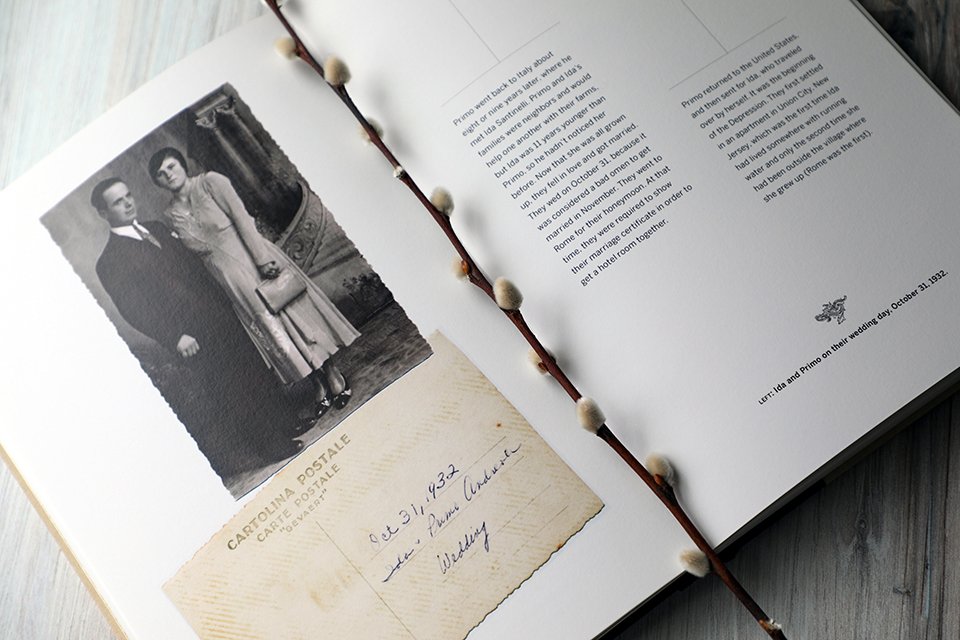


6 tips for choosing the best family photos to use as writing prompts
Family photos can be useful tools to jog memories and call forth stories. We share how to determine which images will elicit the best family stories.
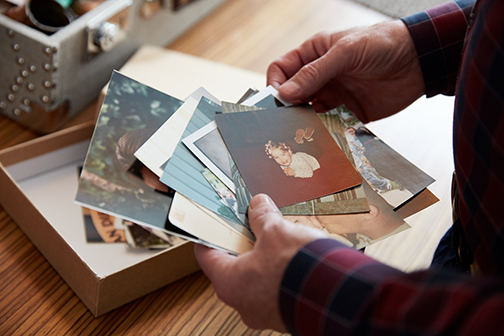
There are no rules for how to choose a photo that will be effective as a biographical writing prompt, but we can offer a few guidelines for the types of images that often elicit storytelling that is deeper and more meaningful than a mere identifying caption.
That’s the goal, after all: To use a photo as a starting point for your storytelling—as a jumping off point for memories, a touchstone for emotions, a lead-in to a narrative from your life.
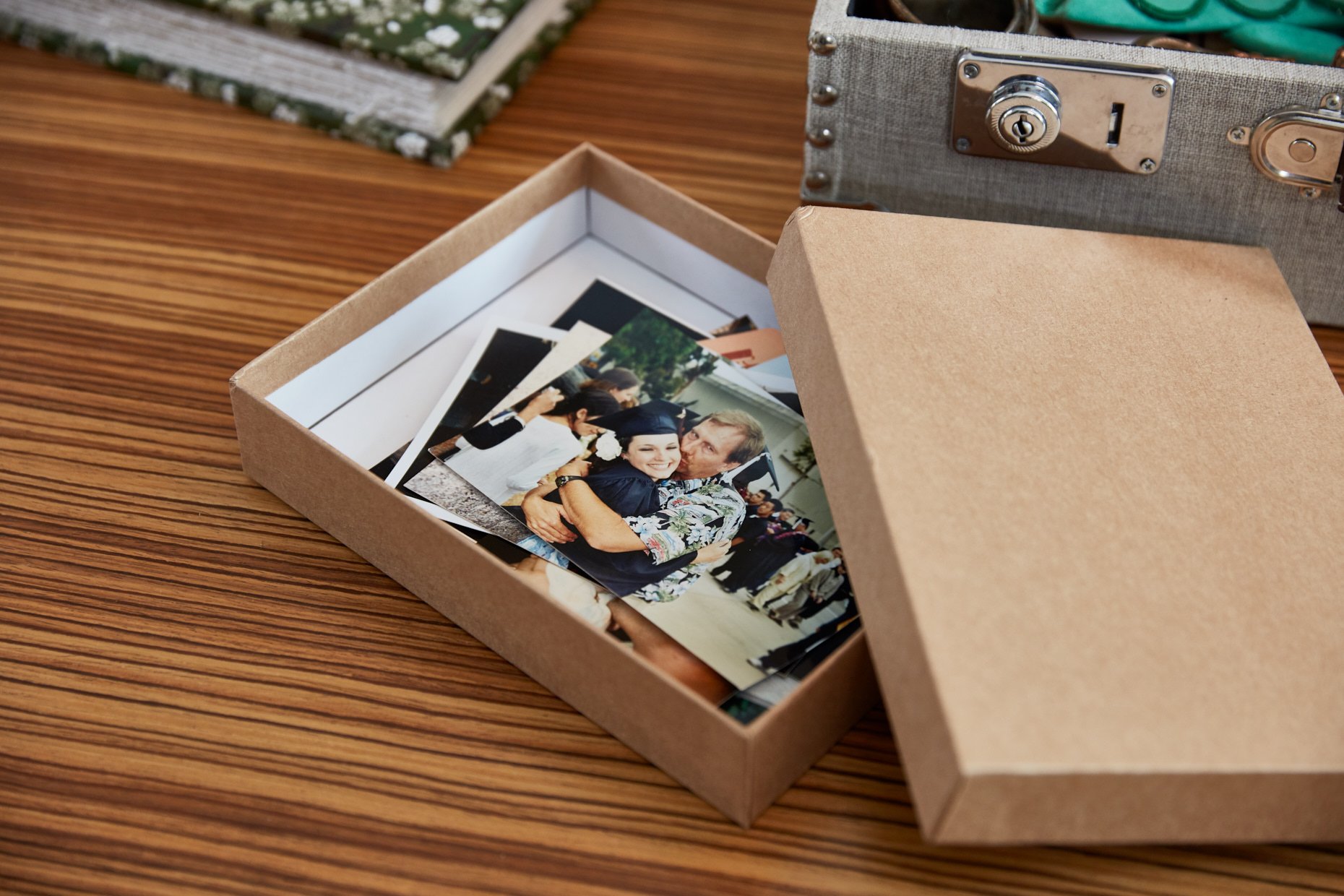
So get out your old family photo albums or that dusty box of print photographs from the basement! Then…
Step One: Choose 10-20 pictures to start with.
Begin randomly looking at photos.
Rather than focusing on those that are frame-worthy, look for photos that elicit a strong feeling from the viewer (you, or the family member from whom you would like to capture stories).
Set aside 10-20 images that stopped you in your tracks in number two (even if you stopped to wonder about the image as opposed to reliving memories as a result of looking at it; sometimes it’s the mysteries behind a photo that draw forth particularly revelatory stories).
Now it’s time to choose a photo with which to begin your reminiscing. Whether you are using the photo as a writing prompt or as a vehicle to jump-start conversation in a personal history interview, the following suggestions will be helpful in selecting images that lead to substantial storytelling.
“Photos reveal themselves in layers,” Maureen Taylor (aka ‘The Photo Detective’) writes on her blog. “You study the clues and talk to family but every time you look at it or show it off to family you might learn something new. One thing leads to another.”
Step Two: Determine if the photo is story-worthy,
Ask yourself if the photo you are holding does any of the following six things—and if the answer to one or more of them is yes, then you’ve got yourself a winner. Set it aside and make sure it’s on hand the next time you want to delve into some family history writing!

The photo invokes an emotional response.
Do you feel a rush of excitement or a flush of scarlet creep up your face when you first spy the picture? It may make you feel anguish or sorrow, pride or exasperation, abundant joy or abiding love—the key is, it makes you feel.
If a family photo has such a visceral effect on you, this will be most fruitful for writing its story.
“Photographs are about one specific second, but they can also be about the future,” Beth Kephart writes in The Quest for Truth. “Photographs can operate as metaphor and counterweight, as tease and opposition, as the other half of a parenthesis.”
That photo that moves you is a doorway to your past that is clearly connected to your present in some way. Explore why you feel the way you do, and how this feeling fits into your life then and now. Provide context for your feelings; set the scene.
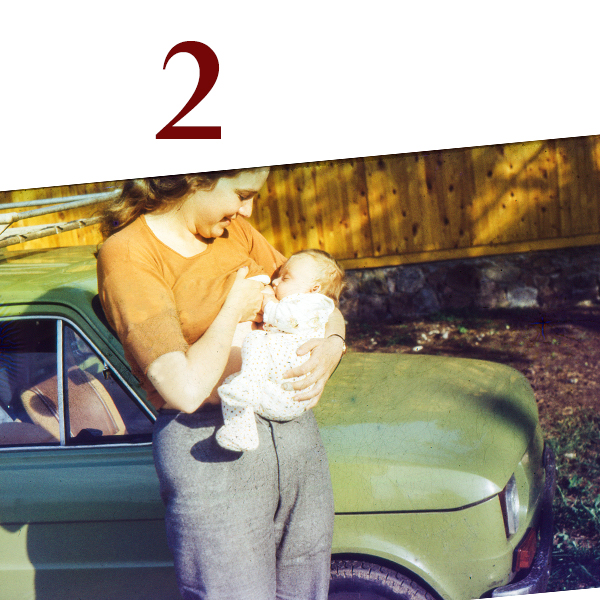
The picture tells a visual story.
Sometimes a picture itself already reveals a story: If the who, what, where, when, and why (or most of those) are apparent just from looking at the photo, then it’s likely a good candidate for embellishing upon. Of course, it’s ideal to choose images whose stories matter to you in some way.
The snapshot of this woman breastfeeding certainly tells a story about who she was as a mother—and if the mores of the time period and the town are known, and her character as well, then the storyteller can dive deep. A grown child looking at this image might use it as a jumping-off point for talking about their relationship over the years; or perhaps how their mom was part of a strong line of women before her; maybe she was only able to have one child, or 10, or only girls…
A photo is a moment in time, but on the periphery are details that help make up its narrative. What photo would have been shot just before this one? Just after? What’s in the frame? What (and notably who) is not in the frame? By starting with a picture whose story seems readily available, we can develop depth by asking such probing questions and tapping our memories for more.

Details draw your attention.
Your facial expression at the time the picture was snapped. The pattern of your grandmother’s well-worn house dress. A missing button on your dad’s shirt, or the papers falling from his briefcase. The water stain on the bedroom wallpaper. If some detail in a photo draws your eye again and again, there is more to be probed.
What does the detail begin to tell you? What beyond the frame of the photo—on that day, or a decade before or after the photo was taken—makes you focus on it? By taking the time to meditate upon all that the detail calls forth in your mind, you will reveal a greater meaning to this photo than could ever be revealed upon initial inspection.
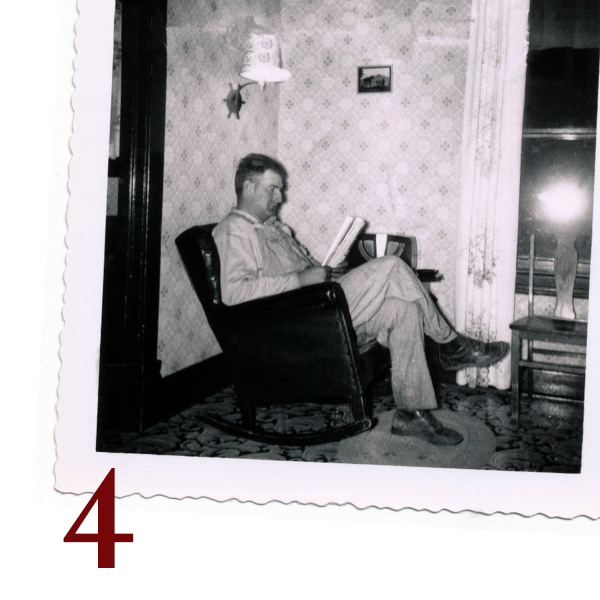
The photo portrays part of the subject’s everyday world.
My favorite type of modern family pictures could be described as documentary family photography: people in their natural environment, doing what they do every day. (Check out talented photographer Jen Grima’s work for inspiration.) I love capturing our routine family narrative this way because the resulting photos are so evocative of time and place, and they set us in scenes that are real and personal, uniquely ours.
Many old family photos do so less consciously, perhaps, but the impact is the same. We are drawn to such pictures because they reveal what our or our ancestor’s life was like back then. So if a snapshot of your aunt holding you while she’s hanging the laundry crosses your path, use it to tell a story. If you find a picture of grandpa reading in his favorite recliner, dad trimming the hedges at your childhood home, or your baby crawling amidst the messy remnants of Christmas wrapping paper, use them all—find their stories.

The image intrigues you.
Is it a curious shot? Out of the ordinary for your family or for the time period? Is someone missing who you would have expected to be present in that scene?
If it makes you wonder, then it very well may lead to a worthwhile story. Perhaps you end up asking for relatives’ input to get to the bottom of your intrigue, or maybe in lieu of concrete answers you surmise the story behind the old photo, thereby revealing a narrative of your own in relation to the photo. Chances are, whatever your approach the resulting observations will be as alluring to the next person as the original photograph was to you.
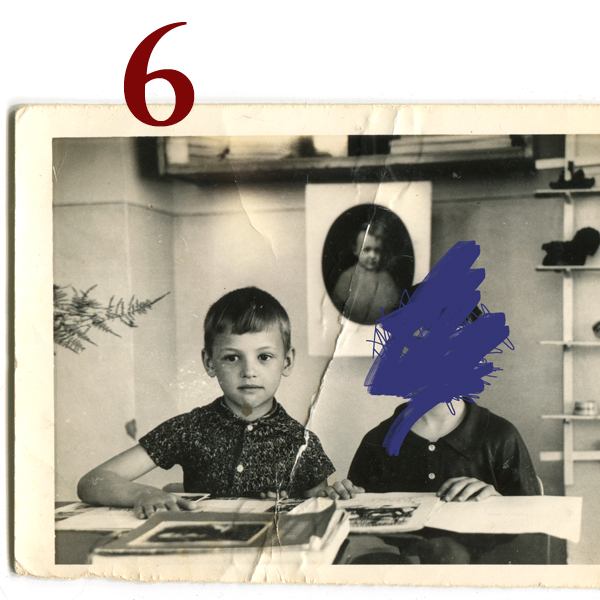
The physical print tells its own story.
My grandmother had a tendency to hold a grudge, so it was not too surprising to find among her things photos that had an individual literally cut out of the scene (or crossed out with ballpoint pen). Now there’s a story to be revealed! The same could be said for pictures that have been torn, damaged by flood or fire, or found tucked away in a book.
Sometimes getting to the story behind the photo is as fun—and constructive—as getting to the story that resides within it.
Step 3: Start sharing your stories.
Read more about how to use old family photos as biographical writing prompts—we’re talking nitty-gritty advice, from where to begin after looking at the photo to how to capture your memories.
Download the advice in a handy printer-friendly booklet here, entitled “How to Use Photographs as Prompts for Writing Life Stories.”
Explore more intense self-reflective writing prompts in Beth Kephart’s memoir writing workbook.
Once you’ve written your first life story vignette, consider doing something special with it—we’ve got five easy ideas.

Sharing is good
Print and share your family photos with loved ones. Besides generating conversation, you will spark joy, find genealogy clues, and discover even more treasures.
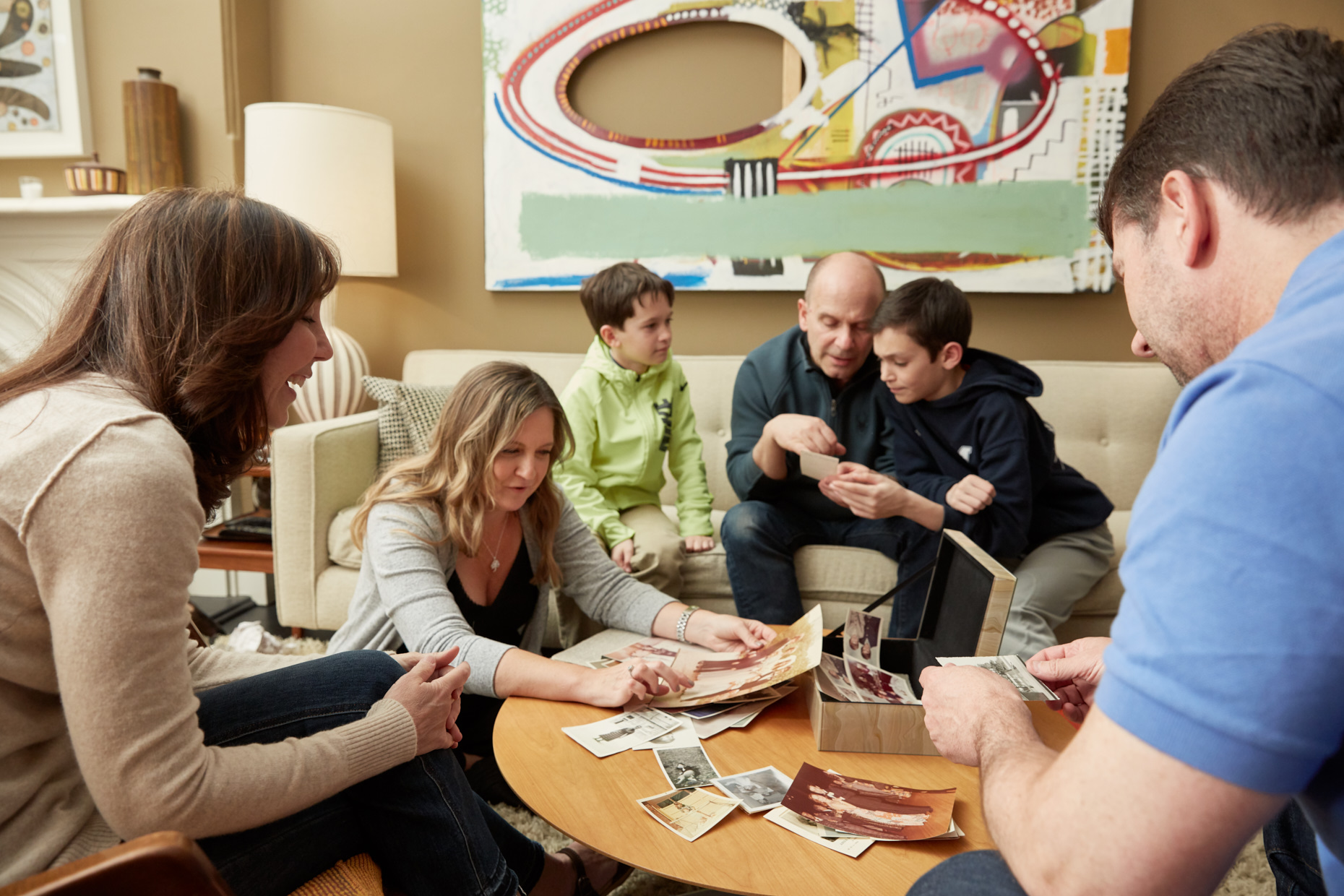
“Sharing is good.“ This childhood lesson is applicable in all areas of life, of course, but today I want to encourage sharing of your family photos.
It’s been written about ad nauseum in recent years: Our digital photo scrolls are out of control…we need to stop taking so many pictures and live in the moment…we never print our pictures anymore.
While I agree wholeheartedly with each of these lamentable statements, it’s the lack of printed photos that troubles me most—specifically, the sense of connection and excitement that gets lost when we neglect to print our photos, and share them in person.
In person, I say.
It’s temporarily gratifying to get lots of likes on an Instagram share, to see heart emojis galore on your Facebook post. But the joy that results from sharing a memory in person—well, that simply can’t compare.
Why You Should Share Your Photos
A family photo holds a story. It is a font of memories, frozen in one still frame.
Amazingly enough, the story shifts with each participant: Your mom, maybe, who took the photo, remembers things just a bit differently than you do; and your sister, a few years older, recalls things from an entirely different perspective. What about your baby brother, who only saw this photo—and heard its associated stories—years later?
Like all stories derived from memories, truth is subjective. And while a photo seems to capture a scene exactly as it happened, well, that’s subjective, too. Can you say “conversation starter”?!
So besides sparking conversation, why should you share your photos—and your photo memories—with loved ones? Here are three compelling reasons:
1 - You share, they share.
It’s contagious. You show someone an old photo from your childhood, and they reciprocate with a shot they had in a drawer somewhere. You pull out your dad’s old scrapbook filled with family photos from his youth to spark conversation with your parents, and they reveal they have two more stored in the basement.
Sharing what you have encourages family members to share some of their own family treasures, too—and what could be better than that?
2 - You might learn something.
From a name scribbled on the back of an old photographic print or a comment made in passing by a family member to whom you are showing your photos, you just may discover something new: details or backstory that enrich your own experience of the picture; or perhaps a surname or location that helps with a genealogical search.
Just because your family elders have not shared such info before doesn’t mean they don’t know it—too often I hear, “Well, no one ever asked me.” So show…and ask!
3 - You’ll feel darn good.
Sharing the joy and love associated with your favorite family photos makes that joy grow. You get that altruistic benefit that comes from sharing of yourself—witnessing another’s enjoyment, and feeling your own heart swell.


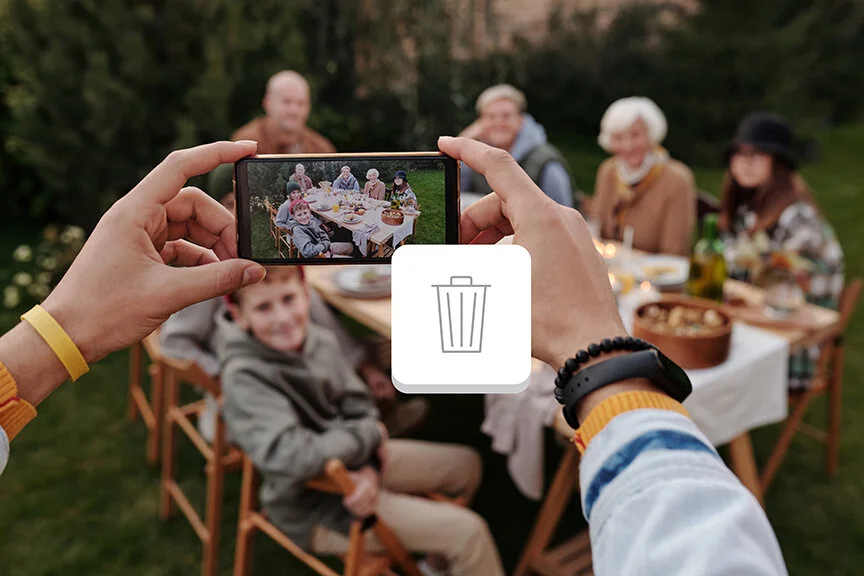


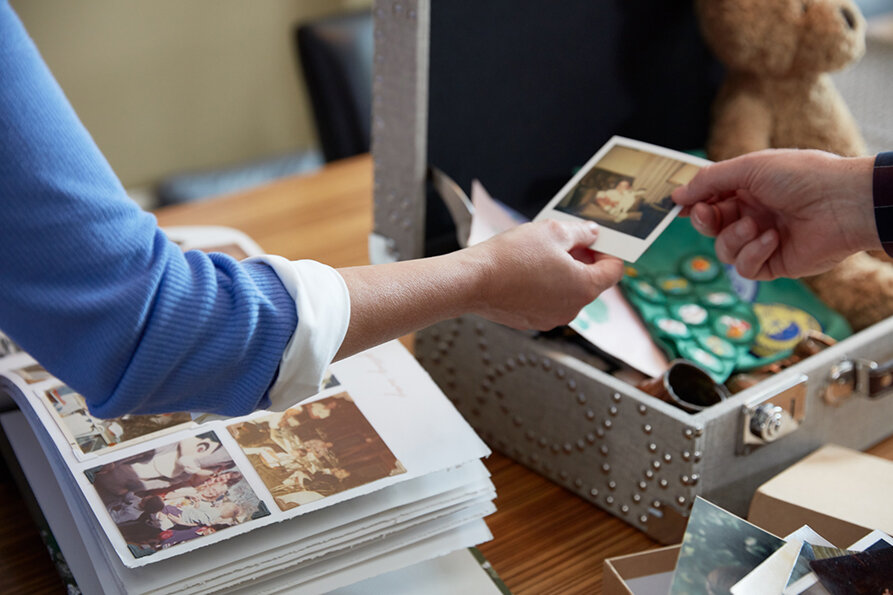

Is digital story sharing for you?
Want to record family stories? “There’s an app for that!” Undoubtedly, there is—but which one is right for you? My top picks for digital story sharing services

Want to record family stories? “There’s an app for that!” Undoubtedly, there is—but will you use it, or will it sit unopened on the last page of your device’s scroll?
If you and your family members are more inclined to take action with tech tools as opposed to pen and paper, here are my top picks for digital story sharing services:
StoryWorth
Who it’s right for:
Connected grandparents, multi-generational families separated by distance
How it works:
With a StoryWorth subscription, users are emailed once a week with prompts to answer a question based on their life experiences. The array of questions is vast and evocative, though users may always choose to answer a question they themselves craft.
Pros:
When a reply is input, answers are emailed to a preset list of people—so, as many family members and friends as you want to designate may receive your stories.
It’s a lot easier to type than it is to write things out longhand (remember those days?!), so users are more likely to get into a rhythm answering questions regularly online than they might otherwise be with an old-fashioned memory-prompt journal.
For individuals who may not have a computer or email address, or for whom typing may be difficult, StoryWorth also offers an audio plan with stories recorded over the phone (some restrictions apply).
Cons:
At the end of the year StoryWorth automatically crafts a black-and-white book of memories based on the subscriber’s responses—and while that’s great in theory (I’m all about preserving memories in a book, after all), there is no room for editing, personalization, or revision.
Also check out:
Two similar apps that are still in beta but look promising are Life Mapping (which “maps” your path through life) and iRememba (leave your legacy via “digital time capsules”).
Family Search Memories App
who it’s right for:
Genealogy fans & family historians
how it works:
Your family historian may already be registered on Family Search, but are they familiar with the Memories features? Users may upload photos, stories, documents, and audio recordings that add depth to the names on their family tree.

The Family Search Memories app displays stories in a gallery view, as shown, or in a list view to make finding specific entries easier.
pros:
The Family Search Memories app allows you to capture priceless family moments through photos and voice recordings on your phone, even when you don't have Internet access.
Family history is truly brought to life—and promises to genuinely capture the next generation’s imagination—when pictures and details exist, not just data and documents.
cons:
While FamilySearch vows to “store your precious moments free forever,” the fact remains that it is a business, and businesses—especially tech businesses—can change (or cease to exist) over time. (Don’t let this app or “the Cloud” be your only means of storing your photos and stories, please.)
Regular Old Email
WHO it’s right for:
The less tech-savvy elders in your family, or those who might prefer to write but are hampered by arthritis or other physical debilitations
how it works:
The art of letter-writing may be dead, but that doesn’t mean long-term correspondence need be, as well. Begin a regular correspondence with a loved one that goes beyond cat memes and dinner dates: Set some ground rules (“let’s explore your past, Mom,” or “I’d love to know more about your college and war years, Dad”) and timeline (at least once per week, perhaps) and start sharing notes.
I was especially inspired by journalist Anderson Cooper, who undertook a year-long extended email conversation with his mother that resulted in a book—and that tapped into, as Cooper said, “not the mundane details, but the things that really matter, her experiences that I didn’t know about or fully understand…”
pros:
No subscription or monetary commitment is necessary. All you need is an email address and access to a computer (available at most local libraries if one is not accessible at home).
It can be easier to delve into difficult or emotional topics when not face-to-face with a loved one. And since correspondents may take some time to review what they have typed, they can be thoughtful about their story sharing.
We have become accustomed to typing, and can pour out our thoughts much more quickly than if we were writing on paper—so conversations may go longer, deeper, more quickly.
cons:
There is a disconnect when reading rather than hearing, and tone or inflection is lost on a screen. Participants must get to know one another’s writing style—and understand that sometimes an actual conversation should ensue to clear up any confusion or hurt feelings.
You may accrue a wonderful catalog of communications through an email correspondence, but the onus is on you to do something to preserve what you have gathered. Don’t let the stories—and the love and understanding that ensues—languish; contact us to help you turn your memories into an heirloom book, or consider simply printing them out (with dates) for the next generation to read and learn from.





Vintage, unknown
While I love browsing nostalgic #foundphotos on Instagram, my scrolling is always accompanied by a twinge of sadness. It’s the storytellers who renew my hope.
As an avid Instagrammer, I have followed with interest—and plenty of enjoyment—many vintage photo collectors. It is fun to scroll through a feed of old black-and-white images that bring to life times past: to see families gathering in their linoleum-floored ’60s kitchens, kids adorned in their ’70s patterned outfits playing outside in their yards, multiple generations sitting around on ’50s-era lawn chairs while someone barbecues. And all those car shots—what could feel more nostalgically American?!

Vintage “found photos” from the Anonymous Project’s Instagram feed.
These photos are weighted with a sense of time that is palpable. The curvy edges of print snapshots are often included in the digital representations of these images—they are clearly of another time. And yet, they are recognizable; they capture moments and milestones and emotions that often mirror our own. In their anonymity they become universal...in a most personal way.
I find the whole “found photo” movement intriguing. I am attracted to it for the aforementioned reasons. And yet, while I am “liking” image after image that makes me smile and remember, I feel a twinge of sadness. For while these photos are recognizable to me in their universality, their individual stories have been lost.
A recent New York Times article explores the phenomenon in “Moments Big and Small in Vintage Photos.” It’s what got me thinking about found photos again, and what renewed that ache I often feel when looking at them.
Sarah Moroz writes:
And while fashion and fads may have changed, these faintly remembered slices of life still resonate with contemporary viewers. “I realized that what a guy was doing in the 1940s, I did in the ’70s and ’80s,” Mr. Schulman said of the range of both playful and emotional vignettes. “The themes of today are also the themes of earlier times — we’re not different.”
So true, and so clearly why I, like thousands of others, gravitate to these images.
And yet…
I wish the stories attached to these photos were real.
I wish the memories associated with them belonged to the subjects and their kin, not anonymously to the world at large.
I wish we all valued our personal family archives enough to preserve and document them.
And yet…
I will continue to follow accounts such as The Rescued Photo and China Lost and Found, and to double-tap the pictures that resonate with me.
But I will cherish even more the vintage family photos shared by storytellers: the people who attach slice-of-life vignettes to their images, who share personal recollections and memories, places and dates and names to their pictures. The family archivists, personal historians, and memory keepers who use photographs as a means to remember to remember.
I am talking about:
Rachel Labour Niesen, the steward of the #savefamilyphotos movement and one of the best at promoting this message.
Kay Evans Little, who is “remembering my ancestors and family, one photo and story at a time,” and others like her using social media to share and celebrate the stories behind their family photos (two of my favorites: Rosa Rucco and Vivian Love).
And the many folks who have taken up the #genealogyphotoaday challenge.

On the Save Family Photos Instagram feed, it is not only about the photos: what’s not pictured here are the captions that accompany the photos, which are submitted by the more than 34 thousand followers and tell the stories behind the photos!
I’d love to hear your thoughts below! Please comment and share—
Who are your favorite #familyphoto storytellers on Instagram?
What is your take on the attraction to #foundphotos (also often referred to as vernacular photography)?
Are YOU doing anything to capture the stories behind your photos???
Dawn Roode’s curated roundup for the week of Sept. 23, 2026, is overflowing with recent reads on memoir, life story writing, and family history preservation.