
Memories Matter
Featured blog Posts

READ THE LATEST POSTS
Think YOUR KIDS would never throw away your cherished photos? I wouldn’t be so sure...
Imagine: Your treasured family photos, one day thrown in the trash—by your own kids?! Here, the secret to ensuring your photo memories live on.

I know you didn’t snap all those family pictures just for them to end up in the trash…did you?
What would you grab first if your house were on fire?
Your family photos, if you’re anything like most Americans, would be somewhere atop your theoretical list.
We value those old albums passed down from our parents. We cherish the letters Gram tied with a ribbon from when Pops was at war.
But you know what? Those family mementos of old were typically part of small collections, often curated into albums or stored neatly in a single box. In other words, easy to move—and inviting to go through on occasion.
What of your own photos? Are they curated? (Doubtful.) Is the collection in one place? (Yeah, right.) Is it accessible—emotionally accessible, not easy to reach on a shelf? (Oh, you don’t even understand this question?)
Allow me to explain: If your photos number in the thousands, exist across multiple social media platforms and devices, and finding one image that holds meaning poses a challenge—well, that’s not an emotionally accessible family archive.
What does make for an inviting family photo collection?
Your descendants will be more likely to hold on to your photos if:
they can find ones that matter to them
they know who is in the pictures
the stories behind the photos are evident
they are not overwhelmed by the sheer volume and disarray of the photo collection.
I write often about finding the stories behind our family photos, and I believe those stories are what make those photos valuable in the first place.
There are plenty of approaches to whittling down our photo collections, from Marie Kondo minimalism to genealogy purists’ detailed preservation. And I’m more than happy to connect you with a professional photo organizer who can take on the grunt work for you according to your own values.
But I urge you to go beyond mere organization. Paring down and labeling your collection will certainly go far in making your collection valuable to your kids. Adding stories and curating your collection to convey meaning, however, will make your family photo collection invaluable to them.

Would you like to learn more about how we can work together to preserve the stories behind your photos? Please schedule a time for a free 30-minute consultation.
Would you rather begin such a project on your own? I’ve got some resources for that, too:
free download
Grab your free copy of this helpful guide chock-full of tips and ideas for writing the stories behind your favorite family photos.
recommended read
Your memories live in your head and heart, but family photos, heirlooms, and mementos sure do call those memories forth—here’s how to use them to help you begin to create a life story book.
advanced techniques
Interested in paring down your family photos? Photographers call this process culling, and I’ve put together some best practices for culling your family photo collection with intention.

Life Story Links: January 5, 2020
Ways of remembering, first-person essays worth your time, and efforts to tell stories of real peoples from all walks of life: new reads for the new year.
“The years on someone’s gravestone are when they lived. The dash represents how they lived.”
—David Allen Lambert
![On this day in 1920, the Boston Red Sox sold Babe Ruth to the New York Yankees for $125,000 in what would come to be known as the Curse of the Bambino. Pictured above: Lou Gehrig, George Herman [Babe] Ruth and Tony Lazzeri in a 1927 photograph by Un…](https://images.squarespace-cdn.com/content/v1/55d35604e4b08af97dadd334/1608672183720-I6KA9WATTCEDFFYYW7K5/lou-gehrig-babe-ruth-tony-lazzaeri-yankees.jpg)
On this day in 1920, the Boston Red Sox sold Babe Ruth to the New York Yankees for $125,000 in what would come to be known as the Curse of the Bambino. Pictured above: Lou Gehrig, George Herman [Babe] Ruth and Tony Lazzeri in a 1927 photograph by Underwood & Underwood, courtesy The Miriam and Ira D. Wallach Division of Art, Prints and Photographs: Photography Collection, The New York Public Library.
All Peoples
SHOULD OLD ACQUAINTANCE BE FORGOT?
“From the pews of a church where white deacons once refused to seat African Americans, a group of Black singers in Alabama reminds us why preserving our memories of this historic year is vital—even if we'd rather just leave 2020 behind.” Take three minutes and forty-five seconds to relish the sounds and watch here:
MAKING HISTORY RELATABLE
The Canadian War Museum made a conscious effort to include a diversity of voices in its latest exhibit, “Forever Changed: Stories from the Second World War,” which turns to individual stories to make an impact. “You learn something about the person—maybe it’s hopeful, maybe it’s sad, maybe it’s scary—but each one stands on its own as something that you can feel a connection to.”
SHARE YOUR PERSONAL HISTORY
Are you an immigrant of color in America? NPR invites you to share a short audio clip telling about your family’s history involving “themes of identity and assimilation in America” for a new project looking at our country’s melting pot.
Flickers from the Past
AH, MEMORIES!
Dan Rodrick writes that memories “are like old toys that need to be taken from storage and wound up to make sure they still work. If you don’t do that, they stop speaking to you, and one day you’ve forgotten the sound of your father’s voice.”
“THE GHOST ON THE ZOOM CALL”
Judy Bolton-Fasman reflects on the weekly group video calls she has with her mom, who is in a nursing home, and “the times she sees her mother, my abuela, inhabiting a Zoom cubicle…. Abuela has been dead for over forty years.”
IN LETTERS
“There will be no (or vanishingly few) books of collected emails, and who would want them?” Dwight Garner wonders in this piece mourning the letters that will no longer be written, and remembering the great ones that were.
First Person Reads Worth Your Time
SELF-DISCOVERY THROUGH READING
For Jenny Offill, “Mrs. Dalloway is…[a book] to which I have mapped the twists and turns of my own autobiography over the years. Each time [I reread it], I have found shocks of recognition on the page, but they are always new ones, never the ones I was remembering.”
A VIRTUAL BEST-OF
The editors at Narratively (“human stories, boldy told”) have picked their favorite stories from the past year, and I recommend perusing their list. A few of my favorites:
“I Quit My Job at 50 to Reinvent Myself. Pro Tip: Don’t Do This.” by Ivy Eisenberg, laced with a wonderfully acerbic self-deprecating wit and canny cultural touchstones
“Snowed in with a Ghost” by Krista Diamond: “‘Building’s haunted,’ the landlord said, with more boredom in his voice than the statement merited. ‘Ramona. That’s the ghost’s name. She was here when this was a brothel.“”
“My Secret Life as a Coronavirus Nomad” by JB Nicholas: “As a freelance journalist, I’ve struggled financially for years. Then the pandemic hit and I got thrown on the street. But I will go on — I always do.”
...and a Few More Links
A beloved WWII photo comes to life in a virtual reunion.
A year-by-year glance over the first ten years of The Public Domain Review
Tips for anyone considering creating a family website
A look back at “the lives they lived”: remembering some of the artists, innovators and thinkers we lost in the past year
Short Takes

“What’s the best way to share my family photos & stories online?”
You want a digital record of your photos and other family history stuff but realize social media is not a good permanent solution. Consider a family website.
Sure, my primary focus is on creating books to preserve your stories—but at the end of the day, it’s my mission to help you ALL undertake some type of personal preservation project to ensure your legacy is passed on. And there’s no denying that we live much of our lives online these days.
While I love Facebook for keeping me updated as to what’s going on in my local community, and I can sure as heck get lost on some of my favorite Instagram feeds, I don’t recommend relying on ANY social media platform for permanent storage of your family archive. So, what if you want to share your family photos and stories online—for more than just a few fleeting likes?
I invited a memory-keeping colleague to share her thoughts on the matter—welcome NYC–based certified professional photo organizer Marci Brennan on why you should consider creating a family website:

Consider letting the whole family, from kids to grandparents, contribute to making your new family website.
Consider Making a Family Website
Staying in touch with family is paramount these days. Social media, for example, has been instrumental in helping us maintain relationships. But when it comes to tech, not everyone is comfortable with every social media site or app. This is even more important when considering family members of various ages. And social media sites often change their privacy policies. There’s also an increasing number of targeted, distracting ads on them.
Families are realizing that creating a dedicated family website is the best option. It provides a safe and secure place to share and preserve family history while avoiding the pitfalls of social media sites.
Many of these family websites are multi-functional. They offer a variety of services such as message boards, blogs, calendars, and other options. And they have aesthetically pleasing, user-friendly interfaces.
Here are a few of the benefits and features of a dedicated family website:
Access and sharing for all
Family sites level the accessibility field. Age and comfort with tech matter less, as the best sites make navigating their contents easy. All ages can access the site by typing a customized URL / domain name into their browser. Sites are device-agnostic. No special passwords or registration required.
easy connection to your family
Staying in contact with our families allows us to grow closer together. By using a family website, members can share their photos and videos as well as create events. It can become a family communication and library hub. Weddings, anniversaries, birthdays, and graduations can be shared, as well as other important events. Personal projects, movies, family recipes, and other tips can even have their own pages.
Preserving your history
Adding a family tree is a great way to manage, organize, and preserve your family heritage. Photos of people, special places, and memorabilia can inspire memories and spark conversations. Posting digitized versions of old media (such as 8mm, Super 8 and VHS tapes) add another layer of interest and history. Older family members can share and document their stories, preserving their memories. The current family as well as future generations will benefit.
Getting started
There are a few options to choose from when creating your family website. I recommend
…which are all dedicated to photography and family memories. Take a look at each site and see which one is best for you.
The Rewards
Many of us will accumulate a massive amount of photos in our lifetimes—tens of thousands, if not more. Perhaps your photos have been professionally scanned, organized and backed up on an external hard drive (or two) already. Or maybe, as the family historian, you have even done this yourself. While that is an essential step and an added layer of security, passing along your photo legacy on a family website to future generations is the ideal solution. This makes inheriting family photos much easier and more enjoyable for everyone. Sharing a curated family library with present and future generations is a timeless and uniquely precious gift.
about the author
Marci Brennan is a TPM certified professional photo organizer. She lives in Queens, New York, and works with her husband, videographer/photographer Chris George. Together they offer photo and video organizing services throughout New York City and beyond. At Past Present Pix their goal is to help busy families manage, organize, and preserve their photo and video collections so their valuable media is always at their fingertips and safely backed up.






Life Story Links: December 22, 2020
Last-minute reads while we await Santa's arrival: first-person tales to inspire & foment, diaries expected and not, plus some family history for good measure.
“Memoir begins not with event but with the intuition of meaning—with the mysterious fact that life can sometimes step free from the chaos and become story.”
—Sven Birkerts

A whimsical vintage Christmas card, created between 1950–1963, by Oscar Fabres, a Chilean illustrator who studied art in Paris and settled in New York in 1940, courtesy of the New-York Historical Society.
Accounting for Life
HONORING THE YEAR GONE BY
Austin–based video biographer Whitney Myers shares some thoughts on the sacred work of reflection including helpful pages you can print to guide you in New Year’s reflections and a bunch of fun conversation starters.
NOW IS THE TIME TO START (OR RESTART)
“About 10 years ago, I started adding a diary calendar feature to record at least one thing that happened every day—the profound and the mundane—so that I captured both the forest and the trees that make up the map of my life.” David G. Allan, who has kept a diary consistently since 1986, makes a compelling case for journaling about your life, now.
ACCIDENTAL DIARIES
A writer peruses his recent history through 14 years’ (and $12,017 worth) of Amazon purchases: “Looking through it all was unexpectedly cathartic; almost like a shorthand, accidental diary that I never got around to keeping.”
What’s Missing
AURAS OF POSSIBILITY
“Even as we regret who we haven’t become, we value who we are. We seem to find meaning in what’s never happened. Our self-portraits use a lot of negative space.” This exploration of our unlived lives—and what it’s like to explore them—is an intriguing and worthwhile read from Joshua Rothman.
THAT EMPTY FEELING
Last week I shared what I hope will amount to a dose of comfort for anyone grieving a loved one during this holiday season—a post that is all the more relevant as, right now, it seems as if we’re all grieving something.
First Person Tales
“SITTING ON MY MOTHER”
An encounter with his high school sweetheart (and her White Shoulders perfume) lead this writer on a path of rediscovery, reorientation, and re-disorientation that ends at his mother’s grave—and “an urge to reckon with the stories that make up [his] life.”
ARCHIVE OF AMERICAN VOICES
The latest season of the StoryCorps podcast explores how people deal with one of the only constants in life: that things change. Listen in to stories of how people cope while their lives are in flux, highlighting the lessons they’ve learned along the way. On the following episode, hear how Alice Mitchell and her younger brother Ibukun Owolabi found a way to move forward—from baby steps to teenagehood—after losing their mom:
CHILDHOOD MEMORIES
“According to my parents, the only real Santa was in Kirven’s Department Store. The other Santas around town, including the one at the new Kirven’s in Columbus Square, were ‘Santas helpers,’” Perry Hamilton, a personal historian in Laguna Hills, California, writes. Read about his childhood Santa realization here.
AN UNEXPECTED RESET
“I was tremblingly weak, and yet my COVID lifestyle was strangely enjoyable. My spirit floated somewhere above my suffering body, experiencing the days like shards of light piercing the dark.” Memoir coach Sarah White, a self-described “freelancer who rarely takes vacations,” on the surprising gifts of a relatively mild bout of COVID-19.
A Little Family History
HOLIDAY TRADITIONS OF YORE
After spending most of the last year writing about (and getting to better know!) her great-grandparents, Lisa O'Reilly wondered what Christmas traditions they brought with them when they came to America. Here the California–based personal historian dives into “Christmas Traditions from the Old Countries.”
HERITAGE DISCOVERY VIDEOS
The folks at RootsTech invite you to submit a personal video from 90 seconds to five minutes showcasing your heritage. Topics include food, culture, travel, and, as exemplified in the video below, traditions. They’re also seeking videos that highlight genealogy tips and tricks. Learn more here.
...and a Few More Links
New personal history business launches in the UK.
The Best of Brevity: Twenty Groundbreaking Years of Flash Nonfiction now available in paperback
One mom learns that “my props were my memorabilia and my kids were my memories.”
The joy of reliving her childhood bookshelf
On the occasion of the 25th anniversary of “This American Life,” Ira Glass, a pioneer of the genre of audio narrative journalism, picks a few of his favorite episodes.
Examining the archives of writer Julian Barnes
Short Takes

Who (or what) are you missing this holiday season?
I hope you'll take comfort in these personal stories of vulnerability and loss during the holidays. (Sharing memories about loved ones is always a good thing.)

The 2020 Christmas and Hanukkah season will be anything but normal—but one constant is that stories are always welcome!
There’s nothing “usual” about these December holidays. This pandemic year has taken us all for an unexpected ride. And while funny memes and abundant comfort food may ease our path, they do little to truly soothe our souls.
I recently shared a post on social media: A 2020 gift list for grievers curated by Allison Gilbert, author of the wonderful book Passed and Present: Keeping Memories of Loved Ones Alive. One commenter noted how “everyone is grieving something this year.” Ah, yes, I thought—maybe that’s why the post resonated more deeply than usual with me.
And maybe that’s why I feel compelled to share a few resources for anyone who is, indeed, grieving during this season.
I am no stranger to holiday grief, having lost my mom unexpectedly just three days after Christmas in 2009, and two of the very personal posts below reveal my vulnerability at this time of year—as well as how story sharing about our deceased loved ones can be healing (dare I say, even joyful). I hope you can take a measure of comfort from my words.
The middle post offers up a list of memory-provoking questions designed to elicit holiday stories from a family member. While the original intent was to use them to guide a personal history interview with a loved one, again, this pandemic year may challenge that approach… So, if you are physically apart from your relatives, consider interviewing them from afar via Zoom (or a good old-fashioned phone call)—just remember to hit record on your smart phone or on a recorder to ensure you capture their memories for posterity! Another idea: Set aside some of your own time to write about your memories; these questions work just as well as writing prompts, after all.
Wherever you are, whomever you are missing, know that I am with you in spirit and wishing you peaceful and happy holidays!


Life Story Links: December 8, 2020
An array of recent stories on the how sharing our life stories can be transformative (for both the teller and the listener), plus memoir resources & news.
“There is not one big cosmic meaning for all, there is only the meaning we each give to our life, an individual meaning, an individual plot, like an individual novel, a book for each person.”
—Anaïs Nin

Bubble gum kids series of photographs by Cornell Capa for LIFE magazine, January 1947.
The Stories of Our Lives
LETTERS TO THE KIDS
"Somehow we had never really found time to tell stories. Everybody was just busy doing stuff, living our lives." After Bob Brody, a writer in NY, came to this realization, he spent a year writing letters to his grown children “as an act of love and memory…but also as a legacy—a repository of knowledge about the relatives who came before them.”
JUST SAY YES
What are the chances that we’ll all hear—and preserve—our parents’ stories if we don’t ask for them? Yeah, not great. Here are three easy ways to get the family storytelling ball rolling.
“NARRATIVE THERAPY”
Longtime South Carolina–based personal historian Mary Johnston shares how she helps Lowcountry writers transform memories into memoirs during the pandemic.
“TRUTHS THAT MATTER”
“I am haunted by what I don’t know about my father, and long to know, no matter how many pages of declassified documents pertaining to his old night fighter squadron that I’ve been able to obtain,” Paul Hendrickson writes in this meandering but worthwhile piece that’s, ultimately, about two writers and their complicated relationships with their fathers’ pasts.
Write On!
FIND SERENITY THROUGH WRITING
For the past several years Massachusetts–based personal historian Nancy West has led writing groups at which she promotes the value of establishing a daily writing practice. During the pandemic, she compiled her favorite "three-minute journaling" prompts into a book.
DEMENTIA LETTERS PROJECT
Kathryne Fassbender, CDCS, founder of Dementia Letters Project, invites you to write a letter—addressed to “yourself, your family, dementia, to a loved one with dementia, the community, God, anyone, everyone”—sharing your dementia-related story.
The Power of Our Voices
LETTERS TO HER SON
The New York Times calls Homeira Qaderi’s memoir, Dancing in the Mosque, “a stunning reminder that stories and words are what sustain us, even—and perhaps especially—under the most frightening circumstances.”
WOMEN’S VOICES
“This documentary [The Girl Inside] will make you think about the power of your own voice, the healing gift of story-telling, and what message you want your life to speak into the world.”
Miscellany: Food, Photos & Grief
FOLLOWING THE BREADCRUMB TRAIL
“Each bowl of okra soup or snippet of kitchen-table conversation is an ark from the past…” How to apply insights from chefs and culinary historians to cook family recipes that hold special meaning to you, even if the elders who originally made them are gone.
WHEN WE WERE YOUNG
A baby's first sip of stout, picnics beside cars, and braving cold seas: Nostalgic photos showing family life in Britain between the ’40s and ’70s collected in new book.
AMIDST HER GRIEF
“There was no gathering or reception after, no hugs and fellowship with our family and friends, no stories exchanged in anyone’s yard,” memoirist Nicole Chung writes in this poignant piece about the signposts of mourning and honoring our grief.
...and a Few More Links
Older adults remember past events with remarkable accuracy, new study finds.
Forever ambassador Ellen Thompson-Jennings details layouts and resources for making your own family stories book.
One family’s Milanese Jewish recipes that survived generations of secrecy
Winter online writing classes from Creative Nonfiction (including historical narratives and the thirty-minute memoir)
Thoughts from writer Sarah Cannon on writing a hybrid memoir
Interesting thoughts on the idea that memory lies at the heart of various academic disciplines
Short Takes

Want your parents’ stories? Here are 3 easy ways to help get them.
Preserve your parents’ (and grandparents’) stories meaningfully for the next generation with these three ideas that make the process simple and enjoyable.

Don’t wait until it’s too late to capture your parents’ stories—your kids (and YOU!) will be grateful to have them one day.
Of course you want your parents’ stories. We all do. But the chances of us getting them without asking for them is, well, pretty unlikely.
I inherited three journals—you know, the ones with those guided family history questions on every page?—from my mom. I got goosebumps when I unearthed them among her things; the prospect of “hearing” from her one more time made me giddy, even in my deepest grief. But when I opened them, there was almost nothing inside: Each book had a few random pages filled out, and by “filled out” I mean she had written one or two sentences or, in some cases, a few words. I already knew her favorite color was yellow and that she had one brother. I wanted deeper memories—recollections in the shape of stories, written in a way that brought her childhood and later experiences to life for me. None were there.
Unless our parents are writers—and writers who turn their attention inwards, at that—the only stories we probably get are the ones they share around the dinner table. For one thing, dinner table conversation is a dying art (multiple generations around the dinner table regularly—come on!). For another, those oral stories aren’t preserved unless someone deems to write them down (you?).
There ARE ways, though, to ensure that we do preserve our parents’ stories meaningfully for the next generation. Here are three that I can help you with right now:

1 - Grab this free guide and encourage your kids to interview their grandparents.
Early on in the pandemic I created this guide to help combat the loneliness many elders were facing as in-person visits waned and social distancing became the norm. I was heartened when it took off—and when I heard from folks just how meaningful the conversations that ensued were.
This 20-page guide is chock-full of good things to help you get your kids involved in capturing stories from their grandparents! Designed especially for kids ages 8 and up (and we mean way up—you’re never too old to embark on a conversation with your loved ones!), the e-book includes:
45 family history questions
3 fun bonus activities
interview recording tips
historical timeline
ideas for what to do post-interview

2 - Enroll your parents in our memory & writing prompt course to get them writing about their own lives.
Perhaps instead of an interview you’d like to see your parents write about their own memories? Going this route allows for thoughtful reflection that provides stories with even more meaning—and ensures the process will continue for a while beyond a one- or two-hour interview.
My Write Your Life course provide exactly what your parents will need to begin their life writing journey:
weekly memory prompts on topics such as Childhood Memories, Food Memories, Life Transitions, and more (themes change every few weeks, and course lasts for a full year)
writing tips that will help them with their assignments but not burden them with unrealistic literary expectations
a dose of inspiration (staying on track isn’t always easy, but reminders of just why it’s so important really do help!).
The best part? Lessons are delivered straight to their email inbox on the day of their choosing, and I am always available for added support and Q&A. And at just $99 for a year-long, enrolling is a no-brainer for anyone who wants to write about their life!
3 - Invest in personal history services to professionally capture their stories—I’d love to interview them!
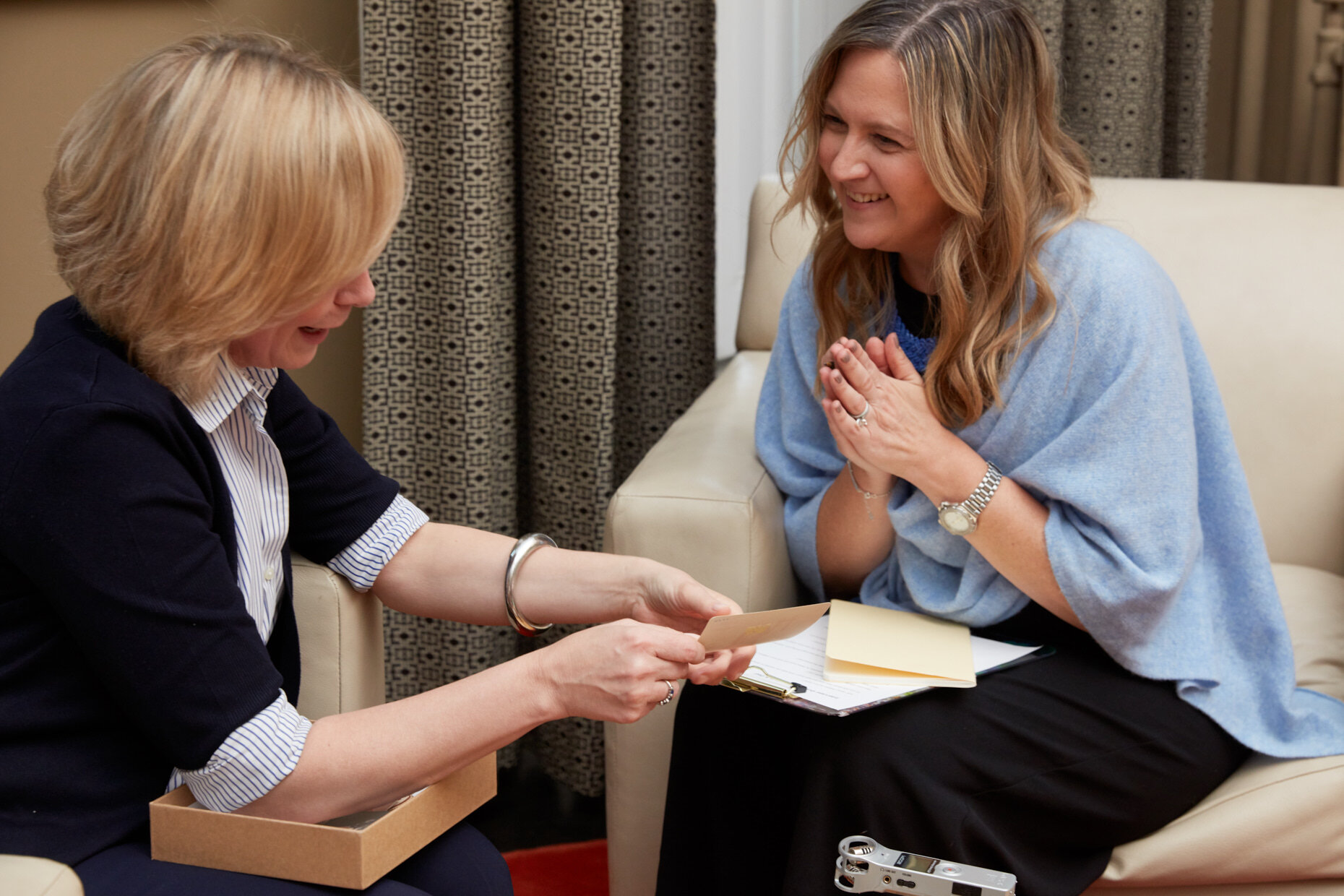
If you prefer a full-service approach to capturing your parents’ stories, then personal history interviews are the best way to go.
In a nutshell: I interview your parents to capture their memories, help them curate their photos and mementos, and turn everything into an heirloom book with a cohesive narrative and engaging design.
We can do a single 90-minute interview to capture memories from a specific time in their life, or conduct a series of interviews over weeks or months to more fully paint of picture of their legacy.
All my projects are 100-percent customized, so it’s best if we chat to see how we can best work together. Investment for personal history heirloom books start at $1,500.
Which option is right for you?
I hope you found helpful resources here to put you on the path to capturing your parents’ stories for your family archive.
If you have questions or there is anything I can help you with on your journey, please don’t hesitate to reach out!

Life Story Links: November 24, 2020
Conversations on memoir, memories of Thanksgiving, new courses of note, plus a diverse array of stories about memory-keeping and life story preservation.
“We all want to get to the masterpieces of our writing lives by the shortest route possible. Trouble is, the shortest route possible is always the road ahead.”
—Bill Roorbach

On this vintage postcard, a parrot says to the turkey: “I would rather spend my life behind the bars than lose my head upon the block.” Courtesy New-York Historical Society, 1907.
Courses of Note
WRITE YOUR LIFE
Last week I began rolling out short memory and writing prompt courses geared at anyone who wants to preserve their family stories, even if they don’t consider themselves a writer.
OBITUARY HELP
In a free lunch-and-learn from Keeper on Tuesday, December 1, grief expert Allison Gilbert interviews professional biographers Kate Buford and Abby Santamaria about “how to expertly craft the kinds of obituaries that truly honor and celebrate your loved ones.”
The Memoir Files
TIM & MARY TALK
In this wide-ranging conversation Tim Ferriss speaks to Mary Karr about why she staged fights in her university memoir classes, how she found poetry in the idioms of her Texas upbringing, and why every writer should keep a commonplace book. Listen in here, or read the full transcript on Tim’s site:
PLAYING WITH FORM
“I think memoir is so much more than a single person’s memories, or the story of one life. That’s a power of the form for me—that it is so poetic, and it is so flexible, you can play with it.” Kao Kalia Yang, a self-described “prose writer with a poet’s sensibility,” on pushing the boundaries of the memoir genre.
IN HIS WORDS, IN HIS VOICE
In these five audio excerpts from Barack Obama’s new memoir, A Promised Land, the former president tells stories about spending time with some of the women in his life as well as his decision to approve the raid that led to the killing of terrorist mastermind Osama bin Laden.
DIVERSE, PERSONAL WAR STORIES
“After poring over people's correspondence and journal entries, it can be emotional seeing a young soldier's attitude…change from excited about going abroad to huddling in the trenches fearing for their lives,” historian Jacqueline Larson Carmichael said. Her new book, Heard Amid the Guns: True Stories from the Western Front, 1914-1918, is out this month.
Times, They Are A-Changin’
A VASTLY DIFFERENT FRESHMAN BREAK
Massachusetts–based personal historian Nancy West shares a first person piece about welcoming her daughter home from college for Thanksgiving, a ritual made quite different due to Covid-19.
TURKEY TALES
“These 29 Thanksgiving vignettes…exuberantly celebrate many cultures, stories, and people that loved us through their cooking,” Becky Hadeed writes. She curated a variety of holiday stories—sometimes funny, sometimes poignant, altogether relatable—for this episode of The Storied Recipe, which you can (and should!) listen to in full here:
MORE PANDEMIC JOURNALING
For the first 25 years after the pandemic, materials from University of Connecticut’s Pandemic Journaling Project will be available only to academic researchers; after that, the entire collection will become a publicly accessible archive. Each week a few entries are featured anonymously, with permission.
Potpourri
A “GREAT AND GEEKY” LEGACY
”I know people get upset when celebrities die,” former Jeopardy! contestant Burt Thakur said. “To me, he wasn’t a celebrity. To me, Alex Trebek was just another uncle.” Read tributes from fans of the American icon, as well as obituaries at Legacy.com and USA Today.
BEYOND A FINANCIAL LEGACY
“The question of how to pass personal values to future generations—and to continue to have some influence long after death—is expanding the traditional parameters of estate planning.” A look at family legacy trusts from Barron’s.
PILOT PROGRAM FOR MEMORY-CARE PATIENTS
Telememory, a telehealth startup that uses AI to power its digital technology, is helping families collect, curate, and reminisce together even as it tracks memory-care patients’ emotional responses to help improve their health and happiness.
MUSEUM OF SMELLS
I inhaled the tiny pot of Play-Doh my son got in his Halloween bag this year then stashed it in my room for when I need another sniff of nostalgia—for me, it truly is a singular childhood scent. Which of “your own personal smell memories” have become part of you? The New York Times asked readers, and their answers are unsurprisingly evocative.
NOW CASTING
How I Got Here, a new television series, is looking for second-generation individuals aged 14–30 to be cast on the program; subjects will travel (with their parent or grandparent) to their country of origin. Deadline for applications is December 1, 2020.
Our Stories, Our Selves
REASONS FOR DOCUMENTING PERSONAL HISTORY
“Sharing one’s personal history can benefit the individual recounting it as well as family members. One study found that reminiscing and storytelling reduce older people’s loneliness and increase feelings of social connectedness and overall well-being,” reports the Catholic Sentinel.
PERSONAL HISTORY RESOURCE
StoryCorps has released this seven-minute masterclass with Daniel Horowitz Garcia on how to conduct a great interview:

A GIFT FOR THE FUTURE
Pam Pacelli Cooper of Verissima Productions in Massachusetts coins a new verb, ‘ancestoring,’ and offers a few ideas for how to get good at it.
...and a Few More Links
“Memory Walking” exhibit in Poughkeepsie, NY, celebrates ordinary objects, family history.
Fair use: a statement on best practices for biographers drafted jointly by legal scholars, book publishers, and writers
Hippocampus magazine announces winners of “Remember in November” creative nonfiction writing contest.
Conversation with an ancestor surrounding the verity of Alexander Hamilton as a slave owner
Browse videos (mostly of biographers speaking about their subjects) from the archives of the Leon Levy Center for Biography.
The prospect of a memoir by President Trump is proving divisive in the publishing industry.
Short Takes
Dawn Roode’s curated roundup for the week of Sept. 23, 2026, is overflowing with recent reads on memoir, life story writing, and family history preservation.