
Memories Matter
Featured blog Posts

READ THE LATEST POSTS

Recipe for remembering
Our food memories—sneaking tastes of Nonna’s sauce from the pot, learning to grill ribs from Dad—are worth preserving. Ideas to easily capture stories & recipes.

Ever have a friend drop by your house unannounced and drool over the smell of your simple chicken soup? Have you ever craved a gooey peanut butter sandwich after a bike ride with your kids? When foods remind us of the past—especially fond memories from childhood—we find comfort and more than a little inspiration for revisiting those times.
When I am interviewing a client for a life story book, often it’s their food memories—recollections of sitting around a family table, sneaking tastes of Nonna’s sauce straight from the pot, or learning to grill from Dad—that call forth meaningful stories.
How about you?
Preserving your food memories
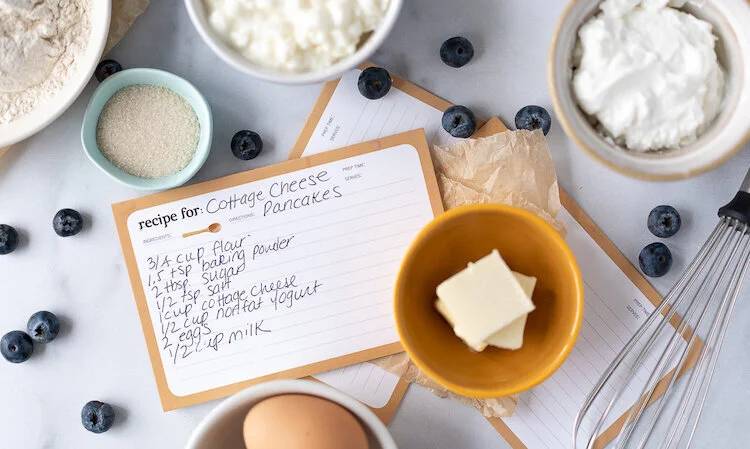
I encourage you to record handwritten recipes from your own kitchen (your kids’ favorite meals, holiday traditions) along with recipes from your family archive (the birthday cake passed down from your mother-in-law, the Old-World dishes that bring a taste of your heritage home).
Then take it a step further by jotting down the memories associated with those recipes. Ask the kids and other relatives to do so, as well (everyone has their favorites, no doubt, and it’s fun when memories overlap!).
Trust me, you are creating a meaningful—and delicious—legacy! Stash the cards in a recipe box, or use them as the raw material for a family cookbook.
A few ideas to get you started:
Grab a piece of note paper and jot down a list of recipes that hold meaning for your family. Don’t think just about holiday meals or complicated dishes—even that three-ingredient dish that you fall back on during busy weeknights should be included. My grandmother used mayo instead of butter to cook up the best grilled cheese ever, and you can be sure I’m passing that simple but critical tidbit on!
If the recipe was handed down by a relative, indicate with whom it originated, and any tweaks subsequent cooks have made along the way.
Consider asking family members to fill in cards and contribute them to your collection. It’s always wonderful to have notes in loved ones’ own handwriting, and reading the memories they attach to the recipes will be a tasty bonus.
Be specific.
Mention the cast-iron pan with the always-loose handle that Bubbe cooked his eggs in. The apron Aunt Ida wore only on Thanksgiving. How cherry Jell-o brings you back to your childhood, and the aroma of anise transports you to Brooklyn at Easter.
Details, details—the scents and colors and textures...the truth of the story lies in the details.

Want memory & writing prompts sent weekly?
Our 8-week Food Memories course provides expert writing guidance & thoughtful prompts to spark your memories, delivered straight to your phone—for just $15.








Life Story Links: July 15, 2019
Memoir suggestions to inspire your own autobiographical writing, business-building courses, and lots of first-person pieces that reveal the powers of story.
“We tend to be preoccupied by the present, with one eye cocked on the future. But history, after all, isn’t really about the past. Our history is about who we are right now and where, as a society, we’re headed (just as an obituary isn’t about death but about a life).”
—Sam Roberts

Noah Garland with his sons and some of their families. Southern Appalachian Project near Barbourville, Knox County, Kentucky, November 1940. Photographed by Marion Post Wolcott, courtesy U.S. Farm Security Administration.
Turn the Page
READING LIST
Memoir reading suggestions to inspire your own vignette-style life story writing, from Annie Dillard and Kelly Corrigan to Robert Fulghum and Sandra Cisneros.
BOOKS FOR THE AGES
“Books are a portal to our personal histories. Pick up a worn copy of a childhood favorite and you might be transported to the warmth of a parent’s arms or a beanbag chair in a first-grade classroom or a library in your hometown. Avid readers could build autobiographies around their favorite books...” With that, the team at the Washington Post has developed a fabulous list of what to read at every age, from one to 100.
MUST-READ MEMOIRS
The New York Times’s book critics select the 50 best memoirs of the past 50 years. Cool feature: Click the asterisks throughout the article to create your own list of must-read books. Do your favorites make the list?
Continuing Education
THE ART OF EDITING
Patricia Charpentier’s Orlando–based Writing Your Life hosted its first live webinar, The Art of Editing, on June 8. Catch a replay of the educational 90-minute webinar here.
RESCUING HISTORY
Personal historian Mary Voell's 16-week online course The Making of a Family Historian provides a framework and tools to organize and research family history before beginning your autobiographical writing.
True Stories Uniquely Told
TWO SISTERS, ONE MEMOIR
“Recently two sisters in their seventies asked if I could help them write a joint memoir,” Massachusetts–based personal historian Nancy West says. Though they lived in the same household, the sisters had substantively different childhood experiences, making the exploration of their shared past that much more fascinating.
PERSONALIZING IMPERSONAL RECORDS
Thor Ringler has run the My Life, My Story program at the the William S. Middleton Memorial Veterans Hospital in Madison, Wisconsin, since 2013. In that time the program has recorded life stories of more than 2,000 veterans—and placed the short biographies in each vet's' electronic medical record.
IMMIGRANT FORGER
“At almost the exact moment my family left Warsaw for the long trip across Europe to Antwerp and a ship to America, a second group started the trip as well, this one carrying forged visas and passports with the names of my family members,” Kenneth D. Ackerman writes in this investigation into the “the immigrant forger” Joseph Rubinsky.
THE ACHES AND PAINS OF MEMOIR
“The risk of nonfiction is that people are like ‘I know everything about you,’ and I’m like no, you just know this fun house mirrored projection of the people in my life through one lens, which is mine.” T Kira Madden, Roxanne Gay, and other memoirists on the dialogue around their writing.
THIS IS MY BRAVE
After chronicling her challenges of living with mental illness while raising two young children, and striking a chord with many people, Jennifer Marshall morphed her blog into a powerful nonprofit that uses storytelling as a tool for healing.
Time for Headphones
PODCAST, PERSPECTIVE
Believable is a podcast from Narratively “about how our stories define who we are.” Each episode “dives into a personal, eye-opening story where narratives conflict, and different perspectives about the truth collide.” In this episode, a woman’s struggle to corroborate her own life:
EXTENDING YOUR REACH
Listen to Lettice Stuart discuss incorporating public speaking into your personal history business marketing plan on the latest episode of Amy Woods Butlers’ The Life Story Coach podcast.
...and a Few More Links
Preserving your legacy of love before it’s too late
Focus on historical photography: the Daguerreotype
The blogger quietly preserving Maryland’s culinary history
A practicing psychologist on why we need memoirs
Short Takes

Life Story Links: March 11, 2019
An array of topics, from how to curate family heirlooms and photos to group biography recommendations and a son's loving personal history interview with his mom.
“I wish I had realized that family history is a perishable commodity. It disappears with time, as memories fade, and as loved ones pass on. I wish I had known that the most important aspect of family history is preserving a record of the present for the future.”
—Gordon B. Hinckley

Out of the Boxes
AMONG THE RESIDUE
This book was discovered among the papers not sent to the author’s literary archive in Oxford. "Its yellow and curling title page announced Really and Truly: A Book of Literary Confessions." And inside…the handwritten opinions of the owner’s grandmother, as well as those of Virginia Woolf and Rebecca West.
PRESS PRINT
In last week’s post “Sharing Is Good” I implore everyone to print—and share—family photos. Why? Because besides generating conversation, you will spark joy, find genealogy clues, and discover even more treasures.
CURATE KEEPSAKES LIKE A PRO
“Family curators have been organizing and saving family history for a lot longer than Marie Kondo has been teaching people how to discover joy in decluttering,” observes The Family Curator. "Trends. They come. They go. I’m happy to report that family heirlooms aren’t dead yet."
Storytelling, Your Way
GROUP BIOGRAPHIES
Carolyn Burke’s Foursome is a group biography that interweaves the lives of Alfred Stieglitz, Georgia O’Keeffe, Paul Strand, and Rebecca Salsbury. Here she shares five books that inspired, spurred, or otherwise helped her to think of writing group biography.
GREAT GRANDMOTHER’S GENEROSITY
Personal history varies from family history in myriad ways, though they often do (and should!) complement one another. Here is an example of piecing together a family narrative from documents, a worthwhile step in sharing genealogical research. Just imagine, though, if the people had recorded their own stories—how much richer the narrative would be!
“HAPPY VERY EASY”
“My parents are getting older and even though I have a good relationship with my mom…I’ve never had a super-deep conversation with her,” Kane says. Here he asks her 11 intimate questions “before it’s too late,” and the resulting video, full of playful banter and deeply moving moments, is a wonderful example of how effective—and relatively easy—at-home video interviews can be.
Opportunities Knock
THE LONGEVITY ECONOMY
“According to AARP, the economic activity of Americans 50+ is the equivalent of the third largest economy in the world.” Personal history is one of four career opportunities in the field of aging explored in a recent Forbes article.
SEEKING SUBMISSIONS
Madison, Wisconsin–based personal historian and educator Sarah White publishes first person stories on her blog True Stories Well Told. “Short, true, and diverse in genre—a reminiscence, a reflection on your writing process, a book review, a question—it's all welcome for consideration,” she says.
Voices Carry
“MAMA’S LAST PICNIC”
Margaret-Ann Allison, who would have been 83 years old today, shared a remembrance of “Mama’s Last Picnic” with NPR, where broadcasters were “so charmed by her soft southern accent that they asked her to read it aloud on the air.” While we can’t hear her honeyed voice, we can read it here, as shared by her daughter.
“WHERE THE TROUBLE STARTED”
A traumatic experience changes the course of a girl’s life, and eventually resides deep in a box in her mind. But, she writes from a distance of decades, “it does not belong in a tucked away box like a dark and dirty secret I can’t touch.” Saidee Sonnenberg tries to make sense of experience through writing.
VALUE OF LIFE REVIEW
”What it does when you go back and review your life”—by really digging in, getting to know your parents and their motivations and their parents’ motivations—is it leads you to empathy, Jane Fonda says during this brief interview where she revisits the writing of her memoir and memories of her mother.
...and a Few More Links
Untold story of the Warsaw ghetto: Who Will Write Our History
Help students become oral historians with these complete lesson plans from The Tenement Museum.
Taylor Swift says nostalgia inspires songs: “I love preserving memories”
“Oldtimers, tell your stories. Youngins, start asking.”
Fun tool: What book was the bestseller the year you were born?
See if the StoryCorps Mobile Tour is coming near you.
Short Takes
Life Story Links: February 12, 2019
Ruminations on the nature of memories, inspiration for using letters to inform memoir, a pining for handwritten recipes, plus a few family history reads.
“Certain moments are vividly conceived during adrenaline rushes—falling in love, thinking you’re about to get hit by a bus. But the brain isn’t a file cabinet…and what you forget says as much psychologically as what you remember.”
—Mary Karr

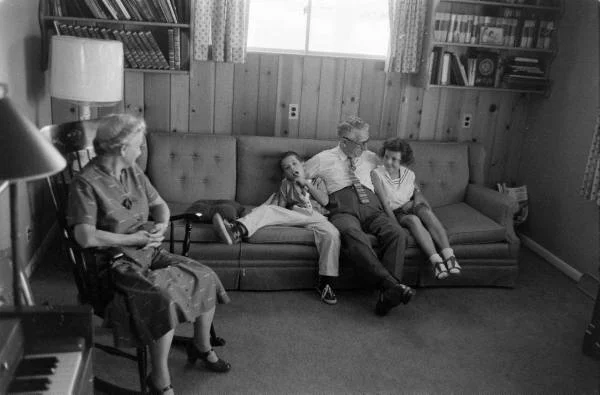
Retired man with family, 1959. Photograph by Stan Wayman for LIFE magazine. ©Time Inc.
On Memories and Memoir
DIARIST AS MEMOIR WRITER
An aspiring memoirist seeking famous writers’ letters and essays for motivation receives an inspired list of book recommendations. I can almost guarantee you’ll find something new to you and revelatory on the list.
“THIS IS MY LIFE”
“The past is a giant ball of tangled yarn that I simply do not know how to untangle,” writes N. West Moss in this keen meditation on the nature of memories. Later: “The thread of my own story spools from me like an endless ribbon. It says to me, ‘This is my life. This is my life.’”
CHOOSING YOUR STORIES
“If you answer a few interesting questions while you still draw breath, you will leave a gift of inestimable value to those who come after you,” writes Alison Taylor of Utah-based Pictures and Stories.
Pieces of the Past
FOOD OF LIFE
A reissue of Ntozake Shange’s If I Can Cook/You Know God Can (Beacon Press, 2019) prompts LitHub to share this deliciously personal excerpt. The book’s subtitle, “African American Food Memories, Meditations, and Recipes” merely hints at the rich and eclectic content within, a tribute to food as a people’s living legacy.
RECIPE FOR NOSTALGIA
“The internet is making paper recipes obsolete, but many modern cooks see the cards as tangible mementos of favorite foods and the beloved cooks who made them over and over again.” Frayed edges and oil stains? All the better.
VOICES FROM LONG AGO
Susan Hood of Remarkable Life Memoirs in New York shares a handful of handwritten letters she revisited among her parents’ things, feeling reconnected to them and gleaning a bit of family history along the way.
OBJECT LESSONS
We all know how photos and family heirlooms tell stories, but what about objects as mundane as bakeware? Are there simple objects that reflect significant truths about who you are?, asks Massachusetts–based personal historian Nancy West.
Family History Reads
DIGGING STUFF UP
“They’re the myths that are a part of the story of yourself, whether you like them or not,” Jaya Saxena writes of uncovering genealogical facts. “Learning your history is forced reckoning, asking you to consider whose stories you carry with you and which ones you want to carry forward.”
#NOTATROOTSTECH2019
You needn’t travel to Utah to benefit from the family history event of the year, RootsTech. Discover how you can learn about storytelling, interviewing, and genealogy from the comfort of your own home.
...and a Few More Links
Urban Archive invites New Yorkers to submit photos for their new crowdsourced history project.
Familygenealogy.online launched tools and resources for exploring family trees.
HippoCamp, a conference in PA for creative nonfiction writers, has opened early-bird registration.
“How to Turn Your Parents’ Stuff into Something Cool”
Short Takes

Life Story Links: Blog Roundup, March 20, 2018
Personal historians weigh in on the urgency to tell your life stories, the intersection of downsizing and memoir writing, and how to write about family secrets.
“The past, like the future, is indefinite and exists only as a spectrum of possibilities.” —Stephen Hawking
Of Interviewers...
LOVE AND LOSS
Personal historian Lisa O'Reilly, of Carpinteria, California, writes “To Mom, With Love,” a most personal and urgent message that calls upon us all to capture our loved ones’ stories...before it is too late.
THE STORIES THAT WE WEAVE
Amanda Lacson of NYC’s Family Archive Business LLC distills some of the lessons she learned at Columbia University’s Oral History MA workshops, and discusses how we, as biographers and personal historians, can earn and tell better stories for our clients.
MEMOIR MOTIVATED
“There’s no quicker way to rip us off the rollercoaster and park us on the granny-bench than to adverb your verbs.” Just one of the colorfully on-point writing tips in Cyndy Etler’s “How to Write Memoir So They Don’t Read It, They Live It.”
SENIORS & THEIR STUFF
Discussions with professional organizers led MA-based Nancy West to discover interesting points of intersection between her work and theirs: How writing your memoir can help you declutter, destress, and maybe even downsize.
...and Interviewees
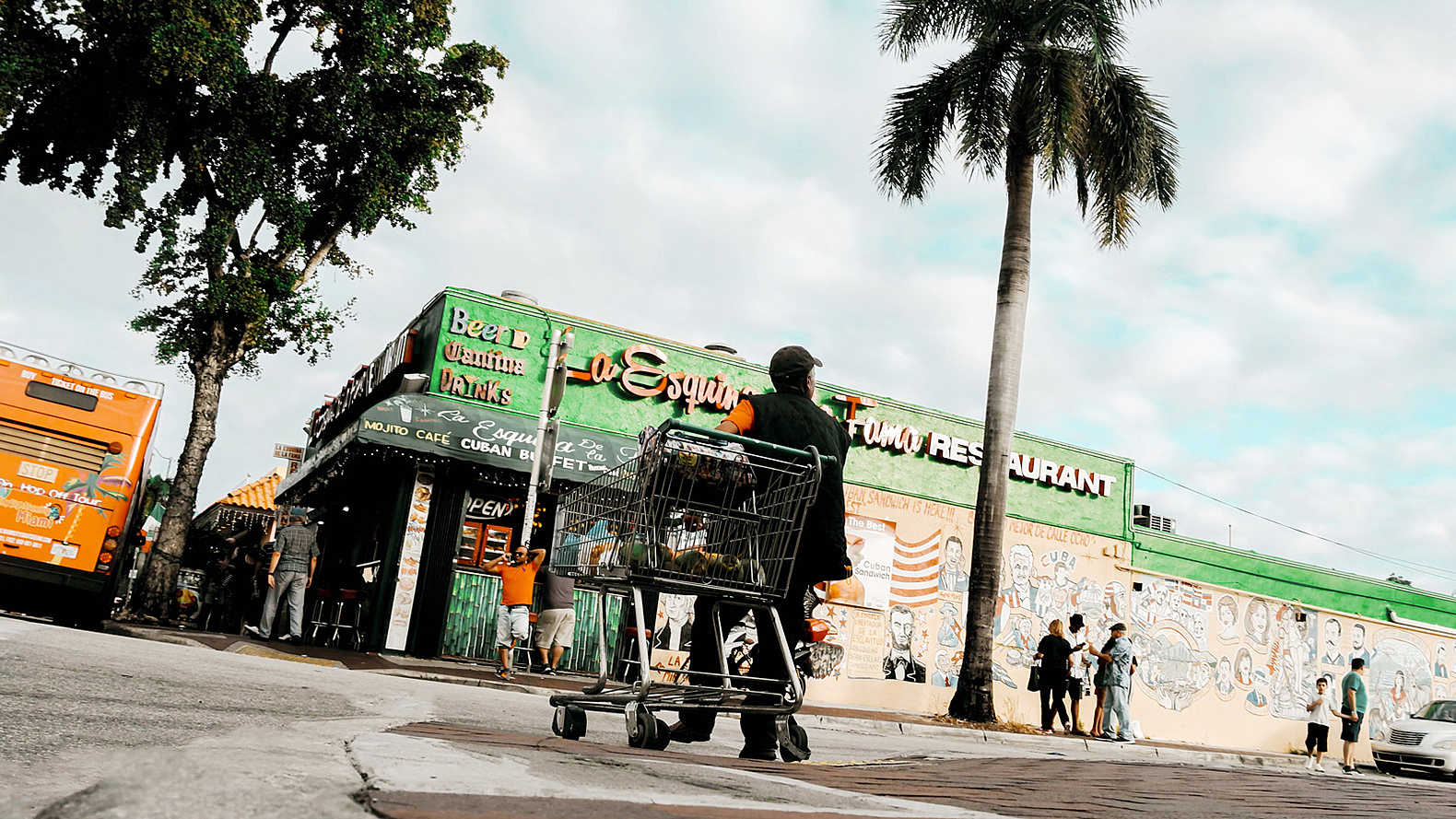
THE PLACE THEY CALL HOME
Miami’s iconic Little Havana neighborhood is home to an interactive museum exhibit that invites audiences to step into the daily lives of ten local residents whose passion, creativity, and penchant for history is ensuring that future generations will experience the Little Havana they know and love. Get a taste of their stories.
WHAT’S IN A NAME?
“We spend our life identifying ourselves by our name,” writes Karen Bender of Virginia-based Leaves of Your Life. “Your name will go on the cover of your book. Surely, your feelings about that name warrant a paragraph or two within its pages.”
FIRST PERSON
“I ate until I was stuffed full of memories.” Esmé Weijun Wang finds her way back to a beloved childhood dish.
...and a Few More Links!
- Lisa Pontoppidan of Boston-based Personal Story Films shares why she loves capturing stories—and personalities—on film, including “the spirit that shines from their eyes.”
- Freeze Frame: A panicky realization that some of my most cherished photos might be left out of my family archive led me to write this cautionary tale.
- The Audio Transcription Center rounds up seven digital recorders recommended for oral history interviews.
- Amisha Padnani, digital editor on the obituaries desk at the New York Times, has turned an idea for recognizing overlooked women into a movement.
- “My grandmother taught me that stories aren’t important because they’re written, they’re important because they’re living, embodied in the teller and the listener alike,” writes Kristin Chang.
- Digging into your family history you will find all kinds of people. Once a dark secret is uncovered, what should you do?
Dawn Roode’s curated roundup for the week of Sept. 23, 2026, is overflowing with recent reads on memoir, life story writing, and family history preservation.