
Memories Matter
Featured blog Posts
READ THE LATEST POSTS

“To be continued…”: When breaking up a family history interview is wise
There are a variety of reasons—including traumatic memories—when pausing a personal history interview is the best course of action. Give in to the silence if...
There are many times when it’s good to hit the proverbial pause button during a personal history interview—you can always pick up the topic during another session.
I was in a meeting with fellow personal historians recently when we got on the topic of helping our clients discuss challenging times during their personal history interviews. There was so much wisdom in that (Zoom) room and one thing I jotted down was a simple phrase: “To be continued…”.
In this case, we were talking about a son wanting to hear about specific—difficult—times in his mom’s life: These were things she didn’t talk about with her family, but that certainly contributed to her identity and outlook on life. It’s understandable that he would want to learn more about his mother’s experiences. But—and this is a big “but”—when my fellow personal historian brought up this topic during an interview session, the person answering questions only went so far before getting quiet. Was it too awful to probe? Was the subject paralyzed by bad memories associated with the experiences? Did she even want to “go there”?
As trained personal historians, my colleagues and I are accustomed to giving people space—space to formulate answers, to think, to spend time exploring memories and being heard; it is a sacred space. Often moments of quiet during an interview will lead to meaningful and surprising stories. But sometimes, well, they won’t—sometimes, those extended silences may go nowhere. And that is 100-percent okay.
And sometimes, those silences are productive in another way: A seed has been planted via the question, and that seed needs time to germinate. Hence, that phrase I took note of: “To be continued…”.
Saying those words out loud either at the end of an interview or after a pregnant pause in the midst of an interview gives the subject time and space. The words are a recognition of the fact that, yes, we can continue this topic another time. That, yes, it’s okay to give it some breathing room. And that, no, we don’t need to finish this conversation right now.
Remember, though, that it’s not only a probe of traumatic experiences that may necessitate those words, “to be continued.” You may want to turn the conversation towards something lighter and more fruitful during a personal history interview in other circumstances, too. Here are a few instances where hitting the proverbial pause button on your interview (or at least on a topic that ends in a prolonged silence) can be beneficial:
Decide to resume discussion of a topic in a subsequent family history interview when:
the interview subject feels like exploring the current topic (whether involving trauma or otherwise) is too emotional, too difficult, or too uncomfortable
the interview subject would like to consult with a family member to check details on a sensitive memory or story
the interview subject is feeling tired
the interview subject has expressed that they would like to think about how to approach the topic
the topic being discussed could reveal things that negatively impact a loved one or other individual (in this case, be sure to reiterate that anything that comes up during the interview can be removed later, whether from an edited recording, a transcript, or a book).
One other thing worth noting: All of the above reasons for breaking up a personal history interview involve some form of challenge, but there’s another strong reason for resuming conversation again later—quite simply, because every time we tell a story, new aspects of our memories may come to the fore. So each new telling of a story may add texture, details, meaning. “No memory is ever alone,” Louis L’Amour wrote, “it’s at the end of a trail of memories, a dozen trails that each have their own associations.” So take one trail today, another tomorrow. Give your subject space. Let them know it’s more than okay for your conversation “to be continued…”.






On the ever-changing nature of our stories: In conversation with Rachael Cerrotti
Our memories are anything but fixed—and when stories are passed down to a new generation, their malleability, their meaning, and their impact change, too.
“It’s the best part of storytelling for me, that it’s never going to stay the same.”
—Rachael Cerrotti
Memoirist and host of the podcast “We Share the Same Sky,” Rachael Cerrotti
Rachael Cerrotti knew her grandmother Hana’s story when she was growing up. Hana, or Mutti, as she was called by her loved ones, was a Holocaust survivor. She visited schools to share her testimony with young students. She spoke with Rachael about her past.
But stories have chapters, and they are received differently by different people at different times in their lives. Stories can be told one way to a group of students, and another to a young, devoted granddaughter. Those same stories may take on an entirely new mien when handwritten in a private journal, captured in the moment with no distance for reflection.
What is Hana Dubová’s story, then?
Well, of course, there isn’t just one.
Rachael—a granddaughter, photojournalist, podcast host, and author—has explored her grandmother’s story faithfully. During her college years, cognizant of the fact that Hana was getting older, Rachael began getting together regularly with her grandmother, recording their conversations along the way. After Hana passed away in 2010, Rachael says she spent the first half of her twenties on her bedroom floor in Boston, going through Hana’s diaries and the rich archive she left behind. She would eventually retrace her grandmother’s footsteps, traveling through Europe and getting to know, intimately, those who knew Hana and her story. As Stephen D. Smith, executive director of the USC Shoah Foundation, writes in the foreword to Rachael’s book, We Share the Same Sky, “She made her grandmother’s homes and hiding places her homes, her places to hide.”
I have recommended We Share the Same Sky in a formal review and gifted the book to friends; I have extolled the podcast—a must-listen for anyone who values stories and family; and recently I was fortunate enough to chat with Rachael about the (inevitable, frustrating, and beautiful) flexibility of memory.
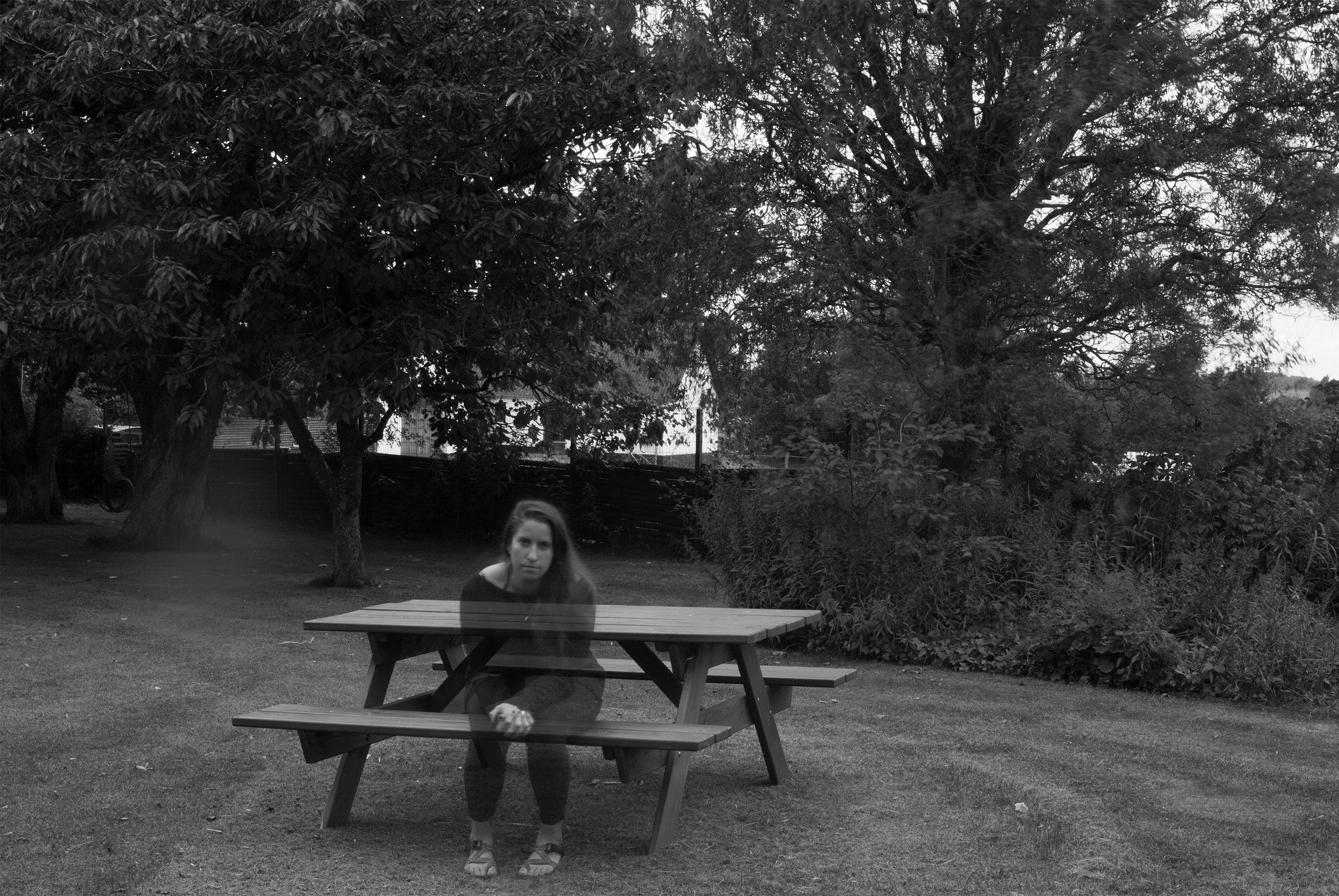
The same stories may hold different meaning for us at different times in our life.
“The story has grown up as I have grown up,” Rachael writes in the preface to We Share the Same Sky.
While Rachael gradually reveals Hana’s story to us, she also weaves in her own perspective and life changes, making for a poignant and powerful meditation on the meaning of inherited trauma and the elasticity of memory. She writes to her grandmother: “Your diaries and letters are the literature of your past, and each tells a slightly different story. I read and reread your stories as if they were fables, modern-day fairy tales that are constantly changing meaning. Every time I open to a familiar page, I read the words in a new way.” And isn’t that the nature of all family stories?
Often I talk about the enduring value of our stories: When we hear stories from family members about their experiences, we usually ruminate longest over the ones that feel the most familiar to us. Rachael echoes this during our conversation, admitting that if she is one day blessed with being a mother and a grandmother, she will most certainly see her grandmother’s stories in a new light again with each milestone.
When Rachael revisited her grandmother’s testimony after her husband’s death, she found new meaning, new depth there: “It was guidance and it was permission and it was warmth, and the words just carried everything within it,” she said.
“I think we're all drawn to stories that impact us in some ways and that feel relevant,” she said.
“We all kind of hold onto the stories that we need to hear, and I think a lot of us dig into our past trying to reckon with something or to try to understand ourselves better,” Rachael said. “Realizing that our memories are malleable gives us some ownership over them, different than just being resigned to them.”
Beyond fact-checking: Our narratives hold truths, even when they are contradictory.
While We Share the Same Sky is based on Rachel’s own experiences and research during her immersive travels as well as her grandmother’s personal writing, she did not turn to libraries or historical records to fact-check her grandmother’s stories (except for instances when an occasional age or date did not cohere).

“What I was always drawn to was the stories we tell ourselves and the stories we tell our kin, and those have nothing to do with the archives,” she told me.
In the book, she writes: “There are cracks in all our memories; sometimes they are exposed by our own inconsistencies, sometimes they are challenged by other people’s perspectives, and sometimes they change with time.”
Indeed, have you ever reread an old diary entry only to wonder, Did I really write that? Or even, Did I really feel that? Has the way you have told a single important story—say, coming out of the closet as a teen, or emigrating to a new country—changed over time? With time comes perspective, and with perspective comes a new way of regarding our experiences. Each telling of our stories reveals new truths.
“Stories do not have to be stuck in time,” Rachael said. “There are so many versions of stories that can all contradict each other and still all be truthful.”
Our ancestors’ stories become our stories.
One of the things that drew me to Rachael’s body of work, I told her, was how she deftly wove Hana’s story into the fabric of her own. Stephen Smith recognized this, too, writing: “What Rachael seemed to know is that her jumbled identity was not a godforsaken hand-me-down but a tapestry of individual stitches that needed to be understood to appreciate the whole. As you read this book, you will see each of those colorful stitches painfully embroidered into her life one by one.”
“Originally this was a story of people that had passed away,” Rachael told me. “This was a story of history. And then getting to meet all these people and having them meet my curiosity where it was at—that was this invitation to keep coming back.”
“These relationships don’t stop because you’ve stopped writing the story,” she said. “The story doesn’t end because you send it in to the publisher. That’s that chapter, and that’s okay.”
Hana’s life has informed and shaped her granddaughter’s. And Rachael has honored Hana’s legacy by revealing the nuances and truths in her diaries, and by encountering—and re-integrating—her stories again and again. In the epilogue, she writes directly to Mutti:
“I have completely lost myself in your story, creating for myself an experience out of each of your retellings. What started as a simple family history project has become this web of community. When I pull a thread in one part of the world, the story in another place changes. Your memories have become my landmarks, the symbols of my own past.”
Each of us is writing our own narrative, transitioning from one chapter to the next, weaving our ancestors’ stories into our own. I hope you will read We Share the Same Sky with this in mind, and—as Rachel hopes, as well—inspire conversation and story sharing between not just grandmothers and granddaughters, but among generations of your own family.
Discover Rachael Cerrotti’s work
Listen to her podcast of the same name.
Follow her on Instagram for updates on her life, upcoming appearances, and future endeavors.
And perhaps most exciting, Rachael is launching a new podcast this week, called The Memory Generation, subtitled “Conversations about our memories.”


























Affiliate disclosure: As an Amazon Associate, we may earn commissions from qualifying purchases from Amazon.com.
Dawn Roode’s curated roundup for the week of Sept. 23, 2026, is overflowing with recent reads on memoir, life story writing, and family history preservation.