
Memories Matter
Featured blog Posts

READ THE LATEST POSTS
Life Story Links: December 11, 2018
Fine examples of first-person storytelling to inspire your own life story writing, plus wisdom on reminiscence & a look at the legacy of Pearl Harbor survivors.
“I do not understand how memory works, I say, how we think we remember things that never happened and how we can forget the things that have. I want to know what I would find if I unspooled my memories and laid them out against my mother’s and my grandmother’s. I imagine the textures and seams of our competing recollections; I imagine them synthesizing to form a richer whole.”
—Crystal Hana Kim

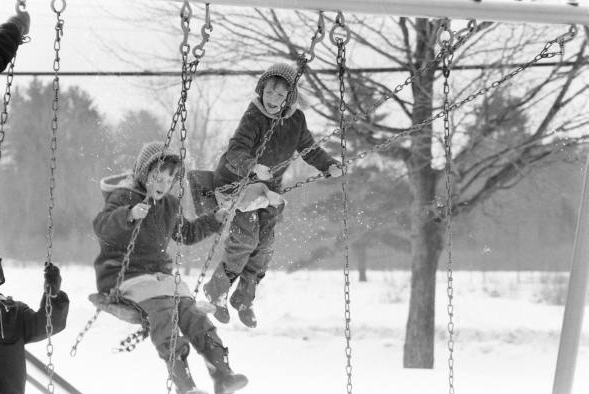
1st Grade Twins on Swings, 1963. Photograph by Yale Joel for LIFE magazine. ©Time Inc.
First Person Reads
EATING TO AMERICA
“When I wanted to have a family just like everyone else’s I could slide into a booth at Pizza Hut and in the darkly lit restaurant my odd family could almost pass for a mom and a dad and two kids, and maybe even American ones, as long as we whispered,” writes Naz Riahi in this delicious read.
CUTS AND QUESTIONS
“He ran his hands through his hair inspecting just like he had inspected my sewing at age seven, my planting at age twelve, and my oil change at age fifteen,” writes Yollotl Lopez in her tribute to eight years of hair cutting—and loving ritual—with her father.
SCENES FROM A LIFE
In “The Proposal and the Purse,” personal historian Deborah Wilbrink relays scenes from an almost-relationship. Her first-person vignette, hosted on Sarah White’s True Stories Well Told site, is indicative of the type of writing Sarah teaches in her flash memoir classes.
Remembrance, Reminiscence & Legacy
CELEBRATING HANUKKAH WITH STORIES
“Unless people intentionally take the time to ask questions, we often don’t get to hear the stories of our elders,” says Rabbi Susan Goldberg, who designates Hanukkah as an optimal time to ask those questions.
PEARL HARBOR MEMORIAL
For the first time, there were no survivors of the USS Arizona at the annual ceremonies marking the December 7, 1941, attack on Pearl Harbor. “It wasn't the pages of a book—it was your life. It was your mother, your brother. It was your house going up in flames in bombings.” Memories that survivors have carried for so long live on in oral histories.
CONFERENCE TAKEAWAYS
In my latest post I share thoughts from the 2018 International Reminiscence & Life Review Conference including compelling anecdotal evidence on the value of reminiscence work, research challenges, and the shifting nature of autobiographical memory.
...and a Few More Links
The best reviewed memoirs and biographies of 2018
How millennial parents are reinventing the family photo album
“If you want to write a great book, hire a scribe.”
The StoryCatcher app has been updated.
Short Takes

“Nobody ever asked me before”
Thoughts from the 2018 International Reminiscence & Life Review Conference including research challenges, anecdotal evidence, and autobiographical memory.
Thoughts on Reminiscence and Life Review
I recently attended the 2018 International Reminiscence and Life Review Conference in Boston, where researchers and practitioners presented an abundance of new information, much of it evidence-based, about the value of life review.
And while the data is certainly thought-provoking, it was the personal (subjective) narratives of those in attendance that I found most inspiring—and reflective of my own experience.
The Limits of Reminiscence Research
I am not a medical or scientific researcher. I was impressed nonetheless with the efforts of researchers to quantify how reminiscence can help individuals with dementia or mild cognitive impairment, for instance, or patients with symptoms of depression.
At a time when one of the world’s largest pharmaceutical companies has halted research into finding new drugs to treat Alzheimer’s disease, more money is currently being spent to research the impact of reminiscence and life review on patients with mild dementia or cognitive impairment than any other non-pharmacological intervention, according to Pam Schweitzer, MBE, founder of the European Reminiscence Network.
Anecdotal evidence of reminiscence’s value mounts and flourishes and is shared at a conference such as this, and the circle of telling and recognition and telling of similar experiences is not only affirming, but exciting. Yet the overarching theme was how to find ways to conduct more effective randomized control trials that yield compelling results.
I will leave the studies and scientific quest for data to the experts (and follow their results with great anticipation!). In the meantime, I am heartened by their stories.
Wisdom, Takeaways & Tips from the Conference
There is power in the asking.
During a presentation chock-full of study names and journal links, what stayed with me days later was a five-word quote: “Nobody ever asked me before.”
In a 2004 paper describing her research into facilitating reminiscence and learning about the life experiences of older African-Americans, Juliette Shellman, Ph.D., APHN-BC, designated this as one of five major themes to emerge. “Nobody ever asked me before.”
In my mind, this quote could be attributed to any one of us—any age, any race, religion, or background. It is a recurring theme in my own work, and one of the reasons I find conducting personal history interviews so rewarding: Because once someone does ask, what comes forth from the subject is, well, everything.
I know the power of being a compassionate, open-hearted, and curious listener—do you? Try asking a loved one to tell you some of their story. What ensues will be as much a gift for them as it will be for you.
What helps spark memories in patients with dementia works as well with…everyone.
“Allow time, listen well, and reflect back what people say to encourage and support them,” Pam Schweitzer said.
“Speak slowly.” Be clear, and listen attentively.
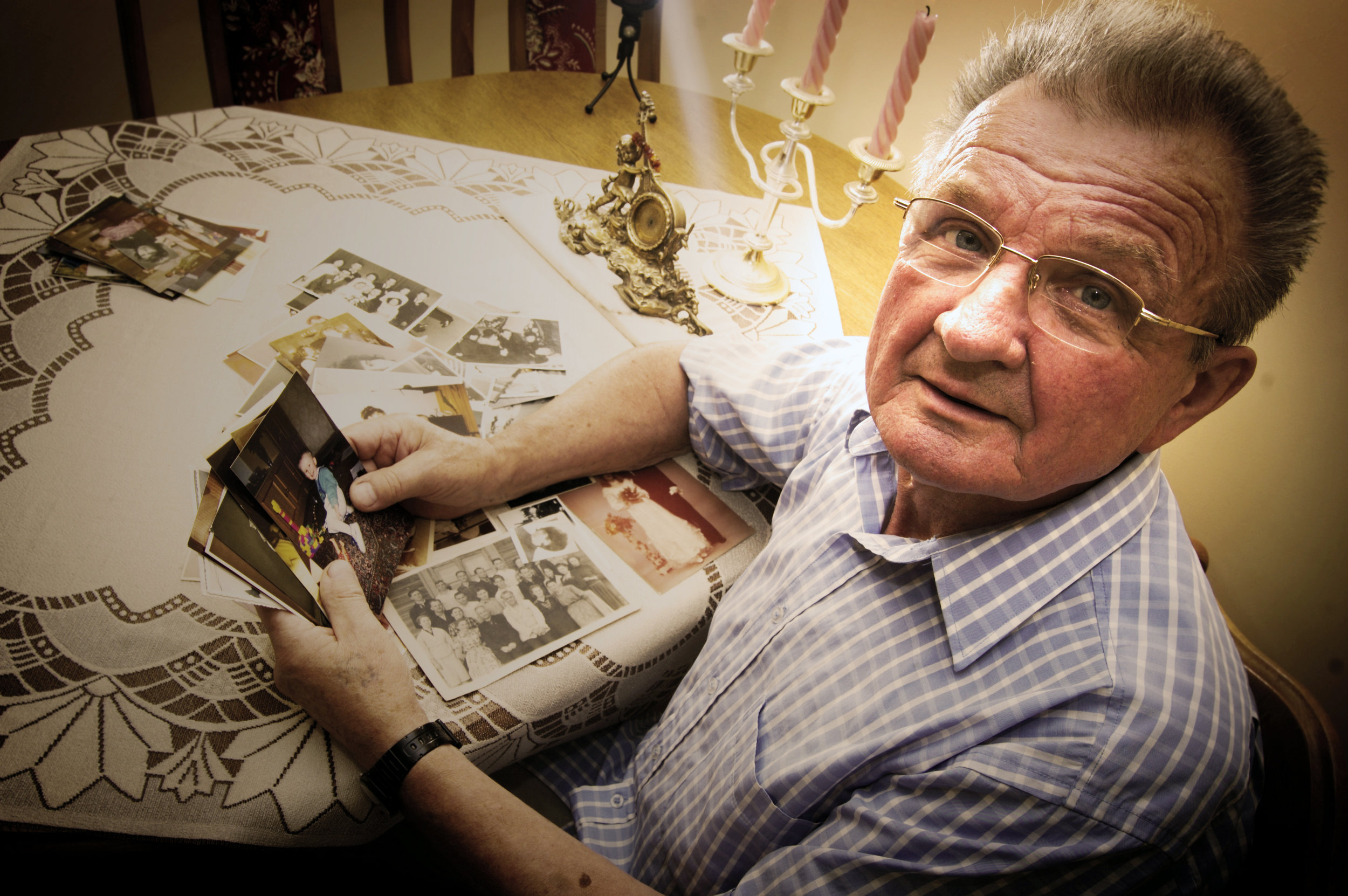
“Use multi-sensory stimulation.” Show old photos, play favorite songs, spark memories through the senses, not just through spoken words.
Yes, these approaches are proven to help guide and support individuals with mild cognitive impairment on their journey of remembering, and we must be especially cognizant of them when conducting interviews with those individuals. Don’t forget, though: These techniques are effective, thankfully, with anyone.
Find tips for engaging in an informal life review interview here.
We all place a premium on our memories.
Most people intentionally create memory aids—scrapbooks or drawers filled with ticket stubs and souvenirs; diaries that chronicle our lives and search for meaning in our experiences. Our devices filled to brimming with family photos (often numbering in the thousands) are perhaps the clearest evidence of documenting our memories.
In today’s technological age, which kinds of memories are we documenting—and how accessible are they? Do these physical reminders (often lost in that long device scroll) extend or alter our autobiographical memory?
These questions were the basis of a lively discussion about how we regard, preserve, and honor our memories as they are catalogued on social media. Apps have proliferated in recent years to help us recollect all that we have posted and shared: The Museum of Me, My Social Book, and After Me among them.
Many of these apps mine personal data from Facebook, Instagram, and other social media platforms to create an (auto)biography. The idea sounds nice, but often the “memories” they present are a superficial, even distorted, representation of the self. Random memories from social media do not equal biography, nor do they, in my opinion, often aid in a search for meaning amidst our memories, for our social media is inherently biased toward positive experiences.
An automated biography is indeed not autobiography in the true sense.
The questions that will continue to interest me are: How do our digital and internal memories interact with one another? Does taking a picture interfere with the quality of an individual memory?
And, as a personal historian, editor, and memory-keeper myself, I will always regard memories as most meaningful when they lead to contemplation. Reminiscence in the truest sense should help us clarify our thinking about the turning points in our life, and enrich the meaning of our life story.
Social media will continue to provides us with important touchstones in our memory-keeping. And all these apps that aim (not always successfully) to “curate” our memories and create a “legacy,” if nothing else, prove to me that collectively, we yearn for reminders of our past and value our memories.
But when it comes to creating—telling, writing, sharing—our life stories, personal reminiscence and curation is still the gold standard.
Related Reading
Efficacy of life review and reminiscence interventions for different target groups, and successful intervention methods, per a 2006 research study
An introduction to narrative medicine: How stories nourish empathy
Dawn Roode’s curated roundup for the week of Sept. 23, 2026, is overflowing with recent reads on memoir, life story writing, and family history preservation.