
Memories Matter
Featured blog Posts

READ THE LATEST POSTS

Exhibit reveals history through personal portraits: “Survivors: Faces of Life after the Holocaust” review
“Survivors: Faces of the Holocaust” will be on display in New York City until the summer of 2023—here’s why you should see the exhibit's powerful photographs.
The monograph of photographs by Martin Schoeller, Survivors: Faces of Life after the Holocaust
On Sunday, September 18, 2022, I attended the opening of an exhibit at The Museum of Jewish Heritage in downtown Manhattan, “Survivors: Faces of Life After the Holocaust.” On view through June 28, 2023, you have ample time to visit—and I suggest that you do.
The exhibition, which showcases 75 large-scale portraits taken by renowned photographer Martin Schoeller, originated at Israel’s Yad Vashem to mark the 75th anniversary of the Liberation of Auschwitz in 2020.
Schoeller photographed these Holocaust survivors and created a short film documenting the process. The New York exhibition includes the entire body of work including the film, brief biographies, and quotes from the sitters.
In an Instagram post that coincided with the original release of the portrait series, Schoeller wrote, “The Survivors in this series, having endured the most appalling campaign of hatred in modern times, stand in for all of the wronged and aggrieved people of the world. And, in their spirit of generosity and warmth, they offer an inspiring testament to the best of what we can be.”
Click through to that post and those that immediately follow it to see many of the portraits included in both the exhibit and the monograph available for purchase.

The poetry of photographic storytelling
Henry Greenspan, whose book On Listening to Holocaust Survivors: Recounting and Life History, approaches the idea of inviting and listening to a survivor’s testimony as an ongoing conversation. He “shows us the ways survivors do ‘make stories’ for the ‘not-story’ they remember. Just as important, he shows us the ways they are not able to do so,” reads the book jacket.
Why quote this book here? Because no testimony is a complete story. No recounting of an individual’s Holocaust experience can be considered representative of history. And what survivors cannot say—what they deem will be ‘unhearable’ by listeners, what they cannot find words to describe—tells as much of their story as the words they have chosen to convey.
A former client of mine—a man who survived Camp Les Mille in France, and whose oral history now resides in the museum housed there—told me of his experiences at length. After an extended silence, he said, “A poem would be best. Things left unsaid that are unsayable. Allusions. Maybe that is what’s needed. But I am not a poet, so there are some things I cannot tell you.”
All this, I suppose, is prelude to my observation that Martin Schoeller’s photographs in this exhibition are poetry: individual portraits as stanzas, lines, that say a great deal—but taken together, all together, they form a visual poem that can only allude to the magnitude of the tragedy, the miracle of resilience, and the humanity and power of bearing witness.
And that is why I implore you to visit—for the juxtaposition of these 75 images in the rotunda, so tightly displayed and so imposing in stature, so gloriously alive and so undeniably affecting…and for the individuals whose faces, and whose stories, are represented therein.
Learn more about “Survivors: Faces of Life After the Holocaust”
Find details about visiting the exhibition, “Survivors: Faces of Life After the Holocaust” at The Museum of Jewish Heritage in New York City.
Scroll down to posts dated August 24, 2020, on Martin Schoeller’s Instagram feed to encounter some of the personal portraits taken for this project.
Purchase Martin Schoeller’s monograph (a stunning book I bought at the museum): “Presented close-up and larger-than-life, every feature of Martin Schoeller’s subjects provides us with a piece of personal and collective history: their faces observe us, their gazes hold us. The lines they bear evidence horrors endured, as well as the triumph of their survival and building their lives anew.”
Browse some of the photographer’s other work, including his signature close-ups of celebrities and other cultural icons and provocative series of homeless individuals and death row exonerees.
Watch a recording of the opening-day Q&A between photographer Martin Schoeller and Sara Softness, the curator of special projects at The Museum of Jewish Heritage; this recording also includes a clip from the moving behind-the-scenes video that accompanies the in-person exhibition.


























“To Write the Past”: A supportive companion for thoughtful memoirists
This small yet dense self-published book comprises nine essays in which writer Sara Mansfield Taber aims to answer “the questions that plague the memoirist.”
To Write the Past: A Memoir Writer’s Companion by Sara Mansfield Taber
In my constant effort to keep up-to-date with the latest on memoir writing—particularly craft essays and books—I ordered the custom-published volume To Write the Past: A Memoir Writer’s Companion by Sara Mansfield Taber.
The book promises “to hearten and embolden those who pick it up to set their memories and musings on the page.”
To be sure, the eight essays within To Write the Past are thoughtful and at times thought-provoking, and the word “musings” is an apt description of the meandering style with which Taber approaches her topic. (The title’s sub-subheading reads, “Musings on the Philosophical, Personal, and Artistic Questions Faced by the Autobiographical Writer.”)
Book review:
“To Write the Past: A Memoir Writer’s Companion” by Sara Mansfield Taber
Taber is most qualified to write about memoir, having penned two memoirs herself and taught autobiographical writing for more than two decades at universities and in group workshops. As a writing coach she says she “has midwifed hundreds of memoirs into being.”
But her expertise on display in this book is broad, philosophical, pensive. You won’t get tips for creating a compelling narrative or weaving dialogue into your stories. You will, however, feel supported. A sense of “we’re in this together, fellow memoirist” pervades the book.
Some essays spoke more directly to me than others, and I have no doubt certain themes will resonate more with you than others based on your own experience as a writer. Taber approaches her topics, as perhaps one would expect a memoirist to do, firmly rooted in her own experiences writing, publishing, and reading memoirs.
The first few essays gripped me the most—I related to them, as a human, a fellow writer, and a personal historian.
On the topic of why we write memoir (something I often consider and write about myself), my yellow highlighter swept across passages. A few favorite lines, so you can get a taste of Taber’s tone and insights:
“Upon my father’s death, up-wellings of love for him, and for my whole past, swirled into the surges of grief, forming a roaring tide of need—to write.”
“As I wrote, it was as if I was writing about some other girl I once knew well. I sensed that she might be of some use to me even now, many years later.”
And:
“By writing, I dig a pool to catch all the joy and pain that constantly leaks from the years past.”
That last quote in particular captures my own urge to write, and oh, how beautifully expressed!
Taber’s musings on the question of legitimacy (“who am I to write my story?”) were familiar and affirming. On who one should be writing for, her thoughts were arresting and fodder for future contemplation. The essay exploring “the question of truth”—one of my favorite topics to discuss with fellow writers—was less exciting for me; “truth is multiple,” she writes, but I wanted more—more than “this is one story of my life.” (For anyone especially intrigued by the notion of writing your truth, I recommend Beth Kephart’s singular Handling the Truth: On the Writing of Memoir as well as her follow-up workbook, Tell the Truth. Make It Matter.)
The essay that resonated least with me concerned the notion, “Should I write something so personal?” I admit: I haven’t questioned this in my own writing. I haven’t encountered such criticism that Taber seems to have (quite strongly, it would seem) that her self-revelations are “too personal.” Her intense—and lengthy—defenses of getting personal felt overdone, though they may speak to you if this is an idea you, too, struggle with.
Overall, To Write the Past is a comforting and considerate meditation on undertaking to write a memoir. Check it out if you want to commune with a likeminded spirit, and to find compelling reasons to move forward in the face of criticism, doubt, or struggle. “There are so many things that get in the way as we endeavor—valiantly or timidly—to set down our autobiographical paragraphs,” Taber writes. Her essays strive to help you navigate those invasive thoughts, circumvent the roadblocks, and find your way on the path to a memoir—your memoir, finally written.
Why? Because: “A memoir is a prayer, an offer of company, an invitation to dinner. An offering of honesty…to whomever will receive it.” A worthy endeavor, indeed.
Note: This is an unsolicited review of a book I purchased at full price. I did not receive any compensation or free products in exchange, and any endorsements within this post are my own.

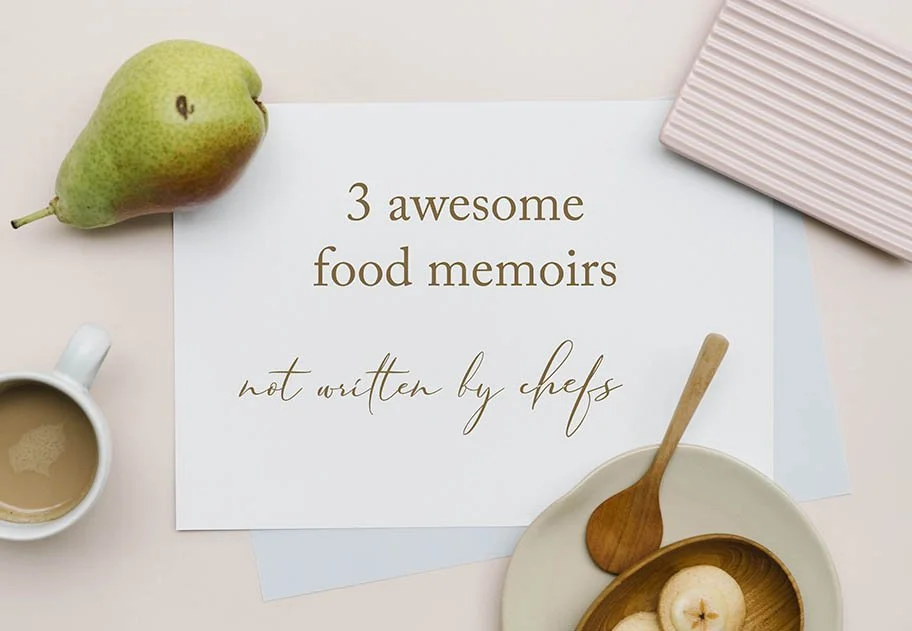
3 awesome food memoirs not written by chefs
Favorite food memoirs that deliciously incorporate recipes and sense memories—fine examples of how you, too, can weave a personal narrative inspired by food.
What is a “food memoir”?
Browsing various online lists of the best food memoirs, one might think they must tell the tale of a chef’s life. Among almost every top-ten list: Anthony Bourdain’s Kitchen Confidential; Jacque Pepin’s The Apprentice: My Life in the Kitchen; and, of course, Julia Child’s My Life in France.
And then there are the divine stories of the food critics and journalists—those who have immersed themselves in the sensuous world of gastronomy professionally—who write memoirs that center around their tables. Among my favorites: Ruth Reichl’s Tender at the Bone and, more recently, Save Me the Plums; Jeffrey Steingarten’s The Man Who Ate Everything; and Born Round by Frank Bruni.
All of the aforementioned memoirs are well worth getting lost in.
But what about the stories of those for whom food simply taps into deep-held memories? For whom the smell of a certain dish transports us back to our childhood kitchens? We needn’t be professional chefs or food writers to deliciously incorporate recipes and sense memories into our life story writing.
If you are looking for some inspiration for weaving food memories into your own memoir writing—or if you just want to read some incredible books that happen to include tasty morsels throughout—add these food-inspired memoirs to your reading list.
title no. 1
“Trail of Crumbs: Hunger, Love, and the Search for Home” by Kim Sunée

(Grand Central Publishing, 2008)
Hailed as “brave, emotional, and gorgeously written” by Frances Mayes, Kim Sunée’s memoir, Trail of Crumbs, struck me as simultaneously tender and bold as she detailed a decade-long period spent living and traveling through Europe. While the locations and foods are exotic (from Harry’s Bar in Venice to her lover’s various homes in Provence, France, and beyond), an undercurrent of sadness prevails as the young writer struggles to find her place in the world. After being abandoned in a marketplace by her Korean mother at the age of three, Sunée was adopted by an American couple and raised in New Orleans—and subsequently spends most of her twenties on a tremulous search for identity.
From Kirkus reviews: “From the crumbs in the fist of an abandoned three-year-old to bowls of richly sauced pasta, her text chronicles the entwining of food with security and love.”
Does the book include recipes?
Yes. Most chapters end with a handful of recipes that Sunée has cooked—and found some comfort in—including crab crawfish she learned to make from her grandfather; kimchi, the traditional fermented cabbage dish of her Korean heritage; and a variety of Provençal dishes including wild peaches poached in Lillet Blanc and lemon verbena, orange couscous, and gratin de salsify.
Author insight:
“…cooking, for me, became like language: another form of survival. It was probably the only thing that I thought I could do well. And, like with my grandfather, it was a gift. It was a way to give love to other people.” —Kim Sunée
Memorable quote:
“Somehow, I thought he’ll never realize that the everything he wants to give me will never take away the nothing that I’ve always had.” —Kim Sunée
title no. 2
“Finding Freedom: A Cook’s Story Remaking Life from Scratch” by Erin French

(Celadon Books, 2021)
Okay, so maybe you’re questioning why I would include a memoir by a successful restaurant owner on this list of food memoirs not by chefs. Maybe it’s a technicality, but while Erin French is now the owner and chef of The Lost Kitchen in Freedom, Maine (and a television personality, to boot), she says, “It makes me uncomfortable when people call me a chef. I’m like, nope! I’m just a girl who cooks.”
More than her lack of formal training, though, it’s that this book, Finding Freedom, recounts French’s life leading up to her role as celebrated restauranteur. She writes with exceeding vulnerability and openness about her strained relationship with her father; dropping out of college to give birth to her son; surviving an abusive marriage; and battling a pill addiction that eventually led to her losing custody of her son for a time. “Despite these hardships, French refreshingly avoids unnecessary self-pity or sentimentality, and the life-affirming details are just as strong,” reads a review from Kirkus.
Indeed, it is her return again and again to the comforts of food—and the joys of the community it can instill—that weave a thread of positivity through French’s story. “It was the power of good, simple food,” she writes. “It was the food I wanted to cook and the way I wanted to make people feel: nostalgic and loved…. It was food that, with one bite, swaddled you, reminding you of your childhood, of someone you loved, and of the one, the few, or the many sweet moments they gave you.”
I was rooting for her. I was wishing I could taste the foods that sustained her. And, to be honest, I was awed by her willingness to bare herself on the page in a way I would like to but have not yet felt brave enough to do.
Does the book include recipes?
While French mentions numerous favorite foods throughout the memoir (her father’s meatloaf, her grandfather’s garlic powder–rubbed steaks, Nanny’s molasses cookies, and her own beloved butter cake, for instance), there are no recipes included within its pages. But don’t fret: You can find an abundance of them in the cookbook she authored in 2017, The Lost Kitchen: Recipes and a Good Life Found in Freedom, Maine: A Cookbook (Penguin Random House). Find a few recipes here, as well.
Author insight:
“Scrubbing my arms in that sink reminds me of my dreams, once, to be a doctor, to chase a different life. But by the time I’ve dried my hands with a kitchen towel, I’ve already glanced around the open dining room, realized who I am, and the dream I did chase—the one I caught in my own backyard…. The road to this place was winding, but it led me home. I found a good life, my own slice of heaven, right here in Freedom, where they told me nothing was possible.” —Erin French
Memorable quote:
“By the meal’s end, the warmth of a home-cooked dinner had turned the cold silence into mild content. For dessert my mother made tapioca, and the soft and creamy vanilla pearls were a salve we all happily gobbled up, curing whatever was momentarily ailing us all.” —Erin French
title no. 3
“Kitchen Yarns: Notes on Life, Love, and Food” by Ann Hood

(W. W. Norton, 2019)
Renowned chef Jacques Pepin had this to say about Kitchen Yarns: “Ann Hood’s tender, witty, and funny voyage through a life of food reminds us that the visceral taste memories of our past are essential benchmarks of our life, and that the stories of a family are always best felt and expressed through those dishes.”
Hood tells us one captivating story after another, rendering slices of her life meaningful through stand-alone essays that overlap and jump back and forth in time and hone in on themes of resilience and love and comfort. Though not told chronologically, the stories grow from moments of transition in Hood’s life—moving to New York City as a single woman, getting divorced, becoming a parent, nurturing her father through cancer, and losing her five-year-old daughter. Through it all, food sustains her; cooking becomes her tether.
She sets aside a room in her new home for her grown son Sam, for when he visits. “He stands beside me in this new kitchen,” she writes, “all six feet, five inches of him, stirring polenta with a long wooden spoon. ‘It smells like home here,’” he tells her. And indeed it feels like home within the pages of this fierce book, one I initially borrowed from the library but decided halfway through to buy for myself—partly because there were so many specific food references that could serve as memory prompts for my own writing, and partly because its memoir-in-essays form and Hood’s writing are inspirational examples I know I’ll be sharing with my own memoir students.
Does the book include recipes?
Yes. Each of the 27 essays that compose this book is anchored by at least one recipe from the author’s experience. And they’re not fussy recipes, either—they’re hearty (“My Perfect Spaghetti Carbonara) and nostalgic (“Fancy-Lady Sandwiches”) and use ingredients such as store-bought pie crust and her dad’s secret flavoring, celery salt. (Of course, there’s also Matt Genus’s Cassoulet.) While Hood’s stories are her main course, the recipes are delicious and inviting accompaniments.
Author insight:
“…perhaps [my parents] would be satisfied that in their ordinary way, they taught me something extraordinary. That even in grief, we must take tentative steps back into the world. That even in grief, we must eat. And that when we share food with others, we are reclaiming those broken bits of our lives, holding them out as if to say, I am still here. Comfort me. As if with each bite, we remember how it is to live.” —Ann Hood
Memorable quote:
“My father’s pals and their wives loved my mother’s Italian cooking, the meatballs and eggplant Parmesan and veal scaloppine. But it was pie that my mother insisted on making. Looking back, I see now that those pies—so American, so contemporary—represented her own independence, her growing up and away from that big Italian family.” —Ann Hood
14 Best RootsTech sessions for family storytellers in 2022
Here are my top picks for RootsTech 2022 sessions teaching about family storytelling and photo legacy. They’re all free, and you've got a year to watch!
Why waste time browsing through hundreds of session descriptions? If you’re interested in learning about preserving and sharing family stories and photos at RootsTech 2022, then look no further and bookmark this page—I’ve curated the best options for family story keepers below.
Again this year, RootsTech, the largest family history conference in the world, will be held virtually—and free of charge. That means there is a wealth of stuff you can access for free! But trust me when I say diving into the menu of seminars and finding exactly what you want can be challenging.
There are 22 family history topics covered in the RootsTech array of class sessions and keynotes in 2022, from technology to travel, from historical records to DNA. While of course all kinds of genealogy topics may be of interest to you, I am honing in on the best that’s on offer on the topic of storytelling.
Of the hundreds (!!) of results that RootsTech dishes out on the storytelling track, here are my favorites—and those I think you may most benefit from.
Bookmark this page and come back to those that interest you when you have time—for while the conference officially runs from March 3-5, most of the content will be available on the website for a full year.
RootsTech 2022 sessions on family storytelling and sharing

Telling Your Stories & Making Connections
1 - Workshop: Start Telling Your Own and Family Stories
“Writing about your memories doesn't have to be an arduous task. In this workshop, we'll complete fun brainstorming exercises to develop family story ideas. Because stories beget stories, we'll also have opportunities to exchange ideas.” Sounds like a session that will be both informative and participatory—that’s my kind of class.
Presenter: Laura Hedgecock is president GeneaBloggers and author of Memories of Me: A Complete Guide to Telling and Sharing the Stories of Your Life.
2 - Stories for Your Family History: How to Tell a Good Family Story
“Learn family storytelling tips that will help others enjoy your stories as much as you do,” describes the course description. Remember: Your own personal narrative is part of your ongoing family history, so it’s important to document your stories for the next generation—hopefully this session will get you started!
Presenter: Sunny J. Morton, author of Story of My Life: A Workbook for Preserving Your Legacy.
3 - Easy Family History Video Stories
If you’re like me and the idea of shooting and editing a video intimidates you, then this course looks like it’s for us. The description promises to cover a storyboarding technique to help with planning as well as simple tools for combining photos, audio, video clips, and music. “This class will use a case study of creating a video story from an inherited World War I wallet. It was created with post cards, voice narration, and other memorabilia.”
Presenter: Rhonda Gaye Lauritzen is a professional biographer and founder of Evalogue.Life.
4 - Create a Family History WordPress Blog
“Blogging is a great way to share family history, family stories, photographs, documents, and more. This short video teaches you how to set up a WordPress blog, how to invite family members to join, how to upload content, and how to make the site private,” reads the session description. Salina will also provide examples of other family history sites for inspiration.
Presenter: Rhonda Chadwick is author of Secrets from the Stacks and teaches family historians and genealogists how to create a family archive for long-term preservation.
Sharing Difficult Stories
5 - Researching and Writing About Skeletons in the Family History Closet
“We all have them: ancestor stories that tend to be hushed up: illegitimate children, desertion, abuse, mental illness, etc. How do we discover the facts and what do we do when our family history research uncovers something unexpected? Recording these kinds of details can be difficult. We’ll explore ways to tell our ancestor’s story with integrity and kindness.”
Presenter: Diana Elder is a professional genealogist, author of Research Like a Pro: A Genealogist’s Guide, cohost of the Research Like a Pro Genealogy Podcast.
6 - Handling Sensitive Subjects in Family Storytelling and Autobiography
“Writing life stories containing adversity can heal and inspire, but we must navigate the danger zones carefully. These include handling different versions of the truth, unreliable memories, abuse, difficult family history, and unflattering details. Learn how to process your story in a safe environment versus when to share with others. This class will provide practical guidance so you will know how to approach sticky questions. Guidance includes: empathy, a mindset of grappling, self-care, and a focus on transformation. These tools can turn the hardest topics in your personal story or family history into lessons of growth. If you approach writing your memoir, life story, autobiography, or family history with care, your words can be a source of strength and healing. The reward is greater insight and stories that will inspire others.”
Presenter: Rhonda Gaye Lauritzen is a professional biographer and founder of Evalogue.Life.
7 - How to Handle Sensitive Topics in Family History
“This presentation examines the ways in which we present our family stories and considers those ancestors whose lives we may deliberately or unintentionally be misrepresenting and why. It discusses why it is important to present a rounded portrait of our families, the good, the bad, the ugly and the marginalized. The potential impact of telling unbalanced stories on current family members will be considered. There will also be suggestions for handling difficult material in a sensitive manner.” The syllabus includes notations on slavery, disability, mental illness, prostitution, and criminals.
Presenter: Janet Few is a community and family historian and lecturer.
Evaluating Family Stories
8 - Is Your Family Folklore Fact or Fiction?
“This presentation helps people understand, it is okay to find out if their family folklore is true.”Using two personal case studies, Pratt shows how to search for clues, where to find information, and how to discreetly share your findings with family.
Presenter: Virginia M. Pratt currently works as a Wiki content project coordinator for FamilySearch.
RootsTech 2022 Sessions on Your Family Photo Legacy

managing your photo archive
9 - Best Foot Forward: Preserving Ancestors' Photos
“Tracking down our ancestors’ photos, documents, and stories can be a treasure hunt with huge rewards,” reads the description for this two-part course from presenters Maureen Taylor and Nancy Lora Desmond. “The images and details we create during our lifetime will be equally impactful to generations down the road.”
In part one, they focus on what materials to digitize, how to properly handle physical artifacts such as photos and documents, options and tips for digitizing materials, smart ways to name files, and how/where to store the materials to ensure long-term preservation. Part two delves into options and tips for storing digitized files, best practices for structuring folders, how to tag details as portable metadata, and why that matters.
This session is suitable for anyone who wants to tackle a DIY family album project or sort and preserve their photo library for the next generation; syllabus indicates course is geared toward beginners.
Presenters: Maureen Taylor, a.k.a. The Photo Detective, is a family historian who focuses on photographs, digital albums, and photo restoration platforms. Nancy Desmond is chief memory officer and co-founder of MemoryWeb, a photo organizing site that makes capturing metadata easy for family historians.
RootsTech Sessions 2022 introducing you to apps and technologies to help preserve your family history stories

10 - Food Heritage
Want to preserve your family’s food stories? Learn about Fareloom, an app designed to help you engage, gather, share, and preserving your own recipes, food stories, and traditions.
11 - Oral History Markers
Want to add audio stories to your family photo books? Check out Audiostickers—their QR codes connect to cloud storage for capturing your oral stories.
12 - Hard Drives
Do you store your digital photos, genealogy documents, and other family history files on an external hard drive? Tech guru Andy Klein describes failure rates of hard drives and introduces cloud storage as an option.
13 - Family Heirlooms
Interested in preserving the stories behind your favorite keepsakes and family heirlooms? Check out GenerationStory, a free app designed especially for archiving such stories.
14 - Family Newsletter
Ever considered creating a family newsletter? Get inspired by presenter Kylie Zhong, who talks about her daughters’ experience interviewing relatives and sharing their stories in a monthly newsletter.
15 - Photographing Journals
ShotBox, a mini portable lightbox photo studio, offers up a tutorial on photographing journals and other bound materials such as books and photo albums.
Honorable mentions
While I have chosen to highlight the sessions above—for their in-depth content and quality presenters—there were a number of shorter or duplicative sessions that may still be of interesest that I wanted to put forth. So here are honorable mentions in many of the family history categories we’ve already covered (who knows, perhaps you’ll find sessions in here that are treasures to you!):
Storytelling
Let Me Tell You a Story: Helping Children Make Connections by presenter Susan H. Porter.
Write Your Family Stories (in 30 Minutes or Less) by presenter Brenda Hudson, a journal facilitator and author of Story by Story: 15 Projects to Write Your Family Legacy
How to Draw Closer to Our Ancestors by presenter Cameron Briggs.
Using Family Stories, Pictures and Keepsakes to Connect Us to Our Ancestors by presenter H. Wallace Goddard.
Documenting an Ancestor by presenter Seema Kenney, an experienced software instructor and a professional genealogist.
Roots for Kids: Sharing Family Stories by presenter Susan Provost Beller, a teacher and author of history books for children.
Creative Journaling for Busy Parents by presenter Kandis Lake, a mom of three and a hobbyist family historian.
Preserve your Legacy in a Simple Word Document Memory Book by presenter Rhonda Chadwick, author of Secrets from the Stacks.
Capturing the Stories of our Families and Communities: A Youth Project by presenter Byron Holdiman, a genealogy librarian and teacher.
Evaluating Family Stories
Why Your Story Matters by presenter Devin Ashby, a global outreach manager for FamilySearch.
Photo Legacy
From a Box in the Closet to a Treasured Family Heirloom (two-parts) by presenter Sara Cochran, a full-time professional genealogist with over twenty-five years of research experience.
Organizing Your Photo Legacy by presenter Cathi Nelson, founder of the professional organization The Photo Managers.
Liven Up Ancestors’ Histories with a Variety of Photos to Engage All Generations by presenter Jean Naisbitt
Organized to Capture Stories: Photos as Triggers for Family Storytelling by presenters from Ponga, photo organization software often used to capture research, crowdsource stories, and curate family legacies.
Family Photographs and a Sense of Belonging by presenter Janet Few, a family and community historian and lecturer.
Remember, RootsTech 2022 is free and virtual—all you need to do is register to gain access to all the great sessions above and many more in so many additional genealogy categories. Happy learning!










Most anticipated memoir & craft books of 2022
Personal historian Dawn Roode of Modern Heirloom Books lists her most anticipated books of 2022 for fans of memoir and the craft of writing. Mark your faves!
Normally when I write about books it’s because I have read them and am recommending them for some specific reason (such as these books to help you with your life writing). Today, however, I am offering up a list of books that are forthcoming this year and that are on my radar. I thought you might like to check them out, too, and pre-order any that pique your interest.
Life writing, craft, and memory-keeping books
Who knows if the list for this first theme of books—about writing memoir and preserving legacies—will grow as the year goes on. For now, these are the three nonfiction titles I am anticipating in 2022. If you’re in the market for more books on how to write your stories, writing and memory prompts, and more craft-themed books, check out my reviews of current titles here.
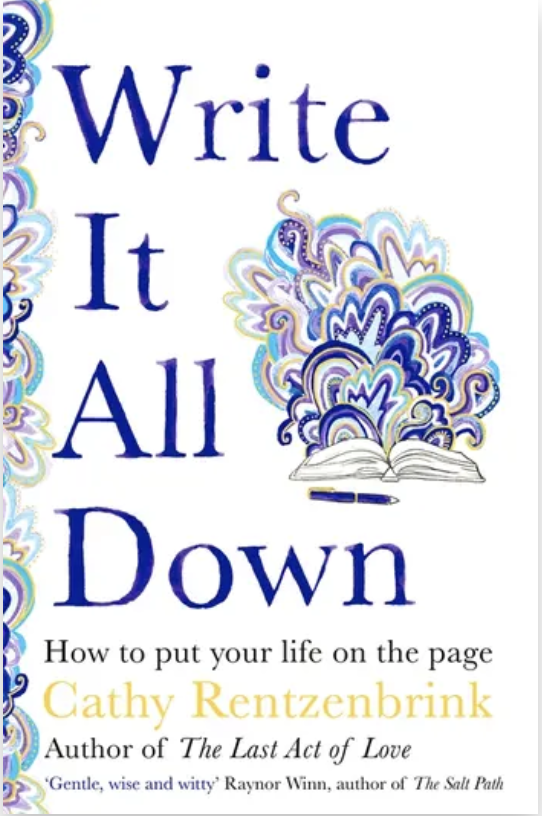
Write It All Down: How to Put Your Life on the Page
By Cathy Rentzenbrink (Pan Macmillan; January 2022)
From the publisher: “Why do we want to write and what stops us? How do we fight the worry that no-one will care what we have to say? What can we do to overcome the obstacles in our way? … Intertwined with reflections and exercises, Write It All Down is at once an intimate conversation and an invitation to share your story.”
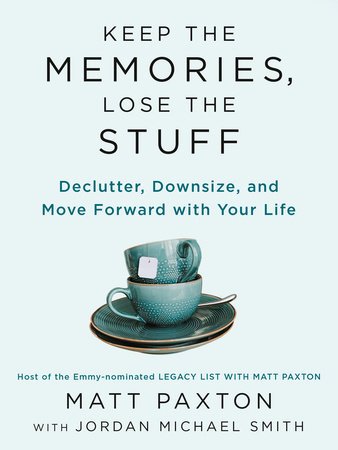
Keep the Memories, Lose the Stuff
By Matt Paxton (Portfolio; February 8)
From the publisher: “America’s top cleaning expert and star of the hit series Legacy List with Matt Paxton distills his fail-proof approach to decluttering and downsizing. Your boxes of photos, family’s china, and even the kids’ height charts aren’t just stuff; they’re attached to a lifetime of memories—and letting them go can be scary. With empathy, expertise, and humor, Keep the Memories, Lose the Stuff helps you sift through years of clutter, let go of what no longer serves you, and identify the items worth keeping so that you can focus on living in the present.”
This is a topic near and dear to my heart (see my free guide “After a Death: How to Make the Process of Going through Your Parents’ Photos Easier”), and I look forward to seeing how Paxton shares his wisdom. A favorite bit of personal historian advice with respect to sorting through your stuff: Take high-quality photographs of items that hold meaning but perhaps take up too much space or no longer feel relevant to your life; this way you can write about why these heirlooms mattered to you (and your family), where and when they originated, etc.—then, after preserving their history, you can give them away without unnecessary guilt.
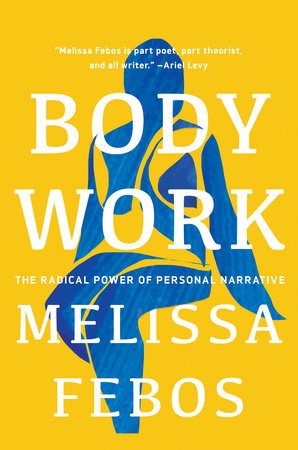
Body Work: The Radical Power of Personal Narrative
By Melissa Febos (Catapult; March 15, 2022)
“If I could do cartwheels, I would have cartwheeled across the room when I learned that the brilliant Melissa Febos is gifting us with a memoir craft book,” writes one reviewer on LitHub.
From the publisher: “How might we go about capturing on the page the relationships that have formed us? How do we write about our bodies, their desires and traumas? What does it mean for an author’s way of writing, or living, to be dismissed as ‘navel-gazing’—or else hailed as ‘so brave, so raw’? And to whom, in the end, do our most intimate stories belong? … Melissa Febos has created a captivating guide to the writing life, and a brilliantly unusual exploration of subjectivity, privacy, and the power of divulgence.”

How to Tell a Story: The Essential Guide to Memorable Storytelling from The Moth
By The Moth, Meg Bowles, Catherine Burns, Jenifer Hixson, Sarah Austin Jenness (April 26, 2022)
I’ve never been drawn to going up onstage to share my stories at a mic, but I am a frequent guest at story slams and Moth main stage performances (migrating to their storytelling podcast during the pandemic)—and I have always marveled at how well the coaching works. Seriously, introverted writers and self-declared non-performers shine when they’re telling their stories for The Moth, and often that can be attributed to having workshopped their material with a team of educators who help develop and shape their stories. Goals? “To hook us in. Make us care about you… [and] conclude as a different person.”
So of course I’m invested in reading their new book that promises to share “secrets of their time-honed process and [use] examples from notable and beloved storytellers,...[and to help you] mine your memories for your best stories.” Everyone has a story to share, so why not share it well?
Biography & Memoir
I firmly believe that reading memoir—good memoir, truthful and well-structured memoir—is a bridge to writing memoir. So beyond the mere sensory pleasure of reading any of the below suggestions, if you are someone who regularly writes about your life or has aspirations to pen your own memoir, take notes when you come across something especially compelling. Does the author employ dialogue to great effect? How do they weave the past and the present? How to they convey universal meaning from singular personal experiences?
My regular readers will know I have an affinity for memoirs told in shorter snippets—often referred to as vignettes—and I am especially eager to read the following from the list below, all examples of the memoir-in-essays form: Bomb Shelter: Love, Time, and Other Explosives by Mary Laura Philpott (April); The Crane Wife: A Memoir in Essays by CJ Hauser (July); and Crying in the Bathroom by Erika L. Sánchez (July).

Lost & Found: A Memoir
By Kathryn Schulz (Random House; January 11, 2022)
Named one of the most anticipated books of the year by The New York Times, Oprah Daily, The Washington Post, and others, Lost & Found is undoubtedly one of the most awaited books of 2022.
Eighteen months before the author’s father died, she met the woman she would marry. In Lost & Found, according to the publisher, “she weaves the stories of those relationships into a brilliant exploration of how all our lives are shaped by loss and discovery—from the maddening disappearance of everyday objects to the sweeping devastations of war, pandemic, and natural disaster; from finding new planets to falling in love.”
“Three very different American families form the heart of Lost & Found: the one that made Schulz’s father, a charming, brilliant, absentminded Jewish refugee; the one that made her partner, an equally brilliant farmer’s daughter and devout Christian; and the one she herself makes through marriage.”
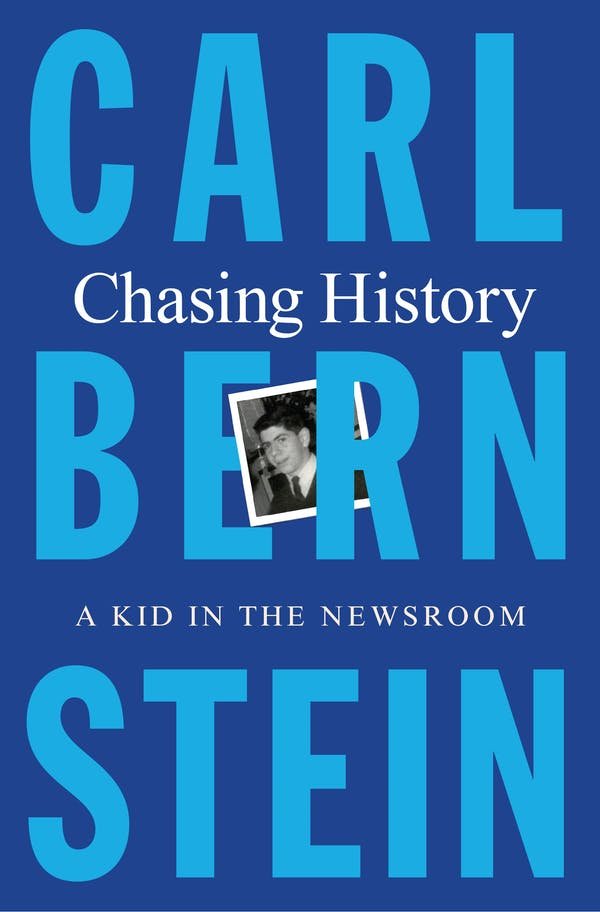
Chasing History: A Kid in the Newsroom
By Carl Bernstein (Henry Holt; January 11, 2022)
According to the publisher, in this book “Carl Bernstein, the Pulitzer Prize-winning coauthor of All the President’s Men and pioneer of investigative journalism, recalls his beginnings as an audacious teenage newspaper reporter in the nation’s capital—a winning tale of scrapes, gumshoeing, and American bedlam.” As a huge fan of the Alan Pakula–directed film and a former magazine editor myself, I am so on board for this account from one of journalism’s most iconic personalities.
Here’s Bernstein on first entering the newsroom of the Washington Evening Star as a high schooler: “The door by which I had entered was at the end of a dim, quiet corridor of the sort you would find in any ordinary place of business. The door through which Rudy Kauffmann now led me opened into another universe. People were shouting. Typewriters clattered and chinged. Beneath my feet, I could feel the rumble of the presses…. In my whole life I had never heard such glorious chaos or seen such purposeful commotion as I now beheld in that newsroom. By the time I had walked from one end to the other, I knew that I wanted to be a newspaperman.” Read an excerpt from Chasing History here.
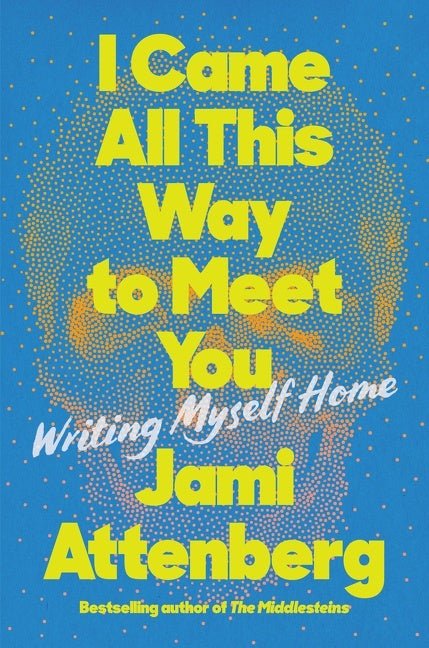
I Came All This Way to Meet You: Writing Myself Home
By Jami Attenberg (Ecco; January 11, 2022)
In her first memoir, acclaimed author “Jami Attenberg—described as a ‘master of modern fiction’ (Entertainment Weekly) and the ‘poet laureate of difficult families’ (Kirkus Reviews)—reveals the defining moments that pushed her to create a life, and voice, she could claim for herself,” shares the publisher. “What does it take to devote oneself to art? What does it mean to own one’s ideas? What does the world look like for a woman moving solo through it?”
In a review for Vogue, Jessie Heyman opines, “Her newest is an episodic collection of Attenberg’s life—her cross-country travels, debilitating injuries, bad plane rides, bad boyfriends—which are all told through her signature intimate and humorous style. But it’s her writing on her own work I found particularly revealing. ‘I became a fiction writer in the first place because stories are a beautiful place to hide,’ she writes.”

Aurelia, Aurélia
By Kathryn Davis (Graywolf; March 1, 2022)
From the publisher: “Kathryn Davis’s hypnotic new book is a meditation on the way imagination shapes life, and how life, as it moves forward, shapes imagination. At its center is the death of her husband, Eric. The book unfolds as a study of their marriage, its deep joys and stinging frustrations; it is also a book about time, the inexorable events that determine beginnings and endings.”
“She writes about being a teenager, trying on identities like clothes, and about being in late middle age, resolutely someone, and yet still wondering, still trying on the other clothes, even while liking her own,” notes a LitHub review.
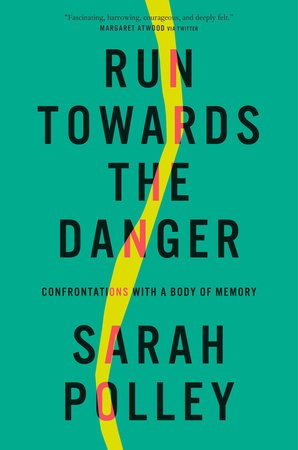
Run Towards the Danger: Confrontations with a Body of Memory
By Sarah Polley (Penguin Press; March 1, 2022)
“These are the most dangerous stories of my life,” Sarah Polley writes in her new memoir. “The ones I have avoided, the ones I haven’t told, the ones that have kept me awake on countless nights. As these stories found echoes in my adult life, and then went another, better way than they did in childhood, they became lighter and easier to carry.”
Polley, an Oscar nominated screenwriter, director, and actor, shares six essays, “each one [capturing] a piece of [her] life as she remembers it, while at the same time examining the fallibility of memory, the mutability of reality in the mind, and the possibility of experiencing the past anew, as the person she is now but was not then,” describes the publisher.
If you haven’t seen Polley’s 2012 film Stories We Tell, it too explores the vagaries of truth and the intersection of the past and present, and I highly recommend it (read my review here), perhaps as a prelude to her memoir.

In Love: A Memoir of Love and Loss
By Amy Bloom (Random House; March 8, 2022)
From one of my all-time favorite writers, Amy Bloom (I still recall discovering her book of stories Come to Me the year after I graduated college and knowing I would buy anything she wrote thereafter), this new memoir explores the period of time she accompanied her husband, Brian, through the final days of his life. After a diagnosis of early-onset Alzheimer’s, the pair begin a heartrending journey of finding a way that Brian can end his life with dignity.
“Most poignant are the intimate moments they share as they make the most of their last days together,” reads the starred review in Publisher’s Weekly. “As [Bloom] writes, ‘I imagine that Brian feels as alone as I do but I can tell he isn’t as afraid.’ The result is a stunning portrayal of how love can reveal itself in life’s most difficult moments.”

Ancestor Trouble: A Reckoning and a Reconciliation
By Maud Newton (Random House; March 29, 2022)
“I never expected to become interested in genealogy,” Maud Newton writes in this 2014 Harper’s cover story that led to her book deal. “When I did, slowly at first and then in great gusts of extreme obsession, I thought I owed the fascination to my mom, a natural storyteller descended from a collection of idiosyncratic Texans. One of her granddads was a strident Dallas socialist; the other killed a man with a hay hook. Her father, Robert Bruce, is said to have been married thirteen times to twelve women.”
According to the publisher, “Maud researched her genealogy…and sought family secrets through her DNA. But immersed in census archives and cousin matches, she yearned for deeper truths…. Searching, moving, and inspiring, Ancestor Trouble is one writer’s attempt to use genealogy—a once-niche hobby that has grown into a multi-billion-dollar industry—to expose the secrets and contradictions of her own ancestors, and to argue for the transformational possibilities that reckoning with our ancestors offers all of us.”

The Unwritten Book: An Investigation
By Samantha Hunt (FSG; April 5, 2022)
More reviews than I can count recommend this book to me. A few, to entice:
“Like a trunk in the attic, The Unwritten Book offers up the most extraordinary, eclectic, and heart-wrenching insights, historical facts, stories, and advice on how to live closer to the dead…. I feel more alive and wiser for having read it,” declares author Cathy Park Hong.
From Rumaan Alam: “The Unwritten Book is a disobedient work—not quite memoir (even as the author interrogates her own life); not quite philosophy (though with much to say on art, faith, ethics, and more); not quite classifiable.”
And from LitHub: ”Fueled by the discovery of her father’s unfinished manuscript, Samantha Hunt is on the hunt (sorry) for clues about all that is left unsaid. Part literary criticism, part memoir, part family history, this new book explores the things that have a hold on us. I, for one, am ready to be haunted by Samantha Hunt once again.”
“Each chapter gathers subjects that haunt: dead people, the forest, the towering library of all those books we’ll never have time to read or write,” notes the publisher. “Through literary criticism, family history, history, and memoir…Hunt explores questions of motherhood, hoarding, legacies of addiction, grief, how we insulate ourselves from the past, how we misinterpret the world.”

Left on Tenth: A Second Chance at Life: A Memoir
By Delia Ephron (Little Brown; April 12, 2022)
Time magazine calls Left on Tenth “a heart-wrenching tale of second chances at life and love” for author and screenwriter Delia Ephron, who chronicles her (often hilarious, always vulnerable) journey of falling in love again after the death of her husband. “But this was not a rom-com: four months later she was diagnosed with AML, a fierce leukemia.”

Bomb Shelter: Love, Time, and Other Explosives: A Memoir in Essays
By Mary Laura Philpott (Atria Books; April 12, 2022)
In this memoir in essays, Philpott sets out to “illuminate what it means to move through life with a soul made of equal parts anxiety and optimism (and while she’s at it, to ponder the mysteries of backyard turtles and the challenges of spatchcocking a turkey),” according to the publisher. “Philpott returns in her distinctive voice to explore our protective instincts, the ways we continue to grow up long after we’re grown, and the limits—both tragic and hilarious—of the human body and mind.”
One Off the Shelf reviewer highlighted this memorable line from Philpott’s book, which makes me even more eager to read it: “I keep trying to make sense of my life by stacking stories upon stories upon stories.” Indeed, don’t we all.
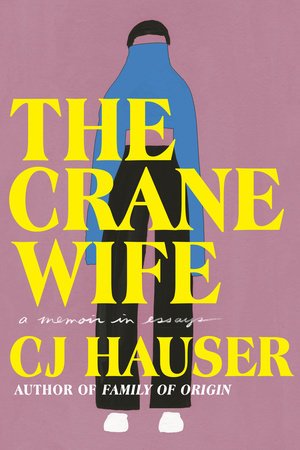
The Crane Wife: A Memoir in Essays
By CJ Hauser (Doubleday; July 12, 2022)
“I think I was afraid that if I called off my wedding I was going to ruin myself. That doing it would disfigure the story of my life in some irredeemable way, CJ Hauser wrote in The Paris Review essay, also called “The Crane Wife.”
“What I understood on the other side of my decision,” she wrote, “on the gulf, was that there was no such thing as ruining yourself. There are ways to be wounded and ways to survive those wounds, but no one can survive denying their own needs.”
From the publisher: In The Crane Wife, CJ Hauser “writes about friends and lovers, blood family and chosen family, and asks what more expansive definitions of love might offer us all. Told with the late-night barstool directness of your wisest, most bighearted friend, [this] is a book for everyone whose life doesn’t look the way they thought it would; for everyone learning to find joy in the not-knowing; for everyone trying, if sometimes failing, to build a new sort of life story, a new sort of family, a new sort of home, to live in.”
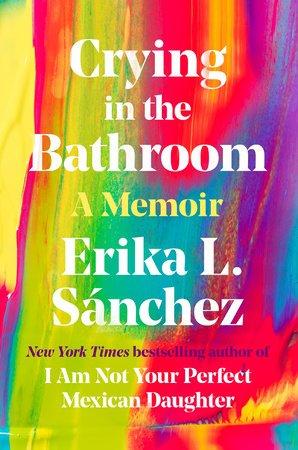
Crying in the Bathroom: A Memoir
By Erika L. Sánchez (Viking; July 12, 2022)
From the New York Times bestselling author of I Am Not Your Perfect Mexican Daughter comes an utterly original memoir-in-essays that promises to be as deeply moving as it is hilarious.
From the publisher’s page: “In these essays, Sánchez writes about everything from sex to white feminism to debilitating depression, revealing an interior life rich with ideas, self-awareness, and perception. Raunchy, insightful, unapologetic, and brutally honest, Crying in the Bathroom is Sánchez at her best—a book that will make you feel that post-confessional high that comes from talking for hours with your best friend.” I’m in.
As yet untitled MEMOIR of Paul Newman
(Knopf; Autumn 2022)
With the hope of debunking the numerous unsolicited biographies about Paul Newman over the years, the actor and philanthropist began recording his life story through oral history interviews with friend Stewart Stern in 1986 (“I should probably at least make some truthful self-examination so the unsolicited biographies wouldn’t be considered as gospel,” he reportedly told Stern).
According to the publisher, the “result is a portrait of the actor in full, from his early days to his years in the Navy, from his start in Hollywood to his rise to stardom, and with an intimate glimpse of his family life.
I met Newman when I volunteered to help set up his first camp, the Hole in the Wall Gang Camp in Ashford, Connecticut, when I was a senior in high school, and was in awe of his selfless nature (and wonderfully mischievous sense of humor), so I especially look forward to hearing stories from his life in his own words.
Diaries & journals

Gathering Blossoms Under Fire: The Journals of Alice Walker, 1965-2000
Edited by Valerie Boyd (Simon & Schuster; April 12, 2022)
From the publisher: “In an unvarnished and singular voice, [Alice Walker] explores an astonishing array of events: marching in Mississippi with other foot soldiers of the Civil Rights Movement, led by Martin Luther King, Jr.; her marriage to a Jewish lawyer, defying laws that barred interracial marriage in the 1960s South; an early miscarriage; writing her first novel; the trials and triumphs of the Women’s Movement; erotic encounters and enduring relationships; the ancestral visits that led her to write The Color Purple; winning the Pulitzer Prize; being admired and maligned, sometimes in equal measure, for her work and her activism; and burying her mother. A powerful blend of Walker’s personal life with political events, this revealing collection offers rare insight into a literary legend.”

The Diaries of Franz Kafka
Translated by Ross Benjamin (Schocken; December 6, 2022)
This new translation of Kafka’s handwritten diaries dating from 1909 to 1923, according to the publisher, contains “accounts of daily events, reflections, observations, literary sketches, drafts of letters, accounts of dreams, as well as finished stories. This volume makes available for the first time in English a comprehensive reconstruction of the diary entries and provides substantial new content, including details, names, literary works, and passages of a sexual nature that were omitted from previous publications. By faithfully reproducing the diaries' distinctive—and often surprisingly unpolished—writing in Kafka's notebooks, translator Ross Benjamin brings to light not only the author's use of the diaries for literary experimentation and private self-expression, but also their value as a work of art in themselves.”
Other memoir & biography titles to look out for in 2022
The Beauty of Dusk: On Vision Lost and Found by Frank Bruni (Avid Reader Press/Simon & Schuster; March 1, 2022)
I Was Better Last Night by Harvey Fierstein (Knopf; March 1, 2022)
Easy Beauty: A Memoir by Chloé Cooper Jones (Avid Reader Press/Simon & Schuster; April 5, 2022)
Happy-Go-Lucky by David Sedaris (Little, Brown and Company; May 31, 2022)
Affiliate disclosure: As an Amazon Associate, we may earn commissions from qualifying purchases from Amazon.com.
Three writers use vignettes to craft moving memoirs
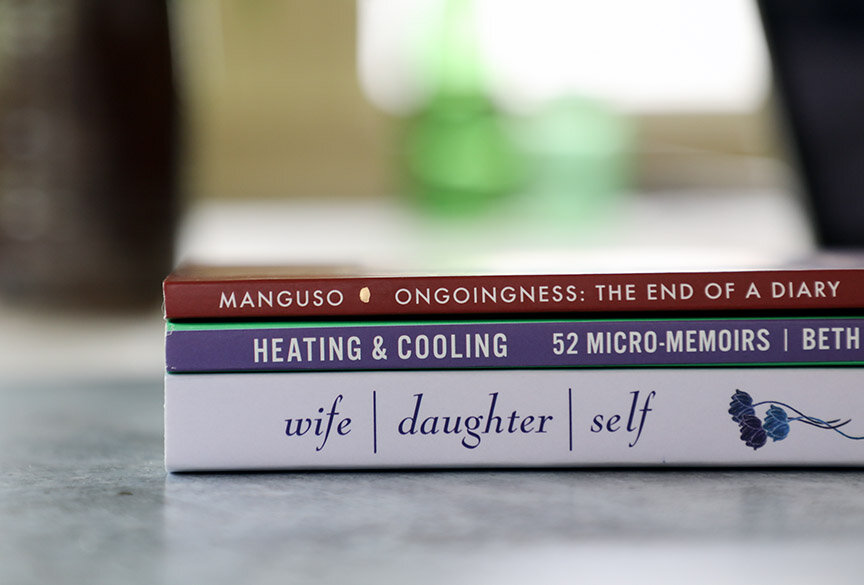
Memoirs by Sarah Manguso, Beth Ann Fennelly, and Beth Kephart each weave together short narratives to create evocative, textured self-portraits of the writers.
I have written often about using vignettes to tell the stories of your life, and I feel strongly that reading works by others to inspire your own writing is a humbling and essential practice. The three books that follow have one big thing in common: The writers weave together fragments—called alternatively essays, micro-memoirs, and meditations—to create a multi-faceted self-portrait. I recommend reading each of these to get a sense of just how powerful and evocative it can be to craft your memoir…vignette by vignette.
memoir in vignettes no. 1
Ongoingness: The End of a Diary
Ongoingness: The End of a Diary by Sarah Manguso (Graywolf Press, 2015) is a series of meditations on the author’s compulsion to keep a continuous diary. She writes early in the book, “From the beginning, I knew the diary wasn’t working, but I couldn’t stop writing. I couldn’t think of any other way to avoid getting lost in time.”
Manguso recalls a time in childhood when she didn’t yet need a diary because “I wasn’t yet aware of how much I was forgetting.” That’s at the heart of it here—the fear of losing memories, of losing pieces of oneself. So she records, she memorializes, and she fights the forgetting…until she has a child of her own, that is. And in Ongoingness, she explores the “welcome amnesia,” as the book jacket calls it, of the next chapter of her life.
Some of Manguso’s insights and observations are elliptical in nature: She circles back to them once and again, each time drawing more or new or different meaning from the same experience. Her prose is crystalline. Her insights are resonant.

Ongoingness: The End of a Diary by Sarah Manguso is a fine example of:
how everyday moments deserve primacy in our writing
how paying attention to details—select, apropos details—can elevate the personal to the universal
how memory is malleable and often elusive—and how, even then, we can mine truth from it in our writing
how “brief” does not mean “lacking”
memoir in vignettes no. 2
Heating & Cooling: 52 Micro-Memoirs
Heating & Cooling: 52 Micro-Memoirs by Beth Ann Fennelly (W.W. Norton & Co., 2017) is another sleek volume that brings the writer to life through what she calls “micro-memoirs” and what I would refer to as “vignettes.”
Don't be fooled: The autobiographical vignettes in Heating & Cooling were not randomly gathered from the author's journals; rather, they were thoughtfully woven together. There is a fine balance between entries that delve into deep waters and ones that skim lightly along the surface. There is a rhythm not only to the words, but to the pieces themselves (which range in length from a single sentence to six pages). There is a layering of themes and a range of moods, a sense of both evocative poetry and direct truth-telling.
Consider reading this book twice: Once, read a vignette or two every night (Ann Patchett calls each entry a “perfect pearl of memory,” and indeed they are worthy of relishing morsel by morsel); then, binge-read the book in one sitting (it's just over a hundred pages, after all, and I promise you the layered themes I mentioned will be all the more apparent to you this way).

Heating & Cooling: 52 Micro-Memoirs by Beth Ann Fennelly is a great example of:
making every word count (Daniel Wallace said, “Every sentence in this book could be sent to the Smithsonian Institution in case future readers want to know what a great sentence looks like.)
how to use humor effectively in your memoir writing
how to curate and compile telling moments from a life to reveal broader themes—and delight the reader
how to be wonderfully vulnerable and alive in your writing
how to construct a book of vignettes that build upon one another and all together draw a richly textured portrait of the writer
memoir in vignettes no. 3
Wife | Daughter | Self: A Memoir in Essays
Ah, perhaps my favorite of the bunch here, Beth Kephart's latest memoir, Wife | Daughter | Self (Forest Avenue Press, 2021) is a book to be savored. And for those of us who open to the first page with the intent of inspiring our own writing, how lucky we are that Kephart has included notes on how she created it in a thoughtful postscript. To wit:
"I write parts whose purpose is to find their way into an implicating whole, the choreography of the thing being the thing, the adjacencies and half sums. The rain that won't come answered, pages later, by the rain that will. The dead communicating with the living.”
Or:
"…the aggregation of parts that constitute this memoir reflect my belief that truth is not continuous, that stories live in the seams, that we remember in bursts and find wisdom in the juxtaposed…”
Kephart is a perpetual seeker of truth—of her truth, of the universal truth; she is on a quest for meaning, and it is through writing that she is most often able to find it. Does she find herself, though—the "self" in the title of this memoir? Do we as readers find her?
We glimpse her, we feel her, we intuit and recognize and yearn for her in the push and pull of her words. We find her in the seams (oh, how I love this notion: that “stories live in the seams,” as Kephart writes and teaches and ultimately manifests in this memoir). We are left to find traces of her and to piece together a fragmented whole ourselves—a whole I envision as a mobile made of shimmering stained-glass mosaics, blowing in the wind, simultaneously reflecting and catching the sun. We know her, even if perhaps we can't summarize who she is in words.
"If you asked about my process, I'd say music,” Kephart writes in the addendum. And there it is: While we are caught up in the music of her life, of her writing, then her craftsmanship—her cognizance of form and her attention to weaving fragments together so they convey more than the sum of their parts—all of that is invisible to us as readers. Beautifully, conspicuously invisible.

Wife | Daughter | Self: A Memoir in Essays by Beth Kephart is a stellar example of:
how to orchestrate a symphony from otherwise disjointed notes
how to carefully choose and weave details so that they become "telling details"
how to write towards truth, allowing the journey of writing to become part of the story; as Kephart says, “the truth is in the trying”
how “writing the same story twice is to puzzle out dimensions”
how considering yourself in relation to others—"Father's daughter. Husband's wife. Son's mother."—can be a gateway to finding oneself, period.

Download Free Writing Prompts Guide
Get all our life story vignette writing prompts in one easy-to-read printable guide!
Discover more posts to help with writing vignettes about your life




Affiliate disclosure: As an Amazon Associate, we may earn commissions from qualifying purchases from Amazon.com.
What’s it like to create an heirloom book together? Let some folks with experience tell you...
Ever wonder what it might be like to work together on your OWN heirloom book project? Listen to past clients' feedback—and words of thanks!—to get inspired.
When I’m not interviewing clients or working directly with families to curate their photos and mementos, I can usually be found at my computer editing and designing your heirloom books.
I get goosebumps when I open a letter or an email from a grateful client. It’s rare that they just say “thanks” and leave it at that. Many wax poetic about the experience and their awe upon receiving the finished book. They almost always express surprise at just how much they actually enjoyed the process of making their book (I try to convey that to prospective clients, but it’s hard to put into words—and why should they trust me, after all, who is trying to sell them a product…?).
Well, let me say that sales is not my thing. I founded Modern Heirloom Books to help people preserve their stories, and sure, it is my livelihood, but it’s my passion first and foremost. So if we’re not a good fit, or you don’t want to move forward, or simply can’t afford to—well, I am not going to give you the hard sell. I may feel bad, I may wish we could have worked together, but it’s got to be a good fit (and timing is so important!).
When I do work with someone, we form a bond—honestly, it’s inevitable. Once trust is established and the stories begin flowing, the bond is initiated. When editing and deeper questions ensue, the bond deepens. And by the end of the process, when a book is almost finished and the excitement is palpable, the bond is even more firmly cemented. How blessed I feel to have a “job” that provides such a sense of connection and meaning.
I’ve been told that I don’t share testimonials from my clients enough. Maybe it’s due partly to a humble nature, perhaps it’s a discomfort with being bold…but I am taking a page from some special fellow creative entrepreneurs and sharing some of the gratitude that’s come my way. It is my hope that you’ll feel comfortable with me, and gain an understanding of what it’s like to work together.
Thank you to ALL of my clients—for trusting me with your stories, and for sharing the love once your project has been completed!
xoxo,
Dawn
Testimonials from past clients: What it’s like to make a Modern Heirloom Book
creating heirlooms to treasure forever
Here’s one I received recently that warmed my heart:
Dear Dawn,
I have just looked through your book again, as I have many times before. As always, I am amazed and gratified by your presentation, layout, and descriptions. THANK YOU SO VERY MUCH. It is all I could have hoped for—even more! From the Table of Contents through the final comment—I loved it all! (All!!)
I started a list of things I wanted to mention to you but it became so lengthy, I had to give it up!
It is a book to treasure—which I do—and I will always be grateful for the beautiful job you have done. IT IS PERFECT!!
I plan to have a splurge and send a copy to all of my family and friends! Once again, I can’t thank you enough!
Fondly,
Judy D.
a process that involves collaboration & care
Here’s a snippet of a review, speaking especially to the twists and turns a project can take:
Throughout the process, Dawn was a joy to work with. She listened carefully. She was diligent in working up drafts and gathering feedback. She was unfailingly patient. She brought her own ideas and didn’t hesitate to make suggestions. She even went above and beyond to supplement our research and to deal with administrative hassles with printers due to our last-minute requirements. She delivered on time and within budget.
In every interaction, Dawn conveyed that she cared as much about the book as we did.
Dawn is a special bookmaker. If you are looking for someone to create that special story or tribute to someone you care deeply about, look no further.
—Jenny P.
…and another about vision and collaboration:
We didn’t even really know what we wanted in the beginning and Dawn produced an amazing result. It is a pleasure working through the creative process with her.
—Amy H.
…plus one about process:
Dawn was always ready to make the changes that were inevitable when putting a book together, with good cheer. She is quite well organized and intuitively understood order, placement, emphasis vs. less. I was extremely happy with Dawn’s finished product and wholeheartedly recommend her.
—Gahl B.
…and one about writing, editing, and curating:
Dawn is a therapist, a storyteller, a magician, and an artist with words—how she took what we said and wove it into a story. It truly blew us away!
The process of sorting through 27 years of pictures and mementos was joyfully reflective, but what brought it all together was Dawn’s vision.
—Susan M.
…ah, and then there are the interviews!
Dawn is a warm and engaging person who makes it easy to open up during interviews—even for me, a pretty reserved girl!
—Samantha D.
finished products that awe & inspire
Dawn is a consummate interviewer, a terrific storyteller, and understands how to combine the graphic elements. She took the cream and really brought it to the top.
—Vern O.
My book was simply stunning! And Dawn was a joy to collaborate with.
—Lily R.
words that hold meaning—and bring joy, comfort
We all hope we can pass something of value on to family and friends. The tribute book did just that for Ann. She was ecstatic and we all had to fight back tears watching her flip through the book. She shows it off to whoever comes in the house.
—Terry C.
I still tear up when I look at this book, almost a year later. It is my most cherished possession.
—Maria C.
Thank you, Dawn, for sharing your gifts with us, and for becoming a part of our family story.
—Joe M.
The book was like a bear hug from my dad. I can’t wait to share it with my future children some day!
—Kayla V.
Would you like to see firsthand what it’s like to work together to bring your dream book to life? Reach out if your’e interested in sharing your own memories in a life story book; or honoring a loved one through stories in a tribute book. I can’t wait to hear from you!
**Because privacy of my clients is of utmost concern, I have not disclosed last names for these testimonials.
Artful memory-keeping ideas from the world of sketch journaling
If writing about your life isn't for you, how about drawing it? Ideas for using a sketch journal to capture your memories, plus the book that will inspire you.
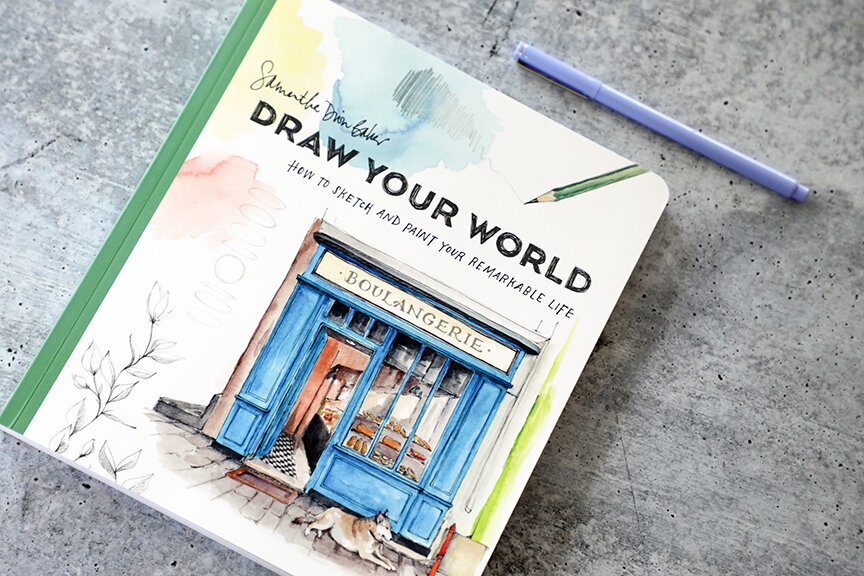
Have you ever thought of keeping a sketch journal? If the idea piques your interest, then Samantha Dion Baker's new book is a must-read. If you've never even heard of a sketch journal—but think that adding some colorful visuals to your handwritten journal might be a fun new idea—then this book is a great read for you, as well.
Draw Your World: How to Sketch and Paint Your Remarkable Life is filled with vibrant pages from the author's own art journals (inspiration in its own right) coupled with reflections on how her journal-keeping journey has evolved over time. Better yet: Baker offers up specific journaling prompts to help you put pencils and paintbrushes to paper.
Sketch-journaling as memory-keeping
"My entire art-making practice has evolved into a memory-tracking practice,” the Brooklyn–based mom and artist writes. Indeed, she sketches everything in her always-at-hand journals, from her morning coffee and the dog sitting across from her while she drinks it to a fabulous bag spotted on the subway during her commute. Why record the seemingly mundane? Well, paying attention to the present so acutely is a form of meditation, Baker has said; and from my perspective, honoring our daily routines—how we live the bulk of our lives—is equally as important as capturing milestone moments such as birthdays and graduations.
"A sad day, a happy day, a milestone day, a holiday, a sick day—all of these days are filled with tiny moments that, when drawn or written about, will help transport me back,” Baker wrote in her first book, Draw Your Day. "It is fun for me to capture the life of a working mom living in New York City by writing down all of the things I manage to do in one day. " These drawing can invoke sense memories later on—when you look back at that lip gloss you used every day for two years, you'll not only remember the color but the smell and feel of it, too.
Art-inspired ideas for capturing the memories that matter most to you
Samantha Dion Baker is all about honoring the present and the past. In addition to the “bits of the ordinary” that she includes on most every journal page, she suggests striving to capture ideas and emotions. And while, certainly, she provides specific technical advice and tips for what tools you'll need to begin a sketch journaling practice, she stresses that anyone—even a non-artist—can undertake to capture memories through art. “Drawing your world is accessible to anyone compelled to translate the outside world onto a flat surface,” she writes.
The full pages shown from her travel journals in Draw Your World are especially inspiring, as they weave together written observations, sketched remembrances, and tiny details that create such a vibrant and emotional picture of days spent in places from Iceland to Brooklyn. “When we travel,” Baker writes, “my practice becomes more of a family affair, and the artwork and recorded memories in my journal are a gift to all of us as we look at them later on, bringing us back to those precious moments.”
I love her idea of gluing hotel envelopes from family trips right into your sketch journal and stashing receipts, ticket stubs, and other vacation ephemera in there (scrapbook inspired, for sure, but what a surprise when discovering that dimensional element within a two-dimensional journal!).
A few other prompts that I think are relevant for memory-keepers of all kinds:
Present-tense, or ongoing:
every year on your child's birthday, draw a portrait of them (if that's too intimidating, draw some of their favorite things or quote something they've said that year)
celebrate a lost loved one through art
draw souvenirs or scenes from your vacations
Past-tense, or reflective:
"Think back to your happiest moments, jot them down in a notebook, and then create abstract paintings titled as those memories,” Baker suggests.
If your recall your first car, draw it (you can search online for reference photos if you don't have a picture of your own), then—my favorite part!—“record any adventures and road trips you remember in it."
What other ideas come to mind for you? A fair number of family history interview prompts could easily translate into sketch journaling ideas—consider drawing your grandmother in the kitchen, or painting the pie she made for you as a child that never failed to bring a smile; or sketch out what you wore—and carried in your bag—on the first day at a big new job. The possibilities are endless!

A few squares from the Instagram feed of Samantha Dion Baker showing sketches from her journals, where she captures both details from her everyday life and bigger moments from vacations and family milestones.
Get inspired by Samantha Dion Baker:
Follow her Instagram feed, where she shares vibrant pages and sketches from her journals.
Buy her first book, Draw Your Day: An Inspiring Guide to Keeping a Sketch Journal, for an introduction to art journaling and inspiration to pay attention: “Let the small pages of your sketch journal become a personal lens, a way to organize and creatively make sense of the world around you.”
Pick up a copy of her most recent book, Draw Your World: How to Sketch and Paint Your Remarkable Life, for a more expansive way to approach your sketch journaling (and to see how the author’s personal pages have evolved over time).
Up next for the artist and author: Draw Your Day for Kids! This book will include sketch pages for young readers to record their memories and feelings, and will become an original keepsake as they grow up (oh, how I love THAT!).
Note: This is an unsolicited review of a book I purchased at full price. I did not receive any compensation or free products in exchange, and any endorsements within this post are my own.
Affiliate disclosure: As an Amazon Associate, we may earn commissions from qualifying purchases from Amazon.com.



Dawn Roode’s curated roundup for the week of Sept. 23, 2026, is overflowing with recent reads on memoir, life story writing, and family history preservation.