
Memories Matter
Featured blog Posts


READ THE LATEST POSTS
Life Story Links: May 11, 2021
Your biweekly dose of all things personal history—including fresh first person reads, photo printing help, and lots about the memories held in our possessions.
“One of the most significant facts about us may finally be that we all begin with the natural equipment to live a thousand kinds of life but end in the end having lived only one.”
—Clifford Geertz

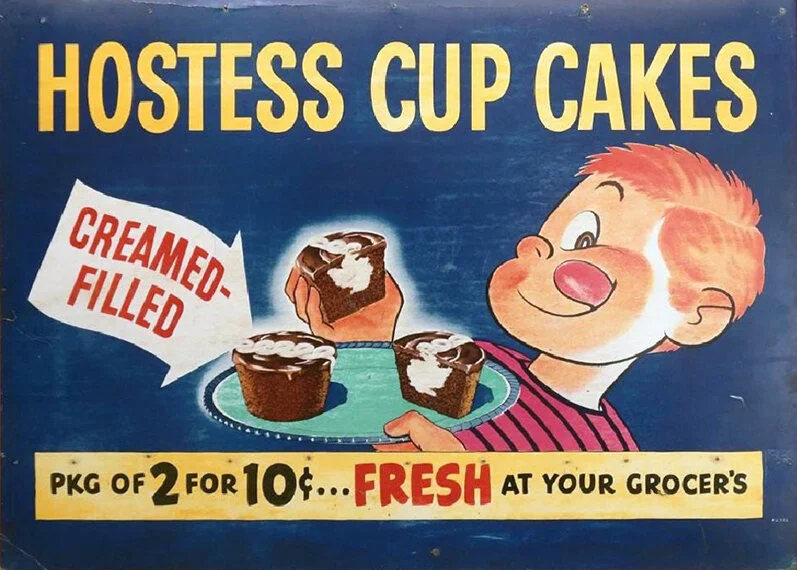
Yes, today is Hostess Cupcake Day here in the United States! Rather than indulging in the sugary treat, let’s celebrate with a vintage advertisement, shall we?
Discover: Recent First Person Reads I’ve Loved
“MY MOTHER IN THERE”
A few weeks after her mother dies, writes Marie Mutsuki Mockett, “I am forgetting that my mother was sick. Her essence has clarified…and my mind is furiously picking through memories, panning for gold, holding on to the nuggets that were her.”
LIFE IN MINIATURE
“More recently, I’ve felt that the worthier challenge may lie not in resisting the occasional backwards glance, but in trying to see that child [I was] and her fictions with compassionate eyes.” Kate Guadagnino on the solace of her childhood dollhouse.
FIGHTING THE INEVITABLE
“The ‘law’ was passed down in my family like a hideous heirloom.” Anna Dorn on doing everything possible not to follow in her father’s footsteps.
“WHAT ARE YOU WAITING FOR?”
“I never tired of talking to [my nieces and nephews] or playing with them; I’d happily volunteer for their parents’ less-favorite tasks, from diaper changes to dips in the pool. Pregnancy, though, still felt future state. But it would happen when the time was right. Right? Right.” Shelia Monaghan on the legacy of children.
Mementos, Memories, and Overwhelm
DISASSEMBLING A LIFE
Literary left-wing legend Frances Goldin had hoped that after she died, friends and loved ones could hold a “potluck shiva” in her home, “where people could take memorabilia and items they wanted or needed or that she had designated for them, while celebrating her life.” Covid had other ideas.
GRIEF, HIDDEN IN A STORAGE LOCKER
“My mother was kind and overly loving, yet she’d never told me about her life before me.” More than a decade after her mother’s death, Blake Turck finally has the emotional resolve to go through the stuff of her mom’s life—and learns that memories live inside us, not in things.
TCHOTCHKE CHALLENGES
“Especially with items of high sentimental and low financial value, documenting and sharing the stories and feelings associated with possessions can be a big step toward letting go.” Philadelphia–based personal historian Clémence R. Scouten offers advice for dealing with passed-down items to which we may hold an emotional attachment.
An Instinct to Preserve
FIGURING IT OUT AS SHE GOES
“Part of why I write about my own life, it’s my attempt to freeze all this ceaseless, endless, constant change,” says Alison Bechdel about her new memoir. “I just want to put down something that doesn’t move. Life is change.”
RECORDING LIFE
This senior “began making books for [each of her four children] on the day they were born, and presented each with a personal life history on their 60th birthday.” Now she is typing her memoir on a laptop her kids gave her.
VIDEO: UNINTENDED MEMOIR
Amy Tan: Unintended Memoir is an “intimate portrait [featuring] archival home movies, personal photographs,…as well as new interviews with Tan,” who speaks about traumas in her life and how writing helped her heal.
JEWISH STORY PARTNERS
“There is nothing like storytelling to foster connections and help us understand life’s deepest truths.” A new foundation aims to expand the range of stories told about Jewish lives.
Nitty Gritty Help
UM, WHY SO SMALL?
When many members of a family are contributing images to a memory book, chances are some of those pictures (maybe even your own) will not print well. Here are three common digital photo mistakes and how to avoid them.
...and a Few More Links
three new books about memory—and keeping it sharp
interesting infographic on the power of storytelling
Author Rachel Kushner’s new essay collection includes “eloquently written features about her personal history that are equal parts gripping and revealing.”
“The pandemic shaped my family for generations. Not COVID—the 1918 flu”
A new biography of Marjorie Kinnan Rawlings, author of The Yearling
Short Takes


“Why the $#%&* are my pictures so small?!”
Ever printed photos from your phone or digital camera and they look grainy, blurry, or small? Here’s why, and how you can fix it for optimal print results.
In recent months I have heard from more and more people wanting to celebrate their loved ones in tribute books. Whether for a milestone birthday or anniversary, or even to say “congrats” for an achievement (virtual graduation, anyone?), these books are an opportunity to show your love through words and pictures.
But it breaks my heart when the pictures in the books look like postage stamps.
So, today a public service announcement: If you are taking digital photos of your life—whether it be for an eventual family album, yearbook, scrapbook, or even just to live on your devices indefinitely (shudder to think!!)—you MUST use high-resolution images.
Despite sending detailed instructions on how to upload high-resolution images for a book, many people still send me low-resolution digital files and then wonder: “Why the $#%&* are my pictures so small?!”
Every answer I give is some version of: “Well, they’re too damn small!”
Why your digital photos are printing so small: 3 mistakes to avoid
1 - Your photos are too small because you are relying on social media to save and gather them.
Often clients will tell me it’s just easier to pull the photos from an album on Facebook—they’re easy to find, so readily accessible. But what many people don’t realize is that once you upload a picture to Facebook, the platform immediately converts your image to a lower resolution—translation: the file is now smaller, and you can’t get those pixels back.
Even Google Photos degrades photo quality when uploading images to your collection unless (a) you change your setting to request differently or (b) you have the paid version that allows for more storage.
Solution: Keep an archive of all your important photos on your computer, an external hard drive, or in the Cloud. The better organized they are, the easier it will be to find the original (high-resolution) image when you need it!

While it may seem convenient, pulling an image from a social media platform such as Facebook is NOT ideal for printing. These sites immediately strip away pixels from images upon upload, so you’ll need to find your original digital file if you want it to print with a high quality.
2 - Your photos are too small because you have your digital camera settings wrong.
Maybe you wanted to ensure you could hold as many pictures as possible on your memory card, or maybe you simply never went in to check the settings on your new high-end digital camera. Whatever the reason, many people (are you one of them?) are shooting all their family photos on a low-resolution setting.
If you are taking photos that you plan to eventually print for an album or in a book, you must ensure that the images are taken with enough pixels per inch. And just because your camera comes with a high megapixel count, you’re not necessarily set up to capture high-resolution images (there’s image compression to consider, for example, and how much digital zoom you may be using when taking a shot).
“Choosing the right settings on your camera is only the starting point to getting the best resolution possible out of your images,” Elizabeth Mott writes in this helpful piece about how to ensure you’re taking high-resolution photos with your digital camera.
My advice? The cost of both smart phone storage and memory cards for digital cameras has come down sufficiently that I think buying one with LOTS of storage is worth the investment; once you know you’ve got plenty of space to save your photos, snap away at the highest resolution possible—I promise you won’t regret it when you feel compelled to print one of those precious gems (or, even better, many of them in a book).

Every camera manufacturer displays resolution settings differently. Here is an example of choices on a Canon DSLR. If you’re photographing for print, use either the large setting (L, which translates to a 5184 x 3456 JPEG image of 18MP) or the RAW one (which has the same pixel dimensions and file size, but is not compressed like the JPEG).
3 - Your photos are too small because you are being, ahem, lazy.
Not sure where to find the original image? Take a screenshot, many people figure. Or use the shot your daughter emailed to you (without realizing she did not attach the original but a lower-resolution version to increase send speed). If you, like most people, do not have a meticulously organized folder system for backing up your digital photos to a computer or external hard drive, then finding images when you need them will undoubtedly be a challenge. But if you want photos to appear in your book, then you need to do the legwork to discover where those high-res versions are.
A professional personal historian or photo manager can help you do this detective work, if you’re not so inclined. (Give me a call ; )
But no matter who does the legwork, I implore you: Go to the effort of finding the original—larger, higher-quality—photo if you plan to print it. Why pay for a book, an enlargement to frame, or any other printed memory if it’s not going to look good?
When you email a photo from your phone to another person, you have the option of choosing if you want to “reduce message size by scaling the image.” Doing so is one way images get degraded and end up needing to print at small sizes. For optimal print results, choose “actual size” when sending an image.
Your memories matter enough to treat them with care—and your photos are, if nothing else, repositories of your memories!












Life Story Links: April 27, 2021
For memory-keepers: A curated collection of recent stories about memoir (reviews & first person excerpts) and family history (as preserved through narrative).
“In guided autobiography, we encourage the use of metaphors; in the case of major branching points in life, we ask, ‘If your life is like a river, what caused it to flow in the directions it did?’”
—James Birren

Today, April 27, is National Tell a Story Day. This vintage photograph by Russell Lee shows the wife of a Farm Security Administration client reading to her son, April 1939. Image courtesy Library of Congress Digital Archive.
Exploring Family History Through Narrative
“THE WHOLE STORY“
“Listen to the songs your ancestors sing to you. Be mindful of the songs you sing to others.” The 2021 UCSF Last Lecture, delivered by Peter Chin-Hong, MD, encouraged exploring one’s personal history in order to find one’s true voice.
HERITAGE, QUESTIONS, STORIES
“We can’t tell the full story without each other.” Two women researched slavery in their family, but what they discovered held different meaning for each.
FORGING MEANING FROM TOUGH TIMES
“Survival becomes a pivotal point in our story that needs to be preserved. It is the part of our story that reminds us what we are capable of, what we can endure, and what we overcame.” Lisa Lombardi O’Reilly on “the times that remind.”
“DEAR FAMILY…”
Collected letters from Australian and New Zealand soldiers “held a sense of mana in the families, keeping the memory alive of someone that, in some cases, had died over a 100 years ago.”
MY GRANDMOTHER, THE SPY
“I was going through her things and found myself staring at a letter that I had seen in childhood and I didn't really understand. It had to do with some sort of covert work she had done for the British.” In a new podcast Enid Zentelis shares the story of her grandmother, who she learned was a WWII spy:

Click the image for a 3-minute video about Enid Zentelis’s mission to learn the truth about her late grandmother, a Hungarian-Jewish Holocaust survivor—and a spy. “I wondered how I could serve my grandmother’s story, and simultaneously communicate the effects of generational trauma; the way some family members succumb to it, and the way others turned it into a source of strength and determination,” Zentelis says.
Recommended First Person Reads
LOW COUNTRY LEGENDS
“Were those really the voices of loved ones long gone who called out my name in subway cars and expensive restaurants and while I brushed my teeth?” J. Nicole Jones on familiar ghosts and family legacies.
CROSSING BORDERS
“‘Berlin? Seriously?’ my Jewish friends marveled. If you want to bring conversation to a halt at your local Purim carnival, try mentioning that you’re relocating to the city where the Gestapo was headquartered.” Laura Moser on moving to the neighborhood where her grandfather lived before fleeing the Nazis.
LIFE IN THE DARK CITY
“When you are forty-three in New York City, raising children, you have already lost the New York that mattered to you at age twenty-three. The loss I am talking about is something else entirely.” Emily Raboteau on pandemic NYC.
THEIR STORIES ARE OUR STORIES
“Our stories are even richer and more complicated than we sometimes realize, especially stories that are the most familiar to us, the stories that have been passed down.” Menachem Kaiser in conversation about the ever-evolving nature of Holocaust memory and storytelling.
WRITING THROUGH GRIEF
“I wanted to write that person, share her writings, immortalize her in a small way—she who had not been able to author her legacy.” Maryanne O'Hara on turning to personal writing in the wake of her daughter’s death.
Hodgepodge
STORIES UNTOLD
“My life is not interesting enough” and “it’s too self-centered to write my memoir” top the list of reasons I hear for not writing about one’s life. Click to read about why I think these reasons are bunk.
FOUR MEMOIRS WITH REMARKABLY DIFFERENT APPROACHES
The University of Pennsylvania’s alumni magazine turns its attention to the writing lives of four of its cohorts including stories about “middle school memories, meditations on motherhood, a prismatic accounting of the self, and a long life well and furiously lived.”
AN ARCHIVAL PROJECT IN THE AGE OF COVID-19
In “Portraits of an Epicenter: NYC in Lockdown,” a group of creative college students share photo essays and written reflections of living through the pandemic. “Although the city was unified in this experience, no two experiences of the lockdown were the same.”
HONOR HER STORY
Mali Bain, a personal historian in British Columbia, Canada, says she has been inspired by her clients’ unique ideas for Mother’s Day gifts. Here, she shares a few of them.
Virtual Events that May Interest You
April 30: First conference of International Institute for Reminiscence and Life Review at its new home, UCONN School of Nursing
May 1: Virtual (paid) workshop: “The Power of a Legacy Letter and How to Write One”
May 19: Storykeep presents a free live webinar to acquaint you with private podcasting, a new tool for documenting and sharing family narratives and connecting family across generations.
...and a Few More Links
Short Takes

Why, exactly, are you not telling your stories?
Is your life too boring to tell people about? Do you think it's self-centered to write a memoir? Or that your kids don't care about your stories? Think again.

I hear lots of reasons for not writing about oneself. Do any of these sound familiar?
I hear a lot of reasons from people as to why they’re not sharing their life stories, not writing their memoirs. And while you undoubtedly believe in your reasons, I’m here to say that most of them are, well…bunk.
The top five reasons I hear for not preserving family stories follow—which one applies to you? Click on the one that most resonates to jump to MY reasons why your outlook is, ahem, flawed. (I value story sharing too much to worry about offending here, but if I seem overconfident, I admit: I believe I am right—that your stories matter, enough to be shared and preserved. Will I convince you?)
Let’s nix these 5 excuses for not telling your family stories about your life:

“My life is not interesting.” “Boring.” “Like everyone else’s.”
Whether this is your genteel humble nature or a bit of insecurity speaking, I am calling your bluff. Everyone’s life is interesting, yours included.
After decades of interviewing people for a living, I can say with confidence that even the most shy, low-key folks will start sharing wonderful stories if approached with curiosity and an open heart. They may start out glancing away, shifting in their seats, confident in their boringness…but after a few probing questions—and sometimes a little humor—the stories don’t just begin to eek out, they flow liberally.
I have seen it too many times to count: An initially reluctant storyteller midway through telling me a lengthy tale from their life makes eye contact with me and realizes, “Wow, this is me talking, huh?!” Usually a surprised laugh escapes before they continue regaling me with their stories, and we have settled in for a most productive interview.
The best part, in my opinion? The interview subject is almost always eager to come back for more! Digging into our memories is like reaching into a bag of potato chips—no one can stop at just one…story.

“I don’t want to seem like I’ve got a big head.”
Alas, preserving your own life story is not narcissistic. At least, not most of the time.
Do you plan on simply creating a list of your estimable accomplishments alongside photos of all your awards? If it’s not for a professional bio or a book specifically about your work, then maybe that’s a little self-centered. More importantly, it doesn’t really say anything about you—about who you are inside, about what propelled you towards your accomplishments (and even what you learned from those occasional failures).
On the other hand, if you plan on telling stories that reveal who you have become—lessons learned, adventures taken, and relationships nourished—then that, alas, is a memoir that creates meaning from your experience. Your life has mattered, and how you have chosen to live it has impacted everyone in your circle. By writing that kind of life story, you are giving your readers the gift of YOU.
As my colleague and friend Samantha Shubert has said, “It’s anything but vanity to know yourself and to want to share your story with the generations still to come.” Indeed. In my opinion, it’s a most generous act.

“I don’t have time.”
If your only excuse for not preserving your memories in one way or another is “I don’t have time,” then maybe memory-keeping isn’t really a priority for you. We’re all busy, but I would argue this: We make time for what matters most to us.
Try this: Either choose a method for recording your stories that takes minimal time, or find one that is so irresistibly fun and rewarding that you’ll be carving out time from your calendar tomorrow.
The low-commitment route:
Devote 30 minutes every Saturday and Sunday to writing in a journal dedicated to capturing your memories. That’s a mere one hour per week! I recommend
using this one supercharged writing prompt—“I remember…”
or brainstorming a list of memories then using that list as writing prompts each time you sit down to write.
If you do this every weekend for a year, you’ll not only have developed a journaling practice, you’ll also have written a fairly thorough personal history!
The “I can’t resist” route:
Here are three ideas to make your story sharing process so enjoyable that you won’t consider crossing it off your schedule:
Pick one of your favorite people to talk to—a sibling, parent, friend—and connect intentionally every two weeks or so. You can talk on the phone, chat over Zoom, or get together in person, but the goal is this: To pick a topic and reminisce together about it. Use an app on your phone or a digital voice recorder to capture the conversation. This gives you the joy of connecting in a meaningful way AND an accountability partner to help you stay on track.
Hire a personal historian to interview you during one or a few scheduled sessions. You get the benefit of someone skilled in coaxing memories from storytellers, plus the sacred space to share without distraction or judgment. You don’t even have to commit to making a book or a video—many professionals, including myself, will conduct audio-only interviews so you can have the peace of mind that those are done, a significant part of your family legacy saved.
Join a writing group. Google “memoir writing groups” or “guided memoir groups” to explore options near you. Some of the biggest advantages to being part of such a group are feeling part of a community; feeding off others’ enthusiasm and ideas; getting feedback on your writing; and, in some groups, receiving writing instruction or prompts. Writing can be a lonely andeavor, but interacting regularly with a group of likeminded people can be invigorating!

“I don’t have money.”
There are plenty of low-cost ways to document your life! Writing in a journal? Don’t buy a fancy leather-bound one, simply write in one of your kid’s leftover school notebooks. Joining a writing group and intimidated by the price tag? Start your own with a Meetup listing—for free.
And if you’re considering hiring a professional biographer to help you capture your stories but feel like the fees are more than you can handle, here are a few things for you to consider (if money talk feels taboo to you, please accept my apology and skip this section):
Think of it as investing in your legacy. You make sure your financial assets are passed on to your loved ones in your will. What about everything else you’d like to bequeath them that’s, dare I say, worth even more? Your values, your wisdom? Lessons learned through hard-earned experience? Even that recipe for great-grandma’s key lime pie?
Consider the alternative. What will happen if you don’t preserve your stories for the next generation? Your kids will have regrets that they didn’t ask you…about this, about that, about so many things. They’ll inherent family photos with no stories attached, so—if not by their hand, then likely by their children’s—those precious pictures and mementos will likely end up in the trash bin. Trust me, too many folks tell me they WISH they had hired me to capture their parents’ stories before it was too late.
Tell me: What do you value? If you say “family,” then hiring a personal historian is worth it—passing on a tangible record of your life and stories is a precious gift for generations of family members to come (how would you feel if your parents had done such a thing for you?!). If you say “experiences,” then hiring a personal historian is worth it—for, as so many clients have told me, they value the time spent reflecting thoughtfully on their life even more than the finished book (give me a call and let’s chat about what that experience could be like).
Where are you spending your money? My husband’s gym membership fees were automatically deducted from his bank account every month; he hadn’t gone in more than a year, but kept paying “in case” he finally recommitted. My neighbor pays for a landscaper to mow her lawn in the summer, even though her college-age son is bored and offers to do it regularly. Hopefully you’re more responsible with your money than this (!), but I wonder if there aren’t things that you’re spending money on that mean a lot less to you than your legacy?

“My kids don’t care.”
Hmm, you may be right about that—for the moment.
There’s been a lot written in recent years about how kids don’t want their parents’ stuff. But an antique armoire is a lot different than a precious family photo. A set of pricey china is a lot different than a heritage of stories.
And a carefully told and curated personal history—as opposed to boxes of stuff that your kids know somehow meant something to you—will one day be welcomed by your kids.
Let me ask you this: Are there things you wish you knew about your own parents? That you wish you had been able to ask them before they passed away?
Now: Did you care about those things when you were in your twenties?
And how about this: Aren’t there things you’d like to say to your kid(s)—that you want to know, deep down in your heart, that you have communicated to them?
Your stories are the gift your children don’t yet know they want.
So, do your reasons hold up? Want to chat about capturing your stories—and how we might be able to overcome any resistance, together? Why not schedule a free half-hour consultation to see what approach might be best for you?

Life Story Links: April 13, 2021
A curated reading list for memory keepers with recent pieces about the stories of heirlooms and family photos, preserving food memories & connecting generations.
“Don’t be afraid of writing into the heart of what you’re most afraid of. The story of a life lives in what you would rather not admit or say.”
—Kate Christensen

Vintage postcard. Happy spring!
Memory Palace
THE ART OF FORGETTING
“The fragments of experience that do get encoded into long-term memory are then subject to ‘creative editing.’ To remember an event is to reimagine it.” A look at Lisa Genova’s new book, Remember.
LOOKING BACK…
“As we look back on ‘the good old days,’ we need to ask ourselves: Was the past actually as great as we remember it? And what can we learn from all these walks down memory lane?” Is romanticizing the past okay?
STORY TIME
“Grandchildren who come to their grandparents with genuine curiosity will inevitably tap a rich well of stories from their elders.” Last week I wrote about why grandparents are excited to share stories with their grandkids (and how to go about getting them).
Food Memories, Preserved
AN OMNIVOROUS WRITER
In her hybrid memoir-cookbook, The Book of Difficult Fruit: Arguments for the Tart, Tender, and Unruly (with recipes), Kate Lebo explores fruit “as a way to understand her memories of broken hearts and health issues, by giving attention to its messier bits—all with accompanying ways to make jams, smoothies, shrubs, and more.”
SCHMALTZY SALON
Limited spots are available for a short live event on April 20th in which Israeli author Shifra Cornfeld tells a story about her complicated relationship with her father and a quest to discover his past through his love of pecan pie.
The Stories Behind Our Stuff
“WHAT LOSS LOOKS LIKE”
“We couldn’t hold her hand as she left us. But now we had something that represented her at the very end,” Elinor Halligan says of her mother's pendants. Browsing this collection of artifacts—remnants from loved one’s lives, stories collected in the fabric, wood, and stone of things—is an emotional endeavor.
LIFELONG POSSESSIONS NO MORE?
“Isn’t that how this is supposed to work? We pass on possessions that tie the generations together as they move through the family.” Every year or so a major publication tackles the idea that family heirlooms are frequently getting thrown out instead of passed on. This month a Wall Street Journal writers tackles the notion that our kids don’t want our stuff.
The Big Picture
REDISCOVERED CHILDHOOD PORTRAIT
Alice Neel painted two neighborhood boys in her studio in the 1960s, but the finished painting was never seen by them. Decades later, the sole surviving brother saw his likeness hanging in the Met.
PHOTO INHERITANCE
Feeling burdened by all your old family photos? Many people think giving them to the kids now is a great idea—but then stress about how to split them up. Mollie Bartelt, a photo estate planner, has some tips in the video below.
And for families where the parents didn’t divvy up those photos among the kids already, going through boxes and meaningful mementos after the death of a parent can be challenging. Download this free guide for expert—and compassionate—guidance.
The Business of Personal History
MONEY MATTERS
Rhonda Lauritzen of Evalogue Life gets real with an in-depth conversation about what life story professionals do (and should) charge for their services, and why sometimes we do a project “just for love”:
...and a Few More Links
“Everybody's stories matter”: New Haven Museum collects accounts of pandemic life
Filmmaker weaves decades’ worth of home movie footage into film to create “an indelible portrait of a family separated by incarceration.”
Tips for keeping a memorable travel journal
In the Oscar-nominated documentary short A Concerto Is a Conversation, composer Kris Bowers' family lineage is traced through discussions with his 91-year-old grandfather, Horace.
Inspired by a similar project at Columbia University, Bowdoin Moments seeks to create “a living autobiography.”
A review of Wife|Daughter|Self: A Memoir in Essays by Beth Kephart
Short Takes

Curious about your parents’ lives? Get your kids to interview them.
You might be surprised by how much your parents will open up—with fun stories, with meaningful lessons—when your kids interview them about their lives.

Kids age seven and older can conduct meaningful family history interviews with their grandparents—even from a distance over Zoom or other teleconferencing software.
What you don’t know about your parents’ lives could fill a book. Actually, multiple books, more like it!
Even those of us who are close to our parents—who speak to them every day on the phone, who love spending time with them, and who rely on them for emotional support or perspective—even we take a lot about our parents for granted. It’s the nature of the parent-child relationship, right? On the children’s end: a built-in assumption that our parents will, quite simply, always be there for us. On the parents’ end: an assumption that our kids see us as “mom” or “dad” rather than “Lillian” or “Jonathon.”
The results of those assumptions? For the kids, that we are less likely to feel any sense of urgency around asking our parents for their stories. For the parents, a sense that their grown kids don’t really want to know about their lives before becoming parents.
Trust me, as a personal historian I have seen this story play out far too often. Grown kids who come to me only after their parents have died, haunted by the guilt that they never got around to asking their mother or father about their lives. Parents who come to me unsure if telling their stories will even matter—“No one has ever asked me,” a father might say, or “My kids don’t care about any of this!”
Sure, you can sit down and interview your parents about their lives (I encourage it, for sure!). But I’ll let you in on a secret: Often folks reveal much more of themselves to a stranger. When I interview someone professionally to capture their stories, I have the advantage of not being emotionally attached to the people or the stories. It’s a guaranteed no-judgment zone. Not to mention that having dedicated time and space for someone to tell their story helps clear the mental clutter and get right to the heart of story sharing.
There’s someone else who can get your parents to speak freely, I bet: your kids. Grandchildren who come to their grandparents with genuine curiosity will inevitably tap a rich well of stories from their elders.

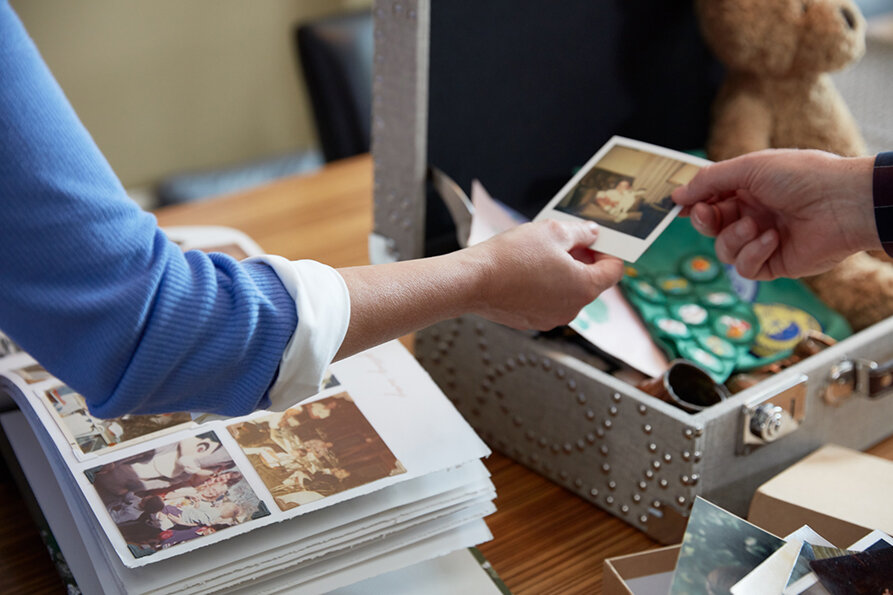
Looking at photos, whether in an old family album or on a device, is a great way to prompt memories and get the stories flowing from grandparent to grandchild (and vice versa!).
A few reasons why grandparents are excited to share stories with their grandkids:
TO IMPART LESSONS: By talking about their life journey—including funny missteps and even big failures—grandparents can share some of their hard-earned wisdom with the next generation.
TO CONNECT MEANINGFULLY: How often do your parents get to have real conversations with your kids? This is a rare—and precious—opportunity.
TO REFLECT INTENTIONALLY: Like writing in a journal, being interviewed for one’s life stories provides a chance for reflection that we rarely indulge in during our busy lives. It’s a practice that’s good for our mental health, according to research, but beyond the research, it just feels darn good.
TO HAVE SOME FUN: Sharing childhood memories and grown-up exploits with the grandkids—what could bet better? It’s a chance for the grandparent to pull out some favorite old photos, to get a little nostalgic, and to share a piece of themselves with someone they love unconditionally. Laughs will ensue, I promise!
If you’d like to encourage your child to interview your parents, I hope you’ll download this popular resource that I’ve been giving away for free since the pandemic began—The Kid Kit: Everything You Need to Interview the Grandparents. Originally available for purchase in the Modern Heirloom Books store, I felt strongly that during this time of separation (and newly-found comfort in connecting over Zoom), I wanted as many people as possible to have it.
Inside you’ll get not only interview questions (and those are AWESOME, if I say so myself—they’re designed with kids aged 7+ in mind and cover a wide range of topics), but you’ll also get bonus activities, a history timeline, and tips for how to continue the story sharing post-interview.

FREE RESOURCE: Questions, Activities & More
Get your kids talking—really talking—to your parents. They’ll get stories even YOU’VE never heard!

Life Story Links: March 30, 2021
A curated reading list for memory keepers including recent pieces about the craft of memoir, connecting generations through story, and history held in letters.
“You don’t need anyone’s permission to be the author of your life. It’s yours. Write it.”
—Cheryl Strayed

On this day in 2003, a law banning smoking in NYC restaurants and bars went into effect (and as a then–New Yorker, I was one of the seemingly few who were happy about it at the time!). Vintage photo of woman smoking in front of the Fifth Avenue entrance to the New York Public Library, 1954, by Angela Rizzuto, courtesy of the Anthony Angel Collection, Library of Congress Digital Collection.
Connecting the Generations
A TEEN AND HIS GRANDFATHER
A teenager reflects on the last couple of years of his PawPaw’s life, during late-stage dementia, and finds five lessons learned from the experience.
IT STARTED WITH A LETTER
Jacob Cramer founded Love for Our Elders when he was in his third year at Yale: The nonprofit collects handwritten and video letters for isolated elders (hundreds of thousands of them to date!). The group has also compiled a “Senior Storybook,” to which you can contribute.
LEGACY LOOMED LARGE
“I wish now that I had asked my father more about his one-and-only game against [Elgin] Baylor, more about that league and those times. But dad died 15 years ago. As close as we were, some of his history will always be cut off from me.”
PROMPTS IN A JAR
Elizabeth Thomas, a personal historian based in Salt Lake City, Utah, shares rules for a simple family history game that makes capturing stories from your family elders fun and engaging.
A GIFT FOR GENERATIONS TO COME
“And remember, you don’t have to call yourself a ‘writer’ or know much about creative writing techniques to write a personal history…. Your children and grandchildren or other members of your family will love anything that gives them a better picture of your life.”
“BRIDGED”
“Maybe, I thought, writing is about so much more than what can be contained within the margins of a page. Maybe it’s about what can be bridged. Or shoved together. At least for a moment.” Jennifer De Leon on mother-daughter relationships and the power of memory.
The Why Behind Story Preservation
CONVEYING THE URGENCY
Like many personal historians, I struggle with finding a way to adequately convey to everyone just how important it is to both ask our parents about their lives and tell them how we feel—and to do so now.
WAR STORIES
"My dad told me a lot of stories about being a poor kid in Kentucky...and I didn't write them down. And so I forgot,” said Tom Everman. So, the air force veteran recently wrote his own memories of the Vietnam War—for his children.
Epistolary Exchanges
“DEAR G.I.”
In 1966, a Massachusetts mother of three began writing to young men serving in Vietnam. One became her most steadfast pen pal, writing her 77 letters over seven years, and now that correspondence is gathered in a book.
1950S DRAG ARTISTS TELL THEIR STORIES
“I don't know why you guys want to tell this story,” various subjects told a co-director of the new documentary P.S. Burn This Letter Please. The film—like the letters it is based upon—opens a window into a forgotten world where being yourself meant breaking the law and where the penalties for “masquerading” as a woman were swift and severe.
The Stuff of History
WHIRLWIND TRIP DOWN MEMORY LANE
“Two men. Two lives,” Dan McCullough writes. “One album of memories shared only by these two men, precipitated by one of them standing in a doorway a week ago today.”
A ‘VISUAL MEMORY‘ OF WAR IN SYRIA
“There is growing concern that digital evidence of history’s most documented conflict is being syphoned away by the Internet’s indiscriminate trash can.” As one Syrian activist put it, “It’s not just videos that have been deleted, it’s an entire archive of our life.”
THE OLDER, THE BETTER?
“It’s the photo albums, the well-loved baby blankets, and the shoe boxes full of letters that have left me paralyzed.” A thoughtful look at why decluttering can be so emotionally fraught.
“RIGHTSIZING”
Jeannine Bryant, author of Keep the Memories, Not the Stuff, “recommends attaching a story or experience to prized possessions, such as pointing out the single item that came from the ‘old country’ with an ancestor, to explain why it's important to you—and why it might become a cherished item for them someday.”
FROM TRASH TO TREASURE
“Why are you spending so much time on just one person—and just one person’s garbage? Because it’s such a robust story,” archaeologist Seth Mallios says in this piece exploring how he and his students are revealing the story of Nathan Harrison, one artifact at a time:
On the Craft of Memoir
OUT OF THE SHADOWS
Anna Brady Marcus writes about why you must include not just the light experiences (the ups, the joy) but the darker ones (the downs, the struggles) in your autobiography, too.
TIME STAMPS
Beth Kephart has “taken an idiosyncratic tour of time in memoir” and here shares some of her observations on how a writer might approach time on the page.
...and a Few More Links
This year’s college admissions essays became a platform for high school seniors to reflect on the pandemic, race, and loss.
New book features young authors from across the country, ages 7 to 13, sharing their personal stories and experiences about life during the pandemic.
Why do so may people think novels reflect the author’s personal history?
Clothes are a gateway to personal stories in Chinatown Pretty: Fashion and Wisdom from Chinatown’s Most Stylish Seniors.
Halted by pandemic, heritage travelers turn to great reads that delve into ancestors’ often surprising histories.
A rather negative take from a Wall Street Journal Opinion writer on an epidemic “of non-memorable life stories”
Actress Sharon Stone tells her story in new memoir.
Short Takes

“I wish I had asked my mom that” and other heartbreaking regrets YOU can avoid
It seems obvious: We should ask our parents about their lives—lessons, loves, adventures, ancestors. Then why do so many of us wait too long and then have regrets?

Ask your parents to share stories from their life—not only will you have the security in knowing their legacy is preserved (no regrets of unasked questions!), but you’ll undoubtedly gain some laughs and lessons along the way.
If there’s one thing I’ve learned over and over again in this business of memory keeping, it’s that we all take our loved ones for granted—and we think that tomorrow or the next day we’ll be able to have that meaningful conversation. I struggle with finding a way to convey to everyone just how important it is to both
ask our parents about their lives
and tell them how we feel
—and to do so now.
Unfortunately, for many people, it’s only stories of regret that sink in:
I could tell you the story of my friend who came out as gay to his mom as she lay in her hospice bed, unresponsive. He likes to believe she heard him.
I could tell you the story of my client who had a million ideas why her mother was so emotionally closed off, but who never asked her mother to share her experiences. She is haunted by her many questions…and lack of answers.
I could tell you the story of an almost-client who booked me to interview her grandfather, who was a Holocaust survivor, only to have him die two days before our scheduled interview. We shifted to creating a tribute book in his honor, but how much more special would having his own stories have been?!
Often I simply share this powerful quote from William Zinsser that says so much with so few words:
“One of the saddest sentences I know is, ‘I wish I had asked my mother about that.’”
Have you asked your parents or grandparents about their lives? If that seems like something you just don’t have time for, please think again.
3 ways to ask your parents for their stories—before it’s too late
Not sure how to capture your parents’ stories? Here are three foolproof ways to invite, hear, and preserve your parents’ stories. Whichever you choose, I implore you: Get started now.
1 - Record an interview with your mom or dad.
No need to overthink this—just find a way to sit intentionally with your parents for the express purpose of listening to their stories. Use an audio or video recorder to capture the conversation. You can always decide what to do with it later. Choose questions from this free guide, or make them up as you go along.
2 - Ask your parents to write about their memories.
They don’t have to think of themselves as writers to undertake a project such as this, but they do need to be committed to writing regularly. So, provide them some friendly accountability: Ask if they’ll call you once a week to read their stories to you (and your siblings, if you have any—a fun excuse for a Zoom get-together!); or, undertake an email correspondence with your parents where you ask the questions and they reply with their stories.
I recommend they spend an hour or so brainstorming a list of memories, then use the items on that list as prompts for their life story writing; or consider signing up for a class with weekly memory prompts to get them going.
3 - Hire a pro to help your parents record their stories.
Whether your parents don’t have the stick-with-it-ness to keep writing, or you’re too busy or otherwise unable to interview them, or you simply want the best experience possible, consider partnering with a personal historian such as myself to record your parents’ stories and preserve them in an heirloom book. I’d be happy to chat with you about the ways to bring your project to life.
A surprising benefit of going this route: Some people feel more comfortable telling their stories to an open-hearted stranger as opposed to a family member—it could be because they know they have a captive audience who hasn’t heard their stories before, or because they may fear familial judgment for certain experiences or decisions in their past—but whatever the reason, the stories often flow more smoothly and fully when told to a professional interviewer.
This approach also allows you to let your parents know how much your stories mean to you while taking the pressure off you to guide the project through to completion.
Whether you interview your parents or ask them to journal about their life, let them know, in no uncertain terms, that their stories hold value for you. Convey just how special this undertaking is to you and not only will you get their stories, you’ll inevitably grow closer in the process.

Modern Heirloom Books offers plenty of free family history resources to help you interview your parents and capture their stories for posterity, including this guide, “56 Essential Family History Questions to Ask Your Parents Before It’s Too Late.” Click the button below to access it right now!