
Memories Matter
Featured blog Posts

READ THE LATEST POSTS

The little book that every aspiring memoirist should read
Introducing the two-word writing prompt guaranteed to keep your memories and your pen flowing, plus the book by Joe Brainard that inspired it: “I remember...”.

The little book that could: I Remember by Joe Brainard is a cult classic and a favorite of aspiring memoirists and memory keepers.
Buy this book now: I Remember by Joe Brainard.
(I don’t suggest borrowing it from the library, because you will want to pull it out next week, in five years, when you’re staring at a blank computer screen or journal page; it’s a tiny book, so it won’t take up too much space on your bookshelf, after all.)
This book is a delight to read. And this book holds the key to writer’s block.
Brainard’s memories, recounted in a stream-of-consciousness fashion, are short and pointed, often mere phrases or single sentences, occasionally a brief paragraph, each beginning “I remember...”:
“I remember the only time I ever saw my mother cry. I was eating apricot pie.
“I remember how much I cried seeing South Pacific (the movie) three times.
“I remember how good a glass of water can taste after a dish of ice cream.
“I remember when I got a five-year pin for not missing a single morning of Sunday School for five years. (Methodist.)”
As Ron Padgett writes in the book’s afterword, “Few people can read this book and not feel like grabbing a pencil to start writing their own parallel versions.” Indeed. “It is one of the few literary forms that even non-literary people can use.”
The two-word prompt that never fails
Like many before me, I was first introduced to Joe Brainard’s book in a weekend writing workshop with memoirist Dani Shapiro. She read some snippets out loud and I was immediately enlivened. Our assignment: to write nonstop for 10 minutes, finishing the sentence “I remember…” over and over with no concern for chronology or connectedness.
As she describes, “When I give that exercise at retreats, I look out from where I’m sitting at a sea of people, and not one of them hesitates. Those are extremely evocative words.”
“I remember.”
Those are the words Shapiro calls evocative.
And they are the words that form her (and my) favorite writing prompt: “I remember…” is a steadfast prompt, an old friend that can be pulled out and used often, always to new effect.
As Padgett writes, “Even the smallest [memory] can exert a mysterious tug, and when it is clearly recalled it can release a flood of other memories.”
Your turn: Start writing using the prompt “I remember…”
“Memory is just this storage locker of incredibly rich material and we often can’t get at it when we’re trying to remember something or thinking in some chronological way or straining and reaching,” Shapiro said on an episode of her now defunct Facebook Series, “Office Hours.”
“Where we can really get to it is on the page, following the line of words, and allowing associations to pile one on top of the other.”
So, grab a pen and start writing.
don’t discriminate against memories that seem meaningless or small
don’t worry about making connections between one memory and another
don’t stop until your 10 minutes are up.
Some remembrances will be short and specific. Here are two of mine:
“I remember patent leather black shoes with one scuff on the toe.”
“I remember drinking Diet Coke nonstop when I worked at Vogue. My production assistants swore I needed an IV drip of caffeine. One of them berated me for buying cups of ice from the bodega for a dollar.”
Other remembrances will be more profound, perhaps longer, such as this one from Brainard:
“I remember having a friend overnight, and lots of giggling after the lights are out. And seemingly long silences followed by ’Are you asleep yet?’ and, sometimes, some pretty serious discussions about God and Life.”
Let your mind wander—no restrictions—and your pen will follow. You’ll be surprised by what bubbles up.
“People almost invariably find memories that they didn’t know that they had,” Shapiro said in an interview with Marie Forleo about this exercise.
“We don’t tell ourselves stories in our heads. We have these disparate memories that don’t connect. And when we allow them to be associative and to bounce one off the next, it creates all sorts of interesting material.”
Who should give this writing prompt a try?
Personally, I think the simple phrase “I remember…” as a springboard for writing has universal appeal. It’s fun, it’s alluring, and it’s easy.
It may be especially beneficial for certain people, though.
This writing exercise is good for:
helping you open the floodgates of memory when you feel stuck
warming up at the beginning of a writing session—putting pen to paper and having a relatively easy task (simply finishing the sentence “I remember…”)
brainstorming memories: Without the pressure of remembering something specific, your list will inevitably be diverse and surprising—providing fodder for a future memoir or personal essay.
So if you’d like to discover the power of short reminiscence, and emulate it to create your own list of prompts for future development, well, I Remember is the book for you..
Note: This is an unsolicited review of a book I purchased at full price. I did not receive any compensation or free products in exchange, and any endorsements within this post are my own.
Affiliate disclosure: As an Amazon Associate, we may earn commissions from qualifying purchases from Amazon.com.
P.S. I’d love to hear some of your reflections. What are a few of your favorite things you wrote using the writing prompt “I remember…”? Share in the comments or shoot me an email!

“Stories through the vessel of cherished food memories”
Meet the story- and food-loving host behind the inspiring podcast The Storied Recipe, then click on a few of my favorite episodes for a taste of her interviews.

On The Storied Recipe podcast host Becky Hadeed, pictured, invites guests to share their stories through the vessel of cherished food memories.
Podcast recommendation: The Storied Recipe
If you look at the Instagram feed for The Storied Recipe you’ll be excused for thinking that the founder is simply a food photographer. Becky Hadeed is, of course, a photographer who turns her lens (rather gloriously) to food, but she is so much more, and at the heart of all she does is a bone-deep respect for story.
On The Storied Recipe podcast, Becky begins each episode with a few words describing her mission: Giving a platform for her guests to “share their stories through the vessel of cherished food memories,” thereby inviting us all to “honor those that have loved us through their cooking.”
And there’s the attraction for me, as you can imagine! I have written often about the power of smells and tastes to conjure memories, to transport us back to our childhood kitchens. If someone is a reluctant storyteller, it’s often their food memories that get them going.
Becky’s conversations with her podcast guests are fairly wide-ranging, but they somehow always circle back to food stories and a cherished recipe (which Becky cooks herself and photographs in her garage studio).
It’s not surprising, either, that my favorite episodes highlight stories from “everyday people” who happen to light up with the telling of their food memories. Whereas we would expect a chef or a cookbook author to be inspired by the foods of their past, it’s the regular folks talking about their family members and the tastes of their childhood that are often most inspiring.
The person behind the podcast
Becky posits that her love of story came before food, but it’s a close call.
“I always say that reading was my first love, because when I used to go to the library or open a new book (and I opened hundreds every year, as a child), I got the same feeling of happy butterflies that I got when I saw a crush! Reading gave me comfort and insight and a way to occupy my mind.”
She says she’s always seen “individual stories as the best way to make sense of history and the world.” As with so many of us, that belief likely started with tales told by her grandparents, who resided next door to Becky when she was growing up, as well as her great-grandmother, who lived to 103. Becky loved hearing stories of their lives and asking them for more—and more!—detail. “So this idea that personal story is the best way to learn about culture and heritage and history was just...it was so obvious to me.”
Becky is a naturally curious soul who still seems surprised when someone expresses gratitude for her openness. People have often told her how “they found themselves sharing things with me that they never shared with anyone else,” she says.
Listen to a few of her podcast episodes and you’ll see why: Becky is what I call a generous listener. Her questions spring from a well of both genuine curiosity and openhearted respect. In today’s world (as I know all too well from my own experience as a personal historian), giving someone our full attention and asking questions that convey real, engaged interest—well, it’s all too rare.
And because Becky’s love for food runs parallel to her love for story—and because her photography began to shine a light on food—it was only natural that her podcast allow guests to tell their stories through the lens of food. She says she feels those same butterflies that she gets while reading when she is in the kitchen, “when I figure out how to put together all the random things I have in my fridge, when I see the light falling on the carrots I'm chopping, or when I see a new recipe I want to try.”
The gift of cherished food memories
“What I really want to do is to take meaningful photographs of food for people that celebrate the relationships in their lives,” Becky says.
That means more often than not the foods Becky cooks and photographs are humble fare that remind a guest of mom, grandpa, the homeland, or childhood. Sure, there’s a complex recipe here and a vaulted dish there, but there are also basic tea cakes and beloved street food.
Becky’s own go-to food memory is like that. It bestows comfort and a return to a simpler time—and, as Becky says, it “proves that it’s the story and the people that really matter.”
“My mom is an excellent cook—she’s really the best cook I know. But that special memory I go back to the very most came from my grandmother, who wasn't a cook at all. She always made me root beer floats. Just ice cream and root beer, that's it. I drank them through her silver (real silver) iced tea straws. They were delicious and made me happy.”
When Becky’s grandmother died, Becky inherited her silver (and uses it in her food photography still). “In fact, I'm drinking an iced coffee through one of those straws right this minute,” she tells me.
That straw holds stories for Becky, and continues to make her feel happy. And it’s the inherited cake pans, the passed-down recipes handwritten on index cards, and the familial food knowledge that Becky hopes to get her guests talking about—the little (often surprising) things that make them happy.

The silver spoons Becky inherited from her grandmother and a couple of root beer floats were the subject of some of Becky”s earliest food photography. “They were delicious and made me happy,” she says of the treats her grandmother made for her as a child.
Are you Becky’s dream guest?
If you’ve got a treasured food memory you’d like to share, consider applying to be a guest; you just might turn out to be on my next favorite episode.
“The beauty is in the mundane,” Becky says. “It’s the everyday people whose stories are not told over and over again that hold the real wisdom and beauty.”
“Time and time again, I've gotten on the phone with a regular person and we've talked for hours (!) about their grandmother or their father and I get off in tears, so in awe of this person's fortitude and love,” she says.
On the other end of the spectrum, if you know a chef or a high-profile foodie who tells captivating tales around the dinner table, why not turn them on to the podcast? Maybe they’ll want to share their untold food inspirations, too. (Rahul Mandel, wanna dish? Becky says she’d love to hear about Bangladesh and your mom and about so much more than your (fabulous) cakes!)
Favorite episodes, free download & related links
My favorite episodes of The Storied Recipe podcast:
“Food is very emotional.”
Selina Göldi on the soul of a place, how cooking in the French countryside helps her reconnect with the instinctual aspect of cooking, “the map of her childhood landscape” in Switzerland, and entertaining with her whole “heart and body and soul.” Oh, and a recipe for a German no-bake layered cake that her grandmother and mom prepared for celebrations.

“They would always forget to put something in.”
Becky speaks to her longtime friends Robert and Lisa amidst lots of laughter, musings on what exactly is pudding? (no real conclusions drawn), memories of stirring the Christmas pudding for good luck, and how much whiskey to pour in, give or take. (Sorry, this family recipe’s a secret.)

“I found my entire family in a Ukranian village.”
American-born Lydia on the power of calling herself “Piotr’s granddaughter,” discovering the foods of her childhood on a foreign table, and trading shots of homemade vodka with a dying woman. Oh, and a recipe for (a lot!) of varynyky (otherwise known as pierogis).

Seth Greenberg: Lessons from an Iconic NYC Bakery and Laura Clark: Thanksgiving in Italy are two more of my favorite episodes.

Freebie I know you’ll love:
The DIY Storied Recipe Book, which you can print at home, creates space for you to preserve your recipes and the stories behind them.

The Storied Recipe Instagram feed:

After a recent account hack, Becky lost thousands of followers, so the feed is still building; you’ll get a taste of her food photography as well as updates about new podcast episodes.
All food photographs by Becky Hadeed, courtesy The Storied Recipe.
Related reading:
Check out more podcast recommendations for life storytellers, creative entrepreneurs, oral historians, and anyone who loves a captivating first person story.
Read more posts with first-person food memories and tips for preserving your own.
Our A Taste of the Past recipe card set pairs nicely with a bottle of burgundy—a most thoughtful hostess gift or a little homespun comfort for yourself anytime.
What about YOUR Food Memories?
Care to preserve your own food memories—or a whole bunch of your life stories with a few luscious food memories thrown in? I’d be honored to interview you for a book of your own. Reach out to see how we can work together!

Book recommendation: “Life Is in the Transitions,” by Bruce Feiler
Bruce Feiler's latest book, Life Is in the Transitions, offers up a helpful toolkit for dealing with life's curveballs through a lens of storytelling.

Bruce Feiler’s new book, Life Is in the Transitions: Mastering Change at Any Age, was released July 14, 2020 from Penguin Press.
If you are into family history at all, chances are you’ve heard of Bruce Feiler. He is one of the most-oft quoted experts on the power of storytelling in genealogy circles. After his article “The Stories that Bind Us” went viral in 2013, Feiler went on to author a book that dove deeper into the topic and headline the 2016 RootsTech conference.
Feiler calls himself a “lifestorian,” and his current book goes far in legitimizing that title.
This month he released Life Is in the Transitions, a book based not only on research from past psychological and university studies, but on a trove of data he collected himself over the course of three years when he roamed the country (all 50 states, in fact) interviewing people about their lives.
Not just any old meandering, curiosity-fueled interview, either, but what Feiler calls the “Life Story Interview,” based on narrative studies pioneer Dan McAdams’s template, modified for his purpose today: “My goal is to understand how we all live now—how we navigate the transitions, disruptions, and reinventions in our lives in a way that allows us to live with meaning, balance, and joy.”
Feiler includes the interview template in the final pages of the book, and this, to me, is one of the most valuable extras he provides.
For as someone who interviews people for a living—helping you discover and articulate your own stories, and ultimately guiding you to find the meaning within your experiences—the straightforward yet flexible form of the Life Story Interview provides me with another way to do just that. Also: It gives YOU the tools you need to have enlightening and meaningful conversations with family members (something that both Feiler and I hope you do!).
I read the book with two different agendas:
One, as Feiler hoped: to better understand how to weather the myriad transitions we face in our modern lives, not only philosophically, but practically—to discover a toolkit for handling the changes and coming out (often better for it) on the other side.
Two, as a personal historian: to find more proof, more relatable anecdotal and data-driven evidence, that crafting and sharing our own personal narratives can be healing, productive, and best of all, meaning-making.
And yes, I got this and more from my reading.
Why You Should Read this Book
1 - As a Tool for Your Own Discovery
Feiler’s premise is simple: We are no longer living in a straight line with predictable milestones shaping our lives. Rather, we are bombarded by changes (more often, and at varying times).
“We experience life as a complex swirl of celebrations, setbacks, triumphs, and rebirths across the full span of our years,” Feiler writes. And yet, all of our coping mechanisms are based on this outdated notion of life as a single forward trajectory.
Moreover, our expectations of life are based in this same idea. If we correct that—if we can instead expect the nonlinear life trajectory as normal, even inevitable—we’ll be much happier, Feiler posits. “Trained to expect that our lives will unfold in a predictable series of stately life chapters, we’re confused when those chapters come faster and faster, frequently out of order, often one on top of the other.”
A cursory reading of Life Is in the Transitions goes far in letting us know that we’re not alone in our nonlinear experience of life; a deeper reading provides myriad opportunities for self-reflection as well as strategic approaches for navigating all those curveballs life is sure to yet throw our way.
And considering we’re all in the midst of what Feiler refers to as a “lifequake” as we navigate the Covid-19 pandemic, what could be timelier?
2 - as a source for some inspirational human stories
It’s easy to get lost in the mini-narratives of people’s lives that Feiler includes throughout the book: they’re placed in certain chapters to illustrate certain tenets of Feiler’s newly proposed paradigm of life transitions; but they’re also simply enjoyable to read, relatable even as they tell of one-of-a-kind scenarios. None of the transitions that are described in these stories are straightforward or simple—but they are real and compelling, and in the end, quite inspirational.
3 - as motivation for talking to your family about their stories.
“We have become a generation of unstorytellers… We need to return to the campfire. And we can. It’s as simple as saying to someone, Tell me the story of your life. And when they’re finished, say, I’d like to tell you mine.”
I could not agree more, and with Bruce’s easy-to-follow Life Story Questions on hand, I hope you will too!

A Few of My Favorite Quotes from the Book
“Lives are made up of memories, but when those memories remain episodic and disconnected, their impact dissipates.”
“Storytelling allows us to take life events that are exceptional, unforeseen, or otherwise out of the ordinary and domesticate them into meaningful, manageable chapters in the ongoing arc of our lives. This act of integration is storytelling’s greatest gift. It conventionalizes the unconventional. It transforms the untellable into a tale.”
“Everybody has a story, and not always the story the listener or teller expects to hear. The sharing is what brings out the surprise.”
“Transitions are autobiographical occasions.”
“Stories stitch us to one another, knit generation to generation, embolden us to take risks to improve our lives when things seem most unhopeful.”
Note: This is an unsolicited review of a book I purchased at full price. I did not receive any compensation or free products in exchange, and any endorsements within this post are my own.
Affiliate disclosure: As an Amazon Associate, we may earn commissions from qualifying purchases from Amazon.com.
Related Reading
Listen to an interview with Bruce Feiler on dealing with life-altering transitions (NPR).
Read the Kirkus review: “An unusual self-help book, of particular use to those contemplating writing a memoir or otherwise revisiting their past.”


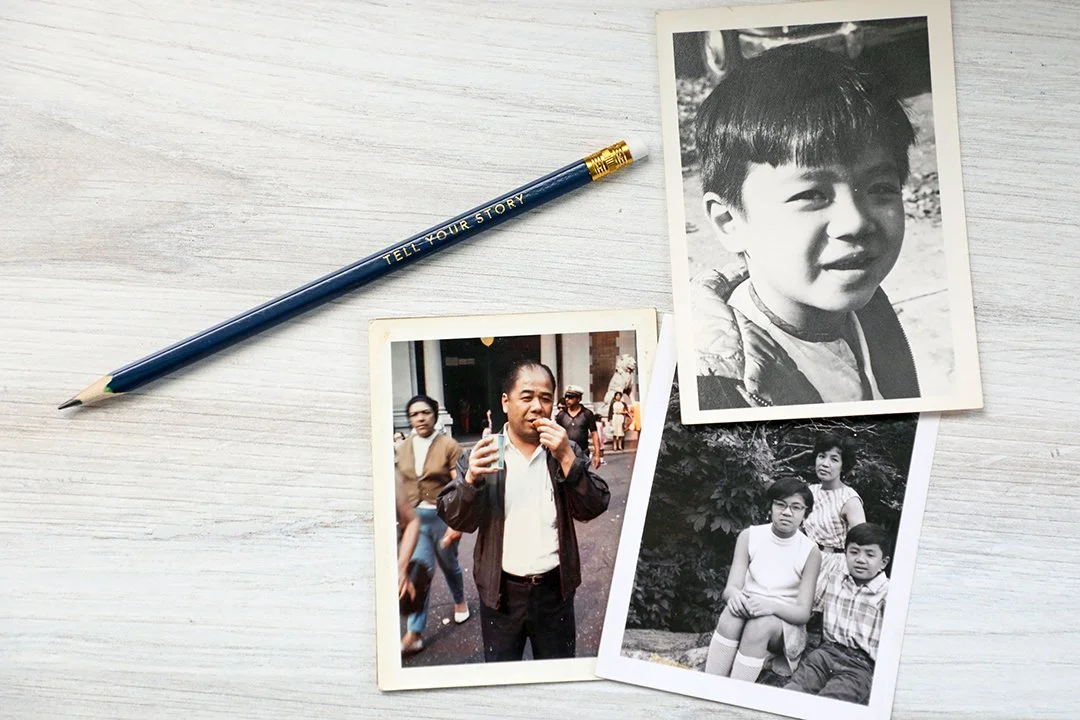






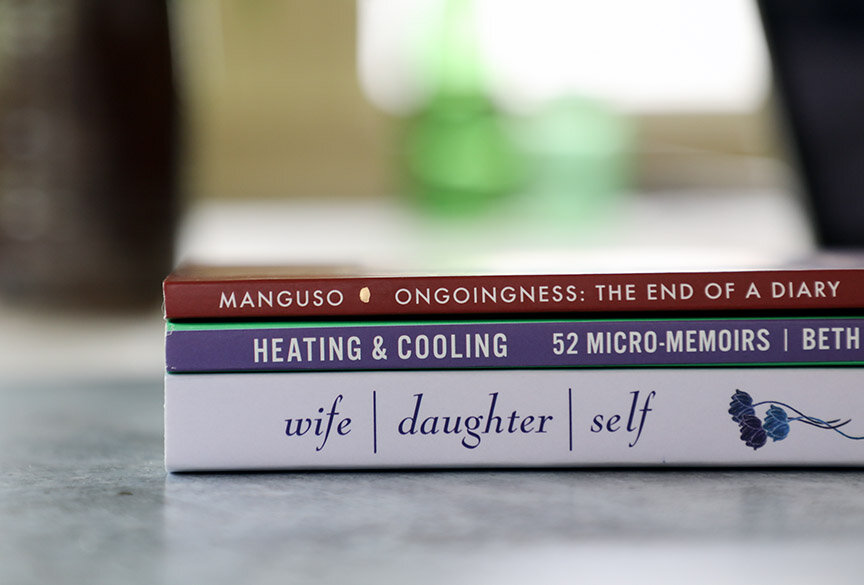


Have you read Life Is in the Transitions? I’d love to know what you think. Share one of your own favorite quotes, lessons, or insights in the comments, won’t you?
The vignette: What to read to be inspired
Memoir reading suggestions to inspire your own vignette-style life story writing, from Annie Dillard and Kelly Corrigan to Robert Fulghum and Sandra Cisneros.

Reading memoir in the format in which you would like to write is an effective way to internalize style and discover what may and may not work for you.
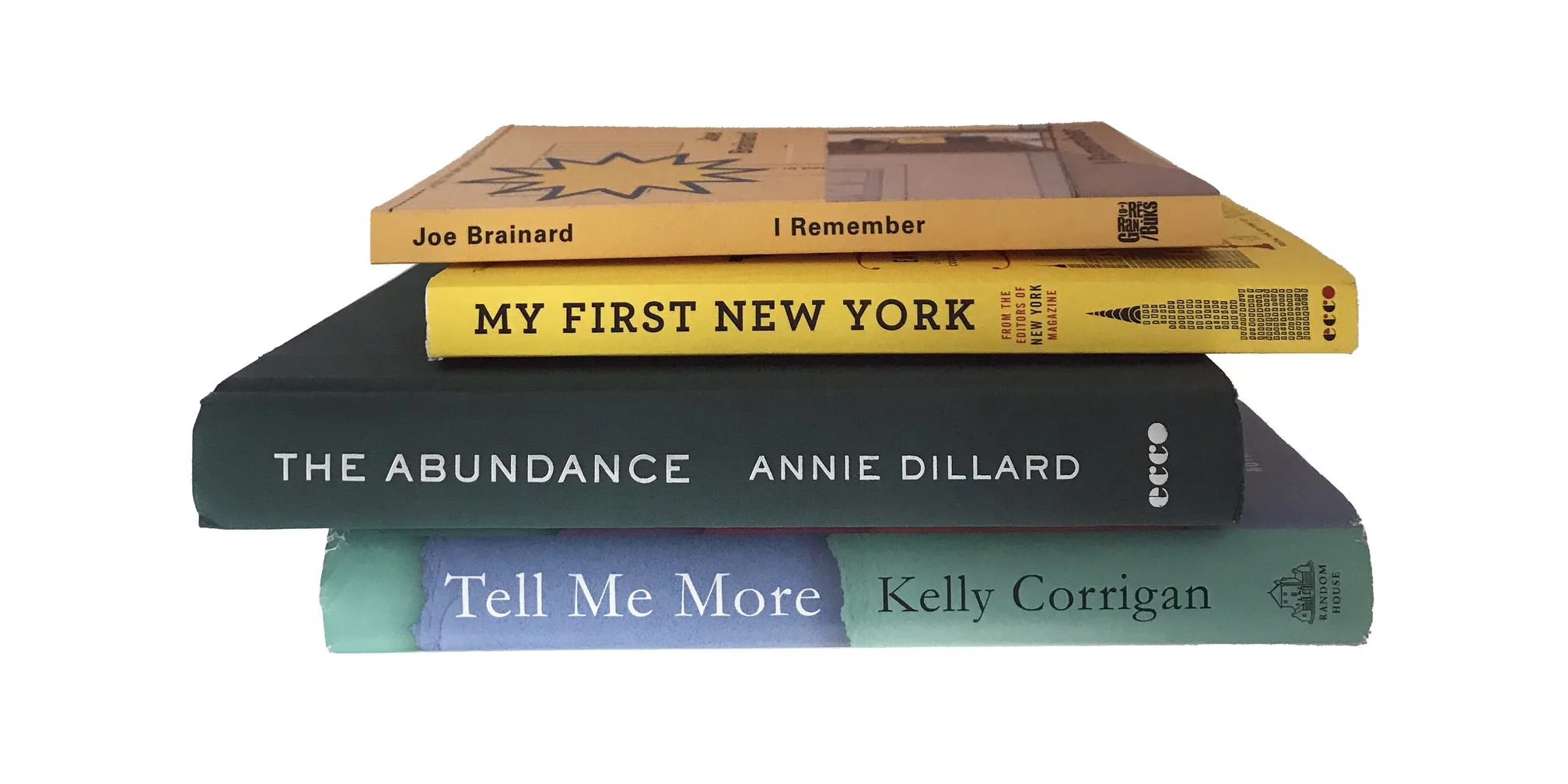
Here are a few titles that, in my opinion, utilize vignette-style writing to its fullest potential.
Vignette-Style Autobiographical Writing
The Abundance: Narrative Essays Old and New
(2016) by Annie Dillard
The entry titled “Jokes” is a fine example of writing from family experience that feels particular and universal at the same time; even without a true narrative arc, Dillard develops her parents into real characters and paints a picture of her home that makes the reader feel a welcome guest.
Tell Me More
(2018) by Kelly Corrigan
Read this joy-filled, sensitive memoir not because it is vignette-driven (it is not) but because it very likely started out that way. Corrigan—who has been called “the voice of her generation” by O: The Oprah Magazine and “the poet laureate of the ordinary” by HuffPost—beautifully weaves 12 stories together to create a book that says plenty about her life, and ours. Consider Corrigan’s book a goal to strive for in terms of using life experience to convey something beyond yourself, and of editing stories so they transform into a whole that is greater than its parts.
My First New York: Early Adventures in the Big City
(2010) from the editors of New York magazine
This compendium of candid accounts from various luminaries puts New York City on the map in an entirely new and wholly personal way. Each vignette (called “small, glittering essays” by the LA Times) is an exquisite example of capturing a slice of life via an interview (translated for the book into as-told-to pieces), an approach anyone can try simply by speaking into your phone’s voice recorder and transcribing—and editing—later.
I Remember
(1975) by Joe Brainard
Dani Shapiro introduced me to this tiny gem during a memoir writing workshop a few years back, and I have recommended it countless times since. Brainard’s memories, recounted in a stream-of-consciousness fashion, are short and pointed, often mere phrases or single sentences, occasionally a brief paragraph, each beginning “I remember...”. Read this book to discover the power of short reminiscence, and emulate it to create your own list of prompts for future development.
Finding Inspiration in Fiction
The House on Mango Street
(1984) by Sandra Cisneros
This a great fictional model for vignette-style of writing. The book is a series of sketches and vignettes written in rich, poetic prose that together form a loose narrative about the author’s Chicano childhood. The vignettes add up, as Cisneros has written, “to tell one big story, each story contributing to the whole—like beads in a necklace.” Told in first person, the book reads like a true autobiographical exploration. Her language is lush and figurative, offering us a glimpse into her world without much editorial exposition.
Discovering Voice
All I Really Need to Know I Learned in Kindergarten
(1986) by Robert Fulghum
Robert Fulghum, whose eight nonfiction books all rose to the top of the New York Times Bestseller List, refers to his writing as “stories, observations, and affirmations.” His books are filled with anecdotes, wit, and wisdom around everyday experiences and life-changing transitions.
He says his “writing usually begins as journal entries—notes to myself—lines of verbal perspectives drawn from walking around and stopping at intersections as I move camp each year.” Fulghum says he molds his raw ideas into stories by sharing them aloud with a walking companion, thereby “editing” his stories as he goes. “In time, the stories and reflections migrate into book form,” he writes. “Even so, please keep in mind that I think of what I’m doing as writing letters and postcards to friends, always ending with the unspoken tag line: ‘Wish you were here.’”
Two more of Fulghum's titles to check out for inspiration for using a casual voice to capture vignettes that resonate:
What on Earth Have I Done? (2007)
It Was on Fire When I Lay Down on It (1989)
Related Reading on Vignettes
In “How to Write a Good Story in 800 Words or Less” you’ll find writing tips and, more importantly, one of the best examples of how powerful brief character writing can be, a 145-word piece by Meyer Berger.
Check out our Vignettes Writing Prompts series:
Learn how to use family photographs as writing prompts, and how to choose the best photos to use.
If you’d like memory and writing prompts delivered to your phone weekly, sign up for our short—affordable!)—Write Your Life courses.
Affiliate disclosure: As an Amazon Associate, we may earn commissions from qualifying purchases from Amazon.com.
FREE Writing Prompts Guide
Get all our life story vignette writing prompts in one easy-to-read printable guide!

3 Must-listen podcast recommendations for life story lovers
Each of these powerful podcasts comes in at under an hour: Listening recommendations on memoir, narrative structure, family secrets, writing prompts, and more.
If only there were more time in a week to listen to all the podcasts I would like to! As a former journalist who often bemoans the state of media these days, I find respite and refuge and inspiration in the podcast arena, where interviews are often in-depth and surprising, and where there is plenty of content aimed at lovers of memoir, life story, and family history.
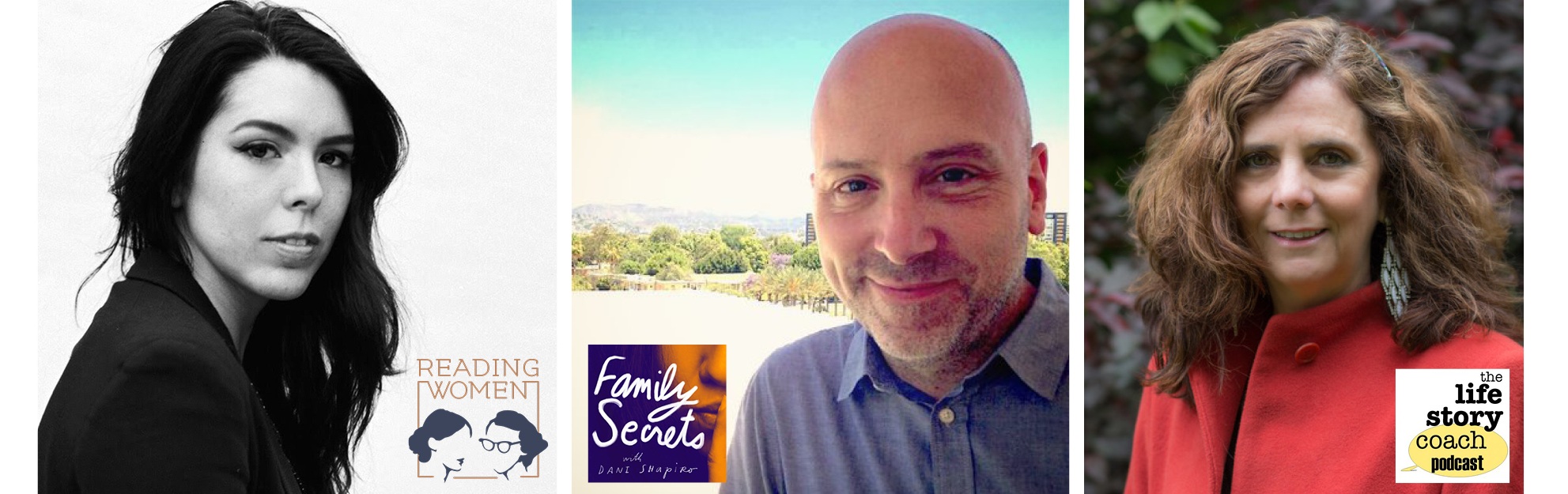
Here are a handful of my favorites in recent weeks—I hope you give them a listen, and please let me know your own favorites in the comments so I can add them to my playlist!
Click on the numbered links below to go straight to that review:
Steve Lickteig on Dani Shapiro’s Family Secrets podcast (41 minutes)
T Kira Madden on the Reading Women podcast (40 minutes)
Beth Kephart on The Life Story Coach podcast (46 minutes)
An Open Secret Revealed
On Dani Shapiro’s Family Secrets podcast, Steve Lickteig talks CANDIDLY about the secret of his own identity that not only his family, but an entire small Kansas town, kept from him. As a child, he was told that he was adopted. But that didn't turn out to be entirely true, or even half of the story.
“There is a real power in crafting a truthful narrative—or at least as truthful as you can make it, your emotional truth,” Steve Lickteig tells Dani Shapiro in this episode of her new Family Secrets podcast. As a longtime fan of Shapiro (Hourglass will always be among my favorite memoirs), I’ve listened to all of the Family Secrets episodes. And while I absolutely suggest subscribing, I will say that her talk with Lickteig is the one that lingered longest with me—and which would make a wonderful introduction to the series for a first-time listener.
Lickteig is a journalist himself, and perhaps it is his deep rootedness in storytelling that makes his conversation with Shapiro so resonant; he is articulate and thoughtful, conscious of creating a narrative out of his family history that enlightens something greater than his own perspective.
Listen to the full episode at left, or head over to the Family Secrets page to hear more from the likes of guests Debbie Millman, Jane Mintz, and Jim Graham.
During Shapiro’s interview with Lickteig he recalls his occasional unease (and simultaneous journalistic pride) at the way he comes across in his 2011 documentary Open Secret, which explores in depth the stories he shares on the podcast. He says the film portrays him in ways that are at times unflattering, but yet true to his experience.
Open Secret is described as Lickteig’s “20-year search for who his real birth parents were; why a whole town kept the truth from him; and how his family's tumultuous history revolves around the hidden lives of two unconventional women.” I haven’t watched the film yet, but indeed, it’s on my watch list.
An Unconventional and Evocative Memoir
T Kira Madden, author of Long Live the Tribe of Fatherless Girls, talks about owning her story with Kendra Winchester and Autumn Privett on the Reading Women podcast.
Topics of conversation include:
getting permission—or not—from her family members to write about them
discovering the form that would best suit her narrative, from weaving a linear thread through disparate stories and ways of storytelling to creating the skeleton that would support her memoir structurally
how reading The Chronology of Water by Lidia Yuknavitch gave her permission to allow “form and content to play with each other,” and to tell her stories in a nonlinear way
how to separate herself from her memoir
the ways in which we inherit parts of our parents’ identities (“understanding myself meant understanding more about my mother and understanding more about my father”)
how the “memory loop [she] was caught in for years” transformed into memoir
I was immediately drawn to Madden’s book when she described it alternatively as a “funky memoir” and “scattered essays that make up my life so far.” It is so much more than a coming of age tale, and trust me, those “scattered” pieces are woven together meaningfully.
“The honesty and vividness with which Madden writes and the tightly controlled structure she utilizes only emphasize the fact that Long Live the Tribe of Fatherless Girls is a deeply compassionate book, though not an apologetic one,” Ilana Masad writes in a review for NPR. “In baring the bad and ugly alongside the good, Madden has succeeded in creating a mirror of larger concerns, even as her own story is achingly specific and personal.”
Give the full 40-minute interview a listen here, or visit the Reading Women podcast page for show notes.
This was my introduction to Reading Women, and I will undoubtedly be listening to more. A couple that are in my listening queue are a discussion of Kindred by Octavie E. Butler and Homegoing by Yaa Gyasi (I recently read Kindred and highly recommend it for history lovers especially) and, of course, their exploration of memoir from last September.
The Questions We Ask
Award-winning memoirist and memoir writing teacher Beth Kephart introduces Amy Woods Butler’s Life Story Coach listeners to ways we can help others write memoirs that matter.
When I sat down to listen to this conversation between memoirist Beth Kephart and life storyteller Amy Woods Butler, I had no idea that I had indirectly introduced them…but how happy I am that I did!
Kephart has fed my writing soul for years; I have personally relished her fiction, endorsed—and continue to use—her writing workbook, and forward her newsletter to friends often. I imagine this less-than-an-hour interview with Kephart will entice you to want to hear more.
In this The Life Story Coach session recorded in 2019, Kephart and Butler hit upon topics including:
the wide variety of her experience teaching memoir and writing memoir
“getting to our stories in sideways fashion”
the power of contextualized and unexpected writing prompts
why she is drawn to memoirs with “that scenic, atmospheric detail-rich quality”
the gap between one’s spoken word and written word
and the Juncture newsletter, where Kephart explores topics such as what makes a memoirist approachable, interviews current memoir writers, and includes reader book recommendations, as well.
If you’d like to hear more of Beth Kephart’s writing wisdom over the years, here are three older podcast interviews with her you may enjoy:
“I’ve written memoir in the quest to answer very specific questions,” Kephart tells Dan Gottlieb in a wide-ranging conversation about the therapeutic value of memoir (also with a social psychologist) and how she helps others learn to tell their own stories. She talks about what memoir is not, and how to get to what it is and should be for each of us.
You can also listen to Kephart speak about Handling the Truth here, and hear her in conversation with Dani Shapiro about her latest memoir Inheritance (which inspired the Family Secrets podcast referenced above!) here.
What podcasts are you listening to—specifically those having to do with memoir, storytelling, and oral history, or any that have just captivated you?

Experience RootsTech 2019 from the Comfort of Home
RootsTech 2019 offers opportunities for accessing the family history conference from home. Highlights, and how to get the most from your virtual experience.

RootsTech 2019 takes place in Salt Lake City, February 27–March 2, 2019—but if you can’t make it to Utah, you can experience much of the family history conference virtually.
Discover Your Story, Discover Yourself
“Discover Your Story. Discover Yourself.” So reads much of the literature promoting this year’s RootsTech conference. And while a majority of sessions focus on nitty-gritty genealogical exploration, there is plenty to learn about storytelling, family history interviews, and preservation of those stories through technology.
RootsTech is billed as “a global family history event where people of all ages learn to discover, share, and celebrate their family connections across generations through technology.” And while there is much that can be experienced only at the Salt Palace Convention Center—such as the hundreds of exhibitors in the expo hall, one-on-one mentoring opportunities, and the serendipity of new connections forged through in-person meetings—the RootsTech team has provided ample opportunity for experiencing the event from the comfort of your home.
Free Streaming Schedule: Highlights
A full streaming schedule for RootsTech 2019 includes a detailed list of keynote speakers (including Diahan Southard and Kenyatta Berry) as well as breakout sessions that will be made available live during the conference.
Here are my top picks for those interested in family history storytelling and memory preservation:
Hear Them Sing! Social History and Family Narrative
11:00am GMT/ 1pm EST , Wednesday, February 27
Join Rebecca Whitman Koford as she discusses how the addition of social history enhances family narratives and clarifies the songs of our ancestors. She will discuss how to contextualize ancestors’ lives with social history research and use it to inspire others to want to know more about those who have passed.
“Jumping the Broom,” Oil, Inheritance, and African American Marriage in the South
3:00pm, Thursday, February 28
Kenyatta Berry will cover the tradition of jumping the broom, the informal marriage ceremony for the enslaved. Kenyatta will also share the story of her paternal ancestors in Arkansas and East Texas, as well as her methodology to uncover their pasts.
Why and How to Put Yourself into Your Family History
8:00am GMT / 10AM EST, Friday, March 1
In family history, it’s easy to overlook ourselves and the generations we know because we don’t feel like history! But you are a part of your family history. In this Power Hour, Curt Witcher, senior manager of the Genealogy Center, will show you why putting yourself into your family history is so important (along with the science to back it up). Amy Johnson Crow, author and host of the Generations Cafe podcast, will show you how you can include yourself without getting overwhelmed. Scott Fisher, host of the Extreme Genes radio show, will show you interview techniques to get more (and better) stories.
Trace the Story of Immigrant Ancestors in 3 Steps
8:00am GMT / 10AM EST, Saturday, March 2
Susan R. Miller, D. Joshua Taylor, and Frederick Wertz explore 3 key steps to unlocking the story of your immigrant ancestors with the New York Genealogical and Biographical Society.
Personally, I’ll also be watching a few of the other sessions, including The Silent Language of the Stones: Reading Gravestones through Symbols and Carvings on March 2nd (ancient symbols have always intrigued me!) and, if I have time, actress Patricia Heaton’s main stage keynote.
Which sessions have you placed in your own calendar?
The RootsTech Virtual Pass
In addition to the free live streaming detailed above, RootsTech also offers a paid option for a Virtual Pass that grants access to exclusive recorded sessions on demand. The videos will be edited (not available to stream live) and accessible for one full year beginning about two weeks after the conference has ended.
Considering my own recent road blocks uncovering my maternal line’s German roots, I am likely to spring for the $129 Virtual Pass; there are two breakout sessions included in the schedule that speak directly to German genealogy help.
One of the 18 genealogy sessions included in the Virtual Pass may be of particular interest to family history storytellers:
20 Hacks for Interviewing Almost Anyone, and Getting a Good Story
Have you ever gone to interview someone and could not get them to talk? Are they video shy? Are they reluctant to share? Do they have memory loss? Is their story a difficult one to tell? Personal historian Karen Morgan and speech-language pathologist Joanna Liddell share tips for quickly building a rapport with your subject. You will learn how to prepare for the interview, maximize the environment, put your subject at ease, use story prompts, listen actively, handle difficult topics, and discover how the role of an audience affects the stories the subject tells.
Check out the full schedule of Virtual Pass videos here.
I am not affiliated with RootsTech in any way. This roundup is intended as a recommendation based on my own insights and experiences for likeminded family history storytellers.

“Stories We Tell” isn’t new, but it’s worth a watch
Watch the 2012 film Stories We Tell as much for the dramatic exploration of one family's narrative as for the questions it raises about the malleability of truth.

Stories We Tell is a 2012 genre-bending documentary from director Sarah Polley. I recall being intrigued by the film trailers, but never made my way to the theaters to see it at the time of its release. A fortuitous sighting of the DVD in my local library led me to check it out this week, and I am so glad that I did.
In the film Polley brings together her siblings, father, and friends of her family, to explore the past in ways that are both seamless and contradictory, each individual weaving their own narrative threads to form a story much more complex than perhaps even Polley envisioned at the outset.
The subject? Well, one the one hand it is Polley’s deceased mother, Diane, whom the director lovingly brings to life through family stories and lots of colorful family video footage (and how glorious much of that is!). On the other hand, however, the subject is truth itself, and how elusive and malleable it inevitably is.
A Search for the Vagaries of Truth
Ultimately, Polley seeks to explore the past primarily through personal history interviews of those involved in her mother’s life, and to come as close as she can to some kind of truth.
“Can you tell the whole story from beginning to end, in your own words?” Sarah asks each of her subjects as prelude to her interviews.
Those interviews begin almost innocuously, with some discomfort at the prospect of delving into family secrets amidst bits of embarrassed laughter. But Polley deftly draws out the stories in a most compelling way, and we are privileged to be witnesses to a gradual unfolding of truths that feels especially intimate.
We are drawn into her mother’s story—into the dramas of infidelity and the banality of everyday life. And while that drama is captivating, it is the rather meta exploration of getting to the story—of watching it reveal and fold back in on itself—that makes this film a true gem, in my opinion.
“I am interested in the way we tell stories about our lives,” Polley says in one scene. “About the fact that the truth about our past is often ephemeral and difficult to pin down. And many of our stories, when we don’t take proper time to do research about our pasts, which is almost always the case, end up with shifts and fictions in them, mostly unintended.”

Watch the trailer for Stories We Tell.
Concentric Circles of Experience
Polley began conducting interviews and filming of her family members before she had a clear sense of what the project might become. Would it even be released, or remain a private undertaking? Through five years of production she let the stories speak for themselves.
In a letter to one of the players, Harry, she wrote: “I wouldn’t even pretend at this point to know how to tell [this story] beyond beginning to explore it through interviews with everyone involved, so that everyone’s point of view, no matter how contradictory, is included.”

“Why is that we talk and talk, or at least I certainly do, without somehow conveying what we’re really like?”
—Michael Polley
But is giving everyone’s perspective equal weight truly the best way to get to the truth, Harry wonders? Those who were “direct witnesses to the events” are more reliable narrators, after all, are they not? Or are the peripheral reactions and relationships that contribute to a family’s entire narrative all worthy?
These questions are explored and alluded to throughout, giving weight to the film and making Sarah Polley’s late appearance in the film all the more powerful. Particularly near the end, when Sarah herself begins to ruminate on why she feels compelled to tell this story and expose it to the world, the telling is eloquent and moving and raw in a most beautiful—and recognizable—sense.
Who owns these stories? Is there one version of personal history?
Polley’s brother Michael wonders aloud that while doing an interview might bring you as close to truth as you can get, does Sarah’s editing of it turn it into something different?
The questions amidst the stories are at the heart of Stories We Tell. What questions will they raise for you?
Related Reading
View a discussion guide from Influence Film Forum with thought-provoking questions and a few suggestions for exploring your own family stories.
Discover another documentary, Nobody’s Business, that explores the nature of memory through the lens of family history.
See where to stream or rent Stories We Tell, or buy the DVD.
“The truth was becoming more and more ephemeral as opposed to closer,” said Sarah Polley in a brief interview about her film.
Affiliate disclosure: As an Amazon Associate, we may earn commissions from qualifying purchases from Amazon.com.










The reluctant interviewee: “I’m just an ordinary guy”
In his 1996 documentary Nobody’s Business, Alan Berliner interviews his father about family history. The result is a poignant study of the nature of memory.
“Who the hell would care about Oscar Berliner?” barks…Oscar Berliner.
In Nobody’s Business, Oscar Berliner, the reclusive father, has the spotlight turned on him by his filmmaker son Alan Berliner, and the results are a poignant study in the nature of memory.
Nobody’s Business is not new; it is an Emmy-winning independent (raw and experimental) documentary from 1996. I discovered it only recently, though, and felt compelled to share. I hope the review that follows may inspire you, too, to explore screening Alan Berliner’s most personal film.

Filmmaker Alan Berliner filming his father Oscar on a Florida beach, circa 1993
End of Story
“I’m American.” That answer which my grandmother repeated each time I asked her about her—hence our—background—is echoed by Berliner’s father. He has no idea where his family is from, he says, and he does not care. Who cares?
HIs son the filmmaker cares, and persists in trying to get his father to come around to his way of thinking. After a trip to the Family History Library in Salt Lake City, Berliner shows Oscar photographs of his ancestors, including a picture of the street where they lived.
Oscar: “What does it matter?”
Alan: “Your ancestors walked on that block.”
Oscar: “Really, what does it matter?”
Oscar: “I have no emotional response. They could be taken out of a story book. I don’t know them!”
But the son is as stubborn as his father, and he challenges, probes, pushes.
Didn’t his father ever ask his own parents about where they came from? Well, no: “I never asked. They never said.”
His father remains recalcitrant. “I’m American. Period, that’s it.”
Strange Relatives
Delving into his family history a little further, Berliner interviews cousins and other relatives about their heritage—and the result is no more informative than his conversations with his father.
“No one ever talked about it,” says one cousin.
“We’re strangers who share a common history,” says another.
When a distant cousin is enumerating how he and Alan Berliner are related, he ultimately concludes they are “sort of relatives and sort of strangers…strange relatives.”
Indeed, Oscar sums it up best: “The one thing we share is the one thing we all know nothing about.” Their family history.
And yet the faithfully seeking Alan Berliner travels to the small towns in Poland where his ancestors walked, and to Utah to uncover records of the past. He describes himself in his journal as “questing after people I didn't know, people I will never know. Hoping to breathe in…even one tiny molecule of air once upon a time exhaled by my ancestors that might still be floating around the Polish countryside. Looking to incorporate it into my body, my breath, my being.”
Alan Berliner is the poet, the compassionate descendant, urgently probing the past for connections and meaning.
“Next question.”
Berliner’s journals elucidate his process and travels and struggles to “see how I might tell the story of my father's life, amidst his stoical reluctance to talk about it.”
His father is indeed reluctant, even combative at times (something Berliner visually brings home through footage of boxing matches cut throughout his dialogue with his father), never fully giving himself over to the conversation.
Despite the combativeness of the conversation, though, he tells his son that “yes,” he is enjoying himself during the interview. He is lonely in his old age. He thinks such personal questions—about divorce and marriage and war—are best left for private conversations. Each time the son inches closer to eliciting a truth or a story, though, his father balks: “Next question.”
Oscar Berliner died in August 1996, just months after Nobody’s Business debuted. He had gotten to sit next to his (very nervous) son at the premiere at the New York Film Festival at Alice Tully Hall, and told a friend that it was the happiest night of his life.
“'‘Oscar Berliner & Son’ is now closed for business,” Alan wrote in his journal after his father’s funeral. “We’ve retired. He's moved out, I'm moving on. Like everything else about him, it's a sad melange of ironies and contradictions. But I loved him out loud and people heard, understood, respected, and seemingly—in turn, found a way to love him too.”
A Legacy of Love & Longing
As he gets closer to finishing the film’s editing, Berliner records in his journal:
“The film is beginning to touch a nerve. To reach a kind of truth about ‘identity.’ About some of the hidden places inside of ‘family.’ My father is so honest, so raw, so real. He's incredibly alive as a character. I just need to let him be himself.”
And kudos to Berliner for letting his father be just that.
I felt privileged to witness the interchanges between father and son. To recognize some of their push and pull from my own family experiences (I, like Alan Berliner, have always ascribed a larger meaning to the past, and strive to derive meaning from—and pay respect to—my ancestors’ lives). To be part of this intimate dance.
Watching Nobody’s Business, I felt like I was witnessing a meaningful journey for Alan Berliner, son and filmmaker.
“Somehow in the cauldron of my life’s process, this feels important—both as personal gesture, and as public example,” Berliner wrote of making the film. I hope you will watch it and perhaps discover some meaning for yourself along the way.
Affiliate disclosure: As an Amazon Associate, we may earn commissions from qualifying purchases from Amazon.com.
Dawn Roode’s curated roundup for the week of Sept. 23, 2026, is overflowing with recent reads on memoir, life story writing, and family history preservation.