
Memories Matter
Featured blog Posts

READ THE LATEST POSTS
How the Proust Questionnaire can unlock your memoir
Discover how the Proust Questionnaire can unlock your memoir. Reflective questions to spark memory, deepen insight, and reveal your authentic story.
Long before personality quizzes filled our social media feeds, there was the Proust Questionnaire, a simple yet profound set of prompts designed to reveal a person’s true nature.
The questionnaire’s origins trace back to a 19th-century parlor game known as a “confession album.” Marcel Proust, the French novelist and essayist, famously answered one as a teenager and again later in life. His thoughtful, introspective responses transformed what had been a lighthearted pastime into something enduring—a tool for exploring identity, values, and emotion.
Writers have been using versions of the Proust Questionnaire ever since. Journalist Bernard Pivot adapted it for French television interviews; decades later, James Lipton brought a shorter, creative version (see first comment below) to a new audience at the end of each episode of Inside the Actors Studio. And Vanity Fair has long featured entertainers and cultural icons answering the questionnaire on the magazine’s back page.
The enduring appeal of the Proust questionnaire lies in its elegant simplicity: a series of deceptively straightforward questions that invite deep reflection.
Why it works for memoir writing
The Proust Questionnaire offers a shortcut—not to a finished memoir, but to the heart of one. Each question nudges you toward the emotional truths that make a story come alive.
When you’re writing personal history, the hardest part is often identifying what really matters: the moments, beliefs, and relationships that define you. Proust’s questions bypass the timeline and reach directly for meaning.
Try answering them not as a rapid-fire quiz, but as a reflective exercise. Linger on the answers. Explore why you believe what you believe, or how your answers might have changed over time. The results can be illuminating—and often provide an authentic foundation for scenes, anecdotes, or reflections in your memoir.
The (original) Proust Questionnaire
What is your idea of perfect happiness?
What is your greatest fear?
What is the trait you most deplore in yourself?
What is the trait you most deplore in others?
Which living person do you most admire?
What is your greatest extravagance?
What is your current state of mind?
What do you consider the most overrated virtue?
On what occasion do you lie?
What do you most dislike about your appearance?
Which living person do you most despise?
What is the quality you most like in a man?
What is the quality you most like in a woman?
Which words or phrases do you most overuse?
What or who is the greatest love of your life?
When and where were you happiest?
Which talent would you most like to have?
If you could change one thing about yourself, what would it be?
What do you consider your greatest achievement?
If you were to die and come back as a person or a thing, what would it be?
Where would you most like to live?
What is your most treasured possession?
What do you regard as the lowest depth of misery?
What is your favorite occupation?
What is your most marked characteristic?
What do you most value in your friends?
Who are your favorite writers?
Who is your hero of fiction?
Which historical figure do you most identify with?
Who are your heroes in real life?
What are your favorite names?
What is it that you most dislike?
What is your greatest regret?
How would you like to die?
What is your motto?
(The Proust Questionnaire is part of the public domain; this version has been widely adapted and reinterpreted over time.)
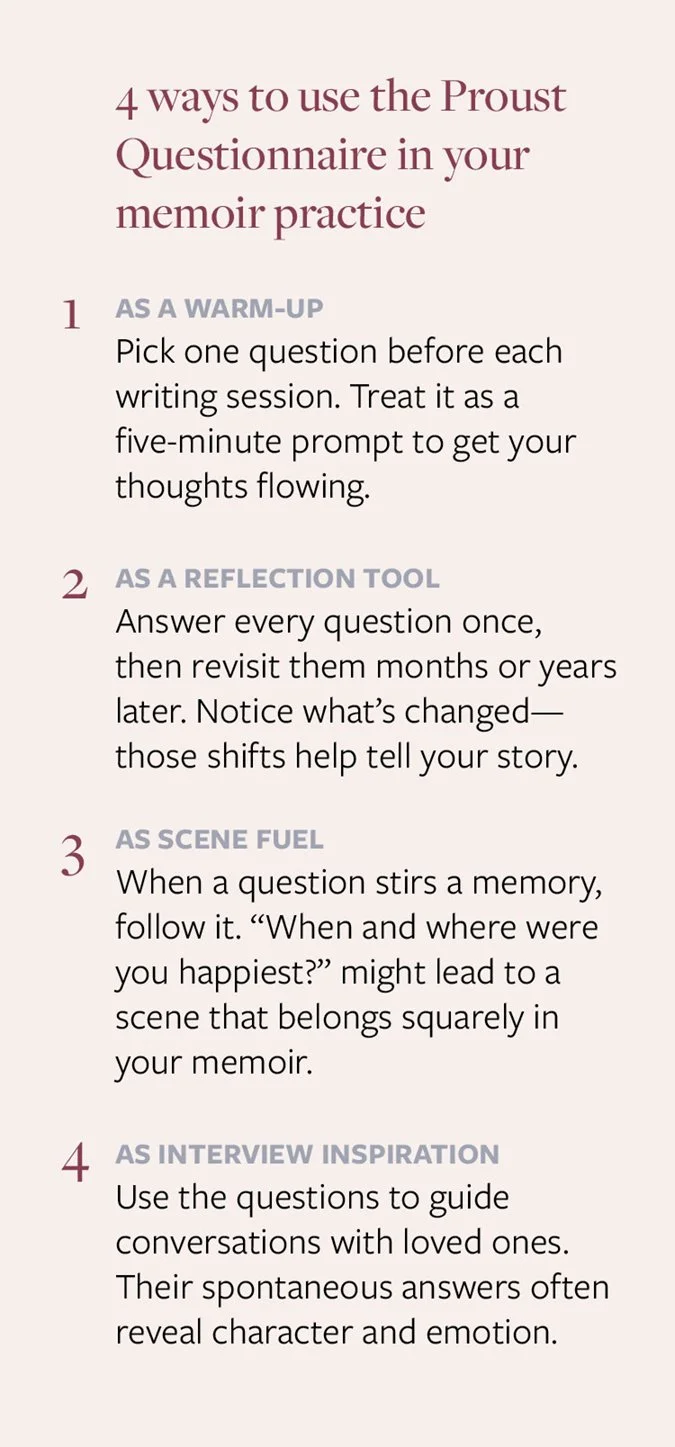
How to use it in your writing practice
as a warm-up
Pick one question before each writing session. Treat it as a five-minute prompt to get your thoughts flowing.
as a reflection tool
Revisit your responses every few years. Shifts in your answers reveal growth, changing priorities, and new perspectives.
as Scene Fuel
When a question stirs a memory, follow it. “When and where were you happiest?” might lead to a scene that belongs squarely in your memoir.
as interview inspiration
Try posing these questions to parents or grandparents. Their answers can form the basis for a rich oral history or tribute project, might inspire them to write their own memoir, or even provide you with context in yours.
Helpful ideas
Start with Spontaneity.
Don’t overthink—write your first, instinctive answers. You can always expand later.
leave a legacy snapshot
Print or handwrite your responses, date them, and tuck them into your journal, scrapbook, or memory box. Future generations will treasure such a discovery.
Why I love it as a memoir tool
I’ve always been drawn to exercises that reveal depth through simplicity—and this one never fails. The questions are timeless, the answers always specific. They bridge introspection and storytelling, reminding us that the best writing doesn’t begin with chronology or plot. It begins with truth.
Many of the most memorable stories I’ve helped shape at Modern Heirloom Books began with reflections such as these: small, personal revelations that grew into full portraits of a life. Whether you’re writing a full life story or just gathering memories for your family, the Proust Questionnaire offers a wonderfully accessible place to begin.









“Write Your Life” delivers weekly memory & writing prompts via email
Learn about our Write Your Life course, providing memory prompts, writing guidance and a dose of inspiration to anyone who wants to preserve their stories now.

Last year, I spent weeks researching courses for writing about your life. I found nearly a hundred of them, and even paid to enroll in a few to see what they were like.
Originally I wanted to be able to offer suggestions to people who reached out asking my advice on life writing courses. Somewhere along the line, though, I got motivated to create something different.
Instead of a full-on memoir course, I wanted to teach how to write about your life in smaller narrative vignettes.
Instead of focusing on the nuts and bolts of writing—grammar, character, dialogue, etc.—I wanted to cut to the chase and get students writing their memories from the outset.
Instead of teaching writers who want to publish and sell their work, I would target regular folks who want to capture their stories for their loved ones—and for themselves.
Instead of providing run-of-the-mill family history writing prompts like Storyworth and their slew of copycat competitors (I offer such prompts for free!), I would create thoughtful, open-ended prompts accompanied by examples, tips, and inspiration—with real value added from my years of experience as a writer and editor.
And lastly, instead of charging hundreds of dollars for a course you might not even have the gumption to finish, I wanted to create something truly affordable and different.
I believe with all my heart that your story matters. Your mom’s and granddad’s and spouse’s stories matter. And each one of you—every one of us who is living our story—should be able to write about them.
What makes the Write Your Life courses different?
These courses are tailor made for you. They will help you write about your life, to get your stories down on paper, and to think beyond the often trite questions in those ready-made memory journals.
You’ll look forward to getting your weekly prompts, and you will actually complete your stories.
Introductory themes are CHILDHOOD MEMORIES and FOOD MEMORIES, with new themes starting every few weeks. Themes build upon one another or stand on their own, depending upon how much you want to write.
If you enroll in Write Your Life, you’ll get weekly memory prompts, writing tips, and inspired ideas that are:

encouraging
The memory prompts go above and beyond a simple directive. You’ll explore how memories resonate for YOU. Writing beyond first impressions allows you to go deeper, to discover more than you could first have imagined. Memory cues, sample explorations, and inspirational notes provide encouragement without worry (for things like “what if I can’t remember?” or “but, I am not a writer!”).
Your stories matter—and you CAN do this!
helpful
With concise, RELEVANT writing tips from a professional, you will feel supported on your journey of capturing your stories.
This is not a course to help writers polish and fine-tune their skills. It is a course for people who want to write but don’t normally consider themselves a writer—and the writing advice you receive will be helpful but not unwieldy. Our goal: To help you write stories that are engaging and enlightening—that will entertain your ancestors with anecdotes, sure, but that go further by delving into life lessons, values, and the journey to becoming you!


flexible
You choose what day of the week you would like to receive your weekly lessons. You choose which themes to explore in depth, and which to write shorter snippets about.
You may write in a journal or type on your computer.
And you have a whole week to ruminate on your memory prompts and write your stories. Enough time to let the details bubble up, to call a sibling or parent to talk about the past, or to search for an old family photo album with pictures to help jog your thoughts—but not so much time that you don’t get to it at all. Because next week, another memory prompt and writing exercise is coming!
affordable
At just $132 $99 for a WHOLE YEAR course, pretty much anyone can take advantage of this learning opportunity. There’s no recurring subscription fee or annual membership required (unlike other weekly family history Q&A prompts we know of). And since prompts are open-ended and you get a PRINTABLE page each week, you can invite a friend or family member to write along with you.
Why email? Because most of us have a phone or computer, and it’s a convenient delivery method. There’s no videos to watch or long book to read; our lessons get to the point quickly and clearly, and you get to writing all the more quickly, too.
Oh, yeah, and I don’t expect you to write while staring at a screen. Each week you’ll get a beautifully designed PDF page to print out and work from (and in the end, you’ll have a year’s worth to return to or share with others!).

Why wouldn’t you enroll?
Memory journals from your local bookstore are a nice idea, but frankly I have seen too many of them gifted and never filled out. I inherited two of them from my own mom, each with fewer than three questions filled out, some with only a few words. Disappointing, to say the least…
Subscriptions like Storyworth are great if you just need a nudge without any real writing guidance or support—and if you want a simple, “free” book at the end (though, from my experience, many people never finish the prompts, and therefore never get their book). THIS course—which I took over a year to develop and which incorporates years’ worth of my professional experience guiding life writers one-on-one—is designed to encourage you to finish…whether it’s within the initial year or later ✍🏼❤️
Consider enrolling in Write Your Life yourself, or, if you want your parents’ stories, consider gifting* them with these Write Your Life prompts—trust me, inviting your family elders to share their stories with you (and preserve them for the next generation) is one of the best gifts you could give them!

Before you gift: Writing isn’t for everyone!
Remember, this is a WRITING subscription. If you know your parent or family member loves to write (even if it’s just in a journal), this may be a wonderful option for them. If, on the other hand, they groan at having to write a short note, you might not want to “gift” them something that can feel like a burden. Consider asking them if they’d be interested first, or gift them a starter package of personal history interviews, where their stories will be RECEIVED by an engaged and generous listener…
Rather Talk about Your stories than write?
If writing still isn’t your thing but you want to preserve your stories, consider TELLING them in a personal history interview. Reach out to see how we can work together—it is my honor to listen to you (or a loved one) share stories, and preserve them in a book!
A Year of Memory & Writing Prompts
Explore our year-long “Write Your Life” email course
How to create your own life writing prompts
Good writing prompts will rid you of blank-page anxiety—and you can easily write your own! Here, 5 steps to drafting a library of personalized memoir prompts.
Taking some time to intentionally create a list of writing prompts that are personalized to your own experience will save you time (and headaches!) later.
Every writer starts with a blank page. Some are just more intimidated by that sea of paper white (or the blinking cursor on your computer screen) than others. Perhaps the best writing advice, proffered so often I am not sure who to attribute it to, is to simply start—even if that means dragging your pen across the page in squiggles until a word forms in your head.
But good writing prompts are a prescription for blank-page anxiety.
There are plenty of places to find good writing prompts, from writing groups (a great place to find supportive community around your writing) to craft books (this workbook from Beth Kephart is one of my faves), from email subscriptions (I offer a full-year of prompts called Write Your Life) to blog posts (here is an example from Jericho Writers, and here is an old reliable on my blog).
You can create your own memory prompts, too. It’s easy, as long as you set aside some time to be thoughtful and jot them down.
5 steps to drafting your own library of life writing prompts
Brainstorm
Ever since my seventh grade English class where I learned about brainstorming, it’s been the most powerful tool in my workplace arsenal. (I say “workplace,” but truly, brainstorming has been helpful in every area of my life—and I swear I learned not just to write in this teacher’s class, but to really think—so thanks, Mr. Lorusso!). Grab a piece of paper or open up a blank document on your computer, set a timer for five minutes, and write down every single thing you think may be fodder for future writing about your life. Do not edit yourself, and try to write continually—no pauses. This is not the time for filtering yourself. Be creative, get sloppy, and surprise yourself.
Wait a week.
Trust me, the emotional and cognitive distance will be helpful.
It’s time to curate.
Give your brainstorming document a read. Do you spot any themes? Any nuggets that surprise or delight you in their specificity or their mere presence? Your goal is to extract phrases and themes that will prompt writing down the road. Create a list of bullet points, and if possible, nest them under subheadings designating various themes. These don’t need to be overly fleshed out, just specific enough for them to spark YOUR memory and get you thinking.
Assess the writing prompts that you generated.
Did you fill a page or more with ideas for future writing? If so, I recommend you break them down into priorities, and create a basic plan for tackling them. (Another fun option that works for people who like things a little more loosy-goosy, like me: Skip this step and simply keep your curated list of prompts on hand—then, when you sit down to write, you can begin writing in response to whichever one stirs your memories at the moment!)
If the results of your brainstorming session were less than impressive, you may want to give it a go another time after taking a walk in nature (it really helps!). Or tap into these other ways to generate life writing prompts for yourself:
Go through your family photo archive to select pictures that jog your memories. Here’s some advice on how to best use those family photos as writing prompts.
Perhaps you need more structure than a freewheeling brainstorm session provides: Try this life timeline exercise to come up with memory prompts.
And if you prefer simple, straightforward questions to respond to in your writing, check out this free guide with essential family history questions. There are enough questions to keep you busy for a long time!

















Discover life writing journal prompts all around you!
Sometimes all it takes to get unstuck with your personal writing is paying attention. Here are some easy (fun) ways to come up with journal writing prompts.

I recently felt called to indulge in a journal a little more special than what I usually write in, and bought this handmade beauty from BINDbyBIND, a partnership between memoirist (and now bookmaker) Beth Kephart and her artist husband, William Sulit.
Sometimes the stark whiteness of a blank journal page can be paralyzing. Our desire may be there to journal regularly, but the inspiration isn’t always as close to hand.
I have toyed with the idea of creating a prompt-a-day guide with a life writing prompt for every day of the year, and who knows, that may one day still come to fruition. For now, though, I rely heavily on serendipity to guide my own journal writing. I try to stay conscious of discovering ideas throughout my day. A few recent prompts have come from situations as unexpected as:
a sloppy note I had handwritten on a scrap of paper while still barely awake after an especially vivid dream
an experience of a fictional character in a novel I was reading; I had never had the same experience, but the emotions that arose for the character evoked a strong response from me…later resulting in a fruitful journaling exploration.
a feeling of déjà vu—this sensation of having been somewhere or done something before has intrigued me since I was a young girl, and whenever I feel it acutely, I like to dig in (when I remember to) on the page.
Can you imagine yourself, also, coming up with some interesting writing prompts simply by paying attention to what’s going on around you?
A front view of the hand-bound journal pictured above; I was drawn to the colors (yellow, my mom’s favorite, and blue, mine) and am using this journal just for thoughts on that relationship. Do you have journals set aside for certain types of writing?
Other reliable places to find writing inspiration are:
from looking at old family photos (even if a distinct memory does not surface, some catalyzing feeling almost inevitably will)
relying on a book such as Beth Kephart’s Tell the Truth. Make It Matter.
As I wrote previously: “The prompts and exercises within are wonderfully original, expertly crafted, and simultaneously pointed and open-ended enough to have you furiously filling in those blank pages with purpose.”using your own life timeline to prompt recollections worth writing about.
while not necessarily their intended purpose, decks of conversation cards can often provide out-of-the-box journaling ideas, from lighthearted and fun to profound and thought-provoking; I’ve been sharing some of my favorites on occasion on Instagram, such as this one:
The low-pressure, high-yield memory-keeping project I’ve recently started
I might not have time for the full-fledged memoir I want to write, but I can make time every day for this easy and significant journal exercise—and so can you.
Not every memory-keeping project we undertake needs to be ambitious—even getting one short memory down on paper each night can be both enjoyable and fruitful.
I help people preserve their family stories and personal legacies for a living, and yet I am way behind in documenting my own (the cobbler’s shoes and all that).
Don’t get me wrong, it’s not like I haven’t begun—I started my business after creating an heirloom book in my mom’s memory, after all. And I do create family annual books that are predominantly photo books with some text. But these don’t tell my stories—or my family stories—in the in-depth way I know I’d like to.
For the moment, I don’t have time to delve into a big project of my own, not when I am juggling so many for my clients. But that doesn’t mean I can’t do some things along the way to work towards those goals.
For example, down the road I hope to undertake (and finish!) a family heritage cookbook. This has been on my mind for a few years now. So I do little things when I can: I have scanned all my mom’s and grandmother’s handwritten recipes that mean something to me; I have handwritten the recipes for some of my son’s favorite foods, and digitized those, as well. And about twice a year when I am making something I know I’d like to include in the cookbook, I get out my good camera and take some beautifully lit shots of the ingredients, prep, and finished dish. When it comes time to make this “a project,” I’ll be well on my way.
Similarly, I have begun early steps towards a more in-depth storytelling book about my own experiences. I have made a life timeline, and brainstormed topics and themes I would like to write about. But I am still mulling over how I’d like that book to take shape, and I don’t presently have the time to devote to it.
Yet, NOT doing these things now gives me pause. I won’t say it keeps me up at night, but it did preoccupy me on a recent night when I couldn’t sleep. I am more conscious than most of how often people miss the opportunity to capture their loved ones’ stories. All too often I am helping people preserve stories through second-hand accounts—what someone remembers their father having told them before he died; or scouring a grandmother’s meager journals for snippets of her own stories.
It’s not for nothing that the single most resonant quote I share with people is this one from William Zinsser (the quote appears on the home page of my website for this reason):
“One of the saddest sentences I know is ‘I wish I had asked my mother about that.’ ”
I don’t want that to ever be a sentence my own son utters.
And so, while I am moving at a snail’s pace with the bigger memory-keeping projects I aspire to, I recently vowed to devote some time every night to a more simple memory-keeping endeavor: I have designated a journal as my “I Remember” book. In it, I try every night to write at least one sentence, maybe more, that begin with the words “I remember.”
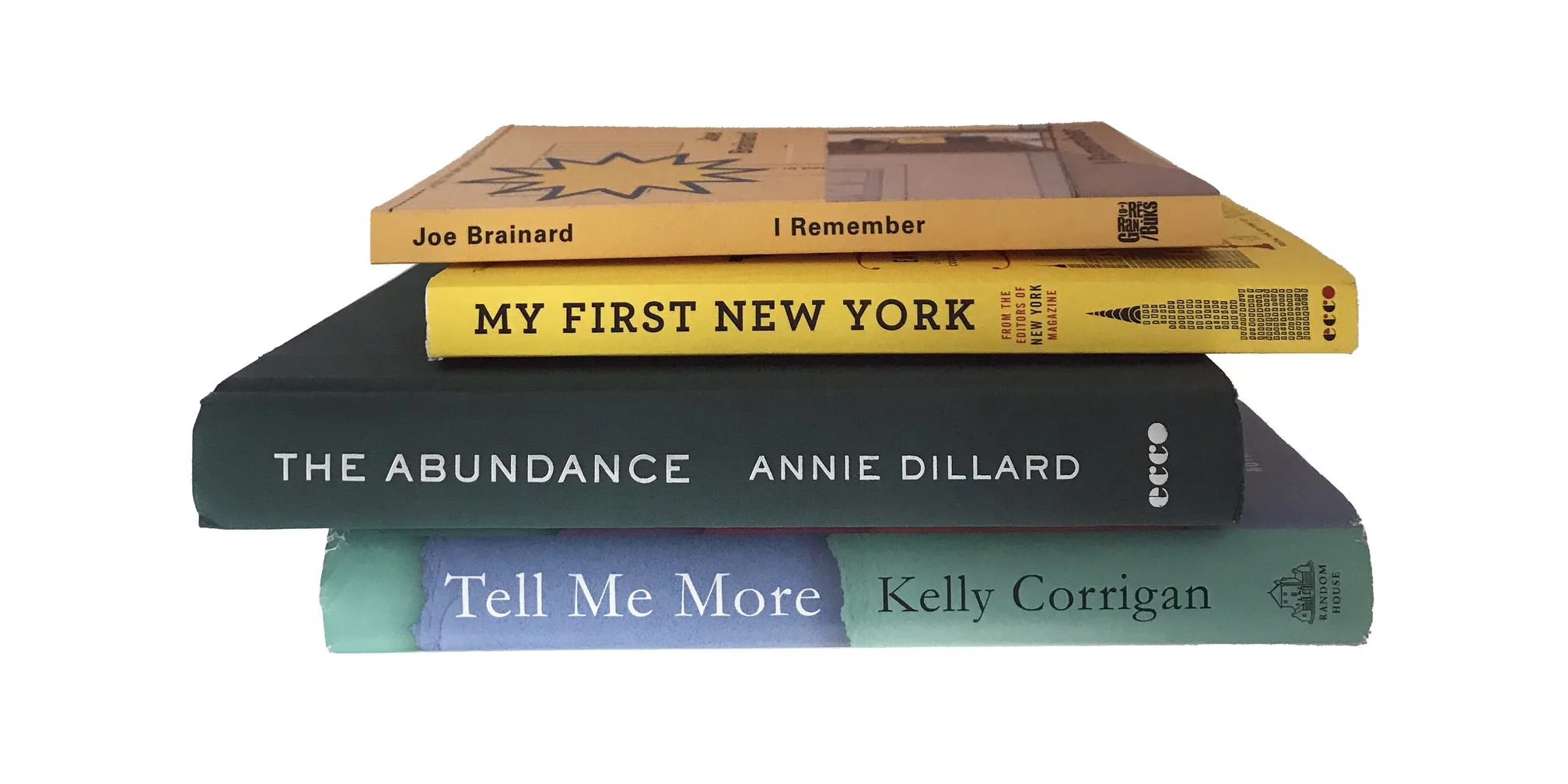
I was inspired first by the prevalence of easy-to-maintain journals such as this line-a-day memory journal or this five-minute gratitude journal. I see these posted across my social media feeds by friends and influencers alike, and am drawn to their low-pressure approach to diary keeping. But because I want to focus right now on recording memories from my past, not my current day-to-day, I took inspiration as well from a book I was first introduced to by Dani Shapiro: I Remember, by Joe Brainard.
I have written about the value of this book before, and even shared some wonderful remembrances written by colleagues and friends here (it’s great inspiration!). So why did I never think of making this a nightly practice? Probably, I imagine, because I always tend to “think big.”
But I’ve thought of it now, and I’ve begun. And I am loving it.
How you can start your own low-pressure memory-keeping practice
Would you like to start your own low-pressure, high-yield memory keeping project?
Simply:
Buy a journal or create a new document on your computer.
Open this journal or document every day to write down one (or a few!) short remembrances. Just a sentence or two each, even a phrase if you feels it’s evocative.
Optional:
Date your entries if you like, or simply keep a continual list without regard for when you wrote them.
Set a regular time for writing in your “I Remember” journal, or carry it with you for whenever a few moments present themselves.
Consider that one day you may use this journal as a jumping-off point for a bigger personal history project—but know that by no means do you have to! This book will be chock-full of memories that I assure you will run the gamut from fun and lighthearted to deep and reflective—and it may one day be cherished by your own next of kin.
See what I mean about low pressure? Won’t you join me in this intentional remembering? Honestly, it’s one of my favorite things to do every evening, and I feel so wonderfully accomplished as the pages continue to be filled. One memory at a time…

A fun—and easy!—exercise for generating new autobiographical writing
Want a life writing prompt that gets your pen moving AND delivers a trove of future ideas for your memoir? Here it is—and bonus, it's a fun one!
This simple writing prompt will get you typing—and it will provide lots of ideas for future writing, too. All it takes is eight minutes!
A blank page is sometimes—heck, often—all it takes for us to back away from our desk and ignore our writing. But rather than turn to dusting or laundry or making multi-level to-do lists (all active forms of procrastination I have indulged in, I admit), instead, try a writing prompt to get your pen moving.
Writing prompts are so powerful because they are low-pressure (no expectation of publication, no working towards a finish line!); and they are elastic (let your ideas go in any direction you wish, and write anywhere—even during the 15-minute train transfer on your commute).
And while writing in response to a prompt can serve to simply get your creative juices flowing, doing so can also supply you with a bank of ideas for future writing.
When it comes to autobiographical writing, this multi-part writing prompt guarantees to result in a list of topics for you to mine when you sit down to write your memoir in earnest.
An iterative writing prompt for aspiring memoir writers

Get inspired!
For inspiration, check out the Six-Word Memoirs site—it’s chock-full of small-dose mini-memoirs (or order one of their books to keep by your desk).
Set a timer for 8 minutes.
Jot down as many one-sentence memoirs as you can.
If you were to stop here, you’d have brainstormed some ideas you can write about down the road. But if you keep going…
Choose one of those one-sentence memoirs and write as many first lines as you can for that memoir.
Or
Choose one of those one-sentence memoirs and write as many chapter titles as you can think of.
Or
Choose one of those one-sentence memoirs and write as many memories associated with it that you can think of.
…by doing any of these options that build upon the first writing prompt, you’ll likely discover which ideas are most fertile—and which simply don’t have legs.
This approach relies on your gut for idea generation—try to keep your pen moving (or your fingers sweeping across your keyboard) with no thought for editing or deliberation. Don’t worry if the one-sentence memoir you are writing has any merit or potential—just write it. Then write another, and another, until your timer goes off.
If you’ve never done brainstorming in this way, chances are you will love the sense of freedom and inspiration that comes with it (I know I do!). But the best part, in my opinion, is that you’ve now got a rough list of topics to consider: Should I write about this? How about that?
Next step: How to tap your ideas for real memoir writing
Wait at least a few days (that emotional and narrative distance is helpful). Then sit down and review your list of one-sentence memoirs—and all the writing associated with them—and take note of which ones resonate. Which ones make you itch to pick up your pen and start writing immediately? Which one makes you feel uncomfortable in that good way—you know, when you fear diving in but know deep down that there’s something substantive there?
Transfer these ideas to a notebook or new document. Consider this your own personal library of memoir writing prompts. Then: Start writing.
Two unexpected writing prompts about family
These two writing prompts about family—and what it means to you—may be just the ticket to more thoughtful storytelling and personal meaning-making.
“Families are united more by mutual stories—of love and pain and adventure—than by biology. ‘Do you remember when . . .’ bonds people together far more than shared chromosomes . . . a family knows itself to be a family through its shared stories.”
—Daniel Taylor
definition:
family*
1 : a group of people who are related to each other
2 : a group of persons of common ancestry : CLAN
3 : a group of people united by certain convictions or a common affiliation : FELLOWSHIP
There are plenty of official definitions of the word family in the dictionary, many of them self-referential, most of them rooted in cultural norms of another time (“the basic unit in society traditionally consisting of two parents rearing their children,” for instance).
Here's the thing, though: The idea of family—what family means to you, who belongs to your family—is as personal as it gets. And yet…it's not something many of us think about, is it?
We may sit down to do some family history work—clicking on those green hints in Ancestry, sending away for land deeds and marriage certificates—and the assumption is we're discovering our family. Kin. But is that the extent of it?
More and more these days genealogy efforts may yield surprising results, especially since DNA entered the picture: a father who isn't biologically a father; a daughter who was raised as an only child only to learn she was the product of a sperm donation…and that she has 18 half-siblings by blood. How might these individuals rethink who their family is (and isn't)?
Moreover, the idea of family has evolved over time, and for some, their “chosen family” may play a more significant role in their life than blood relatives do. What is a “chosen family”? According to the SAGE Encyclopedia of Marriage, Family, and Couples Counseling, “Chosen families are nonbiological kinship bonds, whether legally recognized or not, deliberately chosen for the purpose of mutual support and love.” I have plenty of friends whose chosen family is their world.
You needn’t have made a shocking discovery through DNA or chosen a group of friends as your primary family, however, to have something important to say on the matter of what family means to you. Even in the most traditional of families, some relationships hold more weight than others. And what we derive from family—support, inspiration, pressure, trauma, love, fun, stability—can run the gamut, and have a profound impact on our notion of self.
So while documenting our family history is essential, so too is stepping back to ask ourselves a few questions about our family—in fact, it may be just the ticket to more thoughtful storytelling and meaning-making. Are you ready?
Writing prompts to yield deeper family history stories
Consider both of these questions, grab a journal or your laptop, and start writing.
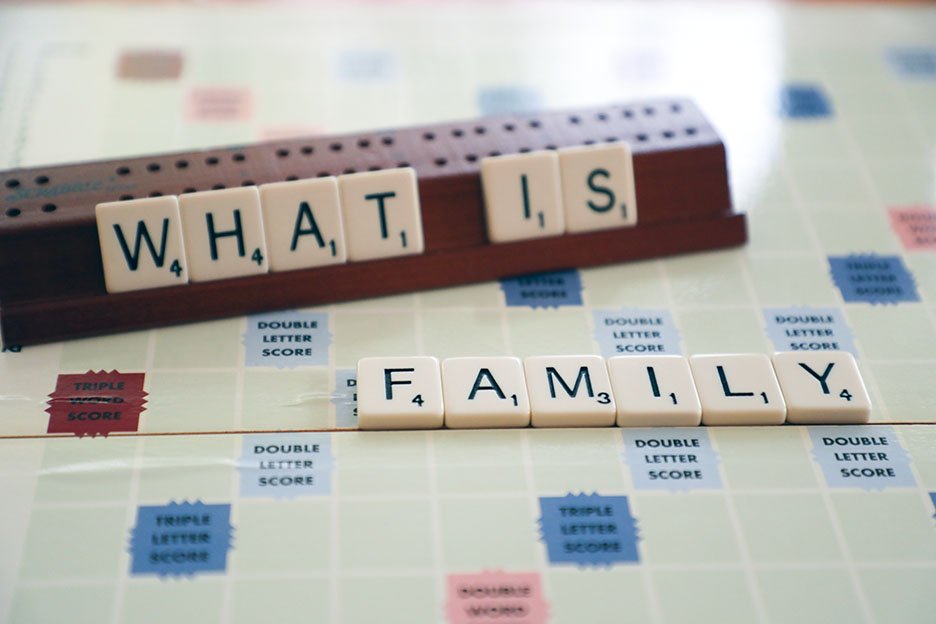
What does the word ‘family’ mean to you?
Who is your family?
You're not writing for publication here. Rather, you're ruminating. Finding meaning through your writing.
And remember: Your responses to these prompts could be wildly different today than tomorrow, and that's okay.
How you answer these questions is revealing. Your own definition of “family” is foundational to how you discuss your personal history. How you regard past experiences may shift once you become more aware of your vision of your family (and where you fit into it).
What will you do with the writing that results from these prompts? A couple of ideas:
Think about your answers and integrate them into your own life narrative. You are the narrator of your own story, and writing about themes such as what family means to you is a path to self-discovery. As Sara Aird has written about storytelling and identity: “The final stage of writing yourself into existence will be accepting who it is you are finding, believing that who you are creating is real and true and worthy.”
Use your initial writing as fodder for more refined life writing. Was there a surprising nugget in there? Or perhaps you gained clarity on an overarching theme in your life story? Writing about your own life necessarily covers family ground; hopefully thinking deeply about questions of who and what family means to you will allow you to delve even deeper into your own personal stories.
* definitions from Merriam-Webster Dictionary
Explore more blog posts in these categories:
The little book that every aspiring memoirist should read
Introducing the two-word writing prompt guaranteed to keep your memories and your pen flowing, plus the book by Joe Brainard that inspired it: “I remember...”.

The little book that could: I Remember by Joe Brainard is a cult classic and a favorite of aspiring memoirists and memory keepers.
Buy this book now: I Remember by Joe Brainard.
(I don’t suggest borrowing it from the library, because you will want to pull it out next week, in five years, when you’re staring at a blank computer screen or journal page; it’s a tiny book, so it won’t take up too much space on your bookshelf, after all.)
This book is a delight to read. And this book holds the key to writer’s block.
Brainard’s memories, recounted in a stream-of-consciousness fashion, are short and pointed, often mere phrases or single sentences, occasionally a brief paragraph, each beginning “I remember...”:
“I remember the only time I ever saw my mother cry. I was eating apricot pie.
“I remember how much I cried seeing South Pacific (the movie) three times.
“I remember how good a glass of water can taste after a dish of ice cream.
“I remember when I got a five-year pin for not missing a single morning of Sunday School for five years. (Methodist.)”
As Ron Padgett writes in the book’s afterword, “Few people can read this book and not feel like grabbing a pencil to start writing their own parallel versions.” Indeed. “It is one of the few literary forms that even non-literary people can use.”
The two-word prompt that never fails
Like many before me, I was first introduced to Joe Brainard’s book in a weekend writing workshop with memoirist Dani Shapiro. She read some snippets out loud and I was immediately enlivened. Our assignment: to write nonstop for 10 minutes, finishing the sentence “I remember…” over and over with no concern for chronology or connectedness.
As she describes, “When I give that exercise at retreats, I look out from where I’m sitting at a sea of people, and not one of them hesitates. Those are extremely evocative words.”
“I remember.”
Those are the words Shapiro calls evocative.
And they are the words that form her (and my) favorite writing prompt: “I remember…” is a steadfast prompt, an old friend that can be pulled out and used often, always to new effect.
As Padgett writes, “Even the smallest [memory] can exert a mysterious tug, and when it is clearly recalled it can release a flood of other memories.”
Your turn: Start writing using the prompt “I remember…”
“Memory is just this storage locker of incredibly rich material and we often can’t get at it when we’re trying to remember something or thinking in some chronological way or straining and reaching,” Shapiro said on an episode of her now defunct Facebook Series, “Office Hours.”
“Where we can really get to it is on the page, following the line of words, and allowing associations to pile one on top of the other.”
So, grab a pen and start writing.
don’t discriminate against memories that seem meaningless or small
don’t worry about making connections between one memory and another
don’t stop until your 10 minutes are up.
Some remembrances will be short and specific. Here are two of mine:
“I remember patent leather black shoes with one scuff on the toe.”
“I remember drinking Diet Coke nonstop when I worked at Vogue. My production assistants swore I needed an IV drip of caffeine. One of them berated me for buying cups of ice from the bodega for a dollar.”
Other remembrances will be more profound, perhaps longer, such as this one from Brainard:
“I remember having a friend overnight, and lots of giggling after the lights are out. And seemingly long silences followed by ’Are you asleep yet?’ and, sometimes, some pretty serious discussions about God and Life.”
Let your mind wander—no restrictions—and your pen will follow. You’ll be surprised by what bubbles up.
“People almost invariably find memories that they didn’t know that they had,” Shapiro said in an interview with Marie Forleo about this exercise.
“We don’t tell ourselves stories in our heads. We have these disparate memories that don’t connect. And when we allow them to be associative and to bounce one off the next, it creates all sorts of interesting material.”
Who should give this writing prompt a try?
Personally, I think the simple phrase “I remember…” as a springboard for writing has universal appeal. It’s fun, it’s alluring, and it’s easy.
It may be especially beneficial for certain people, though.
This writing exercise is good for:
helping you open the floodgates of memory when you feel stuck
warming up at the beginning of a writing session—putting pen to paper and having a relatively easy task (simply finishing the sentence “I remember…”)
brainstorming memories: Without the pressure of remembering something specific, your list will inevitably be diverse and surprising—providing fodder for a future memoir or personal essay.
So if you’d like to discover the power of short reminiscence, and emulate it to create your own list of prompts for future development, well, I Remember is the book for you..
Note: This is an unsolicited review of a book I purchased at full price. I did not receive any compensation or free products in exchange, and any endorsements within this post are my own.
Affiliate disclosure: As an Amazon Associate, we may earn commissions from qualifying purchases from Amazon.com.
P.S. I’d love to hear some of your reflections. What are a few of your favorite things you wrote using the writing prompt “I remember…”? Share in the comments or shoot me an email!
Dawn Roode’s curated roundup for the week of Sept. 23, 2026, is overflowing with recent reads on memoir, life story writing, and family history preservation.