
Memories Matter
Featured blog Posts


READ THE LATEST POSTS
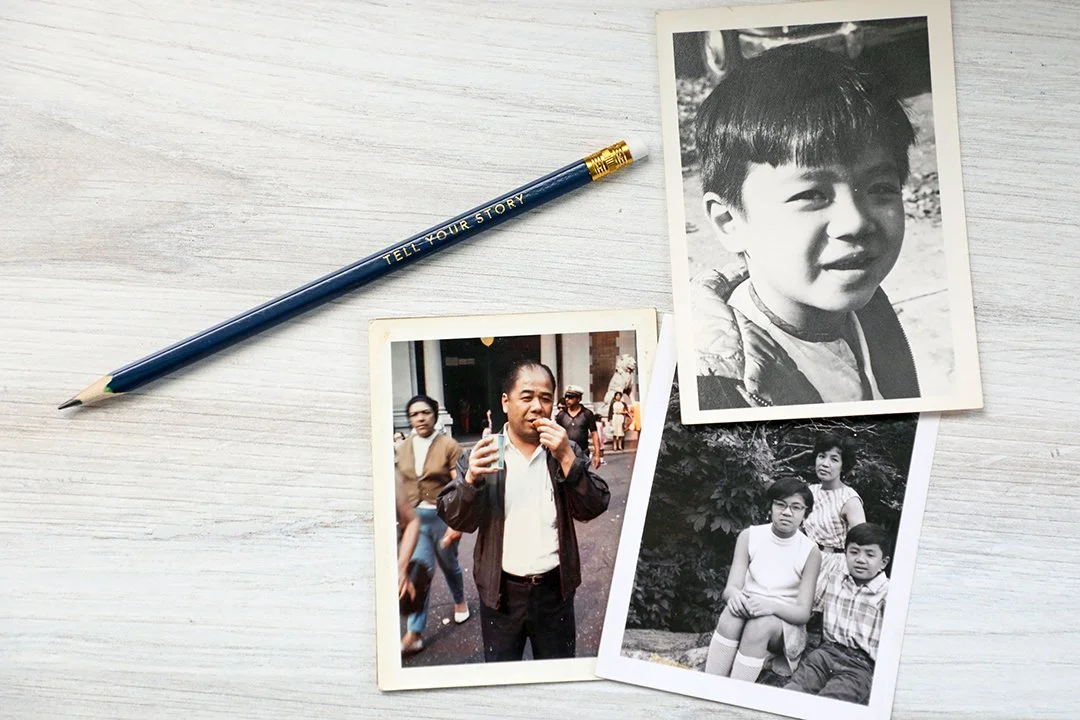
A year’s worth of journal writing prompts
Stay inspired with 52 weekly writing prompts for journaling and family history. Capture memories, dreams, and stories big and small. Bonus: Downloadable guide!
Never face down a blank page again—download our free guide with a life writing prompt for every week of the year, then tuck it in your journal or pin it near your computer for inspiration at your fingertips!
Keeping a journaling or family history practice alive through the entire year can feel daunting—until you realize you don’t have to come up with ideas on the spot. Having a set of weekly prompts at your fingertips gives you structure and inspiration, while still leaving room for your stories to flow in their own unique direction.
To make it easy, I’ve gathered 52 prompts—one for every week of the year—that weave together themes of reflection, memory, family history, traditions, and everyday moments. Each month offers four prompts tied to the seasons and natural rhythms of life.
Whether you use these life writing prompts to spark daily journaling, guide family conversations, or record stories for future generations, these questions will help you capture the richness of your life and legacy.
TIP: Our free download includes one page of writing prompts per month, so you can print them out and paste into your daily planner or tuck into your journal for easy reference! Get yours here.
Click below to jump to any month’s writing prompts:
January
February
March
April
May
June
July
August
September
October
November
December
January – New Beginnings
week 1 Reflection:
What were your greatest accomplishments, biggest challenges, surprises, joys, and losses last year? Keep things simple with a list if that’s all you can handle as the new year begins, or dive deep and probe for meaning!
week 2 Setting intentions:
How do you want to shape the coming year? What do you hope will happen? What habits, relationships, or parts of yourself would you like to nurture? Dream big or be practical—whatever approach suits you right now!
week 3 Memory:
What childhood home do you remember best? Describe its sights, smells, sounds, people. Can you draw a map of its layout? Why do you think you remember what you do (or don’t)?
week 4 Life list—fun:
What was your favorite toy, game, or pastime as a child?

February — Love & Connection
week 1 Love Letter:
Write a letter to someone who influenced your life deeply (friend, partner, ancestor). What have they taught you?
week 2 Lasting bonds:
Think about a meaningful friendship. What made it special? What lessons or memories does it carry?
week 3 Memory:
What meals remind you most of your childhood? Describe the smells, flavors, and people around you. Could you cook up these dishes if you tried?
week 4 Life list—food:
Was there a dish you hated as a kid but now love (or vice versa)? What changed?

March — Women’s History Month
week 1 Female influences:
In honor of Women’s History Month, write about a woman who shaped your life. What qualities of hers live in you? Does (or did) she know her impact on you?
week 2 Unsung stories:
What story of a mother, grandmother, or other woman in your family deserves to be remembered? It needn’t be a drama-filled story—it just might be a small moment that held major impact.
week 3 Identity:
Tell about a time when someone asked you, “Who are you?” How did you respond? How has your answer changed?
week 4 Silenced stories:
Do you have any stories you once hesitated to tell but now feel are important? Why did you hold back? Remember—no one needs to see what you write in the privacy of your journal, even now.
April – Renewal & Growth
week 1 Spring awakening:
Describe a time you started over, intentionally or by chance. What changed inside you?
week 2 Nature as metaphor:
Choose a flower, tree, or garden from your past. What did it symbolize in that season of life?
week 3 Lost recipe:
Recall a family recipe that has been lost or half-forgotten. What do you remember and what do you wish you knew?
week 4 A letter you never sent:
Write the letter—to someone living or gone—that you wish you’d sent.
week 5 Turning point:
What was the moment when you felt you were no longer a child?
May – Heritage & Traditions
week 1 Family gatherings:
Describe a family celebration or tradition that left a strong impression.
week 2 Keepsakes:
Write about an object you’ve inherited (jewelry, recipe, letter). What story does it carry? If nothing comes to mind, consider writing about an object that holds meaning to you now that you hope a child or other family member will one day cherish.
week 3 Memory:
Who in your family was the storyteller? Capture a tale you remember hearing from them.
week 4 Life list—values:
What values do you see passed through your family (kindness, humor, hard work)? Where did they come from?
June – Journeys
week 1 Travel:
Recall a trip (near or far) that shaped you. What moments do you still see vividly?
week 2 Going forth:
Write about a time when you “set out”—to college, a job, a new city, an adventure.
week 3 First job:
What was your first job, or a formative work experience? How did it shape you?
week 4 Failure and growth:
Write about a time you failed at something important. What did you learn from it? How did you handle it?
week 5 Mid-year check-in:
Look back on the first half of the year. What have you done, and what are you proud of? What do you still want to finish?
July – Independence
week 1 Independence:
Write about the first time you made a big decision on your own.
week 2 Reflection:
What does freedom mean to you personally? Reflect on a moment when you felt free.
week 3 Memory:
When was the last time you felt awe? What brought it on?
week 4 Life list—home:
What place(s) feel most like home to you? What makes it feel that way?
August – Everyday Moments
week 1 Summer snapshot:
Capture a vivid childhood summer memory—sights, smells, sounds.
week 2 Daily life:
Write about an ordinary routine that reveals something bigger about who you are.
week 3 Life list—soundtrack:
What song takes you back instantly to a time in your life? What story is tied to it?
week 4 Memory:
Tell a story from your teen years—a friendship, conflict, turning point, or just a funny, sad, beautiful, or poignant memory.
September – Growth
week 1 Back to school:
Recall a memorable teacher, mentor, or lesson.
week 2 Lifelong learning:
What skill or habit did you learn later in life that changed you?
week 3 History made personal:
What historical event shaped your family (war, migration, economic change)? How?
week 4 Life list—school supplies:
Do you remember back-to-school shopping when you were a kid? What items did you love…or wish for?
week 5 Memory:
Describe a small, ordinary moment that brought you unexpected joy. What made it stand out?
October – Family History Month
week 1 Roots:
In honor of Family History Month, write about the earliest ancestor you know by name.
week 2 Family lore:
Capture a funny or legendary family tale. What truths lie beneath it? Has the telling of the tale changed over time?
week 3 Life list—ancestors:
If you could ask a grandparent three questions, what would they be? Write what you know and what you wish you knew.
week 4 Heirlooms:
Pick a family heirloom. What is its story and how did it come to you?
week 5 Memory:
Write about one of the following (and save the others for another day!): your earliest memory, your most elusive memory, your favorite memory.
November – Gratitude
week 1 Life list—gratitude:
Write about five things you’re grateful for this year. Choose one and go deeper.
week 2 Reflection:
Reflect on a hardship that later became something you were thankful for.
week 3 Memory:
What kindnesses have you witnessed or experienced this year? Elaborate on one that moved you (or that you hope moved someone else), or take the prompt in an entirely different direction that resonates for you right now.
week 4 Absence:
Think of someone you miss. Write about what you learned from them and what you carry forward, what you would tell them if they were here, or how you honor their memory.
December – Holidays & Reflection
week 1 Traditions:
Describe your favorite holiday ritual and why it matters.
week 2 Reflection:
As the year winds down, reflect on how you’ve changed since January. What do you want to carry forward?
week 3 Surprises:
What was the biggest surprise of the year? How did it make you feel? Change you?
week 4 Dream on:
Write about one wish or dream you have for the coming year, small or large. What will you do to make it come true?
Stories live best when they’re shared. My hope is that these prompts not only inspire your own journaling, but also spark conversations with the people you love. Imagine what your children or grandchildren might discover if even a few of these questions were answered and preserved.
If you’d like to keep this list handy, I’ve created a printable version with all 52 prompts—perfect for tucking into your journal!
P.S. This list is formatted for the year 2026, with five prompts for the months of April, June, September, and October—but it can be used any year (52 weeks is 52 prompts, no matter when the weeks fall 😉).
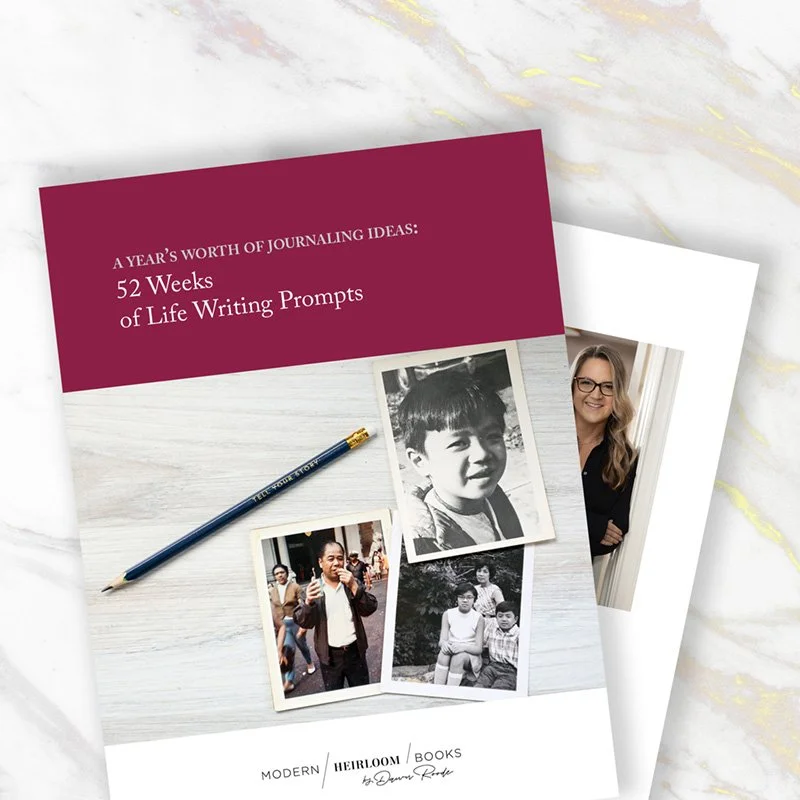
Free Printable Guide!
Download all 52 life writing prompts in a beautifully designed guide that you can tuck into your journal or pin up near your computer—inspiration always at your fingertips!
Want even more prompts—and writing guidance along the way?
Our email subscription, Write Your Life, offers 52 weeks of life writing prompts geared specifically for building towards a memoir or personal history. How are they different?, you must be wondering! Well:
With Write Your Life, each week you’ll receive a thoughtful prompt with follow-up questions, examples of directions you might take, guidance for accessing memories and developing them into stories, and inspirational quotes and resources—PLUS subscribers get a companion e-book overflowing with even more pro tips.
While this free journaling guide is tied to the seasons, the Write Your Life subscription is intentionally crafted to start with easy-to-access memories that lead to deeper life reflection as you go. It’s designed to lead you towards a finished memoir, and prompts from one week build upon others you have written about previously.
The Write Your Life prompts are delivered to your email inbox each week to help keep you accountable and spur you to write—really write!! (If you’ve got a loved one who’s been thinking about writing about their life, this makes a wonderfully original and thoughtful gift, too 😉).












Introduce yourself: a writing prompt, a life prompt
Go beyond labels with this powerful memoir prompt: introduce yourself without name, job, or age. Includes writing tips and a free downloadable worksheet.
Sometimes scrolling Instagram is a massive waste of time (okay… often), but I usually restrict it to in-between moments—like sitting in a doctor’s waiting room or waiting in the car to pick my son up. Every once in a while, though, a little gem sparkles bright.
One such gem came from Jade Bonacolta, a thought leader and marketing exec who doles out bite-sized career and life wisdom in her feed. She posed a deceptively simple question:
“If I asked you to introduce yourself without mentioning your name, job, age, ethnicity, or the city you live in, what would you say?”
Well, if that isn’t a provocative memoir writing prompt, I don’t know what is.
An evergreen memoir writing prompt
“Introduce yourself.” Seems straightforward, right? But most of us are conditioned to start with the basics—our job titles, family roles, geographic location, or where we grew up. These details are comfortable and expected. But they’re also just labels.
Bonacolta explains: “When you strip away these social labels, people tell you who they are. Who they really are. You hear about their values, the things they're obsessed with, the beliefs that guide their decisions.”
For memoir writing—or even just gaining clarity about your identity—this is a powerful exercise. And it’s one you can return to again and again throughout your life or project. Below are a few tangible ways to work with this prompt, whether you’re just starting your memoir or feeling stuck midway through.
3 ways to work with this writing prompt
Freewrite with No Filters
Set a timer for 10 or 15 minutes and respond to the prompt: “Who am I, without my name, age, job, or hometown?” Don’t censor yourself. Let it be messy. Start with phrases like:
• “I am someone who…”
• “I feel most myself when…”
• “What drives me is…”
Let your values, passions, fears, and quirks take center stage. You might surprise yourself with what emerges when you're no longer listing résumé bullet points.
🔍 Bonus Tip: Repeat this exercise at different points in your memoir-writing journey. The way you answer will shift—and that evolution might become part of your story.Create a character sketch—of yourself.
Treat yourself like one of the characters in your memoir. Without using surface-level identifiers, how would you describe yourself in a story? Try writing a paragraph or two about yourself in the third person. For example:
She moves through the world guided by curiosity and a hunger for connection. She tucks grocery receipts into her notebook, convinced they’ll mean something someday. She believes that books can save lives, that being a mom is a sacred undertaking, and that cheese belongs on everything..
This not only deepens your understanding of your own voice but can become rich material in your actual manuscript.Use It to unlock a chapter or theme.
If you’re feeling stuck in the middle of your memoir, revisit this prompt through the lens of your younger self, or the version of you at a pivotal point in the story. Ask yourself:
• Who was I then, beyond the job I had or the place I lived?
• What mattered to me at that moment?
• What did I believe about the world? About myself?
These reflections often lead to unexpected turns or unlock deeper emotional truths—especially useful when your writing feels stalled or superficial.

Get a free companion worksheet…
…with exercises using this “Introduce Yourself” prompt to jump-start your memoir writing!
You are more than a bio.
In a world that constantly asks us what we do, it’s grounding—and sometimes healing—to return to who we are. This simple question from an Instagram scroll can serve as a compass not only for writing, but for living more intentionally.
So, go ahead. Introduce yourself.
But this time, leave the labels behind.





How to create your own life writing prompts
Good writing prompts will rid you of blank-page anxiety—and you can easily write your own! Here, 5 steps to drafting a library of personalized memoir prompts.
Taking some time to intentionally create a list of writing prompts that are personalized to your own experience will save you time (and headaches!) later.
Every writer starts with a blank page. Some are just more intimidated by that sea of paper white (or the blinking cursor on your computer screen) than others. Perhaps the best writing advice, proffered so often I am not sure who to attribute it to, is to simply start—even if that means dragging your pen across the page in squiggles until a word forms in your head.
But good writing prompts are a prescription for blank-page anxiety.
There are plenty of places to find good writing prompts, from writing groups (a great place to find supportive community around your writing) to craft books (this workbook from Beth Kephart is one of my faves), from email subscriptions (I offer a full-year of prompts called Write Your Life) to blog posts (here is an example from Jericho Writers, and here is an old reliable on my blog).
You can create your own memory prompts, too. It’s easy, as long as you set aside some time to be thoughtful and jot them down.
5 steps to drafting your own library of life writing prompts
Brainstorm
Ever since my seventh grade English class where I learned about brainstorming, it’s been the most powerful tool in my workplace arsenal. (I say “workplace,” but truly, brainstorming has been helpful in every area of my life—and I swear I learned not just to write in this teacher’s class, but to really think—so thanks, Mr. Lorusso!). Grab a piece of paper or open up a blank document on your computer, set a timer for five minutes, and write down every single thing you think may be fodder for future writing about your life. Do not edit yourself, and try to write continually—no pauses. This is not the time for filtering yourself. Be creative, get sloppy, and surprise yourself.
Wait a week.
Trust me, the emotional and cognitive distance will be helpful.
It’s time to curate.
Give your brainstorming document a read. Do you spot any themes? Any nuggets that surprise or delight you in their specificity or their mere presence? Your goal is to extract phrases and themes that will prompt writing down the road. Create a list of bullet points, and if possible, nest them under subheadings designating various themes. These don’t need to be overly fleshed out, just specific enough for them to spark YOUR memory and get you thinking.
Assess the writing prompts that you generated.
Did you fill a page or more with ideas for future writing? If so, I recommend you break them down into priorities, and create a basic plan for tackling them. (Another fun option that works for people who like things a little more loosy-goosy, like me: Skip this step and simply keep your curated list of prompts on hand—then, when you sit down to write, you can begin writing in response to whichever one stirs your memories at the moment!)
If the results of your brainstorming session were less than impressive, you may want to give it a go another time after taking a walk in nature (it really helps!). Or tap into these other ways to generate life writing prompts for yourself:
Go through your family photo archive to select pictures that jog your memories. Here’s some advice on how to best use those family photos as writing prompts.
Perhaps you need more structure than a freewheeling brainstorm session provides: Try this life timeline exercise to come up with memory prompts.
And if you prefer simple, straightforward questions to respond to in your writing, check out this free guide with essential family history questions. There are enough questions to keep you busy for a long time!



















How to write a loving tribute to your spouse or partner
A love letter (or book!) overflowing with memories makes a thoughtful anniversary gift. Here, 14 writing prompts to help you honor—and surprise—your partner.
Whether you want to write a personal love letter for Valentine’s Day or an extended tribute to your spouse for a milestone anniversary, the writing prompts below will give you ideas for sharing your love on the page.
Read through the list of prompts and mark the ones that resonate the most—then start there with your writing. Some of the prompts may yield long stories while others might only spark a phrase or sentence; that’s okay. Our relationships are as unique as our signatures—honor what makes yours special!
One tip before you begin: Don’t put pressure on yourself to sound like anything other than you. Think of your writing as an extended letter to the one you love and let your voice come through.
14 thematic memory prompts to help write about your love
THE SETUP
How, when, and where did you meet? Tell the story of your first meeting, your courtship, and your favorite memories from the early days of your relationship.
CUTE QUIRKS
Share some of your partner’s quirks that make them them. Does she twist her hair around her finger when deep in thought? Does he put post-it notes all over the house to remind him of mundane things? Hone in on their character traits that are unique and lovable and…specific.
ADVENTURES OF A LIFETIME
Take this prompt in any direction you wish: Perhaps your biggest (ongoing?!) adventure has been parenthood—write about that. What other adventures have you been on together? Think travel destinations, new skills you endeavored to learn together, and passions you’ve developed over the years.
SAYINGS & PET NAMES
Do you have a special way of saying “I love you”? What about terms of endearment for one another? If there’s a fun story here, then of course tell it; otherwise simply weave your sayings and pet names throughout your writing.
HEARTH & HOME
How do you define home? Is it a more ephemeral notion of being together, or have you built spaces to live that embody your family philosophy? Describe the first place you lived together, the most challenging place you called home, and the home where you find yourselves now.
LOVING LIST
This one’s fun and invites creativity and playfulness: Write a list of “50 Things I Love About You” that includes everything you can think of, from seemingly obvious-yet-true things such as the color of their hair or the feel of them in bed beside you to more personal-and-unexpected things like “the way you set out a mug and a Splenda packet for me when you make coffee in the morning,” “the way you croon country music in the car,” or “the fact that you’re still trying to convert me to someone who will be on time.” The more specific here, the better!
MISHAPS & MISDEMEANORS
Write about “that time” you made a wrong turn and ended up weekending in a different town than you expected, or accidentally missing a birthday—little things that may have gone wrong that you weathered together (and maybe even ended up enjoying).
INSIDE JOKES
Do you and your partner glance across a crowded room and know exactly what the other is thinking? Are there inside jokes that you’ve shared for years? Write about your secret language of laughter and, well, just knowing what the other may need.
ROLE REVERSAL
How are you two different? Write about how you at times complement one another and at other times clash. Try to find the humor or the life lessons in your differences. Find the stories and also some underlying wisdom.
OFFER GRATITUDE
What are you most thankful for in your relationship? Think about your partner’s qualities that you appreciate, but also ways you mesh and make your way through the world together. Like with each of these memory prompts, try to hone in on some specific details or moments that come to mind when you think about gratitude.
GOING DEEP
Aim to write the most epic love letter, including thoughtful reflections such as:
times you missed your partner or wished they were near
ways your spouse has changed you or impacted your outlook on life
why you consider your partnership a successful one
your favorite romantic gestures from your years together
how you have manifested being there for one another “through good times and bad, through sickness and health.”
FROM THE ARCHIVE
Did you save early handwritten letters your partner sent you? How about everyday notes or even emails? Unearth these and consider including one or quotes from a few in your tribute.
BONUS REVEAL
You’ve been writing about your beloved all this time, but remember that sometimes the real gift is sharing a bit of YOURSELF. Consider telling them something they may not know about you yet. It could be a silly anecdote from your childhood or a deep-seated fear you’ve held for decades. No matter what you decide to share, allow yourself to be vulnerable.
BUCKET LIST
Perhaps you’ve been married for 25 years and you’re celebrating a host of favorite memories in this book. For this prompt, turn your attention to the memories you’d yet like to make. What’s still on your to-do list? What dreams do you hold for your future together?
Remember that your efforts to create something meaningful for the person you love is gift enough—this really is one occasion where “it’s the thought that counts.” So have fun with this, be thoughtful as you write, and you’re sure to craft a gift that your partner will cherish!
And if you need help packaging your extended love letter into an heirloom book, please reach out to see how we can work together.
