
Memories Matter
Featured blog Posts


READ THE LATEST POSTS

Write the way you talk—your family will thank you
Any life story book passed down to the next generation is a gift—but it's an even better gift if it sounds like the real you: Write with your authentic voice.

One reason that life story books that derive from personal history interviews are often so compelling is that they reveal the subject’s true voice.
Picture it: An interviewer and a subject settle in for some reminiscing. Perhaps the story sharing is stilted at first. Then a comfort level is established and a rhythm is found and stories flow—and the storyteller, free of pretenses, sounds just like they always do. Maybe a little more animated (it’s exciting sharing all those memories!) or a little more sentimental (again, those memories!!), but like them.
If that same individual sat down to write their stories, though, all too often their voice would get lost. Even the most seasoned writers can spend too much time focusing on making things sound “writerly” at the expense of sounding natural.
Reading work that is written with a disregard for one’s own voice can feel labored—but mostly, it can feel like we’re hearing from someone we’ve never met. Where is the Aunt Ida you know and love amidst all those flowery adjectives and semi-coloned sentences? What happened to Grandmom’s penchant for punctuating her thoughts with cuss words? How about the southern idioms that Pop usually wields—without them it’s as if he’s speaking a different language altogether.
William Zinsser (who wrote my all-time favorite book about autobiographical writing, Writing About Your Life: A Journey into the Past) put it this way when describing a life story book his father left to him:
“Not being a writer, my father never worried about finding his ‘style.’ He just wrote the way he talked, and now, when I read his sentences, I hear his personality and his humor, his idioms and his usages, many of them an echo of his college years in the early 1900s. I also hear his honesty. He wasn’t sentimental about blood ties, and I smile at his terse appraisals of Uncle X, ‘a second-rater,’ or Cousin Y, who ‘never amounted to much.’”
He just wrote the way he talked.
When drafting your own life stories, write the way you talk, I implore you. Let your loved ones hear you when they read your memoir. Give them the gift not only of your memories, but of your voice, too.
3 ways to know your memoir voice is your authentic voice

Read a few paragraphs aloud without getting tripped up.
If you stumble over pronunciation or find the rhythm wonky (too many commas? too many long sentences?) then you’ve lost your voice. “If you’ve gone wrong, tried in print to be something you are not in life, the phrases feel like marbles in your mouth,” Anna Quindlen says in her book Write for Your Life. “But if you’ve gotten your own voice down on the page, you will read aloud and think: ‘Yep, that’s it. That’s me.’”

Leave your thesaurus in another room.
If you’re constantly looking up ‘better’ words, chances are they’re not words that would normally come out of your mouth. You’re not trying to impress your audience (most often, your family and descendants); you are trying to reveal yourself to them in new—honest—ways.

3 - Edit for clarity and impact only.
Don’t rewrite your sentences to make them sound overly polished or ornate. Don’t edit with an editor or teacher in mind, but with an audience of loved ones: Read your stories and ask yourself, Is this how I talk? Is my personality there? Is the STORY compelling/interesting/funny/engaging/memorable? Edit your work so the answers to those questions are, ‘yes!!’.
Oh, and the easiest hack to writing life stories that maintain your true voice? Speak your stories into a recorder, then transcribe (and lightly edit) them later.
If you write with an authentic voice, your readers will be captivated by you—your words, your stories, you.
























Why you should stop researching your memoir now
Research and fact-checking are integral parts of creating your memoir—but there's a good chance that it may be getting in the way of your actually writing it.
Ten more family tree hints just popped up on your Ancestry account.
Your sister called with news that she found another box of Nanna’s family photos in the basement.
That family history blogger you love just posted a great review of a life writing book that you NEED to read!
Stop! Seriously, every day will bring a new “reason” you shouldn’t start writing your memoir. It’s time to focus on the reasons that you should.
While researching your memoir is an intensive—and necessary—endeavor, getting caught up in a never-ending web of research will only delay your writing. So, how do you know when you’ve gathered enough research to finally put pen to paper?
3 signs your research is strong enough to begin your memoir:

You’ve got more than a file folder filled with research materials.
You’ve got a stack of papers delineating a lot of puzzle pieces: dates for key events on your life timeline, photos showing places and people involved in your stories, photocopies of pages from your journals, newspaper clippings providing historical context. And you’ve got an idea in your head for the path your memoir will take. That’s enough, I say, to begin putting your puzzle together. A crucial point is that you are writing toward truth. “At some point, we have to trust what we have and what we can make of what we have,” Beth Kephart writes in Handling the Truth. “We can be absolutely sure of just one thing in all of this: that our hearts are true throughout the making of our story.”

You feel compelled to begin telling your stories but wonder if you’ve got all the facts straight.
Unless you are questioning the essential bedrock of your story, it’s time to forget about the facts and focus on your truth. When you have finished a first draft of your memoir, then you can turn your attention to fact-checking historical information such as dates or place names. I suggest devising a system early on for earmarking facts that need to be checked later: It can be as simple as a question mark in the margin or using only a pink highlighter for facts to come back to. Don’t worry about these details while you are in the flow of writing—they will slow you down unnecessarily and hamper your creativity.

Your curiosity leads you down one research rabbit hole after another.
Let’s face it, researching can be fun. You unearth something interesting about an ancestor (oh, how I’d love to know more!); discover that your neighbor was embroiled in your family drama (ah, another interview opportunity!); learn that the street your grandfather grew up on was named for his hometown in Italy (how the heck did that come about?!). Many of these nuggets have potential to add wonderful details to your story, but do they all? Probably not. Don’t go down a research rabbit hole unless you expect to find something that, when stitched into your story, helps the reader rather than distracts them. “Sidestep or leap over those rabbit holes, work on, and you’ll complete your book,” memoirist Barbara Scoblic writes. “Go down the rabbit holes and you’ll wind up with an encyclopedia instead of a memoir.” Indeed.
3 fun—and fast—ideas for researching your memoir
Before you begin writing:
Find historical context through newspapers.
No matter what time in your life your memoir hones in on, adding color and texture specific to the era will enrich your writing. Head to the library and find the local newspaper from the day you were born, perhaps. Or read the major headlines from big city newspapers on various days within your time period—the Great Depression, the Vietnam War, the carefree mid-1960s. You may find a few telling details to include, or simply get inspired by the prevailing mood of the time. Allow yourself one or two days for this research, then move on.
Midway through your writing journey:
Revisit your journals.
If you have kept a diary throughout your life and used it as a reference when deciding what to mine for your memoir, chances are you went through it fairly closely in the planning stages. Maybe you took notes, captured full quotations to include in your narrative, even narrowed down your memoir’s time frame as a result of your journal keeping. Still, it can’t hurt to reread some pages when you’re in the midst of writing your memoir. The immediacy of journal writing—the perpetual present tense, the unknowing of what is to come—can startle us back into a state of emotion; it can spark ideas that didn’t seem relevant early on but that may prove to have great resonance now that your story is unfolding.
When you’re stuck:
Talk to someone.
You thought you’d remember every detail of the day your dad walked out, but the picture is getting murky. You can’t recall why your family left that spring break vacation in Florida early, but you know in your bones it was something big. Whatever notion you’re stuck on, asking a family member, friend, or other involved party what they recollect can be helpful. If you can’t come to a consensus about “what really happened,” either use language to reveal your ambivalence (“I remembered things differently from my sister…” or “I can only use my imagination to paint a complete picture of that day…”), or write a composite of the event that is faithful to the truth as you experienced it. “If you strive for emotional honesty and permit yourself the vulnerability it requires, your reader will in all likelihood forgive your factual alteration, omission, or embellishment of details,” Tristine Rainer writes in Your Life as Story—that is, if you write authentically and do not intentionally alter events to fit a new narrative.
Yes, research is a key component of crafting your life story. Accuracy is “a first-and-foremost objective of memoir,” Marion Roach Smith has written. Just remember, there are times when setting aside the task of researching is your best course of action. Write. Just write. You can always come back to the research later. If you don’t begin to get your stories onto the page, all that research will have been a mere hobby.

The low-pressure, high-yield memory-keeping project I’ve recently started
I might not have time for the full-fledged memoir I want to write, but I can make time every day for this easy and significant journal exercise—and so can you.
Not every memory-keeping project we undertake needs to be ambitious—even getting one short memory down on paper each night can be both enjoyable and fruitful.
I help people preserve their family stories and personal legacies for a living, and yet I am way behind in documenting my own (the cobbler’s shoes and all that).
Don’t get me wrong, it’s not like I haven’t begun—I started my business after creating an heirloom book in my mom’s memory, after all. And I do create family annual books that are predominantly photo books with some text. But these don’t tell my stories—or my family stories—in the in-depth way I know I’d like to.
For the moment, I don’t have time to delve into a big project of my own, not when I am juggling so many for my clients. But that doesn’t mean I can’t do some things along the way to work towards those goals.
For example, down the road I hope to undertake (and finish!) a family heritage cookbook. This has been on my mind for a few years now. So I do little things when I can: I have scanned all my mom’s and grandmother’s handwritten recipes that mean something to me; I have handwritten the recipes for some of my son’s favorite foods, and digitized those, as well. And about twice a year when I am making something I know I’d like to include in the cookbook, I get out my good camera and take some beautifully lit shots of the ingredients, prep, and finished dish. When it comes time to make this “a project,” I’ll be well on my way.
Similarly, I have begun early steps towards a more in-depth storytelling book about my own experiences. I have made a life timeline, and brainstormed topics and themes I would like to write about. But I am still mulling over how I’d like that book to take shape, and I don’t presently have the time to devote to it.
Yet, NOT doing these things now gives me pause. I won’t say it keeps me up at night, but it did preoccupy me on a recent night when I couldn’t sleep. I am more conscious than most of how often people miss the opportunity to capture their loved ones’ stories. All too often I am helping people preserve stories through second-hand accounts—what someone remembers their father having told them before he died; or scouring a grandmother’s meager journals for snippets of her own stories.
It’s not for nothing that the single most resonant quote I share with people is this one from William Zinsser (the quote appears on the home page of my website for this reason):
“One of the saddest sentences I know is ‘I wish I had asked my mother about that.’ ”
I don’t want that to ever be a sentence my own son utters.
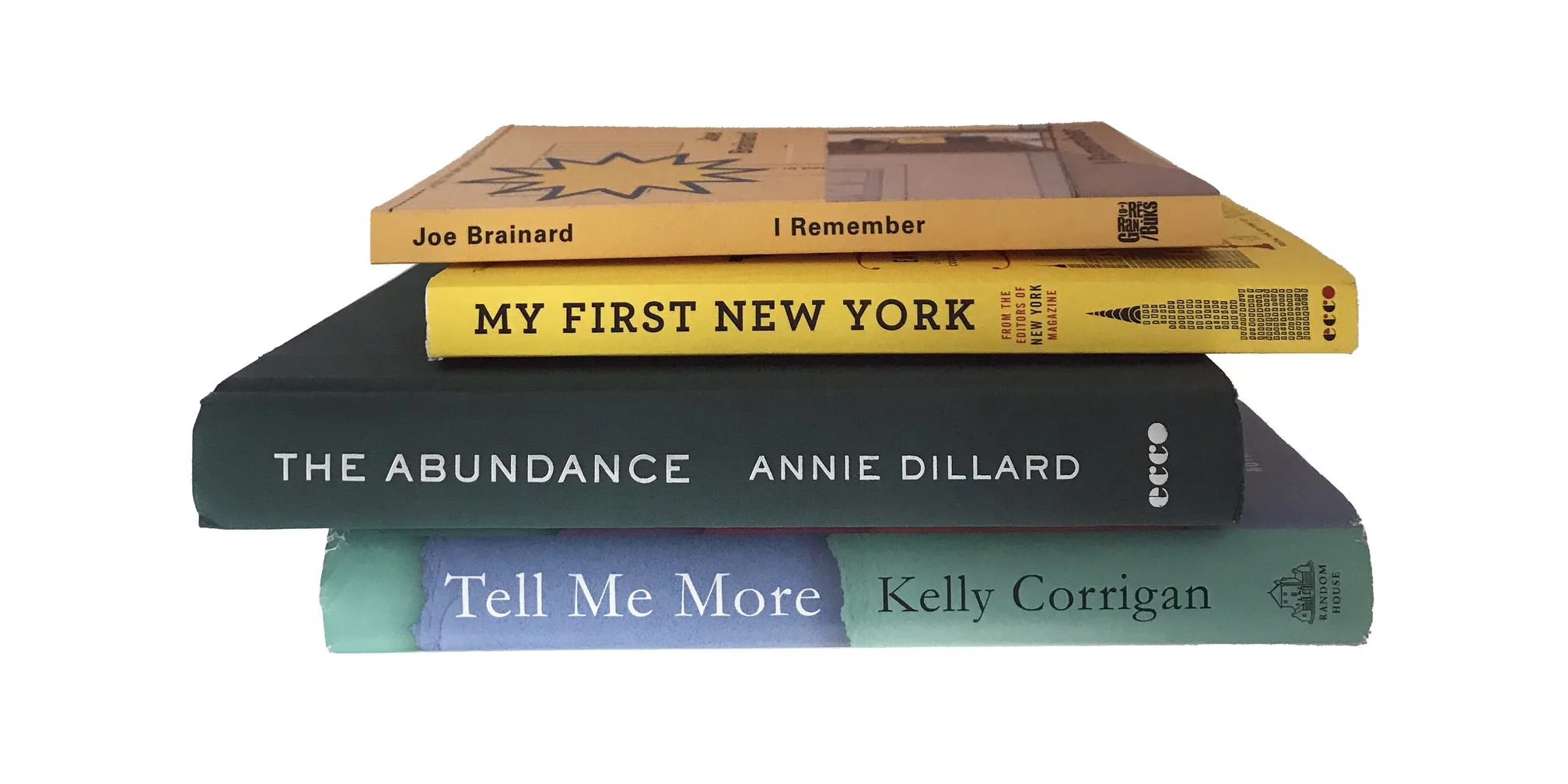
And so, while I am moving at a snail’s pace with the bigger memory-keeping projects I aspire to, I recently vowed to devote some time every night to a more simple memory-keeping endeavor: I have designated a journal as my “I Remember” book. In it, I try every night to write at least one sentence, maybe more, that begin with the words “I remember.”
I was inspired first by the prevalence of easy-to-maintain journals such as this line-a-day memory journal or this five-minute gratitude journal. I see these posted across my social media feeds by friends and influencers alike, and am drawn to their low-pressure approach to diary keeping. But because I want to focus right now on recording memories from my past, not my current day-to-day, I took inspiration as well from a book I was first introduced to by Dani Shapiro: I Remember, by Joe Brainard.
I have written about the value of this book before, and even shared some wonderful remembrances written by colleagues and friends here (it’s great inspiration!). So why did I never think of making this a nightly practice? Probably, I imagine, because I always tend to “think big.”
But I’ve thought of it now, and I’ve begun. And I am loving it.
How you can start your own low-pressure memory-keeping practice
Would you like to start your own low-pressure, high-yield memory keeping project?
Simply:
Buy a journal or create a new document on your computer.
Open this journal or document every day to write down one (or a few!) short remembrances. Just a sentence or two each, even a phrase if you feels it’s evocative.
Optional:
Date your entries if you like, or simply keep a continual list without regard for when you wrote them.
Set a regular time for writing in your “I Remember” journal, or carry it with you for whenever a few moments present themselves.
Consider that one day you may use this journal as a jumping-off point for a bigger personal history project—but know that by no means do you have to! This book will be chock-full of memories that I assure you will run the gamut from fun and lighthearted to deep and reflective—and it may one day be cherished by your own next of kin.
See what I mean about low pressure? Won’t you join me in this intentional remembering? Honestly, it’s one of my favorite things to do every evening, and I feel so wonderfully accomplished as the pages continue to be filled. One memory at a time…






Don’t put your memoir on your bucket list.
If writing your memoir means enough to you to put it on a bucket list, please read this—I’ll help you easily move it from future project to present-day endeavor.
A “bucket list” is a great idea—IF you plan on ticking things off that list by actually doing them! Too often, though, a bucket list is relegated to the portion of our brain for long-term dreams—the future.
Any and every item you have penciled in on your bucket list deserves not just a little hopeful dreaming every now and then, but a plan—a way to make your future dreams your present reality!
So, research that trip you’ve always wanted to take to Spain—then turn your research into an itinerary and an international ticket. Want to become more conversant in wine-speak? Sign up for an introductory class at your local community college, then invite a few friends over for treats and a tasting. Want to write your memoir? Pick up a pen and…what?
How to start your memoir, now.
If you dream of passing on your stories but don’t start now, you won’t ever get to it.
And it’s important: It’s important to you, because crafting your experiences into a narrative can help you make sense of your story, find meaning in your life, and navigate future choices with greater intention; it’s important for your family members because your experiences—especially those that demonstrate resilience—can help strengthen them, and, well, because they love you (tell me you wouldn’t be overcome with emotion to receive a book of your parents’ or grandparents’ stories written just for you?!).
But chances are your dream of writing your memoir will remain on your bucket list if you don’t know where to start. So, start here:
Decide if you’re up for writing your stories.
If you’re comfortable writing, then get yourself a notebook just for your memoir, or create a new file on your laptop. If the idea of writing scares the bejeezus out of you, then simply decide to speak and record your stories instead.Consider what part(s) of your life are worth telling.
This one may take a day—or even a week—but you shouldn’t be paralyzed by the choices here. Maybe you write a life timeline or follow the guidance here about brainstorming your life, then choose from among the ideas. Or maybe you just start with your most compelling memories—the ones that come to mind often or that you’ve told verbally around the dinner table for years. Just remember: Just because you write it doesn’t mean it will necessarily make the cut of what gets into your final memoir; and just because you start here doesn’t mean you can’t veer over there later. The idea is to be thoughtful and intentional about choosing a memoir theme or scope without letting the task delay your actual writing unnecessarily.Imagine your book done, then make a plan for it to get done.
Take just a moment to visualize your finished memoir. Let it soak in: Yes, it’s possible; yes, you can do it. Then forget about that finished book lest the blank page before you prove too daunting. In terms of making a plan, keep it simple—schedule a couple of hours a week, or whatever you can spare, for writing. Then, honor that time on your calendar and schedule around it.Begin writing—now.
Seriously, right now. When you finish reading this post, jot down a sentence, then another. If you want to begin with some phrases and initial brainstorming, fine…but write a full paragraph of autobiographical writing straight out of the gate.
There are plenty of other steps I could have inserted in there:
researching best methods for writing a memoir
reading other memoirs as inspiration
knowing who the audience for your memoir will be
checking your old journals for ideas
gathering photographs to use as memory prompts…and on and on.
And while all of those things are valid ways of making your memoir better, they’re also great excuses for not starting! Perfection, as they say, is the enemy of “done.”

So do what you need to in order to commit to starting your memoir. Print out the list of four actions above and check them off as you go. Or add them into your phone schedule or paper planner so time is blocked off (otherwise I can assure you more “urgent” matters will take their place!). But foremost among these steps: Pick up your pen or open your laptop and start writing.
If you really need to procrastinate a little more (!) and want to explore some ways to make your memoir great, check out these helpful posts:
A fun—and easy!—exercise for generating new autobiographical writing
Want a life writing prompt that gets your pen moving AND delivers a trove of future ideas for your memoir? Here it is—and bonus, it's a fun one!
This simple writing prompt will get you typing—and it will provide lots of ideas for future writing, too. All it takes is eight minutes!
A blank page is sometimes—heck, often—all it takes for us to back away from our desk and ignore our writing. But rather than turn to dusting or laundry or making multi-level to-do lists (all active forms of procrastination I have indulged in, I admit), instead, try a writing prompt to get your pen moving.
Writing prompts are so powerful because they are low-pressure (no expectation of publication, no working towards a finish line!); and they are elastic (let your ideas go in any direction you wish, and write anywhere—even during the 15-minute train transfer on your commute).
And while writing in response to a prompt can serve to simply get your creative juices flowing, doing so can also supply you with a bank of ideas for future writing.
When it comes to autobiographical writing, this multi-part writing prompt guarantees to result in a list of topics for you to mine when you sit down to write your memoir in earnest.
An iterative writing prompt for aspiring memoir writers

Get inspired!
For inspiration, check out the Six-Word Memoirs site—it’s chock-full of small-dose mini-memoirs (or order one of their books to keep by your desk).
Set a timer for 8 minutes.
Jot down as many one-sentence memoirs as you can.
If you were to stop here, you’d have brainstormed some ideas you can write about down the road. But if you keep going…
Choose one of those one-sentence memoirs and write as many first lines as you can for that memoir.
Or
Choose one of those one-sentence memoirs and write as many chapter titles as you can think of.
Or
Choose one of those one-sentence memoirs and write as many memories associated with it that you can think of.
…by doing any of these options that build upon the first writing prompt, you’ll likely discover which ideas are most fertile—and which simply don’t have legs.
This approach relies on your gut for idea generation—try to keep your pen moving (or your fingers sweeping across your keyboard) with no thought for editing or deliberation. Don’t worry if the one-sentence memoir you are writing has any merit or potential—just write it. Then write another, and another, until your timer goes off.
If you’ve never done brainstorming in this way, chances are you will love the sense of freedom and inspiration that comes with it (I know I do!). But the best part, in my opinion, is that you’ve now got a rough list of topics to consider: Should I write about this? How about that?
Next step: How to tap your ideas for real memoir writing
Wait at least a few days (that emotional and narrative distance is helpful). Then sit down and review your list of one-sentence memoirs—and all the writing associated with them—and take note of which ones resonate. Which ones make you itch to pick up your pen and start writing immediately? Which one makes you feel uncomfortable in that good way—you know, when you fear diving in but know deep down that there’s something substantive there?
Transfer these ideas to a notebook or new document. Consider this your own personal library of memoir writing prompts. Then: Start writing.


Stop waiting, start writing: Why now is the right time to begin your memoir.
Ignore those naysayers who warn that you must be passed middle age to begin writing your life stories: Start your memoir now, no matter how old you are.
“Too often memories die with their owner, and too often time surprises us by running out,” wrote one of our foremost authorities on memoir writing, William Zinsser.
Speaking candidly about the fact that we have a limited number of days on this Earth can be hard—no one wants to contemplate their death or jinx the happy times we’re living in right now. That’s why we come at it sideways sometimes—like with this quote that I often reference, again from Zinsser, because it inevitably—every time—elicits an emotional response:
“The saddest sentence I know is ‘I wish I had asked my mother about that.’”
That resonates with you, doesn’t it?
It is sad to think our mother’s—or father’s or grandparent’s—stories have died with them.
And one day your own kids will wish they had asked you for more: more stories, more details about your childhood, more names on the family tree. But it’s a simple fact that most times our children don’t value our stories until they are older; they don’t invite conversation about it now—but they will cherish them later.
That’s why it’s so important for you to begin recording your life stories now. Whether you write in a journal, work with a memoir coach, or share your memories during a series of personal history interviews, the time to begin is now.
Don’t worry that you are too young—all your stories matter, and you can always write more later, when you’re older.
Don’t worry that you haven’t lived your full life—we are all in the midst of our narrative, and reflecting upon your stories of the life you have lived thus far is worthwhile. “Every event, and certainly every event worth writing about, will always remain tattooed on our neurons. So it is never too early to start giving those events, which are our lives, a form,” Benjamin Moser has written. “It is a homage we pay ourselves. More solid than a memory, a memoir will outlast it, because until a memory is put into words, it remains mist, never shore.”
Don’t worry that you don’t have enough time to write—there are ways to make the time for something as important as your life story.
And don’t worry that you will have more perspective when you are older: “Of course someone will look back at his first broken heart with a different perspective at the age of 40, or 60, or 80. But that doesn’t mean that these perspectives are better, or that our self-understanding travels toward some telos of perfect consummation with every passing year,” Leslie Jamison wrote. “The narratives we tell about our own lives are constantly in flux; our perspectives at each age are differently valuable. What age gains in remove it loses in immediacy: The younger version of a story gets told at closer proximity, with more fine-grain texture and less aerial perspective.”
So don’t risk not having the time to tell your stories. Preserve them now. As Zinsser suggests, “be a recording angel and record everything your descendants might want to know.” Starting…right now.

I’m feeling stuck with my life story writing (can you relate?)
Sometimes a life writing project can become overwhelming—so much so that we stop writing at all. Get back on track with your memoir with this three-step reset.

When our memoir writing feels overwhelming and writer’s block sets in, sometimes a project reset is in order.
I spend my days helping people write their memoirs and craft their life stories into meaningful heirloom books to pass on—and yet, when it comes to writing my own personal stories, I have been completely stuck.
For a while I thought it was burnout, not having the energy to focus on my own stories because I was “storied out” from everyone else’s. But that’s not it.
Sometimes I think it’s my perfectionism creeping in—it has a habit of hindering my progress when I feel that something isn’t living up to my overly high standards (even though, as a longtime editor, I am fully aware that first drafts are meant to be anything but perfect!). But it’s not this, either, for I have done too little to even assess my storytelling as imperfect.
Could it really be that I am feeling overwhelmed by the task before me? How could that be when I work regularly to calm overwhelm and set priorities for my clients every single day? How could that be when I’ve written so much about how to approach your life story writing that I could gather it all into a book (hey, why haven’t I done that yet, either?!)?
Well, here’s the reason I haven’t been making progress with my own personal narrative: Despite knowing the steps—and despite having taken the first few of them—somewhere along the way I neglect my plan. I ignore the life timeline I’ve thoughtfully written; I start jotting notes in an entirely new notebook (separate from my previous writings, many on the same topics); and I keep going back to square one, thinking my newer ideas are more urgent than those I have already begun executing. I am tripping over myself constantly.
A project reset: 3 steps to getting my (and your) life writing back on track
I spent much of this morning procrastinating in the form of…
cleaning out my email inbox
scrubbing every surface in my office…and kitchen, and bedroom…
driving into town to run two errands that could totally have waited!
This is a routine familiar to every professional writer I know, but I feel no less guilty for knowing this.
The oft-repeated advice for escaping this avoidance routine? SIT IN THE CHAIR AND WRITE. That’s it. Just sit. And write.
But, to circle back to the first part of this blog post: I don’t know what to write. And so…a full project reset is in order.
If you, too, are feeling overwhelmed in the middle of your life writing endeavor, try this: Go back to square one and organize (or, perhaps, reorganize) everything:
Compile all your writing.
Gather all of your writing into one pile. Include journals (even the ones with a mere two paragraphs of personal writing within their pages); loose papers (even the notes scribbled on the back of bill envelopes); and printouts of writing you’ve done on your computer. If you’ve created a life timeline, have this on hand, as well.
Sift through your stories.
Set aside a block of time—likely between one and two hours—to review what you’ve got. Take notes about recurring themes you encounter in your writing, and about new ideas that come to mind during your reading. Are there glaring omissions? Blocks of writing that feel more complete than the rest?
Plan with intention.
Make a plan for diving back in to your memoir project with intention. Designate ONE place for your writing to happen (a single document on your computer, perhaps, or a preferred notebook for handwritten musings). Decide on a major theme for your project, and file any writing that does not adhere to this theme in a folder marked “future writing.” And finally, set some reasonable goals for yourself: Will you write a little every day, or for a chunk of time every Saturday, perhaps? Do you aim to have your stories compiled into a book (if so, you may want to start gathering photos as you go). Are there holes in your storytelling that may need further research—a conversation with mom or a sibling, maybe, or a trip to the library? If so, sketch out a plan for moving forward with all those elements.
Sometimes our storytelling gets muddled. There’s so much we want to say, we’re scattered in our approach, we start and stop so often that we lose our place. It’s all okay. So I tell myself, and so I say to you! Hopefully, a reset is all we need. It’s what’s on my agenda for tomorrow, now that my home is squeaky clean and, fingers crossed, procrastination–proof…

Think you’re too busy to write about your life? Think again.
Three easy ways to make memoir writing more approachable—and more efficient, so you can finally fit it into your busy schedule.
Want to commit to writing your memoir? Let’s do this together! I’ll give you three ways to make the process more efficient so it takes less time; and you need to say “yes” to carving out space on your schedule. Ready?
We live in a culture of busy-ness—we’re all busy, all of the time. But are you allocating your time to things you love, or to things that satisfy others in your life (your boss, your children, your spouse, your friends)? I won’t pontificate about why I think it’s important to be mindful of the trap of busy-ness, but I will offer some tips for making time to focus on a passion project you’ve been thinking about for a while…and cross my fingers that you take steps to get started, at long last.
In this case, I am suggesting three ways to make time for writing about your life—but if your goal is something else creative, many of these tenets hold true.
Want to write your memoir? Do these 3 things to make the time.
1 - Set small goals.
Forget about the memoir you envision, with that favorite childhood photo of you on the cover, and that dedication to your beloved mom. Don’t even think about what printer you might use, or where you will end. Instead, focus on one story at a time.
I am not advocating sitting down to write with nary a notion of where you are heading (though, if that gets your pen moving, then so be it!). Rather, I suggest planning your life story book by first organizing your family archive; then drafting a life timeline; and, next, narrowing down themes you would like to write about.
Once these architectural elements are done, you may begin writing. Create a regular schedule with reasonable expectations—perhaps 500 words a day, or if you are fitting your memoir writing in amidst full-time work responsibilities, maybe 1,500 words every weekend. Or ignore word counts altogether and tackle one story at a time.
Declare goals for yourself and set corresponding deadlines for accountability. Then, focus only on one goal at a time. You’ll see that as you start ticking off your objectives along the way, your momentum will carry you forward. With each story you write, I am willing to bet 10 more will pop into your head as future ideas!
2 - Narrow your topic.
During the prep work I recommend in the previous step, you should have narrowed down some themes for your memoir. I go into more detail about that here, but for now I want to encourage you to go even further: Take a look at the themes you may have chosen, then see how you might hone in on them even more.
Did you decide to write about your family travels growing up? Narrow your focus to, maybe, “What I learned driving around small-town America in my youth”; or “How taking pictures of my childhood travels helped me appreciate the world.” Note that while you of course can narrow a theme down from a subject perspective (instead of all your travels, focus on those in the United States or those from just your teen years), you can also narrow your focus by writing towards a lesson or insight.
The more precisely you can whittle your theme, the easier it will be to tackle writing about it.
3 - Say goodbye to perfectionism.
Ever heard the saying “Done is better than perfect”? Nothing will hamper your writing more than trying to get it perfect the first—even the second—time around.
Free writing exercises such as this one will hopefully get the words and ideas flowing, even if they are on a topic different from what you’d like to write about on any given day. Consider beginning your writing practice with a 10-minute free write, then shifting into writing about your self-assigned topic. Doing so often alleviates pressure and allows us to dive right in.
Don’t edit along the way, either. Just write. Get your thoughts down. Memoirist Anne Lamott has memorialized the expression “shitty first draft,” and writes in her beautifully encouraging Bird by Bird,
“The first draft is the child’s draft, where you let it all pour out and then let it romp all over the place, knowing that no one is going to see it and that you can shape it later… just get it all down on paper, because there may be something great in those six crazy pages that you would never have gotten by more rational, grown-up means.”
Is it perfection in life rather than perfection on the page you are concerned with? I’m no therapist, but I can say with conviction that none of us is perfect, and that we learn (and teach) from our struggles and failures, so writing about them can be valuable. Allow yourself to be vulnerable, remembering this caveat at all times: Just because you write it doesn’t mean anyone else has to read it! You maintain full control of your words and stories; you can rip them up or delete a file any time. But don’t be hasty: Give yourself some emotional and temporal distance from your writing before making such an assessment. If you’ve allowed yourself to be vulnerable in your memoir writing and then find yourself questioning if you went too far, wait a month and go back to read your words afresh. You may surprise yourself with the level of nuance and honesty in your writing. Ask yourself, Would one of my loved ones appreciate and relate to my words one day?
I admit, I didn’t manufacture more time in your schedule. But I hope I made the notion of writing about your life more approachable—and more efficient, so you can indeed fit it into your days. Start saying ‘no’ to things that don’t feed your soul, and start saying ‘yes’ to things such as this that you want to do but haven’t yet…! Set up a free half-hour consultation if you’d like a professional memoir coach to help guide you.