
Memories Matter
Featured blog Posts

READ THE LATEST POSTS

6 tips for choosing the best family photos to use as writing prompts
Family photos can be useful tools to jog memories and call forth stories. We share how to determine which images will elicit the best family stories.
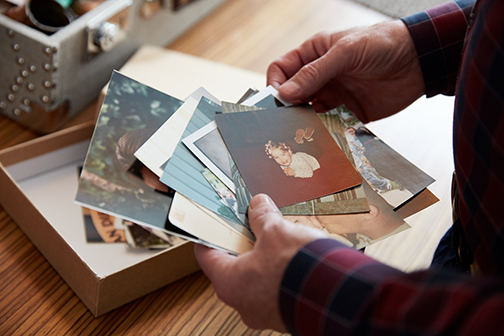
There are no rules for how to choose a photo that will be effective as a biographical writing prompt, but we can offer a few guidelines for the types of images that often elicit storytelling that is deeper and more meaningful than a mere identifying caption.
That’s the goal, after all: To use a photo as a starting point for your storytelling—as a jumping off point for memories, a touchstone for emotions, a lead-in to a narrative from your life.
So get out your old family photo albums or that dusty box of print photographs from the basement! Then…
Step One: Choose 10-20 pictures to start with.
Begin randomly looking at photos.
Rather than focusing on those that are frame-worthy, look for photos that elicit a strong feeling from the viewer (you, or the family member from whom you would like to capture stories).
Set aside 10-20 images that stopped you in your tracks in number two (even if you stopped to wonder about the image as opposed to reliving memories as a result of looking at it; sometimes it’s the mysteries behind a photo that draw forth particularly revelatory stories).
Now it’s time to choose a photo with which to begin your reminiscing. Whether you are using the photo as a writing prompt or as a vehicle to jump-start conversation in a personal history interview, the following suggestions will be helpful in selecting images that lead to substantial storytelling.
“Photos reveal themselves in layers,” Maureen Taylor (aka ‘The Photo Detective’) writes on her blog. “You study the clues and talk to family but every time you look at it or show it off to family you might learn something new. One thing leads to another.”
Step Two: Determine if the photo is story-worthy,
Ask yourself if the photo you are holding does any of the following six things—and if the answer to one or more of them is yes, then you’ve got yourself a winner. Set it aside and make sure it’s on hand the next time you want to delve into some family history writing!

The photo invokes an emotional response.
Do you feel a rush of excitement or a flush of scarlet creep up your face when you first spy the picture? It may make you feel anguish or sorrow, pride or exasperation, abundant joy or abiding love—the key is, it makes you feel.
If a family photo has such a visceral effect on you, this will be most fruitful for writing its story.
“Photographs are about one specific second, but they can also be about the future,” Beth Kephart writes in The Quest for Truth. “Photographs can operate as metaphor and counterweight, as tease and opposition, as the other half of a parenthesis.”
That photo that moves you is a doorway to your past that is clearly connected to your present in some way. Explore why you feel the way you do, and how this feeling fits into your life then and now. Provide context for your feelings; set the scene.
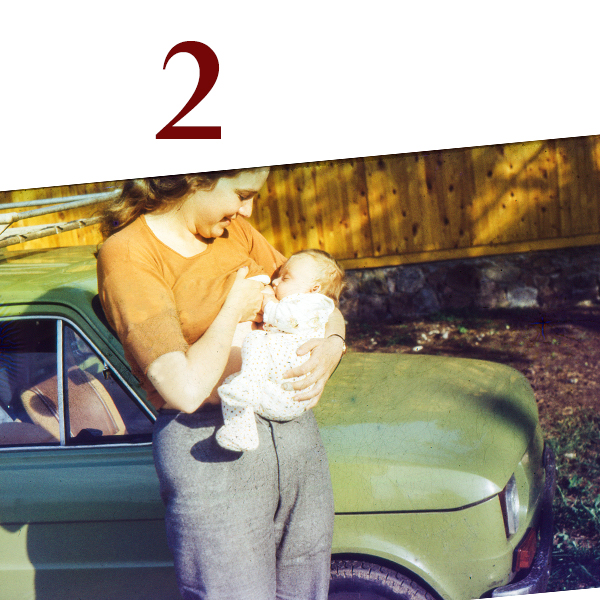
The picture tells a visual story.
Sometimes a picture itself already reveals a story: If the who, what, where, when, and why (or most of those) are apparent just from looking at the photo, then it’s likely a good candidate for embellishing upon. Of course, it’s ideal to choose images whose stories matter to you in some way.
The snapshot of this woman breastfeeding certainly tells a story about who she was as a mother—and if the mores of the time period and the town are known, and her character as well, then the storyteller can dive deep. A grown child looking at this image might use it as a jumping-off point for talking about their relationship over the years; or perhaps how their mom was part of a strong line of women before her; maybe she was only able to have one child, or 10, or only girls…
A photo is a moment in time, but on the periphery are details that help make up its narrative. What photo would have been shot just before this one? Just after? What’s in the frame? What (and notably who) is not in the frame? By starting with a picture whose story seems readily available, we can develop depth by asking such probing questions and tapping our memories for more.

Details draw your attention.
Your facial expression at the time the picture was snapped. The pattern of your grandmother’s well-worn house dress. A missing button on your dad’s shirt, or the papers falling from his briefcase. The water stain on the bedroom wallpaper. If some detail in a photo draws your eye again and again, there is more to be probed.
What does the detail begin to tell you? What beyond the frame of the photo—on that day, or a decade before or after the photo was taken—makes you focus on it? By taking the time to meditate upon all that the detail calls forth in your mind, you will reveal a greater meaning to this photo than could ever be revealed upon initial inspection.
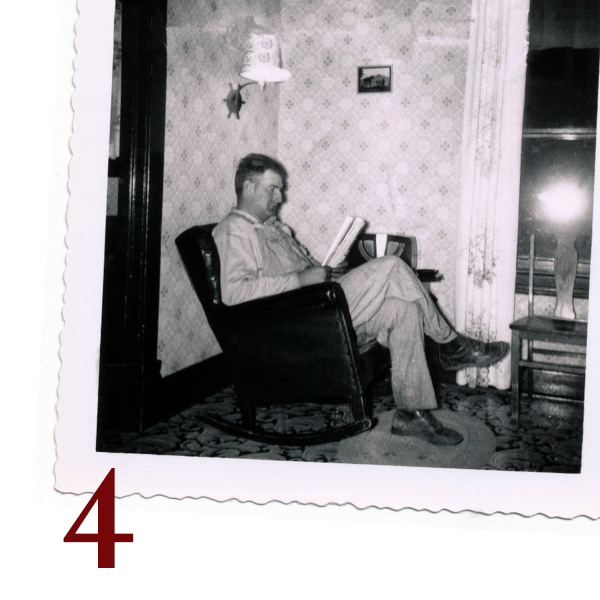
The photo portrays part of the subject’s everyday world.
My favorite type of modern family pictures could be described as documentary family photography: people in their natural environment, doing what they do every day. (Check out talented photographer Jen Grima’s work for inspiration.) I love capturing our routine family narrative this way because the resulting photos are so evocative of time and place, and they set us in scenes that are real and personal, uniquely ours.
Many old family photos do so less consciously, perhaps, but the impact is the same. We are drawn to such pictures because they reveal what our or our ancestor’s life was like back then. So if a snapshot of your aunt holding you while she’s hanging the laundry crosses your path, use it to tell a story. If you find a picture of grandpa reading in his favorite recliner, dad trimming the hedges at your childhood home, or your baby crawling amidst the messy remnants of Christmas wrapping paper, use them all—find their stories.

The image intrigues you.
Is it a curious shot? Out of the ordinary for your family or for the time period? Is someone missing who you would have expected to be present in that scene?
If it makes you wonder, then it very well may lead to a worthwhile story. Perhaps you end up asking for relatives’ input to get to the bottom of your intrigue, or maybe in lieu of concrete answers you surmise the story behind the old photo, thereby revealing a narrative of your own in relation to the photo. Chances are, whatever your approach the resulting observations will be as alluring to the next person as the original photograph was to you.
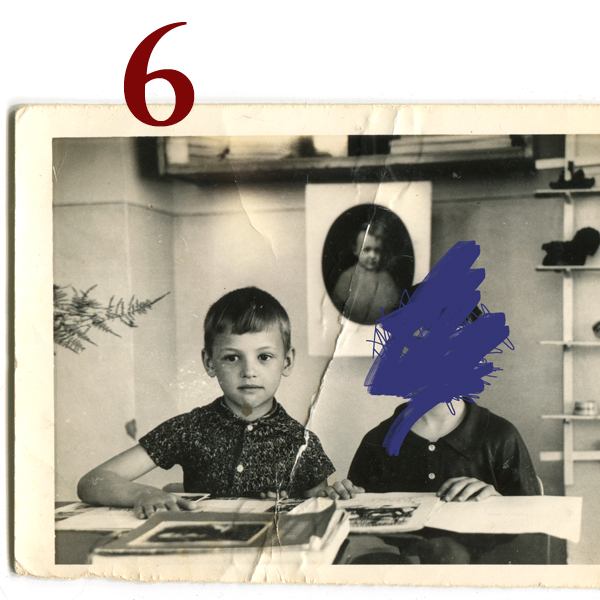
The physical print tells its own story.
My grandmother had a tendency to hold a grudge, so it was not too surprising to find among her things photos that had an individual literally cut out of the scene (or crossed out with ballpoint pen). Now there’s a story to be revealed! The same could be said for pictures that have been torn, damaged by flood or fire, or found tucked away in a book.
Sometimes getting to the story behind the photo is as fun—and constructive—as getting to the story that resides within it.
Step 3: Start sharing your stories.
Read more about how to use old family photos as biographical writing prompts—we’re talking nitty-gritty advice, from where to begin after looking at the photo to how to capture your memories.
Download the advice in a handy printer-friendly booklet here, entitled “How to Use Photographs as Prompts for Writing Life Stories.”
Explore more intense self-reflective writing prompts in Beth Kephart’s memoir writing workbook.
Once you’ve written your first life story vignette, consider doing something special with it—we’ve got five easy ideas.

“Honoring Mamita”
Yuliana Gomez Delgado reflects on a favorite photograph with her grandmother, a shot that has taken on new meaning now that Yuliana herself knows what it is to be called Mother. As she poignantly writes, “Burying her was saying goodbye to my childhood—it was the first time I realized time went forever forward, and so many happy memories were destined to stay behind.” And yet, she finds a lasting way to honor her Mamita, and create a loving legacy for her family.
You don’t have to call yourself a writer to write meaningful vignettes about your life. There are some notable books that can guide you on the journey of writing your life stories, and our blog regularly offers advice on the topic. Sometimes, though, all you need is a little inspiration.
With that in mind, here is the second contribution in our “Pictures Into Words” series, vignettes from other memory-keepers who know the joy and process of using a photograph as a prompt for writing. Each provides not only a wonderful short read, but a fine and unique example of how you too may approach telling the stories behind your family photographs.
Since it's still May, we’re proud to feature recollections of another strong matriarch in honor of Mother’s Day. In her piece, Yuliana Gomez Delgado reflects on a favorite photograph with her grandmother, a shot that has taken on new meaning now that Yuliana herself knows what it is to be called Mother.
Pictures Into Words:
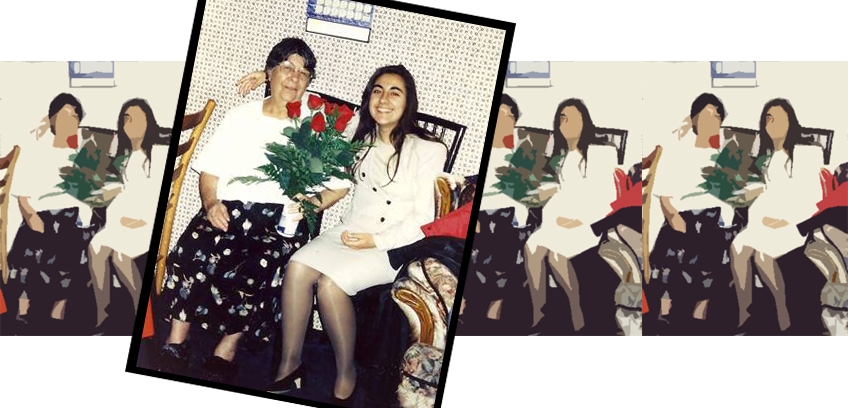
The writer, Yuliana Delgado, with her maternal grandmother, Mother's Day, 1996
Honoring Mamita
By Yuliana Delgado
I keep this picture in a safe place because of all that it represents to me. It was Mother's Day 1996 and we were visiting my Mamita (what I called my mom’s mom, my abuela or grandma) after church that Sunday. I was hamming it up for the camera, but I can still feel the scratchy icky-ness of those seldom-worn pantyhose on my legs and how silly I felt in my beige suit. What can I say, I tried to dress up a little since I lived in sweats and tees pretty much all the time (I was in college after all!). Beyond how I felt about my church garb on that day, what I remember clear as day is the incredible love and gratitude I felt for Mamita, whose health had been declining rapidly over the previous months.
Holy crap, that was 20 years ago! I was in my teens and a sophomore in college. And yet, despite my relative youth, I think I knew how little time I had left with my incredible, wonderful, always happy, always positive Mamita, María Noemí. In the days that followed that weekend, we visited her Queens apartment as much as we possibly could, to spend time or just to help around the house after her grueling radiation sessions or after those exam days, when the poking and prodding she had to endure at the hospital left her exhausted.
Almost two years to the day that this picture was taken, Mamita left us, finally succumbing to the cancer that had ravaged her body. Despite the fact that I knew it was coming—and as I think is always the case—her death was beyond painful, surprising, crushing. It didn’t matter that I knew the day would come, it had to come; knowing she was gone forever still destroyed me. Burying her was saying goodbye to my childhood—it was the first time I realized time went forever forward, and so many happy memories were destined to stay behind.
I found this photograph about two years ago, when I was pregnant with my daughter. While we had decided upon Sofía as our girl’s first name, we were struggling with a middle name. The picture brought inspiration. I would honor Mamita in a most special way, one that would keep her ever-present in my life: We would give our baby Mamita's middle name. It was the best way I could honor her, so many years after she left us. And Sofía Noemí is in, so many ways, a little bit like Mamita.
I hope Mamita’s great-granddaughter can carry on her spirit and legacy. Her name is a way to have her again in our lives. And whenever I look at my Sofi, I know we chose the name well.
-----------------------
Yuliana Gomez Delgado is the managing editor at MamasLatinas.com. She lives in New Jersey with her hubby, 4-year-old son, 20-month-old daughter, and two cranky Chihuahuas, Pablo and Arnie.
Dawn Roode’s curated roundup for the week of Sept. 23, 2026, is overflowing with recent reads on memoir, life story writing, and family history preservation.