
Memories Matter
Featured blog Posts

READ THE LATEST POSTS

Think you’re too busy to write about your life? Think again.
Three easy ways to make memoir writing more approachable—and more efficient, so you can finally fit it into your busy schedule.
Want to commit to writing your memoir? Let’s do this together! I’ll give you three ways to make the process more efficient so it takes less time; and you need to say “yes” to carving out space on your schedule. Ready?
We live in a culture of busy-ness—we’re all busy, all of the time. But are you allocating your time to things you love, or to things that satisfy others in your life (your boss, your children, your spouse, your friends)? I won’t pontificate about why I think it’s important to be mindful of the trap of busy-ness, but I will offer some tips for making time to focus on a passion project you’ve been thinking about for a while…and cross my fingers that you take steps to get started, at long last.
In this case, I am suggesting three ways to make time for writing about your life—but if your goal is something else creative, many of these tenets hold true.
Want to write your memoir? Do these 3 things to make the time.
1 - Set small goals.
Forget about the memoir you envision, with that favorite childhood photo of you on the cover, and that dedication to your beloved mom. Don’t even think about what printer you might use, or where you will end. Instead, focus on one story at a time.
I am not advocating sitting down to write with nary a notion of where you are heading (though, if that gets your pen moving, then so be it!). Rather, I suggest planning your life story book by first organizing your family archive; then drafting a life timeline; and, next, narrowing down themes you would like to write about.
Once these architectural elements are done, you may begin writing. Create a regular schedule with reasonable expectations—perhaps 500 words a day, or if you are fitting your memoir writing in amidst full-time work responsibilities, maybe 1,500 words every weekend. Or ignore word counts altogether and tackle one story at a time.
Declare goals for yourself and set corresponding deadlines for accountability. Then, focus only on one goal at a time. You’ll see that as you start ticking off your objectives along the way, your momentum will carry you forward. With each story you write, I am willing to bet 10 more will pop into your head as future ideas!
2 - Narrow your topic.
During the prep work I recommend in the previous step, you should have narrowed down some themes for your memoir. I go into more detail about that here, but for now I want to encourage you to go even further: Take a look at the themes you may have chosen, then see how you might hone in on them even more.
Did you decide to write about your family travels growing up? Narrow your focus to, maybe, “What I learned driving around small-town America in my youth”; or “How taking pictures of my childhood travels helped me appreciate the world.” Note that while you of course can narrow a theme down from a subject perspective (instead of all your travels, focus on those in the United States or those from just your teen years), you can also narrow your focus by writing towards a lesson or insight.
The more precisely you can whittle your theme, the easier it will be to tackle writing about it.
3 - Say goodbye to perfectionism.
Ever heard the saying “Done is better than perfect”? Nothing will hamper your writing more than trying to get it perfect the first—even the second—time around.
Free writing exercises such as this one will hopefully get the words and ideas flowing, even if they are on a topic different from what you’d like to write about on any given day. Consider beginning your writing practice with a 10-minute free write, then shifting into writing about your self-assigned topic. Doing so often alleviates pressure and allows us to dive right in.
Don’t edit along the way, either. Just write. Get your thoughts down. Memoirist Anne Lamott has memorialized the expression “shitty first draft,” and writes in her beautifully encouraging Bird by Bird,
“The first draft is the child’s draft, where you let it all pour out and then let it romp all over the place, knowing that no one is going to see it and that you can shape it later… just get it all down on paper, because there may be something great in those six crazy pages that you would never have gotten by more rational, grown-up means.”
Is it perfection in life rather than perfection on the page you are concerned with? I’m no therapist, but I can say with conviction that none of us is perfect, and that we learn (and teach) from our struggles and failures, so writing about them can be valuable. Allow yourself to be vulnerable, remembering this caveat at all times: Just because you write it doesn’t mean anyone else has to read it! You maintain full control of your words and stories; you can rip them up or delete a file any time. But don’t be hasty: Give yourself some emotional and temporal distance from your writing before making such an assessment. If you’ve allowed yourself to be vulnerable in your memoir writing and then find yourself questioning if you went too far, wait a month and go back to read your words afresh. You may surprise yourself with the level of nuance and honesty in your writing. Ask yourself, Would one of my loved ones appreciate and relate to my words one day?
I admit, I didn’t manufacture more time in your schedule. But I hope I made the notion of writing about your life more approachable—and more efficient, so you can indeed fit it into your days. Start saying ‘no’ to things that don’t feed your soul, and start saying ‘yes’ to things such as this that you want to do but haven’t yet…! Set up a free half-hour consultation if you’d like a professional memoir coach to help guide you.

















Life Story Links: December 14, 2021
A wealth of reading on the topics of memoir writing, honoring lost loved ones through storytelling, and the best creative nonfiction pieces to read now,
“But here’s the other thing I believe about writing memoir. Even if you never publish your story, it deserves to be told. There is much to be learned from the simple act of figuring out what your story is ABOUT. Which is not the same as WHAT HAPPENED.”
—Joyce Maynard
Vintage photo of postman with his sack of deliveries; the magazine in front is The Literary Digest, dated May 22, 1920. Original photograph from Bain News Service, 1920, courtesy of Library of Congress Prints and Photographs Division Washington, digital collection.
Telling Our Stories
WHO IS YOUR FAMILY?
While documenting our family history is essential, so too is stepping back to ask ourselves a few questions about our family. These two writing prompts may be just the ticket to more thoughtful storytelling and meaning-making.
STORIES HOLD POWER
On this episode of Stories in Our Roots podcast, host Heather Murphy interviews Laura Roselle of the Family Narrative Project about how we can change the meaning of a story by shifting the way we tell it:
IN CONVERSATION
Memoirists Michelle Bowdler and Kenny Fries discuss “how to write honestly and fearlessly about one’s life and the larger meaning of one’s personal experiences.”
BEING OPEN ON THE PAGE
“I’ve taught writing for more than thirty years, and I always explain to my students that writing it down is the opposite of covering it up,” Gina Barreca, Ph.D., writes in this piece suggesting that stories need a heart.
Discovering the Stories of Others
READING LIST
For your future reading pleasure: Bookmark this list of the best 60 essays in the creative nonfiction genre from the past year, as selected by the staff and readers of Entropy.
RICH NONFICTION NARRATIVE WRITING
How creative nonfiction —“this nonfiction form that let you tell stories and incorporate your experiences along with other information and ideas and personal opinions”—became a legitimate genre.
A MEMOIR FOR COVID TIMES
“Happy and sad, upbeat and poignant, optimistic and anxious, all of these stories [in the community memoir Sorrows & Silver Linings: Global Pandemic in a Small Town] paint a picture of what life was like in Carlisle when COVID struck in spring of 2020,” journalist Nancy West writes.
Memories, Legacy, Life
MEANINGFUL GIFT IDEAS
“All of these gifts connect to conversation, memory-keeping, and story-sharing in some way,” says Whitney Myers, the video biographer behind Sacred Stories in Texas. Her list of holiday giving ideas includes stocking stuffers, too.
TALKING ABOUT DECEASED FAMILY
“We got up and started walking along the edge of the lake when Andy stopped and said, ‘Boys, I have something to tell you.’” How one family honors the memory of three who died years before, with love and intention.
“THE LIFE STORY FACTORY”
“As the pandemic brought mortality into sharp relief, ghost-writing collective StoryTerrace experienced an uptick in business, publishing biographies about and for regular people. Here…we discover the extraordinary things you learn when you spend your days detailing ordinary lives.”
QUITE A JOURNEY
A U.S. soldier overseas during World War II lost a bracelet inscribed with his sweetheart's name. With the help of a hobbyist treasure hunter, the U.S. Embassy, the Marines, and, finally, a Czech-speaking woman in Colorado, it was returned to him. Hear the story:
...and a Few More Links
Review of the new book Artful Truths: The Philosophy of Memoir
Landmark photo archive of black life in New York comes to the Met.
A Florida city keeps the memory of Zora Neale Hurston alive with a heritage trail.
LitHub gathers the best reviewed memoirs and biographies of 2021.
Old photo album shows high school life in Michigan before WWII.
Rediscovered film footage offers rare glimpse of everyday life in 1920s Ireland.
Short Takes

Life Story Links: July 28, 2020
Lots about memoir (writing and reading), free learning opportunities, the complexities of family history, and, of course, recommended first-person reads.
“I will always believe that storytelling matters, that glimpses of lives different than ours—whether they come through images or stories—have the potential to change us by opening the world to us and fostering compassion. We are so much better when we listen to each other.”
—Vikki Reich

With professional baseball’s opening day pushed back from March 26 to July 23, our national pastime is getting a late start this year due to Covid-19. This vintage photo celebrates the Negro National League Champions of 1935, the Pittsburgh Crawfords. Photograph courtesy Schomburg Center for Research in Black Culture, Photographs and Prints Division, The New York Public Library Digital Collections.
On Craft
THE BUILDING BLOCKS OF MEMOIR
“It was really rewarding when my 60-year-old Italian mother-in-law, who I adore, said she saw herself in parts of the book. We’re completely different, and yet, my narrative joined us.” Davon Loeb, author of the lyrical memoir The In-Betweens, addresses the idea of finding universality in individual stories and filling in the gaps of his memories without fictionalizing.
WHERE TO BEGIN?
It's important to focus your life story writing on themes that both hold real meaning for you and that you feel will resonate with your family. Last week I wrote about how to identify impactful themes for your memoir.
“THINK SPECIFIC, THINK SMALL”
“One of the most common concerns we hear from prospective clients is that first-person writing seems intimidating, maybe even overwhelming. And one of our most common responses is to break a project down into bite-size pieces,” Samantha Shubert of NYC–based Remarkable Life Memoirs advises.
Time-Sensitive Offerings
GRIEF IN THE SEASON OF COVID
The workshop series “Remembering Our Loved Ones During an Unprecedented Time” from author and grief expert Allison Gilbert continues tonight at 8pm ET with a session discussing ways to meaningfully organize your family photos; and on August 4 with a topic of clearing clutter while staying connected to heirlooms that hold stories.
LIKE HIDDEN CAPTIONS
Learn best practices for adding metadata to photos so your pictures are tagged with names, dates, and other identifying info that make it easier for you to find them when you need them (and so future generations will know who's in the pictures, too). This one-hour class is free for now ($49 value).
LIMITED FREE SHOWING
The Public Theater’s The Line, a documentary-style play, is available to watch free until August 4, 2020: Crafted from firsthand interviews with medical first responders during the COVID-19 pandemic, The Line stars Lorraine Toussaint, Alison Pill, John Ortiz and other actors who bring their stories to life. I highly recommend finding the time to view this original work by Jessica Blank and Erik Jensen which has been called “immediate and urgent” and “stinging with truth.”

Lorraine Toussaint in The Line, available to view free on The Public Theater’s YouTube channel through August 4. Actors speak directly to the camera using words captured from interviews with real-life first responders to powerful effect.
Family History Finds
A CAPTIVE AUDIENCE DURING COVID
The ranks of amateur genealogists have grown during the coronavirus pandemic, and they’re boring their sheltered relatives, reports the Wall Street Journal. “Genealogy is boring. But everyone loves a good story and family history is filled with very good stories.” Personal historians suggest focusing on the scandals you unearth to drum up interest.
WRITE IT OUT
You never know how recording your own story will impact others, but you can always know that your story is important—it matters!” This short blog from RootsTech offers up ideas for journaling during hard times.
PHOTO MEMORIES
Seeing her precious family photo, damaged in Hurricane Harvey, now fully restored and framed, one woman declared that maybe “I can be restored back to new,” too. Watch students working with Adobe’s “The Future Is Yours” program return lost memories to their owners in the moving video below. (While this recording is two years old now, I am sharing (a) because it’s refreshingly inspiring to see pre-pandemic hugs and (b) because you can volunteer for the ongoing program to help others.)
First Person Stories that Resonate
BLACK AND WHITE
“When I told my father I was going to marry Jake he said, ‘If you marry that man you will never set foot in this house again.’” Mixed-race couples from four generations in Britain tell their stories.
HISTORY REMEMBERED
Only about two percent of the men and women who served in the American armed forces from 1941 to 1945 are still alive. This piece gathers stories from participants in some of World War II’s most iconic moments, including from the only surviving witness of the German surrender signing.
In the Telling
WHOSE AUTHENTICITY?
“What I know for sure is that in order to create new ways of being, Native peoples must reclaim and revalidate the truth in our stories,” Taylor Hensel writes in this piece on indigenous ways of being and the idea of narrative as power.
THE IMMEDIACY OF THE MOMENT
“The velocity of my mother’s death and my distance from it all feel like a death in brackets. There is no touch, no contact, no final conversations, no holding the hand of the dying.” Jennifer Spitzer on losing her mother to Covid-19 and reading Virginia Woolf.
UNEXPECTED ENCOUNTER
“I was in Italy, having lunch with friends, and one of them brought out a volume of Borges stories—he happened to be reading them. I said, ‘Let me tell you about my travels with Borges through the highlands of Scotland,’” Jay Parini writes. His friend told him to write a book; Borges and Me: An Encounter comes out in August.
A POET TURNS HER HAND TO MEMOIR
“I took with me what I had cultivated all those years: mute avoidance of my past, silence and willed amnesia buried deep in me like a root.” Natasha Trethewey on the seven-year process of writing her mother's story in Memorial Drive: A Daughter’s Memoir.
...and a Few More Links
How to curate your family photo slideshows like a professional photo editor
Alex Trebek “has written a memoir of consummate caginess.”
Creative tributes in place of a traditional memorial service
Autobiographical writing prompt: the story of everyday things
We’re all field workers in the effort to document the (many) happenings of this year.
Local newspaper turns the spotlight on Massachusetts–based family history film company Second Avenue Video.
Maryland–based personal historian Pat McNees offers up an anti-racism reading list.
On learning to decipher her father’s past in Nazi Germany, and the nuances of family history
Short Takes

Life Story Links: June 25, 2019
The value of attaching stories to our stuff, ways to organize your memories around the artifacts of your life, and a moving eulogy honoring Gloria Vanderbilt.
“In writing, the big things in life are best illustrated by their small details. A recent widow struggling with the clasp of her charm bracelet for the first time since the death of her husband illustrates, illuminates and focuses in on grief. Go small and explode life’s large themes.”
—Marion Roach Smith

Boys just returned from hunting, Knox County, Kentucky, circa 1940. Photographed by Marion Post Wolcott, courtesy U.S. Farm Security Administration.
Lost & Found
MORE THAN STUFF
“If we want our family heirlooms and objects to have stories, then we must attach the story to them,” Kim Winslow writes. See how she does just that with a simple bench passed down from her husband’s mother.
FOUND PHOTOGRAPHS, MEMORIES GONE FERAL
Every photograph is “a marker, the living trace of a human who may otherwise survive only as a census entry, or not even that. We cannot discern their accompanying stories, and we can’t do anything for them.” The (missing) stories behind other people’s photos.
140,000 VHS TAPES
“This was not just a story about an archive, but a chance to use the archive to tell a story of the complicated person Marion [Roach] was,” filmmaker Matt Wolf says of his documentary Recorder: The Marion Stokes Project. I missed the screenings in NYC and Montclair, New Jersey, but hope to catch one soon.
After a Death
GRIEF VALLEY
“As much as I miss my dad (and I do miss him terribly) I miss the me that he knew, too. I grieve the loss of our shared story,” John Pavolovitz writes. When someone you love dies, you lose a part of yourself, too: “You lose the part of you that only they knew. You lose some of your story.”
GOODBYE TO AN ICON
Almost immediately after the news broke that Gloria Vanderbilt had passed away on June 17, tributes began pouring in on social media. Her son Anderson Cooper, with whom she wrote a revealing memoir, took to the air for this moving eulogy:
Ways In
TIMED WRITING EXERCISE
By limiting oneself in word count and time allotted for writing, undertaking any life story project becomes both more urgent and more relaxed. How to write a 300-word autobiographical vignette in 30 minutes.
CALL FOR SUBMISSIONS
Do you have a story about a time you were literally lost—maybe on a winding back road, in a sprawling city, or inside a cavernous building? Or maybe you were metaphorically lost, unsure of your life's direction, until that one moment or one person changed everything. Submit your writing to Hippocampus by Sept. 15, 2019, to be considered for their “Lost” themed issue.
OBJECT LESSONS
“Imagine telling your own story, your autobiography, around the artifacts of your life—your first trike, wagon and bicycle followed by the automobiles you owned…or other objects that are unique to your life”: Ideas for storytelling using objects as markers of time.
...and a Few More Links
He couldn’t talk about what he saw in WWII, so he painted it.
Memoir review: My Father Left Me Ireland
Check out the new website for Personal Historians Northeast Network.
Short Takes
Life Story Links: February 26, 2019
Writing the suffering, memoir as therapy, family history come to life in a surprising film from Ancestry, plus a few life story reads worth your time.
“Some writers have a more defined sense of cause and effect. Plot. My sense of life is more moment, moment, and moment. Looking back, they accrue and occur to you at a certain time and maybe you don’t know why, but you trust that they are coming back to you now for a reason. And you make a leap of faith. You trust you can put these moments together and create story.”
—Amy Hempel

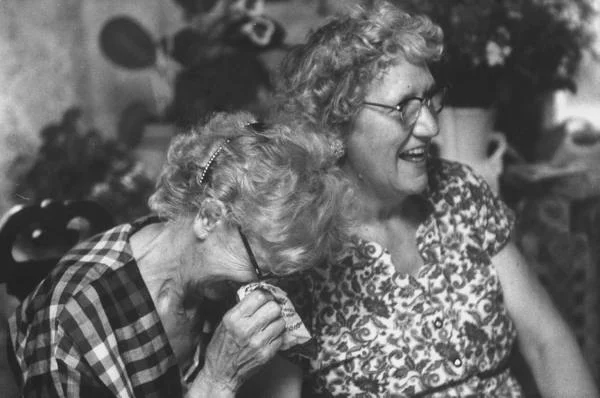
Toom Sisters, July 1957. Photograph by Al Fenn for LIFE magazine. ©Time Inc.
Writing the Suffering
“ARE YOU GOING TO WRITE ABOUT THAT?”
The complicated choices of memoir writing: Judy Goldman on finally being able to write about her husband.
ADOPTION JOURNEYS
“Preserving the full story of your adoption journey may mean sharing some of the pain, too—but how much you include is a personal decision.“ Last week I delved into this topic in the hopes of helping adoptive parents consider how to best shape their personal narrative.
Understanding Blossoms
MEMOIR = POWERFUL THERAPY
“You validated my life.” Such is the nature of the feedback memoir coach Bob Becker receives from senior citizens and other participants in his Connecticut memoir workshops. “Sharing your story is for you first,” he says.
RAILROAD TIES
In this powerful short film (below) created by Ancestry and Sundance, six strangers meet in Brooklyn—and at the historic Plymouth Church, an integral station along the Underground Railroad, learn how they are bound together by the deeply webbed histories of their ancestors.
See also a panel that was recorded live after a screening of the film, including Harvard historian and Finding Your Roots host Henry Louis Gates Jr., Ancestry historian Lisa Elzey, featured historian Melissa Collom, and featured descendant Gayle George.
First Person Pieces
ENGELBERT HUMPERDINCK, WHERE ARE YOU?
Of attending a concert of her childhood musical crush Kavita Das writes that “memories [came] flooding back to me of how it felt to be so small my feet didn’t touch the car’s floor but also to have felt so big that my voice drowned out all the clamor of New York City on those song-filled drives with Mommy.”
STORIES, LONG BURIED
“That grandma told me the story at all was unusual. She lived in the present. Didn’t reminisce.” How one family story leads this writer down a genealogical rabbit hole.
“ME, BY ME”
NYC-based journalist Cynthia Ramnarace learns that, while she is the writer in her family, she was not necessarily the right person to write her own relative’s stories. She explores why, and delves into her inspiration to start Memoiria Pubishing—in the end revealing why she is the perfect catalyst to bring other “people’s stories from minds to lips to paper.”
On Craft
WRITING RETREAT: TWO OPENINGS REMAIN
In honor of her imminent MFA graduation (congrats!), Wisconsin–based personal historian Sarah White is hosting a small-group Nova Scotia writing retreat. Participants will spend three days at Windhorse, a rural farm/eco-retreat, followed by two days in bustling Halifax on the campus of University of King's College.
BUTTERFLY TOWN, USA
On the latest episode of The Life Story Coach podcast, Amy Woods Butler speaks with publisher Patricia Hamilton about a curated community history project for which she received more than 400 submissions—and how she sold out of a 500-print run on launch day.
...and a Few More Links
Chinese immigrants etched their anguish into walls.
Stop sharenting?
View the top 12 finalists in the 2019 RootsTech FilmFest.
A look at how “artful historians” are preserving the past in engaging new ways
On The Life Story Coach podcast: Mike Oke and his unorthodox approach to life story writing
Short Takes

Life Story Links: Blog Roundup, June 26, 2018
Icons of interviewing Studs Terkel and Brandon Stanton, unconventional memoirs, Stonewall memorabilia, plus tips on telling the whole truth in your own memoir.
“Here’s the deal. The human soul doesn’t want to be advised or fixed or saved. It simply wants to be witnessed—to be seen, heard, and companioned exactly as it is.” —Parker J. Palmer

A photo of the Christopher Street Liberation Day March from the Rudy Grillo Collection, as submitted to the Stonewall Forever Project. You can help preserve the untold stories of the Stonewall Riots by donating personal photos and letters, too.
Voices of Our Time
THE ART OF CONVERSATION
“I hope the voices in this wonderful archive will help us to better appreciate one another,” Lois Baum says of the Studs Terkel Archive, an audio treasure trove of the late broadcaster’s newly digitized 6,000+ tapes. In his 45 years on WFMT radio, Terkel talked to a wide array of the 20th century’s most interesting people—and now you can explore those interviews for free.
HOW TO LISTEN
Humans of New York’s Brandon Stanton opens up to Tim Ferriss about the power of biography, how being 100 percent present is more important than the questions in an interview, and hanging in there when things get tough.
NYC: SEEKING HISTORICAL MEMORABILIA
Stonewall Forever, a project launched last year after Google granted a Greenwich Village community center $1 million to preserve oral histories of those present during the Stonewall Riots, is collecting photographs, letters, diaries and protest material to be considered for an online collection.
Stories of Our Lives
BEYOND DESCENDANCY
“Birth dates, death dates, immigration records, legal proceedings—none of those capture the measure of a person’s soul,” writes Massachusetts-based Nancy West, who chronicles why genealogy is only the beginning of one’s personal history, and how memoir uncovers heartfelt nuance.
BEHIND THE BOOK
“They have the most incredible story and it has been weighing on my for years that we need to get it written down,” Olive Lowe’s aunt told her. And so it was that Lowe, of Life Stories by Liv in Mesa, Arizona, went on to capture how her aunt helped a family from South Korea immigrate to the United States after their son was born with a severe form of spina bifida.
THE GIFT OF BRAG
Karen Bender, a certified guided autobiography instructor in Virginia, has some advice for budding memoirists: “Tell the truth. Not a watered-down truth or a polite truth, but the full ‘hey Ma, look at me!’ truth.” Worried about seeming less than modest? Let your friends and family do the bragging via quotes from interviews.
DADDY’S DUTCH
“So, the morning passed with a daughter peeking into the academic world of a father who had spent a lifetime learning and now was sharing his special knowledge,” reflects Carol McLaren of Unique Life Stories in Pinon, Arizona. How poring over a rare book in seventeenth century Dutch made a cross-generational connection.
NOTHING IS LOST, INDEED
Clinton Haby of San Antonio–based StoryKeeping says he is enriched by his work through the bonds he forms with those he has the privilege of interviewing—and the resulting production ensures the storyteller’s spark is just a “press play” away.
...and a Few More Links
- Five unconventional memoirs recommended by writer Glen David Gold
- “We Survive by Telling Stories,” by Carolina Hinojosa-Cisneros
- Paul Sullivan died in Vietnam 50 years ago, and his family has kept his memory alive ever since
- Sarah White on handling the income insecurity of the personal historian lifestyle
Dawn Roode’s curated roundup for the week of Sept. 23, 2026, is overflowing with recent reads on memoir, life story writing, and family history preservation.