
Memories Matter
Featured blog Posts
READ THE LATEST POSTS

“I wish I had asked my mom that” and other heartbreaking regrets YOU can avoid
It seems obvious: We should ask our parents about their lives—lessons, loves, adventures, ancestors. Then why do so many of us wait too long and then have regrets?

Ask your parents to share stories from their life—not only will you have the security in knowing their legacy is preserved (no regrets of unasked questions!), but you’ll undoubtedly gain some laughs and lessons along the way.
If there’s one thing I’ve learned over and over again in this business of memory keeping, it’s that we all take our loved ones for granted—and we think that tomorrow or the next day we’ll be able to have that meaningful conversation. I struggle with finding a way to convey to everyone just how important it is to both
ask our parents about their lives
and tell them how we feel
—and to do so now.
Unfortunately, for many people, it’s only stories of regret that sink in:
I could tell you the story of my friend who came out as gay to his mom as she lay in her hospice bed, unresponsive. He likes to believe she heard him.
I could tell you the story of my client who had a million ideas why her mother was so emotionally closed off, but who never asked her mother to share her experiences. She is haunted by her many questions…and lack of answers.
I could tell you the story of an almost-client who booked me to interview her grandfather, who was a Holocaust survivor, only to have him die two days before our scheduled interview. We shifted to creating a tribute book in his honor, but how much more special would having his own stories have been?!
Often I simply share this powerful quote from William Zinsser that says so much with so few words:
“One of the saddest sentences I know is, ‘I wish I had asked my mother about that.’”
Have you asked your parents or grandparents about their lives? If that seems like something you just don’t have time for, please think again.
3 ways to ask your parents for their stories—before it’s too late
Not sure how to capture your parents’ stories? Here are three foolproof ways to invite, hear, and preserve your parents’ stories. Whichever you choose, I implore you: Get started now.
1 - Record an interview with your mom or dad.
No need to overthink this—just find a way to sit intentionally with your parents for the express purpose of listening to their stories. Use an audio or video recorder to capture the conversation. You can always decide what to do with it later. Choose questions from this free guide, or make them up as you go along.
2 - Ask your parents to write about their memories.
They don’t have to think of themselves as writers to undertake a project such as this, but they do need to be committed to writing regularly. So, provide them some friendly accountability: Ask if they’ll call you once a week to read their stories to you (and your siblings, if you have any—a fun excuse for a Zoom get-together!); or, undertake an email correspondence with your parents where you ask the questions and they reply with their stories.
I recommend they spend an hour or so brainstorming a list of memories, then use the items on that list as prompts for their life story writing; or consider signing up for a class with weekly memory prompts to get them going.
3 - Hire a pro to help your parents record their stories.
Whether your parents don’t have the stick-with-it-ness to keep writing, or you’re too busy or otherwise unable to interview them, or you simply want the best experience possible, consider partnering with a personal historian such as myself to record your parents’ stories and preserve them in an heirloom book. I’d be happy to chat with you about the ways to bring your project to life.
A surprising benefit of going this route: Some people feel more comfortable telling their stories to an open-hearted stranger as opposed to a family member—it could be because they know they have a captive audience who hasn’t heard their stories before, or because they may fear familial judgment for certain experiences or decisions in their past—but whatever the reason, the stories often flow more smoothly and fully when told to a professional interviewer.
This approach also allows you to let your parents know how much your stories mean to you while taking the pressure off you to guide the project through to completion.
Whether you interview your parents or ask them to journal about their life, let them know, in no uncertain terms, that their stories hold value for you. Convey just how special this undertaking is to you and not only will you get their stories, you’ll inevitably grow closer in the process.

Modern Heirloom Books offers plenty of free family history resources to help you interview your parents and capture their stories for posterity, including this guide, “56 Essential Family History Questions to Ask Your Parents Before It’s Too Late.” Click the button below to access it right now!

Meaningful conversation when your loved one is on hospice—here’s help
How to have meaningful conversation with your loved one on hospice, including the best life review questions & 4 things we all should say when someone is dying.

“My mom just entered hospice. I would like to create a book—do you have questions I could use? I would like to do this as I am sitting with her.”
This request came to me from someone who filled out a basic form on my website. My heart cracked open as I wondered what I could offer her.
At once I could see myself sitting by my own grandmother’s hospice bedside; I could feel that sense of helplessness and urgency to do something. I could imagine this individual typing that inquiry to me, a stranger, with a blind faith that it would be answered.
Well, I did answer her. It took me a while (and some research) to craft a response that I thought would truly be helpful at this time, as none of the resources I had thus offered online met the need. And then I realized—if she was looking for questions to ask a hospice patient, others were too.
If your family member is on hospice or has been diagnosed with a terminal illness, consider some of the questions and insights below to help you have meaningful end-of-life conversations with them.
Honor the urgency—and sacred nature—of talking with your loved one on hospice
It’s no surprise that when we are hit with the notion that our loved one is going to die, we feel an urgency—an urgency to connect, to hear their stories, to help them find meaning in their life and peace with their imminent passing.
Most of us take for granted that our family members will be around tomorrow. Tomorrow we can ask questions. Tomorrow we can hear their stories.
But when tomorrow is taken away, then what? Is it irrational to try to squeeze a lifetime’s worth of questions into what could be a finite few days or hours?
I have long offered a list of “essential” questions to use in interviews with parents or grandparents—but this is a long list, designed for those who have the luxury of time to conduct interviews.
When a loved one is on hospice, time is of the essence. So I recommend you get to the heart of the matter quickly, and focus on questions that lead them on a journey of meaningful reflection. (Remember, this is more about them than it is about you.)
Help the dying find a “sense of completion”
Research shows that people who are dying feel an urgency to “find a sense of completion” and to feel that they have contributed to others during their lifetime.
Palliative care expert Ira Byock has long written about how we can understand dying as a time of learning, repair, and completion of our lives—and how everyone deserves to “die well.”
One of his fundamental recommendations is that family members help their dying loved ones find that sense of completion by saying four things:
“Please forgive me. I forgive you. Thank you. I love you.”
It’s not a matter of simply reciting the words, of course. Each person must find personal meanings within the words, and find a way to express that meaning to their loved one.
“Thank you for being a mother who always listened to me, Mom.”
“Please forgive me, Daddy, for not helping you to cope better during your divorce”
“Mama, I forgive you for the things you did that caused me pain.”
Conversation may or may not ensue, but the offering of the words, the emotions, the gratitude, is a true gift. It helps both the dying person and their family member feel like important things have not been left unsaid.
Ask questions that help create “a biography of joy”
Like the woman who wrote to me wanting to use the time at her mother’s bedside to ask biographical questions, many people desire to learn more about their loved one as they near death. Perhaps there are things they always wanted to know, but time never seemed of the essence—until now.
There are myriad lists of family history questions out there, but these are designed for interviews where there is less sense of urgency.
When interviewing a hospice patient about their life, a more condensed life review is in order. Ask questions that speak about life transitions (graduation, career change, marriage, becoming a parent, moving homes, etc.) and that lead the subject down a path of happy reminiscence.
Questions that probe big changes in one's life usually prove to have very poignant answers.
Things such as:
Tell me about all you have loved.
What is the best decision you ever made?
What have you loved most in this life?
What has surprised you about people? About yourself?
How would you like to be remembered?
What hopes do you have for your family?
And then, there are times when someone on hospice may not want (or be able) to delve so deeply.
Consider bringing them a smile through lighthearted questions.
Questions such as:
Sing me your favorite song.
Do you remember your first kiss?
What was your favorite toy as a young child?
Did you ever play a prank on someone?
And remember: While you certainly have a deep interest in learning the answers to these life review questions,
“Stories also can be a gift that the ill person gives to others. People living with debilitating effects of illness may struggle with feelings of unworthiness and a sense of being a burden to others. The recording of family stories involving the marriage of matriarch and patriarch, seminal events, and the history of the family during war or natural disasters is a tangible way that people can contribute to their children, grandchildren, and the generations to come.” **
This life review is foremost an opportunity for the dying person to reflect and find meaning in their life. What a gift that is.
Navigate end-of-life conversations with grace
It is a most generous gift for you to go beyond providing comfort and personal care to inviting your family member to reflect on their life. By asking them questions and giving them space to share, you are creating an opportunity for integration—for a sense of self-actualization to happen at the end of their life.
“At the end of the day, or at the end of a life, we want to know that our lives counted for something, that we mattered, that our lives have had meaning,” palliative care nurse Charlene Thurston says. “What matters most to people is not what they’ve accumulated, but whom they’ve touched; whom they’ve loved and been loved by.”
By asking your loved one certain biographical questions, you are helping them take stock of their life—to articulate how it has had meaning, and to name their most special relationships.
Listen generously. Make eye contact. Use old photos or mementos as memory prompts.
And I urge you to hit "record" on your phone's recording app or on a mini digital recorder. We feel so confident we will remember the things our loved ones say, but I speak from experience when I say this is not always the case, especially when we are in a caregiving role and emotions are so close to the surface.
I hope these things are helpful to you in your effort to capture your loved one’s stories. Cherish the time you have together. Being a caregiver may not be easy, but it is indeed a gift.
** This quote and the idea of creating a “biography of joy” derive from a paper entitled “Caring When Cure Is No Longer Possible” by Ira R. Byock, M.D. and Yvonne J. Corbeil.

Most helpful blog posts for memory keepers, memoirists, and family historians
The best posts to help you with memory-keeping, including family history questions, memoir writing tips, family photo preservation ideas & heirloom book themes.
After years of blogging and helping people create books about their lives, I thought it would be a good idea to organize all the most helpful posts on the Modern Heirloom Books site in a way that makes it easier for you to find what you’re looking for—hurray!
What follows are some of the most comprehensive and useful posts to help you in all aspects of your memory-keeping—from capturing life stories through oral history interviews to writing your own memoir, from family photo preservation to finding the stories behind those precious photos, it’s all here!
how to use this catalog
Bookmark this page in your browser so you can come back to it easily.
Click on any of the topics below to go straight to that section.
Click on any of the story names to go straight to that post—they’re all hyperlinked.
topics to explore
Creating a family photo archive

If you are interested in WRITING about your life:
Memoir Writing Prompts
The foolproof life writing prompt guaranteed to get your pen moving.
This multi-part writing prompt is generative—it will yield even more ideas for future writing.
Learn about our Write Your Life memory and writing prompt subscriptions
Writing prompts for life story vignettes: 300 words in 30 minutes
Writing prompts for life story vignettes: the self-interview
Thinking about the meaning of the word ‘family’ yields two foundational writing prompts
Unexpected places to discover great life story questions to use as writing prompts
Memoir Writing Tips
How to break down a life story book project into three simple steps
How to create a life timeline for your memoir writing project
How to set a realistic deadline for your life writing project
Differences between biography and memoir—and why you should write your life stories (plural)
Ever consider using a list format to explore your life stories?
Feeling stuck with your life writing? Try this 3-step reset.
How to get your memoir off your bucket list and onto the page.
Three ways to research your memoir—and when to know your research is enough to begin
“The messy middle”: Pushing through the toughest part of memoir writing
Not sure if NOW is the right time to write your memoir? Ask yourself these two questions.

If you are interested in learning more about capturing your FAMILY STORIES:
Family History Interview Questions
Tips for Preserving Your Family Stories
Best practices for conducting family history interviews at home.
How to get a parent who doesn’t want to talk about their memories to open up
How to turn an oral history interview into a compelling story
Eight things you can do to be a good steward of your own family history
Differences between scrapbooking and creating personal history books
How to interview a loved one who is on hospice: Ask questions that help create “a biography of joy”
How to be a good storyteller if you are the subject of a family history interview
Tips for interviewing a pair of your grandparents together at the same time.
When to break a family history interview into multiple sessions
How to edit your family history so it will make sense 20 years from now
To read or not to read? How to handle a deceased family member’s personal letters
Go beyond the paper trail: 3 fun ways to follow clues about your family’s past
How to avoid scope creep and make sure you FINISH your family history project

If you are interested in creating a FAMILY PHOTO ARCHIVE:
Organizing & Saving Your Family Photo Collection
How to organize your family archive as a resource for sparking memories
Follow these basic photo organizing principles so you leave a manageable photo legacy for your kids.
What to do to ensure your kids don’t throw out your family photos
Make sure you’ve digitized the family photos in frames around your home.
Why sometimes a “bad” photo is the perfect picture—and worth saving
The one thing not to do if you want your photos to print beautifully in your memory book
Telling the Stories Behind Your Photos

If you are interested in finding ways to HONOR A DECEASED LOVED ONE:

If you are interested in finding IDEAS FOR HEIRLOOM BOOKS:
Your 10-step plan for making an heirloom-worthy family cookbook
10 heirloom book themes to narrow your life story book focus.
Adoptive parents: Preserve your journey to adoption in an heirloom book.
Six heirloom book ideas, from travel journals to family recipe books with a twist
“Dear Daughter, on Your Wedding Day,” the most meaningful gift for the bride-to-be from her parents
How to create a vacation photo book or family travel journal
Why I think classic (not trendy!) design is best for your personal history book

Do you need to be convinced that YOUR STORIES ARE WORTH SAVING?
How your stories’ enduring value can offer life lessons to your grandkids and beyond
How to leave a legacy that is a blessing to your descendants
Hear one client’s experience: “It was more for me than anyone else”
Wanting to know more about our parents’ lives is not a trend.
Your grown kids might not care about your stories now, but they will someday.
Genealogists share their reasons for valuing our own family stories.
“I wish I had asked my mom that” and other heartbreaking regrets you can avoid
Let Josh convince you that now is the time to tell your stories.
You’ve got reasons why you aren’t telling your story; I’ve got reasons why you should.
This post will be updated regularly as new relevant content is added. It was most recently updated on August 29, 2025.

“When was your first kiss?” & other fun questions to ask Mom and Dad
There are plenty of lists of generic family history questions around—but what about fun ones? Settle in for an entertaining interview with the parents!

The days are passed when you might cringe with embarrassment imagining your parents’ first kiss (at least, I hope they have!). But have you ever asked them about it?
How about their most embarrassing moments? The time they were really and truly naughty? The lie they told you when you were a kid?
One of the consistent reactions I get when life story books are presented to families is this: “I never knew this side of my mom” or “I always thought of Dad simply as Dad—how wonderful to discover him as a person!”
So many questions I ask my personal history clients revolve around transitional times in their lives: decisions that impacted the course of their life, and lessons learned on the path to becoming who they are now. But life isn’t just about the milestones; it’s about the everyday moments and experiences that add up to a life.
And you know what? A lot of those moments are funny—and fun. Why not explore them in conversation with your parents? You’ll enjoy yourselves even while you get to know them on a whole new level! (Bonus points: Hit “record” on your smart phone or a digital recorder to ensure their stories are captured for posterity.)
38 questions to explore your parents’ fun sides
Don’t just ask this questions that appeal to you: Invite stories. Ask follow-up questions. Listen with interest, and no doubt questions even better than the ones below will come to mind as your parents are sharing. Most of all—have fun!
Questions to Get You—and Your Parents—Smiling
What is the funniest fashion fad you gave into during your teen years? In your twenties?
Tell me about a time you laughed inappropriately.
What is the funniest thing you recall Grandma/Grandpa ever doing?
What are some funny things your kids said or did when they were little?
When was your first kiss? Tell me the story.
What’s the most embarrassing thing that has ever happened to you?
What are you hoping I don’t ask? Come on…
Tell me about a time you were unabashedly naughty.
What’s the most satisfying thing you ever got away with?
Did you ever tell us kids white lies when we were young?
What is the funniest practical joke you ever played on someone?
Do you remember a favorite lullaby or bedtime story from your childhood?
Tell me about any pets you have had—and maybe a time or two they made you truly happy.
Do you have any goofy tendencies or unique habits?
If someone gifted you $5 as a kid, what would you immediately want to buy?
Seemingly Benign Questions that May Yield Surprisingly Deep Answers
What is the worst date you were ever on?
How would you describe your sense of humor?
What has been your grandest adventure?
What always makes you laugh?
What is the most incredible dream you have ever had?
Who from your childhood would you characterize as reliably funny?
What is the nicest thing you have ever done for someone?
What is the nicest thing anyone has ever done for you?
What is the biggest surprise you have ever gotten?
Questions their Spouse May Prefer to Answer on their Behalf
Tell me a funny story about a time Mom/Dad got a little tipsy.
Have you ever had to rescue Mom/Dad from an embarrassing guffaw?
What did you do for fun on your dates together (allow both to reply—often the interplay of their reminiscing together will be as fun as their answers!)
What scenes would be on your spouse’s blooper reel?
Quickfire Round: Questions that Reveal Fun Details
Did you have nickname(s) as a child?
Can you remember any knock-knock jokes or funny riddles?
What was your favorite cartoon character as a child?
What is your favorite… card game?
… ice cream flavor?
… musical group?
… movie?
… place to visit?
… candy bar?
Make a goofy face, won’t you? (Get your camera ready!)

Get your free guide of Essential Family History questions
All the questions (not just the funny ones!) to ask your parents to capture their stories, presented in a beautiful printable guide
I'’d be honored to hear your stories.
Do you prefer to have a professional personal historian conduct interviews with you or your loved ones? That’s what I’m here for! Schedule a free 30-minute consultation to see how we can work together—I can’t wait to hear all about you!

“What’s the best way to share my family photos & stories online?”
You want a digital record of your photos and other family history stuff but realize social media is not a good permanent solution. Consider a family website.
Sure, my primary focus is on creating books to preserve your stories—but at the end of the day, it’s my mission to help you ALL undertake some type of personal preservation project to ensure your legacy is passed on. And there’s no denying that we live much of our lives online these days.
While I love Facebook for keeping me updated as to what’s going on in my local community, and I can sure as heck get lost on some of my favorite Instagram feeds, I don’t recommend relying on ANY social media platform for permanent storage of your family archive. So, what if you want to share your family photos and stories online—for more than just a few fleeting likes?
I invited a memory-keeping colleague to share her thoughts on the matter—welcome NYC–based certified professional photo organizer Marci Brennan on why you should consider creating a family website:

Consider letting the whole family, from kids to grandparents, contribute to making your new family website.
Consider Making a Family Website
Staying in touch with family is paramount these days. Social media, for example, has been instrumental in helping us maintain relationships. But when it comes to tech, not everyone is comfortable with every social media site or app. This is even more important when considering family members of various ages. And social media sites often change their privacy policies. There’s also an increasing number of targeted, distracting ads on them.
Families are realizing that creating a dedicated family website is the best option. It provides a safe and secure place to share and preserve family history while avoiding the pitfalls of social media sites.
Many of these family websites are multi-functional. They offer a variety of services such as message boards, blogs, calendars, and other options. And they have aesthetically pleasing, user-friendly interfaces.
Here are a few of the benefits and features of a dedicated family website:
Access and sharing for all
Family sites level the accessibility field. Age and comfort with tech matter less, as the best sites make navigating their contents easy. All ages can access the site by typing a customized URL / domain name into their browser. Sites are device-agnostic. No special passwords or registration required.
easy connection to your family
Staying in contact with our families allows us to grow closer together. By using a family website, members can share their photos and videos as well as create events. It can become a family communication and library hub. Weddings, anniversaries, birthdays, and graduations can be shared, as well as other important events. Personal projects, movies, family recipes, and other tips can even have their own pages.
Preserving your history
Adding a family tree is a great way to manage, organize, and preserve your family heritage. Photos of people, special places, and memorabilia can inspire memories and spark conversations. Posting digitized versions of old media (such as 8mm, Super 8 and VHS tapes) add another layer of interest and history. Older family members can share and document their stories, preserving their memories. The current family as well as future generations will benefit.
Getting started
There are a few options to choose from when creating your family website. I recommend
…which are all dedicated to photography and family memories. Take a look at each site and see which one is best for you.
The Rewards
Many of us will accumulate a massive amount of photos in our lifetimes—tens of thousands, if not more. Perhaps your photos have been professionally scanned, organized and backed up on an external hard drive (or two) already. Or maybe, as the family historian, you have even done this yourself. While that is an essential step and an added layer of security, passing along your photo legacy on a family website to future generations is the ideal solution. This makes inheriting family photos much easier and more enjoyable for everyone. Sharing a curated family library with present and future generations is a timeless and uniquely precious gift.
about the author
Marci Brennan is a TPM certified professional photo organizer. She lives in Queens, New York, and works with her husband, videographer/photographer Chris George. Together they offer photo and video organizing services throughout New York City and beyond. At Past Present Pix their goal is to help busy families manage, organize, and preserve their photo and video collections so their valuable media is always at their fingertips and safely backed up.






Who (or what) are you missing this holiday season?
I hope you'll take comfort in these personal stories of vulnerability and loss during the holidays. (Sharing memories about loved ones is always a good thing.)

The 2020 Christmas and Hanukkah season will be anything but normal—but one constant is that stories are always welcome!
There’s nothing “usual” about these December holidays. This pandemic year has taken us all for an unexpected ride. And while funny memes and abundant comfort food may ease our path, they do little to truly soothe our souls.
I recently shared a post on social media: A 2020 gift list for grievers curated by Allison Gilbert, author of the wonderful book Passed and Present: Keeping Memories of Loved Ones Alive. One commenter noted how “everyone is grieving something this year.” Ah, yes, I thought—maybe that’s why the post resonated more deeply than usual with me.
And maybe that’s why I feel compelled to share a few resources for anyone who is, indeed, grieving during this season.
I am no stranger to holiday grief, having lost my mom unexpectedly just three days after Christmas in 2009, and two of the very personal posts below reveal my vulnerability at this time of year—as well as how story sharing about our deceased loved ones can be healing (dare I say, even joyful). I hope you can take a measure of comfort from my words.
The middle post offers up a list of memory-provoking questions designed to elicit holiday stories from a family member. While the original intent was to use them to guide a personal history interview with a loved one, again, this pandemic year may challenge that approach… So, if you are physically apart from your relatives, consider interviewing them from afar via Zoom (or a good old-fashioned phone call)—just remember to hit record on your smart phone or on a recorder to ensure you capture their memories for posterity! Another idea: Set aside some of your own time to write about your memories; these questions work just as well as writing prompts, after all.
Wherever you are, whomever you are missing, know that I am with you in spirit and wishing you peaceful and happy holidays!


Want your parents’ stories? Here are 3 easy ways to help get them.
Preserve your parents’ (and grandparents’) stories meaningfully for the next generation with these three ideas that make the process simple and enjoyable.

Don’t wait until it’s too late to capture your parents’ stories—your kids (and YOU!) will be grateful to have them one day.
Of course you want your parents’ stories. We all do. But the chances of us getting them without asking for them is, well, pretty unlikely.
I inherited three journals—you know, the ones with those guided family history questions on every page?—from my mom. I got goosebumps when I unearthed them among her things; the prospect of “hearing” from her one more time made me giddy, even in my deepest grief. But when I opened them, there was almost nothing inside: Each book had a few random pages filled out, and by “filled out” I mean she had written one or two sentences or, in some cases, a few words. I already knew her favorite color was yellow and that she had one brother. I wanted deeper memories—recollections in the shape of stories, written in a way that brought her childhood and later experiences to life for me. None were there.
Unless our parents are writers—and writers who turn their attention inwards, at that—the only stories we probably get are the ones they share around the dinner table. For one thing, dinner table conversation is a dying art (multiple generations around the dinner table regularly—come on!). For another, those oral stories aren’t preserved unless someone deems to write them down (you?).
There ARE ways, though, to ensure that we do preserve our parents’ stories meaningfully for the next generation. Here are three that I can help you with right now:

1 - Grab this free guide and encourage your kids to interview their grandparents.
Early on in the pandemic I created this guide to help combat the loneliness many elders were facing as in-person visits waned and social distancing became the norm. I was heartened when it took off—and when I heard from folks just how meaningful the conversations that ensued were.
This 20-page guide is chock-full of good things to help you get your kids involved in capturing stories from their grandparents! Designed especially for kids ages 8 and up (and we mean way up—you’re never too old to embark on a conversation with your loved ones!), the e-book includes:
45 family history questions
3 fun bonus activities
interview recording tips
historical timeline
ideas for what to do post-interview

2 - Enroll your parents in our memory & writing prompt course to get them writing about their own lives.
Perhaps instead of an interview you’d like to see your parents write about their own memories? Going this route allows for thoughtful reflection that provides stories with even more meaning—and ensures the process will continue for a while beyond a one- or two-hour interview.
My Write Your Life course provide exactly what your parents will need to begin their life writing journey:
weekly memory prompts on topics such as Childhood Memories, Food Memories, Life Transitions, and more (themes change every few weeks, and course lasts for a full year)
writing tips that will help them with their assignments but not burden them with unrealistic literary expectations
a dose of inspiration (staying on track isn’t always easy, but reminders of just why it’s so important really do help!).
The best part? Lessons are delivered straight to their email inbox on the day of their choosing, and I am always available for added support and Q&A. And at just $99 for a year-long, enrolling is a no-brainer for anyone who wants to write about their life!
3 - Invest in personal history services to professionally capture their stories—I’d love to interview them!
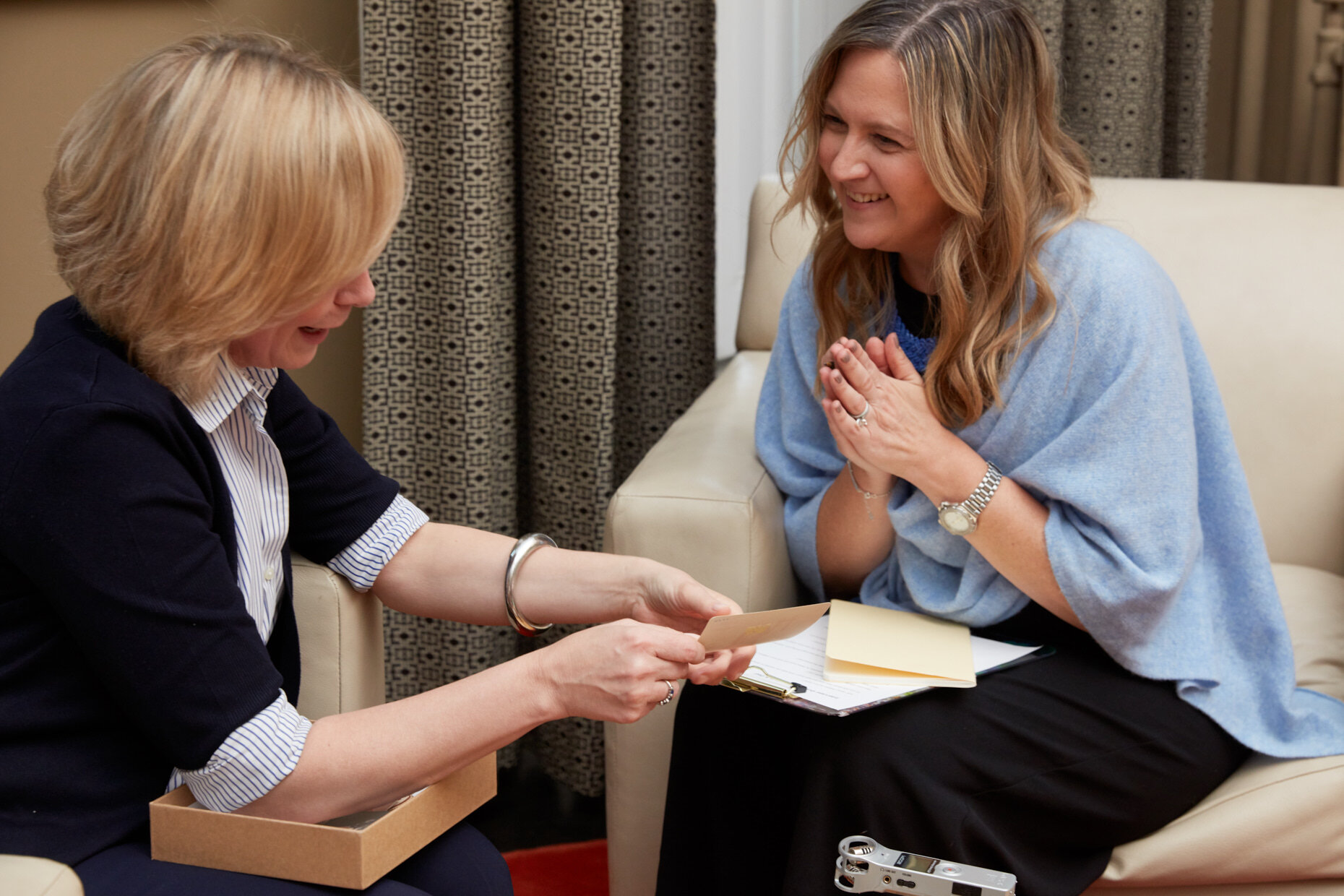
If you prefer a full-service approach to capturing your parents’ stories, then personal history interviews are the best way to go.
In a nutshell: I interview your parents to capture their memories, help them curate their photos and mementos, and turn everything into an heirloom book with a cohesive narrative and engaging design.
We can do a single 90-minute interview to capture memories from a specific time in their life, or conduct a series of interviews over weeks or months to more fully paint of picture of their legacy.
All my projects are 100-percent customized, so it’s best if we chat to see how we can best work together. Investment for personal history heirloom books start at $1,500.
Which option is right for you?
I hope you found helpful resources here to put you on the path to capturing your parents’ stories for your family archive.
If you have questions or there is anything I can help you with on your journey, please don’t hesitate to reach out!

Thanksgiving 2020: A most unusual time to celebrate
The way we gather and celebrate Thanksgiving this year will be impacted by the pandemic. May you find gratitude and connection while staying healthy.

How will your Thanksgiving celebration be impacted by the pandemic—will you have a smaller get-together, forgo travel, or connect virtually? I hope that however you observe the holiday this year, that you are able to feel real gratitude and find connection with loved ones.
What will Thanksgiving look like this year?
With smaller families who have remained in a Covid bubble, maybe your Thanksgiving will not be much different from previous years.
What about for larger families spread far and wide who usually use the holiday as a time to get together in one big group? Or families who are caring for a sick family member? In most parts of the country gathering inside in large groups without masks is still not recommended—and well, it’s kind of tough to eat turkey with a mask on.
I don’t know about you, but I am all “Zoomed” out. Don’t get me wrong—I am grateful for technology that allows us to connect, to hear one another’s laughs and continue our jobs. After a while, though, the allure of the screen dims and we crave hugs and touches and the buzz of energy in a shared space. And I think if I have to watch Great Aunt Constance pull her pumpkin pie from the oven over my computer screen without getting to savor the scent, I just might skip the holiday altogether.
This isn’t a post where I share “5 ways to make Thanksgiving special during a pandemic” or prescribe “ways to express your gratitude during a Covid-19 Thanksgiving.”
No, it’s a post where I ask, with genuine curiosity: What will your Thanksgiving look like? Have you thought about finding ways to connect virtually that don’t feel so…virtual?
How do I envision my own Thanksgiving?
For me, perhaps I will focus on the gratitude part of Thanksgiving, which often gets lost in the stuffing-and-cranberries food mayhem. Maybe I’ll write about all that I am grateful for; maybe I’ll talk about it with my son and husband. Maybe I’ll meditate on the unforeseen blessings this pandemic has manifested for many of us.
Maybe I’ll also focus on the celebration of the fall harvest—it’s always been my favorite time of year, after all, so maybe no matter the weather I will get outside for a walk at the very least, a sunset hike if I can swing it. Maybe I will create a new dish inspired by the autumn bounty at my local farmer’s market—and maybe it will make it onto the menu of future Thanksgivings when everyone can be present around one table again.
Maybe I’ll feel sad at the nature of our celebration. Or maybe I’ll revel in the closeness of my immediate (very small) family.
What I know for sure is that no matter what, Thanksgiving will be different this year.
I may not get as many hugs, but there will most likely be more leftovers in my fridge. And there is much—so very much—that I am grateful for.
Making Thanksgiving memories last
I will definitely be writing about this Thanksgiving after all the desserts are cleared, as part of my family history archive. I’ll ask my son to, as well, and though I may get an eye roll before he does so, I have no doubt his reflections will be thoughtful (and matter to him in years to come).
Will you join me in writing about your Thanksgiving experiences this year, whether it’s simply for your eyes only in your bedside journal or for inclusion in a life story book down the road?
If you prefer to revel in Thanksgivings past, you may want to use these Thanksgiving-inspired oral history questions as writing prompts rather than as interview questions this year. Or if you’re up for a Zoom call that’s slightly more purposeful than watching the Cowboys game together from your separate couches, consider interviewing a loved one—and no, I don’t mean asking them every question on the list, but rather picking two or three of your favorites and spending some time reminiscing together. Now that’s some socially-distanced Thanksgiving togetherness I can get behind!

Remembering
Thanksgivings Past
Use this list of 55 questions as writing prompts or to interview a loved one about their holiday memories.
What will your Thanksgiving look like this year?
Dawn Roode’s curated roundup for the week of Sept. 23, 2026, is overflowing with recent reads on memoir, life story writing, and family history preservation.