Memories Matter
Featured blog Posts
READ THE LATEST POSTS
How to edit your family history so it will make sense 20 years from now
Ready to edit your family history or life story book? Follow these three tips from a personal historian to ensure everything is clear for your descendants.
You’ve written your family history in narrative form (congratulations, that was a major undertaking that took great commitment and effort!!!), and now you’re on to next steps: giving your work a final edit and determining how you will preserve it for the next generation. I’m here to share three things you should do during the editing process to ensure that all your hard work is understood and appreciated by your readers.
1 - Be explicit with family members’ surnames and ages.
Your mom’s sister who was named Margaret but only ever went by Aunt Peggy to you and your siblings was actually called Maggie when she was a little girl. There may be a great story in there (and if, so, try to find it through interviews!), but I’m sharing this example to illustrate how important it is to be explicit when introducing family members (a.k.a., your characters).
On first reference, give a person’s full name, as well as some type of relational status (e.g., “my aunt” or “mom’s brother”). How you approach adding in the relationships will depend on the voice you are using to tell your stories. So, if you have written the majority of your family history in first person, then all of the relationships should be in relation to you—“my paternal great-grandmother,” “my father’s step-sister,” etc. If you have chosen to write in a more neutral third-person voice, then determine who the main character is of the particular story you are editing, and designate all people in relation to them—so, if Mary Smith is your story’s protagonist, you’ll introduce people as “John Joseph Smith, Mary’s older brother” and “Desirae Kensington Smith, Mary’s mother.”
You’ll also want to mention any nicknames that you are aware of—and do so in the most clear way possible. Because imagine you simply say “Aunt Peggy decided to move to Texas…” and a relative who has only ever known her as Maggie is reading this; you run the risk of your character going unrecognized or being confused for someone else. I guarantee the chances of this happening increase exponentially the further your reader gets on your family tree. Your grandchild will have no idea who these people are beyond the picture you create on the page.
I think it is so helpful to include an age—even an approximate age—when orienting a reader at the beginning of a particular family story. Was Aunt Peggy approaching 40 when she had her first child? Was your father just a teenager when his own father died? Again, adding ages in this way is to make it easy for your readers to follow what’s happening. You are abundantly familiar with your characters—they are your family, after all, and you’ve likely been spending a lot of time with them via your research; your readers, however, are not quite so familiar. So seamlessly give them the info they need without having to flip back to see who the heck Mike Jessup is again!
2 - Orient your reader with explanatory help throughout your family history.
Just as your reader two generations on will need help with names and relationships, they, too, will need help with other details you may take for granted. Try to do a read of your material as if you are someone who has no familiarity with your family or their history. What questions arise? Where might you add context to help bring your story to life?
A few examples of details you may want to include or elaborate on:
Beyond a city name, can you characterize where they lived: Was that place in that time a wealthy enclave, a haven for transplants from the big city, a blue-collar town where neighbors watched out for one another’ kids?
Beyond a year, might you add some details that reveal how history may have impacted them? “The year was 1865, and while the Civil War had ended, that reality hadn’t quite sunk in for many who lived in my great-grandparents’ home state of Louisiana.” This could be a great opportunity to take advantage of new developments in artificial intelligence and ask ChatGPT or Google Bard for help describing what a time period or region was like—just be sure to include a directive in your chatbot inquiry to “use only factual information” when generating your answer!
What other parts of your story might be vague or confusing for a new reader? If you don’t think you can identify such problem areas, perhaps ask a friend or colleague to give your family history story a read and mark their questions in the margins. I bet you’ll be surprised by some of their queries!
3 - Provide graphic “cheat sheets” to make things easy for your readers.
Reading an account of genealogical research can seem like an exercise in…well, putting someone to sleep—but sharing stories, not just facts, and providing elucidating information (as described above) are great ways to engage your readers. Another is to include visuals that aid in your storytelling.
Family photos go a long way in drawing readers into a story, of course, but there are other graphics you may want to add. Consider creating:
Family tree charts: This can be as simple as a family chart that is generated through your Ancestry or FamilySearch account. Note that I used the plural here—while, yes, you may include a large family tree showcasing all the ancestors whose names you know, I recommend creating a few smaller charts that are relevant to a specific chapter or story. So if you’re telling stories about your second-great-grandfather Will Shannon, make Will the root of your tree and show just his parents and his siblings; then, in a subsequent chapter when you have an account of Will’s son, your great-grandfather, Marcus, create another family chart with Marcus at the root. Do you see why? That way your reader can easily glance at the chart to orient themselves within the family without really taking themselves out of the story.
Maps: If you’re a die-hard genealogy buff, then perhaps you have insurance maps and land ownership maps in your files—include those if they are clear and they help illustrate some aspect of your family history. Then consider including more straightforward maps—an outline of your country of origin with relevant cities marked, say, or a map of the world with your ancestors’ immigration journeys marked with arrows. There are plenty of resources online to buy inexpensive digital maps, including Creative Market or Fiverr (for custom creations); and you can explore public domain maps from David Rumsey and also around the web.
Want to use your life story to inform your fiction?
This new book by Ruta Sepetys, You: The Story, is a great tool for those who want to use their own life experiences to inform their fiction writing.
This new book from Ruth Sepetys, You: The Story, is a great resource for anyone who wants to write fiction informed by their own life experiences.
What if you don't want to write a memoir, but you know that stories from your life are compelling? What if you’re rereading your journal one night only to discover that the twists and turns in those pages read like a movie script? Maybe it's time to consider using your life experiences to inform a fictional book.
Why not? Transforming scenes from your life into scenes in a novel is a tried-and-true way to infuse a fictional account with an underlying truth that readers can relate to.
In her recent book You: The Story (Viking, 2023), Ruta Sepetys suggests you put a piece of yourself into your fiction: “When you do, you'll pull the reader to the page and share something resonant and meaningful that will keep them there.”
But how? I recommend you begin by picking up a copy of Sepetys’s book, subtitled “A Writer's Guide to Craft through Memory.” While I was drawn to it for the snippets of wisdom applicable to personal historians and memoirists, I soon realized it's a better resource for those who want to be inspired by their life, not depict it directly on paper.
3 ways you'll learn to effectively write from your life
You'll have a library of creative writing prompts at your fingertips.
Each chapter of You: The Story concludes with a handy recap (in easy-to-scan bullet points) as well as a series of writing prompts aimed to help you with that chapter's premise. Working on writing genuine-sounding dialogue? There are prompts for that. How about creating a setting that's immersive, believable? That, too.
Some of the suggestions may seem obvious, but I would argue that they will only seem so in retrospect. Sepetys encourages you to brainstorm a list of settings from your own life, for instance—addresses (including corresponding time periods and people around you) as well as memories you associate with each place. It's through detail, after all, that dialogue and setting and characters come to life. So detail is what she (and you) are after.
Here's an example of a writing prompt from the chapter called “Setting”:
Recall a time when you thought, What in the world am I doing here? Write for ten minutes about that time. Describe the setting and your feelings there.
Note that it's not just the color of the walls or the overarching smell of a place, it's also the way the place made you feel. Throughout the book the author implores you to consider, at every turn: How do these things from YOUR life impact your fictional characters? Mine your life for details, then fold them into your imaginative narrative.
You'll learn how to turn real people into characters.
Putting people you know into your book is generally a no-no (while it’s unlikely, lawsuits have even been brought by individuals who have recognized themselves in a story and took umbrage at their portrayal). Just about every fictional character, though, is an amalgamation of people we have come across in our lives. You want a reader to identify with a character—to feel like they recognize this person, whether in themselves or in someone they know—and the best way to do that is to root them in some reality.
Sepetys offers up an array of ways to do this, from tapping into archetypes and personality quirks to identifying a character's personal rhythms and rendering their nuances. She explores how you can create believable characters inspired by your life in three chapters—“Character Development,” “Voice,” and “Dialogue”—and it is here I think she provides the most value through concrete examples, instructive writing prompts, and helpful tips.
“Your true voice is layered deep within your life experience and your memories,” she writes. “It's the voice of your old diary, the voice of your desperation, and sometimes the voice you hope no one else will hear.”
You'll discover even more reasons to preserve your memories.
If you're here on this site, I'm fairly confident you're already a memory-keeper of one kind or another. I've been one since I was a child (really). And still I felt inspired by Sepetys’s words.
“Memories are like leaves,” she writes. “They fade, fall, and scatter beneath the slightest sigh of wind. So for now, think of ways to press them between wax paper and preserve them for one quiet day in the future.” One day when you might be in need of sensory details to bring a character to life. One day when you might need a glimpse of the you that you were 10 years ago. One day when your son or daughter asks you to recall something that has long since blown away on the breeze.
Whether you choose to tap into your life by writing a personal memoir or a fictional account, I encourage you to look inward and write what you find. As Sepetys says, “Work with your stories. Water them with your blood and tears and laughter. The world needs them.”
Your life is a story.
One of my favorite bits of wisdom from Ruta Sepetys’s book applies whether you are turning your life stories into fiction or nonfiction:
“Use your own best judgment about which memories you might be able to responsibly dig through and which ones you should avoid. Protect your head and your heart. Always.”
Note: This is an unsolicited review of a book I purchased at full price. I did not receive any compensation or free products in exchange, and any endorsements within this post are my own.
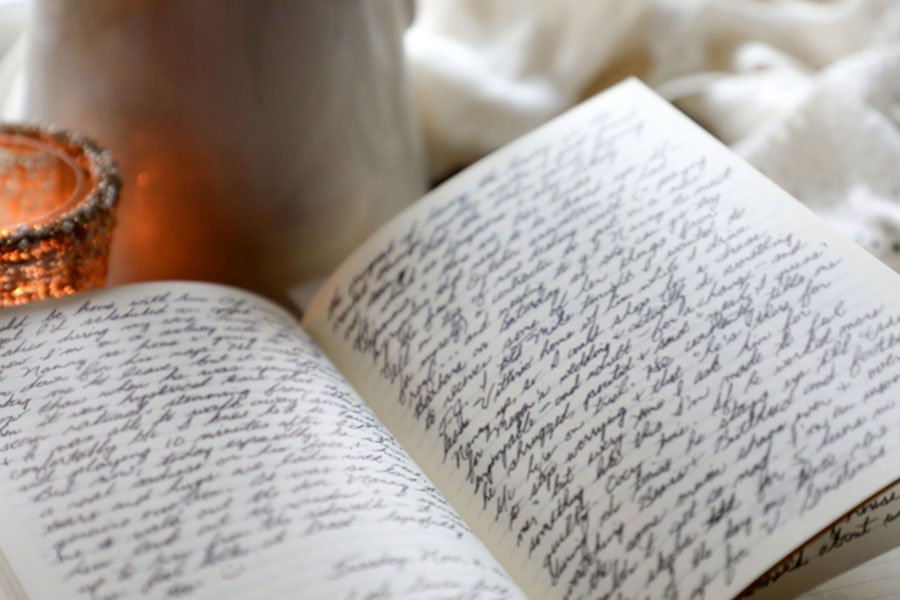
What should I do with my journals?
Have you ever thought about what will happen to your diaries—who will read them, how you may one day use them? Join me as I consider this profound question.
So many factors come into play when considering whether to save or destroy your personal journals. What’s your thinking?
As an off-and-on journaler since young adulthood, there are two main things that stop me from being consistent with my journaling: finding time, and wondering what on earth I should do with them after they are written.
The first challenge—time—is fairly easily addressable. I have tried gratitude journals or other short memory-keeping prompts that can be completed in just 10 to 15 minutes with great success. I also firmly believe that we make time for what matters to us—so if keeping a diary can make its way atop your priority list, chances are you can squeeze it into even the busiest schedule.
But that second question troubles me more.
The case for destroying my journals upon completion?
A personal journal has value, in my opinion, because it is a place where we can be our unfettered selves—free from the constraints of worrying about what other people will think, or worrying about the quality of that writing. A diary is a place to be vulnerable, even to work out problems through the very act of writing about them.
Are they something I envision other people reading? No.
At times I have formatted my journal as an ongoing correspondence with my deceased mom. It helps orient me, feel like I am speaking to someone rather than sending messages out into the ether, and imagine a compassionate soul receiving my words. Perhaps if she were still alive I could envision her actually reading them. But, well, I wouldn’t want anyone else to read them.
Which poses a dilemma if I ever want to use those diaries as a touchstone for future memoir writing, as so many life writers do (and as I often recommend!). Because if I hold onto them, someone else may find them. If I hold onto them, someone else will certainly discover them when I am gone.
Let me be clear: It’s not like I am writing anything awful in those journals. On the contrary, the types of things I share—the overwrought emotions and unprocessed (often reactionary) thoughts—are likely universal in many ways. But they’re not necessarily how I want to be remembered. It’s why at some point in my 30s I destroyed my diaries from my teen years (I am ashamed now to say how dreadfully embarrassed I felt upon rereading them as an adult—I hadn’t yet learned to be compassionate with my former selves). I am still not even sure if I am happy or regretful of that decision to get rid of those angsty handwritten pages.
In the introduction to A Writer’s Diary, the collected journals of Virginia Woolf, Woolf’s husband writes:
“At the best and even unexpurgated, diaries give a distorted or one-sided portrait of the writer, because, as Virginia Woolf herself remarks somewhere in these diaries, one gets into the habit of recording one particular kind of mood—irritation or misery, say—and of not writing one’s diary when one is feeling the opposite. The portrait is therefore from the start unbalanced…”
…a fairly adequate description of why I don’t intend my diaries to be read by anyone other than me.
When I ponder the question of whether to save or destroy my journals, though, I sometimes come to the conclusion that I should save them, but that I should write with an audience of my child or future descendants in mind. That’s certainly what some famous diarists have done. But, as Joan Didion wrote in the essay “On Keeping a Notebook”:
“…our notebooks give us away, for however dutifully we record what we see around us, the common denominator of all we see is always, transparently, shamelessly, the implacable ‘I.’ We are not talking here about the kind of notebook that is patently for public consumption, a structural conceit for binding together a series of graceful pensées; we are talking about something private, about bits of the mind’s string too short to use, an indiscriminate and erratic assemblage with meaning only for its maker.”
Ah, so much fodder for thought, and yet I reach no conclusions—“to save or to destroy my journals” still exists as an unanswered question for me.
Where do you stand on this?
The case for saving our journals
Of the many reasons one might have for keeping a journal, here are a few that, in my opinion, merit their safekeeping:
keeping a journal as an autobiographical record
Whether as a tool for future memoir writing or as a piece of your legacy you pass down to loved ones as is, a journal can be an important piece of your personal history to preserve. Read this post for a specific writing prompt that will yield fodder for your autobiographical writing.
keeping a journal as a personal record
Such personal writing can be a valuable resource for you to look back on later in life. They can help you to remember important events, to track your progress, and to reflect on your thoughts and feelings. Read a thought-provoking exploration of what it means to write memoir as a tool for self-understanding (“like a good therapist”) in this old New York Times article.
keeping a journal as a source of inspiration
Perhaps you plan to use your journal as a source of inspiration for your writing, art, or music. They can also help you to come up with new ideas for projects or to solve creative problems. Read these thoughtful reflections from The Marginalian by Maria Popova on celebrated writers and their ideas about the creative benefits of keeping a diary (there are, unsurprisingly, conflicting notions on whether or not to keep said diaries!).
Ultimately, the decision of what to do with your journals is up to you. There is no right or wrong answer, and the best option for you will depend on your individual circumstances and preferences. That said, I would absolutely love to hear what you think about this! Please share in the comments—I promise to reply and get a conversation going.
The best photo captions do these things
Photos that have no captions will leave readers of your heirloom book guessing. Make sure to write captions that either tell a story or provide vital details.
Every photo caption in your life story book should either tell a story or provide vital information.
Whether you are designing a family photo book with highlights from the past year or creating a long family history book with plenty of narrative text alongside a few select images, writing good captions is a key to success.
Why do I even need captions?, you may ask—especially when you already know who is pictured and you immediately recognize the scene. Who wants to state the obvious?
Well, consider this: You (and even your immediate family) are not the only ones who may be looking at this book. What if your cousins or a friend pages through it? What if—and hopefully this is the case—your kids’ kids one day read it?
And think about the effect of time: Just because you currently remember that Tom’s birthday party was held at the bowling alley two towns over, will you really remember that detail a few years from now (I can say with certainly I would not!).
Don’t worry, though, as I’ve got a little cheat sheet for you. Every caption should do one of these two things:
Every family photo caption should…
Tell a story…
Sure, you may have told a long story in the main text portion of your book that relates to a given photo, but you want to deliver value to the reader who is combing through the pages quickly, too. Admit it—sometimes you just want to page through a book and read the graphic type and look at some pictures! I guarantee your descendants will one day do this, too. So either add a new detail in the caption (how wonderful it is to get even more context or emotional punch through a caption!) or concisely reiterate what the photo is showing.
Sharing interesting info alongside the photos in your book entices new readers to go further and read the whole story. Strong captions also provide touchstones for someone who has already read the entire book, but wants to revisit the stories to reminisce and sit with their memories for a while.
…or give vital information
Indicate who is pictured in a photo with clear directionals—for example, “clockwise from top left” or “from left.”
Family photo books don’t need full names for immediate family members, but do consider using first and last names for your children’s classmates or your work colleagues, for example.
In more in-depth storytelling books such as a memoir, a legacy book, or a family history book, do use surnames to identify people the first time they are shown. And occasionally be specific about relationships, particularly as you get further back on your ancestral lines (“my paternal grandmother, Betty…”, for example, orients the reader so they don’t have to flip back to your text or a family tree to avoid confusion).
Include dates and locations for milestone events such as a bar mitzvah, a wedding, or a ship passage across the ocean. If you know an approximate date, you can say something like, “circa 1912” or “early spring, 2020.”
Ask yourself: If I encountered this photograph in a book, what would I want to know about it? That simple strategy will help guide your caption writing.
Photos that don’t need captions:
secondary shots from the same scene or location, when details are enumerated in a nearby caption
mood shots, such as the spring flowers blooming in your yard or the sunset on your camping trip
photos used graphically on section openers, as long as they appear again in the main text
images that are self-explanatory (so if it’s a location shot and there is a sign saying where it is, for instance)
A fun way to spark childhood memories for your memoir
Smells (such as of Mom’s perfume or Grandpa’s grease-stained clothes) and sounds—especially music—can trigger long-buried memories helpful for writing memoir.
Music is one of the most immediate ways to tap into childhood memories—so listen to some nostalgic songs before sitting down to write your life stories.
Revisiting journals from our adolescence and poring through old family photos are tried-and-true ways to call forth memories to be mined during memoir writing. If you want to get a little more creative, though—and tap into your senses—try these two super-fun ways to travel back in time.
Using the senses to trigger deeply hidden memories
Surround yourself with smells from your childhood.
When I was reading Prince Harry’s blockbuster memoir, Spare (a wonderfully engaging read, perhaps because of his celebrated ghostwriter), I earmarked a page where Harry describes bringing “Mummy’s favorite perfume” to his therapist’s office in an ongoing effort to revive memories about her he had long regarded as “dead.”
“I read somewhere that smell is our oldest sense, and that fitted with what I experienced in that moment, images rising from what felt like the most primal part of my brain.” He goes on to describe quite a few “resurrected memories” of the late Princess Diana—painful memories that had been suppressed, but joyful ones, too: “The sound of her laughter that day, lost to me all these years, was back—it was back. Loud and clear as the traffic outside the therapist’s windows,” he writes. “I cried with joy to hear it.”
Smell is indeed our oldest sense, and it apparently has a direct pathway to the brain, putting us in touch not just with raw experiences but with the emotions tied to them.
Probably the most familiar experience of smells transporting us back to a sense memory is the scent of baking bread or chocolate chip cookies—or any comfort food we associate with a parent or grandparent. But like Harry’s reaching for his mom’s perfume, there are plenty of other smells we can seek out to spark memories of an earlier time in our life or of a lost loved one. Think childhood perfumes (Love’s Baby Soft, anyone?) or mom scents (Jean Naté? Pond’s Cold Cream? Noxzema?). Think dad smells (cigar smoke? musky cologne? car grease? sawdust?).
What did your school smell like? The hospital where you had an extended stay? How about your granddad’s Oldsmobile, that never seemed to shake that new car smell? Where does fresh-cut grass take you? The sulfurous scent of the marsh where you played with your siblings?
Thinking about—and naming—the scents of your past will help ground your autobiographical writing. Returning to those scents intentionally (like Harry did with his mom’s perfume) can go a step further and literally draw out those memories. Try it, and please, let me know how it goes! I am especially curious to hear just what smells evoke vivid memories for you.
Make a playlist of nostalgic songs.
My husband and son’s birthday gift to me this year was tickets to A Beautiful Noise - The Neil Diamond Musical on Broadway. For a little context: When I was a kid, Neil Diamond was part of the soundtrack of our home. My mom would turn the volume up loud enough to be heard over the vacuum cleaner when she was doing chores! While Simon and Garfunkel or Tom Petty might be playing on any given day, Neil Diamond was always—always!—in rotation.
I knew the words to every song (though I would never admit to that—I didn’t deem him cool enough…he was “mom” music). At some point as an adult I did go to a Neil Diamond concert with my mom, though even then I was ambivalent, singing along on the inside while my mom danced excitedly and sang loudly.
These days I mostly belt out “Sweet Caroline” with all the other revelers at wedding receptions and occasionally hear a hit on Sirius, glad to be reminded of my mom. So I was caught off guard with how fervently my emotions swelled up during the Broadway show. Hearing songs I hadn’t heard in years literally transported me to my childhood living room.
When I came home, I looked up Neil Diamond’s discography on Spotify and did a deeper dive. And I remembered even more. Silly songs from his first Hot August Nights album that I definitely haven’t heard since childhood—“Porcupine Pie” and “Gitchy Goomy”—created a sense that no time had passed. I felt like I felt as a seven-year-old girl; I giggled; I almost cried. I honestly don’t think I would have ever had access to the memories these songs called forth without them. It was a prime time to pick up a pen and start writing about that time in my life.
What songs would make your nostalgia playlist? Are there musical artists that your parents listened to on repeat? Are there songs that have the power to transport you back to your teen years?
Make a playlist of these songs and listen for a while before sitting down to work on your memoir. Even if the songs don’t spark specific episodic memories, they’re sure to put you in a certain mood that just may come through in your writing.
Related reading
Life (and life writing) lessons from a WSJ obituary writer
Why leave your legacy in the hands of someone else? Try your hand at writing your own obituary with these tips—it just may be the start of your mini memoir.
James Hagerty, a longtime obit writer for the Wall Street Journal, shares his years’ worth of life writing wisdom in the book Yours Truly: An Obituary Writer’s Guide to Telling Your Story.
There are many reasons I recommend picking up a copy of the book Yours Truly: An Obituary Writer’s Guide to Telling Your Story by James R. Hagerty. Among them: his flair for telling a good old, draw-you-right-in story, honed over decades as a reporter; his ability to distill a lifetime’s worth of living into a manageable piece of writing that is both enlightening and engaging; and his respect for everyday folks whose names we might not otherwise know had he not shined a light on them on the Wall Street Journal obituary pages (and now, in this book).
Most of all, though, I recommend you read Yours Truly to glean some life writing wisdom for yourself. My hope, like Hagerty’s, is that it will put you on the path to writing your own mini-memoir long before your family needs to craft your obituary.
For now, here are five lessons derived from the book to spark your inspiration.
Your family wants your stories—even if they seem disinterested now.
Have you ever been to a funeral, a wake, or shiva and witnessed how hungry the family members of the deceased are for stories—for any and every little morsel of memory about their lost loved one? I have. And I have also been the grieving individual desperate for such recollections.
In my years of creating tribute books to help people memorialize their lost loved ones, I am continually saddened by the regrets my clients express: regrets for not asking as many questions about their family member’s life as they “should have”; regrets for not expressing their feelings and gratitude before it was too late.
As Hagerty shares in his book, it’s often not until someone sits down to write an obituary that they realize how limited their knowledge is. “I am struck by how much [family members of the deceased] care about ensuring their loved one’s life will be remembered—and by how little they know about that life.”
This, by the way, is in no way laying blame—we all fall into this trap of taking our loved ones for granted, of thinking of them as “mom” and “dad” without really reflecting on them as individuals with rich lives of their own. Even professional personal historians like myself have felt this way—heck, it’s the reason many of us came to do what we do.
Hagerty, too, expresses: “Even if I had tried to write [my father’s] story, I would have struggled. I lived in my father’s house for my first 18 years and saw him at least once a year for the next 20-some. How can it be that I knew so little about him? Even the basic facts are blurry.” Of course he regrets not knowing more, not asking more—and it’s only in hindsight that he wishes his dad told his story—“I’m sure we would have read every word and kept it in a safe place,” he writes.
Just because your family members aren’t asking for your stories now doesn’t mean they won’t want them someday. They will, I promise.
You’ve got stories worth telling—really.
“My life is boring.”
“Ugh, I don’t have any stories—just scattered memories here and there.”
“I’ve lived a simple life, not worth talking about.”
I’ve heard all the excuses for not writing about your life and, frankly, they’re rubbish. I have yet to meet a person who felt this way who didn’t ultimately go on and on about their experiences during a personal history interview, only to surprise themselves with just how wonderful their life has been! Sure, it may take a while for some people to get warmed up, but by asking them the right questions and leading them on a path of self-discovery through reminiscence, they inevitably rediscover just how riveting their life has been.
You can “find” your stories through writing, too, and in his book, Hagerty brilliantly walks you through how to do just that. As he says, “If you think your life has been uneventful, think again. Once you start writing, you may find it’s been far more interesting than you realized.”
In addition to offering up three questions you should ask yourself before embarking on any autobiographical writing, Hagerty shares plenty of examples of life writing that will showcase just how fascinating so-called “regular” people can be—and trust me, there’s a lot to be gained by reading about the lives of others if you want to write about your own!
Recounting tough times is as important as sharing happy memories.
This is a topic I address with every person I work with: Yes, the happy memories and funny stories should go into your book—but your challenges, your failures, and your resilience must be there, too. It’s those stories that may one day provide comfort or guidance to one of your children. It’s those stories that show your humanity and that inspire.
Just as I encourage my subjects during personal history interviews, Hagerty too encourages his readers to go beyond describing episodes from your life to find meaning among them. Be thoughtful about what an experience meant to you, about what lessons you learned. Place these episodes from your life in a broader context.
“The experiences that shaped you are often what other people least understand and would be most interested to know.” Yes!
And don’t just think about recent milestones from your life. Hagerty notes that “the most common error I see in obituaries is to underestimate the importance of childhood and teenage years, and the struggles to find a career, a mate, a vocation, or a purpose in life.” It’s during those formative years that some of our biggest—life-defining!—decisions are made. They are worth exploring in a loved one’s obituary and in your own memoir writing.
“In life stories, generic will never do.”
We’ve all heard the maxim Show, don’t tell. Paint a picture of the environment you describe. Be specific about place names and clothing styles. Choose details that reveal your specific experience—including details of our modern life, for what we take for granted today may one day seem dated, even quaint: corded phones, drive-in movie theaters, and handwritten (mailed!) letters seem like relics of the past, but even more recent references to sending someone a message via a pager, hanging out at the mall, or picking your “top 8” in MySpace are already “of their time.”
This doesn’t, of course, mean to flood your stories with details, but choose telling ones, and be specific when it counts. If you are talking about your first job, describe the company and your role with real examples. If you say you felt demeaned at work, share a representative episode that made you feel that way. Allow your readers to imagine themselves experiencing life alongside you.
“Without details,” Hagerty writes, “a story shrivels into oblivion.”
Something is better than nothing.
I’ve said to many a personal history client, “Done is better than perfect.” So, too, is something better than nothing.
I am grateful for the few things my mom hand wrote in the memory journal she kept on her bookshelf. She answered about 10 of the 100 or so prompts with a mere sentence or two—and while I wish she wrote more, I cherish those sentences.
“You may never finish the project,” Hagerty writes. “That’s okay. An imperfect, incomplete story, offering whatever you can to muster to explain yourself and share the lessons you’ve learned is a precious gift to your friends, loved ones, and maybe even posterity in general. As for the memories you will resurrect and the insights into living you may discover, those are gifts to yourself.”
It’s a gift to your family, as well. A gift of legacy they will assuredly keep in a safe space in their home, and in their hearts.
Note: This is an unsolicited review of a book I purchased at full price. I did not receive any compensation or free products in exchange, and any endorsements within this post are my own.
Affiliate disclosure: As an Amazon Associate, we may earn commissions from qualifying purchases from Amazon.com.
What to do when you have too many memory-keeping ideas
Don’t let all those memory-keeping ideas swirling around your head overwhelm you. Instead, take some time to hone in on which stories to tell first—here's how.
Lots of light bulbs going off in your head? Consider that a good problem to have—chances are your next life writing project is amidst that mental clutter! Take a few steps, outlined below, to hone in on which topic to tackle first.
I recently had a conversation with a gentleman who had a multitude of ideas for book topics—he wants to tell his own story, his mother’s story, the story of his more-than-100-year-old family business, the story of the best friend from college who recently passed. The talk was chaotic—a maelstrom of memories. It was exciting.
Fertile ground—that’s my positive spin on what can often be considered overwhelming: early talks with folks who know they want to preserve their legacy in a book, but have too many ideas. For while it can indeed be overwhelming for you, I am able to take notes as an objective listener and ask questions to help you refine your goals and, ultimately, set priorities.
Sheer overwhelm is, from my experience, the number-one reason most people let their life story book ideas languish. I’ve written a lot about ways to minimize that overwhelm (check out this post for easy ways to minimize the fuss and just get started, for example)—but right now I want to focus on narrowing down your ideas to the most pressing one.
How to choose which life story theme to explore first.
These steps are applicable whether you want to write your memoir (perhaps as a series of vignettes!), speak your stories into a recorder to be transcribed for a life story book later, or simply to create a photo album or oral family history. No matter the final form of your life story preservation, following these four simple steps will help you get control of your ideas and settle on one topic to tackle first.
Step 1 - Do a brain dump.
Get all those ideas out of your head and onto paper. It’s okay if your scribblings are as messy as those ideas swirling around your mind—just write them down, one phrase and memory at a time. This is what we call brainstorming, and it’s both effective and cathartic. Give yourself 10 minutes, tops, but try not to pick your pen up from that paper…keep the ideas flowing! I recommend doing this with good old-fashioned pen and paper.
Step 2 - Make a list.
Type up your handwritten ideas in list form without regard for order or relevance. Don’t edit or ruminate over anything; just make it presentable, then print a copy you can mark up later.
Step 3 - Step away from the page.
Seriously, slip your paper in a drawer and forget about it for a week. This will give you enough emotional distance to approach the next step with the necessary perspective.
Step 4 - Set priorities.
Okay, maybe this one’s a little thorny. What if every idea looks A-MA-ZING?! What if your heart palpitates at the thought of choosing one life story topic over another? It’s all good. It means you’re excited about preserving your stories and, most likely, that you’ve lived a life filled with stories worth sharing!
Remember that your goal here is to set some realistic priorities—to identify which life story angle you are going to tackle first (and that doesn’t necessarily mean it’s “the best.”). It DOES mean you’re choosing a topic
(a) that is currently at the forefront of your mind, for whatever reason;
(b) that you’ve already written a bit about and would like to develop further;
(c) that a family member has expressed interest in;
(d) that you feel some urgency about capturing before memories fade;
(e) or that troubles you, and you want to explore to write your way to clarity…
These are just some of the reasons you might choose one memoir topic over another. Simply having a gut feeling about one idea is reason enough to pursue it, in my opinion.
You can’t finish a life story book, memoir, or oral history memory-keeping project if you don’t start. By picking one of these ideas as your first priority, you’re on the right (productive!) path.
Do those four steps still feel too overwhelming?
Sometimes you may not be up for all that. There is another way: Set aside time for a few introductory personal history interviews. That’s what I am doing with the aforementioned client who was overflowing with life story ideas—we’ve scheduled three interviews that we are looking at as “data collection.” I will guide the conversations with an open mind, paying attention to those stories that get him excited, that spark 10 more possible related stories, that feel like the fertile ground I referenced earlier. I will also note those that may seem more like a chore to talk about, that don’t feel as urgent.
You can do the same thing with a loved one if you like. Ask a family member or friend to sit down for an intentional reminiscing session. It needn’t be a formal interview like the one I will have with my client, but it should be approached with purpose. Tell them what you are hoping to achieve (to narrow down your ideas for a memory-keeping project or personal history book) and invite them to ask questions and comment on what they find of interest. You can record the session to hear how your voice betrays your feelings about a given topic, or take notes as you go. Either way, I am willing to bet the very process of sitting down to talk about your memories will both get you excited to begin preserving your stories for real AND help you decide which aspect of your life to explore first. Good luck!
Ready to start writing your life stories?
Don’t stress about the quality of your writing—use your authentic voice.
Not sure how to proceed but still chomping at the bit to preserve your life stories? Consider scheduling a free 20- to 30-minute phone consultation to see how we could work together.
Two great resources to help you write an ethical will
Ethical wills—also called legacy letters—are great ways to pass on values and life lessons to your descendants. These two books will help you create your own.
One helpful resource to guide you in writing your own ethical will: this step-by-step book from Susan Turnbull, founder of Massachusetts–based Personal Legacy Advisors.
“What do I want my loved ones to inherit, in the broadest sense of the word?” Susan Turnbull asks in her guide, The Wealth of Your Life.
So, beyond the physical wealth you have accumulated in your lifetime, what else should you think about passing on? Things like your values, your stories, your family history—these things make up intangible wealth that, for many, is as important (if not more so) than your material assets. But how, exactly, to pass those on?
Leave your values, not just your valuables
The answer comes in the subtitle to Turnbull’s book, “A Step-by-Step Guide for Creating Your Ethical Will.”
An ethical will is simply a document you create to pass on wisdom, stories, and other information you feel is vital for your loved ones to know. It is an opportunity to share love, gratitude, and lessons with them. To leave a legacy with words.
Originally an ancient Jewish oral tradition, ethical wills have come to be known by more descriptive modern terms such as legacy letters and forever letters—but no matter what they are called, their intention is “to share the deepest truths of our lives for our loved ones to know and to hold even when, especially when, we are gone,” as Rabbi Steve Leader writes in For You When I Am Gone: Twelve Essential Questions to Tell a Life Story.
My life story?, you might be thinking. Well, yes, you may endeavor to preserve your full life story for the next generation (if you’re on my website, you know that’s undoubtedly something I champion!)—but most ethical wills are shorter documents (often between two and 10 pages, Turnbull suggests) and therefore much more approachable. It may evolve over time, too. “Start by creating a short message that captures the most important things you want to say,” she writes. “Peace of mind will be your immediate reward. You can add to that core message later, as time and inspiration allow.”
Here are two very different resources that I highly recommend for anyone interested in crafting your own ethical will.
The best books to help you craft your own ethical will
1 - a practical ethical will workbook
Susan Turnbull’s workbook is meant to be read and filled in—so get your pen ready!
Title: The Wealth of Your Life: A Step-by-Step Guide to Creating Your Ethical Will by Susan Turnbull
Who it is right for: A self-starter who wants to craft their own ethical will by the end of Turnbull’s book.
Biggest benefit: The nitty-gritty guidance (including, for instance, a list of values to consider writing about, and questions to narrow down your intentions) is thought-provoking; and the worksheets are incredibly helpful tools that also mark your progress as you go.
Consider: Buying one guide for yourself and another for your life partner, sibling, or a close friend—going on this journey together may provide both motivation and a means to grow closer.
This is a short, spiral-bound book that’s meant to be used as a tool. The author has broken out the steps to creating your ethical will not only clearly, but gracefully: Questions and prompts are accompanied by “lightbulb” asides that nudge you in the right direction, plus short examples of real-world answers that illustrate, among other things, that using your authentic voice is a powerful thing.
One of my favorite tips: You can convey values without sermonizing. “It is in your everyday life that your values find their expression.” In other words, use stories to reveal your values. Writes Turnbull, “In so doing, your values become obvious, you provide an interesting record of a slice of your life, and you will touch your audience in ways you can never imagine.” Indeed.
2 - an inspirational read that leads by example
I recommend reading Steve Leder’s book twice—once to relish the personal writings within, then again with the intention of answering his questions to craft your own ethical will.
Title: For You When I Am Gone: Twelve Essential Questions to Tell a Life Story by Steve Leder
Who it is right for: Anyone who wants to immerse themselves in years’ worth of wisdom, all the while becoming inspired to share your own.
Biggest benefit: Thoughtful, rich examples of excerpts from ethical wills from a wide variety of people of differing backgrounds and life experiences. The answers people provided to the 12 guiding questions Leder supplies are heartening and motivating.
Consider: Finishing your ethical will and then…writing more! For me, personally, answering the 12 questions in this book promises to yield more than my ethical will for my son—a whole lot more.
An ethical will can be both a way for descendants to remember a lost loved one and a primer on how to live a better, happier life.
Rabbi Steve Leder—who has presided over more than a thousand funerals over the past three decades—knows the value of stories in creating legacy. If you ask the right questions, he says, meaningful stories pour forth. In this book, he has distilled those questions for us. “These questions are deliberate and so is the order in which I ask them,” Leder writes. “They have helped countless families tell the deepest, most honest, and often beautiful truths by which their loved ones lived.”
Sound intimidating? It’s shouldn’t be. Not only can you do this, but you will also gain insights and feel a sense of peace upon completion, “a promise of continuity,” as Leder says. While he thought he would be imposing on those he asked to contribute to his book, on the contrary, most of the individuals thanked him for allowing them the opportunity to be thoughtful and to share their stories.
The 12 chapters in For You When I Am Gone each introduce one question, some rationale for its inclusion, and then varied answers from real people. I recommend reading this book in its entirety, then beginning again with the intention of answering each question yourself as you finish its chapter. That’s what I have done.
Two messages that resonated greatly with me: ““We cannot learn from a story no one has ever told us” and “To share our story with someone is to say, you matter to me.” Leder also professes urgency: “My message is, ‘Don’t wait.’ Because none of us ever really knows which conversation might be our last.”
For You When I Am Gone is the best book on life writing that I have read in years; it has become the book I have gifted most often since it was published last year. I hope you’ll pick it up, and that you’ll take the messages from Leder and Turnbull to heart and begin writing your own ethical will.
This clever turn of phrase from Turnbull’s guide says it all: “What you have learned is as valuable as what you have earned.” So pass it on—please!
Note: This is an unsolicited review of two books I purchased at full price. I did not receive any compensation or free products in exchange, and any endorsements within this post are my own.
Affiliate disclosure: As an Amazon Associate, we may earn commissions from qualifying purchases from Amazon.com.