
Memories Matter
Featured blog Posts
READ THE LATEST POSTS

Curious about your parents’ lives? Get your kids to interview them.
You might be surprised by how much your parents will open up—with fun stories, with meaningful lessons—when your kids interview them about their lives.

Kids age seven and older can conduct meaningful family history interviews with their grandparents—even from a distance over Zoom or other teleconferencing software.
What you don’t know about your parents’ lives could fill a book. Actually, multiple books, more like it!
Even those of us who are close to our parents—who speak to them every day on the phone, who love spending time with them, and who rely on them for emotional support or perspective—even we take a lot about our parents for granted. It’s the nature of the parent-child relationship, right? On the children’s end: a built-in assumption that our parents will, quite simply, always be there for us. On the parents’ end: an assumption that our kids see us as “mom” or “dad” rather than “Lillian” or “Jonathon.”
The results of those assumptions? For the kids, that we are less likely to feel any sense of urgency around asking our parents for their stories. For the parents, a sense that their grown kids don’t really want to know about their lives before becoming parents.
Trust me, as a personal historian I have seen this story play out far too often. Grown kids who come to me only after their parents have died, haunted by the guilt that they never got around to asking their mother or father about their lives. Parents who come to me unsure if telling their stories will even matter—“No one has ever asked me,” a father might say, or “My kids don’t care about any of this!”
Sure, you can sit down and interview your parents about their lives (I encourage it, for sure!). But I’ll let you in on a secret: Often folks reveal much more of themselves to a stranger. When I interview someone professionally to capture their stories, I have the advantage of not being emotionally attached to the people or the stories. It’s a guaranteed no-judgment zone. Not to mention that having dedicated time and space for someone to tell their story helps clear the mental clutter and get right to the heart of story sharing.
There’s someone else who can get your parents to speak freely, I bet: your kids. Grandchildren who come to their grandparents with genuine curiosity will inevitably tap a rich well of stories from their elders.

Looking at photos, whether in an old family album or on a device, is a great way to prompt memories and get the stories flowing from grandparent to grandchild (and vice versa!).
A few reasons why grandparents are excited to share stories with their grandkids:
TO IMPART LESSONS: By talking about their life journey—including funny missteps and even big failures—grandparents can share some of their hard-earned wisdom with the next generation.
TO CONNECT MEANINGFULLY: How often do your parents get to have real conversations with your kids? This is a rare—and precious—opportunity.
TO REFLECT INTENTIONALLY: Like writing in a journal, being interviewed for one’s life stories provides a chance for reflection that we rarely indulge in during our busy lives. It’s a practice that’s good for our mental health, according to research, but beyond the research, it just feels darn good.
TO HAVE SOME FUN: Sharing childhood memories and grown-up exploits with the grandkids—what could bet better? It’s a chance for the grandparent to pull out some favorite old photos, to get a little nostalgic, and to share a piece of themselves with someone they love unconditionally. Laughs will ensue, I promise!
If you’d like to encourage your child to interview your parents, I hope you’ll download this popular resource that I’ve been giving away for free since the pandemic began—The Kid Kit: Everything You Need to Interview the Grandparents. Originally available for purchase in the Modern Heirloom Books store, I felt strongly that during this time of separation (and newly-found comfort in connecting over Zoom), I wanted as many people as possible to have it.
Inside you’ll get not only interview questions (and those are AWESOME, if I say so myself—they’re designed with kids aged 7+ in mind and cover a wide range of topics), but you’ll also get bonus activities, a history timeline, and tips for how to continue the story sharing post-interview.

FREE RESOURCE: Questions, Activities & More
Get your kids talking—really talking—to your parents. They’ll get stories even YOU’VE never heard!

Life Story Links: March 30, 2021
A curated reading list for memory keepers including recent pieces about the craft of memoir, connecting generations through story, and history held in letters.
“You don’t need anyone’s permission to be the author of your life. It’s yours. Write it.”
—Cheryl Strayed

On this day in 2003, a law banning smoking in NYC restaurants and bars went into effect (and as a then–New Yorker, I was one of the seemingly few who were happy about it at the time!). Vintage photo of woman smoking in front of the Fifth Avenue entrance to the New York Public Library, 1954, by Angela Rizzuto, courtesy of the Anthony Angel Collection, Library of Congress Digital Collection.
Connecting the Generations
A TEEN AND HIS GRANDFATHER
A teenager reflects on the last couple of years of his PawPaw’s life, during late-stage dementia, and finds five lessons learned from the experience.
IT STARTED WITH A LETTER
Jacob Cramer founded Love for Our Elders when he was in his third year at Yale: The nonprofit collects handwritten and video letters for isolated elders (hundreds of thousands of them to date!). The group has also compiled a “Senior Storybook,” to which you can contribute.
LEGACY LOOMED LARGE
“I wish now that I had asked my father more about his one-and-only game against [Elgin] Baylor, more about that league and those times. But dad died 15 years ago. As close as we were, some of his history will always be cut off from me.”
PROMPTS IN A JAR
Elizabeth Thomas, a personal historian based in Salt Lake City, Utah, shares rules for a simple family history game that makes capturing stories from your family elders fun and engaging.
A GIFT FOR GENERATIONS TO COME
“And remember, you don’t have to call yourself a ‘writer’ or know much about creative writing techniques to write a personal history…. Your children and grandchildren or other members of your family will love anything that gives them a better picture of your life.”
“BRIDGED”
“Maybe, I thought, writing is about so much more than what can be contained within the margins of a page. Maybe it’s about what can be bridged. Or shoved together. At least for a moment.” Jennifer De Leon on mother-daughter relationships and the power of memory.
The Why Behind Story Preservation
CONVEYING THE URGENCY
Like many personal historians, I struggle with finding a way to adequately convey to everyone just how important it is to both ask our parents about their lives and tell them how we feel—and to do so now.
WAR STORIES
"My dad told me a lot of stories about being a poor kid in Kentucky...and I didn't write them down. And so I forgot,” said Tom Everman. So, the air force veteran recently wrote his own memories of the Vietnam War—for his children.
Epistolary Exchanges
“DEAR G.I.”
In 1966, a Massachusetts mother of three began writing to young men serving in Vietnam. One became her most steadfast pen pal, writing her 77 letters over seven years, and now that correspondence is gathered in a book.
1950S DRAG ARTISTS TELL THEIR STORIES
“I don't know why you guys want to tell this story,” various subjects told a co-director of the new documentary P.S. Burn This Letter Please. The film—like the letters it is based upon—opens a window into a forgotten world where being yourself meant breaking the law and where the penalties for “masquerading” as a woman were swift and severe.
The Stuff of History
WHIRLWIND TRIP DOWN MEMORY LANE
“Two men. Two lives,” Dan McCullough writes. “One album of memories shared only by these two men, precipitated by one of them standing in a doorway a week ago today.”
A ‘VISUAL MEMORY‘ OF WAR IN SYRIA
“There is growing concern that digital evidence of history’s most documented conflict is being syphoned away by the Internet’s indiscriminate trash can.” As one Syrian activist put it, “It’s not just videos that have been deleted, it’s an entire archive of our life.”
THE OLDER, THE BETTER?
“It’s the photo albums, the well-loved baby blankets, and the shoe boxes full of letters that have left me paralyzed.” A thoughtful look at why decluttering can be so emotionally fraught.
“RIGHTSIZING”
Jeannine Bryant, author of Keep the Memories, Not the Stuff, “recommends attaching a story or experience to prized possessions, such as pointing out the single item that came from the ‘old country’ with an ancestor, to explain why it's important to you—and why it might become a cherished item for them someday.”
FROM TRASH TO TREASURE
“Why are you spending so much time on just one person—and just one person’s garbage? Because it’s such a robust story,” archaeologist Seth Mallios says in this piece exploring how he and his students are revealing the story of Nathan Harrison, one artifact at a time:
On the Craft of Memoir
OUT OF THE SHADOWS
Anna Brady Marcus writes about why you must include not just the light experiences (the ups, the joy) but the darker ones (the downs, the struggles) in your autobiography, too.
TIME STAMPS
Beth Kephart has “taken an idiosyncratic tour of time in memoir” and here shares some of her observations on how a writer might approach time on the page.
...and a Few More Links
This year’s college admissions essays became a platform for high school seniors to reflect on the pandemic, race, and loss.
New book features young authors from across the country, ages 7 to 13, sharing their personal stories and experiences about life during the pandemic.
Why do so may people think novels reflect the author’s personal history?
Clothes are a gateway to personal stories in Chinatown Pretty: Fashion and Wisdom from Chinatown’s Most Stylish Seniors.
Halted by pandemic, heritage travelers turn to great reads that delve into ancestors’ often surprising histories.
A rather negative take from a Wall Street Journal Opinion writer on an epidemic “of non-memorable life stories”
Actress Sharon Stone tells her story in new memoir.
Short Takes

“I wish I had asked my mom that” and other heartbreaking regrets YOU can avoid
It seems obvious: We should ask our parents about their lives—lessons, loves, adventures, ancestors. Then why do so many of us wait too long and then have regrets?

Ask your parents to share stories from their life—not only will you have the security in knowing their legacy is preserved (no regrets of unasked questions!), but you’ll undoubtedly gain some laughs and lessons along the way.
If there’s one thing I’ve learned over and over again in this business of memory keeping, it’s that we all take our loved ones for granted—and we think that tomorrow or the next day we’ll be able to have that meaningful conversation. I struggle with finding a way to convey to everyone just how important it is to both
ask our parents about their lives
and tell them how we feel
—and to do so now.
Unfortunately, for many people, it’s only stories of regret that sink in:
I could tell you the story of my friend who came out as gay to his mom as she lay in her hospice bed, unresponsive. He likes to believe she heard him.
I could tell you the story of my client who had a million ideas why her mother was so emotionally closed off, but who never asked her mother to share her experiences. She is haunted by her many questions…and lack of answers.
I could tell you the story of an almost-client who booked me to interview her grandfather, who was a Holocaust survivor, only to have him die two days before our scheduled interview. We shifted to creating a tribute book in his honor, but how much more special would having his own stories have been?!
Often I simply share this powerful quote from William Zinsser that says so much with so few words:
“One of the saddest sentences I know is, ‘I wish I had asked my mother about that.’”
Have you asked your parents or grandparents about their lives? If that seems like something you just don’t have time for, please think again.
3 ways to ask your parents for their stories—before it’s too late
Not sure how to capture your parents’ stories? Here are three foolproof ways to invite, hear, and preserve your parents’ stories. Whichever you choose, I implore you: Get started now.
1 - Record an interview with your mom or dad.
No need to overthink this—just find a way to sit intentionally with your parents for the express purpose of listening to their stories. Use an audio or video recorder to capture the conversation. You can always decide what to do with it later. Choose questions from this free guide, or make them up as you go along.
2 - Ask your parents to write about their memories.
They don’t have to think of themselves as writers to undertake a project such as this, but they do need to be committed to writing regularly. So, provide them some friendly accountability: Ask if they’ll call you once a week to read their stories to you (and your siblings, if you have any—a fun excuse for a Zoom get-together!); or, undertake an email correspondence with your parents where you ask the questions and they reply with their stories.
I recommend they spend an hour or so brainstorming a list of memories, then use the items on that list as prompts for their life story writing; or consider signing up for a class with weekly memory prompts to get them going.
3 - Hire a pro to help your parents record their stories.
Whether your parents don’t have the stick-with-it-ness to keep writing, or you’re too busy or otherwise unable to interview them, or you simply want the best experience possible, consider partnering with a personal historian such as myself to record your parents’ stories and preserve them in an heirloom book. I’d be happy to chat with you about the ways to bring your project to life.
A surprising benefit of going this route: Some people feel more comfortable telling their stories to an open-hearted stranger as opposed to a family member—it could be because they know they have a captive audience who hasn’t heard their stories before, or because they may fear familial judgment for certain experiences or decisions in their past—but whatever the reason, the stories often flow more smoothly and fully when told to a professional interviewer.
This approach also allows you to let your parents know how much your stories mean to you while taking the pressure off you to guide the project through to completion.
Whether you interview your parents or ask them to journal about their life, let them know, in no uncertain terms, that their stories hold value for you. Convey just how special this undertaking is to you and not only will you get their stories, you’ll inevitably grow closer in the process.

Modern Heirloom Books offers plenty of free family history resources to help you interview your parents and capture their stories for posterity, including this guide, “56 Essential Family History Questions to Ask Your Parents Before It’s Too Late.” Click the button below to access it right now!

Life Story Links: March 16, 2021
Helpful reads for those who value memory-keeping, including conversations about legacy videos, memoir writing, and interviewing loved ones, plus life story ideas.
“Memoir begins not with event but with the intuition of meaning—with the mysterious fact that life can sometimes step free from the chaos and become story.”
—Sven Birkerts

Today would have been my mom’s 74th birthday, so in her honor I am sharing a vintage photo from her teen years—in curlers, on hammock, jokingly giving a drag of her ever-present cigarette to…a youngster. (Yup, I wish I could ask her who all the players in this picture are.)
Helpful Tips for Anyone Who Values Memory-Keeping
HOW TO INTERVIEW SOMEONE IN HOSPICE CARE
When someone I never met wrote to me asking for advice on interviewing their dying mother, I spent some time researching before I answered her. Then I realized that other people might be looking for similar help.
“WHEN DISASTER STRIKES”
“The more we can do now to prepare for an eventual disaster the better off we’ll be—both in terms of safety as well as in protecting our irreplaceable family treasures,” archivist Rachael Cristine Woody writes. This helpful post includes handy checklists for preparing your family treasures for the worst.
CAPTURING FAMILY LEGACY IN VIDEO
In this engaging conversation with video biographer Steve Pender of Family Legacy Video in Tucson, Arizona, he explores topics including putting your family’s story in context of broader world history, and what to do it you think your own stories aren’t interesting enough to save. Listen in below, and click through to discover past episodes.
Our Stories, Our Selves
“A MEMORY PLAY”
“It’s through the film’s specificities that Minari depicts a family like any and no other. And it’s through preserving memories of love, heartbreak and sacrifice…that Chung’s excavation of his own childhood hits on achingly resonant truths about the fluid, formative essence of family.”
ON MEMOIR & FLUID STORYTELLING
“We’re all yearning, thwarted, loving, losing, grieving, laughing, crying, hoping. Our selves matter when we write stories that illuminate the human condition.” Beth Kephart in conversation about her new book, Wife | Daughter | Self: A Memoir in Essays, and on the process and value of memoir.
AN OPPORTUNITY TO SHARE
When Mira Rosenblatt, 97, went for her second shot of the Covid-19 vaccine, a nurse asked her if she was nervous. “I’ve been through way worse,” she said, proceeding to share her life story—including surviving the Holocaust and going on to have eight grandchildren and four great-grandchildren.
“A YEAR LIKE A LIFETIME”
Whitney Myers, an Austin–based video historian, reflects on some of the universal themes she sees “over and over in the interviews I’ve done and year after year throughout the stories of our lives.”
LETTERS FROM—AND TO—THE TROOPS
Legendary comedian Bob Hope, who Congress officially named an “honorary veteran,” uplifted thousands of GIs—not only through his USO tours, but through letters he answered over the years. That correspondence is now collected in a book, Dear Bob: Bob Hope's Wartime Correspondence with the G.I.s of World War II.
...and a Few More Links
Toronto–based historian Dustin Galer, founder of MyHistorian, is featured on CBC.
Archivist hopes to reunite personal photos with tornado victims a year after storms.
How people are writing the history of the pandemic through everyday journals
A writer on her love affair with libraries (including the joy of discovery)
Teaching resources from Facing History and Ourselves for helping students reflect on the past year
Fun read: The untold history of the Barbizon Hotel for Women
Digital archivist Zoe Morrison, based in Florida, shares a friend’s old photo collection—and how clues to stories emerge from the pictures themselves.
The Home Edit and Ancestry share tips for storing your sacred keepsakes.
Short Takes

Meaningful conversation when your loved one is on hospice—here’s help
How to have meaningful conversation with your loved one on hospice, including the best life review questions & 4 things we all should say when someone is dying.

“My mom just entered hospice. I would like to create a book—do you have questions I could use? I would like to do this as I am sitting with her.”
This request came to me from someone who filled out a basic form on my website. My heart cracked open as I wondered what I could offer her.
At once I could see myself sitting by my own grandmother’s hospice bedside; I could feel that sense of helplessness and urgency to do something. I could imagine this individual typing that inquiry to me, a stranger, with a blind faith that it would be answered.
Well, I did answer her. It took me a while (and some research) to craft a response that I thought would truly be helpful at this time, as none of the resources I had thus offered online met the need. And then I realized—if she was looking for questions to ask a hospice patient, others were too.
If your family member is on hospice or has been diagnosed with a terminal illness, consider some of the questions and insights below to help you have meaningful end-of-life conversations with them.
Honor the urgency—and sacred nature—of talking with your loved one on hospice
It’s no surprise that when we are hit with the notion that our loved one is going to die, we feel an urgency—an urgency to connect, to hear their stories, to help them find meaning in their life and peace with their imminent passing.
Most of us take for granted that our family members will be around tomorrow. Tomorrow we can ask questions. Tomorrow we can hear their stories.
But when tomorrow is taken away, then what? Is it irrational to try to squeeze a lifetime’s worth of questions into what could be a finite few days or hours?
I have long offered a list of “essential” questions to use in interviews with parents or grandparents—but this is a long list, designed for those who have the luxury of time to conduct interviews.
When a loved one is on hospice, time is of the essence. So I recommend you get to the heart of the matter quickly, and focus on questions that lead them on a journey of meaningful reflection. (Remember, this is more about them than it is about you.)
Help the dying find a “sense of completion”
Research shows that people who are dying feel an urgency to “find a sense of completion” and to feel that they have contributed to others during their lifetime.
Palliative care expert Ira Byock has long written about how we can understand dying as a time of learning, repair, and completion of our lives—and how everyone deserves to “die well.”
One of his fundamental recommendations is that family members help their dying loved ones find that sense of completion by saying four things:
“Please forgive me. I forgive you. Thank you. I love you.”
It’s not a matter of simply reciting the words, of course. Each person must find personal meanings within the words, and find a way to express that meaning to their loved one.
“Thank you for being a mother who always listened to me, Mom.”
“Please forgive me, Daddy, for not helping you to cope better during your divorce”
“Mama, I forgive you for the things you did that caused me pain.”
Conversation may or may not ensue, but the offering of the words, the emotions, the gratitude, is a true gift. It helps both the dying person and their family member feel like important things have not been left unsaid.
Ask questions that help create “a biography of joy”
Like the woman who wrote to me wanting to use the time at her mother’s bedside to ask biographical questions, many people desire to learn more about their loved one as they near death. Perhaps there are things they always wanted to know, but time never seemed of the essence—until now.
There are myriad lists of family history questions out there, but these are designed for interviews where there is less sense of urgency.
When interviewing a hospice patient about their life, a more condensed life review is in order. Ask questions that speak about life transitions (graduation, career change, marriage, becoming a parent, moving homes, etc.) and that lead the subject down a path of happy reminiscence.
Questions that probe big changes in one's life usually prove to have very poignant answers.
Things such as:
Tell me about all you have loved.
What is the best decision you ever made?
What have you loved most in this life?
What has surprised you about people? About yourself?
How would you like to be remembered?
What hopes do you have for your family?
And then, there are times when someone on hospice may not want (or be able) to delve so deeply.
Consider bringing them a smile through lighthearted questions.
Questions such as:
Sing me your favorite song.
Do you remember your first kiss?
What was your favorite toy as a young child?
Did you ever play a prank on someone?
And remember: While you certainly have a deep interest in learning the answers to these life review questions,
“Stories also can be a gift that the ill person gives to others. People living with debilitating effects of illness may struggle with feelings of unworthiness and a sense of being a burden to others. The recording of family stories involving the marriage of matriarch and patriarch, seminal events, and the history of the family during war or natural disasters is a tangible way that people can contribute to their children, grandchildren, and the generations to come.” **
This life review is foremost an opportunity for the dying person to reflect and find meaning in their life. What a gift that is.
Navigate end-of-life conversations with grace
It is a most generous gift for you to go beyond providing comfort and personal care to inviting your family member to reflect on their life. By asking them questions and giving them space to share, you are creating an opportunity for integration—for a sense of self-actualization to happen at the end of their life.
“At the end of the day, or at the end of a life, we want to know that our lives counted for something, that we mattered, that our lives have had meaning,” palliative care nurse Charlene Thurston says. “What matters most to people is not what they’ve accumulated, but whom they’ve touched; whom they’ve loved and been loved by.”
By asking your loved one certain biographical questions, you are helping them take stock of their life—to articulate how it has had meaning, and to name their most special relationships.
Listen generously. Make eye contact. Use old photos or mementos as memory prompts.
And I urge you to hit "record" on your phone's recording app or on a mini digital recorder. We feel so confident we will remember the things our loved ones say, but I speak from experience when I say this is not always the case, especially when we are in a caregiving role and emotions are so close to the surface.
I hope these things are helpful to you in your effort to capture your loved one’s stories. Cherish the time you have together. Being a caregiver may not be easy, but it is indeed a gift.
** This quote and the idea of creating a “biography of joy” derive from a paper entitled “Caring When Cure Is No Longer Possible” by Ira R. Byock, M.D. and Yvonne J. Corbeil.

Life Story Links: March 2, 2021
From notable memoir excerpts to thoughtful pieces on language, family history, and self-identity, this curated list is full of great new reads for memory-keepers.
“In the silence of listening, you can know yourself in everyone, the unseen singing softly to itself and to you.”
—Rachel Naomi Remen

Vintage photograph of nurse feeding a baby, taken between 1935-1945, courtesy of the Manuscripts and Archives Division, The New York Public Library Digital Collections.
Family Stories Matter—a Lot
FAMILY, HERITAGE, KNOWLEDGE
The Deseret News recently spoke with three of the keynote speakers at this year’s RootsTech Connect about their respective family histories and why knowing about one’s heritage matters.
STRESS-FREE WRITING
“I didn’t once notice an ungrammatical sentence or a misplaced comma in that collection of memories. That’s not what matters. What matters is authenticity, voice, and perspective. What matters is that our stories get told, in all of their imperfect glory.” Some really great tips from author Angie Lucas about preserving your stories.
Engaging History
HISTORY AS WE LIVE IT
The Pandemic Journaling Project now has more than 6,500 entries from more than 750 people, containing “perhaps one of the most complete records of North Americans’ internal adjustments over months of pandemic, protest, and political division.”
OUT OF THE BOXES…
Robert Blomfield was a medical student in the sixties when his passion for photography led him to document—in evocative pictures—post-war Edinburgh. Recently his family began to catalogue and digitize thousands of images in the archive and is sharing the legacy with a wider audience.
First Person Reads
WHAT IT MEANS TO BE A BLACK MOTHER IN WHITE AMERICA
“It has been critically important to me that Chris, as a white man, understands how dearly I hold onto my own Blackness, but equally important that he understand how necessary it is that our son be encouraged to hold onto his Blackness, too.” Rebecca Carroll’s memoir powerfully weaves the writer’s commentary with her life experience.
HER WRITING, THEN
“Technically, I’d written a memoir, but what kind of memoir was it? I wrote a book about disability in which the word ‘disability’ appears only once. And that, I’ve since realized, was a mistake.” Sandra Beasley on claiming her identity as a disabled writer.
INHERITED LANGUAGE & FAMILY HISTORIES
“My mother tongue is a linguistic shipwreck; and it is from there that I write the story of my grandparents,” Claudio Lomnitz writes in this excerpt from his memoir, Nuestra América: My Family in the Vertigo of Translation.
Food for Thought
“THE AUTHOR OF NOW”
Are memoirs “a choir made up of soloists only, voices competing for attention, all traveling similar routes, drowning one another out,” as Olga Tokarczuk has put forth? An exploration of the writer’s views on interconnectedness and fiction as a kind of truth.
IN OUR GENES
Using excerpts from the recent documentary The Gene: An Intimate History and season 7 of the series Finding Your Roots, two virtual discussions in March will seek to demystify the science behind genetics and ancestry.
To Health!
THE MEDICINAL POWER OF STORIES
Last week I wrote about how and why storytelling is good not only for the soul, but for our health, too—along with three ways to reap the health benefits of stories in our own lives.
THERAPEUTIC BENEFITS OF LIFE WRITING
And Michael Befus aggregated a LOT of research into one commanding post demonstrating how writing your life story can improve mental health in old age, including lessening symptoms of depression and improving cognitive function.
BEYOND THANK YOU
“It takes a little bravery, but writing sincerely and from the heart turns a polite note into a meaningful memento.” Writing a gratitude letter has proven mental health benefits—not to mention, it simply makes you feel darn good.
...and a Few More Links
a compendium of the most helpful and comprehensive memory-keeping posts on the site
four tips for capturing the spirit of those who have passed in a book
Canon’s new photo culling app
Spring course from Elon University: “Family Storytelling as a Superpower: Helping You Leave a Meaningful Legacy”
Short Takes

Most helpful blog posts for memory keepers, memoirists, and family historians
The best posts to help you with memory-keeping, including family history questions, memoir writing tips, family photo preservation ideas & heirloom book themes.
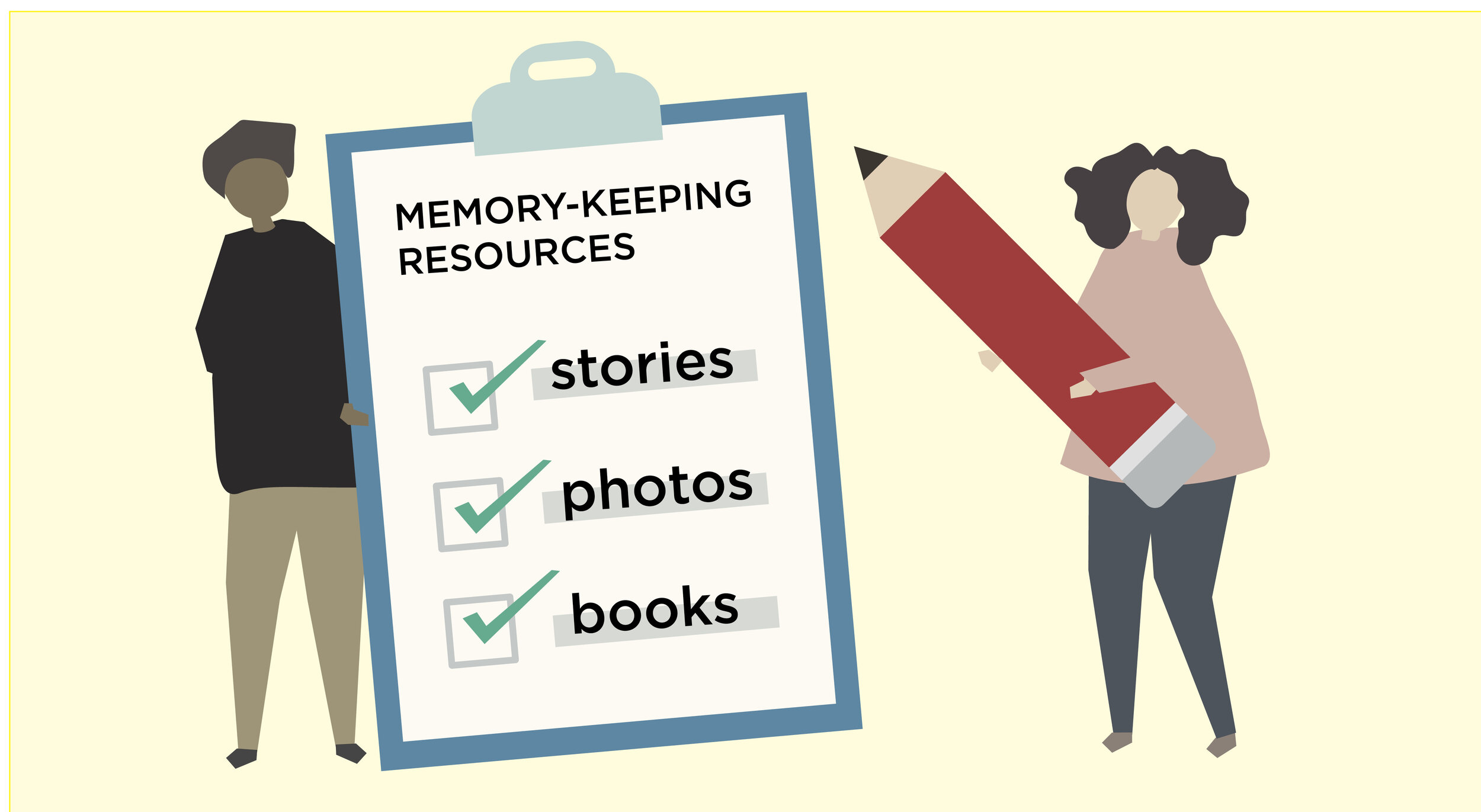
After years of blogging and helping people create books about their lives, I thought it would be a good idea to organize all the most helpful posts on the Modern Heirloom Books site in a way that makes it easier for you to find what you’re looking for—hurray!
What follows are some of the most comprehensive and useful posts to help you in all aspects of your memory-keeping—from capturing life stories through oral history interviews to writing your own memoir, from family photo preservation to finding the stories behind those precious photos, it’s all here!
how to use this catalog
Bookmark this page in your browser so you can come back to it easily.
Click on any of the topics below to go straight to that section.
Click on any of the story names to go straight to that post—they’re all hyperlinked.
topics to explore
Creating a family photo archive

If you are interested in WRITING about your life:
Memoir Writing Prompts
The foolproof life writing prompt guaranteed to get your pen moving.
This multi-part writing prompt is generative—it will yield even more ideas for future writing.
Learn about our Write Your Life memory and writing prompt subscriptions
Writing prompts for life story vignettes: 300 words in 30 minutes
Writing prompts for life story vignettes: the self-interview
Thinking about the meaning of the word ‘family’ yields two foundational writing prompts
Unexpected places to discover great life story questions to use as writing prompts
Memoir Writing Tips
How to break down a life story book project into three simple steps
How to create a life timeline for your memoir writing project
How to set a realistic deadline for your life writing project
Differences between biography and memoir—and why you should write your life stories (plural)
Ever consider using a list format to explore your life stories?
Feeling stuck with your life writing? Try this 3-step reset.
How to get your memoir off your bucket list and onto the page.
Three ways to research your memoir—and when to know your research is enough to begin
“The messy middle”: Pushing through the toughest part of memoir writing
Not sure if NOW is the right time to write your memoir? Ask yourself these two questions.

If you are interested in learning more about capturing your FAMILY STORIES:
Family History Interview Questions
Tips for Preserving Your Family Stories
Best practices for conducting family history interviews at home.
How to get a parent who doesn’t want to talk about their memories to open up
How to turn an oral history interview into a compelling story
Eight things you can do to be a good steward of your own family history
Differences between scrapbooking and creating personal history books
How to interview a loved one who is on hospice: Ask questions that help create “a biography of joy”
How to be a good storyteller if you are the subject of a family history interview
Tips for interviewing a pair of your grandparents together at the same time.
When to break a family history interview into multiple sessions
How to edit your family history so it will make sense 20 years from now
To read or not to read? How to handle a deceased family member’s personal letters
Go beyond the paper trail: 3 fun ways to follow clues about your family’s past
How to avoid scope creep and make sure you FINISH your family history project

If you are interested in creating a FAMILY PHOTO ARCHIVE:
Organizing & Saving Your Family Photo Collection
How to organize your family archive as a resource for sparking memories
Follow these basic photo organizing principles so you leave a manageable photo legacy for your kids.
What to do to ensure your kids don’t throw out your family photos
Make sure you’ve digitized the family photos in frames around your home.
Why sometimes a “bad” photo is the perfect picture—and worth saving
The one thing not to do if you want your photos to print beautifully in your memory book
Telling the Stories Behind Your Photos

If you are interested in finding ways to HONOR A DECEASED LOVED ONE:

If you are interested in finding IDEAS FOR HEIRLOOM BOOKS:
Your 10-step plan for making an heirloom-worthy family cookbook
10 heirloom book themes to narrow your life story book focus.
Adoptive parents: Preserve your journey to adoption in an heirloom book.
Six heirloom book ideas, from travel journals to family recipe books with a twist
“Dear Daughter, on Your Wedding Day,” the most meaningful gift for the bride-to-be from her parents
How to create a vacation photo book or family travel journal
Why I think classic (not trendy!) design is best for your personal history book

Do you need to be convinced that YOUR STORIES ARE WORTH SAVING?
How your stories’ enduring value can offer life lessons to your grandkids and beyond
How to leave a legacy that is a blessing to your descendants
Hear one client’s experience: “It was more for me than anyone else”
Wanting to know more about our parents’ lives is not a trend.
Your grown kids might not care about your stories now, but they will someday.
Genealogists share their reasons for valuing our own family stories.
“I wish I had asked my mom that” and other heartbreaking regrets you can avoid
Let Josh convince you that now is the time to tell your stories.
You’ve got reasons why you aren’t telling your story; I’ve got reasons why you should.
This post will be updated regularly as new relevant content is added. It was most recently updated on August 29, 2025.

Storytelling isn’t just good for the soul—it’s good for your health, too.
Did you know that listening to and sharing stories can help us live longer, happier lives? Discover three impactful ways to bring storytelling into your life.

Here are three ways to incorporate storytelling into your life to reap proven health benefits:
1 - Listen to some entertaining stories.

Can listening to a podcast really be good for your health? If it’s sharing a good story—and by good I mean that it’s relatable, engaging, and yearns toward the universal—then, heck yeah, it can.
Doctors explain it this way (well, I’ve simplified it greatly!):
We hear, “Once upon a time…” and, first, our heart rate increases as our attention is piqued.
Then, as the story begins to unfold, a chemical change happens—our brains release oxytocin, a hormone that causes us to really care about the people involved. Oxytocin helps us to feel bonded, and enhances our feelings of empathy.
According to studies, that release can also lower blood pressure, ease gastrointestinal distress, and even promote wound healing and suppress inflammation.
So the physical effect of listening to a good story goes well beyond leaning in to hear better!
And there’s more: Stories positively impact our mental health.
Researchers have found that seniors suffering from dementia who participate in community-based story sharing programs, sometimes referred to as reminiscence therapy, have improved cognitive function. You know what else? They report being happier.
An interesting finding? It doesn’t matter if the story we hear is happy, sad, or dramatic, as long as we’re engaged!
Two of my favorite places to get stories in bite-size pieces:
StoryCorps home page, for their animated interview clips, which always tug at my heartstrings
2 - Write about a challenging time in your life to help you make some sense of it.

When bad things happen, we need to find ways to fit them into the stories we have told ourselves about our lives. Journaling is one powerful way to do this.
“Storytelling allows us to take life events that are exceptional, unforeseen, or otherwise out of the ordinary and domesticate them into meaningful, manageable chapters in the ongoing arc of our lives. This act of integration,” Bruce Feiler writes in Life Is in the Transitions, “is storytelling’s greatest gift.”
Have you recently divorced your partner? Lost your job? Are you feeling undermined at work or lost at home? Have you suffered trauma in your past? Or are you just feeling a little “off”?
No matter how big or small your challenge, writing about it with intent—to reflect and find meaning—will undoubtedly be helpful. It’s why so many psychologists recommend the practice to patients working through a difficult experience.
What does the data say? Journaling helps improve well-being after traumatic and stressful events, according to a study from Cambridge University. A host of other research enumerates the benefits of expressive writing, as well, from coping more effectively with stress to improved memory function, from helping us make better decisions to accurately naming our feelings.
What do people say? Simply put, it makes us feel better. Journaling can be cathartic, sense-making, calming. By creating a coherent narrative out of something that was experienced mostly through emotions before—anger, sadness, outrage—we can make sense out of the chaos of our lives.
A few tips to get started writing about painful experiences:
Choose one challenging life event or theme to write about more than once. On day one, free-write—jot down impressions and emotions, and allow your pain to flow through your pen. On day two (a week or so later), try to construct a story about your experience; and during a subsequent writing session, probe for meaning. You might want to try writing a letter to your younger self, or imagining what a compassionate friend might say in response to your narrative. If these writing suggestions do not resonate, check out the writing prompts in this article specifically designed to help individuals cope with symptoms of PTSD.
Be gentle with yourself. While writing may bring clarity, it will also drum up some difficult feelings. Consider reaching out to a supportive friend or therapist if the process becomes overwhelming.
Find gratitude. Even in the most challenging circumstances we may find “silver linings.” Write about something you have learned or gained through your journal practice. Try to be conscious of any healing that is happening along the way.
3 - Ask someone you love to tell you stories from their life.

It’s so easy to get into a rut of routine conversation with our loved ones. Next time, skip the quick text asking, “How was your day,” and instead invite more meaningful conversation.
An eight-decade Harvard study found that those with deeper social connections live longer. “The surprising finding is that our relationships and how happy we are in our relationships has a powerful influence on our health,” said Robert Waldinger, director of the study.
According to an article in The Harvard Gazette, “Several studies found that people’s level of satisfaction with their relationships at age 50 was a better predictor of physical health than their cholesterol levels were.”
Relationships, it would seem, are a key ingredient to our well-being, especially as we age.
And intergenerational connection—that between, say a grandparent and a grandchild—may have even greater health benefits.
As Marc Freedman, author of How to Live Forever: The Enduring Power of Connecting the Generations, writes, “an accumulating body of research on purpose, generativity, relationships, and face-to-face contact suggests that engagement with others that flows down the generational chain may well make you healthier, happier, and possibly longer-lived.”
A few ideas for having deeper conversations with your family elders:
Pick one or two questions from a list of family history interview questions to spark some story sharing. And be a good listener: Ask follow-up questions, make eye contact (if you are physically present together or on video chat), and provide a safe space for reflection.
Grab an old family photo to use as a memory prompt and ask your loved one to tell you about a time from their childhood (or yours!).
Go deep: Ask them thought-provoking questions that are usually relegated to philosophy books these days. How do you want to be remembered? What do you wish you knew when you were 20 years old? What has been the great joy of your life?
My biggest wish for you? That you will do one or more of these suggestions not just once, but that you will make them a part of the fabric of your—even healthier!—life.
Dawn Roode’s curated roundup for the week of Sept. 23, 2026, is overflowing with recent reads on memoir, life story writing, and family history preservation.