
Memories Matter
Featured blog Posts

READ THE LATEST POSTS
Why a “coffee table” life story book?
After we record your personal history interviews, I craft your story and photos into an heirloom coffee table book—not a video, not an audio file. Here’s why.
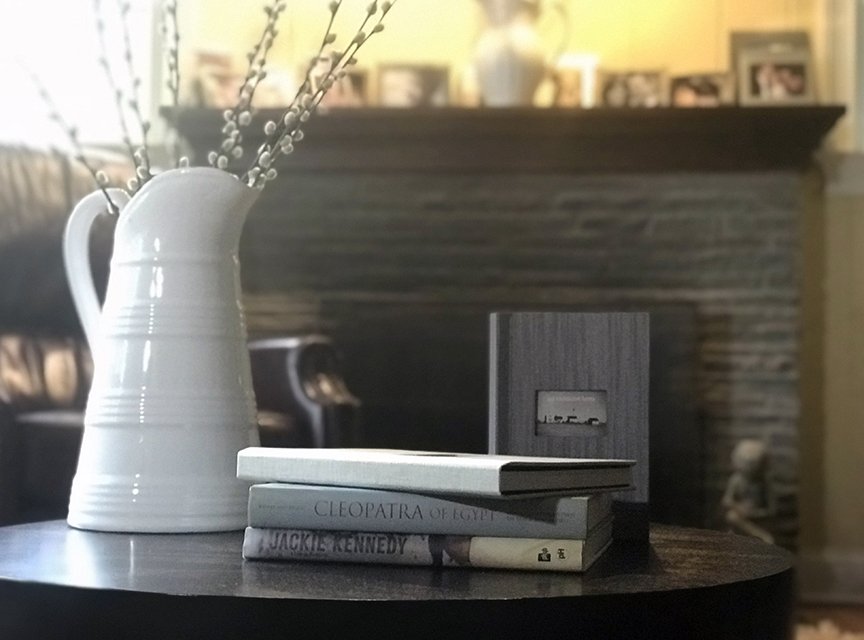
One of the most compelling reasons to preserve your personal stories in a coffee table book? You’ll display it in your home—which leads to people picking it up and engaging with it…which leads to even MORE story sharing and connection.
While I realize that most people have still never heard of a “personal historian,” I have been heartened over the years to understand that most people ARE interested in the services we offer—preserving life stories and family history, often through oral interviews; and the values we hold—a respect for preservation, a love of storytelling, and an abiding belief that intergenerational connectedness is a balm for the soul!
Often when I meet someone new and describe what I do, they ask me, Why books—why not video? Or, Why coffee table books specifically?
Well, the fact that I create personal history books in no way diminishes my respect for other forms of storytelling. If you prefer to record your loved one’s voice and receive edited audio recordings for your family archive, I can refer you to the perfect person to help you with that. Envisioning your family member talking about their memories on film? I’ll happily refer you to a video biographer I know and trust.
Me, though—well, I love books. And I have decades of experience in print. It’s my thing.
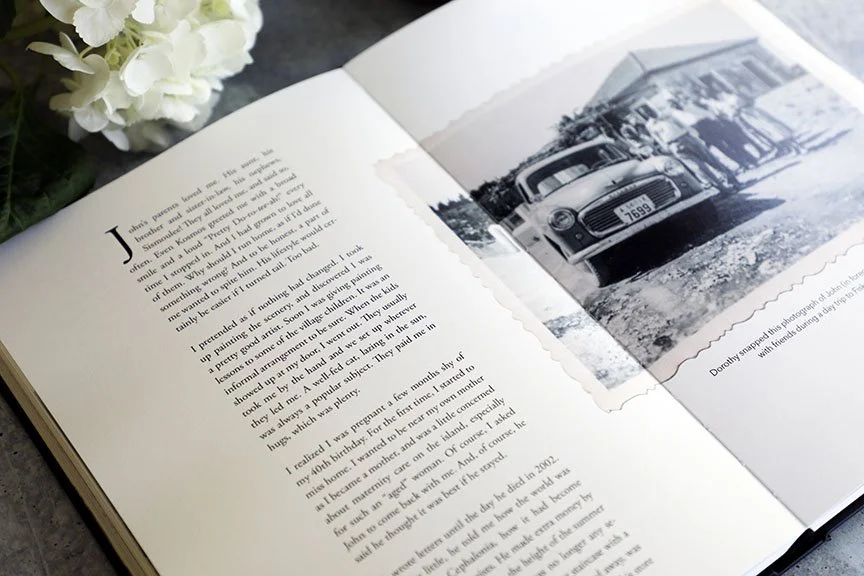
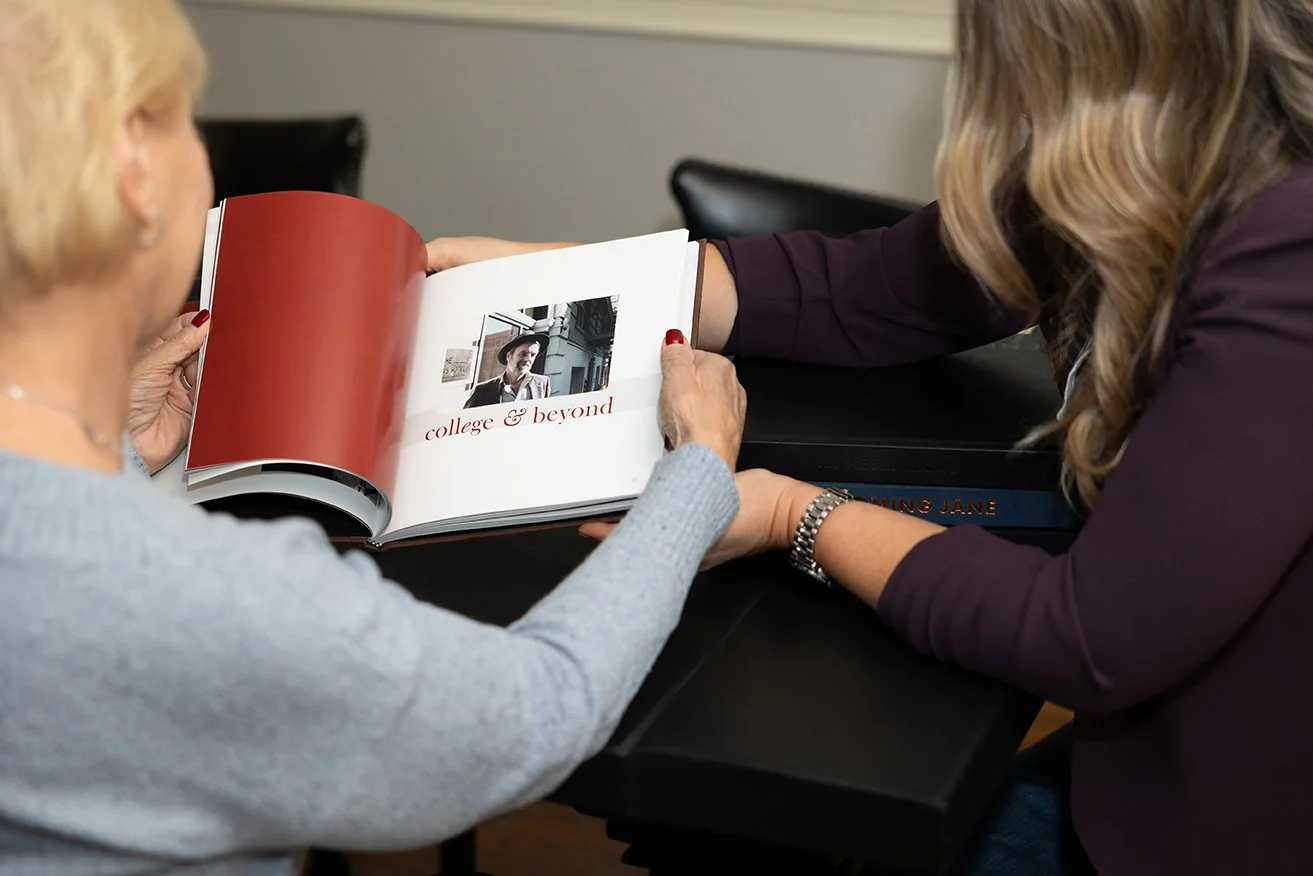
Large photos and ample white space give your heirloom book visual interest and breathing room.
My expertise is in print. And books have my heart.
I worked in magazines for years, back in the heyday when printed magazines were thick and juicy…before they were stunned by online journalism and “content creation.” I worked with some of the best writers, editors, and creative directors around at titles as diverse as Vogue, Harper’s Bazaar, Vanity Fair, Parenting, Child, and Latina. I gained a career’s worth of experience in compelling interviewing, project management, and visual narrative. And it’s both a love of the print medium and my desire to continue using all those storytelling skills that drive me to tell YOUR stories in print.
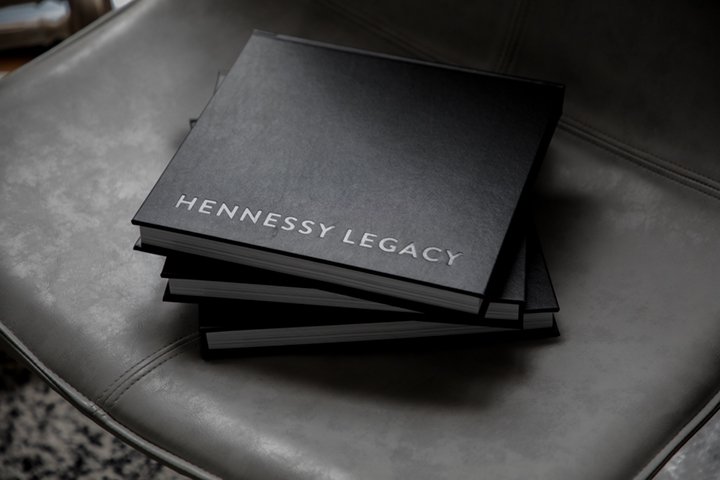
I turn your stories and family photos into heirloom coffee table books because I know you will display such a book in your home. Having your book out all but guarantees people will pick it up and engage with it. And designing it with great photos—and with plenty of entry points—makes it even easier to engage with: so the stories you have included in the book will encourage more (in-person, out-loud!) story sharing.
Some have heard me say, “I don’t want to read a 500-page book of straight text about Obama or Madonna, forget about my grandmother!” That’s not to say I don’t want to KNOW their stories—I do! I just want them presented to me in a way that’s inviting. Arresting. Compelling. INTERESTING!
Generations from now your ancestors will not need a new computer or updated software to access your book—they can pull it off the bookshelf and dive right in!
Print is the forever media format.
A book is a physical thing, with a sense of heft and permanence that the digital cannot provide. The tactile experience of reading a book is emotionally satisfying. A book confers status. It is special, and the story within is, too.
A book is destined to become an heirloom.
A book “can be read in the familiar tone of one’s inner voice, skipped where necessary, laid down when it pleases, and carried about freely,” wrote Robert Graves in 1958. It will never need to be upgraded, archived, or converted to a new media format.
In a digital world, print stands out.
And by the way: Merging print with digital can be more powerful than each medium alone; both serve different functions and are not only valid, but essential. As such, a digital version of your print book is always available: it serves as a backup of the book, and is more easily shared among friends who are not near.
Are both a form of social media? You bet. While you can share and tag and collect comments on a digital book, you may gather around a physical book on your table, laugh, share stories, relive memories, and...make some new ones.










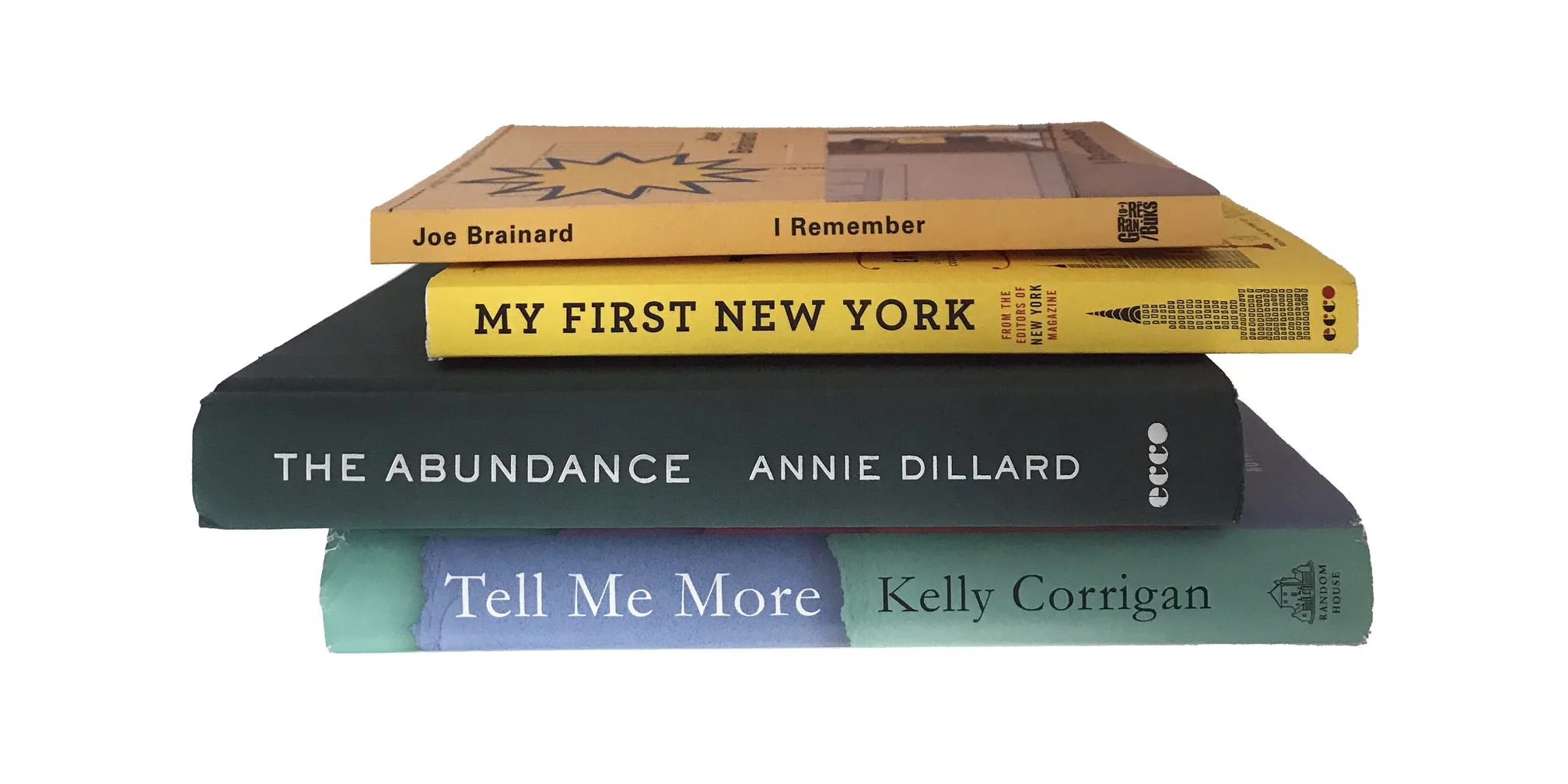



Your 10-step plan for making an heirloom-worthy family cookbook
From gathering recipes to editing, from design to printing, these steps will walk you through how to create a family cookbook to preserve your food heritage.
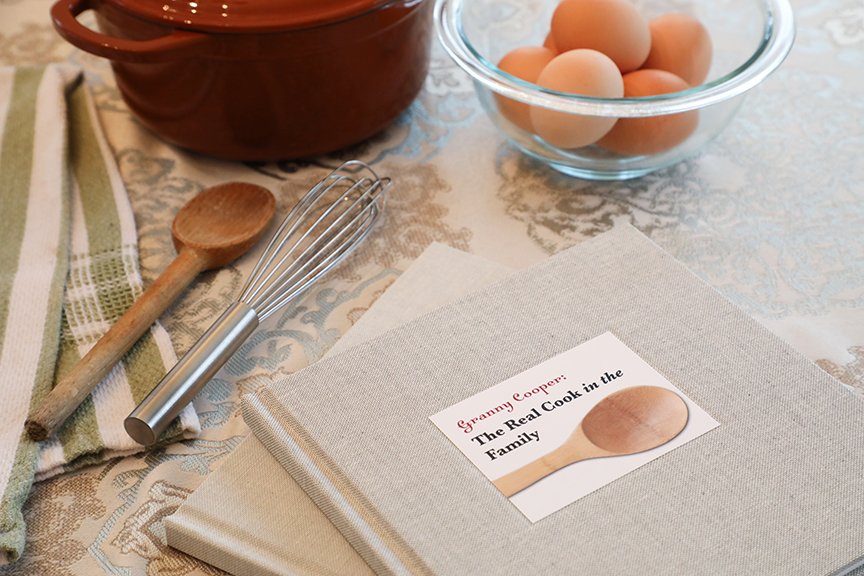
This family cookbook hones in on the recipes of one family member known for her prowess in the kitchen, Granny Cooper.
Want to put all your family recipes into a printed cookbook? Doing so will not only ensure that generations’ worth of foods get passed on, it will also give you the opportunity to indulge in some nostalgia and revisit childhood memories (ah, the smell of my mom’s roast chicken! the texture of Nanny’s potato pancakes!!).
Creating a thoughtful, heirloom-worthy family heritage cookbook takes planning and a fairly serious time commitment, but don’t let that stop you. This 10-step plan—with details on how to execute each step with flair and accuracy—will take the stress out of making your family history cookbook (heck, you might even find the process fun).
1. Decide on a theme.
Sure, your theme can be as broad as “our family recipes,” but I encourage you to go a little deeper; a tighter focus invites more meaningful storytelling and will ultimately help you curate which recipes to include. Some ideas for family cookbook themes:
Cooking with Nana
Holiday Dishes of the Ruggierio Family
The Tastes of Our Childhood
Mama Nash’s Birthday Celebration Secrets
Three Generations’ of Schwartz Recipes
Grandpa Lou’s Barbecue Bible
Categorize your recipes any way you wish—and remember, you can always make a companion volume down the road.
2. Gather recipes.
Here are some key places to look to ensure you get all the recipes you’d like to include (you don’t want to be hunting them down midway through the design process, so focus on finishing this before moving to the next step):
recipe boxes
file folders
magazines and cookbooks (even handwritten faves can be stuffed inside)
your computer
other family members’ homes
in someone’s head (if Bubbe is the only one who knows how to make the matzoh ball soup you love, best get the details out of her head and onto the page!)
I suggest brainstorming a list of recipes you’d like to include with a family member. Having a partner can help not only with accountability but also with discovery.
And don’t discount simple favorites such as the easy vinaigrette your mom made on every school night—you might be surprised by how the simplest of “recipes” can escape us years later.
3. Get cooking.
You didn’t think you’d get away with writing a cookbook without a little recipe testing, did you? If you want the recipes you include to be truly useful, cooking them with someone who has never done so before is a great opportunity to learn what steps may not be clear enough. Include specific tips whenever questions arise—for instance, “a cast iron pan works best” or “letting the meat get to room temperature before roasting will ensure even cooking.” Make sure that all ingredients have measurements; all recipes have cooking times and temps; and, when possible, indicate how many servings a recipe yields. Take notes as you cook and edit your written recipe accordingly later.
A useful approach: Test recipes over the course of a few months so you don’t feel rushed (and can truly enjoy the results over multiple meal seatings). When you’ve worked out all the kinks, then schedule a few consecutive days to cook many of them again, this time with photography in mind. I recommend taking some photographs during prep (you could do a still-life of some key ingredients, or take shots of a sauce simmering on the stove, or of a family member stirring the pot) as well as taking well-lit pictures of the finished dishes, either styled on your counter or at the table with family members included. A cookbook with gorgeous photos is sure to inspire!
4. Determine how you will record everything.
If you are working towards a printed cookbook, at some point all your recipes and stories will need to be typewritten and placed in one document—but that doesn’t mean you have to start that way. In fact, taking handwritten notes in a dedicated notebook while preparing your foods (see previous step) is an efficient way to get everything down accurately. Having a partner will also expedite your process: One person cooks and preps while the other takes notes (and later, takes photos).
If you are including stories alongside your recipes (please do!!), you may want to dictate your memories and record them with an app on your phone—there are plenty of AI-powered transcription services now that make converting your audio files to type easier than ever (check out rev.com or otter.ai). Remember that handwritten recipes will need to be typed up, as well, so they can be imported into layout software and designed after editing.
5. Edit the contents of your book.
Now that you’ve got all of your heritage cookbook content in one file, it’s time to edit. First, focus on structure: Sort your recipes into categories according to the theme you selected at the outset, and place them in an order that makes sense. Add subheadings for each section, as well as any stories that will accompany your recipes.
Next, edit for readability: Cut extraneous things, add explanation where it seems necessary, inject personality into your writing (this is your family cookbook, not a college thesis), and generally make sure everything makes sense and reads well. (A great tip for any kid of writing: Read along out loud and see where you get tripped up—chances are you need to fix your phrasing or shorten a sentence.)
Finally, it’s time for copyediting. If your grammar and spelling skills aren’t stellar, I suggest asking someone else to take on this step. This is where you fine-tune language and ensure consistency of everything from punctuation to fraction styles to ingredient amounts.
P.S. I can hear your groaning about this step—yes, it’s tedious, but impeccable editing will elevate your cookbook from a homespun craft to a real family heirloom.
6. Find a printer.
Yes, I advise you to decide upon a printer before you begin designing your book. Why? Because knowing their specs—available trim sizes, importantly!—and pricing options will help you decide upon a format that best suits your needs. If you know you are printing 10 or more books, you’ll be able to find a printer that discounts bulk orders; and if you just need one or two copies of your cookbook, then print-on-demand is the way to go. Some publishers may have their own proprietary software that makes designing a book with them easier; while others will expect you to prepare press-ready digital files in professional software such as InDesign (not something you want to be learning from scratch for this project, I assure you). This step and the next (design and production) are by far the ones most people need help with, but if you’re fairly tech-savvy and willing to devote some time to this project, you can create something special.
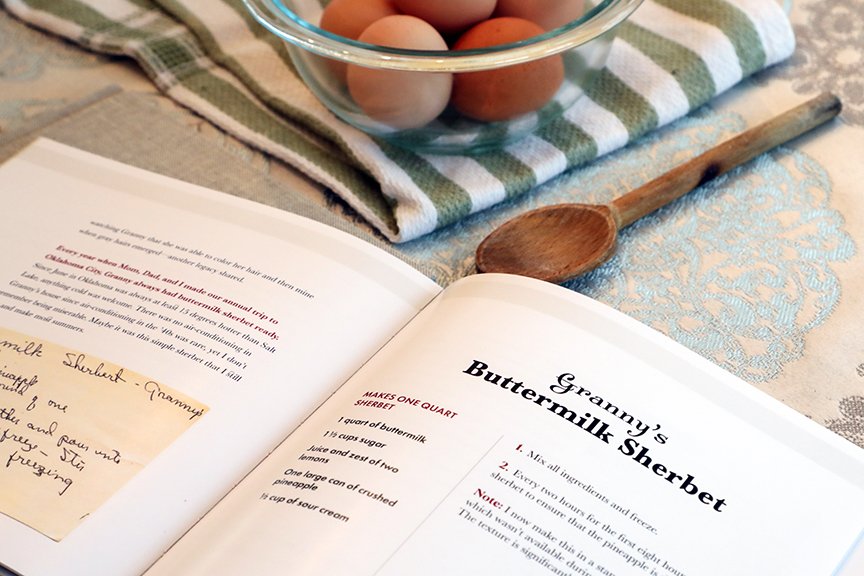
7. Design your cookbook.
If you are not a designer, this can be one of the most challenging steps, especially if you’d like your book to look professional. I recommend finding a few favorite cookbooks to emulate—you may find those on your bookshelf, or a trip to the local library may be in order. Here are a few basic tips to get your cookbook design going:
Create a design template according to the specs from the printer you selected.
Limit your typeface usage to two basic font families: one serif and one sans-serif. Set all stories and accompanying text in a classic serif font such as Times New Roman or Baskerville, then set the actual recipes in a sans serif typeface that has multiple weights such as Futura or Helvetica.
Be consistent with image placement—perhaps a horizontal image of the finished dish at the top of each recipe or a full-page image on the page across from your recipe. The stronger your photography at the outset, the stronger your finished family cookbook will be!
Choose a fairly neutral color palette so your design complements the photographs rather than competing with them. That doesn’t mean no color at all, but rather colors that will work alongside your images. Did you use bright pottery in the images for your Mexican-food cookbook? Then bold colors such as orange and blue may work. If your book includes mostly muted tones (images of bread baking and lots of flour and dough, for instance) then perhaps a combination of a subdued blue and a shade of taupe will work. Whatever combination of colors you choose, use those few tones consistently throughout the design for a cohesive look.
Include page numbers and foot lines throughout the book.
Create a table of contents listing all the recipes and their corresponding page numbers—and if you’re ambitious, also include an index so readers can locate recipes by ingredient.
8. Proofread your book, please!!
You’ve worked so hard to produce this special legacy cookbook—it’s worth your time to read it two, three, even four times to ensure there are no mistakes after it is designed. Ideally you will also ask another individual to give it a read, as your own closeness to the project can make it hard to spot some errors. Copyeditor pro tip: Don’t forget to read the largest type on the page; too often our eyes will skim right over headlines and titles, and that’s the last place you want to see a typo!
9. Print your book.
Hopefully you already settled on a printing service in step number six above. At this point you will need to export your pages in whatever format your printer designates—generally either high-resolution jpegs or PDF files. Check to see if you need to account for bleed (photographs or colors that run off the edges of the page), and pay attention to any warnings for low-resolution images—you’ll want to replace those so your book prints beautifully. After uploading your book files, do a final check to make sure everything looks good before hitting “send.”
10. Share your heirloom cookbook with your family.
Why not host a party with some of the dishes featured in the cookbook? Take some pictures and keep the memory-making—and legacy—going. If you’re gifting the cookbooks to family members, handwrite a dedication on the title page to personalize the books for each recipient.

Free Guide: Preserving Your Food Memories
Download this free printable guide with family history questions designed to elicit food memories.




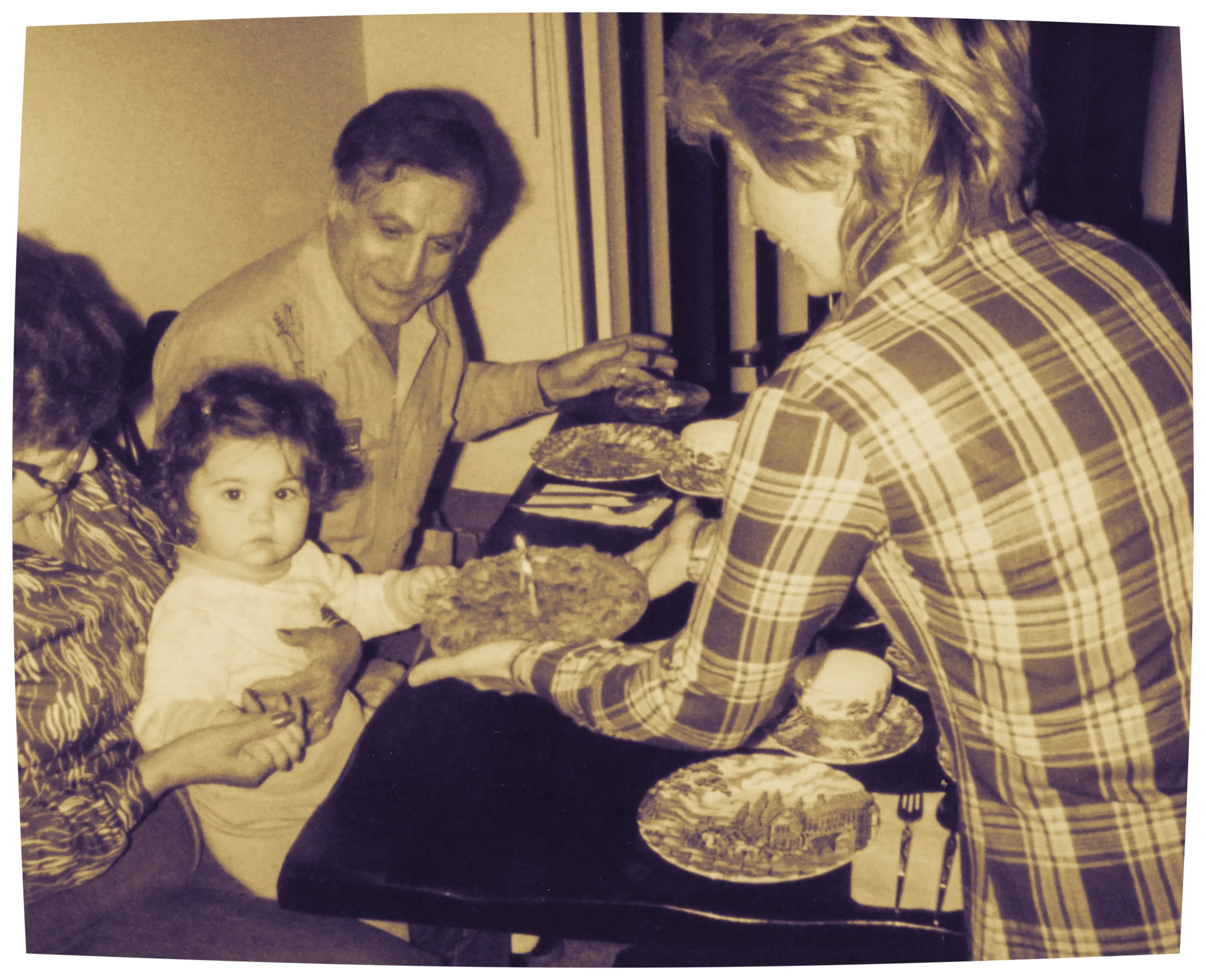

10 Heirloom book ideas to preserve your family history
From life story books to a family history collection, from travel journals to heritage cookbooks, our founder lists 10 of her favorite heirloom book themes.
Maybe you’ve thought about preserving your own or your family’s stories in a book for the next generation. But where to begin? How to narrow down a topic?
Don’t worry, I’ve got you covered. Here are 10 of my favorite heirloom book themes, and I’m willing to bet one of them jumps out at you as just-right for your situation. And if not? No worries, all of our books are fully custom, so let’s chat.
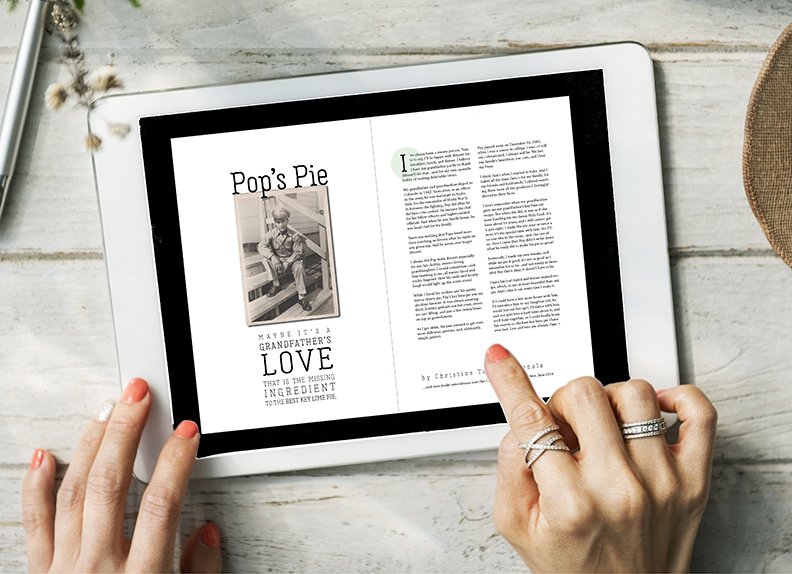
A family cookbook—complete with the stories behind the recipes—is a great option for families whose love language is food.
1 - a heritage cookbook
Be transported to the kitchen of your childhood! Celebrate dishes that have been passed down through generations in a bespoke book that weaves your family’s cherished food memories with nostalgic photographs and handwritten recipes.
2 - LOVE STORY
Perhaps you were bequeathed a beribboned stash of your great-grandparents’ love letters. Or maybe it’s your own love story—how you met, how you choose one another every day, maybe how you almost didn’t meet—that you’d like to share. Let the love flow...
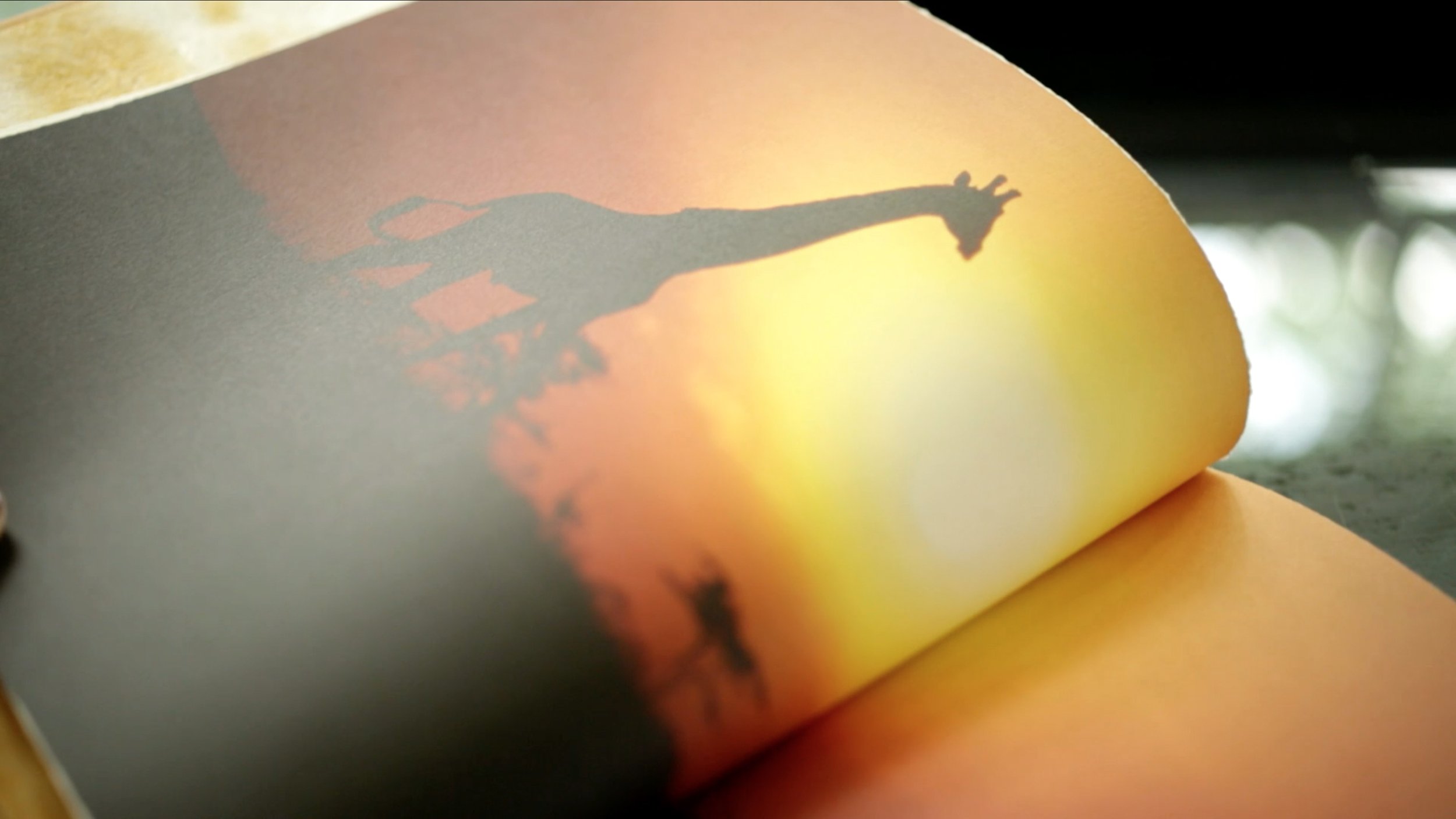
Record your journeys in a travel book so you can revisit your memories from the comfort of home (and inspire the next generation to travel in your footsteps).
3 - travel journal
Are you a voyager? Don’t just make a photo album; record memories. Wherever your journeys take you (an African safari? The Maldives? Alaskan glaciers?), our travel books help you not only remember the places, but relive the moments—and ‘travel’ back there from the comfort of your home.
Your stories matter—tell them in your own words, and they will resonate with loved ones for generations.
4 - your words, your stories
Whether you’ve written a full-on memoir (if you’re partway through, we can help you finish!) or want to capture episodes of your life through a series of personal interviews, tell your own story. It matters. To you, and to those you love. Now is always the right time!

Honor a loved one’s memory by preserving tributes in an heirloom book that you and your family can open any time to feel closer to them.
5 - in remembrance
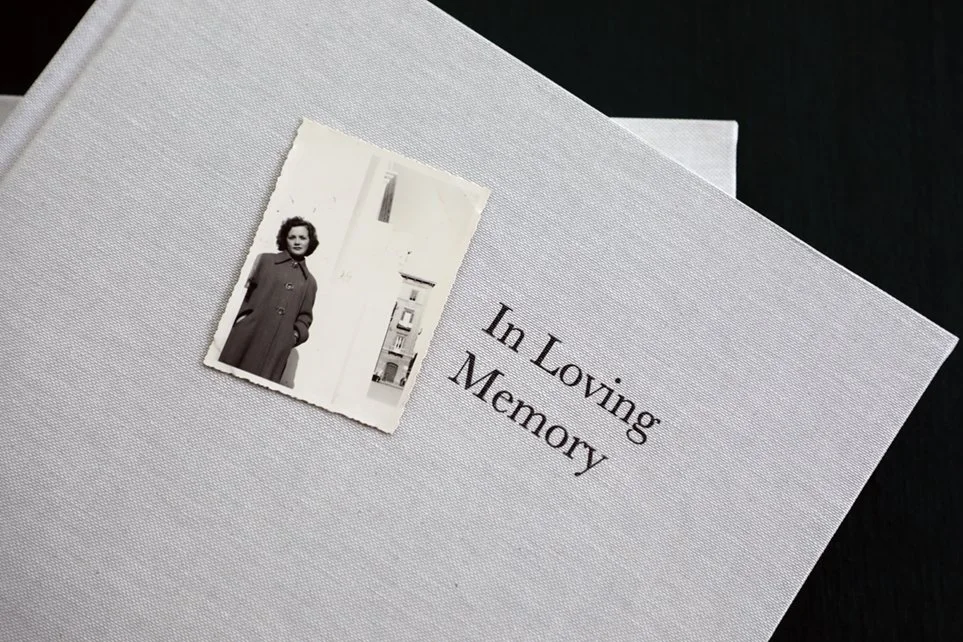
Is there a family member who has passed that you would like to honor? Let’s gather written tributes remembering them with dignity, humor, and grace, then curate photos that capture their spirit. Bound with love, this tribute book will become your most cherished heirloom.
6 - FAMILY HISTORY BOOK
Have you caught the genealogy bug? Consider this: It is highly unlikely your ancestors will be thrilled to sort through 18 boxes of census records and ship manifests, no matter how meticulously catalogued they are. They will, however, read a story. So give them one.

7 - home is where the heart is
As Henry Louis Gates, Jr., says, we are all immigrants. Do you know where your ancestors were born? Have you taken a heritage trip? Perhaps your family lived on the same NYC block for generations. We can bring the stories of your homeland to life, so they are never lost.
8 - LESSONS LEARNED
With experience comes wisdom. By reflecting on the full journey of your life—including challenges overcome and opportunities missed—you leave a legacy that the next generation can both learn from and find inspiration in. Go deep, and be rewarded deeply.
9 - CONVERSATIONS WITH GRANDMA
We’ll conduct interviews with your grandmother or other family elder, gather memorabilia, and find the narrative thread that best captures her story, then weave it all together beautifully. Don’t wait until it’s too late to ask questions.
10 - places in the heart
This book makes your favorite place the central character and gives meaning to the phrase, “If these walls could talk…” Think a beloved family vacation home, a longtime sleep-away camp, or the college you’ve all (multiple generations!) attended.
Wait, your photo book has no captions?
A family photo book without captions is nice—but one with captions is an heirloom. A primer on what type of captions to include and how to design them cleanly.
Whether your photo book includes current snaps for a family yearbook or older images for a family history retrospective like this one, it’s important to include some captions. Design with ample white space and classic typefaces for an engaging and modern feel.
If you do an annual photo book, you’re way ahead of most people in the memory-keeping game—so big props to you! I am a vocal proponent of printing your photos rather than letting them languish amidst a ton of digital clutter on your phone, and getting them into a printed book is a wonderful way to preserve memories for your kids and yourself.
It’s what you’re creating your memory books for, isn’t it? To be able to look back one day and recall the moments big and small from your family’s life? To create a record of your experiences, and celebrate the milestones? To revisit travels and everyday occasions one day in the future?
Well, imagine this: It’s ten years hence, and your daughter is about to graduate from high school. You sit down together and pull out a family photo book from her childhood. What was that teacher’s name? How about that friend she was inseparable from for a whole year? Where was that awesome waterfall you climbed all day to see?
Or this: It’s 30 years from now and your son has recently become a new dad. He’s curious about what his father was like, and if he himself had as much hair as his newborn. You dig out one of your earliest family albums (hopefully you’ve made an extra copy for your son to have, too 😉) and you start reminiscing. But which baby is that in the stroller? Was that photo of your toddler son walking from when he was 10 months or over a year old?
All those details that are so fresh and obvious to you now while you are putting your photo book together won’t be so obvious down the road. Chances are you’ll forget a lot of the nitty-gritty things like places, dates, and ages—and there’s no chance that your kids (or their kids!!) will know if they’re not written down.
Ugh, you’re thinking—what a royal pain in the @$%. I have to write everything down?
No, you don’t have to write everything down. But some things? Sure. Consider doing so a gift to your kids. Adding some captions to your photo book ups the value from a “nice” album to an “invaluable” family heirloom.
The two types of captions every photo book needs
The purely informational caption
You don’t need to type names and dates for every photo—not only would that be time-consuming, it’d be rather boring.
Consider creating sections for every month in your annual family photo book, and titling each section accordingly; you can include specific dates when photos represent milestones such as weddings, Bat Mitzvahs, or graduations (and if you scan a ticket or program that includes the date, you’re covered!).
As far as names go, always include names of new babies when they are first pictured, of close friends or schoolmates alongside your kids, and of family elders who aren’t part of your immediate clan.
Type out locations when you think it might be interesting—perhaps you’d like to revisit that hotel in Hawaii, or take that hike again with the grandkids one day. You can use lots of discretion here, but consider when making your decisions about what to include: If I were looking at my parents’ photo books, would I be curious about this?
The storytelling caption
As a personal historian, you might guess that these are my favorite types of captions, and you’d be right. Rather than get intimidated by the idea of telling a story, consider these ideas:
Choose one photo or series of photos from each month of your family yearbook to elaborate on. If your son’s soccer team made it to the finals and lost by one goal, tell us about it in a sentence or two (include the details of what happened, as well as how he was feeling—proud? disappointed?). If you have a cluster of pictures of family members lounging around the house, talk about it—believe it or not, looking back on everyday moments such as this can feel even more special years from now!
Another option: Have each family member write a few sentences about their favorite memories from the year. It can be off-the-cuff and more emotional (certainly there were plenty of emotions during the early parts of quarantining in 2019, for example); or you can let each person choose one or two photos to spark stories. You might scan their handwritten notes to include as caption-like images, or type out their responses for more traditional captions.
Keep a running list in the Notes app on your phone of memorable quotes from your kids and others throughout the year. You can then incorporate these into your family photo book near appropriate images—voila, ready-made captions that preserve your family voices.
If you want to go even deeper with your storytelling, download my free guide, “How to Use Photographs as Prompts for Writing Life Stories”; and if you’d like to see an example of how you can say a LOT in just 200 words, check out the extended caption in this post.
How to keep your photo book design modern and clean, even with captions
I can think of two main reasons someone might forego including captions altogether: (1) it will be too time-consuming (to which I say: your efforts will be rewarded!); and (2) it will make my layout look too busy (to which I say: read the tips below!).
For some guidance on designing clean, clutter-free book layouts, I enlisted the help of Ontario–based graphic designer Mei Mei Wood, whose aesthetic, like ours at Modern Heirloom Books, is one of timeless elegance.
Here are her top tips for creating a photo book that looks clean and modern, even with the addition of text:
Use one classic font family that has a variety of weights and italics.
“This allows you to style typography in different ways throughout a piece of work, while staying consistent and keeping things simple,” Mei Mei says. Choosing classic typefaces—such as Baskerville or BentonSans (see examples at bottom of page)—also ensures that your book will feel timeless.
Embrace white space.
Oh, Mei Mei, you are singing my tune!! “I can't say this enough: Don't fill your pages with elements. Leave breathing room for your eyes.” Amen.
Always pare back.
“Less is more,” Mei Mei says. “One of the greatest tips I've heard: When you've written something, cut it in half. Then half that again. When you think you can't possibly cut it down any further, reduce it by half again. That's how you figure out what the message truly is.” Such editing can be challenging, though, so I recommend giving yourself a few days between writing your captions and then cutting them down—that distance will help give you perspective and allow you to recognize anything extraneous in your text. “I know this is extremely difficult with ancestry-based memory-keeping projects because the instinct is to preserve as much as possible. But it really is about revisiting work multiple times over a period of days and paring back to what’s essential,” she says.
Incorporate pull quotes.
Again, Mei Mei zeroes in on an easy design approach that pros use that most people don’t think of: “Highlight an important line or two in the layout. It's so visually impactful and can shine a light on what's important.” Pull quotes—short snippets of text that are designed in a larger type size—work well with large blocks of text or alongside a handwritten letter or journal entry.

An example of a serif font family with various weights

An example of a sans serif font family with various weights

A graphic pull quote can accompany an enlarged photo such as this, or can go alongside a block of text or handwritten letter to create visual interest and an emotional touchpoint for someone just flipping through your photo book.












3 Best holiday gift ideas that honor family memories
Give your loved ones a gift they will cherish for years to come—one that puts memories front and center. Here are 3 (doable!) ideas to inspire happy tears.
One-of-a-kind gifts that preserve memories are the best kind of holiday presents!
Are you tired of gifting things that no one in your family really needs? Having trouble finding meaningful ideas for holiday giving? Here are three amazing Christmas or Hanukkah gift ideas, including tips and resources for going the DIY route as well as ideas for getting a pro to handle it all, start to finish. Happy memory-making!
1 - Create a family recipe book.

Not just any recipe book, but one filled with the ingredients and how-tos for your favorite dishes AND the stories and memories associated with them.
Be sure to include:
the foods’ origins (Who made it first? Who might have changed it over the years? Does it derive from a specific region or culture?
notes about any special ingredients (and by this I mean how to source unusual spices, perhaps, but also when using a certain brand—like U-Bet syrup or Eagle condensed milk—is crucial to a dish’s success)
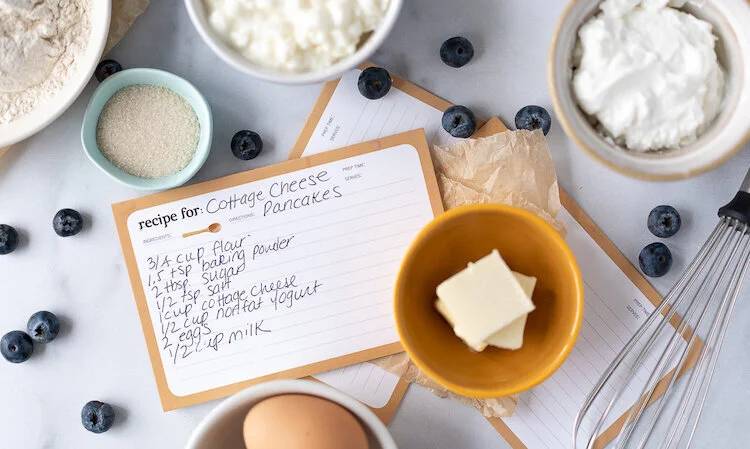
photos of handwritten recipe cards (those grease stains and crossed-out notations add incredible texture to your book!)
even simple foods if they hold special meaning to your family (Mom’s quick cinnamon toast, say, or Poppy’s three-ingredient holiday egg cream)
DIY family recipe book help
If you’re ready to dive in, these tips for getting the family involved in preserving your food heritage may help get you started.
And if you’re not quite ready but love the idea, these recipe cards have space for recording memories alongside your recipes, and they’re a great precursor to creating a family cookbook (they make a unique and thoughtful host gift, too). Use coupon code HOLIDAY2021 for 25% off at checkout, through the end of this year.
Consider a professionally created heirloom recipe book.
If you love the idea of honoring your family’s food heritage but don’t have the time or inclination to undertake such a project yourself, I’m here for you. Let’s set up a free call to discuss your project.
2 - Get those photos off your phone and into a book.

If your photos are sitting on your phone or computer, then you have a bunch of digital files, not a collection of memories. Get them in print for a gift guaranteed to make them (and you!) feel all warm and fuzzy inside.
The hardest part? Believe it or not, it’s not designing your book or finding a printer, it’s curating your photos. Huh? By curating I mean deciding which photos to put into your memory book and which to leave on the cutting-room floor.
Choose photos for your book that:
show you and your family members as you really are—don’t just choose well-lit posed shots and flattering selfies; rather, pick pictures that convey your personalities and exude real emotion
hold some special meaning, even if it’s elusive to outsiders
mark moments beyond the milestones—so, alongside those birthday and anniversary photos, include images from around the dinner table, or sitting under blankets for family movie nights (I guarantee these everyday scenes will grow exponentially in meaning over time!)
DIY photo book help
If you’re ready to get started, I challenge you to add some long captions describing your memories so your family photo book is wonderfully elevated to true memory-book.
Check this page out if you’d like some help with photo book themes.
Hand your photo book over to a pro
Need help with any part of this process? I can help you curate your photos, capture your memories, and design and print your photo book. Set up a consultation or consider buying a gift certificate for future services.
3 - Give them the gift of a generous listener (and time to share their stories!).

Asking someone to share their memories—and then giving them your undivided attention and heartfelt curiosity—is a gift we give not nearly enough. It’s why literally every single one of my personal history clients thanks me profusely for listening to them. For asking follow-up questions and never judging their experiences. For opening my heart and inviting their stories.
And you know what? This gift is free for you to give your loved ones. All it costs is time and a little bit of effort (I’ve even created a free gift certificate printable you can download and present to your loved one!)..
Fair warning: Your mom, granddad, or whomever you plan to bless with this gift, may very well have a look of confusion when they hear what you’re gifting them. Don’t let that deter you—instead, reiterate to them just how much you love them and value their stories, and how spending time together in such a way is as much a gift to you as it is to them. (It really is!!)
A few ideas for giving the gift of listening:
Be an active listener. Give your family member non-verbal cues as they are telling their stories—nod, show emotion on your face. These cues help them know, deep down, that they are being heard, and will urge them to keep sharing
Ask follow-up questions. Your curiosity is a wonderful driver of their stories. And by asking relevant, perceptive, timely questions, you will be helping them construct their story.
That said, be quiet sometimes. There are always times when silence—even an extended, potentially awkward silence—is called for. If you are truly listening and reading their cues, you may feel when this is the case: Do they have a faraway look in their eyes, like they are still inhabiting the world of their story? Give them a few beats to stay there. Have they dropped some profound or surprising insight on you? Just wait. Your patience is a gift, an opening for them to dig deeper and offer up even more out loud.
Don’t judge. Period. Approach this conversation with an open heart and an abundance of empathy.
DIY resources for interviewing your loved one
Will you be the one conducting the interview (or, if that sounds too “official,” leading the conversation)? This free printable guide has a great array of questions to help jog your loved one’s memory and get the stories flowing.
Will your child be asking the questions? This Kid Kit contains everything a child will need to spend quality story sharing time with their grandparents, from questions to historical tidbits to bonus family history activities.
Okay, the fundamental value in this activity is spending quality time together and learning more about your family elder—that’s really and truly it. However, don’t forget that it’s also a prime opportunity for recording their stories. So if you’d like to capture them for posterity (and I suggest you do!), check out this guide from the Smithsonian with specific tips on setting up a voice or video recorder and preserving your questions and answers.
Get some expert help to preserve their stories
Once you have had your story sharing session, you may want to consider having them professionally edited and designed into an heirloom memory book. If so, please reach out to see how I could help you bring your dream book to life.


More essential reads about Christmas memories:


Most helpful blog posts for memory keepers, memoirists, and family historians
The best posts to help you with memory-keeping, including family history questions, memoir writing tips, family photo preservation ideas & heirloom book themes.
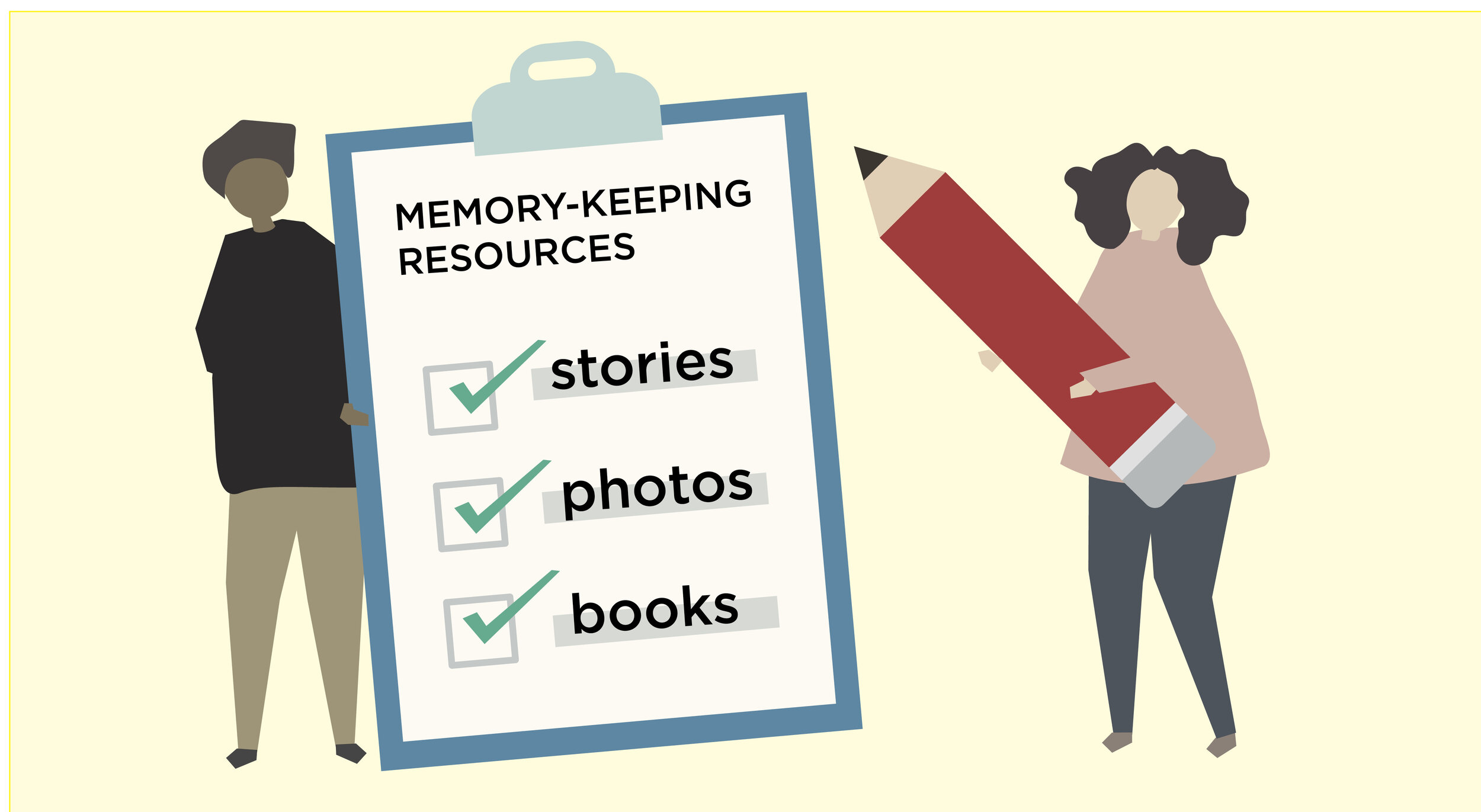
After years of blogging and helping people create books about their lives, I thought it would be a good idea to organize all the most helpful posts on the Modern Heirloom Books site in a way that makes it easier for you to find what you’re looking for—hurray!
What follows are some of the most comprehensive and useful posts to help you in all aspects of your memory-keeping—from capturing life stories through oral history interviews to writing your own memoir, from family photo preservation to finding the stories behind those precious photos, it’s all here!
how to use this catalog
Bookmark this page in your browser so you can come back to it easily.
Click on any of the topics below to go straight to that section.
Click on any of the story names to go straight to that post—they’re all hyperlinked.
topics to explore
Creating a family photo archive

If you are interested in WRITING about your life:
Memoir Writing Prompts
The foolproof life writing prompt guaranteed to get your pen moving.
This multi-part writing prompt is generative—it will yield even more ideas for future writing.
Learn about our Write Your Life memory and writing prompt subscriptions
Writing prompts for life story vignettes: 300 words in 30 minutes
Writing prompts for life story vignettes: the self-interview
Thinking about the meaning of the word ‘family’ yields two foundational writing prompts
Unexpected places to discover great life story questions to use as writing prompts
Memoir Writing Tips
How to break down a life story book project into three simple steps
How to create a life timeline for your memoir writing project
How to set a realistic deadline for your life writing project
Differences between biography and memoir—and why you should write your life stories (plural)
Ever consider using a list format to explore your life stories?
Feeling stuck with your life writing? Try this 3-step reset.
How to get your memoir off your bucket list and onto the page.
Three ways to research your memoir—and when to know your research is enough to begin
“The messy middle”: Pushing through the toughest part of memoir writing
Not sure if NOW is the right time to write your memoir? Ask yourself these two questions.

If you are interested in learning more about capturing your FAMILY STORIES:
Family History Interview Questions
Tips for Preserving Your Family Stories
Best practices for conducting family history interviews at home.
How to get a parent who doesn’t want to talk about their memories to open up
How to turn an oral history interview into a compelling story
Eight things you can do to be a good steward of your own family history
Differences between scrapbooking and creating personal history books
How to interview a loved one who is on hospice: Ask questions that help create “a biography of joy”
How to be a good storyteller if you are the subject of a family history interview
Tips for interviewing a pair of your grandparents together at the same time.
When to break a family history interview into multiple sessions
How to edit your family history so it will make sense 20 years from now
To read or not to read? How to handle a deceased family member’s personal letters
Go beyond the paper trail: 3 fun ways to follow clues about your family’s past
How to avoid scope creep and make sure you FINISH your family history project

If you are interested in creating a FAMILY PHOTO ARCHIVE:
Organizing & Saving Your Family Photo Collection
How to organize your family archive as a resource for sparking memories
Follow these basic photo organizing principles so you leave a manageable photo legacy for your kids.
What to do to ensure your kids don’t throw out your family photos
Make sure you’ve digitized the family photos in frames around your home.
Why sometimes a “bad” photo is the perfect picture—and worth saving
The one thing not to do if you want your photos to print beautifully in your memory book
Telling the Stories Behind Your Photos

If you are interested in finding ways to HONOR A DECEASED LOVED ONE:

If you are interested in finding IDEAS FOR HEIRLOOM BOOKS:
Your 10-step plan for making an heirloom-worthy family cookbook
10 heirloom book themes to narrow your life story book focus.
Adoptive parents: Preserve your journey to adoption in an heirloom book.
Six heirloom book ideas, from travel journals to family recipe books with a twist
“Dear Daughter, on Your Wedding Day,” the most meaningful gift for the bride-to-be from her parents
How to create a vacation photo book or family travel journal
Why I think classic (not trendy!) design is best for your personal history book

Do you need to be convinced that YOUR STORIES ARE WORTH SAVING?
How your stories’ enduring value can offer life lessons to your grandkids and beyond
How to leave a legacy that is a blessing to your descendants
Hear one client’s experience: “It was more for me than anyone else”
Wanting to know more about our parents’ lives is not a trend.
Your grown kids might not care about your stories now, but they will someday.
Genealogists share their reasons for valuing our own family stories.
“I wish I had asked my mom that” and other heartbreaking regrets you can avoid
Let Josh convince you that now is the time to tell your stories.
You’ve got reasons why you aren’t telling your story; I’ve got reasons why you should.
This post will be updated regularly as new relevant content is added. It was most recently updated on August 29, 2025.
Announcing group gifting option for tribute books
If you’ve wanted to create a surprise tribute book telling your loved one JUST how special they are but cost is a factor, consider asking contributors to chip in.

A new offering from Modern Heirloom Books is group gifting, allowing all contributors to chip in towards a most unique surprise gift: a tribute book honoring someone you love.
At the beginning of the pandemic I worried that my business would suffer. Creating books about our lives could seem like an indulgence, after all (though I’ve argued to the contrary). What I didn’t expect was how being forcefully distanced from our loved ones would make so many folks turn inward—and gain a renewed appreciation for all we hold dear.
The first tribute book inquiry came just a few days after New Jersey, where I reside, declared a state of emergency, effectively quarantining us in our homes: A man in South Carolina wanted to create a book for his wife’s 60th birthday. Three days later, I got a request from someone just a county over wanting to create a book for her mother’s 60th birthday. A week later, I began working on a tribute book honoring a teacher in New York City who had died of Covid-19.
I have been working consistently on tribute books for people all over the country every week since then.
And what a privilege it has been! As I gather and edit the tributes for these books, I “get to know” the people being honored. Through personal anecdotes about them, through carefully chosen photographs from their lives, I begin to understand why these individuals are so loved. Lucky me!
In order to be able to bring this service to as many people as possible, I sourced new printers—ones that could create books of a high caliber (beautiful enough to truly be called “heirlooms”) at a lower price point. I streamlined my process even more, so I could guarantee a quick enough turnaround to ensure books would arrive in time for birthday celebrations, even on a tight schedule.
And now, I am thrilled to offer a group gifting option.

The Inspiration Behind Crowd-Sourced Tribute Books
I am working now on a book for three girls honoring the mother they lost at a very young age; the book was begun by a family friend. When one of the daughters casually mentioned that no one ever talks about her mom, this friend felt inspired to encourage her circle of loved ones to, well, start talking! We are gathering stories about this beloved mom in three books—one for each girl to take with her wherever life takes her. My client is paying for this project herself, but along the way, various contributors have asked me how they could help. And, an idea was born…
Beyond wanting to relieve the financial burden for the one gift-giver who hires me, I also wanted to extend this service to more people. By allowing contributors to each chip in for their share, even folks who want to create a tribute book but can’t afford it themselves can now, still, begin to create the gift of a lifetime for someone they care about.
At just $60 per contributor, the cost of a professionally-created tribute book is accessible.
And not only can participants take heart in knowing they are giving a most meaningful heirloom gift to their loved one, but they also receive a digital copy of the completed tribute book, a special keepsake they will cherish, too.
The process couldn’t be simpler for the project coordinator, either! No worries about collecting money, nagging friends and family, and keeping track of all the details—nope, we do that, too. Honestly, I’ve done everything I can think of to make this process as easy as possible for you!
Taking the Next Steps
Are you imagining Dad opening up a tribute book all about him? Or Nonna, or Mommy, or your best-friend-since-kindergarten?
Who would you like to honor?
Telling someone you love them—in a gorgeous, meaningful book!—has never been easier.
Please give me a call or reach out and set up an appointment to chat about how we can bring your tribute book to life—and how you can easily invite friends and family to contribute!
Related Reading:
8 Tips for Creating Your Own Tribute Book in Honor of a Lost Loved One
Your Mom’s Turning 70 and You STILL Don’t Know What to Get Her?
How to Get Started Sharing Your Love in a Book
(and what people are saying about their experiences working with us on their own tribute books!)

Free Guide: How to Create Heartfelt Birthday Tributes
Jam-packed with tips to help you plan, manage, and finish your birthday tribute book project!
Way more than a photo book—the ultimate gift for someone you love
These 3 photo book themes make it easy to show someone how much they are loved! Perfect for surprise birthday and graduation gifts—or just because.
A photo memory book doesn’t have to be comprehensive or long to make people feel all the feels—it simply needs to tell stories that matter.
For that to happen you need to do two things well:
Curate your photos. Choose not only the best in terms of image quality and spiffed-up subjects, but also the images that convey a message and together focus on one theme.
Add meaningful stories. By that I don’t mean cinema-worthy dramas or eloquently written tales—I DO MEAN stories that connect to your theme and evoke an emotional response.
“What theme?!” you may be asking, panic-stricken at the thought of Pinterest–board planning.
Stop worrying and go a classic and straightforward route! Choose one of the three universal themes below and you’ll surprise your loved one with a gift that oozes with love and lets them know just how special they truly are.
Each of these is fairly easy to put together yourself, but if you’d like to hand it off (and take all the credit on gift day!), then shoot me a note to see how I can help.
3 Ideas for photo book gifts that say “I love you” loud & clear
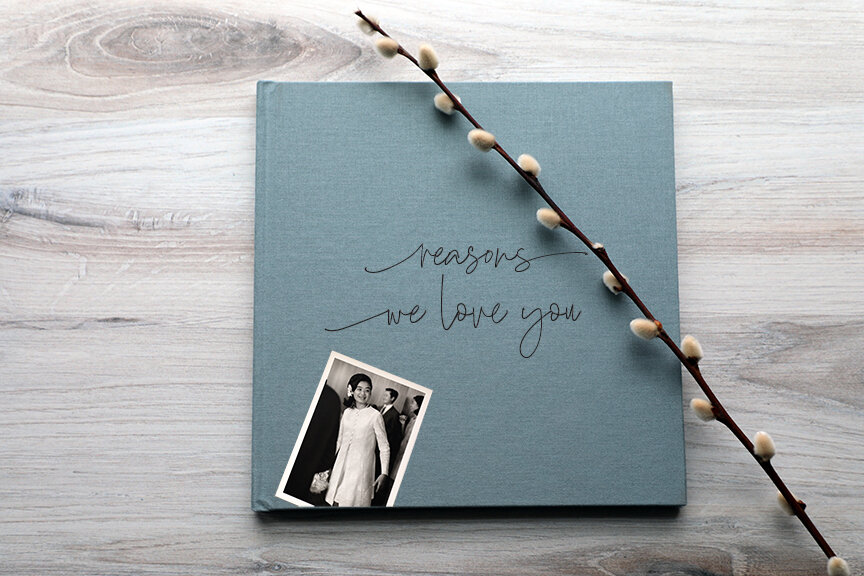
1 - Top 20 Reasons We Love You
Photo storybook theme:
Top 20 Reasons We Love You
Choose photos of:
In this case, choose your stories first—then select photos that illustrate or match up in some way with the stories you have told. There will almost certainly be occasions when you don’t have a picture of something you listed as a “reason you love” them—don’t worry about it and simply include a photo of them (or you, or your family, or your family pet, lol) that makes you smile. It’s all about bringing joy, after all!
Elaborate with stories about:
Exactly what the title says: Tell them why you love them. Be as specific and as silly or sincere as you want! A few samples to inspire your own thinking:
We love you for your generous spirit—and we don’t mean just paying for ice cream after every baseball game, but for offering to help any and every time we need it.
We love you because you are the epitome of a Southern dad—always handsomely dressed (those bow ties!), always a gentleman (you’d never walk out of an elevator before a female!), and always up for a good barbecue (wearing your striped apron at the grill).
We love you for your stupid nicknames (Stefanie is “Pickle,” Alexander is “Ali Baba,” and Marcus is “Delirious”) that somehow always seem to make it into family lore.
We love you because there is not a soul in this family you would not do anything to protect.
We love you for your courage in serving our country for all these years.
We love you for sneaking us mac-and-cheese (the kind from the blue box) for dinner whenever Mom’s out of town.
Every one of these declarations would be made better—and more powerful, more emotional—by elaborating with a quick remembrance or two. They don’t have to be in-depth stories, just quick memories that your loved one will recognize.
Ideal gift for:
a mom or dad on their birthday
your child or sibling as they go away for college for the first time
a grandparent any time at all (trust me, we never say “I love you” in these meaningful ways enough to our elders!)

2 - We’ll Always Remember…
Photo storybook theme:
We’ll Always Remember…
Choose photos of:
Curating images for this book is a fun family history endeavor! Pull out the oldest photos you have—you know, the ones in the old magnetic albums, in drawers and boxes…the ones you actually printed before our photos lived exclusively on our cameras! Try to select images from different periods of your subject’s life: a cute baby photo, a few childhood shots, awkward pictures from the teen years, and on and on. You get the idea: This photo book is a mini-retrospective of your subject’s life, highlighting milestones and favorite memories along the way.
Elaborate with stories about:
These stories should be reflective and fun: Get the whole family in on the act of remembering and sharing memories of your loved one. Consider the title: What will you always remember? Perhaps a sibling remembers skipping stones in the creek or learning to shred at the local skateboarding park. Perhaps a parent recalls moments that made them most proud, from their first steps learning to walk to the day of their bat mitzvah. Suggestion: Select about 30-50 photos you think you might want to include, then sit around the table together talking about the memories they invoke—I promise the best stories will make themselves known.
Ideal gift for:
a son or daughter who is engaged to be married and move on to the next chapter of their life
a loved one’s 50th (or 60th or 70th…) birthday
an anniversary of a longstanding friendship
a family who is selling their home filled with a lifetime of memories.
Any life transition is an opportune time to reflect in this way and honor someone with your collective memories.

3 - A Living Tribute for _________ (Just Because)
Photo storybook theme:
A Living Tribute for _________ (Just Because)
Choose photos of:
Select photos of the person you are honoring that show them at their best—not just physically, but in spirit. Show them laughing, participating in their favorite hobby, visiting beloved places. Most importantly: Try to include a photo of the subject WITH each of the people writing the tributes.
Elaborate with stories about:
Solicit tributes from friends, family members, and colleagues that describe what makes your gift recipient so special. Check out this post for specific ideas for writing meaningful tributes, and remember: Always be specific. It”s boring (and too easy) to say: “I have loved you forever, Charlie.” Instead, say, “I knew from the moment you cooked me a chocolate soufflé in your tiny Greenwich Village kitchen that I wanted you to be in my life forever.”
Ideal gift for:
absolutely anyone who you want to know is special and loved
The beauty in this book is that you are doing it for no occasion at all—you are simply honoring them because they are important to you, and telling them is a generous and loving thing to do. Not convinced? Imagine their awe—and joy!—upon receiving such a gift. Such moments are truly priceless.
Remember: The key to creating a most meaningful photo book gift is to go beyond pictures and add stories!
The ideas above should help you generate stories easily. If you speak from the heart and share memories that matter to you, trust me—they will matter to your loved one, too! Get ready for some happy tears…
Dawn Roode’s curated roundup for the week of Sept. 23, 2026, is overflowing with recent reads on memoir, life story writing, and family history preservation.