Memories Matter
Featured blog Posts

READ THE LATEST POSTS

Life Story Links: July 23, 2024
Personal historian Dawn Roode shares her curated roundup of stories for the week of July 23, 2024: on memoir, family history, biography & memory preservation.
“The reason I write memoir is to be able to see the experience itself…. Writing is a way to organize your life, give it a frame, give it a structure, so that you can really see what it was that happened.”
—Sue William Silverman
Vintage photograph of boy leaning on a fire hydrant in New York City by Morris Huberland, taken in the mid-twentieth century, courtesy the Miriam and Ira D. Wallach Division of Art, Prints and Photographs: Photography Collection, The New York Public Library Digital Collection.
A mosaic of pieces on memoir, personal history, and preservation
HISTORY VAULT
“‘We are absorbed in thinking about our ancestors,’ [Frederic Harrison] wrote. ‘Why do we not give a thought to our descendants?’ Accordingly, he posed his fix: to ‘prepare a Pompeii’ for future researchers to unearth.”
TRANSFORMATIVE POWER OF SELF-REFLECTION
“Every person I have guided on a life writing journey has discovered profound benefits for themselves. Even without a single other individual having read their words, those words have changed them.”
SHIFTING PERSPECTIVES
“A memoir needs to be anchored by facts, yet each of our individual stories can be seen from unlimited perspectives with slight shifts.” Mira Ptacin on the hard art of seeing one’s own writing through rose-colored glasses.
FOR YOUR TBR LIST?
“Stars may or may not be like us, but there is one thing they all seem to have in common: they love writing about their lives.” Time magazine names the 36 best celebrity memoirs.
ON CREATIVE DECISIONS IN BIOGRAPHY
“I just think that when you’re writing a biography, you have a duty to the chronology. The chronology is almost fundamental to the whole enterprise, in my view.” Ryan Cropp speaks with podcast host Gabriella Kelly Davies:
WISDOM FROM SEASONED WRITERS
“In my conversations with my family members and knowing their history and their struggle, I remember that I'm somebody and [they’re] somebody. And that's a very powerful thing.” Author Min Jin Lee talks to fellow writers experienced in family memoir generally, and the migrant journey specifically, about how to talk to parents about their personal history. Listen in:
Short takes


No readers, no matter—your life story benefits YOU
Walking down memory lane can be fun, but writing about your life has big benefits beyond that, including making meaning out of your lived experience.
“A story is a map and we the mapmakers plotting the landscapes of our lives,” Mark Yaconelli writes in Between the Listening and the Telling.
Most people who approach me wanting to explore their personal history are motivated by a desire to create a legacy and pass something of value on to the next generation. Whether it’s a full family history or short vignettes from their own life they hope to capture, they’re usually thinking about an audience of their kids and grandkids, or a broader circle of friends and family—the point is, they’re aware of an audience, even if it’s small.
Without exception, though, every person I have guided on a life writing journey has discovered profound benefits for themselves. Even without a single other individual having read their words, those words have changed them.
There are myriad ways writing about one’s life is good, of course. But for now I want to share just two biggies.
2 profound benefits of writing about your life
RECOGNIZING AGENCY
I don’t mean to get all jargony on you when I say you will recognize the agency you have—I guess what I really want to say is that you are the writer of your own life: You make the decisions, pull the strings, choose the paths…but often we forget that simple fact. We (and I readily include myself in this collective ‘we’) can get caught up in the things that happen to us. “I lost my job.” “I can’t get pregnant.” “My father died.”
Yes, things happen—and despite the conventional wisdom, not always for a reason. But one thing that becomes abundantly clear when writing about your experiences is that how we choose to respond is what defines us.
You will see that you are an active participant in your life—you are not just a storyteller, but a story creator.
In fact, this insight is the foundation of narrative therapy. “With this perspective, individuals feel more empowered to make changes in their thought patterns and behavior and ‘rewrite’ their life story for a future that reflects who they really are, what they are capable of, and what their purpose is, separate from their problems” (Psychology Today).
I bet you never imagined that writing about your life will empower you to rewrite your next chapters…but it will.
INFORMING IDENTITY
From beginning to end, life writing is an exploration that leads to meaning-making. The memoirist asks themselves questions such as: Which experiences are worth telling? Why did I behave a certain way? How is that part of my life a story?
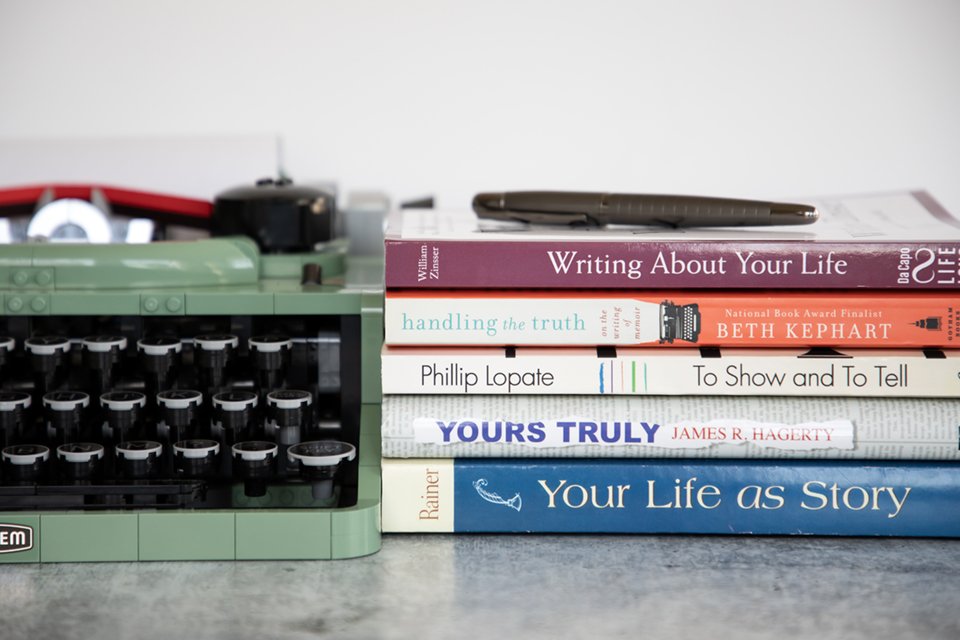
Those questions may at first seem like mere steps toward completing your personal writing, but in truth they are foundational to understanding one’s own identity, as Phillip Lopate explains in this quote from To Show and To Tell:
“In attempting any autobiographical prose, the writer knows what has happened—that is the great relief, one is given the story to begin with—but not necessarily what to make of it…. Writing is one way of self-making.”
Through your writing, you will begin to understand the value in your experiences, to see them as pieces of a bigger puzzle rather than as isolated events. As the best memoirs mine individual experiences to get at a universal truth, so too will your writing bring your own world view into sharper focus.
The memories that come to the surface, and the stories you write about them, will be gifts to your family; the insights you discover along the way will be gifts to yourself.


























Life Story Links: July 9, 2024
Dawn Roode curates stories relevant to family history fans, memoirists, personal historians, and modern memory-keepers—and this week’s roundup is a must-read.
“Because right now there is someone out there with a wound in the exact shape of your words.”
—Sean Thomas Dougherty
Vintage baseball card of George Herman (Babe) Ruth issued by Big League Chewing Gum in 1933, courtesy Library of Congress Digital Collection.
Ways we remember
THE SUBTLE ART OF DIARY KEEPING
“Those people who don’t destroy their diaries must have some secret need or wish for them to be read, a need or wish which affects what is written in varying degrees.” Helen Fielding considers the place of confessional narrative in today’s literary landscape.
ARE YOU A REMEMBERER OR A FORGETTER?
“My father, who is a Rememberer, says his nostalgia often borders on unbearable. If he thinks of his cousin, who died years ago, he can slip into a memory of the two of them at 6, playing hide-and-seek in their grandfather’s house. It sounds beautiful and excruciating at once.”
ON WRITING MEMOIR
“When my writing reveals something about my life that I didn’t see until it appeared on the page—that’s a great surprise.” Memoirist Rachel Zimmerman answers Sari Botton’s questions about the craft.
DIVING WITH A PURPOSE
“How can finding and telling the lost history of the slave trade help me, as a Black American woman, figure out where I belong—and to whom I belong?” Storyteller and diver Tara Roberts is helping document some of the thousand slave ships that wrecked in the Atlantic Ocean.
Love, loss, and memories
FINDING SOLACE IN STORIES
“No one could have guessed that A Family Story would also become our companion in grief. We leaf through it when we miss dad, when we need to hear his voice, or if we want to share family stories with our kids.”
PERSONAL PODCASTS
“With today's technology, we can all record our loved ones in some form, and I would encourage people to do so, in whatever way they can.” A look at how some families are turning to audio recordings to remember lost loved ones.
‘A GENTLE MAN’
Memoirist Joe Wilkins remembers: “In all my boyhood memories, my grandfather shines. What kept me close to him? What let me so completely trust? What had me listening so that even now I hear his voice?”
Biography & memoir
AN INVITING AND NUANCED CONVERSATION
Sara B. Franklin, at once friend and oral historian to her subject, Judith Jones, grappled “with how to tell the story of a person with a life as textured, documented, and purposefully invisible as Jones’s” in the new biography, The Editor.
SELF AS LENS
Writing about the radicalism of the ’70s in her new memoir, 1974, helped Francine Prose come to grips with who she was and who she is now.
CELEBRATING THEIR QUEER FAMILY HISTORY
“It is through these conversations I discovered what a rare and complex person he was, the intense draw he had.... With determination, I brought my uncle’s story out of the shadows.”
EMOTIONAL CATHARSIS
New York–based biographer Alan D. Bergman discusses the unexpected outpouring of emotions subjects may experience while sharing their life stories.
...and a few more links
Short takes

In conversation about “the gift of family stories”
Podcast host Melissa Ceria and personal historian Dawn Roode discuss the importance of family history preservation and finding solace in stories after loss.
Recently I was a featured guest on the podcast The Loss Encounters, hosted by Melissa Ceria.
Melissa is a French-American journalist and the founder of Studio Ceria, which has created and produced high-profile speaker series for Fortune 500 companies and cultural institutions such as the French Institute Alliance Française (FIAF) and NeueHouse in New York. She began her career as a writer and editor at major fashion magazines, including Harper’s Bazaar, where she and I worked together.
Melissa, as creator of The Loss Encounters, and I, as founder of Modern Heirloom Books, share a love and respect for the power of stories; we found our way to family stories, in particular, via somewhat parallel paths. When my mother died, I was bereft at the loss of our shared collective memory, and saddened to discover that the journals she had left behind were only sparsely written in. Melissa, on the other hand, was bequeathed a precious gift just ten days before her father, Lorenzo Weisman, passed—A Family Story, a book he wrote about their family’s history. It is an heirloom that continues to bring her solace all these years later. “It’s filled with stories, photos, poems, and letters that have brought us comfort and connection,” she says.
Our brief conversation, titled “The Gift of Family Stories,” was released as a bonus episode of The Loss Encounters in honor of Father’s Day earlier this month. It is, Melissa says, “dedicated to my dad, and invites all of us to cherish and preserve our own family stories.”
I share it with you here today in hopes that you, too, will be inspired to cherish and preserve your own family stories. Enjoy!
Transcript
(Edited slightly for clarity)

Melissa Ceria: On a warm September evening in 2012, my dad, Lorenzo Weisman, sat down at his dining room table and dedicated the book he'd written about our family to each of his grandchildren. He died ten days later on September 22nd, 2012. His book, titled A Family Story, is a beautiful account of my family's origins, our ancestors, the long life that my parents built together, and the families that joined ours through marriage. It's filled with stories and photos, poems, and letters. There's a lot of love in it. And I'm glad that my dad didn't varnish things. He just told our family's story by piecing together the mosaic of our lives. I think that writing it also allowed him to review his own remarkable journey, and to feel at peace by the time he died. No one could have guessed that A Family Story would also become our companion in grief. We leaf through it when we miss dad, when we need to hear his voice, or if we want to share family stories with our kids. It's been a huge gift for the grandchildren that never got to meet him. Through this, they know dad and we can all talk about him. A decade after his death, I've been thinking about the importance of sharing our stories with those we love. So I called up my friend Dawn Roode. Dawn is the founder of Modern Heirloom Books. As a personal historian, she helps people write their stories and preserves them in beautifully bound books that generations will cherish. Our conversation felt like the call to action. Collecting our memories is a gift for those we leave behind. Hi, Dawn. It's lovely to have you here.
Dawn Roode: Thrilled to be here. Thank you, Melissa.
Melissa Ceria: Tell me how you got started with this work.
Dawn Roode: I was a new mom, and my son had actually been born three months before my mother passed away. It was a very unexpected death. And so, you know, I was dealing with the supreme joys of motherhood and the lowest depths of grief at the same time. And it was a really challenging time for me. I ended up making a book in honor of my mom. Didn't start out that way. It started out me writing a lot of remembrances about her. I had this feverish sense that I was going to lose my memories of her, and it was so important for me to get them down. And as a writer and an editor, someone who came from that background, that was the natural way for me to do so, was to just write in a journal. But eventually, as I went through her photos, I wanted to make something that was more substantive, more permanent. I knew that my son would never know my mom, and that kind of broke my heart, and that was the inspiration for me to make the actual book. It was such a rewarding experience for me, and I thought I might be able to help other people do the same thing.
[00:03:21]
Melissa Ceria: When people start working with you, are they clear about what they want to communicate?
[00:03:25]
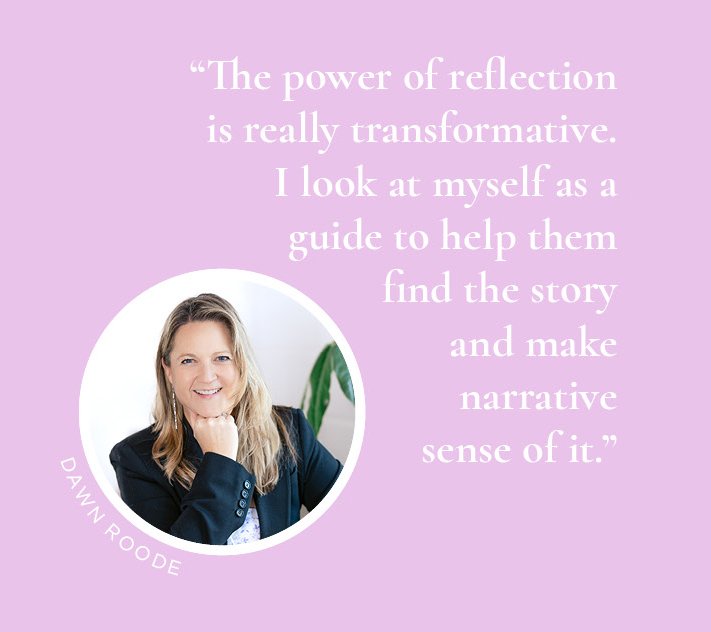
Dawn Roode: It runs the gamut. It's very interesting when someone comes to me and says, "I want to do my story," very often they have a good idea of what they want to share. Almost always, it ends up going in a new direction once the interviews start, because they surprise themselves with what a rich life they've led. "Oh, and I forgot about this." And so the mere act of telling the stories, of me being a curious and engaged listener and asking pointed questions, helps them go in new directions and discover meaning that they hadn't expected in their lives. Other times people come to me where it's the younger generation that wants to preserve their parents’ or their grandparents’ stories, and that's a very different dynamic, where the people come and say, "I don't have a story to tell." It wasn't their idea. They're like, "I have nothing to say. My life is pretty boring, pretty standard." So there's a whole little conversational thing that happens to get them to the right place. And those are even more wonderfully surprising, because at the end they say things like, "wow," I literally had a client say, "I lived a really amazing life so far, and I had no idea." And so that power of reflection, I think is just really transformative. And I look at myself as a guide for them. So I help them find the story and put them on the path to kind of make some narrative sense of it.
[00:04:43]
Melissa Ceria: What are the qualities that support the work that you do?
[00:04:46]
Dawn Roode: So certainly curiosity is one, but I think being a good listener is at the heart of everything that I do. I feel like I hold a sacred space for people. I try to be very generous of spirit with people. I think empathy is another. People are very hard on themselves and I want them to know any of their feelings are valid. The choices they've made are worth looking at with forgiveness, with gratitude.
[00:05:12]
Melissa Ceria: Do you think when we review our own lives, we can be very critical of ourselves? Or do you think we give ourselves more slack?
[00:05:20]
Dawn Roode: You know, it's really interesting. I find when people are writing about themselves, we can be much harder on ourselves. The dynamic when I'm interviewing someone, I can sense when that criticism is coming in, or the reluctance to kind of go in a certain direction because there may be shame or critical thought about a previous decision. What I try to do is empower them that "you came out the other side, and there's a lesson in there for your descendants or for yourself." So the power of two, of me being a listener, I think, helps people find that generosity of spirit for themselves.
[00:05:55]
Melissa Ceria: If somebody isn't prepared to write their own story, or they can't necessarily hire somebody to help them do that, what are some of the ways that we can gather these stories?
[00:06:04]
Dawn Roode: I say to people all the time, it doesn't have to be long. I think that's the biggest thing, is do something rather than nothing, and you can always change it. Four years later you can say, "Oh, you know that thing I have in the drawer? That is something I'm going to go rewrite it." But the fact that you're even thinking about it, I think is always a good start. And then it's just takes some kind of action to do it. And if you can't write, dictate—we have smartphones, so just dictate right into there. There's software that will automatically transcribe it now. And you can leave your voice. Just leave an audio recording if that's easier for you. It doesn't have to be monumental, I think is the message.
[00:06:40]
Melissa Ceria: Do you find that people that you work with, if they are nearing the end of their lives, have a greater sense of peace after they've communicated something to their loved ones?
[00:06:52]
Dawn Roode: I do. It's something palpable that I can feel as our interviews proceed, and as we're getting closer to having something to completion. There's a shift in the way that they are talking about their life. There's a shift and a certain calmness that comes with it. But beyond me sensing it, people have told me that. One client in particular comes to mind who just, he thanked me repeatedly for giving him the space to do this, but I wanted to thank him. I had such gratitude to him for being open about it, and what he was so grateful for was that "I have perspective. That I looked back on my life and realized it was wonderful." What more could you ask for? And what a wonderful thing to tell those that you're leaving behind. There's a great peace that comes from it, and also an empowerment to let go at a certain point when the time comes.
[00:07:46]
Melissa Ceria: Do you think it's in our nature to want to leave messages behind?
[00:07:49]
Dawn Roode: I do, and what I've tried to do through my work and and after losing my mom in particular, is to encourage people to be intentional about what we leave behind so that people aren't scrounging through the emails and their texts in search of something, but that we leave something specific. I think that that holds even greater meaning for both parties. For the person leaving it behind, it gives you a sense of peace that you've said certain things. And for the person receiving that, how wonderful to know that your loved one was thinking of you and that you can hold on to this.
[00:08:21]
Melissa Ceria: It’s not surprising that my dad’s book brings us solace. To Dawn’s point, he wrote it with intention, and the words that he gifted us were meant to offer comfort. I’m so grateful for his gift. This is Melissa Ceria. Thank you for listening.







Life Story Links: June 18, 2024
This one’s worth a bookmark: Thoughts on memoir (limitations, joys, challenges), how and why we preserve our stories for posterity, family history finds & more.
“…writing your life story is not painful, not morbid, and not a sign of vanity. Instead, it is an exercise that will enrich your life and the lives of those who read and learn from it.”
—James R. Hagerty
Vintage photograph of woman picking carrots in Camden County, New Jersey, in October 1938, by Arthur Rothstein, courtesy Farm Security Administration, Office of War Information Photograph Collection Repository, Library of Congress Prints and Photographs Division.
Preserving for posterity
REFRAMING OUR STORIES
“My stories are grounded in grief; they are wrapped up in being widowed young or in my family’s Holocaust survival story,” Rachael Cerrotti writes. In this piece she confronts “certain narratives of self” and offers up inspiring writing prompts connected to three podcast guests with different insights about the stories we tell ourselves—there’s lots of great stuff to digest here!
AN INVITATION TO REMEMBER
I spoke with Melissa Ceria of the thought-provoking podcast The Loss Encounters about discovering the richness of our lives through storytelling. Listen in below, or click here to read a transcript and find more in-depth episodes about what we create from loss. (This short episode was inspired by an autobiographical book Melissa’s father bequeathed to his family.)
EVER AFTER?
“Several companies have emerged in the last few years to develop grief-related technology, where users can interact with an AI version of the deceased—but will that help with grief?”
The craft of life writing
WHAT WE REMEMBER
Last week I wrote about why I chose not to recommend one recent life writing book—and while I don’t mention the book’s title or author, I do share the reasons it didn’t make the grade.
GETTING TO KNOW YOU
Having come from a magazine background, I have a particular affinity for a well-written feature profile, and view the form as a cousin to longer-form biographic writing. In this excerpt from What Makes Sammy Jr. Run?, editor Alex Belth hones in on “the golden age of the celebrity profile.”
CONNECTING THROUGH STORY
CBS Mornings’ David Begnaud interviews Louisiana ghostwriter Olivia Savoie about how one series of client personal history interviews led to a special friendship.
Deep thoughts on memoir and biography
FASCINATION, OBSESSION, INFATUATION…
When the famously elusive Elaine May fails to respond to any of a writer’s pleas for interviews, the would-be biographer, Carrie Courogen, “wondered how a person could have such little interest in or curiosity about the person daring to write the story of their life.”
WRITING AS TEACHER AND FRIEND
“Writing feels inadequate, but it is also how you keep your parents alive—in your own memory at least, which is the best you can do until you can get something published.” Grace Loh Prasad on the memoir that took her more than 20 years to write.
LIMITATIONS OF AUTOBIOGRAPHY
“‘The point of view in a memoir is curious,’ [Jill] Ciment writes. ‘The writer must trick the reader (and herself) into believing that she actually remembers how she felt decades ago. A memoir is closer to historical fiction than it is to biography.’”
THE INHERITED WEIGHT OF EXPERIENCES
“The more we learn about how our body and mind work together to shape our experience, the more we can see that our life story is woven into our biology. It’s not just our body that keeps the score but our very genes.”
Family history, community history
DISCOVERING HER ROOTS
“How odd and surprising it might be, to chance upon a part of your own history on museum walls.” How one woman connected with her family, past and present, through the photographs of two men.
FROM FIRE HAZARDS TO FAMILY TREES
“We create maps to make the unfamiliar familiar. To show us how to get home.” This is a wonderfully interesting look at the history and afterlife of the Sanborn fire insurance maps, which have been reclaimed by historians and genealogists seeking proof of the vanished past.
‘COMMON PEOPLE’S HISTORY’
These four entities act as modern digital archives of personal histories in India, preserving stories as diverse as those covering tattoos and homes, family traditions and family heirlooms, through both images and oral histories.
...and a few more links
“At the Coal Seam of Motherhood”: On writing about our children
Dissecting the pitch deck for startup Kinnect, a new app that aims to preserve family stories
BBC One’s Who Do You Think You Are announces 2024 celebrity subjects.
National History Day keeps pushing students to rigorously examine the past.
Read about the launch of digital legacy platform Please Remember Me Forever.
Short takes
Why a recent life writing book isn’t on my recommended list
It’s important to me to stress some sense of urgency about writing about your life—but I don’t think you’ll have regrets if you don’t write about it ALL.
There are lots of books I read and don’t recommend to you, as they’re not worth your time. For a list of the top titles I think ARE worth your time (with notes on why), check out this post.
I read a lot of books about the craft of writing and about life writing and memoir in particular, and I often share the ones I recommend on social media or on the blog. There are plenty of books I read (or, on occasion, only start to read) then decide they are not worth sharing.
I am not a newspaper columnist; it’s not in me to share a bad review—so the ones I think aren’t worth your time, I usually just skip over. Today, though, I wanted to write a “negative” review…sort of. Without naming the author or title, I thought I’d share what I did not like about a particular recent read.
This book purported to be a step-by-step guide to writing about your life. There were a few good writing prompts sprinkled throughout, but beyond that the author was redundant and made few if any insightful or truly helpful points. On the contrary, they hammered home—on literally every other page—how if you don’t write about every single thing that happens in your life, you will be filled with regret.
“The consequence of not taking action is a life’s worth of memories lost,” they write. “Regret. Regret. Regret.”
Now, don’t get me wrong: I see regret all the time. People who wish they had captured their parents’ stories before they died. People who wish they had begun writing their own stories sooner, before memories began to fade, or before illness or dementia interfered. Heck, the quote I share most often is from William Zinsser: “One of the saddest sentences I know is ‘I wish I had asked my mother about that.’”
However, I don’t think we need to worry about remembering ALL THE THINGS.
“Regret,” the author writes. “Nothing documented. I was forgetting my life. You’ll forget your life too. We always do.”
These repeating remonstrations about forgetting our lives rubbed me the wrong way. They reminded me of the compulsive diarying that Sarah Manguso explored in Ongoingness: The End of a Diary (an incredible short read that I highly recommend—and, ironically, despite the title, Manguso’s diary writing has not ended, just shifted the purpose it holds in her life).
Early in that book Manguso writes:
“I didn’t want to lose anything. That was my main problem… I wrote so I could say I was truly paying attention. Experience in itself wasn’t enough. The diary was my defense against waking up at the end of my life and realizing I’d missed it.”
We should not, in my opinion, write about our lives out of fear. We should be conscious of our mortality and feel a sense of urgency about writing something thoughtful to pass on, yes—but it’s my belief that “that something” can be as brief and straightforward as an ethical will or a legacy letter. And when that life writing takes a longer form, such as a memoir or a life story book or even an extended diary—that it should aim to find meaning in some way, not merely record all our experiences, mundane and profound, for the sake of not forgetting.
We’ve all got enough pressures in our lives without adding an unnecessary one around preservation. Story sharing can be good for your health, research shows. And it’s gratifying, too. But it needn’t be burdensome or reinforce fears. It should be accessible and even enjoyable.
So please do get your life writing project off your bucket list. Start small, if you like (this two-word prompt will help, I promise). And if you’re ready to embark on a bigger project and would like some professional help, reach out to see how we can work together.
But don’t worry about forgetting all the time. Be present. Embrace life as you are living it. Pay attention! And make room for your writing amidst your experiences!
Life Story Links: June 4, 2024
This week’s curated roundup is overflowing with thought-provoking stories about how we preserve our personal histories, memoir tips and recommendations & more.
“Comb through your experiences. Look through a different lens. Walk around a memory, a time period, or a specific event. Interview the memory and jot down questions about it.”
—Rita Sepetys
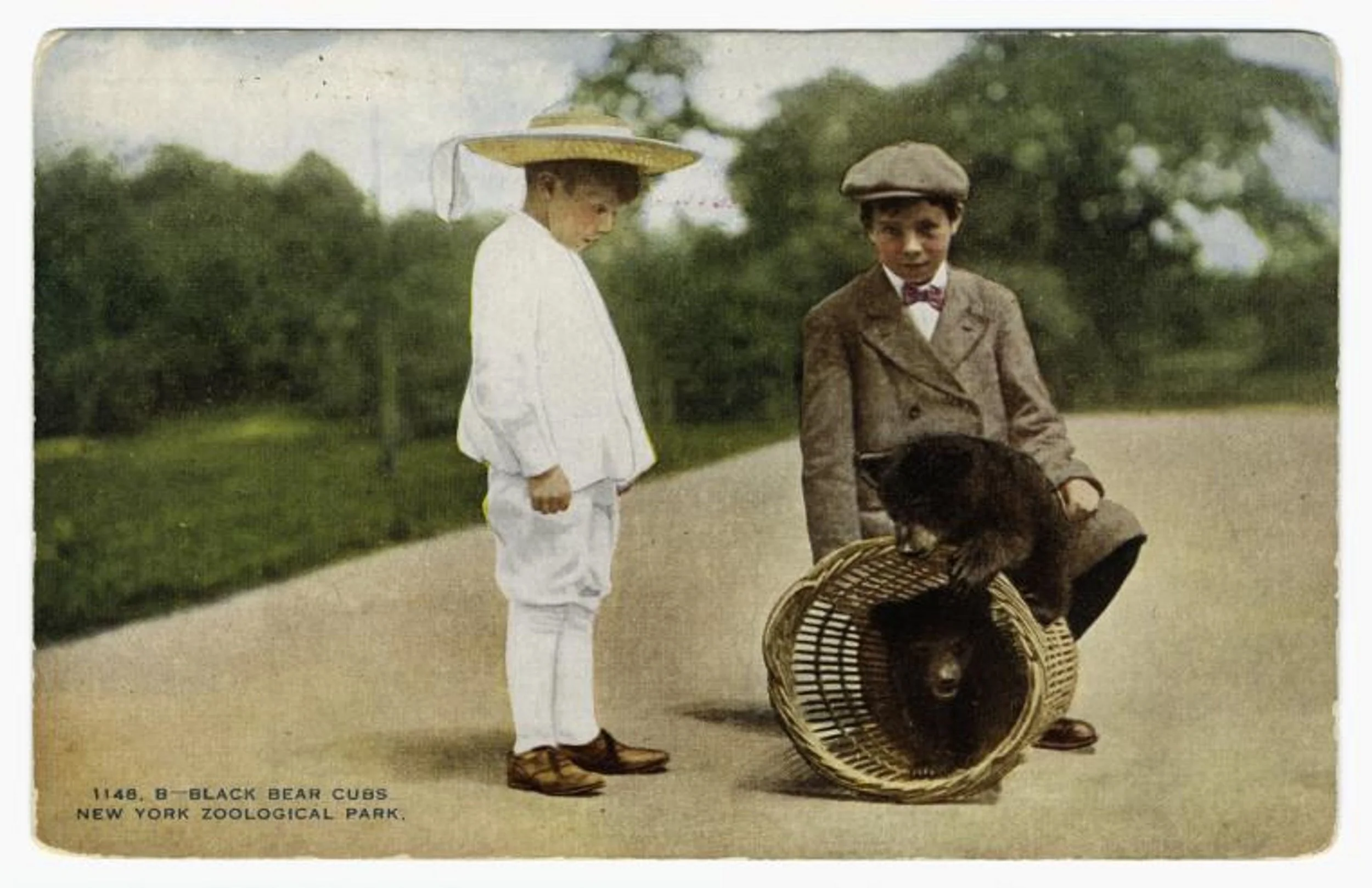
Vintage postcard of black bear cubs from the New York Zoological Park, circa 1914, courtesy of The Miriam and Ira D. Wallach Division of Art, Prints and Photographs: Photography Collection, The New York Public Library Digital Collection.
When our stories overlap
‘IT DEPENDS ON WHO TELLS THE STORY’
Her father “knew how to tell a good story because he grew up in Appalachia, where life is rich with history and the best storytellers are both born and made.” Memoirist Bobi Conn on her family’s long tradition of unreliable narrators and morally gray characters.
NOW OR LATER?
Lilly Dancyger did not let her family read her first memoir before it was published, but she had a very different approach with her second. Here she weighs in on navigating hard (subjective) truths and who you should invite to read your memoir in advance.
A LAYERED NARRATIVE & A STAR TURN
Launching June 5, Pack One Bag is an audio podcast that “tells the epic true story of an Italian family, split apart by love, fascism, and war. Through shocking discoveries—and Stanley Tucci’s artistry—an enthralling personal history comes to life.” Watch the trailer:
How we tell stories
THE CHANGING SHAPE OF NONFICTION
“I was struck then and am struck now...by the notion that confessional writing is subversive.” Christy Moore reviews The Fine Art of Literary Fist-Fighting by Lee Gutkind (the book is subtitled “How a Bunch of Rabble-Rousers, Outsiders, and Ne’er-do-wells Concocted Creative Nonfiction”).
CONVERSATION-BASED STORYTELLING APP
A new app called Autobiographer, which has partnered with Katie Couric to help spread the word, uses “generative AI, voice interfaces, and robust privacy tools” to help individuals preserve their life stories.
Put it in the post
LOVE LETTER
“I like the feeling of knowing that whoever is on the receiving end will smile when they see my letter in their mailbox. That a small slice of me made its way by truck, car, boat, or plane to my receiver’s hands.” Samantha Dion Baker shares some of the most creative letter-writing ideas I’ve ever seen—a joy to scroll through even if she doesn’t inspire you to act!
SEALED FOREVER?
Last week I shared thoughts on the ethics and obligations around reading personal letters that belonged to a deceased family member—I’d love to know, after you read the blog post, how you think you’d react to such a newfound family history bounty!
HISTORICAL CORRESPONDENCE
A letter about harp singing and squirrel stew is one of the primary documents Michael Aday chose to help tell the story of Great Smoky Mountains National Park in his book, Letters from the Smokies. The librarian had 1.4 million records in the park’s archival collection to sift through to help tell its stories.
Memoirs and those who’ve gone before us
THE RESTRICTIONS OF TRADITION
“For Mom and me, visiting our grandmothers was going to be more complicated this time—not just because they were deceased, but because access to graves in Taiwan isn’t straight forward.” Eve J. Chung on tradition, family, and mourning in Taiwan.
GENERATIONAL SHIFTS
Claire Messud’s autobiographically inspired new novel includes characters modeled after late family members. “It was a joy to be with them and to be trying to understand their thoughts. It felt like the opposite of passing judgment.”
THIS WRITING IS ‘AN ACT OF SERVICE’
“Every time I learn something new about a lost loved one, I can’t quite say that it’s like they’re alive again—but man, it’s still a beautiful feeling to discover that there is still more to discover.” Professional speechwriter Chandler Dean provides partly satirical, partly genuine advice for how to write a eulogy.
A MEMOIR HE NEVER THOUGHT HE’D WRITE
Sebastian Junger, whose writing I have long been a fan of, has a new book, In My Time of Dying—a memoir that weaves his journalistic sensibility with his personal experience. Because I plan on reading the book, I have not watched this video, but the hourlong interview looks interesting (find a briefer dive with Anderson Cooper here):
Journalist Sebastian Junger interviewed by Miwa Messer about his new memoir, In My Time of Dying.
Before it’s too late…
GIVE THEM A LITTLE NUDGE
“As I watch my friends grow older and enter new phases of life, I’ve noticed a common thread: Year after year, many of us happen upon questions we wish we’d asked the loved ones who are no longer with us.” Isabel Fattal shares three stories about the power of family stories.
‘I’VE HAD A GOOD LIFE’
“Also known as a pre-funeral or a life celebration, a living funeral is like a unique memorial service held for a person before he or she dies.”
A GRANDFATHER’S WISDOM
In the most recent episode of the podcast Who We Remember, video biographer and host Jamie Yuenger speaks with Liam McCormick about his desire to document the life story of his grandfather and the importance of knowing one’s family history and how it can help make sense of oneself. Watch below, or listen in here.
...and a few more links
California mother helps others cope with loss through new children’s book.
Memoir review: The French Ingredient: Making a Life in Paris, One Lesson at a Time by Jane Bertch
Book review: First Love: Essays on Friendship by Lilly Dancyger
Ta-Nehisi Coates returns to nonfiction and explores the power of stories in upcoming The Message.
How a new biography makes sense of Carolyn Bessette-Kennedy’s short life
Short takes
To read or not to read? How to handle a deceased family member’s personal letters
Discovering a stack of handwritten letters can feel like winning the family history lottery—but is it always the right thing to read (or share) them?
I have created wonderful heirloom books filled with letters that help tell the story of a family. Sometimes, though, we may not feel so comfortable reading our deceased loved ones’ personal reflections. Before you include their letters in your book, reflect on how they’d feel about it—then, make an informed, thoughtful decision.
My parents divorced when I was a child, and I do not have a relationship with my father. But I was close to my mother until her death. She shared a great deal with me, and we spoke openly about our feelings. When I was sorting her estate I came upon things I was excited to find: letters from me that she had saved, a memory-keeping journal where a handful of questions were answered in her pristine penmanship (how I wish she had written more in those pages!), a scrapbook of her youth that she had made in her fifties. I reproduced some things, including favorite handwritten recipes and letters between us, in a tribute book I wrote in her honor about a year after she died. I did not, however, include any of the letters sent between her and her newlywed husband when he was stationed in Korea.
If my mother were alive and we had discovered those saved letters together, I have no doubt she would have shared details with me. She would have told me why she saved them even after a bitter divorce. She would have talked about young love and her dreams and she would have answered any questions I had.
But my mother was no longer here to answer questions or to provide context. At first I was excited to unearth that correspondence; then, as now, I would cherish anything that connected me to my mom. I opened the top letter and began reading. The letter was intimate. It wasn’t sexual, but it was clearly intended for my mother’s eyes only. I refolded the letter, put it back in its envelope, and chose not to read any further. It felt like an invasion of her privacy, and I wanted to respect that.
Was I bound by some moral code not to read my mother’s letters? I don’t think so. To me, it just felt wrong. So I followed my gut.
Indeed, most genealogists regard letters as valuable family artifacts to be mined for family history information and stories. As genealogist Denise May Lovesick writes in her piece “Ethics, Etiquette and Old Family Letters,” “to reject reading old letters on the basis of ‘personal privacy’ seems counter-productive.”
In an online exchange about the ethics of reading letters of a deceased person, questions arise: Can the dead be rights-holders, morally? Is it an invasion of privacy to read letters not intended for you? Does the deceased have a right to have their memory protected? As one contributor shares, “the damage caused to that person is zero (he's dead), while everybody will benefit from the historical knowledge.”
Is it always okay to read (and share) letters from our deceased family?
So while it may not be morally or ethically wrong to read your ancestors’ letters (I have created quite a few books of family correspondence that are treasured parts of those families’ legacies!), if you have reservations, consider these questions:
What is giving you pause?
You may be worried that the letters will reveal a side of your family member you knew nothing about; that may be the case, and you should prepare yourself for that inevitability should you decide to read them. Perhaps you feel like you would be invading their privacy; if you have conviction that if they were alive, they would not want you to read the letters, then it may be prudent to respect those wishes, surmised though they may be.
Are you reluctant to read the letters, to share them, or both?
Remember that there is a difference between you or another loved one reading your parents’ letters, versus digitizing and printing them for a wider audience. You cannot decide whether to share a personal correspondence until you read it, and then you will need to make an informed decision: Will reproducing the letters (in a family history book, for instance) provide insight or historical context without maligning the letter-writer? Then you may want to share them. Will reproducing the letters reveal sensitive information that might hurt someone else, living or deceased? Then you may want to reconsider.
How would you want someone to act if the letters were your own?
Imagine you have a stash of letters hidden in your closet—they are meaningful to you, but private. You have saved them, and hidden them, for reasons known only to you. If a family member were to discover them after you died, would you want them to read them? Such consideration may help you make a mindful decision.
There is no black-and-white answer to the question, Should I read my deceased loved one’s personal letters? It is not morally wrong to read them, nor is it necessarily an invasion of their privacy. But there may be good reasons your gut tells you not to read them—and if that is the case, I hope these reflections will help you come to an answer that is right for you.
If you have a collection of letters that you feel tells an important part of your family history and would like help building an heirloom book around them, please reach out to discuss how we could work together.